

So, you’re asking the big question: "how much does it cost for google ads?" You’ve heard it can bring in a flood of new clients, but you’re worried about the price tag. Let's clear the air right now.
The short answer is, there's no fixed price. For an Australian service business, you could be looking at anywhere from $500 to over $10,000 per month. It all comes down to a live, real-time auction where you’re bidding against your competitors for the top spots. This guide promises to break down exactly how that works and give you a clear roadmap to controlling your ad spend for maximum return.
Your Direct Answer to Google Ads Costs
You're a busy Aussie business owner. You need straight answers, not a bunch of jargon.
The cost of Google Ads isn't like a price list at a café; it's more like a property auction. The final price is set by what the market is willing to pay in that exact moment for a specific keyword.
This section will break it all down for you. We’ll start with a simple look at typical cost ranges, then get into the auction system that runs the whole show. The goal is to give you the confidence to understand and control your ad spend, making sure every dollar you invest brings in real clients.
Typical Google Ads Cost Ranges for Australian Service Businesses
To give you a clearer picture, here’s a quick summary of what you can expect to pay for the different parts of a Google Ads campaign. All figures are in AUD.
| Cost Component | Typical Range (AUD) | What It Covers |
|---|---|---|
| Ad Spend (Clicks) | $500 – $10,000+ | The money paid directly to Google every time someone clicks on your ad. This is the fuel for your campaign. |
| Agency Management Fee | $500 – $5,000+ | The monthly fee you pay a digital marketing agency or expert to build, manage, and optimise your campaigns. |
| Tracking/Tools Fee | $50 – $300+ | Costs for extra software like call tracking or advanced reporting tools that give you deeper insights into what's working. |
This table gives you a ballpark idea, but remember, these numbers can shift based on how competitive your industry is and how aggressive your growth goals are.
Understanding the Live Auction System
Every single time someone hits 'search' on Google, an auction happens in the blink of an eye. Where your ad shows up—and what you pay for that click—is decided right then and there.
Two big things determine the outcome: your bid (how much you're willing to pay) and your Quality Score.
Think of Quality Score as Google’s rating of how relevant your ad and landing page are to the person searching. A high Quality Score is a huge advantage. Google rewards you for it, often giving you better ad positions for a lower cost.
This auction system means you’re not just throwing money at Google and hoping for the best. You're an active player. By creating better, more relevant ads, you can actually outsmart competitors who are just trying to win with a bigger budget.
To really get a handle on what drives your spending, it's worth digging into the real Google AdWord cost to understand all the moving parts. This knowledge is your first step towards building a campaign that doesn't just spend money—it makes it.
Breaking Down the Google Ads Cost Formula
Ever wondered why one click costs $5 while another costs $50? It’s not just about who throws the most money at it. The real decider is Google's Ad Rank formula, which cleverly combines your maximum bid with your Quality Score.
Think of your maximum bid as the highest price you're willing to pay for a single click. It's your ticket into the auction. But the secret sauce that really shapes what you end up paying is your Quality Score.
The Power of Your Quality Score
Your Quality Score is basically Google's report card for your ad. It’s a rating from 1 to 10 that measures how relevant and useful your ad and landing page are to the person searching. A higher score means Google sees your ad as a better, more helpful answer to what they're looking for.
Three main things feed into this all-important number:
- Ad Relevance: Does your ad copy actually match the keywords someone is searching for?
- Expected Click-Through Rate (CTR): Based on past performance, how likely are people to click your ad when it appears?
- Landing Page Experience: After someone clicks, does your website deliver on the ad's promise? Is it easy to use, trustworthy, and relevant?
This diagram shows how your total ad cost is decided in the live auction, where your bid and quality are the two key players.
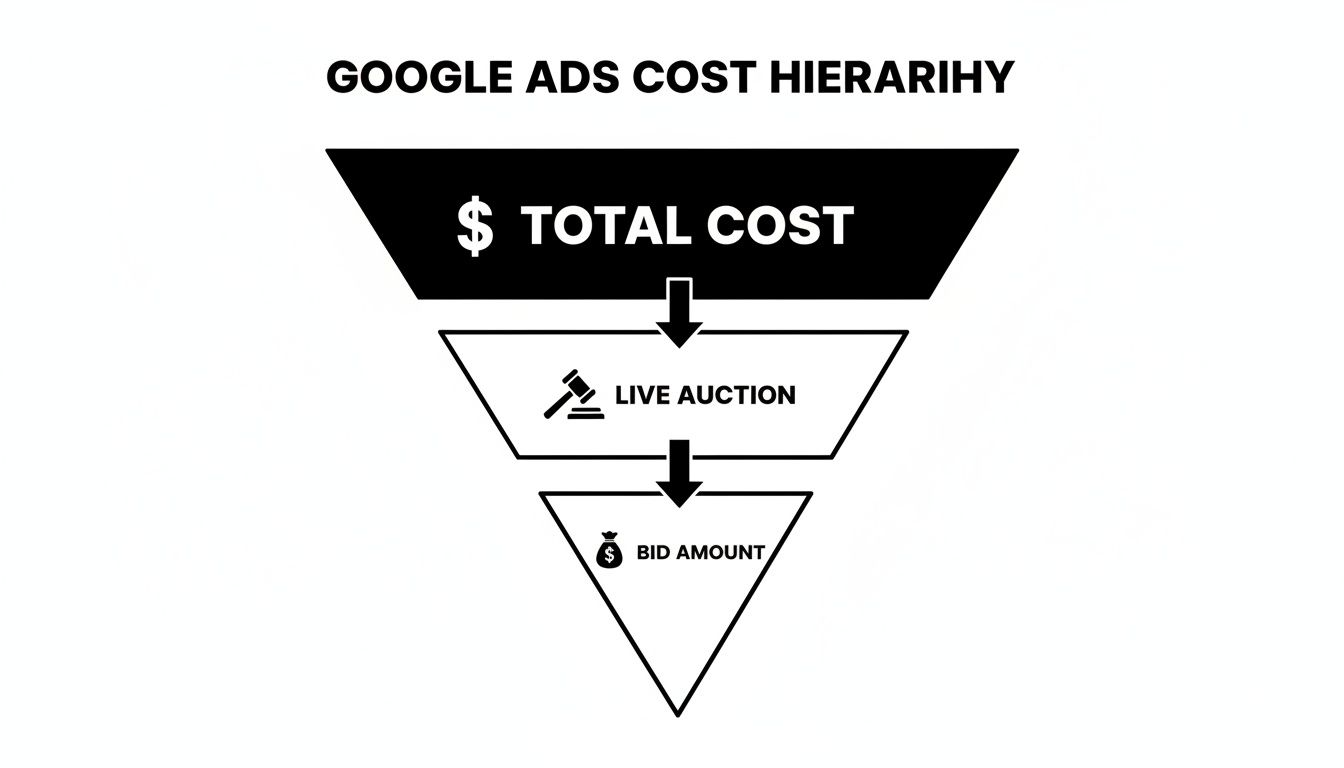
As you can see, the auction is the engine room that sits between your bid and your final cost, making it the central mechanism for figuring out what you actually pay.
How Quality Score Saves You Money
This is where it gets really interesting. A high Quality Score acts like a massive discount. Google actively rewards advertisers who create a great user experience by giving them a better Ad Rank. This often lets them outrank competitors with bigger budgets while paying less per click.
Analogy: Imagine two shops bidding for a prime spot in a shopping centre. Shop A offers huge rent but has messy window displays and a confusing layout. Shop B offers less rent but has a beautiful, welcoming storefront that customers love. The centre manager (Google) will likely choose Shop B because it improves the experience for everyone, even though its bid was lower.
This is exactly why focusing on quality is a much smarter strategy than just trying to outbid everyone. Improving your ad relevance and landing page experience directly lowers your advertising costs and boosts your return on investment. To really get a handle on how your budget translates into performance, it's worth reading up on Understanding Google Ads Cost Per Click in Australia.
What This Looks Like in the Real World
Let's put this into practice. Say your wellness practice is in Melbourne, and potential clients are searching for 'best yoga therapist near me'. In Australia's competitive health sector, average CPCs can be pretty steep. You're not just bidding against other therapists; you're in a high-demand market where a low Quality Score can easily inflate your costs by 20-50%.
Investing in a relevant ad and a strong landing page isn’t just good practice—it's essential for survival and profitability.
Ultimately, winning at Google Ads isn’t about having the deepest pockets. It’s about creating the most value for the user. By focusing on your Quality Score, you work with Google's system, not against it, which leads to better ad positions at a much lower cost. For a deeper look at other pricing models, check out our guide on the cost-per-impression formula.
Key Factors That Influence Your Ad Spend
Your Google Ads budget isn't some fixed monthly bill that just lands in your inbox. Think of it more as a dynamic figure shaped by several key variables you can actually control. Getting a handle on these levers is the first step to mastering your ad spend and making sure every dollar is working hard to bring you new clients.
It's a bit like adjusting the sails on a boat. Small tweaks to your setup and direction can make a massive difference to your speed and efficiency, helping you get where you want to go faster and with less wasted effort. Let's break down the main things that drive your campaign costs up or down.

Industry and Keyword Competition
Hands down, the single biggest factor dictating how much it costs for Google Ads is competition. Some industries are just more crowded and valuable than others, which sparks a bidding war for the top keywords.
For example, a click for “emergency plumber Sydney” is going to cost you a lot more than a click for “local dog walking Penrith.” Why? The potential lifetime value of a plumbing client is huge, so more businesses are willing to bid aggressively to get that click.
Key Takeaway: Highly competitive industries like legal, finance, and specialised trades often see the highest CPCs, sometimes exceeding $50 per click. Your industry’s market dynamics will set the baseline for your advertising costs.
Geographic Targeting
Where you decide to show your ads has a direct impact on your budget. For most service businesses, targeting a broad, national audience is nearly always more expensive and less effective than zeroing in on specific local areas.
Even within a single city, costs can vary. Bidding on ads in affluent metro areas like Melbourne's inner east or Perth's western suburbs will likely cost more than targeting regional towns. This is simply because businesses know these postcodes have a higher concentration of potential customers with more to spend.
Smart geographic targeting allows you to:
- Concentrate your budget right where your ideal clients live and work.
- Stop wasting money on clicks from people well outside your service area.
- Dominate a smaller patch instead of being a tiny fish in a massive pond.
Seasonality and Timing
Customer demand isn't a flat line; it rises and falls with the seasons, public holidays, and even the time of day. An air conditioning technician in Brisbane, for instance, will see a massive spike in searches during a summer heatwave, driving up competition and click costs.
This is where ad scheduling becomes a powerful cost-saving tool. Why run ads for your consulting firm at 2 AM on a Sunday? By setting your ads to run only during business hours or when your target audience is most active, you focus your budget on when it’s most likely to convert. It's a simple strategy that stops you from paying for clicks that won't turn into business.
Ad Network Choice
Google gives you two main places to show your ads, and your choice here dramatically affects your costs and the type of audience you reach.
- Google Search Network: This is the starting point for most service businesses. Your text ads pop up on Google search results when someone is actively looking for what you offer. The intent from users is high, but so is the cost.
- Google Display Network: This network places visual ads (like banners and images) on millions of websites, apps, and videos across the internet. It’s great for building brand awareness and reaching people before they're actively searching. The cost-per-click here is generally much lower than on the Search Network.
For a service business chasing immediate leads, the Search Network is usually the priority. But a smarter, blended approach often uses the Display Network for remarketing—a cost-effective way to stay top-of-mind with potential clients who’ve already visited your website. By understanding and tweaking these key factors, you shift from being a passive spender to an active strategist, putting you firmly in control of your Google Ads budget and its returns.
Setting a Realistic Google Ads Budget
Alright, let's move from theory to dollars and cents. What should a service business in Australia actually expect to spend on Google Ads to get real results?
Honestly, it all comes down to where your business is at and what you want to achieve. Getting the budget right from day one is the key to managing your own expectations and seeing a genuine return on your ad spend.
To make it simple, I've broken it down into three tiers. Think of them as different stages of growth, from just dipping your toes in the water to going all-in on market domination. This will help you figure out how much Google Ads really costs for your specific situation.
Sample Monthly Google Ads Budget Scenarios
To give you a clearer picture, here’s a breakdown of what you can expect at different investment levels. Each tier is designed for a specific business goal, whether you're gathering initial data or aiming for aggressive growth.
| Budget Tier | Monthly Spend (AUD) | Primary Goal | Best For |
|---|---|---|---|
| Tier 1: Testing the Waters | $500 – $1,500 | Data collection & concept proof | Small local businesses or consultants testing Google Ads for the first time with minimal risk. |
| Tier 2: Consistent Leads | $1,500 – $5,000 | Steady, reliable lead generation | Established service businesses (e.g., trades, advisors) needing a predictable flow of clients. |
| Tier 3: Aggressive Scaling | $5,000+ | Market leadership & maximum volume | Multi-location businesses or those in hyper-competitive industries ready to dominate their area. |
Choosing the right tier isn't about spending the most; it's about matching your investment to your business's current reality and future ambitions.
Tier 1: Testing the Waters
This is the perfect starting point if you’re new to Google Ads or just want to see if it’s a viable channel for your business. The goal here isn’t to open the lead floodgates. It’s all about gathering intelligence.
- Monthly Spend (AUD): $500 – $1,500
- Primary Goal: Collect data, see which keywords actually work, and get a baseline for your cost-per-click (CPC) and cost-per-lead.
- Best For: Small local businesses, sole traders, or anyone wanting to validate the platform without a massive financial commitment.
At this level, you’ll be getting a handful of clicks a day. Your main job is to watch what’s happening closely. Which ads get clicks? Which keywords convert? This is your learning phase—find out what works before you scale up.
Tier 2: Consistent Lead Generation
Once you’ve got some data and you know your basic numbers, it’s time to shift into growth mode. This budget is for established businesses that need a steady, predictable stream of new clients to keep the engine running.
This is the sweet spot for most Aussie service businesses. It’s enough budget to compete effectively in local markets and generate a consistent flow of enquiries without needing a second mortgage. The focus moves from just collecting data to actively optimising for conversions.
At this level, things get more strategic. You’ll be fine-tuning your landing pages, tweaking ad copy, and pushing more budget toward the campaigns that are actually making you money.
- Monthly Spend (AUD): $1,500 – $5,000
- Primary Goal: Generate a consistent and reliable stream of qualified leads every single month to fuel growth.
- Best For: Established tradies (plumbers, electricians), financial advisors, and professional service firms with a solid offer.
Tier 3: Aggressive Market Scaling
This is the big leagues. A top-tier budget is for businesses ready to dominate their market, plain and simple. We’re talking an "always-on" presence, outbidding competitors for the most valuable keywords, and expanding into new services or locations.
Think about a real estate agent in a cutthroat Sydney market. To even show up, the costs are eye-watering. Average CPCs for Australian real estate can hit $116.61 AUD, with some keywords spiking to $177.25. A small budget would vanish before lunchtime.
If you're dropping $5,000 a month on clicks, don't forget agency management fees on top—usually another 10-20% of your ad spend. To get a better handle on this, you can learn more about Australian agency pricing structures.
This approach demands expert management and constant tweaking to make sure it stays profitable.
- Monthly Spend (AUD): $5,000+
- Primary Goal: Achieve market leadership, maximise lead volume, and build serious brand visibility across a wide area.
- Best For: Multi-location businesses, national service providers, or companies in hyper-competitive spaces aiming for rapid growth.
By picking the tier that matches your business today, you set yourself up with a realistic budget and a clear roadmap for growing with Google Ads.
Actionable Strategies to Reduce Your Ad Costs
Throwing money at Google Ads is easy. Spending it wisely to actually grow your business? That's the real challenge. So many businesses leak cash through inefficient campaigns, paying for clicks that never had a hope of converting.
This section is packed with proven, hands-on strategies to help you plug those leaks. We're talking about eliminating wasted spend and seriously boosting your return on investment. These aren't just theories; they're practical techniques you can use right now to get more leads without just upping your budget.
Master Your Keyword Match Types
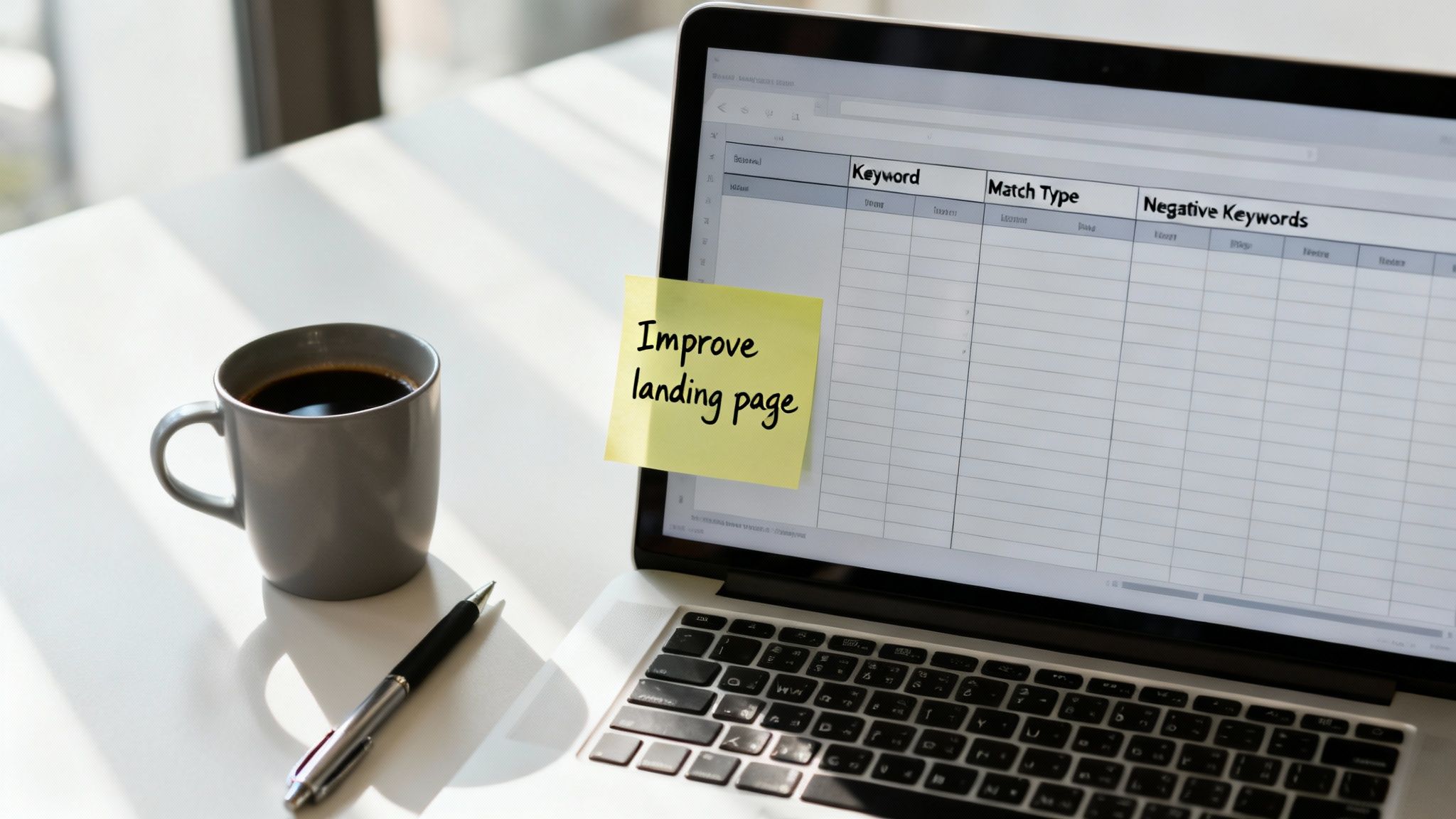
One of the fastest ways to burn through your ad budget is by using the wrong keyword match types. This setting tells Google how strictly a user's search has to match your keyword for your ad to show up. Think of it as setting the boundaries for who sees your ads.
You've got three main types to work with:
- Broad Match: This gives Google the most freedom, showing your ad for searches that are only vaguely related to your keyword. It's incredibly risky and can attract a ton of irrelevant traffic if you're not watching it like a hawk.
- Phrase Match: This is the sensible middle ground. Your ad appears for searches that include the meaning of your keyword. For example, your keyword "lawn mowing service" could match a search for "best lawn mowing service near me."
- Exact Match: This is your most targeted option. Your ad will only show for searches that have the same meaning or intent as your keyword. No guesswork here.
By shifting your budget away from the wild west of broad match and towards the more controlled phrase and exact match keywords, you make sure your ads are only shown to people who are actively looking for what you sell.
Use Negative Keywords Relentlessly
Think of negative keywords as your campaign's personal bouncers—they keep the wrong crowd out. These are simply terms you tell Google not to show your ads for.
For instance, a premium consulting firm would add words like "free," "cheap," and "DIY" to its negative list. A plumber who only does installations, not emergency call-outs, should add "emergency" and "24/7" to stop paying for those clicks.
A well-maintained negative keyword list is one of the most powerful tools you have for cutting wasted ad spend. It actively filters out unqualified searchers before they can even click, saving you a fortune.
Make it a habit to regularly check your "Search Terms" report in Google Ads. This shows you the actual searches that triggered your ads. Find the irrelevant ones and add them to your negative keyword list immediately. This simple routine can save you hundreds, if not thousands.
Improve Your Quality Score
As we touched on earlier, your Quality Score is Google’s rating of how relevant and high-quality your ads are. A higher score means you pay less per click and get better ad positions. Getting this right is non-negotiable for running a cost-effective campaign.
Here’s how to lift your score:
- Craft Compelling Ad Copy: Your ad headline and description must speak directly to the keywords in that ad group. Address the user's problem head-on and offer a clear solution.
- Organise Your Ad Groups: Create tightly themed ad groups with a small, focused list of keywords. Never lump hundreds of keywords into one ad group; it destroys relevance and your Quality Score.
- Enhance Landing Page Experience: The page you send people to must deliver exactly what your ad promised. It needs to be mobile-friendly, load quickly, and have an obvious call to action.
Focusing on these three areas signals to Google that you provide a great experience for its users, and you'll be rewarded with lower costs. A huge part of this is your click-through rate, and you can play around with different scenarios using a click-through rate calculator to see how even small improvements can make a massive difference.
Optimise Your Landing Pages for Conversion
Finally, remember this: sending traffic—even the most qualified traffic—to a landing page that doesn't convert is the ultimate waste of money. Your landing page has one job: turn that visitor into a lead.
Make sure your page includes these essentials:
- A clear, powerful headline that perfectly matches your ad.
- Trust signals like client testimonials, industry awards, or case studies.
- A simple, easy-to-fill contact form or a phone number that's impossible to miss.
- A single, focused call to action (CTA). Don't confuse people by giving them too many options.
When you implement these strategies, you shift your focus from just buying traffic to investing in performance. This proactive approach is the key to controlling how much it costs for Google Ads and turning your campaigns into a predictable, profitable engine for your business.
Deciding When to Hire a Google Ads Agency
Let’s be honest, managing a Google Ads account properly can feel like a full-time job. You start with the best intentions, but before you know it, you’re tangled in a web of keywords, bids, and metrics. That’s time you should be spending on your clients, not wrestling with a complex ad platform.
So, when is it time to hand over the reins? Moving from a DIY approach to partnering with a pro is a big step for any growing business. This guide will help you spot the signs that you’ve outgrown managing it yourself and are ready for expert help.
Signs You’ve Outgrown DIY Management
Most business owners start by running their own campaigns. But there’s usually a tipping point where the time you’re putting in just doesn’t justify the results you’re getting back.
If you find yourself nodding along to any of these, it might be time for a change.
Key signs include:
- You're Spending Too Much Time: If Google Ads is eating up more than a few hours of your week, that's time stolen from your actual business. An agency takes this off your plate, freeing you up to do what you do best.
- Your Results Have Plateaued: Are your costs slowly creeping up while your leads are drying up? An expert can often spot optimisation opportunities you’ve missed, helping you break through that performance ceiling.
- You Feel Overwhelmed by Changes: Google’s platform is always evolving. New features, algorithm updates, and policy shifts happen constantly. An agency's job is to stay on top of these changes, ensuring your campaigns stay effective and compliant with Australian advertising standards.
The Value a Google Ads Agency Brings
Bringing in an agency isn’t just about offloading tasks; it's a strategic move. You're investing in expertise, advanced tools, and focused growth that’s tough to replicate on your own. For a service business, it can be the difference between a campaign that just "runs" and one that drives serious, measurable growth.
A great agency doesn’t just manage your ad spend. They become a strategic partner dedicated to maximising your return on investment. They bring advanced tools, deep industry knowledge, and a fresh perspective to unlock your campaign’s full potential.
An expert partner also offers strategic insights and access to tools that give you a competitive edge. To get a better idea of what this partnership involves, you can explore our approach to expert Google Ads consulting.
Finally, a key benefit is accountability. A good agency provides clear, detailed reports that directly connect your ad spend to real business outcomes, like leads and sales. This clarity helps you understand exactly how much it costs for Google Ads in relation to the tangible results it generates, empowering you to make smarter decisions for your business's future.
Your Top Questions About Google Ads Costs, Answered
To wrap things up, here are the straight answers to the questions we hear most often from Australian service business owners. Think of this as your final checklist for getting your head around Google Ads costs and building a strategy that actually works.
Is It Really Worth Paying for Google Ads in Australia?
Yes, absolutely—as long as you have a smart strategy. Google Ads puts your business in front of people at the exact moment they’re searching for your services. For a service business, that kind of high-intent traffic is gold. When managed correctly, it can deliver a serious return on your investment.
Why Are My Google Ads So Expensive?
In one word: competition. If you’re in a high-value industry like finance, law, or a specialised trade, you’re bidding against dozens of other businesses for the same handful of ad spots. High demand drives up the price you pay for each click. Other common culprits are a low Quality Score (Google is penalising you for poor ads) or targeting keywords that are way too broad.
How Much Should a Small Business Budget Each Month?
A realistic starting point for a small Aussie service business is somewhere between $500 and $1,500 per month. This is enough to get your ads running, gather some initial data, and figure out what’s working without breaking the bank. Once you see a positive return, you can confidently scale that budget up to get a more consistent flow of leads.
How Long Until I See Results from Google Ads?
You’ll start seeing clicks and website traffic almost straight away. But seeing real, profitable results takes a bit longer. Give your campaigns at least 90 days to mature. This gives you enough data to properly tweak your bids, keywords, and ad copy until you’ve got a stable, money-making machine.
At Homer Digital Marketing, we take the guesswork and the stress out of Google Ads. We build and manage targeted campaigns that bring your ideal clients to you, so you can get back to what you do best—running your business. Book a discovery call to see how we can help you grow.
