

Real estate SEO is the art and science of optimizing your website and online profiles to rank higher in search results. It’s the single most effective strategy to ensure potential buyers and sellers find you the moment they search on Google. For any agent serious about generating a consistent flow of high-intent leads without paying for every click, mastering SEO is non-negotiable.
Why Real Estate SEO Is Your Most Valuable Asset
Think about this surprising fact: 97% of homebuyers use the internet to search for properties. If your agency is invisible on Google, you're missing out on nearly the entire market. The old-school tactics of letterbox drops and bench ads are fading fast.
Your next high-value client isn’t driving past your office—they’re at home, on their phone, typing specific, high-intent questions like, "best real estate agent in [your suburb]" or "how much is my house worth in [your city]?" If you’re not there with the answer, your competitors will be. This guide provides the proven, actionable solution you need to dominate those search results.
A powerful real estate SEO strategy isn't about technical wizardry. It's about deeply understanding what your ideal clients are looking for and positioning your agency as the ultimate solution. It’s the most sustainable way to build a pipeline of inbound leads who are already searching for an expert just like you.
Understanding Your Client's Digital Journey
Before diving into tactics, you must learn to think like your clients. Every search query is a question that needs an answer. A potential seller might start with a broad, informational search like "local property market trends" before narrowing down to transactional searches like "real estate agent fees in [your area]."
Your goal is to appear at every stage of that journey. You achieve this by creating helpful, relevant content that builds trust and establishes you as the local authority. For a deeper look at building your online presence, this Digital Marketing for Real Estate Agents Guide is a fantastic resource that underscores the central role of SEO.
The Three Pillars of Real Estate SEO
A powerful SEO strategy is like building a premium property. A valuable house needs three things: a solid foundation, a great design, and a stellar reputation in the neighbourhood. These elements translate directly into the three core pillars of SEO.
Local Presence (The Foundation): This is your digital footprint in the local community. It’s all about optimising your Google Business Profile and ensuring your business details are correct and consistent everywhere online. A strong local presence tells Google you’re a legitimate, trusted local business.
On-Page Content (The Structure and Design): This is everything that lives on your actual website—your property listings, suburb profiles, blog posts, and agent bios. High-quality, relevant content is what answers your clients' questions and proves to search engines that your site is a valuable resource.
Off-Page Authority (The Neighbourhood Reputation): This is all about how other websites see your business. You build it through backlinks from reputable local businesses, glowing client reviews, and mentions in the media. Every one of these acts like a vote of confidence, signalling to Google that other people trust and recommend you.
This diagram illustrates how these three pillars work together to support your entire strategy.
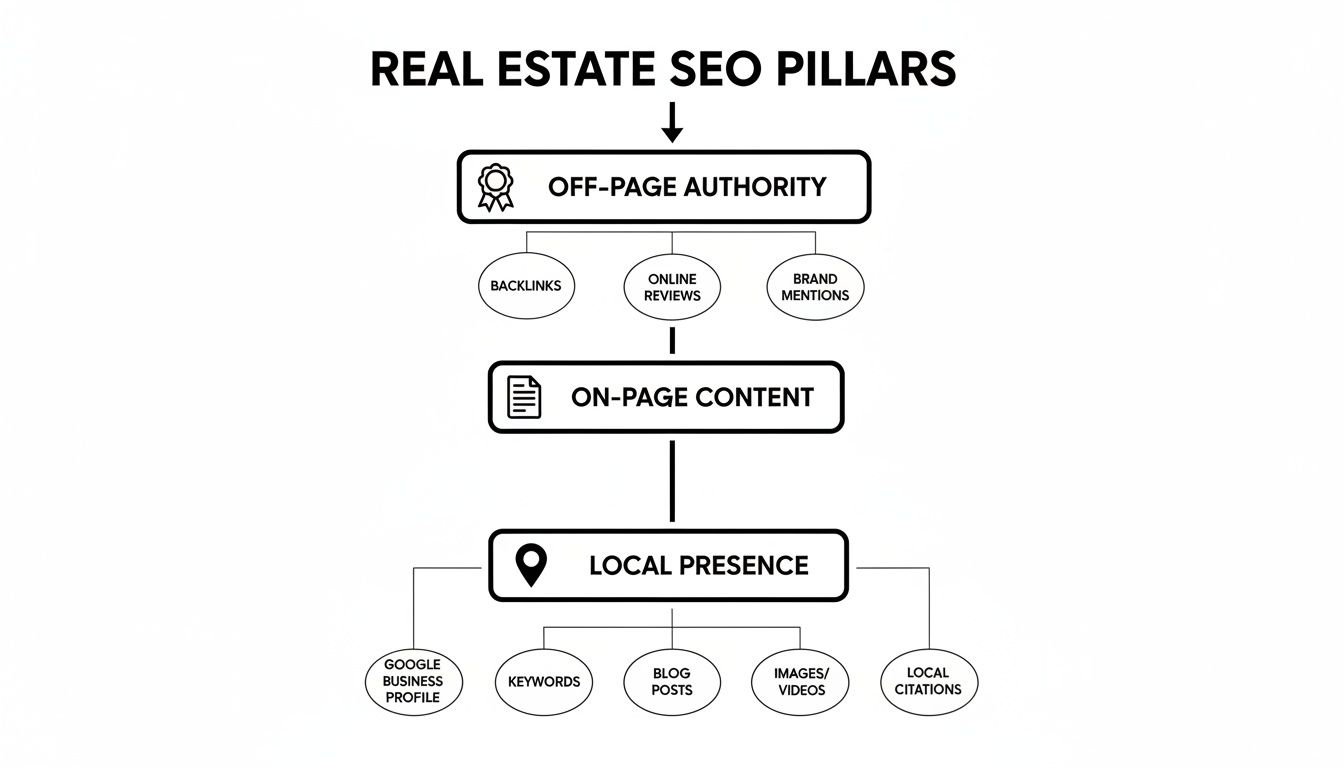
As you can see, your local presence forms the base. Your on-page content builds on top of that, and your off-page authority sits at the very top, cementing your digital credibility.
Mastering Local SEO to Attract High-Intent Clients
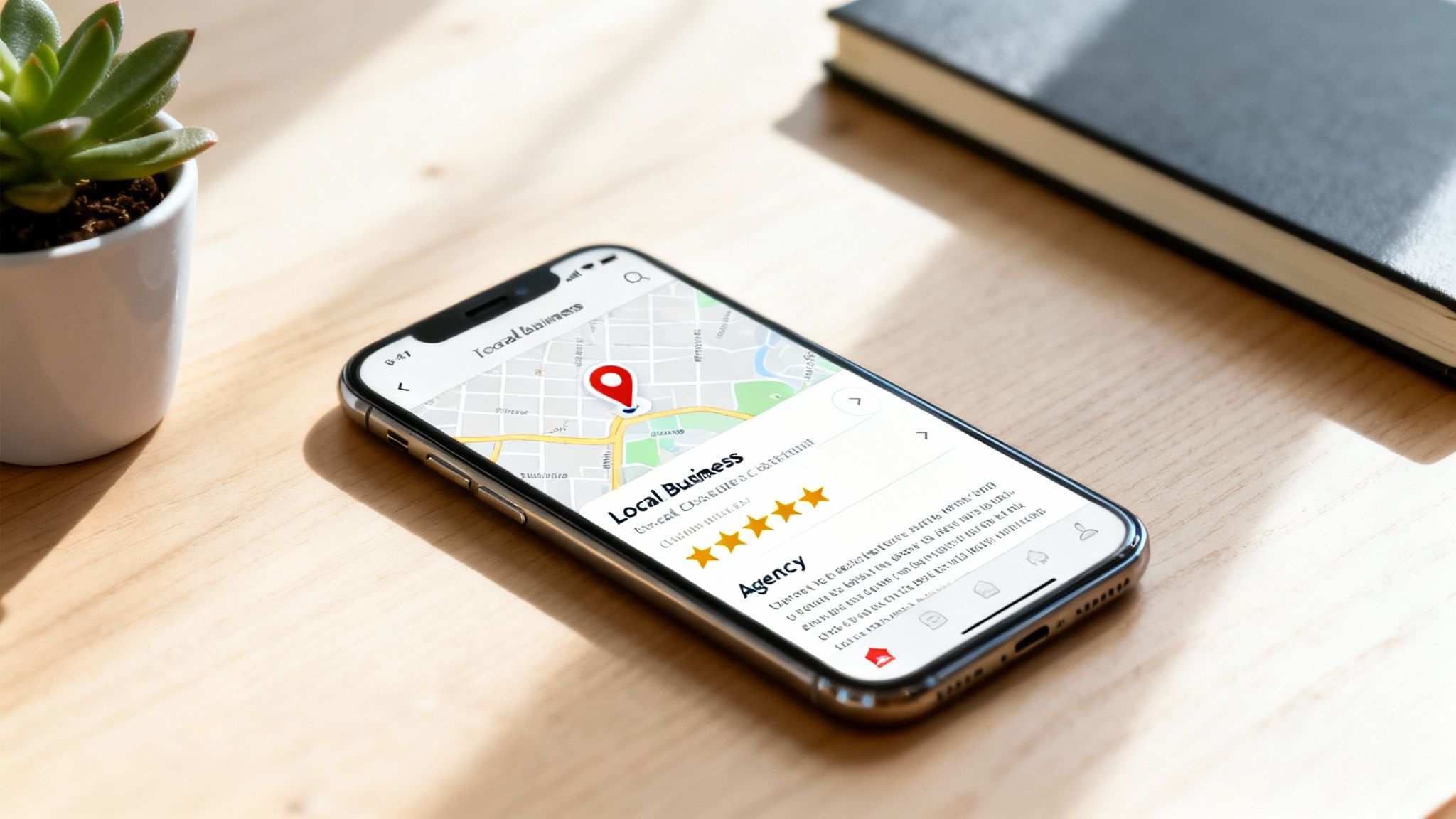
If your website is the house, then local SEO is the foundation it’s built on. It’s the single most powerful way to connect with clients right in your service area—the ones who are actively looking to buy or sell now.
Winning at local search means you win your neighbourhood. And that game starts with your Google Business Profile (GBP).
The data doesn't lie. A massive 46% of all Google searches are for local information. Even more telling, "near me" searches have exploded by over 500% in recent years. For an agent, this translates directly into business, with 78% of local mobile searches leading to an offline conversion. That’s a phone call, a walk-in, or a new lead in your pipeline.
Your Google Business Profile Is Your Digital Shopfront
Think of your GBP as your digital storefront. It's often the very first impression a potential client will have of your agency. A neglected profile is a huge missed opportunity, but a well-optimised one acts like a magnet for qualified leads.
To get your profile working for you, you need to treat it with the attention it deserves. You can find a deeper dive in our complete guide to optimising your Google Business Profile, but here are the non-negotiables:
- Get Your Categories Right: Your primary category must be "Real Estate Agency" or "Real Estate Agent." Don't forget secondary ones like "Real Estate Consultant" or "Property Management Company" if they fit what you do.
- Write a Compelling Description: You have 750 characters, so make them count. Speak directly to your ideal client, explain what makes you different, and integrate LSI keywords naturally like "property appraisals" and "local market expert."
- Use High-Quality Photos: Show off your team, your office, and your recent sales. Google loves seeing fresh photos—it’s a signal that your profile is active and up-to-date.
To turn your GBP into a true lead-generation machine, use this checklist to ensure you've covered all the critical optimisation points.
Google Business Profile Optimization Checklist
| Optimization Task | Why It Matters for Agents | Action Step to Take Today |
|---|---|---|
| Complete Every Section | An incomplete profile looks unprofessional and ranks lower. | Go through every field—services, hours, attributes—and fill it out completely. |
| Consistent NAP Data | Ensures Google trusts your business information across the web. | Check your Name, Address, and Phone number. Make sure it's identical everywhere online. |
| Upload Regular Photos/Videos | Builds trust and shows you're an active, successful agency. | Add at least one new photo of a listing, a happy client, or your team this week. |
| Actively Collect Reviews | Social proof is everything. More positive reviews boost your map ranking. | Send a review request link to your last three satisfied clients. |
| Respond to All Reviews | Shows you're engaged and care about client feedback. | Go to your reviews tab and reply to the last three reviews you received. |
| Use Google Posts Weekly | Keeps your profile fresh and allows you to promote listings. | Create a simple "Just Listed" or "Open for Inspection" post right now. |
| Build Out the Q&A Section | Pre-emptively answers client questions and builds authority. | Ask and answer three common questions, like "What are your commission fees?" or "What suburbs do you service?" |
Following these steps methodically will give you a serious edge over competitors who just set up their profile and forget about it.
Consistency and Reviews Are Your Secret Weapons
Google needs to trust you before it will recommend you. One of the biggest signals of trust is consistency. Your Name, Address, and Phone Number (NAP) needs to be exactly the same everywhere online—your website, social media, and local directories. A tiny difference like "St" versus "Street" is enough to confuse search engines and hurt your ranking.
Think of a consistent NAP as your business’s verified ID card for the internet. It tells Google and potential clients that you are who you say you are, which is a massive factor in local search.
Reviews are the other side of the trust coin for real estate SEO. A steady flow of genuine, positive reviews is powerful social proof. It heavily influences your visibility in the local map pack—that prime real estate at the top of the search results.
Make it a habit to ask happy clients for a review. And just as importantly, respond to every single one. A thoughtful reply to both good and bad reviews shows you’re engaged and builds a trustworthy brand that attracts new clients.
Use GBP Features to Engage Your Audience
Your profile isn't just a static listing; it's an interactive channel. Use the built-in features to actively connect with people in your area and stay top-of-mind.
- Google Posts: This is your mini-blog right on your GBP. Share updates on new listings, announce open house times, or link to your latest market report. Posts only last for seven days, which is a great excuse to keep your profile active.
- Q&A Section: Get ahead of client questions. You can even ask and answer your own questions to provide key information upfront. Think about what people always ask you—commission rates, service areas, the auction process—and answer it here.
Creating Content That Ranks and Converts
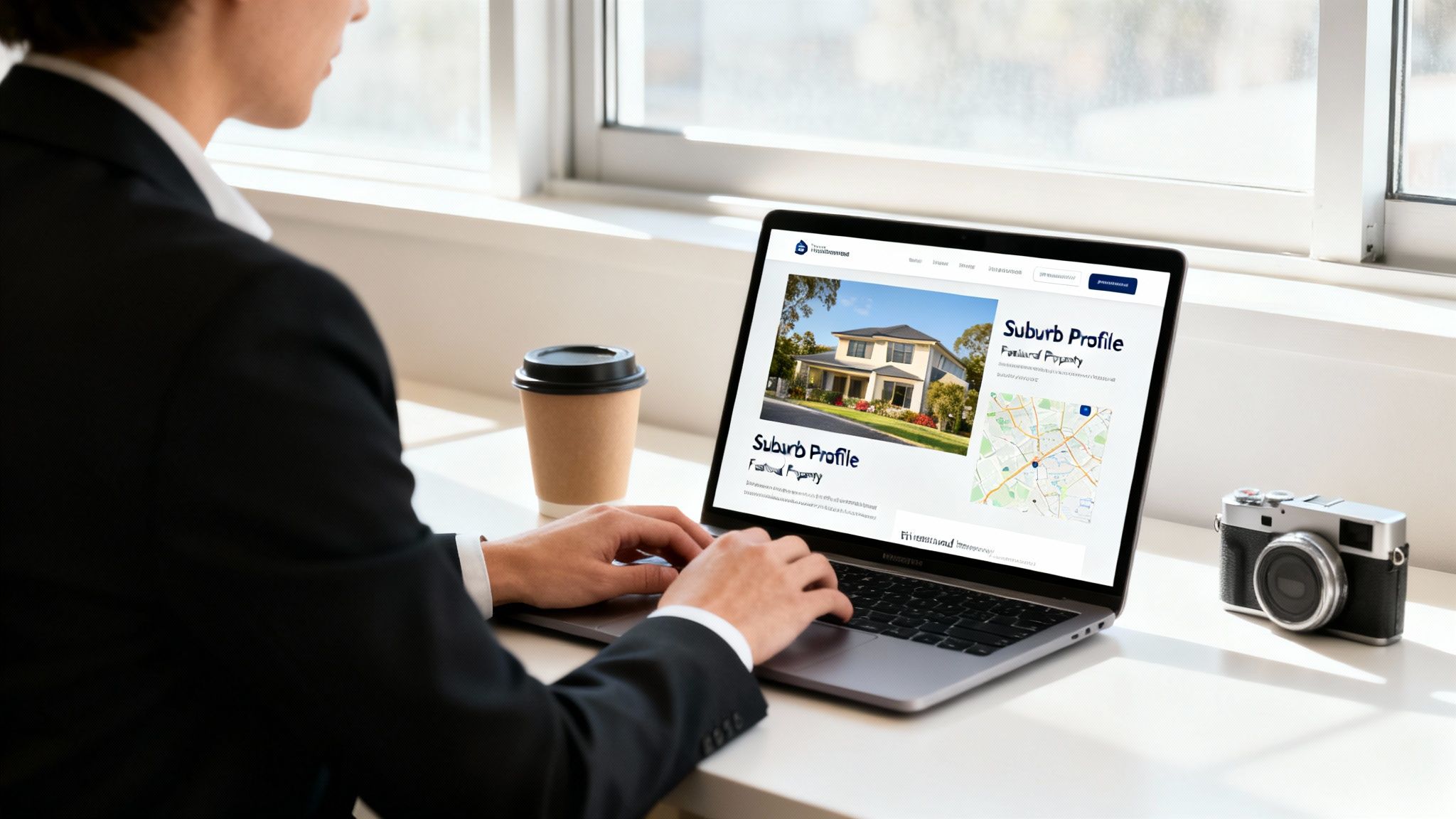
If SEO is the engine, content is the fuel that makes it run. But we're not talking about generic blog posts here. You need a solid content framework that answers the questions your future clients are typing into Google, right at the moment they need help.
The real goal? To build an ecosystem of genuinely useful information. When a potential buyer or seller in your area has a question, your website should be the first—and best—answer they find. That’s how you build trust long before they’re even thinking about picking up the phone.
Become the Go-To Local Authority
Your superpower against the big national portals is your deep, authentic local knowledge. You know the streets, the schools, and the best coffee shop. It's time your content proved it. This is your ticket to attracting high-intent traffic from people looking to move into your suburbs.
Think about the questions your clients ask you every single day. Every one of those is a golden content opportunity.
Here’s where to start with your hyper-local content:
- In-depth Suburb Profiles: Go way beyond demographics. Talk about the lifestyle, the weekend farmers' markets, the dog-friendly parks, and the hidden gems only a local would know.
- Local School Guides: Families live and die by this information. Create detailed guides on school catchments, reputations, and special programs. This content is pure gold.
- Quarterly Market Updates: Anyone can pull data. Your job is to analyse it and give your expert opinion on what it actually means for buyers and sellers in specific neighbourhoods.
By consistently creating content like this, you become the undisputed local resource.
Optimise Your Property Listing Pages
Your property listing pages are your money pages—some of the most important real estate on your entire website. Yet so many agents just copy and paste the generic description from the portals. Big mistake. This is a massive missed SEO opportunity.
Think of each property listing not just as an ad, but as a story. A well-crafted narrative that highlights a home's unique character and lifestyle potential will engage buyers and perform better in search results.
It’s time to transform your listings from a boring fact sheet into a compelling sales tool.
- Write a Unique Property Story: Don’t just list features. Paint a picture. Talk about the morning sun flooding the kitchen or the backyard that’s perfect for family barbies.
- Use High-Quality, Optimised Images: Your photos sell the dream. Make sure they are high-resolution but compressed for fast loading. And give every image descriptive alt text with LSI keywords, like "modern kitchen with stone benchtops in Richmond home for sale."
- Integrate Virtual Tours: Embed 360-degree tours or video walkthroughs directly on the page. This keeps people on your site longer, sending a strong positive signal to Google.
For a deeper dive, our guide on content marketing for real estate agents has even more strategies to help you tell compelling property stories.
Build Trust with Powerful Agent Bios
Finally, don't sleep on your agent bio pages. People work with people they know, like, and trust. Your bio is your chance to build a genuine connection before you've even met.
A strong agent bio does more than list your awards. It tells your story.
- Share why you're connected to the local area.
- Highlight client success stories and sprinkle in testimonials.
- Explain your unique approach and what makes you different.
By focusing on these three pillars—hyper-local resources, optimised listings, and trust-building bios—you create a content engine that works for you 24/7. It attracts, engages, and converts your ideal clients, cementing your position as the go-to agent in your market.
Building Authority with Links and Local Partnerships

In the world of real estate SEO, authority is your digital currency. Having fantastic content and a perfectly tuned local profile is non-negotiable, but if you want to truly own the search results, you need to prove your credibility to Google. This is where backlinks come in.
Think of a backlink as a personal recommendation. It’s a "vote of confidence" from one website to another. When a reputable, relevant local site links to yours, it's telling search engines you're a trusted resource worth paying attention to. The more high-quality "votes" you get, the more authority your website builds, which directly impacts your ability to rank.
But let's be clear: quality is everything. A single, powerful link from a respected local business is worth far more than a hundred spammy links from irrelevant sites. The goal isn't just to build links; it's to earn them.
Cultivating Genuine Local Partnerships
The best way to build a strong backlink profile is by forging genuine relationships within your local business community. These partnerships don't just generate valuable links; they often turn into a goldmine of real-world referrals. Your digital network should be a mirror of your professional one.
Start by thinking about other non-competing businesses that serve the same people you do—homeowners, buyers, and sellers.
Here are a few prime partnership opportunities:
- Mortgage Brokers: Offer to write a guest article for their blog on "Getting Your Finances Ready for Your First Home" in exchange for a link back to your site.
- Home Inspectors: Create a joint "Pre-Inspection Checklist" that you can both host on your websites, with each of you linking to the other as a trusted partner.
- Interior Designers and Stagers: Feature their incredible work in a blog post about "Home Staging Tips That Actually Sell," showcasing their projects and linking back to their portfolio.
- Local Tradies: Plumbers, electricians, and landscapers are the first people new homeowners call. Create a "Recommended Local Services" page on your website and ask the businesses you feature to return the favour with a link.
These collaborations are a win-win, adding value for both of your audiences while quietly building your site's authority.
Every quality backlink is a powerful signal to Google, reinforcing that your website is a central and trusted hub for real estate in your area. This is how you build a digital reputation that fuels long-term, organic growth.
Becoming a Local Media Resource
Another brilliant way to earn high-authority backlinks is by positioning yourself as the go-to real estate expert for local media. Journalists, bloggers, and local news outlets are always on the hunt for expert commentary on the property market.
Don't wait for them to find you. Reach out and offer to provide quotes, data, or insights for their next story on housing trends, interest rate changes, or suburb growth. When they feature your commentary, they’ll almost always include a link back to your website as the source. This move builds a powerful backlink and massively boosts your personal brand and credibility in the community.
If you want to dig deeper into how backlinks boost your credibility, it’s worth understanding the concept of Domain Authority and its impact on SEO. This strategy is all about building a digital network that generates leads both directly and indirectly by elevating your search engine rankings. It's a cornerstone of any serious real estate SEO plan.
Advanced Strategies to Scale Your Real estate SEO
Once you've nailed the basics and your local presence is solid, it's time to claim more digital turf. The same strategies that got you known in one suburb can be scaled to help you dominate an entire region. This isn't just about growing; it's about building a repeatable system that moves you beyond a single-location mindset.
Scaling your real estate SEO means deliberately expanding your digital footprint, targeting multiple service areas with real precision. This isn't about copy-pasting content. It's about creating genuinely valuable resources for each new market you want to win.
Dominate Multiple Suburbs with Location Pages
The absolute cornerstone of any multi-location strategy is building dedicated location pages. Think of them as specific pages on your website optimised for long-tail keywords like "real estate agent in [Suburb B]" or "property manager [Suburb C]".
Each location page should act like a mini-homepage for that specific suburb.
To get these pages ranking, they need to offer unique value and feel anything but generic. Here’s how you build them out properly:
- Hyper-Local Content: Talk about recent sales data, local market trends, and what's great about the schools or community amenities in that specific suburb.
- Unique Testimonials: Feature reviews and success stories from clients you've helped right there in that area. It builds instant social proof.
- Embedded Maps: Add a Google Map showing your service area or office location within that suburb. It’s a simple but powerful trust signal.
- Targeted Keywords: Naturally weave in phrases like "[Suburb Name] real estate expert" and "homes for sale in [Suburb Name]" throughout the page.
Leveraging Client Stories as SEO Gold
Your client testimonials and case studies are probably your most powerful—and most underused—SEO assets. They do far more than just build trust; they create unique, keyword-rich content that Google absolutely loves.
Instead of settling for a simple one-line quote, turn a successful sale into a detailed story.
A great case study tells a story. It should outline the client's problem (like needing to sell their home fast), the strategy you put in place, and the fantastic outcome. This narrative is naturally packed with long-tail keywords and proves your expertise in a way no generic blog post ever could.
This approach turns client feedback from a simple marketing nice-to-have into a strategic SEO weapon that attracts more of your ideal clients.
Integrating SEO with Your CRM for Seamless Growth
Real, sustainable scale happens when you connect your SEO efforts directly with your Customer Relationship Management (CRM) system. This creates a smooth, automated journey from the moment a lead finds you on Google to the day you close the deal.
When it's all connected, no lead ever falls through the cracks. For example, when someone fills out a "property valuation" form on one of your suburb pages, your CRM can automatically tag them based on their location and kick off a relevant email follow-up sequence. It lets you manage leads from multiple areas without feeling overwhelmed.
This link between SEO and your CRM turns your website from a passive online brochure into an active, automated machine that generates and nurtures leads for you. And if you're serious about staying ahead, exploring the best AI SEO tools and Generative Engine Optimization can give you a serious competitive edge.
The data backs this up, big time. Multi-location businesses in Australia see dramatically better organic traffic. In fact, research shows a massive 557% traffic advantage over their single-location competitors. This proves that expanding your geographic focus, when done right with SEO, creates a snowball effect that builds massive visibility. You can dig into more of these Australian local SEO findings to see the full picture.
Measuring SEO Success and Proving Your ROI
If you can’t measure your marketing, you can’t improve it. Pouring money into real estate SEO without tracking the results is like driving blindfolded – you’re moving, but you have no idea if you're getting closer to your destination.
This section cuts through the noise of analytics and focuses on the key performance indicators (KPIs) that actually matter to your bottom line.
The goal here isn’t to get lost in complicated spreadsheets. It’s about drawing a straight line from your SEO activities—like writing a hyper-local blog post or optimising your Google Business Profile—directly to tangible business outcomes.
Key Metrics That Actually Matter
Forget vanity metrics like page views that don't pay the bills. To prove your return on investment (ROI), you need to track the data that signals genuine client interest and business growth. These are the numbers that tell the real story.
Your two best friends for this will be Google Analytics 4 (GA4) and Google Search Console (GSC).
Here are the essential KPIs to watch:
- Organic Traffic Growth: This is simply the number of visitors finding your site through Google search without you paying for an ad. Consistent growth here is proof your SEO strategy is making you more visible.
- Keyword Rankings: Keep a close eye on high-intent, local keywords. Think "real estate agent [your suburb]" or "homes for sale in [your area]". Seeing these climb the ranks in GSC is a direct sign of progress.
- Lead Conversions: This is the big one. You need to track how many visitors take a meaningful action, like filling out a contact form, clicking to call your number, or submitting a property valuation request.
Your ultimate goal with SEO isn't traffic; it's conversions. Every report you create should draw a clear line from your online visibility to the number of qualified leads entering your sales pipeline.
Building a Simple and Effective SEO Report
To prove the ROI of your real estate SEO, you need to show the data in a way that’s easy to digest. A simple monthly report is the perfect tool to connect your efforts to business results and make smart decisions for the month ahead.
Here’s a straightforward framework for your report:
- Executive Summary: Start with a quick, punchy overview. For example, "This month, organic traffic grew by 15%, which led to 12 new property valuation requests. This was a direct result of our improved rankings for 'best agent in [suburb]'."
- KPI Snapshot: Use a simple table to show month-on-month changes for your key metrics.
| Metric | Last Month | This Month | Change |
|---|---|---|---|
| Organic Visitors | 1,250 | 1,438 | +15% |
| Keyword Rankings (Top 3) | 5 | 8 | +60% |
| Phone Call Clicks (GBP) | 22 | 31 | +41% |
| Contact Form Leads | 8 | 12 | +50% |
- Key Wins and Insights: Briefly explain what worked. Did a new suburb profile page start ranking? Did your latest blog post on local market trends bring in a heap of traffic?
- Next Steps: Outline your plan for the upcoming month based on what the data is telling you. For example, "We'll focus on creating more content for [Suburb B] to replicate the success we saw in [Suburb A]."
This simple structure turns complex data into a clear story of progress. It helps you justify your investment in SEO and lets you fine-tune your strategy for even better results next month.
Frequently Asked Questions (FAQ) About Real Estate SEO
Let's address some of the most common questions agents have about getting started with SEO.
How Long Until I See Results from SEO?
SEO is a long-term investment, not an overnight fix. While you can see positive movement in local map rankings within 60-90 days from an optimized Google Business Profile, ranking for competitive, high-value keywords takes longer.
For terms like "real estate agent [your city]," expect to see significant results in 6 to 12 months. This timeline depends on your market's competitiveness, your starting point, and your commitment to consistently creating quality content and building authority.
Should I DIY My SEO or Hire an Agency?
This decision comes down to your time, technical skills, and budget.
- DIY SEO: If you have a limited budget but plenty of time to learn and execute, you can achieve great results. Focus on the fundamentals covered in this guide: mastering your Google Business Profile, creating hyper-local content, and building local citations. It requires serious dedication but is absolutely possible.
- Hire an Agency: If your time is best spent closing deals, hiring a specialist real estate SEO agency is a smart investment. An expert team will implement a sophisticated strategy from day one, handle all the technical complexities, and deliver results faster. The long-term ROI is typically much stronger.
What's the Difference Between SEO and Paid Ads (PPC)?
Both are powerful tools, but they serve different functions in your marketing strategy.
SEO is like buying a house. It requires an upfront investment of time and effort, but over time you build a valuable, long-term asset that generates leads for you 24/7. Paid ads are like renting—the moment you stop paying, your visibility disappears.
Paid ads (like Google Ads) provide instant visibility at the top of search results, but you pay for every single click. In contrast, real estate SEO is about earning those top positions organically. The most effective strategies use both: SEO builds a rock-solid foundation for sustainable growth, while paid ads are used for targeted, short-term campaigns like promoting a new luxury listing.
Ready to stop competing and start dominating your local market? At Homer Digital Marketing, we build powerful Google optimisation and automation systems that turn your website into a consistent lead-generation engine. Schedule a free consultation today and discover how our proven strategies can help you scale.
