

Let's be honest, in a market flooded with options, just showing up isn't a strategy. Brand positioning is how you stop being an option and start being the only option for the right people. It's the deliberate act of carving out a unique space for your business in your customer's mind.
Defining Your Space in a Crowded Market

Picture a massive, chaotic car park where every car is the same shade of grey. Finding the one you're looking for feels impossible. Now, imagine a single, brightly lit spot right at the front, with a sign that says "Reserved for Your Ideal Customer."
That’s your brand position. It's the unique, reserved space you own that makes it effortless for the right clients to find you, choose you, and remember you.
This goes way beyond a catchy tagline or a slick logo. A solid brand position is the North Star for your entire business, guiding everything you do. It dictates:
- Your Marketing Messages: What you say and where you say it.
- Your Service Offerings: The problems you solve and how you package the solutions.
- Your Pricing Strategy: The value you command, not just the price you charge.
- Your Ideal Client: Who you’re built to serve—and just as importantly, who you aren’t.
Basically, it's the instant mental shortcut your audience takes when they hear your name. Think about how FedEx completely owned "overnight shipping" when they started. That powerful positioning made them the automatic choice for anything urgent, long before competitors caught up.
Why Positioning Is a Survival Strategy
In a world where everyone is shouting for attention, being unclear is the fastest way to become invisible. Without sharp positioning, you're just another commodity, left to fight it out on price. A huge reason this matters is its direct impact on how you increase brand awareness and grow your business, setting the stage for real market recognition.
Strong positioning is the bedrock for building a memorable business identity. If you want to dive deeper into this, check out our guide on what is personal branding.
The difference between a business with strong positioning and one without is night and day. It impacts the quality of clients you land, the prices you can charge, and your ability to grow without burning out.
“Brand identity captures the meaning intent of the firm.” – Jill Avery, Harvard Business School Professor
What she's saying is that positioning is intentional. It's about you deciding what your brand means to people, instead of letting the market decide for you.
Strong vs Weak Brand Positioning At a Glance
To make it crystal clear, this table shows the real-world business outcomes of getting your positioning right versus leaving it to chance. Notice how clarity translates directly into better results across the board.
| Business Outcome | Strong Positioning | Weak Positioning |
|---|---|---|
| Client Quality | Attracts ideal, high-value clients who seek your specific expertise. | Attracts price-shoppers and mismatched clients who drain resources. |
| Pricing Power | Allows you to command premium prices based on perceived value and expertise. | Forces you to compete on price, leading to lower profit margins. |
| Marketing Efficiency | Marketing is focused, targeted, and generates a higher return on investment. | Marketing is scattered, generic, and struggles to deliver consistent results. |
| Referrals | Generates consistent, high-quality referrals because people know exactly who to send your way. | Referrals are infrequent and often a poor fit for your services. |
| Competitive Advantage | Creates a unique space in the market that is difficult for competitors to copy. | Blends in with competitors, becoming easily replaceable. |
As you can see, strong positioning isn't a "nice-to-have"—it's a core driver of profitability and sustainability. It's what separates the businesses that thrive from those that just survive.
The Four Pillars of a Powerful Brand Position
Building an unforgettable brand position isn't about some flash of creative genius. It's a deliberate process, built on four essential pillars. Get these right, and you turn a vague idea into a rock-solid framework that guides every single business decision you make.
Think of it like building a house. If even one of the foundations is shaky, the whole structure is unstable and won't stand a chance against the competition.
Pillar 1: Target Audience
First up, and most critical, is your Target Audience. This goes way beyond basic demographics like age or location. To really nail your positioning, you need to get inside your ideal client’s head.
What are their biggest fears, frustrations, and secret hopes? What’s the one problem that keeps them awake at night? For a service business, this is about getting specific. You need to move from a blurry description like "small business owners" to something razor-sharp like "established trade business owners who are struggling to hire reliable apprentices."
A strong brand position is built on empathy. It starts by understanding a specific person's problem so deeply that they feel like you're reading their mind.
This laser focus makes your marketing feel personal. When your ideal client feels seen and understood, they stop seeing you as just another provider and start seeing you as the only solution built for them.
Pillar 2: Market Category
Next, you need to clearly define your Market Category. This is the 'sandbox' you choose to play in, and it instantly sets expectations for your customers. It’s the mental shortcut your audience uses to figure out what you do and who you’re up against.
For instance, are you a "business coach," a "financial consultant," or a "marketing strategist"? Each label triggers different assumptions about your services, your price point, and the results you deliver.
Choosing your category is a strategic move. A generalist consultant might struggle to stand out, but by repositioning as a "profitability consultant for SaaS scale-ups," they create a whole new, less crowded category where they can become the go-to expert. The trick is to define your market in a way that plays to your unique strengths.
Pillar 3: Brand Promise
With your audience and category sorted, the third pillar is your Brand Promise. This is the one, compelling thing you commit to delivering. It's the simple answer to your client's most important question: "What's in it for me?"
Your brand promise isn’t a laundry list of services. It’s the core outcome or transformation your clients get when they work with you. A great brand promise is:
- Unique: It says something your competitors can't (or don't) claim.
- Desirable: It hits on a deep need or pain point for your target audience.
- Concise: It's simple enough to be remembered and repeated.
A recruitment agency, for example, might promise: "We fill your key technical roles with top talent in under 30 days." It's specific, it’s valuable, and it sets a crystal-clear expectation.
Pillar 4: Evidence
Finally, the fourth pillar is Evidence. These are the proof points that make your brand promise believable. Let's be honest, a bold promise without proof is just empty marketing fluff. Your evidence is what builds trust and removes the risk for potential clients.
This proof can come in many forms, and the smartest brands use a mix of them to build an undeniable case for their expertise.
Types of Evidence:
- Case Studies: Detailed stories showing exactly how you solved a specific client's problem.
- Testimonials and Reviews: Social proof from happy clients that validates what you're saying.
- Data and Statistics: Hard numbers, like a "95% client retention rate" or an "average revenue increase of 40%."
- Credentials and Certifications: Industry qualifications that signal you know your stuff.
- Proprietary Methodologies: A unique process or framework that shows you have a structured path to getting results.
These four pillars don't work in isolation—they lock together to create a powerful, coherent, and defensible brand position. When you know exactly who you serve, the category you own, the promise you make, and have the proof to back it all up, you stop being just another option. You become the only choice.
Crafting Your Unbeatable Positioning Statement
Now that you have the groundwork sorted, it's time to sharpen that strategy into a clear, powerful message. Think of your brand positioning statement as your internal North Star—a simple sentence that nails down who you serve, what you deliver, and why you're the only one for the job.
This isn't just a tagline you slap on your website. It's the core script your entire team lives by. It keeps every marketing campaign, sales call, and social media post telling the same strong story. Getting this right is about turning your big ideas into a tool you can actually use every day.
Five Steps to a Powerful Statement
To build a statement that really works, you need a plan. Each step builds on the last, taking you from a wide-angle view of the market to a super-specific declaration of your value. This process makes sure your statement isn't just wishful thinking—it's locked into what your clients actually need and what the market is missing.
- Analyse Your Competitors: First up, map out the competition. Who else is playing in your sandbox? Look closely at their messaging, who they're talking to, and what they promise. Your mission is to find the gap—the unmet need or the ignored audience they've left wide open for you.
- Define Your Unique Differentiators: What makes you genuinely different? This can't be something fluffy like “we have great service.” It has to be tangible, provable, and hard for others to copy. Maybe it’s a specific methodology you developed, a rare mix of skills, or deep expertise in a tiny niche.
- Identify Your Target Client’s Pain Points: Go back to your ideal client. Dig deeper than surface-level problems and find their real frustrations. What's the nagging issue that keeps them up at night? Your positioning has to hit this nerve to work. The better you get this, the more your message will connect. Our guide to customer journey mapping can give you some great pointers here.
- Map Your Value Proposition: Now, connect the dots. How do your unique differentiators solve your client's specific pain points better than anyone else? This sweet spot is where your true value is. It's the clear, compelling reason someone should pick you.
- Draft and Refine: With all the pieces in place, start writing. Use a simple template to get your thoughts organised, then tweak the words until the statement is sharp, clear, and easy to remember.
Taking the time to do this is more important than ever. In the crowded Australian market of 2026, brands that focus on being relevant to a specific audience—rather than shouting at everyone—see up to 43% higher engagement rates. It's no surprise that 43% of Australian marketers are now using AI to sharpen their positioning and create content that truly hits the mark. You can discover more insights in the Australian Marketing Trends 2025/2026 Report.
The Positioning Statement Template
To make the drafting process dead simple, use this fill-in-the-blanks template. It forces you to get specific and makes sure you don't miss any of the crucial ingredients.
For [Your Target Audience], [Your Brand] is the only [Market Category] that delivers [Your Brand Promise] because [Your Reason to Believe].
Let's break that down:
- Target Audience: Who is your ideal client? Get super specific. "Small businesses" is too broad. "Time-poor tradies in Perth" is better.
- Your Brand: Your business name. Easy.
- Market Category: The sandbox you play in. Are you a consultant, a digital agency, a wellness coach?
- Brand Promise: The unique result or feeling you deliver. What's the big payoff?
- Reason to Believe: Your proof. This is your key differentiator—the thing that makes your promise believable.
Putting the Template into Action
Let’s see how this works for a hypothetical Aussie wellness coach. We'll call her "Thrive Corporate Wellness," and she wants to stand out from the thousands of generic life coaches out there.
After going through the five steps, she gets her elements sorted:
- Target Audience: Burnt-out, high-achieving female executives in Australia's tech sector.
- Market Category: Corporate wellness consultancy.
- Brand Promise: A sustainable path to peak performance without the burnout.
- Reason to Believe: Her proprietary "Energy Renewal Method," which combines neuroscience-backed mindfulness with strategic performance coaching.
Now, let's plug it all into the template.
"For burnt-out female executives in Australia's tech sector, Thrive Corporate Wellness is the only corporate wellness consultancy that delivers a sustainable path to peak performance without burnout because we use the proprietary Energy Renewal Method that integrates neuroscience and strategic coaching."
Just like that, she’s no longer just another wellness coach. She’s a specialist with a crystal-clear audience, a unique promise, and a credible reason why she's the best choice. This one powerful sentence becomes the blueprint for her entire business, guiding everything from her LinkedIn content to how she talks to new clients.
Brand Positioning Examples in Action
Theory is one thing, but seeing sharp brand positioning in the wild is where it all clicks. To really get your head around what is brand positioning, let’s break down how five Australian service businesses carved out their own space in a crowded market, becoming the go-to experts in their niche.
These mini case studies show how a deliberate strategy shapes everything from the words you use in your marketing to the clients you attract.
The Wellness Practitioner for Corporate Burnout
A generalist wellness coach was struggling to find consistent clients. She was lost in a sea of competitors all offering vague "stress management." So, she repositioned to tackle a highly specific and urgent problem: corporate burnout recovery.
- Target Audience: High-pressure executives in Sydney's financial district who are completely exhausted.
- Unique Promise: This isn't just about managing stress. It's about building a strategic, sustainable system for long-term peak performance.
- How It Translates: Her marketing ditched generic words like "balance." Instead, she started using language her audience understood, like "optimising mental capital" and "preventing career derailment." Her services shifted from one-off sessions to structured 90-day recovery programs, which easily justified a premium price.
The Buyer's Agent for First-Time Investors
Instead of helping just anyone buy a property, this agent niched down to become the specialist for investment properties for first-time buyers in Sydney.
This single move instantly set them apart from agents focused on luxury homes or family dwellings. Their entire business is now built around educating and empowering a specific group of people, which builds immense trust. All their content is geared towards demystifying jargon, explaining negative gearing, and showcasing entry-level properties with high rental yields.
This clear process—analyse, define, and map—is central to developing a positioning statement this powerful.
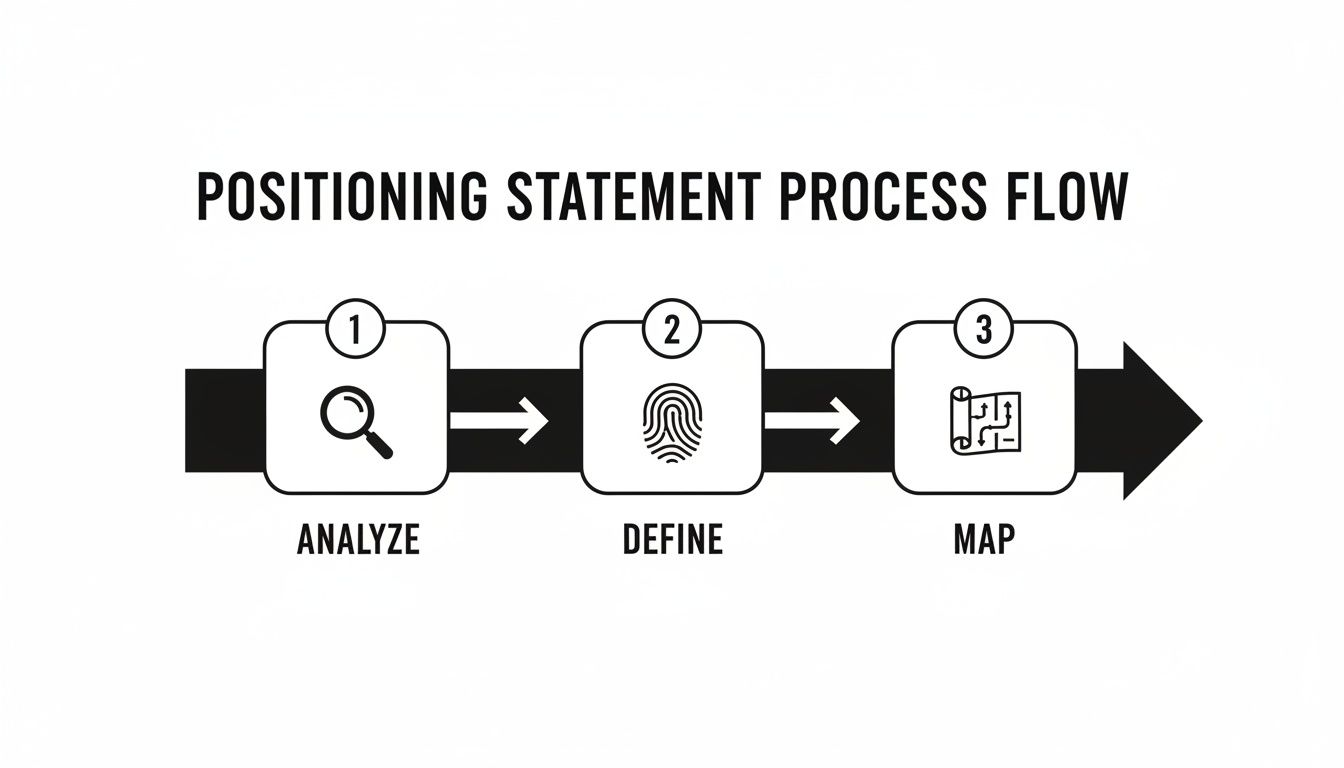
This shows that effective positioning doesn't just happen by accident. It’s a structured journey from broad market analysis to a specific, defined identity.
The Recruiter for Remote Tech Startups
While most recruitment agencies were chasing big corporate clients, this firm saw a market nobody was properly serving: remote IT roles for Australian startups.
They became the experts in the unique culture and technical needs of fast-growing, agile companies. Their entire brand reflects this, from their casual communication style on LinkedIn to their focus on showcasing company culture over corporate prestige. This positioning makes them the obvious choice for both venture-backed startups needing top tech talent and developers looking for flexible, innovative work.
The Auto Shop for Luxury European Cars
This mechanic could have worked on any car that rolled in. Instead, he chose to become the undisputed expert in luxury European car maintenance in his city.
This specialisation meant he could invest in manufacturer-specific diagnostic tools and training that generalist shops just couldn't afford. His marketing doesn't talk about "all makes and models"; it highlights his expertise with brands like BMW, Mercedes, and Audi. This creates a perception of superior quality and care. As a result, he attracts owners who are happy to pay a premium for specialised service, completely avoiding the price wars in the general auto repair market.
By 2026, Australian service-based enterprises that ignore this level of specific positioning risk becoming obsolete. The battle for attention on our home screens is fierce, and being a generalist is no longer a viable strategy when social media offers the highest marketing ROI for targeted audiences. You can read the full IMAA Future Trends report to see why this matters now more than ever.
The Coach for Scaling Service Businesses
Finally, let's look at a business coach who moved away from the vague promise of "business growth." She zeroed in on a tangible, highly desirable outcome: scaling service businesses past six figures.
This immediately filtered out hobbyists and attracted serious entrepreneurs who were ready to invest in real growth.
- Client Pain Point: Hitting a revenue ceiling and getting stuck in the day-to-day grind of their own business.
- Positioned Solution: A proven system for productising services, building a team, and automating marketing to break through that ceiling.
- Resulting Message: Her messaging is direct. It’s full of case studies and testimonials from clients who have successfully smashed the $100k barrier. This specific, outcome-driven positioning makes her value crystal clear and incredibly compelling to her target market.
Activating Your Brand Position Across Digital Channels
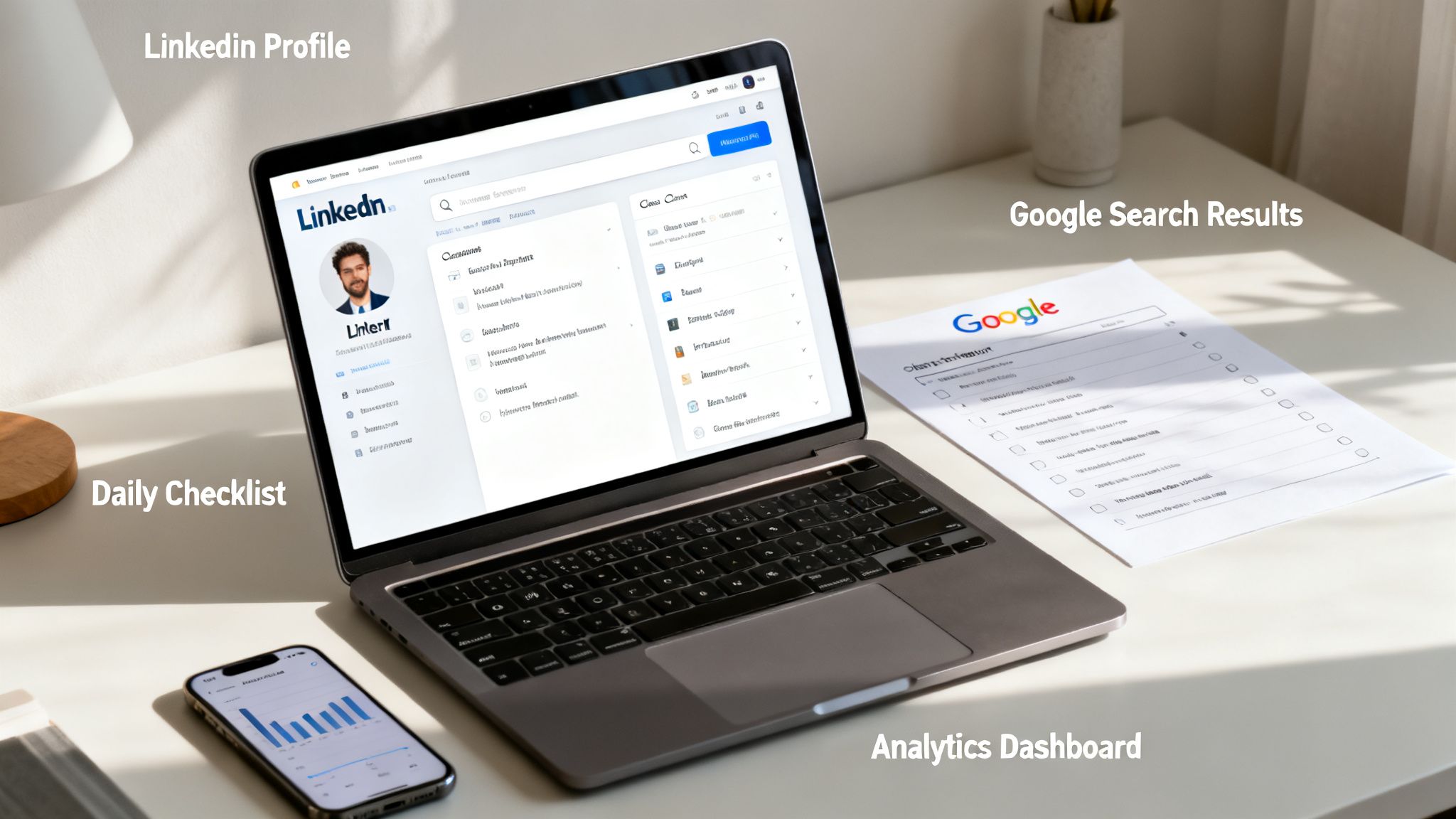
A brilliant positioning strategy is useless if it just sits on a whiteboard. The real magic happens when you execute—turning that carefully crafted statement into a client-attracting machine right where your ideal clients are looking. This is where your positioning stops being a document and starts being a living, breathing part of your business.
For most service-based businesses, there are two key battlegrounds: LinkedIn and Google. One is where professionals go to find solutions, and the other is where buyers do their research. Nail your positioning on both, and you’ll be meeting the right people at the exact moment they need you.
Weaving Your Position into Your LinkedIn Profile
LinkedIn isn't just an online CV anymore; it’s a powerhouse for attracting high-value clients. Your new positioning should drive every single part of your profile, transforming it from a static summary into an active lead-generation asset.
Start with your headline. A generic job title like "Business Coach" won't cut it. Use your positioning to be hyper-specific: "Helping Aussie Tradies Systemise Their Operations to Double Profitability." That headline instantly filters your audience and speaks directly to your ideal client's goals.
Next, gut your "About" section. Don't just list your career history. Instead, tell a story that shows your unique value, hits on key client pain points, and clearly states who you help and the results you get them. Use their language to build an instant connection.
Finally, your content strategy needs to be a direct reflection of your positioning. Every article, post, and video you share should reinforce your expertise in that niche. Think of each piece of content as a proof point, showing you understand the market's challenges and positioning you as the go-to authority.
A well-positioned LinkedIn profile doesn't just attract followers; it qualifies prospects. When someone lands on your page, they should know instantly if you're the right fit, saving everyone a ton of time.
Dominating Your Niche on Google
LinkedIn is for proactive outreach, but Google is where you capture active demand. Your brand positioning should be the bedrock of your entire search engine optimisation (SEO) strategy. It tells you which keywords to target, what content to create, and how to present your business locally.
Your website copy must be a direct mirror of your positioning statement. The headline on your homepage should scream your value proposition. Service pages should be tailored to the specific pains and goals of your target audience, using the exact keywords they're typing into Google.
Your Google Business Profile (GBP) is just as crucial, especially if you have a local focus. Make sure your business category, services, and description are all aligned with your specialised positioning. Encourage reviews from your ideal clients that mention the specific problems you solved for them—this is powerful social proof that backs up your claims.
Measuring What Truly Matters
How do you know if your positioning is actually working? You have to track the right metrics. Forget vanity numbers like follower counts or raw website traffic. The real signs of success are tied directly to your business growth and client quality.
Focus on these key performance indicators (KPIs):
- Lead Quality: Are your enquiries a better fit? You should see a big drop in time-wasting calls with people who aren't right for you.
- Sales Conversion Rates: A clear, compelling position makes the sales process much smoother. Track the percentage of qualified leads who become paying clients.
- Client Feedback and Testimonials: Are clients using the same language you use in your positioning? Positive feedback that mirrors your brand promise is a huge win.
- Average Deal Size: As you cement yourself as a specialist, you should be able to charge more. Keep an eye on whether the value of your projects is going up.
This data-driven approach proves that great brand positioning isn't just a fluffy marketing exercise—it’s a direct driver of profit and sustainable growth.
Common Positioning Mistakes That Undermine Growth
Crafting a powerful brand position is a game of precision, not guesswork. A lot of businesses get it wrong, and it’s usually because they fall into a few common, yet totally avoidable, traps.
Understanding these pitfalls is the first step to building a position that doesn’t just sound good but actually drives real growth. By sidestepping these errors, you save yourself a world of time, money, and missed opportunities.
Trying to Be Everything to Everyone
This is the big one. In a desperate attempt to attract more clients, businesses water down their message until it appeals to no one. You become a generalist in a market that rewards specialists every single time. This "all things to all people" approach makes your brand instantly forgettable and forces you to compete on price.
What to do instead: Get specific. Embrace a niche. Zero in on a distinct target audience with a very particular problem. When you become the go-to expert for a smaller, more defined group, you build a powerful reputation, attract higher-quality leads, and can charge a premium for your specialised skills.
Positioning Around Features, Not Outcomes
So many businesses get this backwards. They build their entire position around what they do (their services) instead of what their clients get (the transformation). Let’s be clear: clients don’t buy SEO services; they buy more customers walking through their door. They don’t buy business coaching; they buy the confidence to finally scale.
A feature-focused position is all about you. An outcome-focused position speaks directly to your client's biggest headaches and deepest desires, making your value crystal clear.
Shifting from features to benefits is probably the single most important change you can make to create a message that truly connects.
Making Promises You Cannot Keep
This one’s a killer for trust. You see it all the time—an aspirational brand promise that the business simply can't deliver on. A promise of "unmatched 24/7 support" is just empty words if your team clocks off at 5 pm. This disconnect doesn’t just disappoint; it shatters your credibility.
What to do instead: Keep it real. Your brand position has to be authentic and provable. Every single promise you make must be backed up by your actual service delivery, day in and day out. It’s far better to underpromise and overdeliver. That’s how you build a loyal client base who knows you’ll get the job done right, every single time. Consistency is credibility.
Your Brand Positioning Questions Answered
Even with the best strategy mapped out, it’s natural to have a few lingering questions. Let’s tackle the most common ones so you can move forward with total clarity.
How Often Should I Revisit My Brand Positioning?
Think of your brand positioning as a living document, not something you carve in stone and forget about. The market shifts, customers evolve, and so should you. A good rule of thumb is to give it a proper review at least once a year.
That said, some events should trigger an immediate rethink. A disruptive new competitor, a major shift in what your customers want, or a pivot in your own business goals are all big enough reasons to pull your strategy out and see if it still holds up. Regular check-ins keep your message sharp.
Can My Business Have More Than One Target Audience?
While you might serve a few different groups, your positioning needs to be laser-focused on a single primary target audience. This is the group whose problem you solve better than anyone else on the planet. If you try to talk to everyone, you’ll end up being memorable to no one.
Of course, you’ll have secondary audiences, but your core messaging, marketing, and the very services you develop should be aimed squarely at that ideal client. This focus is what creates a magnetic brand that pulls the right people in.
Focusing on a primary audience doesn't mean turning away other business. It means creating a brand so strong and clear that it attracts the best business.
What Is the Difference Between Brand Positioning and a Mission Statement?
This one trips a lot of people up, but it’s actually quite simple when you think about who each one is for.
- Brand Positioning: This is for your customer. It’s the specific, competitive space you own inside their mind. It’s how they see you versus everyone else.
- Mission Statement: This is for you and your team. It’s your internal compass—your company’s purpose, its values, and its entire reason for being.
So, your positioning is about how you win in the market. Your mission is about why you’re even in the market to begin with.
How Long Does It Take to Establish a New Brand Position?
This is a marathon, not a sprint. It takes time, consistency, and a whole lot of patience. You can't just change a few words on your website and expect your market to magically get the message overnight.
Realistically, it can take anywhere from six months to two years to firmly embed a new position in the minds of your audience. Every piece of content you share, every client interaction, and every marketing campaign you run either builds up or tears down that position. Consistency is everything.
Ready to stop being a generalist and become the go-to expert in your field? At Homer Digital Marketing, we help service businesses just like yours build a powerful brand position that gets noticed by ideal clients on LinkedIn and Google.
Book a no-obligation strategy call with us today and let’s carve out your winning space in the market.
