

Ever wondered what your customers really experience when they deal with your business? A customer journey map is the tool that gives you that answer. Forget complex charts; think of it as a story—a visual roadmap that follows a person from their first curious glance at your brand to becoming a loyal fan. This guide provides an actionable walkthrough of what is customer journey mapping and how you can use it to find hidden opportunities for growth.
Understanding Your Customer's Story

So, what exactly is customer journey mapping? Let’s break it down.
Imagine you’re planning the perfect holiday for a friend. You wouldn't just book a flight and hope it all works out. You’d map out every single detail: the drive to the airport, the check-in process, the hotel experience, and the trip home. You'd think about the potential pain points (like a long queue) and the moments of magic (like a surprise room upgrade).
That’s what a customer journey map does for your business. It’s a visual snapshot of every interaction someone has with your company, told entirely from their point of view. It captures their actions, thoughts, and feelings at each step, or touchpoint, along the way. It’s a powerful way to step outside your own assumptions and see your business through your customers' eyes.
More Than Just a Diagram
The goal here isn't to create a pretty flowchart for the wall. It's about building a genuine, empathetic understanding of your audience. The mapping process forces you to pinpoint exactly where your customer experience is brilliant and, more importantly, where it’s letting people down. By finding those friction points, you can make smart, strategic decisions that directly boost satisfaction and loyalty.
This is non-negotiable in the Australian market, where customer experience has become a key battleground. In fact, a massive 74% of Australian consumers say their buying decisions are shaped by their overall experience with a brand. On top of that, expectations are climbing fast, with 58% of consumers saying their standards for good service have gone up in just the last year. These numbers show just how urgent it is for businesses to get every touchpoint right. You can dive deeper into these customer experience findings to see how Australian consumer behaviour is changing.
A customer journey map is a story about your customer's experience. It's not just a series of events; it’s a narrative that reveals their needs, motivations, and feelings.
Ultimately, by mapping this journey, you stop reacting to problems and start proactively solving them. You can engineer moments of delight and build stronger, more profitable relationships with the people who keep your business running.
Why Journey Mapping Is More Than Just a Pretty Diagram
Thinking of a customer journey map as just another business chart is a huge mistake. It’s not a one-off task you complete and file away. Done right, it becomes a powerful strategic tool that forces your whole organisation to see your business through your customers' eyes.
The biggest problem in most companies? Silos. Marketing promises one thing, the sales team says another, and customer support is completely in the dark. This creates a clunky, disjointed experience for the customer, breeding frustration and killing trust before you even get started.
Creating a Single Source of Truth for Everyone
A journey map cuts through the noise. It becomes the single source of truth that gets every department—from product and marketing to sales and service—on the same page. For the first time, everyone is looking at the customer experience from the same perspective: the customer's.
When you unite your teams around a shared understanding of what your customer actually needs, feels, and struggles with, you build a collaborative culture. The focus shifts to one single goal: delivering real value at every single stage of their journey.
This unified view is a game-changer. It makes sure your marketing efforts are actually teeing up warm, qualified leads for your sales team, creating a much smoother handover for new clients. We dive deeper into this connection in our guide on how marketing helps sales.
Finding the Hidden Potholes and Goldmines in Your Customer Experience
Along their journey, your customers hit what we call ‘moments of truth’. These are the critical make-or-break interactions that can either lock in their loyalty for life or send them running straight to your competitor.
A journey map is brilliant at shining a spotlight on these moments. It also reveals all the tiny friction points and annoying roadblocks that you don't even know exist—but your customers sure do.
This isn’t just a corporate exercise; it’s a proven method for improving service delivery. The Queensland Government, for example, uses journey mapping to get deep insights into citizen needs, feelings, and frustrations. It’s how they find inefficiencies and spark innovation to deliver better outcomes for everyone.
But this process isn’t just about fixing what’s broken. It's about proactively finding opportunities to genuinely delight your customers when they least expect it.
Journey mapping delivers tangible results you can actually measure. Below, we've outlined some of the core benefits.
Key Benefits of Implementing Customer Journey Mapping
This table breaks down the clear advantages businesses see when they commit to mapping the customer journey, linking each benefit to a real-world business outcome and the departments it impacts most.
| Benefit | Business Outcome | Department Impacted |
|---|---|---|
| Deeper Customer Empathy | Improved product-market fit and more relevant marketing messages. | Marketing, Product, Sales |
| Increased Retention Rates | Reduced customer churn and higher lifetime value (LTV). | Customer Service, Sales |
| Boosted Operational Efficiency | Streamlined processes, reduced waste, and lower service costs. | Operations, Customer Service |
| Higher Conversion Rates | A smoother path to purchase with fewer drop-off points. | Sales, Marketing, UX/Web |
| Cross-Functional Alignment | Broken-down silos and a cohesive, customer-first culture. | All Departments |
Ultimately, investing in customer journey mapping is investing in a sustainable, customer-focused growth strategy. It’s the difference between guessing what your customers want and knowing what they need.
The Core Components of an Effective Journey Map
A great customer journey map isn't just a jumble of data points and sticky notes; it's a story. And to tell that story well, you need to bring together a few core components that build a complete, human picture of your customer's experience.
Think of these as the essential ingredients in a recipe. If you miss one, the final dish just won't work. Each element has a specific job, turning a simple diagram into a powerful tool for real-world change.
This infographic shows what a typical, linear customer journey looks like, moving from that first moment of awareness right through to making a decision.
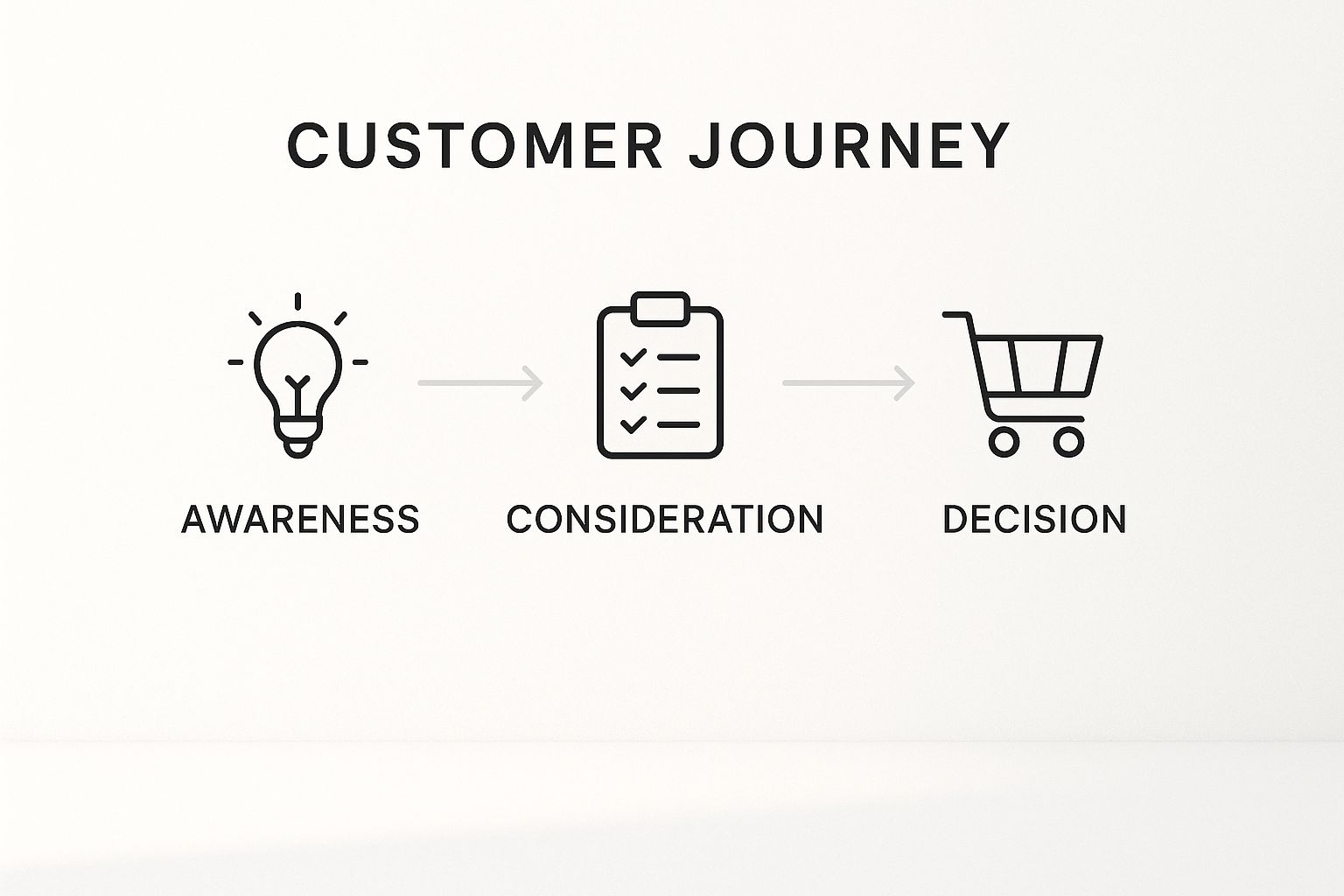
You can see how each phase builds on the last one, creating a clear path that the customer follows.
The Persona: Who Is Actually on This Journey?
Before you can map any journey, you have to know who’s travelling. The persona is your hero—a fictional character built from real data and research that represents your ideal customer. It’s more than just demographics; it captures their goals, what drives them, and the frustrations they face.
A solid persona keeps your map focused and prevents it from becoming too generic. Without one, you risk creating a map that tries to speak to everyone but ends up connecting with no one.
The Stages: The Major Phases of the Experience
The journey isn't a single moment; it’s broken down into distinct stages. These are the big-picture phases a customer moves through, like Awareness, Consideration, Purchase, Service, and Loyalty. Nailing these down gives your map its core structure.
Each stage represents a major goal the customer is trying to tick off. For example, during the 'Consideration' stage, their main goal is probably to compare different solutions to their problem.
A journey map without clear stages is like a story without chapters. It’s a mess, making it almost impossible to see where things are going right or wrong.
The Touchpoints: Where Interactions Happen
Touchpoints are the specific moments of interaction between the customer and your business within each stage. This is where they actually engage with you. It could be seeing a social media ad, browsing your website, calling your support team, or walking into your store.
Mapping every single touchpoint is critical. Why? Because each one is an opportunity to shape your customer's perception of your brand.
Actions, Thoughts, and Emotions: The Human Stuff
This is the real heart of the map—where you get into the human side of the experience. For every touchpoint, you need to dig into:
- Actions: What is the customer physically doing? (e.g., clicking a link, adding an item to their cart, calling for help).
- Thoughts: What’s running through their mind? (e.g., "Is this too expensive?" or "Where on earth are the specs?").
- Emotions: How are they feeling? Are they excited, frustrated, confused, or delighted? This is often shown as an emotional line graph that dips and rises along the journey.
Pain Points and Opportunities: Where You Take Action
Finally, a journey map has to lead somewhere. By looking at your customer's actions, thoughts, and emotions, you can pinpoint their pain points—all those moments of friction, frustration, and confusion.
But here’s the good part: for every single pain point, there's a matching opportunity. This is where you brainstorm solutions and improvements to fix the problem and make the experience better. This is what turns your map from a simple diagnostic tool into a strategic roadmap for growth.
How to Create Your First Customer Journey Map
Alright, theory is great, but turning those insights into a visual, actionable tool is where the magic happens. Let's walk through building your first customer journey map, step by step. This isn't some complex academic exercise; it's about practically visualising your customer's experience so you can actually improve it.
We'll break it down into manageable chunks, taking you from a blank page to a powerful strategic guide.
First, Set Clear Objectives and Goals
Before you even think about templates or tools, stop and ask the most important question: Why are we even doing this?
You need a clear mission. Are you trying to figure out why so many people abandon their shopping carts? Is your goal to make the onboarding process less painful for new clients? Or maybe you’re trying to pinpoint what makes loyal customers stick around.
Your goal will define the scope of the map and keep everyone on the same page. A clear objective ensures the final map isn’t just a pretty picture, but a tool that delivers real business outcomes.
Gather Your Customer Research
A journey map built on assumptions is worse than no map at all. It’s time to get your hands dirty and dig into what your customers are actually thinking, feeling, and doing. The best maps are built on a solid foundation of both qualitative and quantitative data.
Here are the goldmines of information you should be tapping into:
- Customer Surveys and Interviews: Just ask them! Talk to your customers directly about their goals, what motivated them, and what roadblocks they hit along the way.
- Analytics Data: Tools like Google Analytics don’t lie. See what users are doing on your website. Where are they clicking? Which pages have high bounce rates? Follow the digital breadcrumbs to see where they’re getting lost or dropping off.
- Support Tickets and Live Chat Logs: Your customer service team is sitting on a treasure trove of insights. Their records will show you the most common problems, recurring questions, and genuine moments of frustration.
- Social Media and Review Sites: Go where your customers are talking. Public forums and review sites offer raw, unfiltered feedback about their emotional highs and lows with your brand.
Define Your Customer Persona
You can't map a journey for "everyone." A powerful map follows the specific path of a single type of customer. This is why you absolutely need a customer persona—a semi-fictional character based on your research who represents a key segment of your audience.
Give this person a name, a job, goals, and challenges. This persona is the main character in your story. Seeing the journey through their specific lens is what makes the map empathetic and useful. If you have a few distinct customer types, you’ll eventually want to create a separate map for each one.
A map without a persona is like a story without a main character. It lacks focus and empathy, making it difficult to connect with the real human experiences you’re trying to understand.
Plot the Stages and Touchpoints
With your research done and your persona in hand, it's time to start mapping. First, outline the major stages your customer goes through. Think big picture here, like Awareness, Consideration, Purchase, and Loyalty.
Under each stage, list out all the touchpoints—every single interaction that persona has with your brand. This could be anything from seeing a Facebook ad or visiting your website to getting a follow-up email or chatting with your sales team.
Mapping these touchpoints is crucial for spotting gaps and opportunities. For example, it helps you see where you could automate follow-ups to nurture leads more effectively. You can learn more about how to manage these interactions in our guide to marketing automation for small business.
Finally, for each touchpoint, jot down what the customer is doing, thinking, and feeling. This is where you’ll uncover the friction points and moments of delight, turning your map from a simple diagram into a genuine catalyst for change.
Customer Journey Mapping in the Real World
Theory is great, but seeing a customer journey map in action is where it really clicks. Let's move past the concepts and look at how real businesses use mapping to get tangible results. From big retailers to essential services, putting the customer at the centre of the conversation solves some seriously complex problems.

These stories prove that journey mapping isn't just a fluffy marketing exercise. It’s a powerful tool for organisational change that drives real improvements in customer happiness and business performance.
From Online Browsing to In-Store Pickup
Picture a major retail brand grappling with a classic modern headache: making their online and in-store experiences feel like one seamless journey. Customers were browsing online, filling their carts, but then ditching the purchase only to show up in-store. The disconnect was causing inventory chaos and frustrating shoppers who expected their items to be ready and waiting.
By mapping the "Click and Collect" journey, the company found the exact friction points.
- The Problem: High rates of abandoned online carts and a clunky, disconnected experience between their website and physical stores.
- The Insight: The map showed that customers weren't sure if their local store actually had the item in stock. On top of that, the process to reserve something online was confusing and a bit of a nightmare to navigate.
- The Outcome: The retailer revamped its website to show real-time store inventory. They also radically simplified the checkout process for in-store pickups. The result? A massive 30% increase in successful omnichannel sales and a huge jump in customer satisfaction scores.
Improving Patient Care in Australian Healthcare
Journey mapping is also incredibly powerful in sectors where the "customer" is a patient needing care. In the Australian healthcare system, for example, truly understanding the patient experience is critical to improving their outcomes.
One fascinating application combines journey mapping with process mining to untangle the complex paths patients navigate. A powerful study on stroke rehabilitation tracked patient records to see the different sequences of care they received. The research uncovered nine distinct journey types, revealing that while nearly 79% of patients followed the expected path, others veered off course. This kind of detailed insight helps healthcare providers see exactly where their service is falling short and how to build better, more patient-focused strategies.
By visually mapping the entire rehabilitation journey from the patient's perspective—from admissions and therapy sessions to discharge planning—a healthcare provider can pinpoint emotional low points and critical communication gaps.
This empathetic view lets them directly address patient anxieties, streamline confusing administrative hoops, and ultimately, improve care coordination. These examples make one thing clear: no matter the industry, journey mapping gives you a roadmap to understanding and improving the human experience at every turn.
Common Questions About Customer Journey Mapping
Even with a clear idea of what a customer journey map is, a few questions always come up. Let's tackle the common sticking points and clear up any confusion.
How Is a Journey Map Different From a Sales Funnel?
This is probably the biggest point of confusion, and it’s a critical one. While both tools track a customer's path, they look at it from completely different angles.
A sales funnel is all about your business. It tracks your internal process for turning a lead into a sale, focusing on metrics like conversion rates. It’s a clean, linear, top-down view of how you see the sale progressing.
A customer journey map, on the other hand, is all about the customer. It captures their real, often messy and non-linear, experience—including all the thoughts, feelings, and frustrations along the way. It’s an outside-in view that helps you build empathy and see your business through their eyes.
The funnel asks, "How do we push them to the next stage?" The journey map asks, "What is their experience actually like, and how can we make it better?"
Journey Map vs Sales Funnel: A Quick Comparison
Think of it this way: the sales funnel is your company's road map, while the journey map is the customer's travel diary. They both describe a trip, but from entirely different perspectives.
Here’s a simple table to highlight the main differences.
| Attribute | Customer Journey Map | Sales Funnel |
|---|---|---|
| Perspective | Customer-centric (outside-in) | Business-centric (inside-out) |
| Focus | Emotions, thoughts, actions, and pain points | Conversion rates and sales stages |
| Path | Often non-linear and cyclical | Typically linear and sequential |
| Primary Goal | To build empathy and improve the customer experience | To qualify leads and drive sales conversions |
The funnel is a tool for closing deals. The journey map is a tool for building relationships. You really need both to succeed.
What Are Some Common Tools for Creating Journey Maps?
You don’t need to spend a fortune on fancy software to get started. Honestly, the best tool is whatever your team will actually use consistently.
Here are a few popular options that work well:
- Whiteboards and Sticky Notes: The classic. It's visual, hands-on, and fantastic for getting the whole team brainstorming together in a workshop.
- Spreadsheet Software: Tools like Google Sheets or Microsoft Excel are great for creating simple, grid-style maps. They're easy to share, easy to update, and everyone already knows how to use them.
- Diagramming Software: Platforms like Miro, Lucidchart, or Mural are perfect for remote teams. They act like digital whiteboards with pre-made templates and awesome collaboration features.
How Often Should You Update Your Journey Maps?
A journey map is a living document, not a "set it and forget it" project. Your customers change, your products evolve, and the market shifts—so your map has to keep up.
A good rule of thumb is to review your maps at least once or twice a year.
But you should also pull them out any time you make a big change to your business. Think launching a new product, overhauling your website, or changing your customer service process. Keeping your map current ensures it stays a sharp, relevant tool for making smart decisions. Understanding what’s driving results can be tricky, which is why regularly updating your map helps clarify the connection between customer experience and business outcomes. You can explore more about why it is difficult to measure marketing ROI in our detailed guide.
Who Should Be Involved in the Mapping Process?
Whatever you do, don't create a journey map in a silo. If it’s just a marketing exercise, you’ll miss the full picture. You need a cross-functional team to get it right.
Make sure you have people in the room from:
- Marketing: To shed light on the awareness and consideration stages.
- Sales: They have firsthand knowledge of what customers are asking and what their biggest pain points are.
- Customer Service: They’re on the front lines, dealing with post-purchase issues and feedback every day.
- Product/Operations: To explain the technical and logistical side of the experience.
When you bring people together from across the business, you break down those internal walls and build a map that’s far richer and more accurate. Plus, everyone will feel a sense of ownership.
Ready to stop guessing what your customers want and start knowing? At Homer Digital Marketing, we help service-based businesses like yours build powerful, customer-centric strategies that drive real growth.
Discover how our AI-powered marketing systems can transform your customer journey.
