

Ever poured money into an ad campaign only to wonder if anyone is actually seeing it? It’s a common frustration for many business owners. You need to know your marketing budget is delivering real value, not just disappearing into the digital ether.
Without a clear way to measure visibility, you're essentially advertising in the dark.
This is where understanding the cost per impression formula becomes a game-changer. It’s a foundational metric in digital advertising that shows you exactly how much you're paying for your ad to be displayed 1,000 times to potential customers, giving you a clear path to optimizing your ad spend.
Decoding Your Ad Spend: The Cost Per Impression Formula Explained
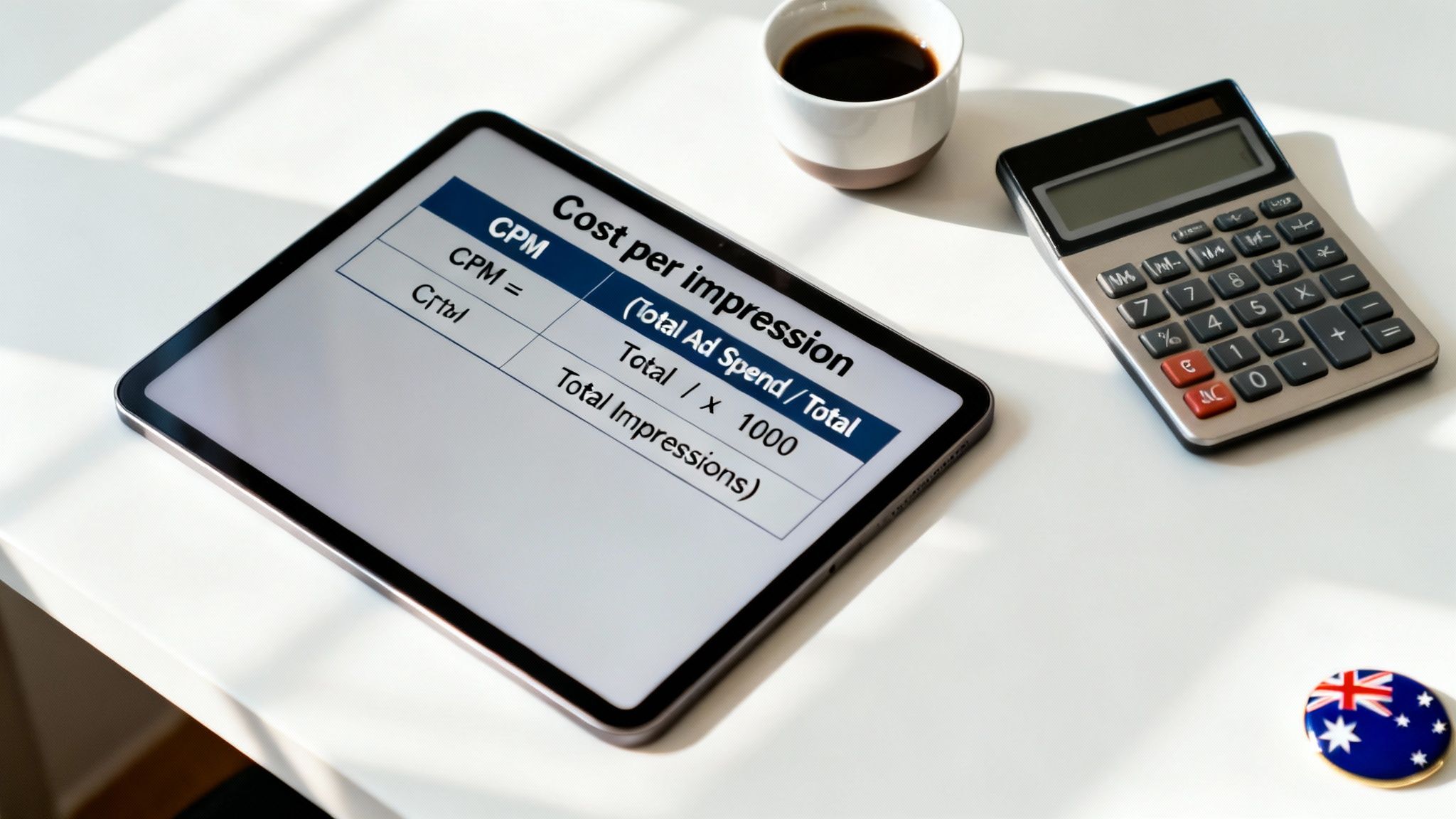
Think of it as the price of a thousand digital "glances." While an impression doesn't track clicks or sales, it measures the most fundamental goal of many advertising campaigns: brand awareness.
Why This Metric Matters
Before you can convince someone to buy from you, they have to know you exist. Cost per impression, or more commonly CPM, helps you put a number on the cost of achieving that initial visibility.
It's particularly useful for:
- Launching a new service or brand: Your main goal is getting your name in front of as many relevant people as possible, as fast as possible.
- Comparing campaign efficiency: It lets you make direct, apples-to-apples comparisons between different ads or platforms to see where your budget gets the most exposure.
- Budget planning and forecasting: Knowing your average cost helps you estimate how many eyeballs you can realistically get with a future budget.
Essentially, it answers the crucial question: "How cost-effective is my campaign at capturing attention?"
To make this practical, advertisers rely on two core calculations. The first is for a single impression, but because that number is usually a tiny decimal, the industry standard is to use Cost Per Mille (CPM), which bundles impressions into groups of one thousand. This approach makes the numbers much cleaner and easier to compare.
Here’s a quick-reference table breaking down both formulas.
The Two Core Impression Formulas
| Metric | Formula | When to Use It |
|---|---|---|
| Cost Per Impression (CPI) | Total Ad Spend / Total Impressions | To find the granular cost of a single ad view. It’s useful for internal calculations but rarely for reporting. |
| Cost Per Mille (CPM) | (Total Ad Spend / Total Impressions) x 1,000 | The industry standard for reporting, comparing campaign efficiency, and setting budgets for awareness-focused ads. |
Stick with CPM for almost all your reporting and analysis. It’s the language every ad platform and marketing pro understands, making it far easier to benchmark your performance against industry standards.
How to Calculate Cost Per Impression Step by Step
Knowing the theory is one thing, but actually crunching the numbers is where you take back control of your ad budget. Let's walk through it with a practical example that any Aussie business owner can follow.

We’ll be using the industry-standard Cost Per Mille (CPM) formula. "Mille" is just Latin for thousand, so this formula tells you the cost for every 1,000 impressions.
The CPM Formula:
(Total Ad Spend / Total Impressions) x 1,000 = CPM
This simple equation is the key to figuring out how efficiently your ad spend is getting eyes on your brand.
A Real-World Example
Picture a local café in Sydney running a Facebook ad campaign to show off its new brunch menu. Their goal is pure awareness—they just want everyone in the nearby suburbs to see their mouth-watering dishes.
Here’s what they’ve got:
- Total Ad Spend: AUD $500
- Total Impressions Generated: 50,000
Now, let's plug these numbers straight into the CPM formula.
-
First, divide the total ad spend by the total impressions:
$500 / 50,000 = 0.01 -
Next, multiply that result by 1,000:
0.01 x 1,000 = $10
There you have it. The Sydney café paid $10 CPM. In plain English, it cost them AUD $10 for every 1,000 times their ad was shown. This single figure is now a super useful benchmark for them to measure all future campaigns against.
Using the Formula for Forecasting
The real power of the cost per impression formula isn't just in looking back; it’s in planning ahead. By flipping the formula around, you can forecast your budget or even your potential reach.
1. Forecasting Your Budget
Let's say the café was thrilled with the results and now wants to generate 150,000 impressions for their next big push. If we assume their CPM stays steady at $10, they can easily figure out the budget they'll need.
- Formula: (Target Impressions / 1,000) x CPM = Required Budget
- Calculation: (150,000 / 1,000) x $10 = $1,500
Just like that, they know they need to set aside an AUD $1,500 budget to hit their new awareness goal. Budgeting is no longer a guessing game; it’s a data-driven decision.
2. Forecasting Your Reach
What if it’s the other way around? The café has a fixed marketing budget of AUD $800 for next month and wants to know how many eyeballs they can get for their money.
- Formula: (Budget / CPM) x 1,000 = Estimated Impressions
- Calculation: ($800 / $10) x 1,000 = 80,000 impressions
This tells them their $800 should get their ad in front of people about 80,000 times. When you master these simple calculations, you stop reacting to results and start proactively planning for them. It’s all about making every single dollar work as hard as it possibly can.
Comparing CPM, CPC and CPA Metrics
Getting your head around the cost per impression formula is a great start, but it's only one piece of the advertising puzzle. To really get smart with your ad budget, you need to see how CPM stacks up against two other heavyweights: Cost Per Click (CPC) and Cost Per Acquisition (CPA).
Choosing the right one isn't about which is "best". It's about matching the metric to your mission. Trying to use the wrong one is like measuring a liquid with a ruler—you're just not going to get the right information. Each model has a completely different job to do.
Think of it like this:
- CPM (Cost Per Mille): This is your digital billboard. The goal is pure, unapologetic visibility. You're paying for eyeballs and brand awareness, nothing more.
- CPC (Cost Per Click): Now we're getting warmer. This is about sparking interest. You're not just paying for a view; you're paying for someone to take that first step and actually visit your website or landing page.
- CPA (Cost Per Acquisition): This is the holy grail of performance. Here, you only pay when something truly valuable happens—a sale, a lead form submission, or a new subscriber. It's the bottom line.
To truly understand your ad performance, you need to compare these metrics. Looking at CPM alongside something like What Is Cost Per Acquisition gives you the full story, from first glance to final conversion.
When to Use Each Metric
Your campaign goal should be the only thing that dictates your pricing model. Simple as that.
If you're launching a new service and want to make your brand a household name in your local area, CPM is your best friend. You can blast your message out to a huge audience for a relatively low cost, building that all-important brand recognition over time.
But what if you're promoting a downloadable guide to capture client details? A view doesn't cut it. You need clicks. That's where CPC comes in. Success here is measured by how many people are intrigued enough to click through and learn more. You pay for that direct engagement.
And finally, if your campaign has one single purpose—to generate sales or qualified leads—then CPA is the undisputed champion. This model ties your ad spend directly to money-making actions, giving you the clearest possible picture of your return on investment.
Key Takeaway: The best advertising model is the one that directly measures the action you want your audience to take. Aligning your metric with your goal is the first step towards a successful and efficient campaign.
CPM vs CPC vs CPA: A Strategic Comparison
So, how do you choose the right tool for the job? It all comes down to what you're trying to achieve. This table breaks down the core differences to help you decide which model fits your next campaign.
| Metric | Primary Goal | Formula | Ideal Use Case |
|---|---|---|---|
| CPM | Brand Awareness & Reach | (Total Ad Spend / Impressions) x 1,000 | Launching a new service, announcing an event, or building brand recognition in a new market. |
| CPC | Website Traffic & Engagement | Total Ad Spend / Total Clicks | Driving users to a blog post, landing page, or product page to encourage exploration. |
| CPA | Conversions & Sales | Total Ad Spend / Total Acquisitions | Generating leads, selling products directly, or driving newsletter sign-ups. |
Each metric tells a different part of your marketing story. CPM builds the audience, CPC brings them to your door, and CPA invites them in to make a purchase. Using the right one at the right time is what separates a good campaign from a great one.
How Ad Platforms Influence Your Impression Costs
Plugging numbers into the cost per impression formula is the easy part. The tricky bit? The number you get back can swing wildly depending on one crucial factor: the ad platform you choose.
Not all digital spaces are created equal, and where you place your ad has a massive impact on what you pay for eyeballs.
Think of it like real estate. A billboard on a quiet suburban street costs a fraction of a massive digital screen in Sydney's Pitt Street Mall. The audience, the foot traffic, and the user's mindset are completely different, and the price reflects that. Digital advertising works exactly the same way.
Every platform—from Google's sprawling network to LinkedIn's professional corridors—is its own marketplace with different rules, audiences, and ad space. Understanding these nuances is key to setting a realistic budget and putting your money where it will actually make a difference.
Platform-Specific Cost Dynamics
So, why does the same ad cost so much more on one platform than another? It all comes down to a few core things that feed into the auction-based pricing models most platforms use.
- Audience Demographics and Intent: A user scrolling through LinkedIn is in a business mindset. Targeting a CEO there is highly specific and valuable, which is why it commands a higher CPM than reaching a broad, casual audience on Instagram.
- Targeting Precision: The more granular the targeting options, the higher the price. The ability to pinpoint an exact job title, a specific interest, or a recent purchasing behaviour is a premium feature, and advertisers will compete fiercely for it.
- Ad Placement Inventory: An ad that appears in a user’s main feed is prime real estate and will cost more than one tucked away in a sidebar or a less-viewed 'Stories' section. The better the visibility, the higher the demand and, you guessed it, the higher the CPM.
This is why it's important to see how different metrics like CPM, CPC, and CPA align with different goals, from simple awareness to direct action.
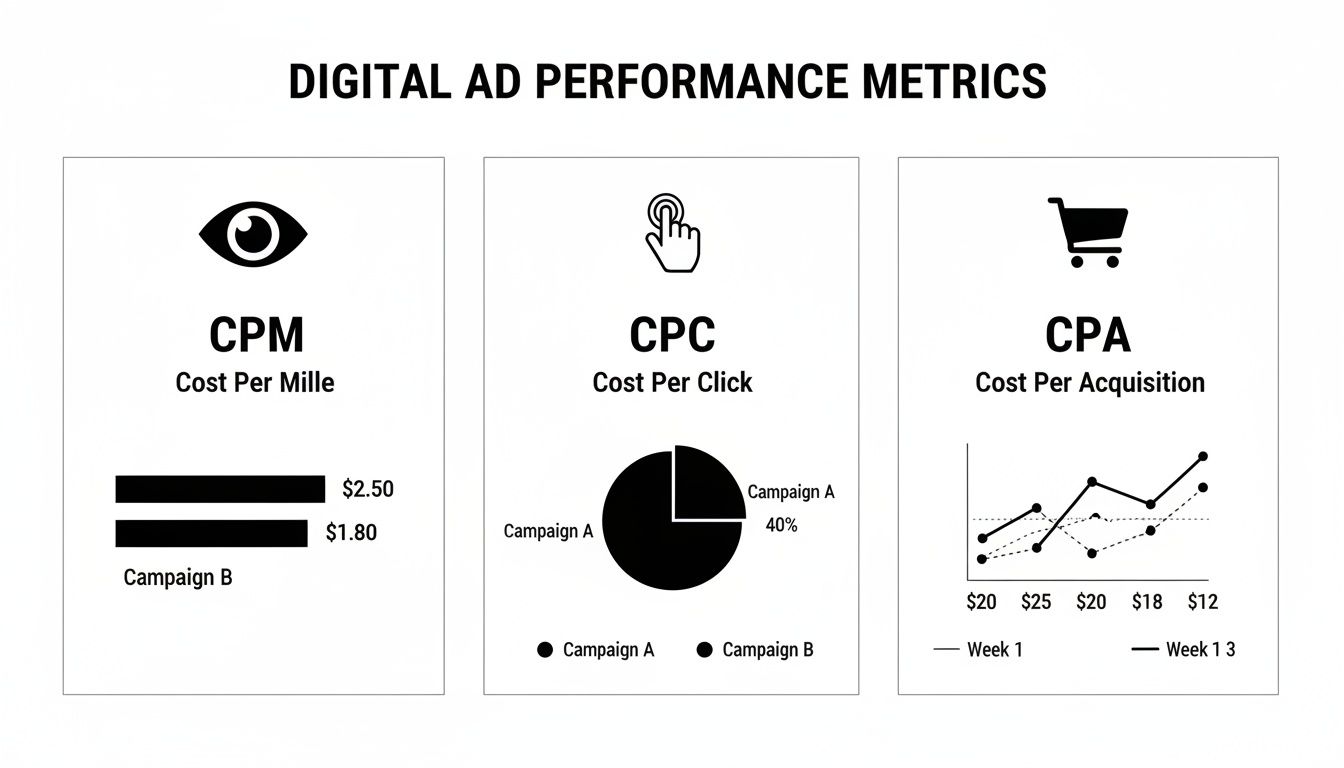
As you can see, while CPM is all about securing views, CPC and CPA track progressively deeper levels of engagement and commitment from your audience.
Typical CPM Ranges in Australia
A 'good' CPM is always relative to your platform and industry. In the Australian market, this means the cost per impression (CPM) formula can produce wildly different results.
For example, Instagram Feed CPMs often sit around AUD $7–$8 for many businesses, whereas a highly targeted programmatic ad campaign might hit AUD $30–$40 or more. This massive difference can completely change your campaign's economics.
A common mistake is treating all impressions as equal. An impression on the Google Display Network, seen by a broad audience, serves a very different purpose to one on LinkedIn targeting a specific industry professional. The key is to match the platform's strengths to your campaign's objective.
If you're selling a visual product, Instagram's lower CPM might be perfect for building widespread brand awareness. On the other hand, a B2B consultancy will likely find LinkedIn’s higher CPM is a worthwhile investment to get in front of high-value decision-makers.
And for businesses wanting massive reach across thousands of websites and apps, partnering with one of the top Google Display advertising companies can provide the scale you need for a major awareness push.
Key Factors That Affect Your CPM in Australia
Knowing the cost per impression formula is one thing, but understanding what makes that number shoot up or drop down is where the real strategy kicks in. The CPM you end up paying isn't some fixed, arbitrary rate—it’s the live result of a dynamic auction, influenced by a handful of critical variables.
Get a handle on these factors, and you'll have direct control over how efficiently your campaign budget gets spent.
Think of it like buying tomatoes at a farmers market. The price changes based on the season, how many people want them that day, and how good they look. Your ad impressions are no different. Let's break down the main forces that shape your costs here in Australia.
Audience Targeting and Specificity
The first major factor is who you're trying to reach. If you cast a wide net with broad targeting—aiming your ads at a massive, general audience—you'll almost always see a lower CPM. It makes sense, right? There's a huge pool of available impressions, so the competition for each one is pretty low.
But a lower CPM isn't always the goal. If you’re a high-end buyers agent in Melbourne, showing your ad to a million people across the country is just burning money.
On the other hand, a hyper-specific audience (like "company directors in the tech industry within a 10km radius of Sydney's CBD") is far more valuable. Competition for this niche audience is fierce, which naturally drives your CPM up. The trade-off? Every single impression is massively more relevant, which often leads to a much better return on your investment, despite the higher initial cost.
Ad Quality and Relevance Score
Platforms like Google and Meta don't just care about who bids the most. They're obsessed with user experience, which means they want to show people relevant, high-quality ads. To figure this out, they assign a quality or relevance score to your ad.
This score is basically a grade based on things like:
- How much your target audience actually engages with the ad (clicks, likes, comments).
- The quality of your creative (your images, video, and ad copy).
- How well your ad and your landing page match up.
A low score acts like a penalty, forcing you to pay a higher CPM just to get your ad seen. But a high score is a reward—it gets you better placements for a lower cost. Understanding the moving parts that affect how much Google Ads cost is essential for making your budget work harder.
Seasonality and Competition
In advertising, timing is everything. Demand for ad space absolutely skyrockets during peak commercial periods like the lead-up to Christmas, Black Friday, or the End of Financial Year sales. As more and more advertisers jump in to compete for the same audience, the auction gets aggressive, and CPMs naturally climb.
This volatility is huge in Australia. Data shows that the median Facebook CPM can surge by around 80% from the start of the year to its peak in Q4, jumping from about AUD $13.53 to nearly AUD $24.37.
These seasonal swings show just how much your budget can be impacted depending on when you run your campaign. You can dig deeper into these trends to inform your strategy and learn about Australian CPM fluctuations.
Actionable Strategies to Lower Your CPM
Knowing your CPM is one thing, but lowering it is where you get a real competitive edge. A lower CPM simply means your budget stretches further, getting your brand in front of more people for the exact same ad spend.
The secret isn't a secret at all. It's about signalling to ad platforms that your content is high-quality and hyper-relevant to the audience you're trying to reach.
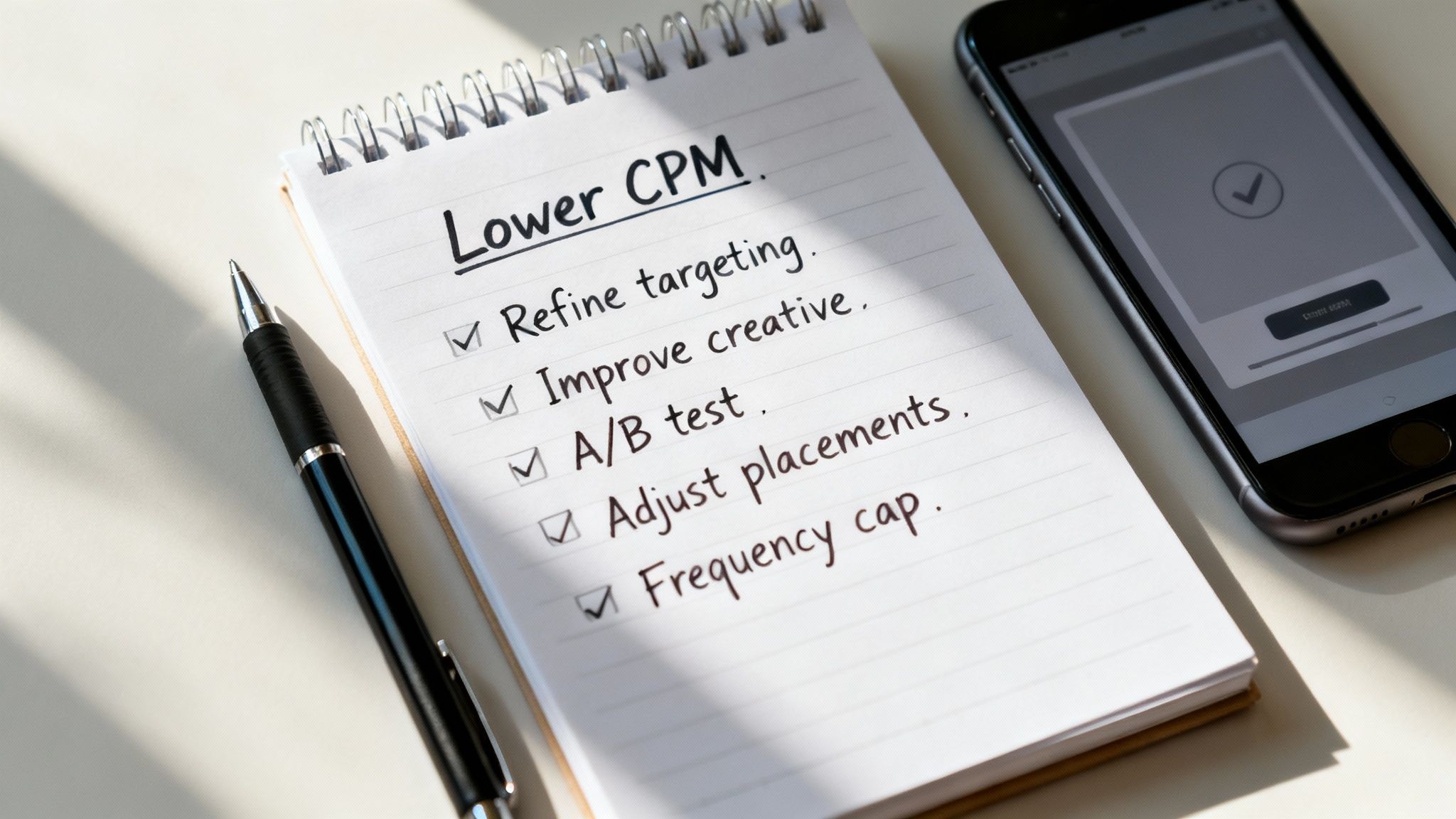
This isn't about finding weird loopholes. It's about systematically improving every piece of your campaign, from who you're targeting to what they see. By focusing on a few key areas, you can make your ad spend far more efficient.
Refine Your Audience Targeting
The fastest way to blow out your CPM is to show ads to the wrong people. Sure, broad targeting might look cheaper on the surface, but platforms will penalise you for low engagement. When you narrow your audience to a more relevant group, your ad's performance almost always improves, and your costs come down.
- Layer Your Targeting: Don't just stop at demographics. Add interests, behaviours, and life events to build a much sharper audience profile.
- Utilise Exclusion Lists: Be ruthless about who you don't want to see your ads. Actively excluding the wrong people stops you from wasting money on impressions that will never convert.
- Build Lookalike Audiences: Got a list of your best customers? Upload it and let the platform's algorithm find people just like them. It’s a powerful way to find a high-quality, relevant audience at scale.
Refining your targeting means every impression has a much higher chance of resonating. Ad platforms love this, and they'll reward you with lower costs.
Enhance Ad Creative and Copy
Think of your ad creative as your first impression—because it is. If it's generic, boring, or just plain irrelevant, people will scroll right past it. That lack of engagement is a massive red flag to the platform that your ad is low-quality, and your CPM will shoot up.
Key Insight: Ad platforms want to keep users happy and on their site. Ads that get high engagement (likes, comments, shares) are seen as valuable content, and they’re often rewarded with lower impression costs and better placement.
The best way to improve your creative is to A/B test everything. Pit a video against a static image. Test two completely different headlines. Even tiny tweaks can lead to significant cost savings over time. For a real-world look at how creative and targeting impact costs, check out a case study detailing a top vCPM in branding.
Optimise Ad Placements and Scheduling
Not all ad placements are created equal. An ad in the main news feed will perform very differently from one in a sidebar or a Stories placement. Most platforms default to "automatic placements," but taking back manual control can slash your wasted spend.
Jump into your reports. See which placements deliver the lowest CPM and the highest engagement, then focus your budget there.
This is especially critical for specialised campaigns. For instance, optimising your LinkedIn Ads strategy means understanding whether the main feed or an InMail placement will reach your B2B audience most cost-effectively.
Remember, CPM (Cost Per Mille) is just the cost to deliver 1,000 ad impressions. In Australia, the average Facebook CPM benchmark was around AUD 11.04. At that rate, an advertiser spending AUD 11,040 would expect to get roughly 1,000,000 impressions—a figure directly tied to their targeting, ad relevance, and even the time of year.
Got Questions About the CPM Formula?
Right, let's clear up some of the common questions that pop up when people start digging into the cost per impression formula. Think of this as the quick-fire round to make sure you’ve got the concepts locked in.
What Actually Counts as an Impression, Anyway?
An impression is counted every time your ad gets shown on a screen. Simple, right? Well, not always.
The exact definition can get a bit murky. Some platforms will count an impression the second your ad loads on the page, even if it’s buried "below the fold" where no one actually sees it.
Others, thankfully, are moving to a “viewable impression” standard. This means a certain chunk of the ad (say, 50%) has to be physically visible on the screen for a set amount of time (like one second) before it’s counted. It’s always worth checking the fine print for the platform you’re using.
What Is a Good CPM in Australia?
This is the classic "how long is a piece of string?" question. There's no magic number for a "good" CPM. It all comes down to your industry, who you're targeting, the platform, and what you’re trying to achieve.
A good CPM is simply one that’s profitable for your business.
To give you some real-world context, a broad brand awareness campaign on Facebook might land you a CPM of around $7-$12 AUD. But if you’re running a super-specific B2B campaign on LinkedIn targeting C-suite executives, you could easily be looking at a CPM over $50 AUD.
The goal isn't to chase some universal benchmark. It's to improve your own CPM over time.
When Should I Use CPM Instead of CPC or CPA?
Choosing the right metric is all about knowing your goal. You wouldn't use a hammer to saw a plank of wood, and you shouldn't use CPM when you really want clicks.
Use CPM (Cost Per Mille) when your number one goal is getting eyeballs on your brand. Think brand awareness, reach, and making sure as many people as possible see your message.
If you want to drive traffic to your website or a landing page, you'll want to focus on CPC (Cost Per Click). And if your campaign is all about getting a direct conversion—like a sale or a lead form submission—then CPA (Cost Per Acquisition) is your hero metric.
Ready to stop guessing and start getting real, predictable results from your marketing? At Homer Digital Marketing, we use proven, AI-driven systems to help Aussie service businesses grow their visibility and bring in a steady stream of ideal clients. Book a quick call to see how we can help you scale.
