
So, how much do Google Ads really cost? While there's no single price tag that fits everyone, a crucial first step is understanding the typical investment. Most Australian businesses should plan to spend somewhere between $1,000 and $10,000 per month to see meaningful results.
Your final number will depend on your industry, how aggressive your goals are, and your overall campaign strategy. Still, that range gives you a realistic starting point for planning your budget and promises a solution to the complex question of Google Ads pricing. This guide will walk you through everything you need to know.
Your Quick Guide to Google Ads Costs in Australia
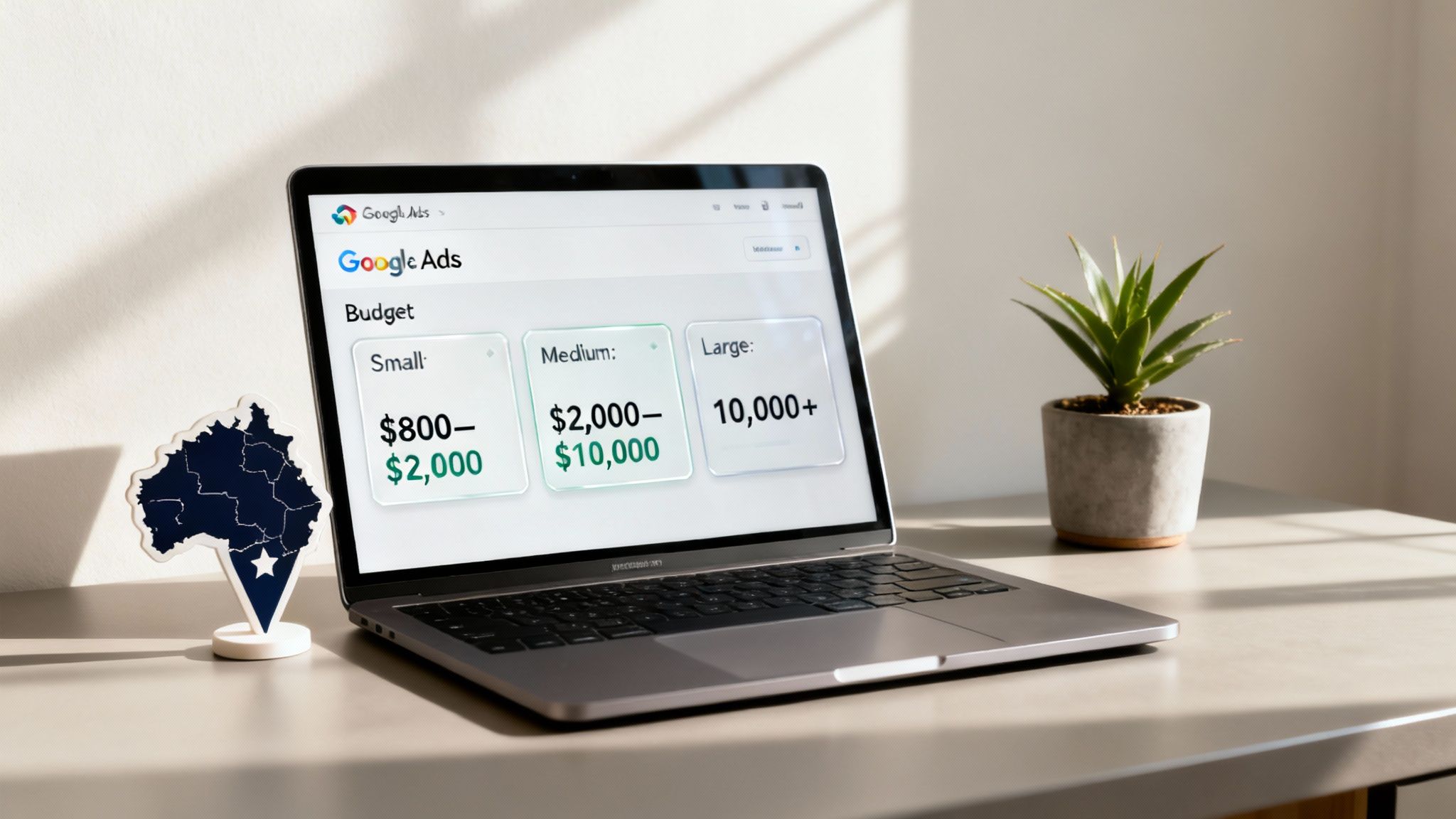
Before you can build a profitable ad campaign, you need to understand what you're likely to invest. And while the classic "it depends" answer is frustrating, we can definitely break it down into clearer, more predictable ranges based on a business's size and ambition.
To give you a clearer picture, here's a quick look at what's typical in Australia.
Typical Monthly Google Ads Budgets in Australia
This table gives a ballpark figure for monthly ad spends based on business size. It's a great reference to see where you might fit in.
| Business Size | Typical Monthly Budget (AU$) |
|---|---|
| Small to Medium (SMB) | $1,000 – $3,000 |
| Mid-Market Brands | $3,000 – $15,000 |
| Large Enterprises/Corporates | $20,000+ |
These numbers are a solid guide, but remember, your industry and goals will always be the biggest factors. You can find more insights on Australian Google Ads spending at quimbydigital.com.
Foundational Pricing Concepts
To make sense of those budget figures, you need to get your head around the two core metrics that actually control your spending:
-
Cost Per Click (CPC): This is simply the amount you pay every single time someone clicks on your ad. Think of it as paying a toll for a potential customer to walk through your digital front door. Your CPC is decided in a real-time auction, which we'll dive into later.
-
Cost Per Acquisition (CPA): Also called Cost Per Lead (CPL), this metric measures how much it costs to get a customer to take a valuable action—like filling out your contact form or calling your business. The average CPL in Australia is around AU$70.11, which really shows how much a good, qualified lead is worth.
Key Takeaway: The goal isn't just to get the cheapest clicks (a low CPC). It's to get valuable customers at a price that makes sense for your business (a profitable CPA).
Once you understand these benchmarks and basic concepts, you can set a realistic budget and start measuring the real return you're getting from your ad spend. This guide will walk you through the details you need to take full control of your advertising.
How the Google Ads Auction Really Works
It’s a common myth that winning on Google Ads is all about who has the deepest pockets. The reality is much more interesting. Think of it less like a brute-force spending spree and more like a clever auction where the smartest bidder—not always the richest—comes out on top.
To get a grip on how much Google Ads cost, you first need to understand how this auction works.
Every single time someone types a search into Google, an auction happens in a split second. This lightning-fast process decides which ads appear and in what order. Your success here boils down to two key things you have complete control over.
The Two Core Components of the Auction
Your ad's fate is decided by a simple but powerful formula. It’s a mix of what you’re willing to pay and just how good your ad actually is.
- Your Maximum Bid (Max CPC): This is the most you're willing to pay for a single click on your ad. You set the ceiling, but thanks to the way the auction is structured, you often end up paying less.
- Your Quality Score: This is Google's rating of your ad's quality and relevance, scored from 1 to 10. A higher score tells Google your ad is a great match for the user, which can earn you better ad positions and, crucially, lower costs.
These two numbers are multiplied to create your Ad Rank. The advertiser with the highest Ad Rank wins the best ad spot.
Ad Rank = (Your Maximum Bid) x (Your Quality Score)
This is exactly why a competitor with a massive budget can still be outranked by a smaller business with a super-relevant, high-quality ad. It levels the playing field.
The Three Pillars of Your Quality Score
Your Quality Score isn't just some random number. It’s calculated based on three specific pillars. Getting these right is the secret weapon for reining in your ad spend and boosting your results.
-
Expected Click-Through Rate (CTR): This is Google’s prediction of how likely people are to click your ad when they see it. It’s heavily influenced by your past performance—if your ads have a history of getting clicks, Google trusts that your future ads will too. A high CTR is a strong signal that your ad is hitting the mark. You can use our handy click-through rate calculator to see how you stack up.
-
Ad Relevance: This one’s simple: how well does your ad match the keywords you’re bidding on? If someone searches for "emergency plumber in Brisbane," your ad copy needs to talk directly about that—mentioning "emergency plumbing" and "Brisbane." Generic ads that don't line up with what the searcher wants will get a low relevance score and struggle to perform.
-
Landing Page Experience: What happens after someone clicks matters just as much. Google checks out your landing page to see if it delivers on the promise made in your ad. A great landing page is relevant to the keyword, easy to get around, trustworthy, and gives the user a clear next step to take.
How Quality Score Saves You Money: A Real-World Example
Let's see this in action. Imagine two businesses are fighting for the top ad spot.
| Advertiser | Max Bid | Quality Score | Ad Rank (Bid x QS) |
|---|---|---|---|
| Business A | $4.00 | 3/10 | 12 |
| Business B | $2.00 | 10/10 | 20 |
Even though Business A is willing to pay double, Business B wins the top position. Why? Its perfect Quality Score gives it a much higher Ad Rank (20 vs. 12).
But it gets even better. Business B will actually pay less per click. The formula for your actual cost is the Ad Rank of the person below you, divided by your Quality Score, plus one cent.
In this scenario, Business B would only pay $1.21 per click ($12 / 10 + $0.01) to lock in a higher position than the competitor bidding $4.00. This is the incredible power of a high Quality Score in action.
The 7 Key Factors That Drive Your Ad Spend
So, we know how the Google Ads auction works. But what's the difference between a $2 click and a $20 one? It all comes down to a handful of critical levers you can pull. Mastering these seven factors is the secret to getting your Google Ads costs under control and turning your budget into a predictable, profit-making machine.
This diagram shows you exactly how your bid and Quality Score work together to determine your Ad Rank, which ultimately decides your ad's position and how much you pay.
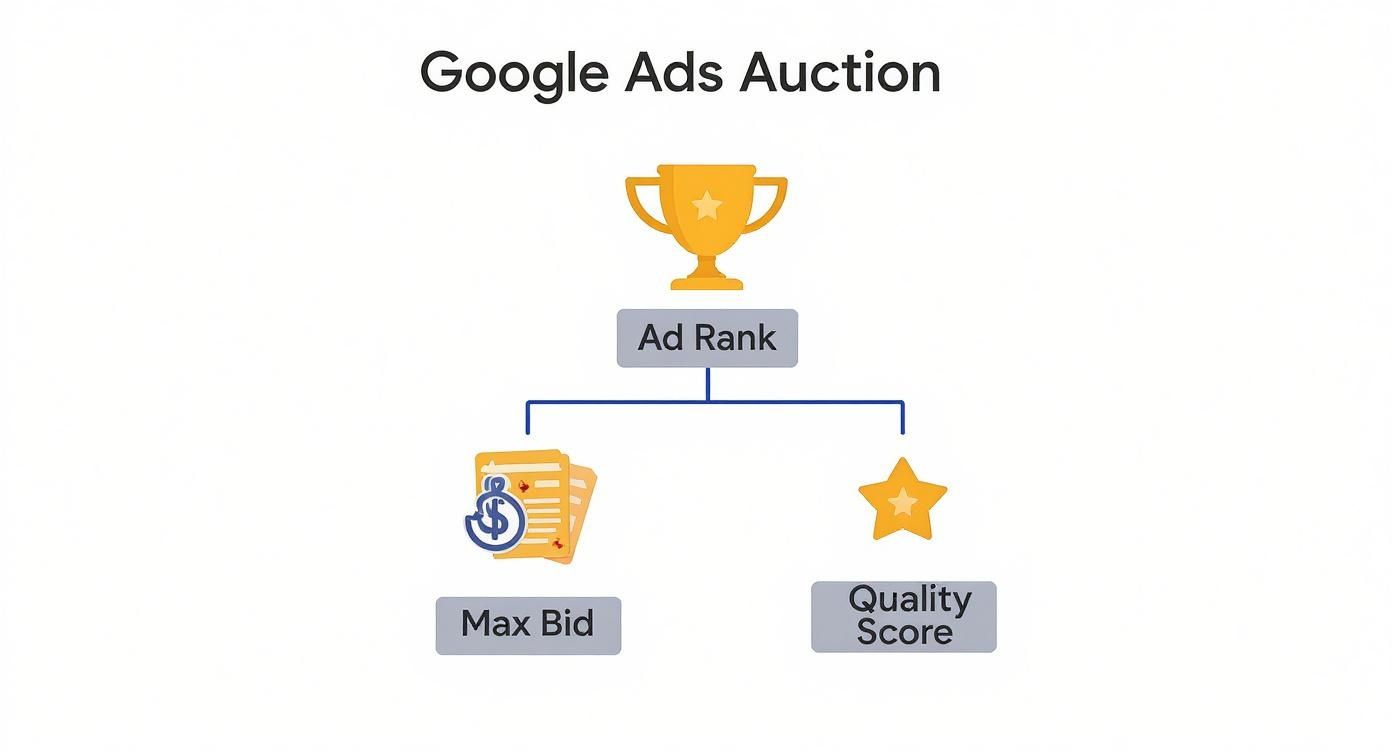
As you can see, a brilliant Quality Score acts like a superpower. It lets a smaller bid beat a bigger one, which directly slashes your costs.
1. Industry Competition
Let's be honest, some industries are just a tougher battleground than others. This has a massive impact on your ad spend. Think about the lifetime value of a single new client. A Sydney law firm could land a case worth tens of thousands, so they’re willing to pay a premium for that click. A local cafe, on the other hand, makes a much smaller profit per customer and just can't compete at that level.
The numbers back this up. While the average cost per click (CPC) for a search campaign in Australia hovers between AU$2 to AU$4, some industries are in a league of their own. Legal services can hit AU$10.61 per click, while insurance can skyrocket to $13.37.
2. Keyword Choice
The exact search terms you bid on can make or break your budget. They generally fall into two camps:
- Broad Keywords: These are short, general terms like "plumber" or "accountant." They get a lot of searches but come with fierce competition. Worse, they often attract people who are just kicking tyres, not ready to buy.
- Long-Tail Keywords: These are longer, super-specific phrases like "emergency hot water repair Perth" or "small business tax accountant Melbourne." The search volume is lower, but you’re capturing someone with a clear problem who needs a solution now. This means better conversion rates and, often, a much lower CPC.
Focusing on these high-intent, long-tail keywords is one of the quickest ways to stop wasting money and see a real return on your ad spend.
3. Geographic Targeting
Where you show your ads is just as important as what you're advertising. The cost to advertise in a dense metro area like Melbourne is way higher than in a regional town in Queensland. Why? More businesses are fighting for the same eyeballs, which drives up the auction price for every click.
By getting specific with your location targeting, you can stop paying a premium for clicks from people who are too far away to ever become a customer. This is non-negotiable for any business with a defined service area.
Pro Tip: Don't just target a whole city. Use radius targeting around your business address. This ensures every dollar you spend is reaching genuinely local prospects who can actually hire you.
4. Ad Quality
We touched on this earlier, but it’s worth repeating: your Quality Score is the ultimate cost-saving tool in your arsenal. It’s Google’s rating of how relevant your ad, keywords, and landing page are to the person searching. Google rewards a high Quality Score with better ad positions for a lower cost per click.
Ignoring your Quality Score is like walking into a shop and willingly offering to pay more than the price tag. Constantly refining your ad copy and landing page isn't just a "nice-to-have"—it's a direct investment in lowering your long-term ad spend.
5. Bidding Strategy
How you tell Google to spend your money is a big deal. You can go old-school with manual bidding, where you set the maximum CPC for every single keyword yourself. This gives you total control but takes a lot of time.
Or, you can use automated strategies like "Maximise Clicks" or "Maximise Conversions." Here, you let Google's algorithm adjust your bids in real-time to hit a specific goal. The right choice really depends on how mature your campaign is and what you’re trying to achieve.
6. Ad Scheduling
Does your phone need to be ringing 24/7? For most service businesses, probably not. If you only answer calls during business hours, running ads at 3 a.m. is likely just throwing money away on clicks you can't even convert.
Ad scheduling lets you tell Google to only show your ads during specific hours or on certain days. This simple tweak focuses your budget on the times when potential customers are most likely to pick up the phone, dramatically improving your cost per lead.
7. Device Targeting
Finally, think about how your customers are searching. Are they on a desktop in the office or on their mobile while they’re out and about? User behaviour changes drastically depending on the device.
You can adjust your bids to prioritise the device that brings in the most valuable leads. For a local emergency plumber, mobile clicks are gold and justify a higher bid. For a B2B consultant selling complex services, desktop traffic is probably where the real action is.
These seven factors all work together, pulling your costs up or pushing them down. Understanding how they interact is key to building a campaign that doesn't just spend money, but actually makes it.
How Different Factors Impact Your Google Ads Cost
This table gives you a quick snapshot of how each factor influences your budget and what you can do about it.
| Factor | Impact on Cost | Optimisation Tip |
|---|---|---|
| Industry Competition | Higher competition = Higher CPCs. | Focus on a niche market or unique selling proposition to stand out. |
| Keyword Choice | Broad keywords are expensive; long-tail are cheaper. | Target specific, high-intent long-tail keywords to attract ready-to-buy customers. |
| Geographic Targeting | Densely populated areas cost more to target. | Use tight radius targeting to focus your budget on genuinely local prospects. |
| Ad Quality | High Quality Score = Lower CPCs. | Continuously improve ad copy and landing page relevance to boost your score. |
| Bidding Strategy | Mismatched strategy leads to wasted spend. | Align your bidding strategy with your campaign goals (e.g., conversions vs. clicks). |
| Ad Scheduling | Running ads 24/7 can waste money overnight. | Schedule ads to run only when your business is open and ready to respond. |
| Device Targeting | Some devices convert better than others. | Increase bids on the devices that drive the most valuable leads for your business. |
By actively managing these elements, you move from being a passive spender to an active investor, making every dollar in your Google Ads account work harder for you.
For a deeper dive into the broader principles that govern paid advertising, you might find this an ultimate guide on paid ads marketing useful.
Budgeting for Success with Real-World Scenarios
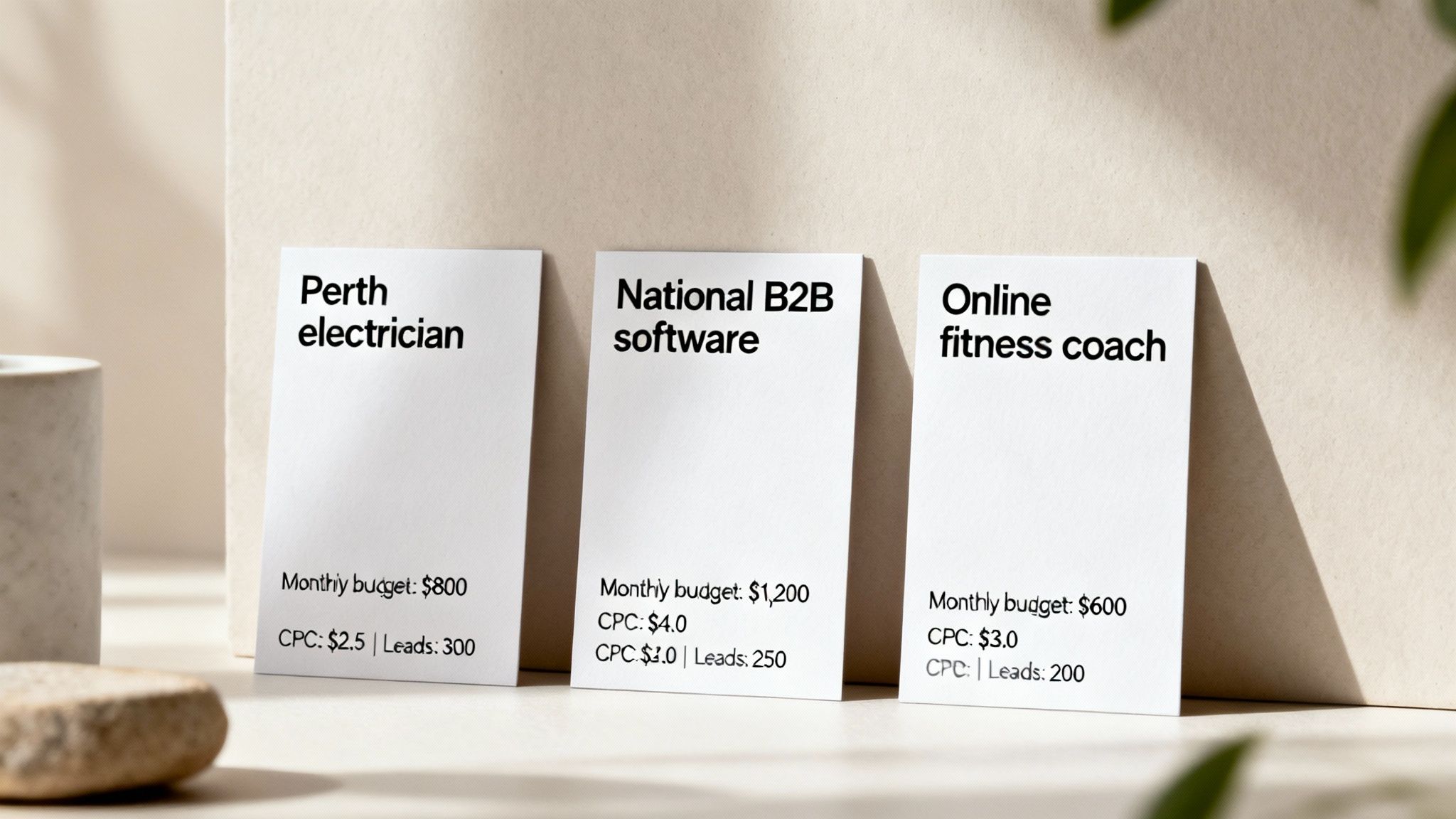
Theory is great, but let's be honest—what you really want to know is how this all plays out in the real world. So, let's move past the abstract numbers and look at some practical examples for Australian service-based businesses.
By breaking down a few different scenarios, you can start to see how a smart, strategic budget can directly fuel your business growth. Think of these as a starting framework to help you plan your own investment and figure out what a realistic return might look like.
Scenario 1: The Local Perth Electrician
This business handles emergency and general electrical work across the Perth metro area. Their number one goal? Get the phone ringing with high-quality calls and form submissions from people who need help, now.
- Sample Monthly Budget: AU$1,500
- Target Keywords: "emergency electrician Perth," "local electrician near me," "power point installation Joondalup." These are specific, high-intent keywords.
- Estimated CPC: The trades are competitive. We can realistically estimate an average Cost Per Click of AU$4.50.
With that budget, the electrician can expect to get around 333 clicks each month ($1,500 / $4.50).
Projected Results: If they have a solid landing page that converts at a decent 10%, those 333 clicks could easily turn into 33 new leads (calls or form fills). Even if they only close four of those jobs at an average value of $800, that’s $3,200 in revenue—a Return on Ad Spend (ROAS) of over 2:1. Not bad at all.
Scenario 2: The National B2B Software Provider
Here we have a company selling specialised accounting software to small businesses all over Australia. The goal is to get free trial sign-ups and demo requests. It’s a longer sales cycle, but the lifetime value of each customer is much higher.
They need to cast a wide net but still be incredibly specific to attract the right decision-makers.
- Sample Monthly Budget: AU$5,000
- Target Keywords: "small business accounting software Australia," "Xero alternative for tradies," "best payroll software for retail."
- Estimated CPC: The B2B software space is tough, so a higher CPC of around AU$8.00 is expected.
This budget would get them roughly 625 clicks a month ($5,000 / $8.00).
Since the goal is a free trial, not an immediate sale, the conversion rate will naturally be lower—let's say around 5%. That works out to about 31 trial sign-ups. If the sales team can convert 20% of those trials into paying customers (that's about 6 new clients), and each has a lifetime value of $2,500, the campaign pulls in $15,000 in revenue. That's a very healthy 3:1 ROAS.
For a deeper dive into typical business advertising costs, check out our guide on the average advertising cost for a small business per month.
Scenario 3: The Online Fitness Coach
This coach provides personalised online fitness and nutrition plans to clients across the country. Their main goal is to get people to book a free 15-minute consultation. It's a crowded market, so sharp, specific targeting is the only way to win.
- Sample Monthly Budget: AU$2,000
- Target Keywords: "online personal trainer for busy mums," "nutrition coach for weight loss Sydney," "virtual fitness coach for men over 40."
- Estimated CPC: The health and fitness space has a more moderate CPC, which we can estimate at around AU$3.00.
With a $2,000 budget, the coach could generate about 667 clicks per month. A compelling offer like a free consultation could hit a strong conversion rate of 8%, leading to roughly 53 consult bookings.
Let's say the coach converts 15% of those consultations into paying clients (around 8 new clients). If the average package is $600, that brings in $4,800 in revenue. This delivers a solid 2.4:1 ROAS, proving that even in a competitive field, a smart budget can drive serious growth.
Choosing the Right Bidding Strategy to Control Costs
Google's bidding options can look a bit intimidating, but picking the right one is your most powerful tool for controlling how much your Google Ads cost. Think of it as giving Google a clear set of instructions on how to spend your money. Get it right, and you’ll hit your goals without blowing your budget.
There’s no single "best" strategy. It’s all about choosing the best one for your specific goal right now. Whether you’re trying to build brand awareness, get more website traffic, or pull in qualified leads, there’s a bidding strategy built for the job.
Manual Bidding for Ultimate Control
Manual Cost Per Click (CPC) bidding is the original, hands-on approach. You tell Google the absolute maximum you're willing to pay for a single click. This gives you the most granular control, letting you set specific bids for every single keyword.
This is a great strategy for brand new campaigns. It helps you gather data and figure out what a realistic CPC actually is for your industry. The downside? It’s very time-intensive and needs constant tweaking to stay competitive.
Automated Bidding for Efficiency and Growth
Automated strategies let Google's machine learning do the heavy lifting. It adjusts your bids in real-time to optimise for your campaign goals, freeing you up from manual work and using a massive amount of data to make smarter decisions than you ever could on your own.
For most service businesses, these are the go-to automated strategies:
- Maximise Clicks: The goal here is simple: get as many clicks as possible within your daily budget. It’s perfect for driving a high volume of traffic to your site, building brand awareness, or growing your remarketing list.
- Maximise Conversions: Once you’ve got conversion tracking set up (a must!), this strategy focuses on getting you the most leads, like form fills or phone calls. Google’s algorithm analyses user signals to hunt down the people most likely to convert.
- Target CPA (Cost Per Acquisition): This is the next level up. You tell Google exactly how much you’re willing to pay for each lead, and it automatically adjusts bids to hit that average CPA. It gives you fantastic predictability over your lead costs.
The key thing to remember is that automated strategies need data to work their magic. It’s often a smart move to start a new campaign with Manual CPC or Maximise Clicks to gather that initial performance data before switching to a conversion-focused strategy like Target CPA.
When to Use Each Bidding Strategy
Knowing which strategy to use and when is crucial for managing your budget. The average Cost Per Click in Australia hovers around AU$4.51, but that number can be misleading. In competitive sectors like legal services, it’s not uncommon to see CPCs climb above AU$10, which makes your bidding choice even more critical to your campaign’s profitability. To get a better sense of these figures, you can explore the data on Australian Google Ads costs at DigitalAutopilot.com.au.
Here’s a quick guide to help you decide:
| Bidding Strategy | Best For… | Pros | Cons |
|---|---|---|---|
| Manual CPC | New campaigns and advertisers who want total control. | Granular control over bids; great for gathering initial data. | Time-consuming; can be inefficient at scale. |
| Maximise Clicks | Driving traffic and building brand awareness. | Simple setup; efficiently uses budget to maximise website visitors. | Focuses on click volume, not quality; can attract low-intent users. |
| Maximise Conversions | Generating leads and sales with a set budget. | Uses AI to find converting users; highly efficient. | Needs historical conversion data to work well; can be volatile at first. |
| Target CPA | Achieving a predictable and consistent cost per lead. | Provides excellent cost control and predictability for leads. | Requires significant conversion data; setting a CPA that is too low can limit reach. |
By aligning your bidding strategy with your business goals, you turn your ad budget from a simple expense into a strategic investment designed to deliver a real, measurable return.
Take Control of Your Google Ads with Homer Digital
Figuring out how much Google Ads cost is one thing, but actually turning that knowledge into business growth is where the real work begins. The good news? Ad spend isn't some mysterious black hole for your money. It's a lever you can pull, adjust, and control with the right strategy and data.
Now, let's get you from theory to results.
At Homer Digital, our entire job is to turn your ad spend into profit. We build our campaigns on a foundation of solid data, total transparency, and a relentless focus on your Return on Ad Spend (ROAS). We don’t just set up ads and cross our fingers; we engineer smart, profitable campaigns specifically for service-based businesses like yours.
Why Partner with Homer Digital?
Our process is simple: give you clarity and confidence in your marketing investment. We handle the fiddly, complex details so you can get back to running your business.
- Data-Driven Decisions: We ditch the guesswork. Real-time data tells us what bids to set, who to target, and how to tweak your campaigns for better performance, day in and day out.
- Total Transparency: You'll always know exactly where your money is going and what it’s doing for you. We give you clear, straightforward reports that focus on the numbers that actually matter to your bottom line.
- Focus on ROAS: Clicks and impressions are vanity metrics. We measure success by the only thing that really counts—your return on investment. Our goal is to make every dollar you spend work harder for you.
We get the unique challenges Australian service businesses face every day. Our team of experienced Google Ads consultants has a proven track record of helping businesses just like yours find their ideal clients and scale without the stress.
Don't let a complex platform hold your business back. With the right partner, Google Ads can become your most predictable and powerful source of new leads and customers.
Ready to see what a properly managed Google Ads campaign can do for your business? It’s time to take the reins and start generating the results you deserve.
Book a free, no-obligation strategy session with our team today. We’ll build a custom plan to hit your specific goals and turn your ad spend into a powerful growth engine.
Google Ads Costs: Your Questions Answered
Even with a solid plan, it’s normal to have a few questions about how much you should really be spending on Google Ads. To give you some clarity, here are the straightforward answers to the questions we hear most from Australian business owners.
What Is a Realistic Starting Budget for a Small Business?
For a local service business in Australia, a realistic starting point is usually between $1,000 and $3,000 per month. This is the sweet spot for gathering enough data to see what’s working without breaking the bank.
Could you start with less? Sure, but it’ll take much longer to figure out which keywords and ads are actually making the phone ring. A budget in this range gets you enough clicks to make smart, data-driven decisions much faster.
How Long Does It Take to See a Return on Investment?
You’ll start seeing clicks and traffic almost immediately, but a positive Return on Investment (ROI) takes a bit of patience. As a rule of thumb, give it at least three months.
This timeframe is crucial because it allows enough time to:
- Pinpoint the keywords that convert into actual customers.
- Tweak your ad copy and landing pages to improve your Quality Score (and lower your costs).
- Optimise your bidding based on what’s actually performing.
- Cut the dead weight—the keywords and ads that are just eating up your budget.
Think of the first few months as an investment in data. That initial learning phase is what sets you up for long-term, profitable results.
Is It Cheaper to Run Ads on the Search Network or Display Network?
Generally speaking, clicks on the Google Display Network are significantly cheaper. It’s common to see a Cost Per Click (CPC) well under $2 for Display ads. In contrast, Search ads in Australia average between $2 and $4, and can climb much higher in competitive industries.
But cheaper doesn't always mean better. Search ads are powerful because they capture people who are actively searching for your service right now. Display ads are more about building brand awareness and reaching people earlier in their decision-making process. The right choice really comes down to your campaign goals.
The most effective strategies often use a mix of both. Use the Search Network to grab immediate, high-intent leads, and use the Display Network to run remarketing ads that keep your brand in front of people who’ve already visited your site.
Can I Stop and Start Google Ads Whenever I Want?
Absolutely. This is one of the biggest perks of Google Ads. You have total control to pause or reactivate your campaigns at any time without any penalties.
This flexibility is perfect for seasonal businesses, for when you need to manage cash flow, or even when your team is just too flat-out to handle a flood of new leads. You’re never locked into a contract with Google, which gives you the freedom to adapt your ad spend to what your business needs in real-time. If you're just starting out and want to build a solid foundation, this guide on getting started with Google Ads is a fantastic resource.
Ready to stop guessing and start turning your ad spend into a predictable stream of new clients?
At Homer Digital Marketing, we build data-driven campaigns that get real results.
Book a free, no-obligation strategy session today and let’s build a custom plan that hits your business goals.
