

Are you tired of seeing your competitors' practices at the top of Google searches while your own website struggles to be found? Effective dental SEO marketing isn't just a buzzword; it's the essential engine for growth, ensuring that when potential patients search for a dentist, they find your practice first.
Why Your Practice Is Losing Patients Without SEO

The patient journey has fundamentally changed. When a toothache strikes on a Sunday night or a patient finally decides to invest in cosmetic work, they don't consult the Yellow Pages. They pull out their phone and search for specific, high-intent phrases like "emergency dentist Sydney CBD" or "best teeth whitening Brisbane cost".
This shift isn't just a trend; it's the new reality. An astonishing 88% of Australians now turn to Google to find dental services. This single statistic highlights a critical truth: if your practice isn't highly visible on Google for these specific searches, you are effectively invisible to the overwhelming majority of potential new patients. This article provides the actionable solutions to fix that.
The Unforgiving Nature of Search Results
It’s not enough to simply exist on Google; you must be at the top. The hard truth is that most people never click past the first few results. In fact, over 92% of searchers don't even bother navigating to the second page.
This creates a winner-takes-all scenario where the practices ranking in the top positions receive nearly all the new patient calls. Being on page two is functionally the same as not being there at all. For a dental practice, this isn't just a missed opportunity—it’s a constant drain on potential revenue.
Key Insight: Every time a patient finds a competitor instead of you, it’s not just one appointment lost. It's a lifetime of care, referrals, and family treatments that just walked out your digital door. The real cost of poor visibility far exceeds the investment in a strategic dental SEO marketing plan.
Let's break down what this really means in terms of revenue.
The High Cost of Poor Google Visibility
This table illustrates the stark financial difference between a practice that invests in its online visibility and one that neglects it. The numbers are undeniable.
| Metric | Practice with Strong SEO | Practice with Poor SEO |
|---|---|---|
| Monthly Local Searches | 2,000 | 2,000 |
| Click-Through Rate (Page 1) | 10% (200 clicks) | 1% (20 clicks) |
| Conversion Rate to Enquiries | 15% (30 enquiries) | 10% (2 enquiries) |
| New Patients Booked | 15 | 1 |
| Avg. Lifetime Value per Patient | $5,000 | $5,000 |
| Potential Monthly Revenue | $75,000 | $5,000 |
As you can see, the gap isn't minor. It represents the difference between a thriving, growing practice and one that is merely surviving. Strong SEO directly translates to more chairs filled and a significantly healthier bottom line.
The Lifetime Value of a Single Patient
Stop viewing dental SEO as a cost. It is one of a dental practice’s highest-return investments.
Imagine this: a patient searches for "dental implants Melbourne" and discovers your practice on the first page. They book a consultation, proceed with the high-value treatment, and become a loyal patient for years.
That single new patient could easily represent thousands of dollars in lifetime value, including:
- High-value initial treatments (like implants, crowns, or orthodontics)
- Consistent hygiene appointments and check-ups
- Future restorative or cosmetic procedures
- Valuable referrals of their friends, family, and colleagues
Now, multiply that by the dozens—or even hundreds—of new patients a powerful online presence can attract each year. The return on investment becomes impossible to ignore. A successful practice requires a consistent stream of new patients, and you can explore more strategies for practice growth and increasing patient volume to complement your SEO efforts. Investing in a robust digital plan is the most reliable method to secure that growth and build a practice that thrives for years to come.
Mastering Local SEO with Google Business Profile
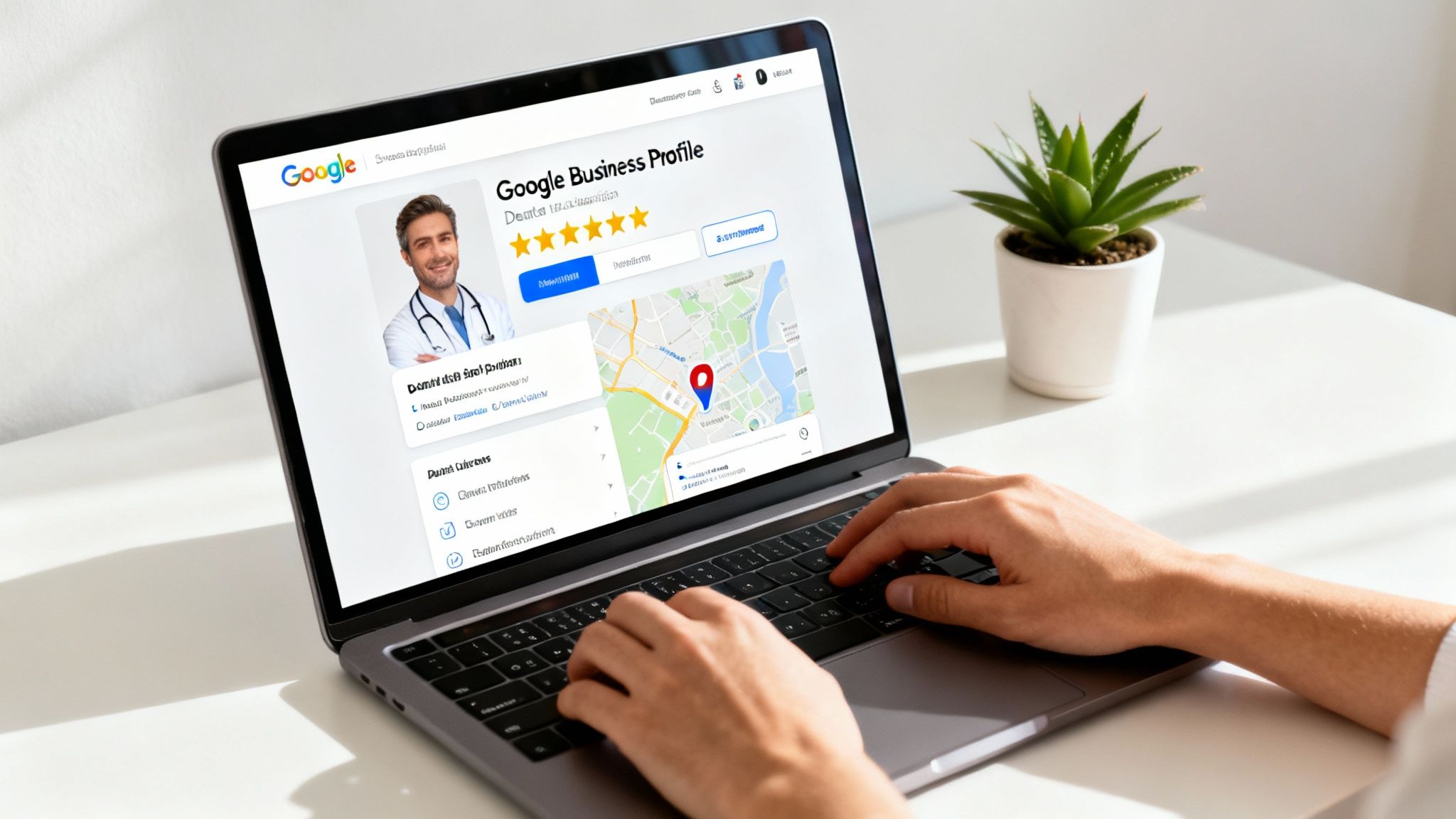
This is the first impression that truly matters. A polished, professional Google Business Profile provides potential patients with the exact information they need, precisely when they need it. Think of it as your digital front door—it's often the very first interaction a person has with your practice online.
Your Google Business Profile (GBP) is no longer just a map listing. It's a dynamic, interactive storefront that can either funnel new patients your way or send them directly to a competitor. For any dentist serious about dominating their local area, optimizing this profile is non-negotiable. It is a cornerstone of effective dental SEO marketing that converts casual searchers into scheduled appointments.
Optimising Your Core Profile Information
First things first: accuracy is paramount. Google views your GBP as the definitive source of information about your practice. Any inconsistencies across the web can create confusion, erode trust, and damage your rankings.
Start by perfecting the essentials:
- Practice Name: This must be your exact, official business name. Avoid keyword stuffing like "Best Dentist in Sydney"—Google will penalize this.
- Address: Your physical address must be precise and consistent everywhere it appears online.
- Phone Number: Always use a local number, and ensure it is the same on every platform.
- Website: Link this directly to your practice’s homepage.
This foundational data must be flawless. To truly master local SEO and start attracting patients in your suburb, ensure you understand the process of listing your business on Google Maps.
Writing a Compelling Business Description
That business description box is prime real estate. You have 750 characters to tell people who you are and why they should book an appointment with you. Don't just list services; tell a compelling story.
Integrate keywords naturally. Instead of a flat "We offer cosmetic dentistry," try something with more personality: "Our Sydney dental practice specialises in creating brilliant, confident smiles with advanced cosmetic dentistry, from professional teeth whitening to complete smile makeovers." It's far more engaging and clearly signals your specialty to Google.
Pro Tip: The first 250 characters are the most crucial. This is what users see before clicking "more," so make every word count. Lead with your key services and what makes your patient experience unique right from the start.
Choosing the Right Categories and Services
Selecting the correct categories is critical for appearing in relevant searches. Your primary category should be "Dentist," or something more specific like "Cosmetic Dentist" or "Orthodontist" if that's your primary focus.
From there, add all applicable secondary categories:
- Dental Implants Provider
- Teeth Whitening Service
- Emergency Dental Service
Next, utilize the 'Services' feature to list every single procedure you offer. Be exhaustive. For each service, add a brief description and, if you are comfortable, the pricing. This level of detail helps you rank for specific, high-intent searches like "cost of dental implants in Parramatta."
The Power of Photos and Posts
Photos build immediate trust and rapport. Patients want to see where they are going before they even book. It’s a fact: GBP profiles with high-quality, authentic images receive significantly more engagement.
Ensure you upload a diverse mix of photos, including:
- Exterior shots: To help patients easily locate you.
- Interior shots: A clean, welcoming reception area and modern treatment rooms make a strong impression.
- Team photos: Putting a friendly face to the practice name is always a great idea.
- Action shots: With patient consent, show your team doing what they do best.
Beyond photos, use Google Posts to share practice news, special offers, and helpful tips. Treat it like a mini-blog that lives directly on your search listing. A quick post about a new teeth whitening special or a "meet the hygienist" feature keeps your profile fresh and signals to Google that your practice is active and engaged.
Regularly updating your profile is key to its success. For a deeper dive, check out our guide on optimising your Google My Business profile and learn how to turn it into a true patient-attracting machine.
A Practical Website SEO Audit for Your Practice
Technical SEO can sound daunting, like something reserved for an IT expert. However, many core issues that could be harming your practice’s rankings are surprisingly easy to identify and fix yourself.
Think of this as a quick health check-up for your website. It’s a crucial first step in any robust dental seo marketing plan, helping you uncover the critical problems that prevent Google from understanding what you do and who you’re trying to attract.
Checking Your On-Page Essentials
On-page SEO is about optimizing the individual pages on your website. These elements are the signposts that tell Google what each page is about, so it can show them to the right patients in your local area.
Getting these right builds a strong foundation.
- Title Tags: This is the clickable headline people see in Google search results. Every page needs a unique title tag that includes the page's topic (your keyword). For example, a teeth whitening page should have a title like: "Professional Teeth Whitening in Sydney | Your Practice Name".
- Meta Descriptions: This is the short summary appearing under the title tag in search results. While not a direct ranking factor, a compelling description (around 150-160 characters) is your sales pitch. It convinces a potential patient to click your link instead of a competitor’s.
- URL Structure: Keep your URLs clean and descriptive. A URL like
yourpractice.com.au/cosmetic-dentistry/veneersis far better for both Google and users than something messy likeyourpractice.com.au/p?id=123.
Assessing Site Speed and Mobile Friendliness
We live in an age of instant gratification. A slow website is a patient-repellent. If your site takes more than a few seconds to load, potential patients will simply hit the back button and move to the next dentist on the list.
Furthermore, most people searching for a local dentist do so on their phones. This makes a mobile-friendly website absolutely non-negotiable. Google’s “mobile-first indexing” means it primarily uses the mobile version of your site to determine your rankings.
A one-second delay in page load time can lead to a 7% reduction in conversions. For a dental practice, that’s a significant number of high-value patients lost simply due to a slow website.
You can easily test your site’s performance using free tools. They not only provide a speed score but also offer practical tips for improvement. You can explore some of the best free SEO tools available in our comprehensive guide to get started.
Analysing the Technical Foundations
Beyond the on-page elements, a few technical checks can uncover major issues holding your website back.
The competition in Australian dental SEO is fiercer than ever, with over 16,500 registered dentists all vying for online visibility. This means even minor technical mistakes can make a massive difference. For example, following Google's August 2023 core update, some dental websites in competitive markets like Melbourne saw a 20% drop in rankings, highlighting the critical importance of technical diligence.
Here’s what to look out for:
- SSL Certificate (HTTPS): Your website URL must start with
https://, nothttp://. This 's' signifies that your site is secure, a confirmed Google ranking signal and essential for building patient trust. - Broken Links: Links that lead nowhere create a poor user experience and signal to Google that your site is not well-maintained. Regularly run a broken link check to find and fix them.
- Image Optimisation: Large, uncompressed images are a common cause of slow websites. Ensure all your images are properly sized and use descriptive alt text (e.g., "patient receiving Invisalign treatment at our Perth clinic") to help Google understand the image's context.
Creating Content That Attracts New Patients
Content is the engine that powers your entire dental SEO marketing strategy. It's what Google analyzes to determine your expertise, and it’s what potential patients use to decide if you’re the right choice for them. Great content does much more than fill a page—it answers questions, alleviates anxiety, and converts a curious browser into a scheduled appointment.
Many practices make the mistake of creating generic, thin pages that do little to build genuine trust. The secret is to shift your focus from simply listing services to actively solving the problems your patients are experiencing. You must provide real value and demonstrate your authority at every opportunity.
Building High-Value Service Pages
Think of your service pages as a digital consultation. This is your chance to explain procedures, manage expectations, and show an anxious patient why they should choose your practice over the competition. A simple list of treatments is no longer sufficient.
Imagine someone is concerned about dental implants. They aren't just searching "dental implants Sydney." They're typing in long-tail questions like, "how much do dental implants cost," "does getting dental implants hurt," and "dental implant recovery time."
Your service page must be the comprehensive resource that answers every one of those questions.
A high-converting service page anticipates and addresses a patient's fears and questions. By providing detailed information on the procedure, costs, recovery, and benefits, you build instant trust and position your practice as the undeniable expert.
This approach transforms a basic webpage into a powerful patient acquisition tool.
Hyper-Localising Your Content
Let's be honest: patients prioritize convenience. They are searching for a fantastic dentist who is also located nearby. This is precisely why creating localized service pages for each suburb you serve is an incredibly powerful tactic.
Instead of a single page for "cosmetic dentistry," you should develop multiple, unique pages such as:
- Cosmetic Dentistry Parramatta
- Cosmetic Dentistry Baulkham Hills
- Cosmetic Dentistry Castle Hill
Each page must be tailored with locally relevant details. Mention nearby landmarks, specific public transport options, or why your practice is an excellent choice for families in that specific community. This sends a strong signal to Google that you are the go-to dentist for that exact area, helping you dominate the search results for anyone searching for "[service] in [suburb]".
Actionable Blog Topics That Build Authority
Your blog is where you can truly connect with patients by addressing their everyday concerns. Here’s a compelling statistic: businesses that regularly publish blog content get 55% more website visitors than those that don’t. It’s your best platform for establishing expertise and attracting people who are not yet ready to book but are seeking reliable information.
Stop writing for other dentists with dense, technical jargon. Start writing for your patients. Consider the conversations you have in the chair every day—those are your best blog topics.
Here are a few proven blog topic ideas that consistently attract new patients:
- Problem-Solving Posts: "What Should I Do for a Sudden Toothache at Night?" This targets users with an immediate, urgent problem.
- Guidance-Based Content: "How to Choose the Best Family Dentist in [Your Suburb]." This positions you as a trusted advisor, not just a service provider.
- Demystifying Procedures: "Is Professional Teeth Whitening Actually Safe? We Break It Down." This directly addresses common fears.
- Cost-Related Articles: "Understanding the Cost of Invisalign in Australia." Transparency about pricing builds immense trust.
- Preventative Care Tips: "5 Simple Habits to Prevent Gum Disease." This demonstrates that you care about their long-term health, not just booking treatments.
By consistently creating content that answers these real-world questions, you become the trusted local authority on dental health. When those readers eventually need a dentist, your practice will be the first one they think of. That's the core of a powerful content strategy—building relationships long before a patient ever steps into your clinic.
Building Authority with Links and Reviews
In dentistry, trust is paramount. Patients are entrusting their health to you, and that trust must be earned long before they sit in your chair. For a modern dental practice, this process begins online. A crucial component of any successful dental seo marketing strategy is building digital authority, which Google measures through two key signals: high-quality links and a strong portfolio of patient reviews.
These are not just technical SEO checkboxes; they are digital proof that your clinic is a respected, valued part of the local community.
Ethical Link Building for Local Practices
Think of a link from another website to yours as a vote of confidence. When a reputable local site points to your practice, it tells Google that you are a trustworthy authority. The goal isn't just to acquire any link; it’s about earning links that solidify your local relevance.
Forget chasing random directories. Instead, focus on building genuine community connections that lead to valuable links naturally.
- Sponsor a local sports team: Get your practice name and website link on the local football club or kids' netball team's site. It’s great for the community and a powerful local signal for Google.
- Partner with nearby health professionals: Build relationships with local GPs, chemists, or chiropractors. You can cross-refer patients and create opportunities for them to link to your website as a trusted dental partner.
- Host a community event: Run a free oral health workshop at a local school or community centre. These events often get mentioned on community websites or local news blogs, earning you valuable local links.
These tactics build real-world relationships that translate directly into the digital authority Google wants to see from a local health provider.
When it comes to link building, not all tactics are created equal. Some require more effort than others, but the payoff can be significant for your local rankings.
Effective Local Link Building Tactics for Dentists
| Tactic | Effort Level | Potential SEO Impact |
|---|---|---|
| Local Sports Sponsorships | Low | High |
| Community Event Hosting | Medium | High |
| Partnering with Health Pros | Medium | Medium |
| Local Business Directories | Low | Medium |
| Guest Posts on Local Blogs | High | High |
Focusing on a mix of these strategies—especially those with a high SEO impact—will give your website the authority it needs to stand out.
The Power of Patient Reviews in SEO
Reviews are the new word-of-mouth. A strong profile of positive patient feedback is one of the most powerful ranking factors for Google’s local map pack. It shows both Google and potential patients that you deliver an excellent experience.
A consistent stream of 4- and 5-star reviews directly impacts your local search visibility and your conversion rate. When a potential patient sees two similar practices, the one with more positive, recent reviews will almost always get the call.
The chart below shows how different types of content contribute to your SEO efforts. Service and local pages form the foundation of your authority, which is then amplified by positive reviews.
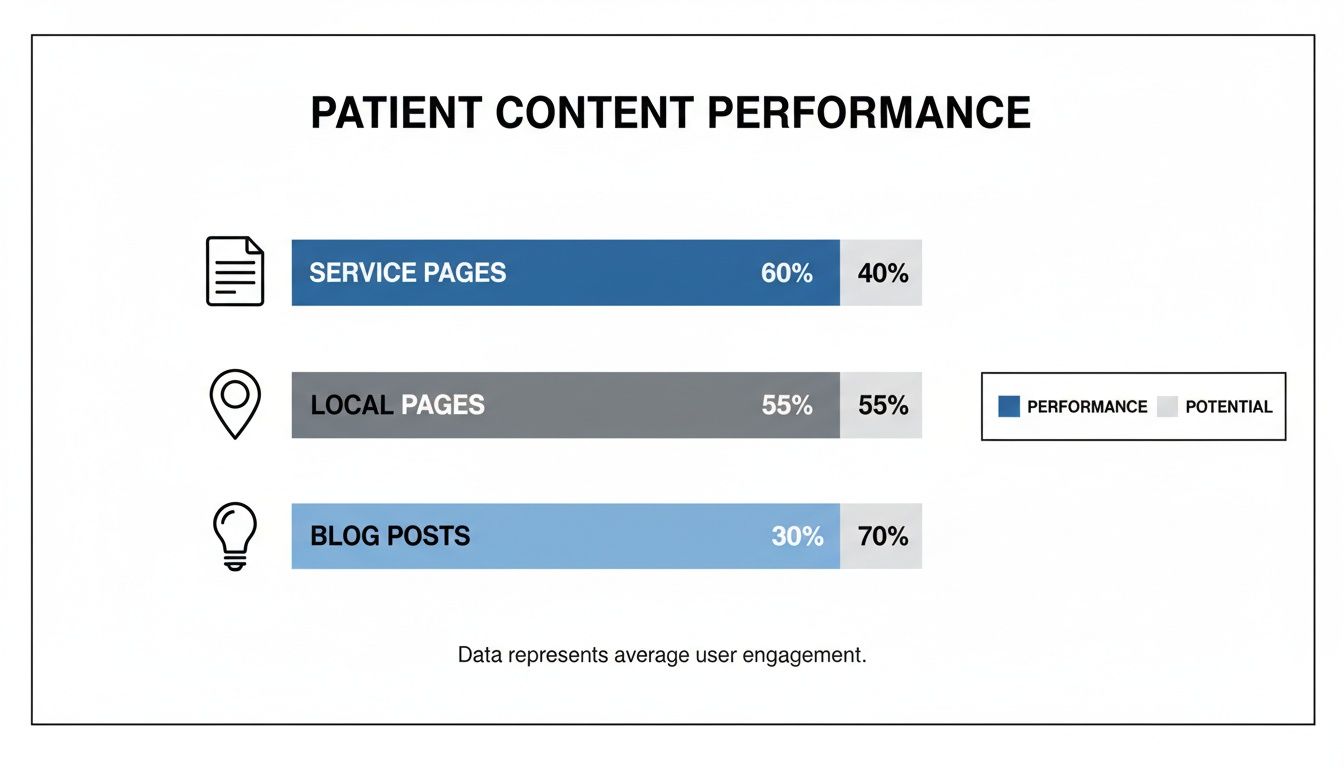
While blog posts are great for attracting new eyes, it's your core service and location pages—backed by strong social proof from reviews—that turn searchers into actual patients.
A Framework for Generating and Managing Reviews
Getting great reviews doesn't have to be awkward. It just needs a simple, repeatable process built into your patient workflow. Your front desk team is your secret weapon here.
A friendly script at the end of a positive appointment is incredibly effective. Try something like:
"We're so glad you had a great visit today, [Patient Name]! It would mean the world to us if you could share your experience on Google. It really helps other patients find us."
It’s just as important to respond to every single review—the good and the bad. Responding to positive reviews shows you appreciate your patients. Professionally addressing negative feedback shows you listen and care, which can often turn a bad experience into a neutral or even positive one in the eyes of other readers.
For more hands-on strategies, you can learn more about how to get more Google reviews in our in-depth article. Building online authority through links and reviews isn't just about rankings; it’s about driving real, measurable growth for your practice.
Common Dental SEO Questions Answered
Even with a clear plan, you're bound to have questions about dental SEO marketing. It's a field that moves fast, and it’s easy to get bogged down in the details or second-guess where you should be putting your energy.
This section tackles the most common questions we hear from practice managers and dentists day in and day out. We'll give you straight answers to help you cut through the noise and feel confident about your marketing.
How Long Does Dental SEO Take To Show Results?
This is always the first question, and the honest answer is: it depends. SEO is a long-game strategy, not a quick fix. You’re building a foundation of trust with search engines, and that simply takes time.
Generally, you can expect to see some positive movement in your rankings and website traffic within 3 to 6 months. But if you're aiming for competitive keywords in a major city like Melbourne or Sydney, breaking into those top spots could take closer to 6 to 12 months of consistent work.
Key Takeaway: Think of SEO like planting a tree, not flipping a switch. The first few months are all about building strong roots—optimising your site, creating great content, and building local citations. The visible growth comes later, but it’s far more stable and valuable in the long run.
A few things can speed up or slow down this timeline:
- Your starting point: A brand-new website will naturally take longer than an established site with some existing authority.
- Local competition: Ranking in a packed urban centre is a much tougher fight than in a smaller regional town.
- Your budget and resources: The more consistent and intense your SEO efforts are, the faster you'll see the needle move.
What Is The Difference Between SEO and SEM?
This is a really common point of confusion. Both are vital for getting your practice seen on Google, but they work in completely different ways.
Here’s the simplest way to think about it: SEO is earning your visibility, while SEM is paying for it.
Search Engine Optimisation (SEO): This is all the organic stuff we’ve been talking about—improving your website, creating content, and building reviews to rank naturally in Google's unpaid results. It’s a long-term asset that builds sustainable traffic over time.
Search Engine Marketing (SEM): This is a broader term that actually includes SEO, but it most often refers to paid advertising, like Google Ads. With SEM, you pay to have your ad appear right at the top of the search results for keywords like "emergency dentist near me."
A smart dental marketing plan almost always uses both. SEO builds your long-term foundation, while SEM can drive immediate patient leads while your organic rankings are still climbing.
Can I Do My Own Dental SEO?
Absolutely. You can definitely get started with the basics yourself. Claiming your Google Business Profile, making sure your website details are up-to-date, and asking patients for reviews are all fantastic first steps that don’t require any deep technical skill.
But a comprehensive dental SEO marketing strategy goes much deeper. Technical audits, advanced keyword research, analysing what your competitors are doing, and strategic link building are complex tasks that demand specialised expertise and, frankly, a lot of dedicated time.
Most practice managers find they hit a ceiling. They can handle the initial setup just fine, but they lack the time and technical know-how to compete at a high level. That's usually the point where partnering with an agency becomes a smart investment, freeing you up to focus on patient care while the experts handle your online growth.
How Much Should I Spend On Dental SEO?
There’s no magic number here. The right investment really depends on your practice's goals, where you're located, and how fierce the competition is. A clinic in a small town will have a very different budget from one in a competitive metro area.
Here’s a more practical way to look at it: stop thinking of SEO as a cost and start seeing it as an investment in patient acquisition.
Think about the lifetime value of a new patient. If a single new patient brings in an average of $5,000 over their time with your practice, acquiring just a couple of new patients each month through SEO delivers a massive return on your investment.
Your budget should really be tied to your growth targets. A more aggressive plan will naturally require a larger investment to get results faster and outrank your local competitors. The most successful practices we see allocate a dedicated slice of their marketing budget to SEO, because they recognise it as the most consistent driver of new patient enquiries.
Is Blogging Really Necessary For My Practice?
Yes, one hundred percent. A common mistake is thinking a blog is just for sharing practice updates. The truth is, it's one of your most powerful SEO tools for attracting patients who are ready to book.
People don’t just search for "dentist Sydney." They search for answers to their real-world problems: "why are my gums bleeding," "is teeth whitening safe," or "how much do veneers cost in Australia."
Your blog is where you answer those questions. Each post is a new opportunity to rank for these valuable, specific keywords, attracting people who have an immediate dental concern. It instantly positions your practice as a trusted authority and builds a relationship before they've even thought about picking up the phone.
The stats back this up. According to HubSpot, businesses that blog consistently get 55% more website visitors. For a dental practice, that’s a huge pool of potential new patients finding you organically, all because you took the time to create genuinely helpful content.
At Homer Digital Marketing, we know that getting your head around the complexities of SEO can feel overwhelming. Our team specialises in creating data-driven strategies that build your practice's authority, attract high-value patients, and deliver a return you can actually measure. If you're ready to transform your online presence and build a reliable system for growth, we're here to help. Schedule a consultation with us today to see how we can build a marketing plan that works for you.
