
At its core, small business SEO services are designed to get your website seen by the right people on search engines like Google. For a service-based business, this isn't just a technical add-on; it's your most direct line to customers actively searching for your expertise. Are you frustrated with being invisible online while your competitors seem to get all the calls? This guide promises a clear, actionable path to change that. By the end, you will understand exactly how to turn your website into a predictable lead-generation machine.
Why Smart Businesses Invest in SEO Services

Think of your business as a brilliant new coffee shop. Without SEO, you’re tucked away on a quiet side street, hoping people just happen to wander by. With powerful SEO, you’re on the main digital highway, with a huge, bright sign that pulls in everyone craving a great coffee. That’s what effective small business SEO services do—they secure you the best real estate online, right where your ideal customers are already looking.
In Australia, it doesn’t matter if you’re a real estate agent in Sydney, a wellness studio in Melbourne, or an accountant in Brisbane; your clients start their search on Google. In fact, a staggering 87% of shoppers kick off their buying journey with an online search. If you’re not showing up on that first page, you’re practically invisible to a massive portion of your market.
Connecting With High-Intent Customers
The real magic of SEO is that it connects you with people who are ready to buy. These aren't just window shoppers; they're actively searching for a solution you provide. Unlike traditional ads that interrupt people, SEO puts you directly in their path at the exact moment they need you. This means higher quality leads and a much smoother path to bringing in new clients.
To get your head around the fundamentals, this resource on What Is Search Engine Optimization Explained is a great place to start.
Building a Long-Term Business Asset
Putting money into SEO is a completely different ball game than paying for ads. The second you stop paying for ads, you vanish. But a solid SEO strategy? That builds a genuine asset for your business that keeps delivering results over time, and those results compound.
SEO is your silent sales engine. It works 24/7 to build your brand’s authority, generate organic traffic, and attract qualified leads, creating a predictable and scalable system for growth.
This isn’t just about getting more website clicks; it’s about building trust and establishing yourself as an authority. When your business consistently appears with the right answers, you become the go-to expert. That authority doesn't just attract new clients—it allows you to command premium prices.
The long-term payoff is huge, and you can learn more about how to track the return on investment of digital marketing to see the full picture. SEO is the foundation for steady, sustainable online growth.
The Core Pillars of a Winning SEO Strategy
Great small business SEO services aren't about exploiting some secret loophole or magic button. It's about building a solid, sensible strategy from the ground up.
Think of your website like a physical shop you want customers to flock to. For that to happen, you need a few things: a solid foundation, clear signage out front, an expert inside who can help people, and a great reputation around town.
Each of these elements lines up perfectly with a core pillar of SEO. Mastering these four components is what separates a website that gets buried on page ten of Google from one that becomes a reliable lead-generation machine. Let’s break down exactly what goes into building that kind of online authority.
Technical SEO: The Foundation of Your Digital Storefront
Before you even think about what your website says, you have to make sure search engines can actually read it properly. This is Technical SEO.
In our shop analogy, this is the concrete foundation, the wiring, and the plumbing. If any of that is faulty, it doesn’t matter how nice the paint job is—the building just won't work.
It’s the same online. Technical glitches like slow-loading pages or broken links will kill your SEO efforts before they even start. In fact, studies show over 75% of users will abandon a website that takes more than four seconds to load and never come back.
A quality SEO service ensures your digital foundation is rock-solid by fixing:
- Site Speed: Optimising images and code so your pages load almost instantly.
- Mobile-Friendliness: Ensuring your site works perfectly on a smartphone, where most local searches happen today.
- Crawlability: Making it dead simple for search engine bots to navigate your site and find all your great content.
A technically sound website is your ticket to the game. Without it, even the best content in the world won't rank because search engines can't see it or index it properly.
On-Page SEO: Clear Signage and a Great User Experience
Once your foundation is solid, it's time to work on what your visitors actually see. This is On-Page SEO. Think of it as the big, clear sign on your shopfront, the well-organised aisles, and the helpful labels on your products. It’s all about making your website easy for both people and search engines to understand at a glance.
This is where we optimise individual web pages to rank higher and pull in the right kind of traffic. It's about speaking your customer's language, right there in your content.
For instance, an accountant in Perth wouldn't just use the generic word "accounting." They’d get specific, using phrases like "small business tax accountant Perth" or "BAS statement help for tradies" in their headings and page text. This aligns their website directly with what real clients are typing into Google, massively boosting their chances of being found.
Content Marketing: The Expert Inside Your Shop
Okay, so people can find your shop and navigate it easily. Now what? You need to give them a reason to stick around, trust you, and eventually do business with you. This is where Content Marketing comes in.
Content is the friendly, knowledgeable expert inside your shop who offers free, valuable advice, answers questions, and proves you know your stuff.
It’s all about creating genuinely helpful articles, guides, and resources that solve your ideal client's problems. A real estate agent might write a blog post on "5 Common Mistakes First-Home Buyers Make in Melbourne." This doesn't just sell their services; it builds trust and positions them as an authority, attracting qualified leads long before they’re ready to sign on the dotted line.
Link Building: The Power of Word-of-Mouth Recommendations
Finally, no matter how great your shop, your signs, and your expert staff are, you need a strong reputation in the community to really succeed. In the online world, this is Link Building (or off-page SEO). It’s the digital equivalent of other respected local businesses and community leaders telling their own customers to check you out.
Every time another credible website links to yours, Google sees it as a vote of confidence. These "backlinks" signal that your site is trustworthy and authoritative, which is a huge ranking factor. A smart SEO service helps you earn these valuable links from reputable sources, cementing your status as a leader in your industry.
How Local SEO Puts Your Business on the Map
For businesses that serve a specific community—like an accountant, bridal shop, or mechanic—local SEO isn't just another marketing tactic. It's the whole game.
It’s the difference between being the first name that pops up when someone searches “best mechanic near me” and being totally invisible to customers who are ready to book an appointment, right now. This is all about capturing high-intent customers in your immediate area. These are people who aren't just browsing; they have a problem and need a solution today.
Your Google Business Profile is Your Digital Shopfront
Think of your Google Business Profile (GBP) as the cornerstone of your local presence. It’s that info box that appears in Google Search and on Maps, showing your address, hours, photos, and reviews. Nailing your GBP is your ticket to appearing in the coveted "map pack"—those top three local listings that get all the attention.
A fully fleshed-out and active profile is non-negotiable. This means:
- Fill Out Everything: Complete every single section—services, products, accessibility details, and accurate business hours. Don't skip anything.
- Use High-Quality Photos: Regularly upload clear, professional photos of your storefront, your team, and your work. Give people a real feel for your business before they even walk in.
- Answer Questions Proactively: Use the Q&A section to answer common questions people might have about what you do.
The Power of Real Customer Reviews
Social proof is everything in local search. A steady stream of positive, recent reviews tells both Google and potential customers that you're trustworthy and deliver great service. In fact, a massive 95% of consumers now trust online reviews as much as a recommendation from a friend.
Encourage your happy customers to leave feedback, and always respond to reviews—the good and the bad. A thoughtful response shows you’re listening and you care. This is how you build an online reputation that not only boosts your ranking but convinces searchers to choose you.
Our in-depth guide to local SEO for business dives deeper into strategies for managing your online reputation.
An optimised Google Business Profile combined with a strong review strategy is the one-two punch that gets you noticed. It tells Google you are a relevant, authoritative, and trusted local business worthy of a top spot.
Creating Content for "Near Me" Searches
To win over local searchers, your website content needs to speak their language. That means creating location-specific pages and blog posts that directly answer what they’re typing into Google.
For example, a Perth-based accountant should have a dedicated service page for "small business tax help in Perth" or write a blog post titled "EOFY Checklist for Perth Tradies." This hyper-local content is a direct match for what people are looking for, making your website the most relevant answer for Google to serve up.
This isn't just a "nice-to-have" anymore. With 46% of all Google searches having local intent and "near me" searches exploding by 500% since 2015, the opportunity is huge. Yet a shocking 56% of local businesses still haven't even claimed their Google Business Profile, leaving the door wide open for competitors.
Decoding SEO Pricing and Measuring Your Return
Let's get straight to the two questions every business owner asks: "How much do small business SEO services actually cost?" and "What results can I realistically expect?"
This isn't about vague promises. It’s about understanding SEO as a strategic investment that builds a long-term asset for your business, not just another monthly bill. Unlike paid ads that disappear the second you stop paying, a smart SEO strategy creates a lead-generating machine that works for you for years to come.
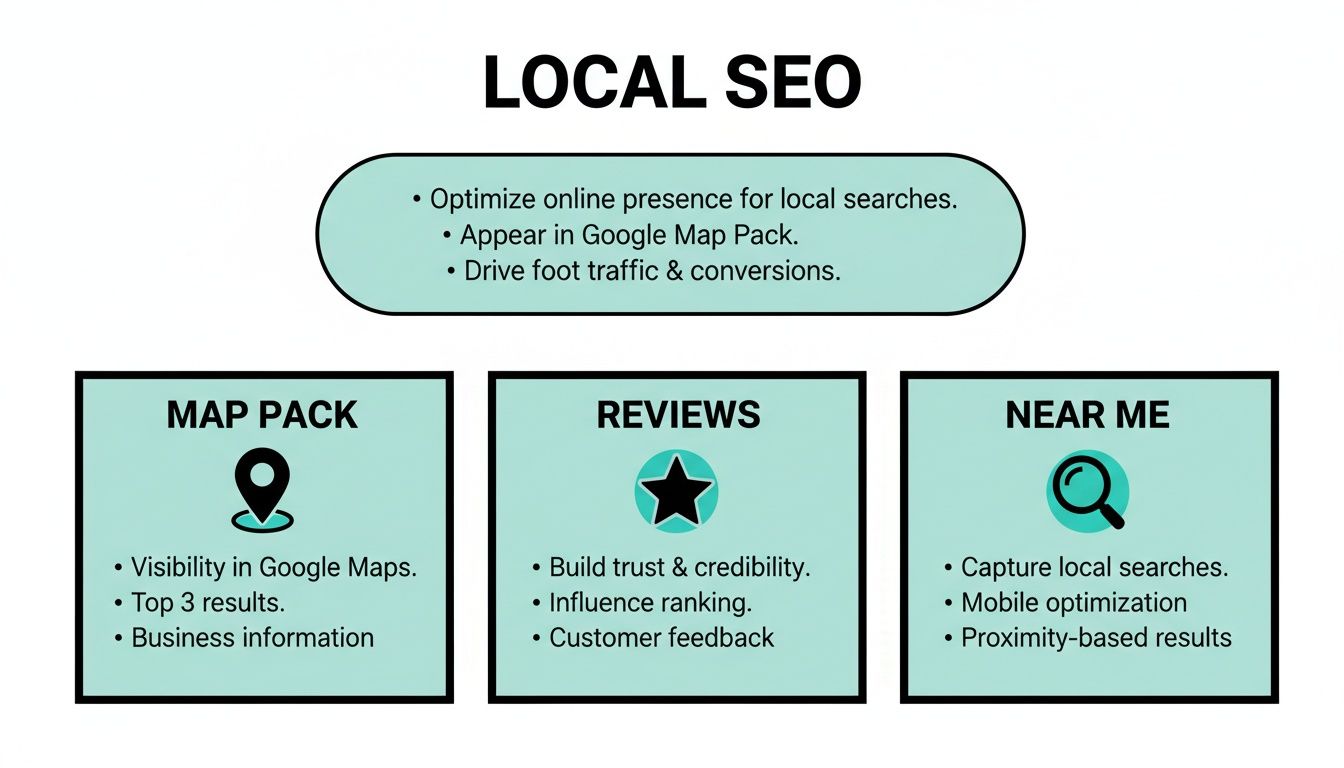
Think of it like this: getting found in the map pack, earning great reviews, and showing up for "near me" searches all work together. They make your business the obvious choice for local customers ready to buy.
Understanding Typical SEO Investment Levels
When you start shopping around for SEO, you'll see prices are all over the place. That’s because the work involved depends entirely on your goals, how tough your industry is, and where your website is at right now.
Instead of hunting for the cheapest option, it’s far more useful to know what you get for your money at different levels.
Australian small businesses are catching on, investing an average of AUD $1,200 a month in SEO. And it’s paying off. The average return on investment for local businesses can hit 500% or more when campaigns are dialled in.
Many are now shifting $14,400 to $30,000 annually away from short-term ads and into sustainable, organic growth that lasts.
Here's a breakdown of what you can generally expect from different SEO packages.
Typical Small Business SEO Service Packages
This table gives you a clear idea of what’s usually included at common price points for Australian businesses.
| Package Tier | Core Inclusions | Ideal For | Typical Monthly Investment (AUD) |
|---|---|---|---|
| Starter / Essential | Google Business Profile optimisation, basic on-page SEO, keyword tracking, and monthly reporting. | New businesses or those in low-competition areas wanting to get the basics right. | $750 – $1,500 |
| Growth / Professional | All Starter features plus regular blog content, local link building, and deeper technical SEO fixes. | Established businesses in moderately competitive markets ready for steady growth. | $1,500 – $3,000 |
| Premium / Dominator | All Growth features plus a full content strategy, advanced link building, and proactive online reputation management. | Businesses in cut-throat industries aiming to become the go-to leader in their area. | $3,000+ |
Choosing the right package is about matching the investment to your ambition and the reality of your market.
Setting Realistic Timelines for SEO Success
Let's be clear: SEO is a marathon, not a sprint. While you can get some quick wins, the real, game-changing results take time to build. Knowing what to expect and when is key, so you don't get discouraged.
SEO success is measured in months, not days. It's about building momentum that compounds over time, creating a predictable and scalable source of new clients for your business.
Here’s a realistic timeline you can expect from a solid SEO campaign:
-
Months 1-3: The Foundation and Early Traction
The first few months are all about groundwork. We’re talking technical audits, fixing website errors, dialling in your Google Business Profile, and aligning your website content with the right keywords. You might start seeing some small ranking jumps for less competitive search terms. -
Months 4-6: Building Authority and Growing Traffic
This is where the content creation and link-building efforts really start to kick in. You should see a noticeable lift in organic traffic to your website and better rankings for your main service keywords. Your business will start popping up more often in local map searches. -
Months 7-12: Gaining Momentum and Increasing Leads
By this stage, the strategy is firing on all cylinders. Your website has built authority, and you should be hitting the first page for a good number of valuable keywords. Most importantly, this visibility will translate into a steady, reliable flow of qualified leads and phone calls.
To truly see the payoff from your investment, you need to measure what matters. A great starting point is integrating Google Search Console with GA4 for enhanced SEO insights. This connection lets you see exactly how your search performance is driving real user actions and conversions on your site, giving you a crystal-clear picture of your ROI.
How to Choose the Right SEO Agency for Your Business
Picking a partner to handle your small business SEO services is a massive decision. Get it right, and the agency becomes a growth engine for your business. Get it wrong, and you’ll burn through your budget and lose months of precious time.
The secret is to look past the flashy sales pitch. You need a team who gets your industry, focuses on real business goals (not just rankings), and is completely transparent. This isn't just hiring a contractor; it's building a relationship with a team that’s genuinely invested in your success.
Green Flags to Look For in an SEO Partner
When you're talking to potential agencies, some signs tell you you're dealing with a quality operator. These "green flags" show a company is focused on delivering real, long-term value, not just ticking boxes.
Keep an eye out for these positive signs:
- Proven Case Studies and Testimonials: A reputable agency will have a portfolio of success stories, ideally from businesses like yours. They should be able to show you hard data on how they improved rankings, traffic, and—most importantly—leads for past clients.
- A Focus on ROI and Business Goals: The conversation should be less about vanity metrics and more about your bottom line. A great partner will ask about your client acquisition costs, average client value, and what you actually want to achieve.
- Transparent Reporting and Communication: You should know exactly what they’re doing and why. Look for agencies that provide clear, easy-to-read monthly reports that connect their activities directly to your business goals.
A great SEO partner doesn't just sell you services; they educate you. They take the time to explain their strategy in plain English, making sure you understand the 'why' behind the 'what'.
Red Flags to Avoid at All Costs
Just as there are good signs, there are glaring red flags that should have you running for the hills. Falling for these tricks can lead to wasted money, Google penalties, and a whole lot of frustration.
Be extremely cautious if an agency does any of the following:
- "Guaranteed #1 Rankings": This is the oldest, dodgiest promise in the book. No one can ethically guarantee a specific ranking on Google. The algorithm changes constantly. This claim is a clear sign they’re either inexperienced or willing to use risky tactics that could get your site penalised.
- Vague or "Secret" Strategies: If an agency can’t—or won’t—explain their methods, it’s usually because they’re using outdated or harmful techniques like buying dodgy links. A trustworthy partner is always open about their process.
- No Access to Analytics: You should always have full ownership and access to your website's Google Analytics and Google Search Console accounts. Any agency trying to keep this data from you is hiding something.
Essential Questions to Ask Before Signing a Contract
Before you jump on a discovery call, get a list of questions ready. The way they answer will tell you everything you need to know about their expertise, process, and whether they're the right fit.
- "What is your process for understanding my business and industry?" A cookie-cutter approach just won't cut it. They need a proper plan to learn about your unique customers, services, and competitors.
- "How do you measure success and what will my monthly reports look like?" You want answers that go beyond traffic numbers. They should be talking about leads, phone calls, and conversions.
- "Can you show me a case study from a service-based business like mine?" Relevant experience is non-negotiable. They need to understand the specifics of your market.
- "What does your communication and support process look like?" You need to know who your point of contact is and how often you'll hear from them.
For a deeper dive into what separates the pros from the pretenders, check out our guide on how to evaluate local SEO agencies. Choosing the right partner is the first step toward building a predictable system for attracting new clients.
Your Action Plan for Sustainable Online Growth

Alright, let's turn the ideas in this guide into a real-world blueprint you can start using today. This isn’t about theory; it’s about taking tangible steps toward lasting results.
Effective small business SEO services are much more than just a race to the top of Google. It’s about building a strong online presence, earning trust with credible authority signals, and creating a marketing engine that brings in leads around the clock.
Think of it like a conveyor belt for your business. SEO done right moves qualified customers from finding you online to booking your services, all without you having to lift a finger.
Best of all, this plan is designed to scale right alongside your business.
Map Out Your SEO Roadmap
-
Run a Quick Site Audit
Use free tools like Google Search Console and PageSpeed Insights to find the technical errors and speed bumps that are holding you back. -
Optimise Your High-Value Pages
Start with the low-hanging fruit. Refresh your homepage, key service pages, and your Google Business Profile. Make sure they’re packed with relevant, targeted keywords and have a crystal-clear call to action. -
Create Consistent Content
Aim to publish 1–2 useful blog posts or local guides each month. Focus on what your customers are actually searching for, like “best [your service] near me,” to attract people who are ready to buy. -
Build Local Authority
Get your name out there. Secure 3–5 local citations (listings in directories) and backlinks from partner websites each quarter. This is a huge trust signal for Google and for potential clients. -
Measure What Matters and Adapt
Keep an eye on your organic traffic, how many people fill out your contact form, and how long they spend on your site. Use this data to fine-tune your keywords and decide what content to create next.
“Think of SEO as growing a fruit orchard. You plant, prune and water consistently. Eventually, it bears a predictable harvest of new clients.”
Weekly SEO Rituals
Here’s a simple checklist to keep the momentum going every week:
- Check for new Google Business Profile reviews and reply within 24 hours.
- Look for new crawl errors in Search Console and fix them ASAP.
- Analyse your top-performing pages in GA4 to spot new keyword opportunities.
- Block out time in your calendar to draft content so it actually gets done.
- See where your competitors are ranking to find gaps you can fill.
Next Steps and Consultation
Treat this action plan as a living document. You should be reviewing it, tweaking it, and re-running your audits every month to stay on track and ahead of the game.
Ready to turn your website into a reliable lead-generating machine?
Book a no-obligation 30-minute consultation with Homer Digital Marketing today. We’ll map out a personalised strategy that fits your goals, your budget, and your timeline.
Your Top Questions About Small Business SEO, Answered
Even after getting your head around the strategy, it's totally normal to have a few final questions before you invest in small business SEO services. We get it. This is where we answer the most common queries we hear from business owners, so you can make your next move with confidence.
How Long Does It Really Take to See SEO Results?
This is the big one, and the honest answer is: it’s not an overnight fix. SEO is all about building a solid foundation and gaining momentum, not just flicking a switch.
Here’s a realistic timeline of what to expect:
- Months 1-3: This is the foundational stage. We’re fixing technical glitches, optimising your Google Business Profile, and laying the groundwork. You might see some small ranking jumps for less competitive search terms during this time.
- Months 4-6: Early traction begins. As we publish targeted content and build your first high-quality links, you should start to see a measurable lift in your organic website traffic. The engine is starting to turn over.
- Months 7-12: Now we're building real momentum. By this point, you should be hitting the first page for several of your most valuable keywords, bringing in a consistent, predictable flow of enquiries and leads.
Can I Just Do SEO Myself?
Look, you can absolutely tackle some SEO tasks on your own, especially if you're working with a tight budget. Things like updating your Google Business Profile, asking happy clients for reviews, and writing the odd blog post are great starting points.
But a professional agency brings years of deep expertise in the heavy-lifting areas—technical SEO, strategic content planning, and link building. These are the complex parts that really move the needle. DIY is a fantastic way to get started, but partnering with an expert is what truly scales your growth and delivers a serious return.
Think of it this way: you might be able to fix a leaky tap yourself, but you’d call in a licensed plumber to replumb the whole house. SEO is no different if you want long-term, reliable results.
Is SEO Better Than Google Ads?
This isn't really an "either/or" question—it’s about knowing when to use the right tool for the job. SEO and Google Ads are two different beasts, and they work best when they work together.
-
Google Ads (PPC): This is all about speed and immediate visibility. You pay to play, securing a top spot instantly, but the traffic disappears the second you stop spending. It's brilliant for testing a new offer, promoting a sale, or getting the phone ringing today.
-
SEO: This is the long game. It takes time to earn authority and trust with Google, but once you rank, you get a steady stream of "free," high-intent organic traffic around the clock. The results from SEO compound over time, building a valuable, lasting asset for your business.
A smart approach often uses Google Ads for quick wins and immediate cash flow, while a solid SEO strategy builds your sustainable, long-term growth engine in the background.
Ready to stop guessing and start growing? The team at Homer Digital Marketing has helped hundreds of service-based businesses just like yours build predictable client acquisition systems. Book a no-obligation consultation today, and let's map out your path to sustainable online growth.
