

Confused about what a DA backlink is? Imagine getting a glowing recommendation from a highly respected industry leader. That's essentially what it is: a link pointing to your website from another site that has a strong Domain Authority (DA) score.
When a website with a rock-solid reputation links to you, search engines like Google see it as a powerful vote of confidence in your business's credibility and expertise. This guide will explain exactly what that means for your business and how you can leverage it for growth.
Unpacking DA Backlinks and Why They Matter

If you're a service-based business owner in Australia, you’ve probably heard SEO experts talking about backlinks. But adding "DA" to the mix shifts the focus from sheer quantity to game-changing quality. It’s one of the most vital ingredients for building an online presence that actually attracts your ideal clients.
To truly understand what a DA backlink is, we need to break it down. It’s a combination of two crucial SEO concepts: a backlink and Domain Authority.
Imagine you're a skilled buyers' agent. A random mention on a brand-new blog is nice, but a feature article on a major Australian real estate news site? That’s a game-changer. That news site has authority, and its endorsement carries serious weight. That’s the difference.
The Core Components of a DA Backlink
The value of these links comes down to how search engines perceive them. Google is constantly hunting for signals that identify trustworthy, expert sources of information, and a link from a high-DA website is one of the strongest signals you can get.
Here’s what that means for your business:
- Enhanced Credibility: When authoritative sites link to you, their reputation rubs off. It tells Google you’re a legitimate and respected player in your field.
- Improved Search Rankings: These powerful "votes of confidence" are a key reason websites climb higher in search results for the services they offer.
- Increased Organic Traffic: Higher rankings lead directly to more visibility, driving qualified prospects—people actively searching for your expertise—straight to your website.
Key Takeaway: A single, relevant backlink from a high-DA website can be more impactful for your SEO than dozens of links from low-authority or irrelevant sites. This focus on quality is the cornerstone of modern, effective link-building.
To help you get your head around these concepts, here’s a quick summary table.
DA Backlink Key Concepts at a Glance
| Term | Simple Explanation | Why It Matters for Your Business |
|---|---|---|
| Backlink | A link from one website to another. Think of it as a citation or referral. | It drives traffic and signals to Google that other sites find your content valuable. |
| Domain Authority (DA) | A score (from 1-100) that predicts how well a website will rank. | A higher DA score suggests greater authority and trustworthiness in Google's eyes. |
| DA Backlink | A backlink from a website that has a high DA score. | This is the gold standard—it passes on the most "authority" and SEO value to your site. |
Ultimately, understanding the power of a DA backlink is the first step toward building a sustainable digital marketing strategy. It’s not about collecting as many links as you can; it’s about earning the right links from the right sources.
Understanding Domain Authority and Backlinks
To get what a ‘DA backlink’ really is, you need to break it down into two parts. Think of them as the engine and the fuel for your website’s online reputation—you can’t get very far without both.
First, let’s talk about Domain Authority (DA). Developed by the team at Moz, this is a predictive score from 1 to 100 that estimates how likely your website is to rank on search engines.
It’s basically a reputation score for your business online. A brand new website is like a new kid on the block—it starts with a low score. An established industry leader? They’ll have a much higher one. It's crucial to know that DA isn't a direct Google ranking factor, but it’s an incredibly useful shortcut for gauging a site’s overall strength. For a deeper dive, you can explore resources on Domain Authority.
The Power of a Digital Referral
The second piece of the puzzle is the backlink. Put simply, a backlink is just a link pointing from someone else’s website to yours. In the real world, this is a word-of-mouth recommendation.
When another business refers a customer to you, that’s a powerful vote of confidence. A backlink works in exactly the same way online. It tells search engines that another website—another ‘business’—vouches for your content, which builds the trust you need to climb the search rankings. You can check out our guide on how to rank higher on Google for more context here.
Combining Authority with Endorsement
So, let's put it all together. A DA backlink is a referral from a business that already has a fantastic reputation.
When a website with a high DA score links to your site, it sends a massive signal to Google. The higher the DA of the site linking to you, the more that ‘vote of confidence’ is worth. It’s the difference between a casual acquaintance mentioning your services and a respected industry giant singing your praises from the rooftops.
The core idea is simple: Google wants to show its users the most trustworthy and relevant results. A link from a high-authority site is one of the clearest indicators that your website is a credible resource worth ranking.
For Australian businesses, backlink strategy has changed dramatically. It's no longer a numbers game; authority and relevance are what matter now. For service-based businesses—whether you’re a wellness practitioner or an IT consultant—a single, high-quality backlink is now far more valuable than a hundred low-quality ones.
Why High-DA Backlinks Are Your Secret Weapon for Growth
Let's cut through the jargon. Getting a backlink from a high-DA website isn't just a tick on an SEO checklist; it's a direct line to your bottom line. When a big, authoritative site links to yours, it’s like a public vote of confidence. Google sees this and starts to trust you more, which is exactly what you need to climb those search rankings.
For an Australian real estate agent, a consultant, or a wellness practitioner, this is huge. It means more people finding your website, more enquiries from prospects who are actually ready to buy, and more leads—all without pouring money into ads.
These links also build your brand’s credibility, positioning you as a leader in your field. In a crowded market, that trust is what makes you the go-to expert instead of just another option.
Building Your Digital Street Cred
The real magic of a high-DA backlink is something called "authority transfer." Think of it like a well-respected industry leader giving your business a public endorsement. That single nod tells Google your website is a credible, reliable source of information.
As you collect more of these endorsements, your own site's authority starts to grow. This makes it so much easier to rank for the competitive search terms your ideal clients are typing into Google every single day. It’s about building a rock-solid foundation for long-term, organic growth.
Let’s be honest: trust and authority are what separate the businesses dominating page one from those lost on page two. And the stakes are high. Websites on the second page of Google get less than 0.83% of all organic clicks. That makes first-page visibility absolutely critical if you want to attract the right clients, a topic you can explore further in our look at Australian SEO trends.
Driving Real Traffic and Qualified Leads
High rankings are great, but they’re pointless if they don’t bring in business. A backlink from a relevant, high-DA site does more than just boost your SEO—it sends you referral traffic.
Imagine a potential client reading an article on a trusted industry blog. They see a link to your website, click it, and land on your page already believing you’re an expert. That lead is warmer, more qualified, and far more likely to convert than someone who just stumbled across your site.
These aren't just random visitors. They are people actively looking for solutions in your niche who now see you as a credible answer. This kind of targeted traffic is one of the most powerful outcomes of a smart backlink strategy, turning your website into a machine that consistently generates high-quality leads.
How to Evaluate the True Quality of a Backlink
So, you've found a site with a high Domain Authority score. That’s a great start, but it's not the whole story.
Chasing a high DA number without looking at the bigger picture is a bit like choosing a business partner based only on their bank balance—you might be ignoring some seriously important details. The real quality of a backlink goes much, much deeper.
This map shows the simple, powerful link between earning quality backlinks, building trust with Google, and driving real business growth.
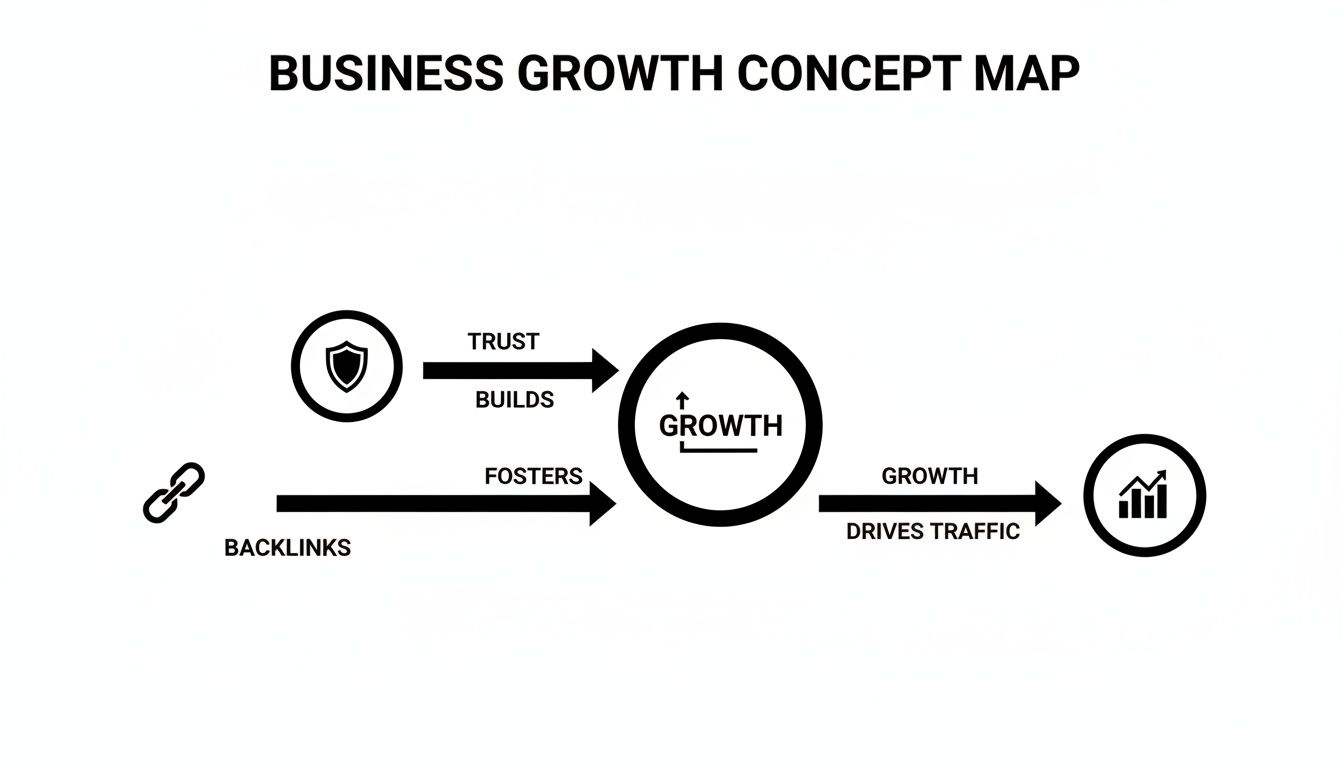
Think of each high-quality link as a vote of confidence that builds your site's authority, which is the foundation for getting sustainable organic traffic. So, how do you spot a golden opportunity and avoid a dud?
Beyond the DA Score
While DA is a handy guide, remember it’s a third-party metric. It's an educated guess. You need to look at any link opportunity through the same lens Google does, and that means putting relevance and context first. Always.
A link from a DA 40 industry-specific blog that your ideal clients actually read is almost always more powerful than a link from a generic, irrelevant DA 60 website.
Why? Because the context sends a much stronger signal to search engines that you’re an expert in your specific niche.
A valuable backlink isn't just a link; it's an endorsement from a relevant source. The more contextually aligned the linking site is with your business, the more weight that endorsement carries.
Your Essential Quality Checklist
Before you chase any backlink, run it through this simple framework. Answering these questions will help you separate the high-impact opportunities from the ones that are just a waste of your time and money.
To assess any backlink opportunity, here's what to look for:
- Topical Relevance: Is the website in your industry or a closely related one? A link from a local business journal means a lot more for an accountant than a link from a pet grooming blog. It's just common sense.
- Website Authority: Don't just rely on Moz's DA. Look at other metrics too. Ahrefs' Domain Rating (DR) is another popular indicator of a site's backlink profile. Using a few of the best free SEO tools will give you a much more rounded view.
- Link Placement: Where is the link on the page? An in-content link, wrapped in relevant text right in the main body of an article, is far more valuable than one buried in a footer or a long, directory-style list.
- Anchor Text: This is the clickable text of the link itself. Ideally, the anchor text should be relevant to the page it's linking to—think "property market analysis" instead of a generic "click here."
High-Quality vs Low-Quality Backlink Checklist
Not all backlinks are created equal. Use this quick checklist to eyeball potential opportunities and instantly tell if they’re worth your effort.
| Quality Factor | High-Quality Backlink (Good) | Low-Quality Backlink (Bad) |
|---|---|---|
| Relevance | From a site in your industry or a related niche. | From an irrelevant or off-topic website. |
| Authority | Reputable site with good traffic and engagement. | Spammy site with a poor reputation or no real audience. |
| Placement | Placed naturally within the main content of a page. | Hidden in a footer, sidebar, or a long list of links. |
| Anchor Text | Uses natural, descriptive text (e.g., "our SEO guide"). | Uses generic text ("click here") or over-optimised keywords. |
This table should be your go-to reference. By focusing on genuine endorsements from relevant sources, you'll build a backlink profile that not only boosts your rankings but also builds real authority and drives qualified traffic to your business.
Proven Strategies to Earn High DA Backlinks in Australia
Knowing how to spot a quality backlink is one thing. Actually earning them is another game entirely.
Forget about risky shortcuts and manipulative tactics that worked ten years ago. The most powerful, sustainable way to build your website's authority today is by creating genuine value and building real relationships within your industry.
This means focusing on ethical strategies that position you as an expert and make high-DA websites want to link to you. For service-based businesses in Australia, this approach doesn't just improve your SEO—it strengthens your brand and reputation at the same time.
Create Genuinely Linkable Assets
The easiest way to get high-quality links? Create something worth linking to. A linkable asset is a piece of content so valuable, useful, or unique that other websites can't help but reference it.
Instead of just pumping out another blog post, think bigger.
- For a recruitment agency: Develop an annual "Sydney Salary Guide" with original data on local industry pay scales. This instantly becomes a go-to resource for job seekers, employers, and journalists looking for stats.
- For a real estate firm: Publish an in-depth "Melbourne Suburb Performance Report" that analyses market trends. Other property blogs and news sites will naturally link back to this kind of valuable data.
- For an IT consultant: Create a comprehensive checklist on "Cybersecurity Essentials for Australian Small Businesses." This asset provides immense value and positions you as a trusted authority.
These assets don't just attract backlinks; they generate leads by showing people you know your stuff. To see how these fit into a broader strategy, it helps to understand the fundamentals of how to get backlinks for SEO.
Guest Posting on Australian Industry Blogs
Guest posting is a classic for a reason. You write an article for another website in your niche, and it creates a win-win: they get high-quality content for their audience, and you get an authoritative backlink and exposure to new, relevant readers.
The key is to be strategic. Don’t waste your time on low-quality sites. Instead, identify respected Australian industry blogs, news outlets, or professional association websites that your ideal clients actually read. A well-placed article on a reputable site builds both your backlink profile and your personal brand.
Build Relationships and Leverage Partnerships
Your professional network is a powerful, and often overlooked, source of high-DA backlinks. Think about the other businesses you already work with and trust.
Building genuine connections is the foundation of modern link-building. A link from a trusted partner is a warm referral, signalling to Google that your business is a legitimate and respected part of the local industry ecosystem.
This strategy is especially effective for service-based businesses.
- An accountant can get a link from a financial planner’s website they regularly partner with.
- A wedding photographer can be featured on the blogs of venues, florists, and caterers they've worked with.
And don't forget the basics. Securing listings in reputable online directories is a straightforward way to build local relevance and authority. To get started, check out our guide on the top business directories in Australia.
The data backs this up. A recent study found that for Australian businesses, links from high-authority domains (DA 50+) drove 3.2 times more traffic than links from lower-authority sites. For service providers who depend on organic visibility to attract qualified leads, that's a number you can't ignore.
Common Backlink Misconceptions to Avoid
Let’s be honest, the world of SEO is full of myths that can send business owners down a rabbit hole of wasted time and money. Falling for these misconceptions about Domain Authority and backlinks won’t just slow you down—it can actively harm your website’s standing with Google.
We need to cut through the noise. By busting these common myths, you can build a link-building strategy that’s smart, healthy, and actually gets results for your service-based business.
Myth 1: A Higher DA Is Always Better
This is one of the biggest mistakes I see people make. They get obsessed with chasing a high DA score and completely ignore what really matters: relevance.
Think about it. A backlink from a DA 45 Australian industry blog that your ideal clients religiously read is a hundred times more valuable than a random link from a generic DA 70 site. Why?
Because Google cares about context. A relevant link tells Google you’re an authority in your niche. That’s a powerful signal, especially for ranking in local search results.
Myth 2: Buying Backlinks Is a Safe Shortcut
You’ve seen the emails flooding your inbox: "Guaranteed DA 70+ backlinks for cheap!" It sounds like a quick and easy win, but it’s a terrible long-term play. Buying links is a direct violation of Google's guidelines, and when (not if) you get caught, the penalties can be brutal. We’re talking about your rankings getting wiped out overnight.
Every dodgy SEO shortcut eventually leads to a dead end. The only sustainable way to build authority is by earning links through great content and genuine relationships. It’s slower, but it’s built to last.
Myth 3: You Should Disavow All Low-DA Links
It’s easy to get caught up in wanting a "perfect" backlink profile filled with nothing but high-DA links. But that’s not how it works in the real world. A natural backlink profile is diverse.
It’s completely normal to have links from all sorts of places—new blogs, local business directories, community forums. Many of these will have lower DA scores, and that’s okay. These links can still drive qualified traffic and show Google you’re a real, active part of your community.
You should only disavow links that are obviously toxic or spammy. Don’t get rid of a link just because its DA is low. A healthy profile is a mixed bag.
Got Questions About DA Backlinks? We've Got Answers
Let's be honest—Domain Authority and backlinks can feel a bit confusing at first. To clear things up, here are some quick answers to the questions we hear most often from Australian service-based business owners just like you.
How Long Does It Really Take to Get a High DA Backlink?
There's no magic button for this one. Earning a high-DA backlink is all about building real relationships and creating content that's genuinely worth linking to, and that takes time.
Realistically, you could be looking at anywhere from a few weeks to several months of consistent effort just to land a single, high-quality backlink. Patience is your best friend here.
Is a Low DA Backlink Ever a Good Thing?
Absolutely. While a high DA score is what we're usually aiming for, a backlink from a low-DA site can still be a huge win if it's super relevant to your business.
Think of it this way: a link from a brand-new but highly respected local industry blog can send you targeted traffic and signal to Google that you're an authority in your niche. When it comes to backlinks, relevance often beats raw authority.
What Tools Should I Use to Check a Website's DA?
There are a few great tools out there to help you figure out a site's Domain Authority. The go-to is Moz's Link Explorer, since they're the ones who created the metric in the first place.
Other industry favourites like Ahrefs and SEMrush have their own similar metrics, like Domain Rating (DR), which also give you a solid idea of a site's authority.
At Homer Digital Marketing, we don't just talk about theory—we build proven strategies that grow your authority and bring in the right kind of clients. If you’re ready to scale your service-based business with a team that delivers real results, let's chat.
Discover how we can help you grow your visibility and scale your business.
