
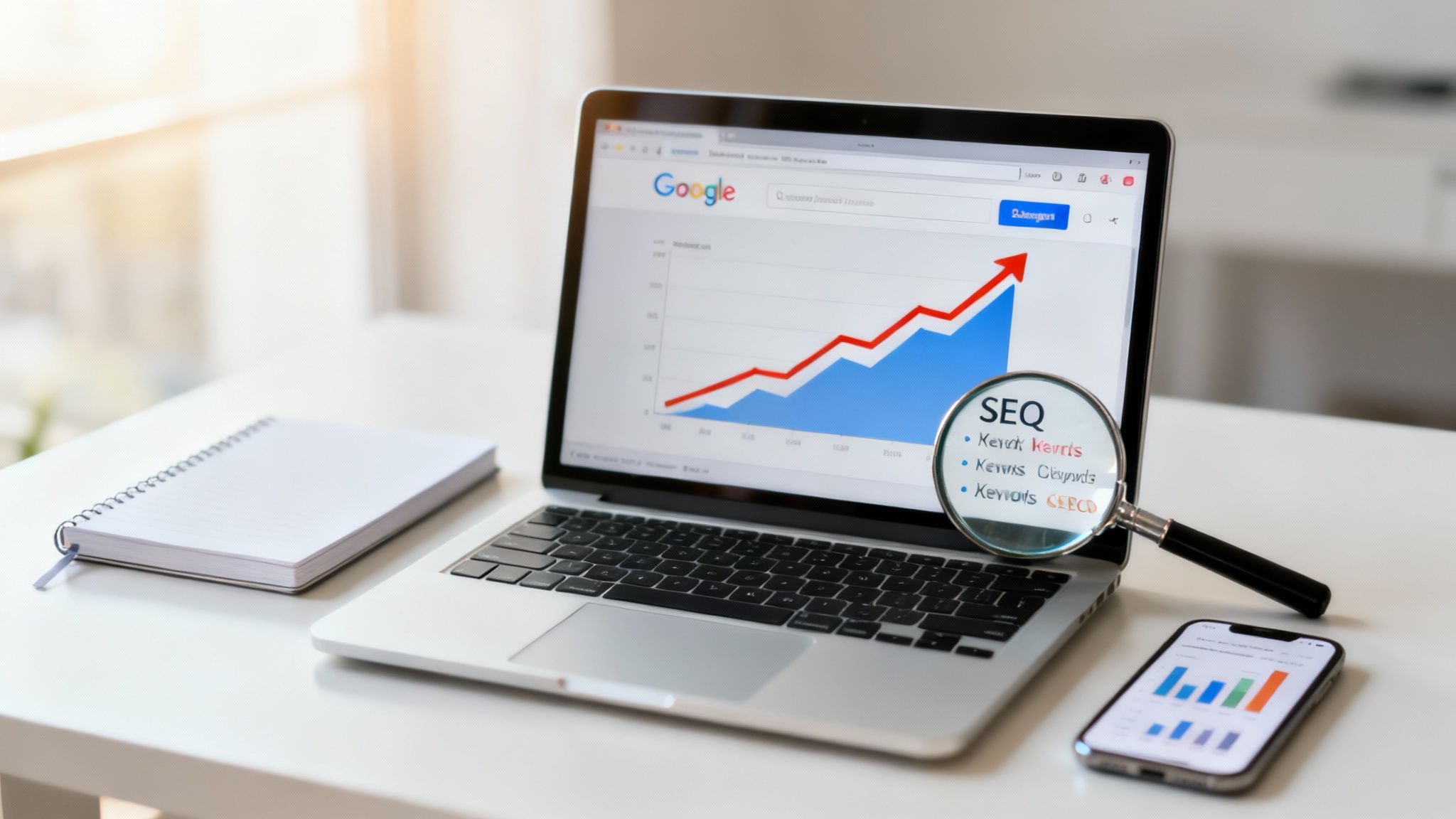
Trying to figure out how to rank higher on Google can feel like shouting into the void. Surprised to learn that 91% of content gets zero organic traffic from Google? It's a tough landscape, but the path to visibility isn't a secret. It boils down to three core pillars: creating genuinely useful content, ensuring your website is technically sound, and building real authority. Get those right, and you'll have a solution to the traffic problem.
Your Path to Dominating Google Search

If you're here, you're in the right place. This guide is a no-fluff playbook designed to show you what it actually takes to get seen on Google. We're skipping the jargon and diving straight into practical, actionable strategies that get real results.
Think of this guide as your roadmap. We’ll walk through everything from decoding what your customers are really searching for to mastering the technical nuts and bolts of your website. You'll get a clear, step-by-step process for auditing your current SEO, finding high-impact opportunities, and climbing the rankings.
What You Will Learn
This isn't just theory; it's about taking action. We're going to break down the essential pieces you need to nail to improve your visibility.
- Audience Intelligence: How to find the exact keywords that show someone is ready to buy (high-intent keywords).
- Content Excellence: Crafting articles and pages that both Google and your readers will love.
- Technical Health: Making sure your website is fast, secure, and easy for search engines to crawl.
- Authority Building: Earning trust through quality links and a strong local presence.
The end goal is simple: attract the organic traffic your business deserves. For most service-based companies, getting a handle on the fundamentals of SEO for small businesses is the single most important step toward long-term, sustainable growth.
Let’s start building your strategy.
1. Find High-Intent Keywords You Can Actually Rank For

If you want to figure out how to rank higher on Google, you have to learn to speak your customers' language. It's about getting inside their heads to understand the exact words and phrases they type into the search bar when they're ready to buy, book, or sign up.
This means looking past the obvious, high-volume keywords and zeroing in on what we call high-intent keywords. These are the terms that signal a searcher is no longer just browsing—they have a problem and they're actively looking for a solution.
Mastering this is your first real step towards climbing the ranks. For a seriously deep dive, learning how to conduct keyword research like an expert will give you a massive edge.
Think Beyond the Obvious (Focus on Long-Tail Keywords)
It’s easy to get fixated on a broad, popular term like "real estate." But the people searching for that are likely just kicking tyres.
A high-intent keyword, on the other hand, sounds more like "how to remove negative reviews fast" or "best buyer's agent for first homes in Sydney." See the difference? The second phrase is dripping with intent. That person isn't just researching; they're looking to hire someone.
Focusing on these specific, long-tail phrases is a game-changer. You attract visitors who are much further down the buying funnel, which means better conversion rates and a much healthier return on your time and effort.
Find Gaps in Your Competitor’s Keyword Strategy
Your competitors are practically handing you a roadmap. By seeing what they're doing right—and wrong—you can find keyword opportunities they've completely missed.
This is where tools like Ahrefs or SEMrush become invaluable. Plug in a competitor’s website and you can see the exact keywords that are sending them traffic.
Look for terms where they’re ranking, but not on page one. If they're stuck on page two or three for a valuable keyword, that's your opening to swoop in with better, more comprehensive content and steal that traffic.
Pro Tip: Don't just clone your competitors' content. Use their keyword list as a jumping-off point. What questions haven't they answered? What related topics have they ignored? This is your chance to become the go-to resource.
For example, a rival auto shop might rank for "car air conditioning repair." A quick look might reveal they haven't created content around "mobile car aircon regas service." That's a specific, long-tail keyword that could bring in highly profitable, ready-to-book customers.
Find and Weave in LSI Keywords
Latent Semantic Indexing (LSI) is just a fancy way of describing words and phrases that are thematically related to your main topic. Think of them as context clues for Google.
When you naturally include these related terms in your content, you're showing Google that you’ve covered the topic in depth. You’re proving your content relevance.
Let's say you're writing a guide on "LinkedIn profile makeover service." To prove you know your stuff, Google expects to see other related concepts.
- Relevant LSI keywords might include:
- Professional headline examples
- LinkedIn summary template
- Boosting profile visibility
- Keyword strategy for skills
- Attracting recruiters
By weaving these ideas into your article, you send a powerful signal that your content is the real deal—a comprehensive resource, not just a thin piece stuffed with a single keyword. You're not just answering one question; you're covering the entire ecosystem around that query. That's what separates the content on page one from everything else.
2. Create Content That Actually Earns Rankings

Once you’ve nailed down your keywords, the real work begins: creating content that genuinely deserves to be on page one. This is the exact spot where so many businesses stumble. They get so hung up on keywords that they completely forget there’s a real person trying to find an answer on the other side of the screen.
The secret to figuring out how to rank higher on Google isn't about trying to trick the system. It’s about creating the single best, most helpful resource for a specific search query.
Content that wins in 2025 (and beyond) is thorough, trustworthy, and incredibly easy to get through. It goes beyond the basics to provide complete answers, backed up by genuine experience and solid data. That’s how you build trust—with your audience and with Google.
Write for People, Not Bots
It's tempting to try and squeeze keywords into every sentence, but that outdated tactic, known as keyword stuffing, is a fast track to nowhere. Google's algorithms are smart. They understand context and synonyms, so you don’t need to awkwardly repeat a phrase over and over. Your number one job should always be to solve the reader's problem.
When you focus on clarity and delivering real value, you create a much better user experience. People stick around longer, engage with what you've written, and start seeing you as an expert. These are exactly the kinds of positive user signals that tell Google your page is a high-quality result, which naturally boosts your ranking.
Think of it as a conversation. You wouldn't repeat the same term over and over if you were explaining something to a client. You’d use natural language, share examples, and focus on being helpful. That's the exact same approach you should take with your writing.
Structure Your Content for Easy Reading
Let’s be honest—nobody wants to read a giant wall of text, especially not on a phone. The structure of your content is just as important as the words themselves. The goal is to make your information as scannable and digestible as possible.
A clean, easy-to-read format keeps people on your page longer, which is a big thumbs-up for search engines. Break up your content using these simple but super-effective techniques:
- Short Paragraphs: Stick to 1-3 sentences max. This creates white space and makes your content feel way less intimidating.
- Clear Headers: Use descriptive H2 and H3 headers to organise your ideas. This helps readers (and Google) get the gist of your article at a glance.
- Bullet Points & Lists: Use them to break down complex info, steps, or features. People are naturally drawn to lists because they’re easy to scan.
For instance, if you’re a recruitment agency writing about interview tips, don’t just write a long block of prose. Turn it into a numbered list like, "5 Common Interview Mistakes to Avoid," with each mistake clearly explained. It’s a simple switch that makes the information far more useful.
Your content's structure is its user interface. A clean, logical layout invites readers to stay, while a dense, chaotic page encourages them to leave immediately.
Go Deeper Than Your Competitors
To outrank the competition, you need to offer more value. This doesn’t always mean writing more words—it means writing a better article. Take a look at the top-ranking pages for your keyword and figure out what they’re missing.
What questions did they forget to answer? What unique data or personal perspective can you bring to the topic? This is what will make your content stand out.
Here’s a simple way to do it:
- Analyze the Top Results: Search your keyword and open the top 5-10 pages. See what topics they all cover and what formats they use.
- Find the Gaps: Make a note of what they haven't covered. Maybe their advice is too generic, their data is old, or they don’t provide any real-world examples.
- Add Your Unique Insight: This is your chance to shine. Share a personal case study, a unique process you’ve created, or stats from a recent industry report.
For example, if all your competitors have written basic guides on "how to choose a buyer's agent," you could one-up them by creating a resource that includes a downloadable vetting checklist, video testimonials from past clients, and a detailed breakdown of hidden fees. You're not just repeating the same old info; you're building a superior resource. And that gives Google a very compelling reason to rank your page higher.
3. Build a Rock-Solid Technical SEO Foundation
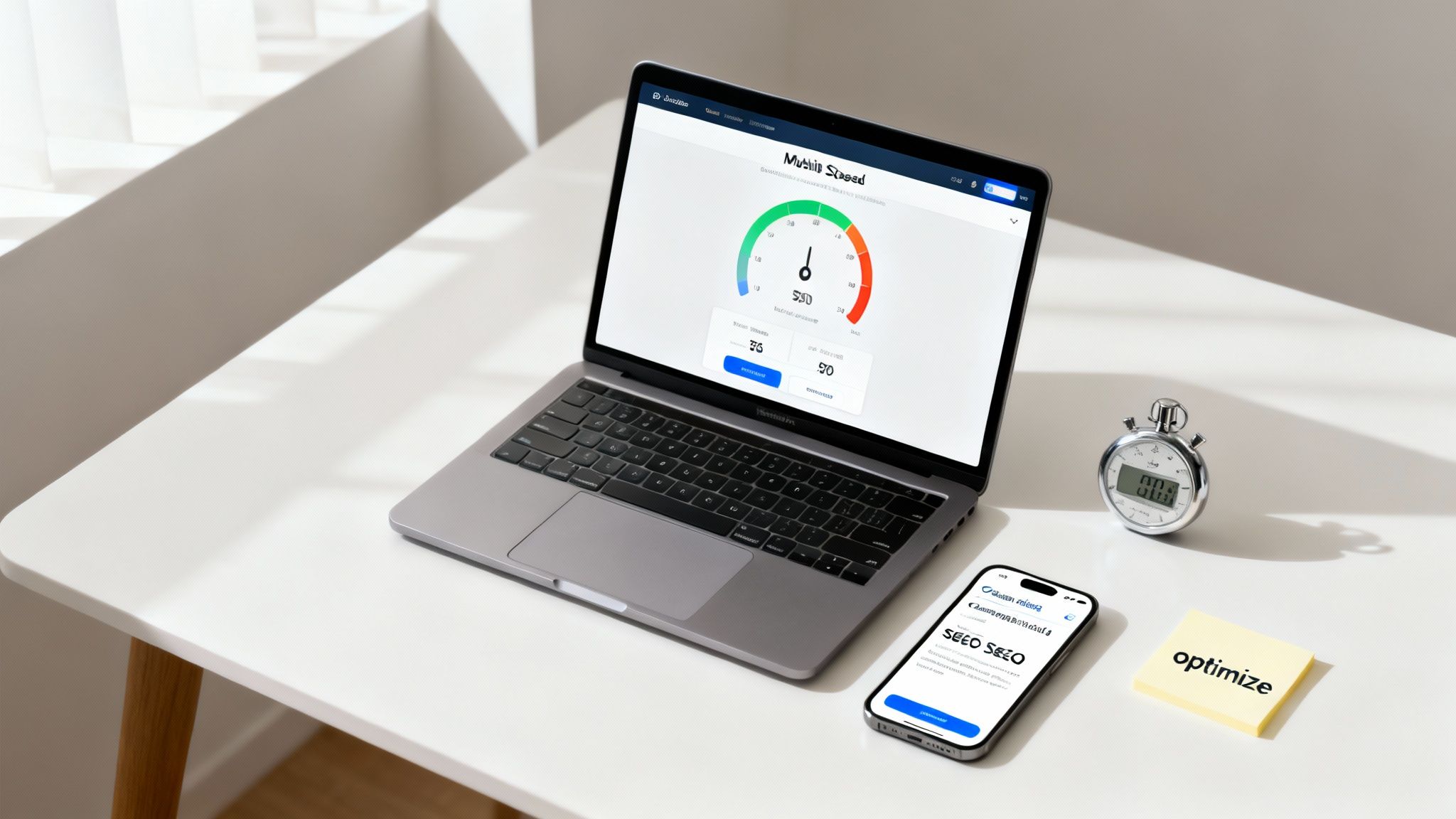
You can have the best content in the world, but if Google’s crawlers can't find, understand, and index it, you’re invisible. This is where technical SEO comes in—it’s the engine room of your website.
Think of it as the framework that holds everything else up. A solid technical foundation makes sure your site is fast, secure, and a breeze for search engines to navigate. Ignoring it is like building a house on dodgy foundations; sooner or later, it's all going to come crashing down.
Getting these fundamentals right creates a smooth experience for both your visitors and the search engine bots that decide your ranking fate.
Craft Titles and Descriptions That Earn Clicks
Your title tag and meta description are your shop window in the search results. They're a mini-advertisement for your page, and when done well, they can seriously boost your click-through rate (CTR).
A punchy title tag should stay under 70 characters and feature your main keyword, ideally right near the start. While the meta description isn't a direct ranking factor, it's your chance to sell the click. Aim for a compelling summary around 150-160 characters that tells the user exactly why they should visit your page.
Create Clean and Descriptive URLs
A clean, logical URL structure helps everyone—users and search engines alike—understand what your page is about before they even click. It’s a small detail, but it contributes to a much better user experience and makes your site far easier to crawl.
Keep your URLs short and to the point.
- Bad Example:
yourdomain.com/p?id=789123 - Good Example:
yourdomain.com/how-to-rank-higher-on-google
The second example tells you exactly what to expect. It's simple, includes keywords, and is easy for someone to remember or share. This simple habit reinforces your page's topic for search engines.
Optimise Your Images with Alt Text
Every single image on your website is another chance to improve your SEO. Search engines can’t "see" images like we do, so they rely on alt text (alternative text) to figure out what an image is showing.
Descriptive alt text not only helps your images show up in Google Images search, driving extra traffic, but it's also a critical accessibility feature for visually impaired users relying on screen readers. Don't just stuff keywords in there; write a clear, accurate description of the image that naturally includes relevant terms.
Alt text isn’t just an SEO box to tick; it’s about making your content accessible to everyone while giving search engines vital context about your page's topic.
Supercharge Your Site with Internal Linking
Internal links are the pathways connecting one page of your website to another. A smart internal linking strategy is a double-win: it guides users to discover more of your great content, and it helps Google understand your site’s structure and which pages are most important.
When you link from a high-authority page to another relevant page on your site, you pass some of that "link equity" along, giving the other page a nice little boost. Always use descriptive anchor text (the clickable words) instead of generic phrases like "click here." This tells both users and Google what the destination page is all about.
Prioritise Site Speed and Mobile Experience
In 2025, speed is non-negotiable. Google has made it clear that page speed is a ranking factor, especially for mobile searches. A slow website is a frustrating website, which leads to high bounce rates and sends all the wrong signals to search engines.
And with Google's mobile-first indexing, how your site performs on a phone is paramount. If your site isn't optimised for a seamless mobile experience, your chances of ranking higher are slim to none.
The Australian digital marketing landscape, valued at $1.5 billion and growing by 12% annually, is all about mobile-first. With the vast majority of Australians browsing on their smartphones, a flawless mobile experience isn't just a good idea—it's essential for climbing the search rankings.
Run Regular Technical Health Checks
Your website isn't a "set and forget" project. Technical gremlins like broken links or crawl errors can pop up at any time, stopping Google from indexing your pages properly. To keep your technical SEO foundation strong, you need to be constantly optimizing your site's performance.
Running regular audits helps you catch and fix these issues before they start hurting your rankings. There are plenty of tools to help you get started. For a rundown of our favourites, check out our guide on the best free SEO tools available to monitor your site’s health. Staying on top of your technical SEO ensures your site remains a strong contender.
4. Grow Your Authority with Links and Local SEO
Google's algorithm is built on trust, and a huge chunk of that trust is earned off your website. This is where off-page SEO comes into play. It's all about showing search engines that you’re a reputable, authoritative voice in your field through signals like high-quality backlinks and a strong local presence.
Think of backlinks as votes of confidence. When another credible website links to your content, it’s basically telling Google, "Hey, these guys know what they're talking about." When you combine that kind of broad authority with a sharp, localised strategy, you've got a powerful recipe for climbing the search rankings.
Focus on Earning Links, Not Just Building Them
The old days of buying links or spamming forums with your URL are well and truly over. Thank goodness. Today, the most valuable links are the ones you earn organically because your content is genuinely useful, insightful, or just too good not to share.
The goal is to create assets that other people actually want to link to. This shifts the focus from chasing links to creating incredible content.
- Create Link-Worthy Content: This could be a definitive guide, an original research report, a useful online tool, or a compelling infographic. Before you hit publish, ask yourself: "Is this piece of content so good that another expert in my industry would stake their reputation on it by linking to it?"
- Strategic Guest Posting: Find reputable blogs in your niche and offer to write a genuinely valuable article for their audience. This isn't about getting a link for the sake of it; it's about providing real value and establishing your expertise on another respected platform.
- Leverage Digital PR: Have some unique data or an expert opinion? Share it with journalists and industry publications. When your business is cited as a source in the news, you often score a powerful backlink from a high-authority domain.
This approach builds a natural, trustworthy backlink profile that signals to Google that you're a leader in your field.
Dominate Local Search with Your Google Business Profile
For any business with a physical address or a defined service area, mastering local SEO is non-negotiable. It's your golden ticket to appearing in the valuable "Map Pack" and grabbing the attention of customers running "near me" searches—people who are ready to buy, call, or visit.
Your number one tool for this is your Google Business Profile (GBP). An incomplete or outdated profile is a massive missed opportunity.
A fully optimised Google Business Profile isn't just a nice-to-have anymore—it's the cornerstone of a successful local SEO strategy. It acts as your digital storefront right inside Google's search results.
Making sure every single section is filled out accurately is a critical first step. If you're looking for a deep dive, our complete guide to Google My Business optimisation provides an actionable checklist to ensure you've covered all your bases.
Harness the Power of Customer Reviews and Local Signals
Positive reviews are one of the most powerful ranking factors for local search. They provide social proof to potential customers and send strong trust signals straight to Google. Encouraging your happy customers to leave feedback on your GBP should be a standard part of your business process.
Beyond reviews, you need to show Google that you are an active and relevant part of your local community.
- Location-Specific Pages: If you serve multiple suburbs or cities, create dedicated pages on your website for each location. Talk about local landmarks, mention community events you’re involved in, and tailor the content specifically for that audience.
- Local Citations: Make sure your business name, address, and phone number (NAP) are perfectly consistent across all major online directories like Yelp, TrueLocal, and other industry-specific sites. Even a small inconsistency can confuse search engines and water down your local authority.
- Hyperlocal Content: Write blog posts about local events, news, or partnerships. This demonstrates your connection to the area and helps you rank for those valuable location-based keywords.
To truly understand how to rank higher on Google in Australia, you have to appreciate just how important local search is. Research shows that around 46% of all Google searches in Australia have local intent, meaning users are actively looking for businesses nearby. This is backed up by the fact that 42% of Millennials who search on Google Maps visit a physical store as a result.
The data, which you can read more about in this Red Search report on Australian local SEO trends, proves the direct link between your online visibility and real-world foot traffic. Optimising for your local area isn’t just an SEO tactic; it's a fundamental strategy for growing your business.
5. Maintain and Amplify Your SEO Success
Hitting that top spot on Google is a massive win, but it’s definitely not the finish line. SEO is a constant game of defending your turf and pushing forward, because the tactics that got you to page one won’t be enough to keep you there.
The trick is to switch your mindset from getting rankings to keeping them. This means you need to be regularly checking your performance and proactively updating your content so it doesn't go stale.
Track the Metrics That Actually Matter
Don't get lost in a sea of data. Instead, focus on the handful of key performance indicators (KPIs) in Google Search Console and Google Analytics that tell you if your strategy is actually working. Think of these tools as your SEO health dashboard.
Here’s what to keep an eye on:
- Organic Traffic: Are the overall visitor numbers from search heading in the right direction?
- Keyword Rankings: Are your most important keywords holding strong or improving? Pay very close attention to any that slip out of the top three spots.
- Click-Through Rate (CTR): Are people actually clicking on your result when they see it? A low CTR can be a sign that your title or meta description just isn't cutting it.
Watching these numbers helps you spot trouble early, giving you a chance to react before a small dip turns into a serious drop.
Don't just celebrate a high ranking; protect it. Consistent monitoring and strategic updates are what separate short-term wins from long-term SEO dominance. The goal is to ensure your content remains the most relevant and valuable resource available.
Prevent Content Decay with Strategic Refreshes
Content decay is a very real threat. It’s what happens when your once top-performing content slowly starts to lose its rankings because it’s become outdated. The fix? A proactive content refresh strategy.
This tells Google your page is still the best, most current answer for a user's query.
A refresh isn't just about tweaking the publication date. It’s about adding genuine value. This means updating old stats, adding new insights, swapping out dated examples for fresh ones, and answering new questions that have popped up around the topic. This keeps your content authoritative and future-proofs all that hard-won SEO success.
Your Top Google Ranking Questions, Answered
We get asked all the time about what it really takes to climb the Google ladder. So, let's cut through the noise and give you some straight answers to the questions we hear most often.
How Long Does It Take to Rank Higher on Google?
This is the million-dollar question, and the honest-to-goodness answer is: it depends. If you're starting with a brand-new website, you’re likely looking at a 6 to 12-month journey before you see real movement for competitive keywords.
Of course, this can speed up if you’re in a less crowded niche or working with a site that already has a bit of history and authority.
A few things will either speed this up or slow it down:
- The Competition: Just how many other established sites are you up against for your keywords?
- Your Content Quality: Are you consistently putting out genuinely helpful, in-depth articles that answer your audience's questions better than anyone else?
- Technical Health: Is your site quick to load, mobile-friendly, and a breeze for Google’s crawlers to navigate?
- Your Backlink Profile: Are you earning quality links from reputable, relevant websites?
SEO is a marathon, not a sprint. Focus on consistent, high-quality effort, and the rankings will come.
Chasing quick wins often leads to short-term tactics that don't last. The real path to sustainable rankings is a steady commitment to creating the best resource for your audience over time.
Can I Rank on Google Without Backlinks?
Look, it's possible to rank for very specific, low-competition long-tail keywords without a strong backlink profile. We sometimes see this with hyper-local search terms or super-niche questions that haven't been answered well elsewhere.
But for any keyword with even a little bit of competition, backlinks are pretty much non-negotiable.
Google still sees links from other authoritative websites as a powerful vote of confidence in your content. They signal that your information is trustworthy and valuable. While great content is king, backlinks are what give the king his authority across the wider kingdom of the internet.
Ready to stop guessing and start ranking? Homer Digital Marketing specialises in building proven Google optimisation systems for service-based businesses just like yours. Let's create a strategy to attract your ideal clients and scale your visibility. Book your free consultation with us today!
