

As a small business owner, you’re fighting for every single customer. But what if the right customers—the ones in your local area actively searching for “best LinkedIn profile makeover service” or “how to remove negative reviews fast”—could find you first?
That’s where this ultimate guide to SEO for small businesses comes in. Search Engine Optimisation is the proven process of making your website more visible on Google, turning it into one of your most powerful, actionable tools for connecting with customers and growing your business. We promise this guide will show you exactly how.
For businesses also investing in social traffic channels, SEO works best when combined with broader digital visibility strategies. Our guide to Brisbane social media marketing for local businesses explains how social platforms and search engines work together to attract consistent leads.
Why SEO Is Your Small Business Superpower
For many small business owners, the whole idea of SEO can feel a bit much. It sounds like a complex, technical puzzle reserved for marketing gurus with huge budgets.
The reality? It’s much simpler than that. At its heart, SEO is about answering your customers’ questions and making it dead simple for them to find your solutions online.
Think of it this way: your physical shop might be on a quiet side street, but good SEO puts your business on the busiest digital high street in the world—Google Search. When a potential customer searches for “best accountant in Parramatta” or “emergency plumber near me,” a solid SEO strategy makes sure your business shows up as a helpful, credible answer. It’s not about tricking the system; it’s about building trust with both search engines and the people using them.
The Growing Need for Digital Visibility
Being visible online isn’t just a “nice-to-have” anymore—it’s essential. This chart of Australian Google Trends data shows that interest in “seo for small businesses” has stayed consistently high for the last five years.
This trend tells a clear story: more and more business owners are realising their customers’ first stop is a search bar. If you don’t show up in those results, you’re basically invisible to a massive pool of people who are ready to spend money.
Ultimately, putting time and effort into SEO delivers real, tangible benefits that go way beyond just getting more website clicks. It lets you:
- Attract High-Quality Leads: You reach customers at the exact moment they’re searching for the services you offer. These are high-intent keywords that lead to conversions.
- Build Lasting Authority: You position your business as a trusted leader in your local area or industry, answering common questions and solving problems.
- Drive Measurable Growth: You get more phone calls, quote requests, and foot traffic—all coming directly from your online presence.
Understanding the Three Pillars of SEO
Search Engine Optimisation can feel like a huge, complicated puzzle. But the good news is that it’s much simpler when you break it down into three core areas: On-page SEO, Off-page SEO, and Technical SEO. Getting these three “pillars” right is the foundation of any solid seo for small businesses strategy.
Think of your website as your digital shopfront. Each pillar plays a different but connected role in getting customers through the door.
This infographic shows you exactly how they all work together.
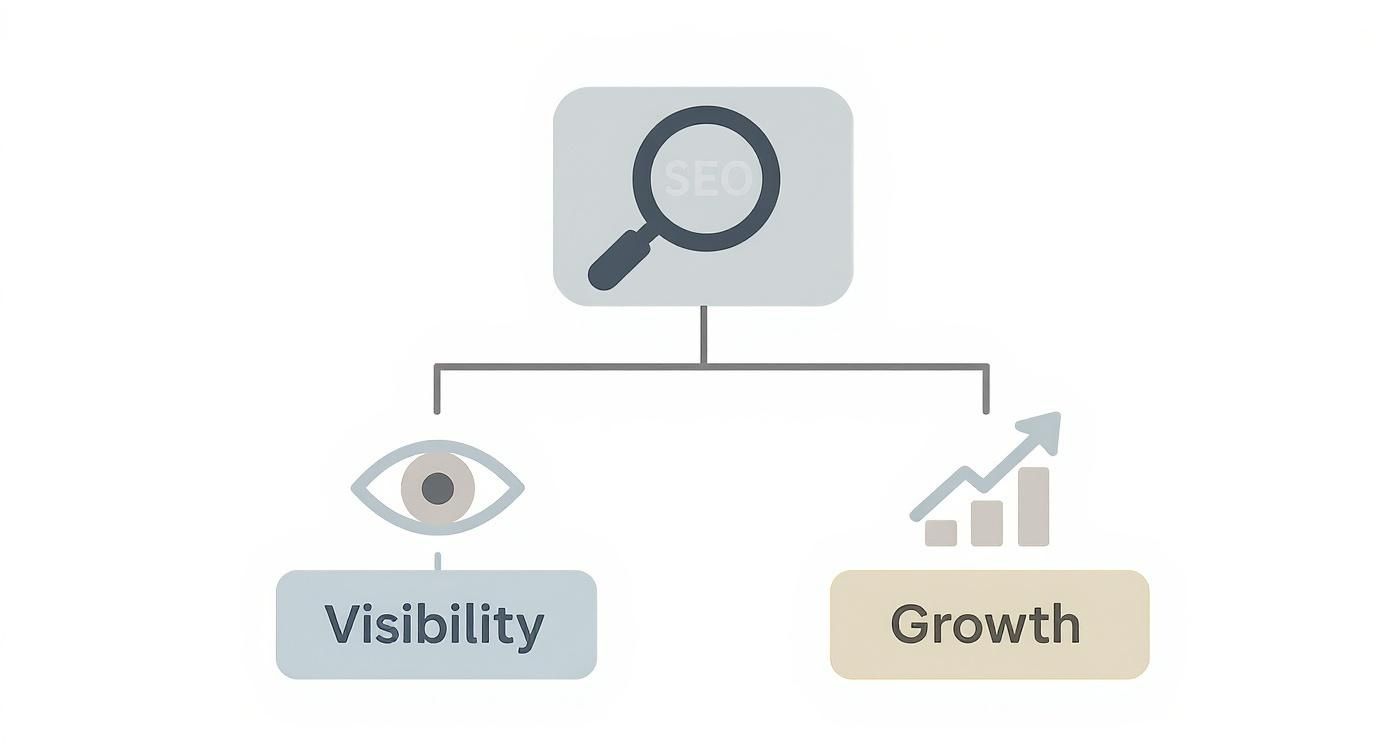
As you can see, a strong SEO foundation leads directly to more online visibility, which is what fuels real, sustainable business growth.
On-Page SEO: Your Digital Shopfront
On-page SEO is everything you do on your actual website to make it crystal clear to both Google and your visitors what you’re all about. It’s how you arrange your products on the shelves, label your aisles, and make your shop feel welcoming.
The best part? This pillar is 100% in your control. It’s all about tweaking your content and the structure of your pages so they’re genuinely relevant to people searching for what you offer.
Key elements of on-page SEO include:
- Keyword Optimisation: This is about figuring out the words your ideal customers are typing into Google (like “accountant for tradies Sydney”) and weaving them naturally into your page titles, headings, and text.
- High-Quality Content: This is the heart of good SEO. It means creating genuinely helpful blog posts, service pages, and guides that actually answer your customers’ questions.
- Clear Page Structure: Using proper headers (H1, H2, H3) helps both search engines and human readers quickly understand what your page is about and how the information is organised.
Off-Page SEO: Your Reputation Around Town
While on-page SEO is what you say about yourself, off-page SEO is what everyone else says about you. It’s your business’s reputation and authority right across the internet. Think of it as word-of-mouth marketing, but for the digital world.
The main goal here is to build trust and credibility. The most powerful off-page signal is backlinks—which are simply links from other websites pointing to yours.
A backlink from a respected industry blog is like getting a personal recommendation. It tells search engines your website is a trustworthy source of information, giving your authority a massive boost.
Other crucial off-page activities include:
- Local Citations: Making sure your business name, address, and phone number are correct and consistent on online directories like Yelp and TrueLocal.
- Google Business Profile: An optimised GBP is a powerhouse for local businesses. If you’re unsure how to optimise your profile properly, our guide on Google Business Profile optimisation explains how businesses can improve local visibility and attract more local searches.
It acts as a mini-website that shows up directly in Google search results. - Online Reviews: Good reviews on Google and other platforms build social proof and signal to search engines that real customers trust and value your business.
Technical SEO: The Solid Foundation
Technical SEO is the stuff that happens behind the scenes. If your shopfront had a broken door, slow service, or a confusing layout, customers would walk right out—no matter how great your products are. It’s the exact same for your website.
This pillar ensures your site is easy for search engines to crawl and index, and that it gives visitors a smooth, hassle-free experience. To build a strong SEO foundation, you need to understand the key search engine ranking factors that Google uses.
Important parts of technical SEO are:
- Site Speed: A slow-loading website is a major turn-off. With 53.3% of all web traffic coming from organic search, users simply won’t wait around for a slow page.
- Mobile-Friendliness: Most searches happen on phones these days, so your site absolutely must look good and work perfectly on any screen size.
- Website Security: Having an SSL certificate (that’s the “HTTPS” bit) is non-negotiable. It protects your visitors’ data and shows both them and Google that your site is trustworthy.
Mastering Local SEO to Win Your Neighbourhood
For most small businesses, the battle for customers isn’t fought on a national stage—it’s won right in your own backyard. Local SEO is how you become the go-to choice for people in your area, showing up at the exact moment they’re searching for your services. It’s all about turning your physical presence into a powerful digital advantage.
This isn’t just a minor tweak; it’s a huge part of any modern small business strategy. Google research shows that 46% of all searches have local intent, highlighting how critical local visibility has become for small businesses.
The link between local searches and real-world business is even stronger: 78% of mobile users who search for a local business will visit a physical store within 24 hours. If you’re ignoring local SEO, you’re leaving money on the table. Simple as that.
Your Most Powerful Local SEO Tool: The Google Business Profile
If there’s one thing you need to get right, it’s your Google Business Profile (GBP). This is the single most important tool in your local SEO arsenal. It’s that info box that pops up in Google Search and Maps, showing your business name, address, hours, photos, and reviews. Think of it less like a listing and more like a free mini-website that Google gives you.
An unoptimised GBP is like having a “closed” sign on your digital front door. But a fully optimised profile acts as a powerful customer magnet, giving people every reason to choose you. For a deeper dive, our guide on what local SEO optimisation involves breaks it all down.
To turn your GBP into a lead-generating machine, get these basics sorted:
- Complete Every Section: Fill out every single field. Your business category, service areas, hours, accessibility info—the lot. The more complete your profile, the more Google trusts you.
- Upload High-Quality Photos: Show off your work, your team, and your shopfront. Profiles with more photos get 42% more requests for driving directions and 35% more clicks to their websites.
- Use Google Posts Regularly: Share updates, offers, and news using the “Posts” feature. It keeps your profile looking active and engaged, which Google loves to see.
- Enable Messaging and Respond Quickly: Let customers contact you directly from your profile and make sure you reply fast. It shows you’re on the ball with customer service.
Finding and Using High-Impact Local Keywords
Local keywords are what your potential customers are typing into Google when they need something now and nearby. These searches are gold because they show a much higher intent to buy than general searches.
Instead of targeting a broad term like “plumber,” which could get clicks from anywhere, a local keyword strategy hones in on specific, location-based phrases. This helps you attract the right kind of traffic—people who are actually close enough to hire you.
A potential customer searching for “plumber” might just be doing research. Someone searching for “emergency plumber in Parramatta” has a burst pipe and needs help right now. That’s the power of local intent.
Here’s how to find and use them effectively:
- Brainstorm Service + Location Combos: Start with the obvious. List all your services and pair them with the suburbs, towns, or regions you serve (e.g., “accountant for tradies Chatswood,” “car detailing North Sydney”).
- Use “Near Me” Modifiers: Searches including “near me” have exploded in recent years. Weave this language naturally into your website content, like, “For residents near Parramatta looking for a reliable plumber…”
- Place Keywords Strategically: Put these local keywords where they count: in your page titles, headings (H1, H2), meta descriptions, and throughout your service page content.
Building Trust Through Reviews and Citations
Beyond your own website and GBP, Google looks for other signals across the web to confirm your business is legit and trusted. The two most important signals here are online reviews and local citations.
Online Reviews: Positive reviews are digital gold. They’re social proof for potential customers and a known ranking factor. Gently encourage satisfied customers to leave a review on Google, but never offer incentives—that’s against Google’s policies. Always respond to all reviews, good and bad. It shows you’re engaged and you care.
Local Citations: A citation is any online mention of your business’s Name, Address, and Phone number (NAP). These listings on directories like Yelp, TrueLocal, and industry-specific sites help Google verify your details. The key here is NAP consistency—your info must be identical everywhere to avoid confusing the search engines.
To help you put this all into action, here’s a quick checklist of the most important local SEO tasks and why they matter for your bottom line.
Local SEO Impact Checklist
This table breaks down the key local SEO actions, explains why they are critical for your business, and highlights the tangible results you can expect.
| Local SEO Action | Why It Matters for Your Business | Potential Impact |
|---|---|---|
| Optimise Google Business Profile | Your GBP is your digital shopfront. It’s often the first interaction a customer has with your brand online. | Increased calls, website clicks, and requests for directions. Higher visibility in local map results. |
| Target Local Keywords | This attracts customers who are nearby and ready to buy, filtering out irrelevant traffic from other areas. | Higher quality leads, better conversion rates, and a stronger connection with your local community. |
| Encourage & Manage Reviews | Positive reviews build trust and social proof, directly influencing a potential customer’s decision to choose you. | Improved local rankings, stronger brand reputation, and more customer confidence. |
| Build Local Citations (NAP) | Consistent NAP information across directories confirms your location and legitimacy to Google. | Better search engine trust, which contributes to higher rankings in local search results. |
By consistently working on these four areas, you’re not just ticking boxes. You’re building a strong, trustworthy local presence that will bring more customers through your door.
Creating Content That Connects and Converts

Look, effective SEO for small businesses goes way beyond just fiddling with technical settings and cramming in keywords. It’s really about positioning yourself as the go-to expert your customers are desperately searching for.
The secret? Creating genuinely valuable, high-quality content. This is how you grab the attention of casual searchers, keep them hooked, and turn them into loyal clients. This isn’t about pumping out generic blog posts for the sake of it. It’s about solving real problems for your audience and proving you’re the best person for the job.
Finding Topics Your Customers Actually Care About
Forget boardroom brainstorming sessions. The absolute best content ideas come directly from your customers’ most urgent questions. You need to get inside their heads. What’s keeping them up at night? What problem are they trying to solve when they type a query into Google?
A great place to start is by listing every single question you’ve ever been asked about your business. Dig through your emails, think back on phone calls, and recall those in-person chats. These are content goldmines just waiting to be tapped.
The most powerful content strategy isn’t complicated: just be the most helpful. When you answer your customers’ questions better than anyone else, Google pays attention.
Once you have a few ideas, you can use free tools to see what people are actively searching for online. A fantastic resource is AnswerThePublic, which maps out all the search questions related to a keyword.
For instance, this is what the tool spits out for “small business accountant”.
Instantly, you’ve got a whole list of blog post ideas like “how to choose an accountant” or “what questions to ask an accountant”—topics that directly hit on a potential customer’s needs.
Structuring Your Content for People and Search Engines
Okay, so you’ve got a killer topic. The next step is to structure your content so both humans and search engines can actually understand it. Let’s be honest, people don’t read websites; they scan them. That makes your formatting choices absolutely critical for keeping them on the page.
A huge, disorganised wall of text is the fastest way to make a visitor click the ‘back’ button. Instead, use a clear structure to make your information easy to digest and navigate.
Try this simple, proven formula for every piece of content you create:
- Catchy Headline (H1): This is your one shot to grab a reader’s attention in the search results. Make it count by including your main keyword and a compelling hook.
- Short Introduction: Hook them in the first few sentences. State the problem you’re solving and promise them a clear solution if they keep reading.
- Descriptive Subheadings (H2, H3): Break up your content into logical chunks with clear subheadings. This helps scanners find what they need and tells Google what each section is about.
- Short Paragraphs: Stick to 1-3 sentences per paragraph. This creates breathing room (white space) and makes the content feel way less intimidating.
- Bulleted and Numbered Lists: Use lists to break down steps, features, or complex ideas. They’re incredibly easy for readers to scan and absorb.
- High-Quality Images: Relevant images, screenshots, or charts do wonders for breaking up text and illustrating your points. Just be sure to use descriptive alt text for every image.
This approach puts your human reader first, which is exactly what Google wants to see.
Write for People, Not Robots
Keywords are still important, but your main focus should always be on providing genuine value. Don’t try to shoehorn keywords into sentences where they just don’t fit. Write naturally. Use a conversational tone. Let your expertise shine through.
When you create content that is truly helpful, you build trust and establish yourself as an authority in your field. This doesn’t just improve your SEO in the long run; it turns readers into customers who believe in what you do. For more in-depth advice on this, check out these Top Content Marketing Tips for Small Businesses.
At the end of the day, great content does more than just rank on Google—it builds a genuine relationship with your audience, creating a reliable stream of organic traffic and qualified leads for your business.
Preparing for the Future of Search with Voice and AI
The way your customers find you online is changing, and it’s happening faster than most people realise. It’s no longer just about typing a few words into a search bar. Now, it’s about asking a question out loud and getting an instant, AI-driven answer. This move toward voice search and artificial intelligence is reshaping SEO for small businesses, and if you get in front of it, you’ll have a serious advantage.
Just think about how you search for things yourself. You probably ask your phone, “Hey Google, where’s the best coffee near me?” or ask a smart speaker to find a local tradie. That conversational, question-and-answer style is quickly becoming the new normal.
Search behaviour is evolving quickly as AI-powered search engines and voice assistants become more common. Businesses that structure their content clearly and answer common customer questions directly are far more likely to appear in AI-generated search results and featured snippets.
The Rise of Conversational Search
Voice assistants and AI are changing the game because they’re changing how people behave. We’re now speaking to our devices in full, natural sentences, not just typing in clunky keywords. All those specific, detailed questions you answer for customers in your shop every day? Those are the exact phrases people are now using to find businesses like yours online.
This isn’t some far-off trend; it’s already a big deal here in Australia. In fact, a huge 33% of Australians are already using voice search every single day. The queries are longer and sound more like a real conversation, and search engines are rewarding businesses that create content to match. You can dive deeper into the Australian SEO landscape over at netstripes.com.
This all means we need to think about our website content in a totally new way.
Optimising for Questions and Answers
To get ready for what’s coming, your content needs to be all about answering your customers’ questions directly. It’s not enough to just list your services anymore. You need to create content that gives clear, simple solutions to their problems.
The goal is to make your website the single most helpful place for any question a potential customer could possibly have. When Google’s AI goes looking for the best answer to a spoken question, you want it to be your website that it finds.
Here’s how you can start tweaking your content for voice and AI search:
- Think in FAQs: Structure your content around questions and answers. You could build out a dedicated FAQ page or simply add Q&A sections to your existing service pages.
- Write like a human: Use a conversational tone that sounds like how people actually talk. Ditch the corporate jargon and stick to clear, straightforward language.
- Target long-tail keywords: Go after longer, more specific search phrases that sound like spoken questions. Instead of “accountant,” think “how much does it cost to hire a small business accountant.”
- Create snippet-ready answers: Keep your answers short and sharp. Aim to answer one question completely in a tight little paragraph, which makes it super easy for Google to grab your content for a featured snippet or an AI summary.
By structuring your content this way, you’re doing more than just optimising for today’s search engines—you’re future-proofing your business. You’re turning your website into a powerful asset that both AI algorithms and real people can understand and trust. Speaking of AI, it’s also being used to create content, and you can learn more by checking out our guide on how AI is being used for content creation in SMBs.
How to Measure Your SEO Success
You’ve put in all this work on your SEO, but how can you be sure it’s actually paying off? Measuring success isn’t about getting lost in confusing charts and endless spreadsheets. It’s about tracking a few key numbers that show a real-world impact on your business.
For a small business, good SEO means focusing on the metrics that directly lead to more customers and more revenue. Forget the vanity stats; we’re talking about tangible results.
Key Metrics That Actually Matter
To stop yourself from getting bogged down in data, zone in on a handful of Key Performance Indicators (KPIs). These are the numbers that paint a clear, honest picture of how your SEO is performing.
Your most important KPIs are:
- Organic Search Traffic: This is simply the number of visitors who find your website through a search engine like Google. A steady increase here is a great sign your visibility is growing.
- Keyword Rankings: Tracking where you show up for your target keywords (like “emergency plumber in Parramatta”) tells you if your optimisation is hitting the mark. Moving up the ranks means you’re capturing more valuable traffic before your competitors do.
- Google Business Profile Leads: For any local business, this is gold. It includes phone calls, requests for directions, and clicks to your website—all coming straight from your GBP listing.
Setting Up Your Tracking Tools
The best part? You don’t need fancy, expensive software to keep an eye on these metrics. Google gives you powerful, free tools that provide all the data you need to get started.
Your goal isn’t just to get more clicks, but to attract the right clicks. Tracking these metrics helps you understand if you’re reaching customers who are genuinely interested in what you offer.
The two non-negotiable tools you’ll need are:
- Google Analytics (GA4): This tells you everything about who is visiting your website. You can see how many people are coming from organic search, what pages they look at, and how long they stick around.
- Google Search Console (GSC): This tool is all about your site’s performance in Google Search. It shows you which keywords people are using to find you, what your average ranking position is, and flags any technical hiccups that might be holding you back.
While these are the cornerstones, there are plenty of other platforms that can support your strategy. To see what else is out there, check out our guide on the best free SEO tools available for small businesses.
Your Simple 90-Day SEO Plan
Learning about SEO is one thing, but taking action is what gets results. Here’s a quick look at the key metrics you should be tracking to measure your progress over the next 90 days.
Key SEO Metrics for Small Businesses
This table breaks down the most important numbers, what they mean, and which free tool you can use to track them.
| Metric | What It Measures | Tool to Use |
|---|---|---|
| Organic Traffic | The number of visitors arriving from search engines. | Google Analytics |
| Keyword Rankings | Your website’s position for specific search terms. | Google Search Console |
| GBP Interactions | Calls, direction requests, and website clicks from your profile. | Google Business Profile Insights |
Use this as your starting point to set goals, put the strategies in this guide into practice, and keep tabs on your progress. SEO is a long game, but consistent effort and smart measurement will put you on the right track for sustainable growth.
Got Questions About Small Business SEO? We’ve Got Answers
If you’re just dipping your toes into the world of SEO, it’s natural to have a few questions. Let’s cut through the noise and tackle the ones we hear most often from small business owners just like you.
How Long Does It Really Take to See SEO Results?
This is the big one, isn’t it? The honest answer is that SEO is a long game, not a quick win. You should start to see some positive movement—think small jumps in keyword rankings and a slight uptick in traffic—within about 3 to 6 months.
But for the kind of consistent, lead-generating results that truly move the needle, you’re looking at a 6 to 12-month timeline. Why? Because you’re building trust with Google, and that doesn’t happen overnight. It takes time for search engines to recognise and reward all the great optimisation work you’re doing.
Think of SEO like planting a tree. You don’t get fruit the day after you plant the seed. But with consistent watering and care, you build something strong and sustainable that pays you back for years.
Can I Do SEO Myself, or Do I Need to Hire an Expert?
You can absolutely get started on your own. In fact, you should! Foundational tasks like beefing up your Google Business Profile and writing helpful blog posts are well within your reach. This guide gives you the perfect starting point.
So, when does it make sense to call in a pro?
- You’re out of time: As your business grows, your time is better spent running it. An expert can take over SEO while you focus on what you do best.
- You’ve hit a wall: If your results have flatlined, a professional can dig deeper to find out what’s holding you back and implement more advanced tactics.
- Your market is cut-throat: Trying to outrank established competitors often requires a more aggressive and technical SEO strategy.
What’s the Single Most Important Part of SEO for a Small Business?
For most local, service-based businesses, the answer is simple: local SEO. Your main goal is to get in front of customers right in your neighbourhood, and that’s exactly what local SEO is built for.
This means your Google Business Profile isn’t just important—it’s everything. It is the most powerful tool you have for driving local calls, website clicks, and people through your door. While website content and technical fixes matter, a rock-solid GBP often delivers the fastest and biggest return on your effort. Start there, and you’ll have a powerful foundation to build on.
Ready to stop guessing and start growing? Homer Digital Marketing uses proven strategies to help service-based businesses like yours attract the right clients and scale with confidence. Let’s build a marketing system that works for you. Learn more about how we can help.
