

If you run a local business, you’ve probably asked, what is local SEO optimization and why does it matter? Simply put, local SEO is like putting your shop window on the busiest digital street in town. A staggering 97% of people search online to find a local business. If you don’t show up in the top 3 Google Maps results (the "local pack"), you’re basically invisible to high-intent customers ready to buy. These are the people actively searching for your services, right now, in your neighbourhood.
This guide moves beyond fluffy theory to give you a clear, actionable framework for dominating your local market. We will break down the essential components of local SEO for small businesses, showing you exactly how to claim your spot at the top. You’ll learn how to master your Google Business Profile, generate a steady stream of five-star reviews, and ensure your business information is accurate everywhere it appears online. If your competitor is in the top 3 map results, they’re getting the calls you should be getting—and we're here to fix that.
What is Local SEO Optimization? A Clear Definition
Local SEO (Search Engine Optimization) is the process of improving your online visibility to attract more customers from relevant local searches. These are the searches that happen on Google and other search engines that include a geographic component, like "plumber near me," "best coffee in Melbourne," or "chiropractor in Richmond."
Unlike traditional SEO which focuses on ranking nationally or globally, local SEO optimization focuses on ranking your business for people in a specific service area. The goal is to appear in the Local Pack (the box with three businesses and a map) and in the localized organic search results that appear just below it. It drives high-intent traffic because people making these searches are typically ready to call, visit, or buy.
Why is Local SEO Critical for Your Small Business?
If you're a brick-and-mortar or service-area business, local SEO isn't just important—it's your lifeline. It levels the playing field, allowing a small, well-optimized business to outrank big national competitors in local search results.
Here’s why it matters:
- High-Intent Customers: People searching locally are ready to take action. They aren’t just browsing; they have a problem and need an immediate solution.
- Dominate the "Local Pack": If you don’t show up in the top 3 Google Maps results, you’re missing out on the majority of clicks, calls, and foot traffic.
- Builds Trust and Credibility: A strong local presence with great reviews and consistent information signals to both customers and Google that you are a reputable, trustworthy business.
- Cost-Effective Marketing: Without it, you miss out on "easy wins" from calls, bookings, and walk-ins that your competitors will get by default. Local SEO delivers one of the highest ROIs of any marketing channel.
The Key Components of Local SEO Optimization
A successful local SEO marketing strategy is built on several core pillars. Each one sends powerful signals to Google about who you are, where you are, and why you’re the best choice for local customers.
1. Google Business Profile (GBP) Mastery: Your Digital Front Door
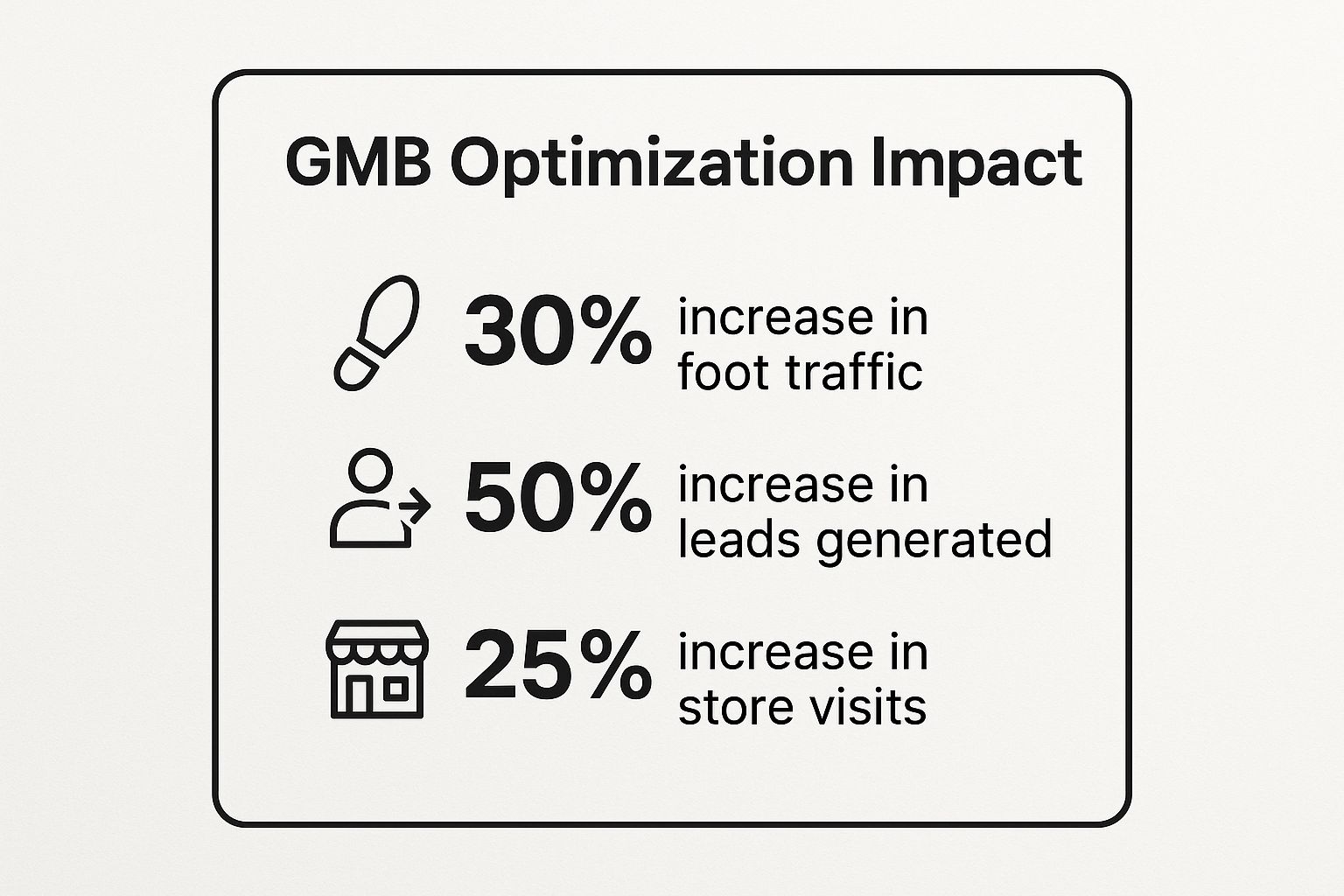
Think of your Google Business Profile (GBP) as the cornerstone of your local online presence. This free tool directly controls how you appear on Google Search and, crucially, Google Maps. Fully optimising every section—from your description and services to images, keywords, and posts—is non-negotiable.
When someone searches for "best cafe near me," the results they see in the prominent 'map pack' are pulled directly from Google Business Profiles. This is why mastering your GBP is the first step.
2. Review Generation Systems: Your Social Proof
Authentic 5-star reviews are digital gold. They are a massive ranking factor for Google and the single most powerful form of social proof for potential customers. A strategy to consistently collect positive reviews is essential. People trust other people, and a steady flow of recent, positive feedback can be the deciding factor between you and a competitor.
3. Citations and Directories: Your Online Footprint
A citation is any online mention of your business's Name, Address, and Phone number (NAP). Ensuring this information is 100% consistent across all platforms—like Google, Yelp, Bing, Apple Maps, and industry-specific directories—is critical. Inconsistent information confuses search engines and erodes trust, which hurts your Google Maps ranking.

4. Localised Content Marketing: Your Voice in the Community
This is where you prove your local authority. By publishing blogs, FAQs, and service pages that target suburb- or city-specific searches (e.g., "Emergency Plumber in Richmond"), you tell Google you are the expert for that area. This content attracts highly qualified local traffic and establishes you as the go-to resource.

5. Technical On-Page SEO: Your Website's Foundation
This involves fixing the behind-the-scenes elements of your website to make it easy for Google to understand. Key technical factors include NAP consistency on your website, using local schema markup (a code that explains your business to Google), and ensuring your site is mobile-friendly and loads quickly.
Common Mistakes Businesses Make with Local SEO
Many businesses try to tackle local SEO but make critical errors that render their efforts useless. The most common mistakes include:
- Ignoring Reviews: Not asking for reviews or failing to respond to negative ones is a huge red flag for both customers and Google.
- Incorrect Business Information: Even a small difference in your address or phone number across directories can tank your rankings.
- No Local Keywords: Writing website content that doesn't mention the specific suburbs or cities you serve.
- An Incomplete GBP: Leaving sections of your Google Business Profile blank is a massive missed opportunity.
- Inconsistency: Dabbling in local SEO for a month and then stopping. It requires ongoing, consistent effort to see results.
Real Success Stories: Local SEO in Action
Theory is one thing, but results are what matter. Here are real-world examples of how a focused local SEO optimization strategy transformed Australian businesses:
- The Melbourne Restaurant: Ranked #1 on Google Maps, doubling foot traffic in under 60 days through GBP optimisation and a review generation system.
- The Local Buyer’s Agent: Went from "invisible online" to 3x inbound leads within 3 months by focusing on reviews, suburb-specific content, and profile optimisation.
- The Cleaning Business: Generated 40% more bookings just by fixing inconsistent citations, boosting their reviews, and fully optimising their Google Business Profile.
- The Chiropractor: Improved their ranking from page 5 to the top 3 in the local pack, resulting in a consistent flow of new patient enquiries.
How to Get Started with Local SEO Today: A Step-by-Step Guide
Ready to take control of your local visibility? Here are actionable steps you can take right now.
- Claim and Fully Optimise Your Google Business Profile: This is your #1 priority. Fill out every single section. Use relevant keywords in your business description and services. Upload at least 10 high-quality photos. For more details, see our guide on what you should put on your Google Business Profile.
- Conduct an NAP Audit: Search for your business online and create a spreadsheet of all your listings. Check for any inconsistencies in your name, address, or phone number and start correcting them. Use our list of the best free SEO tools to use to help.
- Start a Review Generation Campaign: Identify your happiest customers and make it easy for them to leave a review. Send a direct link via email or SMS right after a successful service.
- Respond to ALL Reviews: Thank every positive reviewer. For negative reviews, respond professionally and try to resolve the issue. This shows potential customers you care. Learn more in our guide on what is reputation management and why is it important.
- Create One Piece of Local Content: Write a blog post titled "5 Reasons to Hire a [Your Service] in [Your Suburb]." This is a simple way to start targeting local keywords and demonstrating your expertise.
Why DIY Often Fails vs. Working with an Expert
While the steps above seem straightforward, the reality is that effective local SEO optimization requires time, consistency, and deep technical know-how. Business owners often start with good intentions but quickly get bogged down.
DIY efforts often fail due to:
- Time Constraints: You need to run your business, not spend hours every week auditing citations or responding to reviews.
- Lack of Consistency: Local SEO is a marathon, not a sprint. Sporadic efforts won't move the needle against competitors who are consistent.
- Technical Knowledge: Implementing schema markup, optimising site speed, and navigating Google's constant algorithm updates requires specialised expertise.
Working with a local SEO expert like Maini Homer means you get a proven system built on years of experience. We handle the technical complexities, build the systems for reviews and content, and track the results, so you can focus on what you do best: serving your customers.
About the Author
Maini Homer, founder of Homer Digital Marketing, is a #1 International Bestselling Author and marketing strategist who’s built 18 companies from the ground up. With over 108 million Google views across her businesses, she’s become known as “the visibility queen.” Her speciality is helping service-based businesses dominate both Google Search and Google Maps through smart, results-driven local SEO optimization.
Ready to stop losing customers to your competitors and start dominating your local search results? It’s time to make your business the #1 choice in your area. Book a free, no-obligation local SEO audit today and let's uncover the exact steps to get you to the top of Google Maps.
