
Trying to figure out how much an ad on Google costs? You’re not the only one asking. The short answer is: it’s complicated. For an Aussie service business, a single click could set you back anywhere from a few bucks to over a hundred. It’s a huge range, and it all comes down to how you play the game.
Why There’s No Simple Price List for Google Ads

Unlike buying a print ad with a fixed price tag, Google Ads is a live, fast-paced auction. Every single time someone searches for something, businesses like yours are bidding in real-time for the chance to show up. This means your price isn't set in stone; it’s determined by what your competitors are willing to pay and, crucially, how relevant your ad is.
Think of it like an auction, but with a clever twist. Google doesn't just hand the top spot to the person with the deepest pockets. It rewards the smartest advertiser. And that’s where most business owners get stuck.
Understanding the Key Players in the Auction
The entire Google Ads system boils down to a few core ideas that directly control how much you spend. Get your head around these, and you’ll be in a much better position to manage your budget.
- Cost Per Click (CPC): This is the bread and butter. It's the exact amount you pay every time someone clicks on your ad, decided by the live auction.
- Ad Rank: This is the score that decides where your ad appears on the page. It’s a simple formula: your maximum bid multiplied by your Quality Score.
- Quality Score: This is basically Google’s report card on your ads, keywords, and landing page. A higher score means you can land better ad positions for a lower price.
A great Quality Score is Google's way of giving you a discount for making users happy. If your ad is super relevant to what someone is searching for, you can actually pay less per click than a competitor with a massive budget but a sloppy, irrelevant ad.
What This Guide Will Show You
Feeling a bit overwhelmed? Don't be. This guide is built to cut through the noise for Australian service businesses just like yours. We’ll break down exactly how your industry, your keywords, your ad quality, and even where you're located all feed into your final bill.
By the end, you won't just know how much an ad on Google costs—you’ll have a clear, strategic plan to manage that cost and get the best possible return on your investment.
Decoding Google’s Pricing Models
Before you can nail down an answer to "how much does a Google ad cost?", you first need to get your head around what you're actually paying for. Google doesn't have a one-size-fits-all price tag. Instead, it offers a few different ways to pay, each built for different business goals.
Think of it like this: you can pay for every person who walks into your shop, or you can pay a flat fee to rent a billboard on the highway. Choosing the right model is the first step to making sure your ad spend isn't just a cost, but an investment that gets you the results you want.
Cost Per Click (CPC): Pay for Genuine Interest
The most common model you’ll come across is Cost Per Click (CPC). It’s simple: your ad can be shown a thousand times, but you don't pay a cent until someone actually clicks on it.
Imagine your website is your physical shopfront. With CPC, you only pay a small fee when a genuinely interested customer decides to walk through your door. You’re not paying for the thousands of people who just walk past; you’re paying only for those who show enough interest to come inside and have a look around.
For most service businesses in Australia—whether you're a plumber in Melbourne or an IT consultant in Brisbane—this is the go-to model. It directly links your ad spend to getting traffic to your site, making it perfect for campaigns focused on generating quote requests and phone calls.
Cost Per Mille (CPM): Pay for Brand Visibility
Next up is Cost Per Mille (CPM), where "mille" is Latin for a thousand. With this model, you pay a set price for every 1,000 times your ad is shown (an "impression"), regardless of whether anyone clicks.
Think of CPM as that billboard on a busy digital highway. Your main goal isn't to get every driver to pull over right away; it's to make sure they all see your brand name. Over time, that constant exposure builds familiarity and trust, so when they do need your service, you're the first one they think of.
This approach is best for brand awareness. A new real estate agency wanting to get its name known in the Sydney market, or a wellness coach launching a new program, might use CPM to get in front of as many eyes as possible. To get a better handle on this, you can learn more about the cost per impression formula and see how it works.
Cost Per Acquisition (CPA): Pay for Confirmed Results
Finally, we have Cost Per Acquisition (CPA), sometimes called Cost Per Action. This is the ultimate pay-for-performance model, where you only pay when someone completes a specific, valuable action on your website.
This ‘action’ is a conversion that you get to define. It could be a client booking a consultation, someone filling out your contact form, or downloading your pricing guide. You’re not just paying for a click or a view; you’re paying for a tangible business result.
CPA is like paying a salesperson a commission only after they've closed the deal. For high-value service businesses, like a buyer's agent signing a new client or a recruitment agency placing a candidate, this model is incredibly powerful. It ties your ad spend directly to revenue-generating activities, cutting out the risk and maximising your return.
So, which model is right for you? It all comes down to your business goals. The table below gives you a quick breakdown to help you decide.
Google Ads Pricing Models at a Glance
This table offers a quick comparison of the main Google Ads pricing models, helping you see which one best fits your campaign goals at a glance.
| Pricing Model | What You Pay For | Best For | Example Use Case (Service Business) |
|---|---|---|---|
| Cost Per Click (CPC) | Each click on your ad | Driving immediate website traffic and generating leads. | An electrician wants phone calls for emergency repairs. |
| Cost Per Mille (CPM) | Every 1,000 ad impressions | Building brand awareness and visibility in a target market. | A new accounting firm wants to become known locally. |
| Cost Per Acquisition (CPA) | A specific conversion (e.g., form submission) | Maximising ROI by paying only for confirmed results. | A consultant wants to get qualified client bookings. |
Understanding these models is the key. It shifts the question from a simple "how much does it cost?" to a much smarter, more strategic "how do I want to invest my budget for the best possible outcome?".
The 7 Key Factors Driving Your Google Ad Costs
Ever wondered why one business pays $5 per click while their competitor pays $50 for a similar search term? It’s not random. Google’s ad auction is a dynamic system controlled by seven core factors.
Getting your head around these is the difference between just paying whatever Google asks and actively managing your ad spend to get more bang for your buck. Let's break down what really moves the needle, especially for service businesses here in Australia.
First, this diagram shows the three main ways you pay for ads—CPC, CPM, and CPA—and how they all fit into the ad auction.
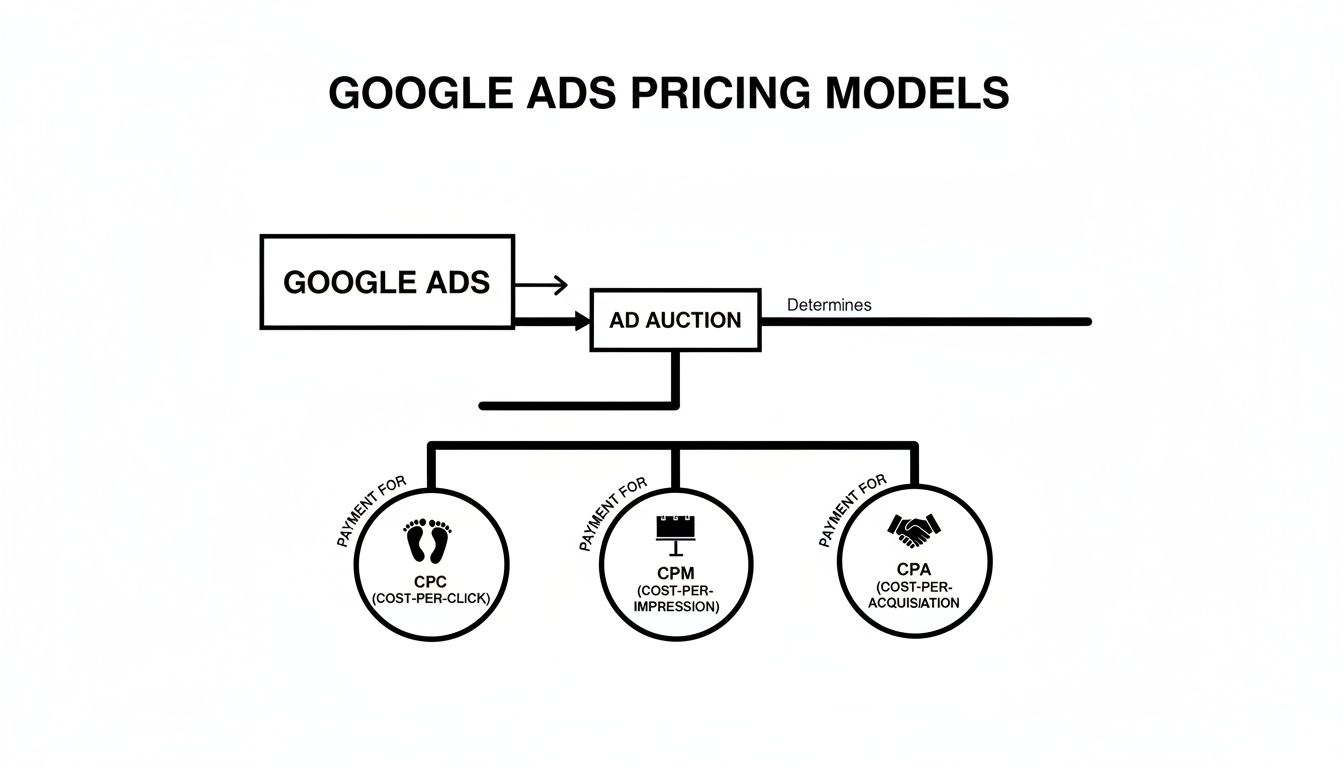
Each model lines up with a different goal, whether that’s paying for clicks (engagement), views (visibility), or actual leads (results).
1. Industry and Keywords
Your industry is, without a doubt, the biggest factor determining your costs. Some sectors are just plain competitive, with businesses falling over each other to pay top dollar for a high-value lead.
Take a real estate agent in Sydney. While the average cost-per-click (CPC) across Google Search is around $2 to $4 AUD, that’s a fantasy in their world. For a keyword like ‘buyer’s agent Sydney,’ they could be staring down the barrel of $10+ per click. Why? Because landing just one client is worth thousands in commission, so the maths makes sense. You can learn more about how budgets work for Aussie businesses on roi.com.au.
On the other hand, a local massage therapist targeting ‘remedial massage near me’ will face way less competition and enjoy much lower click costs. It’s all about supply and demand.
2. Quality Score
Think of your Quality Score as your reputation with Google. It’s a rating from 1 to 10 that Google gives your keywords to measure how relevant and helpful your ad is to the user. A high score is your ticket to lower ad costs.
A high Quality Score is basically a discount. Google rewards you for creating a good user experience by letting you pay less than your competitors for the same ad position.
It’s built on three key pillars:
- Expected Click-Through Rate (CTR): Based on your ad copy and keywords, how likely is someone to actually click on your ad?
- Ad Relevance: Does your ad directly match what the person searched for?
- Landing Page Experience: When someone clicks, does your website deliver on the ad’s promise? Is it easy to use and relevant?
Improving your Quality Score is one of the most powerful levers you can pull to slash your ad spend without hurting your results.
3. Ad Rank
Okay, so Quality Score is your reputation. Ad Rank is what decides where you actually show up on the page. And it’s not just about who throws the most money at it.
The formula is surprisingly simple: Your Max Bid x Your Quality Score = Your Ad Rank.
This means an advertiser with a killer Quality Score of 10 and a bid of $4 (Ad Rank = 40) can actually outrank a lazy competitor with a Quality Score of 2 who’s bidding $15 (Ad Rank = 30). Not only do they get a better spot, but they pay a fraction of the price for it.
4. Location Targeting
Where you show your ads has a huge impact on what you pay. Targeting the hyper-competitive Melbourne CBD will always cost more than targeting a regional town in Queensland.
There’s simply more competition fighting for the same eyeballs in major cities. This is where you can get strategic. If you offer a remote service, you might discover gold by targeting less saturated areas where your ideal customers live, but your competitors aren't looking.
5. Device Targeting
The device someone is using also changes the game. Clicks from mobile phones can be cheaper or more expensive than desktop clicks, and it all comes down to user behaviour in your industry.
For instance, someone searching for an "emergency plumber" is almost certainly on their phone, ready to call right now. Those mobile clicks are incredibly valuable and therefore more competitive. By looking at your data, you can adjust your bids to spend more on the devices that deliver the best returns.
6. Ad Format and Extensions
The type of ad you run and whether you use extensions matters, too. Ad extensions are the extra bits of info you can add to your ad, like site links, call buttons, and your business address.
They make your ad physically bigger on the results page and give users more reasons to click on your ad instead of someone else’s. This naturally boosts your click-through rate, which, as we now know, improves your Quality Score and brings your costs down. It’s a win-win.
7. Your Bidding Strategy
Finally, the instructions you give Google on how to spend your money will directly affect your costs. You can set bids manually or use Google’s automated bidding strategies.
- Maximise Clicks: Tells Google to get you the most clicks possible within your budget. Good for driving traffic.
- Maximise Conversions: Tells Google to find people most likely to take valuable actions, like filling out a form or calling you.
- Target CPA (Cost Per Acquisition): You set a target price you’re willing to pay for a lead, and Google’s algorithm works to hit it.
Choosing a strategy that matches your business goals is the final piece of the puzzle to make sure every dollar you spend is working as hard as it can.
Australian Google Ads Cost Benchmarks and Sample Budgets
Knowing the theory is one thing, but seeing real numbers makes it all click. Let’s stop asking, "how much does an ad on Google cost?" and start asking a better question: "What can I actually get for my money here in Australia?"
This is where we get into the nitty-gritty of real-world costs and what you can expect when you put your budget to work.
Cost Per Click Benchmarks in Australia
The cost-per-click (CPC) swings wildly from one industry to the next. A click for a local wellness coach is going to be far cheaper than a click for a national IT firm bidding on hyper-competitive corporate keywords.
Here’s a rough guide to what you might pay in some key Aussie service industries:
- Real Estate: This is a seriously competitive space, especially in hubs like Sydney and Melbourne. CPCs can go anywhere from $5 to over $25 for high-value terms like "buyer's agent Sydney."
- IT Services: A massive category where costs really depend on your specialty. Keywords like "managed IT support" can easily demand $15-$40+ per click because the lifetime value of a single client is so high.
- Recruitment: Much like real estate, this is a bidding war. You can expect to pay $10-$30 per click for phrases like "executive search firms."
- Wellness & Coaching: This is generally a more affordable field. A local yoga studio targeting "yoga classes near me" might only pay $2-$8 per click. A business coach with a national audience, however, could see CPCs closer to $7-$15.
While these Australian benchmarks are a great starting point, it's also smart to see how they stack up against the global average cost per lead by industry.
Sample Monthly Budgets Unpacked
Your budget isn’t just about spending money; it’s about buying data and speed. The more you can invest, the faster you can learn what works and start optimising.
Just a heads-up: these are estimates. Your actual results will hinge on your industry, Quality Score, and the smarts behind your campaign strategy. The real goal here is to set some realistic expectations.
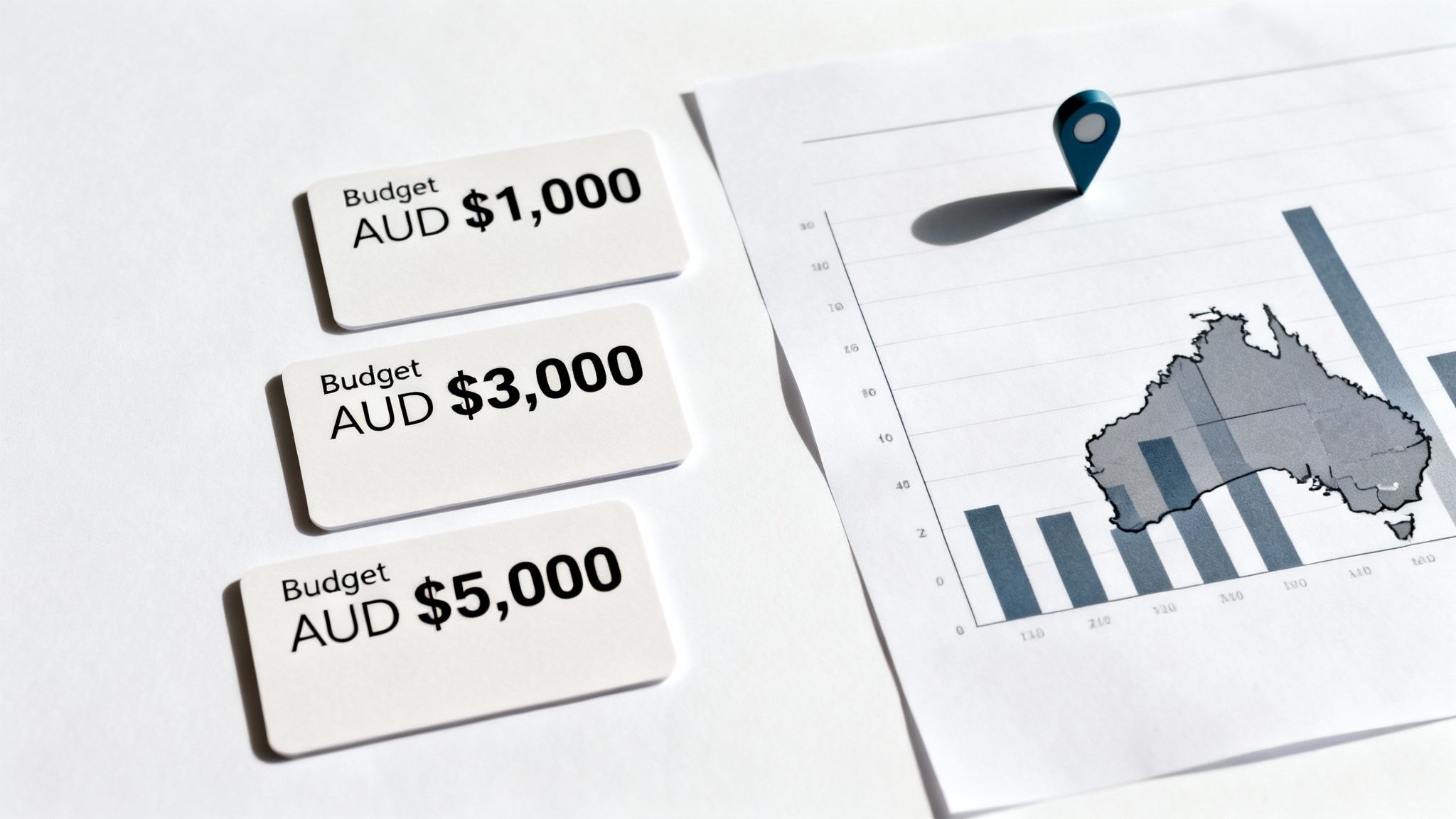
To make this tangible, the table below shows what different budget levels can potentially achieve, helping you match your spending to your business goals.
Sample Monthly Google Ads Budgets for Australian Service Businesses
This table illustrates potential outcomes at different budget levels, helping businesses set realistic expectations for their ad spend.
| Monthly Budget | Target Industry | Estimated Clicks (Low Competition) | Estimated Clicks (High Competition) | Primary Goal |
|---|---|---|---|---|
| $1,000 | Wellness, Local Trades | 200 – 400 Clicks | 40 – 80 Clicks | Test the market, generate initial traffic, and gather data. |
| $3,000 | Consultants, Coaches | 400 – 800 Clicks | 100 – 200 Clicks | Achieve a consistent flow of leads and start optimising for conversions. |
| $5,000+ | Real Estate, IT Services, Recruitment | 800+ Clicks | 200+ Clicks | Dominate a niche, scale lead generation, and maximise ROI. |
As you can see, a bigger budget doesn't just buy more clicks; it buys you a foothold in more competitive—and often more lucrative—markets.
The Role of Agency Management Fees
It’s tempting to DIY your Google Ads, but you have to factor in the cost of your own time and the steep learning curve. The alternative is partnering with a digital marketing agency.
Think of agency fees not as a cost, but as an investment in getting the best possible return. A good campaign manager saves you money by cutting wasted spend, boosting your Quality Score, and spotting profitable keywords you’d probably miss.
In Australia, agency retainers typically run from $800 to over $5,000 per month. Some charge a percentage of your ad spend, usually 10-20%. With average monthly spends for Aussie businesses sitting between $5,000-$20,000, and 88% of them reporting new customer wins, getting expert help often pays for itself.
Ultimately, your budget is just a tool. By understanding these benchmarks, you can set a smart starting point and build a strategy that drives real, measurable growth for your business.
Proven Strategies to Lower Your Ad Spend
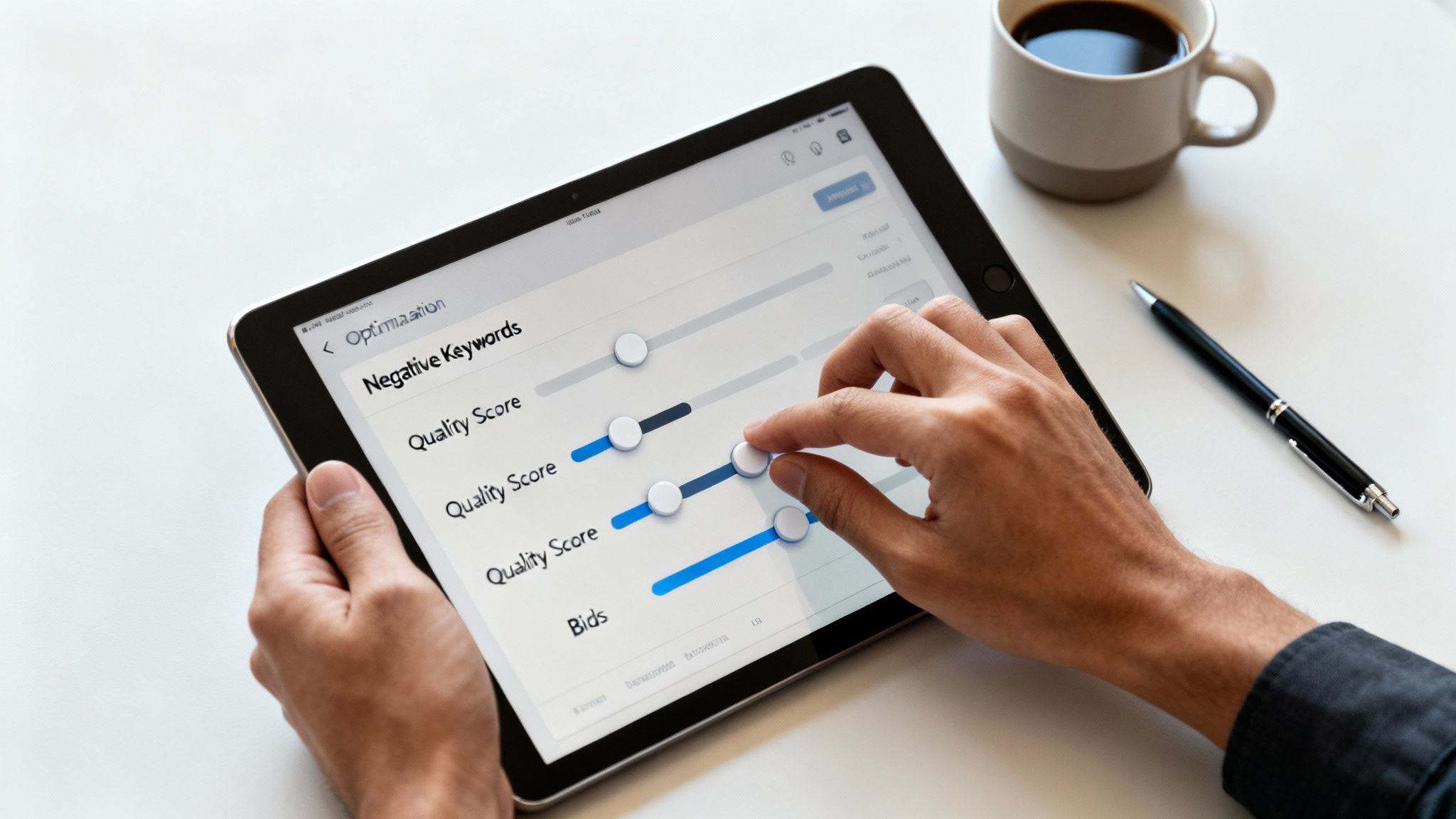
Knowing what drives up your Google Ads cost is one thing. Actually taking control of it is another. This is your playbook for making every dollar work smarter, cutting wasted spend, and seriously boosting your return on investment.
These aren’t just theories; they're the battle-tested tactics we use every single day to get results for our clients. It's time to stop just accepting high costs and start actively driving them down.
Build a Rock-Solid Negative Keywords List
One of the fastest ways to burn through your budget is by paying for completely irrelevant clicks. A negative keywords list is your first line of defence. It tells Google which search terms you don't want your ads showing up for.
Imagine you’re a recruitment agency targeting employers with "IT recruitment services." Without a good negative list, you'll waste money on job seekers searching for "IT recruitment jobs." By adding words like "jobs," "careers," and "resume" to your negative list, you instantly filter out that unqualified traffic.
Make it a habit to check your search term report in Google Ads. Find those irrelevant queries and add them to your list. It’s a simple action that ensures your budget is spent only on people who actually want what you're selling.
Relentlessly Improve Your Quality Score
We've touched on this already, but it's worth repeating: your Quality Score is the single most powerful lever you can pull to reduce your ad spend. Think of it as Google's report card on your ads—a higher score gets you a lower cost-per-click. It's that simple.
Focus your energy on these three pillars:
- Ad Relevance: Write ad copy that speaks your customer's language. If they search for "emergency plumber Sydney," your headline should mirror that exact need.
- Expected Click-Through Rate (CTR): Make your ads impossible to ignore. Use a strong call-to-action, highlight what makes you different, and create a sense of urgency. Get them to click.
- Landing Page Experience: The page someone lands on after clicking your ad must be a perfect match. It needs to be fast, work beautifully on a phone, and make it dead simple for them to take the next step.
Maximise the Power of Ad Extensions
Ad extensions are free add-ons that bolt extra, clickable information onto your ads. This makes your ad bigger, more noticeable, and far more useful on the search results page. Think of it as a free upgrade to your ad space.
By taking up more digital real estate and providing extra information at a glance, ad extensions can significantly boost your Click-Through Rate (CTR). This, in turn, improves your Quality Score and lowers your CPC.
You should be using every relevant extension you can. For service businesses, these are non-negotiable:
- Sitelink Extensions: Point people to key pages like 'Our Services' or 'Book a Consultation.'
- Call Extensions: Add your phone number so mobile users can call you with a single tap.
- Location Extensions: Show your address and a map—absolutely critical for local tradies and professionals.
Implement Smart Bidding Strategies
Stop just bidding for clicks. Start bidding for results. Google’s smart bidding strategies use machine learning to get you more conversions without you having to manually tweak bids every five minutes.
Instead of setting bids yourself, try a strategy like Maximise Conversions. You're essentially telling Google, "Here's my daily budget, now go find me the most leads you can for this money." This data-driven approach means you're paying for actions that actually grow your business, not just traffic.
Of course, for this to work, you need a solid plan for turning those clicks into customers. That’s where a proper strategy for conversion rate optimisation in Australia becomes absolutely vital.
Your Next Steps to a Profitable Campaign
You've made it through the nuts and bolts of Google Ads pricing. The biggest takeaway? Your ad spend isn't some fixed, unavoidable cost—it’s a number you can absolutely control with the right strategy.
Profitability isn't about throwing the most money at Google. It's about making every single dollar pull its weight through a smart combination of relevance, quality, and non-stop tweaking.
Build a Data-Driven Plan
It's time to stop guessing and start planning with real numbers. The first job is to turn those clicks you’re paying for into actual customers. Getting a great return means looking beyond low-cost clicks and focusing obsessively on conversions. A great starting point is implementing proven conversion optimization best practices to ensure your landing pages are doing their job.
A successful Google Ads campaign is a marathon, not a sprint. It relies on consistent testing, learning, and refining your approach based on what the performance data tells you.
This constant cycle of testing and improving is what turns your ad spend from an expense into a powerful investment.
If you’re ready to put all this theory into action for your service business, the path forward is clear. Getting a campaign off the ground that actually delivers growth takes time and real-world experience. If you'd rather accelerate the journey, consider partnering with a dedicated Google Ads specialist who can get you to profitability, faster.
Your Top Questions Answered
When you're diving into Google Ads, a few questions always come up, especially around budget and what to expect. Here are the straight answers we give Australian service business owners, so you can plan your next move with confidence.
Is $500 a Month Enough for Google Ads in Australia?
Honestly, for most service businesses in a competitive Aussie market, $500 a month just won't cut it. It might be enough to dip your toe in the water in a very small, local area with almost no competition, but you won't get enough data to make smart decisions.
For industries like real estate, IT support, or professional services, a budget that small gets swallowed up fast. Think of it as a small test to see what happens, not a budget for actual growth. You need enough spend to gather proper performance data, run meaningful tests, and give Google's algorithm enough room to actually learn who your best customers are.
How Long Until I See Results from Google Ads?
You’ll see clicks and traffic from day one, but seeing a consistent, profitable return on investment (ROI) isn’t instant. It typically takes between one and three months.
Why so long? The first 90 days are all about learning.
This initial period is your data-gathering phase. It's where you discover which ads connect with people, which keywords actually lead to sales, and which audiences are a waste of money. Patience here is everything.
Too many businesses pull the plug too early, look at the initial mediocre results, and mistakenly decide "Google Ads doesn't work for me." In reality, they just didn't finish the learning phase.
Should I Manage Google Ads Myself or Hire an Agency?
Going the DIY route can seem like a great way to save money at first. The reality is that it comes with a massive learning curve and demands a huge time commitment to keep up with constant platform changes. Managing Google Ads properly is a full-time job.
Hiring an expert agency, on the other hand, gives you instant access to specialised skills and strategic insights that come from managing hundreds of campaigns. This expertise almost always leads to a much higher ROI by slashing wasted ad spend and getting you results faster. At the end of the day, it frees you up to focus on what you’re brilliant at: running your business.
Ready to stop guessing and start getting real, measurable results from your marketing? At Homer Digital Marketing, we build data-driven Google Ads campaigns that connect you with your ideal clients.
Book a free consultation today and let's build a profitable strategy for your service business.
