
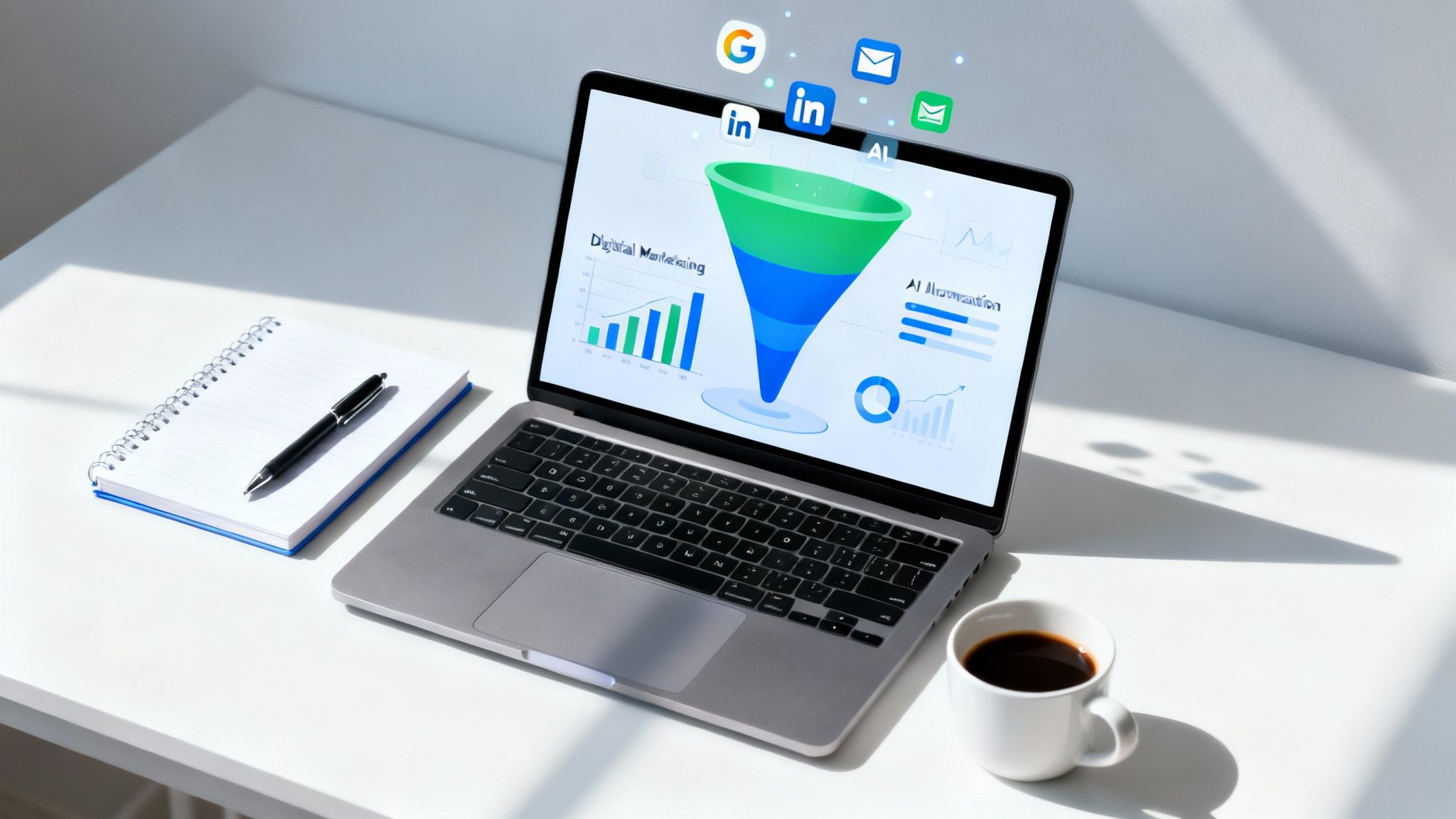
Are you struggling to find a consistent, predictable flow of ideal clients for your service business? You're not alone. Many business owners find themselves trying random tactics, hoping something sticks, only to end up frustrated.
This guide is your complete roadmap. We're going to break down exactly how to build a powerful client acquisition machine from the ground up. Think of your digital marketing as the high-performance engine and lead generation as the high-octane fuel that powers sustainable growth. This actionable guide promises to show you how to connect all the dots—from boosting your visibility on Google and establishing authority on LinkedIn to using smart automation—to create one cohesive, powerful strategy.
Forget the guesswork. It's time to build a proven system that attracts high-value clients, month after month.
The Engine and Fuel of Business Growth

The connection between digital marketing and lead generation is simple but absolutely critical. Imagine your business is a high-performance car. Digital marketing is the finely tuned engine that drives you forward, and lead generation is the fuel that powers every kilometre. You simply can't have one without the other.
An engine without fuel is just a lump of metal. And fuel without an engine is just a puddle on the ground.
It's the same in business. A brilliant marketing campaign that doesn't produce any qualified leads is just noise. And a lead generation tactic with no solid marketing strategy behind it will fizzle out fast. For service-based businesses, getting this synergy right is everything. It's what separates the businesses that wait for work from the ones that build a system to bring it to them.
Understanding the Core Components
Before we can build this client-attracting machine, we need to understand the parts. The best strategies aren’t about jumping on every new shiny object; they're built on a few core pillars that work together to get real results, time and time again.
Whether you're a real estate agent in Melbourne or an IT consultant in Sydney, these fundamentals are the same. Let's take a look at the essential pillars that hold up any modern, effective lead generation system.
Core Components of a Modern Lead Generation System
This table gives a high-level overview of how each part of your marketing contributes to the bigger picture of winning new clients.
| Marketing Pillar | Primary Goal | Key Channels and Tools |
|---|---|---|
| Digital Marketing (The Engine) | Build brand presence and attract your ideal clients. | SEO, Google Ads, content creation, social media, email campaigns. |
| Lead Generation (The Fuel) | Convert attention into actual, interested prospects. | Lead magnets (e.g., eBooks, webinars), contact forms, compelling calls-to-action (CTAs). |
Seeing how the engine and fuel work together is the first step. The engine creates the opportunity, and the fuel converts it into tangible forward motion for your business.
If you want to see how this looks in the real world, it's worth checking out some digital marketing strategy examples that have helped other companies grow. Seeing what works for others can turn these ideas into a concrete plan you can use.
Turning Google Into Your Top Lead Source

Picture this: your ideal client searches for a solution, and your business pops up first, looking like the most trusted answer. That’s not luck; it's the result of a smart Google strategy. For service businesses, Google is the new high street, where motivated prospects are actively searching for help right now.
When someone types in "business consultant in Sydney" or "real estate agent in Melbourne," they’re not just window shopping. They have a real, high-intent need and are ready to act. Being visible on Google means putting your business squarely in their path at that exact moment.
Your Digital Front Door: The Google Business Profile
Your Google Business Profile (GBP) is your digital shopfront. It's often the very first impression a potential client gets, and getting it right is one of the most powerful things you can do for local lead generation.
A complete, well-managed profile builds instant trust. It shows you’re a legitimate, active business and gives people all the info they need to get in touch. Think of it as the foundation of your entire Google presence.
Here's where to focus:
- Complete and Accurate Info: Make sure your business name, address, phone number, and opening hours are identical everywhere online. Consistency is a huge factor for local search rankings.
- Clear Service & Product Listings: Detail exactly what you offer. Use the same keywords your clients would use to describe your services—this helps Google match you to the right searches.
- High-Quality Photos: Show off your work, your team, and your space. Photos add a human touch and are proven to get more people clicking.
- Regular Posts: Use Google Posts to share updates, offers, and news. It signals to Google and potential clients that you're active and engaged.
Building Trust with Social Proof
In the service game, reputation is everything. A fantastic online reputation, built on real client feedback, is your strongest marketing tool on Google. Good reviews don't just feel nice; they directly influence your search ranking and a client's decision to call you.
Industry data shows that most people read online reviews before choosing a local service. This makes a solid strategy for getting reviews a non-negotiable for any business serious about digital marketing and lead generation.
A steady stream of five-star reviews does more than just boost your average rating. It feeds Google’s algorithm a constant supply of fresh, user-generated content packed with keywords, signalling that you're relevant and trustworthy.
The key is making it dead simple for happy clients to leave feedback. Add a review request to your follow-up process and give them a direct link to your Google Business Profile to remove any hassle. For a deeper dive, our guide on mastering your Google presence has practical steps to turn your profile into a lead-generating machine.
Answering Questions with Your Website
While your Google Business Profile gets you found, it’s your website that convinces a prospect to take the next step. Your site needs to be more than just a pretty brochure; it has to be a resource that answers your potential clients' biggest questions.
Create dedicated service pages and blog posts that speak directly to their pain points and goals. When you become the most helpful answer they can find, you build the authority and trust needed to turn a visitor into a genuine lead.
The digital advertising scene in Australia proves how important this is. The market has soared to $17.1 billion, growing at an 8.2% CAGR from 2020 to 2025. This massive growth shows just how vital digital channels are for service businesses looking to expand. Whether you’re a coach, consultant, or real estate agent, tapping into this means owning the search results where your clients are looking. With social media advertising alone grabbing 29.3% of digital ad spend, it’s clear a strong Google foundation is essential for capturing high-quality leads in a crowded market.
Attracting High-Value B2B Clients on LinkedIn

For consultants, accountants, and other B2B service providers, LinkedIn is way more than a digital resume—it's a client acquisition goldmine.
While Google catches clients already searching for solutions, LinkedIn lets you proactively build authority and connect with key decision-makers before they even start looking. Think of it as the professional networking event that never ends.
To succeed with digital marketing and lead generation on LinkedIn, you need to shift from a passive profile to an active strategy. This means turning your profile into a client-focused resource, sharing genuinely helpful insights, and connecting with people without being spammy.
Optimise Your Profile for Client Attraction
Your LinkedIn profile isn't for recruiters; it's for potential clients. Every part of it, from your headline to your summary, should be crafted to address their specific challenges and goals. Treat it like your most important landing page.
Instead of a boring headline like "CEO at [Your Company]", try something that shows your value straight away. For example, "Helping Melbourne accounting firms streamline operations and boost profitability." This instantly tells your ideal client what you do and who you do it for.
Here’s how to turn your profile into a lead magnet:
- Client-Focused Headline: Clearly state who you help and the result you deliver.
- Professional Banner Image: Use a custom banner that backs up your brand message or highlights your expertise.
- Problem-Solving Summary: Your "About" section should tell a story. Map out the common pain points your clients face and explain how your services fix them.
- Featured Section: Pin your best content here—client case studies, testimonials, or links to great articles on your website.
Create Content That Builds Authority
Consistently posting valuable content is the quickest way to position yourself as the go-to expert in your field. The goal isn't to sell; it's to educate, inform, and help. When you share your knowledge freely, you build trust and attract followers who see you as a credible authority.
Your content should work like a magnet for your ideal clients, pulling them in by answering their most pressing questions. This strategy makes you the first person they think of when they need the services you offer.
On LinkedIn, you don't find clients; you create the conditions for clients to find you. By consistently providing value through your content, you build an audience of potential leads who already trust your expertise before the first conversation even begins.
A simple but effective content mix could include:
- Educational Posts: Share tips, insights, or a behind-the-scenes look at how you solve a specific problem.
- Case Studies: Detail a client's journey from a challenge to a successful outcome, focusing on the real results you delivered.
- Industry Commentary: Offer your take on recent news or trends that matter to your target audience.
Conduct Outreach That Builds Relationships
Direct outreach on LinkedIn can be incredibly effective, but only if you do it right. The key is to personalise your approach and lead with value, not a sales pitch. Generic, copy-pasted messages get ignored and can hurt your reputation.
Start by finding decision-makers at companies that match your ideal client profile. Before you reach out, engage with their content—like, comment, or share their posts. This warms up the connection and shows you’ve done your homework.
A powerful tool for this is LinkedIn Sales Navigator, which has advanced filters to help you find the right people. To get the most out of it, check out our guide on how to use LinkedIn Sales Navigator for smarter prospecting.
When you do send a connection request, always add a personalised note. Mention a shared interest, a piece of their content you enjoyed, or a mutual connection. The goal is to start a real conversation, not to pitch your services straight away. This genuine, value-first approach builds trust and turns connections into opportunities.
Using AI and Automation to Scale Your Lead Flow
Trying to manage every lead manually is a fast track to burnout, especially once your service business starts clearing $10K a month. This is the point where smart automation and AI stop being trendy buzzwords and start acting like your most reliable team members, working 24/7 to nurture prospects so you don’t have to.
The idea isn’t to replace the human touch; it’s to amplify it. By automating all the repetitive, time-sucking tasks, you free yourself up to have high-value conversations with your most qualified leads. This synergy is the backbone of any digital marketing and lead generation system built for real growth.
Picture this: a potential client lands on your website, fills out a form, and instantly receives a personalised welcome email. Over the next few weeks, they get a series of genuinely helpful, automated follow-ups that answer their biggest questions and build trust. That's automation working for you.
Demystifying Marketing Automation
At its core, marketing automation is simply using software to handle recurring marketing jobs. It's the engine that powers a smooth client journey, making sure no lead ever slips through the cracks again.
Think of it like a smart assembly line for your leads. Each person is guided through a pre-planned sequence of touchpoints—emails, messages, and content—all timed perfectly to move them closer to becoming a client. You can learn more about what marketing automation is and how it works in our detailed guide.
And this isn't about blasting out robotic, impersonal messages. Modern tools allow for incredibly sophisticated personalisation, making your automated emails and messages feel like they were written just for them.
Practical Automation in Action
Let’s get out of the theory and into the real world. For a service business, automation can completely transform a trickle of leads into a predictable, steady pipeline.
Here are a few concrete examples of how you can put this to work:
- 24/7 Lead Qualification with Chatbots: A chatbot on your website can engage visitors the second they arrive. It can ask qualifying questions, book meetings straight into your calendar, and flag high-intent leads for you to follow up with—all while you’re asleep.
- Intelligent Audience Segmentation: A good Customer Relationship Management (CRM) system automatically groups your audience based on what they do. Someone who downloaded a case study on real estate marketing will get entirely different follow-ups than someone interested in your consulting services.
- Automated Email Nurture Sequences: When a person fills out a contact form, they’re automatically dropped into a "nurture sequence." This is just a series of pre-written emails designed to build your authority and keep your business top-of-mind until they're ready to buy.
Automation creates consistency at scale. It ensures every single lead receives a prompt, professional, and personalised experience—something that's nearly impossible to manage by hand as you grow.
The Impact of AI-Driven Personalisation
Artificial intelligence takes this all a step further by adding a layer of predictive smarts. Here in Australia, service-based businesses are seeing huge wins from this. A staggering 77% of marketers report better engagement from AI-driven personalisation compared to older, static methods.
For real estate agents, consultants, and recruiters, this is a massive advantage in a crowded market. Tools like HubSpot and ActiveCampaign can actually predict what a client might need next, sending the right message at exactly the right time to nudge them towards conversion.
By bringing AI into your marketing, you’re not just automating tasks; you’re making your entire lead generation process smarter and more effective. You're ensuring your budget is spent where it delivers the highest possible return.
Mapping the Modern Client Acquisition Funnel
To turn your digital marketing from a scattered set of activities into a predictable client-generating machine, you need a map. That map is the modern client acquisition funnel. It’s a simple visual journey showing how a complete stranger finds out about you and eventually becomes a paying client.
This isn’t some complicated, ten-stage theory. For a service business, it boils down to three core stages: Awareness, Consideration, and Conversion. Getting your head around these stages lets you see your entire marketing process from a bird's-eye view, spot the weak links, and make sure you’re saying the right thing at the right time.
Stage 1: Awareness – Where Discovery Happens
The Awareness stage is the very top of your funnel, where potential clients first discover you exist. They aren’t looking to hire you just yet; they're just realising you might have a solution to a problem they’re facing.
Your number one goal here is simply to get found by the right people. This is where your efforts on Google and LinkedIn really pay off. Someone might type "accountants for small business in Sydney" into Google, or they might stumble across one of your insightful posts about financial planning while scrolling through their LinkedIn feed.
Here are the most effective tactics for this stage:
- SEO-Optimised Blog Posts: Creating genuinely helpful content that directly answers the questions your ideal clients are asking online.
- Google Business Profile: Making sure your profile is fully kitted out so you pop up in local searches and on Google Maps.
- LinkedIn Content: Sharing valuable insights and commentary consistently to build your reputation and reach in your target industry.
The content you share here should be purely educational and helpful, not salesy. You’re just planting a seed by showing up as a credible, trustworthy expert.
Stage 2: Consideration – Where Trust Is Built
Once someone knows who you are, they slide into the Consideration stage. Now, they're actively weighing up their options and trying to figure out who is the best fit to solve their problem. Your job is to build trust and show them you’re the real deal.
This is where you prove you can walk the walk. The content in this stage needs to show off your results and provide deeper, more specific value. You have to give them the confidence to pick you over your competitors. This is a non-negotiable step in effective digital marketing and lead generation.
Content that works wonders in the Consideration stage includes:
- Detailed Client Case Studies: Showcasing a clear 'before and after' of a project, backed up with real data and client testimonials.
- Webinars or Workshops: Offering a deep dive into a specific topic, which lets you demonstrate your knowledge in real-time.
- In-depth Guides or Whitepapers: Providing comprehensive resources that solve a major pain point for your audience.
At the consideration stage, proof is always more powerful than promises. A single, compelling case study showing real results can do more to build trust than a dozen generic sales pitches ever could.
Stage 3: Conversion – Where Action Is Taken
The final stage is Conversion. By this point, a qualified prospect trusts you and is ready to take the next step. Your goal is to make it as simple and painless as possible for them to do so. Any friction or confusion here can cause a high-value lead to drop off in a heartbeat.
This is where your website's user experience is make-or-break. You need a clear, compelling call-to-action that tells them exactly what to do next.
Essential elements for a high-converting final stage include:
- A Clear Call-to-Action (CTA): Prominent buttons like "Book a Consultation" or "Get a Free Quote" that are impossible to miss.
- Streamlined Booking Pages: An easy-to-use online calendar that lets people book a meeting without the email back-and-forth.
- Simple Contact Forms: Only ask for the bare minimum information needed to get the conversation started.
This simple, three-stage funnel gives you a powerful lens to look through and improve every single part of your client acquisition strategy.
Your Actionable Digital Marketing Playbook
A strategy is useless if it just sits in a document collecting dust. This playbook turns everything we've talked about into a straightforward, step-by-step plan you can start using today to build a powerful client acquisition system. It’s designed to make Google visibility, LinkedIn authority, and smart automation deliver real, tangible results.
Think of this as your roadmap to predictable growth. Following these steps helps you create an integrated system where every part supports the others. It’s how you transform your digital marketing and lead generation from a bunch of random tasks into a well-oiled machine.
Your Three-Phase Implementation Plan
We’ll break this down into three core phases: Foundation, Authority, and Scale. Each one builds on the last, making sure you create a sustainable system for attracting high-value clients.
Phase 1: Foundation – Master Your Local Presence
This first phase is all about building a rock-solid base on Google. The goal is to make sure your ideal clients can find you the second they start looking for a solution.
- Optimise Your Google Business Profile: Treat this profile like your digital front door. You need to fill out every single section with accurate, keyword-rich information, upload high-quality photos, and get a steady stream of five-star reviews from happy clients.
- Build Core Website Pages: Make sure you have clear, persuasive pages for each of your main services. Each page should speak directly to a client's specific problems and position your service as the only logical solution.
Phase 2: Authority – Become the Go-To Expert
With your foundation secure, the next step is to establish yourself as a trusted voice on LinkedIn. This is where you proactively build your reputation and attract opportunities instead of just waiting for them.
- Refine Your LinkedIn Profile: Rewrite your headline and summary to focus on the results you deliver for clients, not just your job title. It needs to work like a compelling sales page for you.
- Post Valuable Content Weekly: Share insights, answer common client questions, and post case studies. Consistency is what builds an audience that knows, likes, and trusts your expertise.
This integrated approach ensures your efforts compound over time. A great LinkedIn post can be repurposed into a blog that boosts your Google ranking, creating multiple touchpoints that reinforce your authority and drive qualified traffic.
Phase 3: Scale – Automate and Amplify
Once you have a consistent flow of leads coming from Google and LinkedIn, it's time to scale your results without scaling your workload. This is where AI and automation give you an unfair advantage.
- Implement a Simple CRM: Start tracking all your leads in one place using a tool like HubSpot or ActiveCampaign. This gives you complete clarity over your entire pipeline.
- Set Up an Automated Welcome Sequence: Create a short series of automated emails for new leads. This simple sequence nurtures prospects, builds trust, and keeps your business top-of-mind so no opportunity ever slips through the cracks.
This playbook gives you a clear, actionable framework. You now have the knowledge and the plan to build a system that consistently delivers your ideal clients, month after month.
Your Top Marketing Questions Answered
When it comes to digital marketing and lead generation, every service business owner has questions. Getting straight answers is the first step to making smart decisions that actually grow your business. Let’s cut through the noise and tackle the three biggest questions we get asked all the time.
How Much Should I Budget for Digital Marketing?
Forget pulling a number out of thin air. Your marketing budget should be directly tied to your revenue goals, not just treated as a random business cost. A solid rule of thumb is to set aside 10-15% of your target revenue for marketing.
So, if your goal is to hit $500,000 in annual revenue, your marketing budget should be somewhere between $50,000 and $75,000 for the year. This approach turns marketing into an investment in client acquisition, ensuring your spend is always working towards a clear growth target. It also means your budget grows right alongside your success.
How Long Until I See SEO Results?
SEO is a marathon, not a sprint. While you might notice some early signs of life within 3-6 months, it usually takes a good 6-12 months to see significant, game-changing results. Think of it as planting a tree—it needs time to grow strong roots before it bears fruit.
Those first few months are all about laying the groundwork: optimising your website, building your authority, and creating content that Google loves. This foundational work is what creates sustainable, long-term growth that keeps paying you back for years, well after a paid ad campaign has run its course. The leads you get from strong organic rankings are pure gold.
SEO is the art of earning trust from search engines. It compounds over time, building a valuable asset that generates leads without you paying for every single click. It's your ticket to a predictable flow of new clients.
Should I DIY My Marketing or Hire an Agency?
This really boils down to a simple trade-off: time versus money. Doing your own marketing can save you cash upfront, but it will cost you your most precious resource—your time.
- Doing It Yourself (DIY): This makes sense if you’re just starting out, have a shoestring budget, and more time than money. You’ll have total control, but be prepared for a steep learning curve and the risk of making expensive mistakes.
- Hiring an Agency: This is the right move when you’re serious about scaling and want to plug into expert knowledge from day one. A good agency is a strategic partner, rolling out proven systems to fast-track your growth while you focus on what you do best: serving your clients.
Ultimately, if your goal is to build a service business that runs without you being stuck in the daily grind, bringing in an agency is what frees you up to work on your business, not just in it.
Ready to stop guessing and start using a proven system to attract new clients? At Homer Digital Marketing, we build the Google, LinkedIn, and automation strategies that help service businesses scale.
Book a free strategy call today and get a clear, actionable plan to grow your business.
