
For Australian service businesses, Google is the modern-day high street. It's where your customers are right now, actively searching for the exact services you offer. But are you truly visible when they look? Many businesses struggle to turn Google's complex ecosystem into a reliable source of leads.
This guide promises a solution. We will cut through the technical jargon and provide a clear, actionable roadmap to get your business seen by high-intent customers. Getting this right is absolutely essential for visibility and growth in today's competitive digital landscape.
Your Introduction to the Google Ecosystem
Welcome to the definitive guide for Aussie service businesses ready to finally get Google working for them. In today's market, your digital presence is everything, and let's be honest, Google is the one pulling the strings. This guide provides actionable steps to turn its powerful tools into a client-attraction machine.
We'll unpack how its core tools work together as powerful engines for growth. Think of Google as your business's central nervous system, connecting every part of your digital strategy. If you're starting from scratch, you can check out our guide on how you can see your business in Google for the foundational basics.
What You Will Learn
This article will break down the most critical parts of the Google platform that actually matter for service-based businesses. You'll walk away with a clear understanding of:
- Google Search: Proven strategies to show up when potential customers are looking for your services.
- Google Business Profile: How to optimize your digital shopfront for local visibility and build instant customer trust.
- Google Ads: The fastest way to get in front of clients who have their wallets out, ready to buy.
By the end of this, you’ll have an actionable plan to increase your visibility, attract customers who are actively searching for what you do, and build a digital foundation for long-term success. Let's turn Google from a headache into your greatest business opportunity.
Why Google Is Australia's Digital Main Street
For any service business in Australia, operating without Google is like setting up a shop with no sign on the door. It’s not just a website; it’s the digital version of a city’s busiest main street. It’s where your potential customers are right now, asking for recommendations and deciding who to hire.
Your customers' journey almost always starts on Google. Whether they need a plumber in Perth, a consultant in Sydney, or a real estate agent in Melbourne, their first move is to type what they need into that little search bar. This is what we call search intent—the specific goal they have in mind. Understanding this is key because it tells you exactly what problem your next client is trying to solve.
The Unquestionable Dominance in Australia
The sheer scale of Google's presence down under is staggering. It's not just a popular choice; it’s a near-monopoly on customer attention, making it the undisputed champion for finding new clients. This isn’t just on desktops, either—mobile search trends show that Aussies turn to Google on every device they own.
Let’s look at the numbers.
Australian Search Engine Market Share Overview
The data below paints a very clear picture of where Australians go to find information online. It's not an even race; Google has a commanding lead that can't be ignored.
| Search Engine | Market Share (%) |
|---|---|
| 93.95% | |
| Bing | 4.12% |
| DuckDuckGo | 0.98% |
| Yahoo! | 0.65% |
| Ecosia | 0.17% |
Source: Statcounter, July 2024
As you can see, the competition isn't even close. This dominance, coupled with Australia's high internet connectivity (95% of the population is online), gives you a direct line to nearly every potential customer in the country. To dig deeper into these numbers, you can explore more search engine statistics on Red Search.
The infographic below shows just how baked into the Australian consumer journey Google really is.
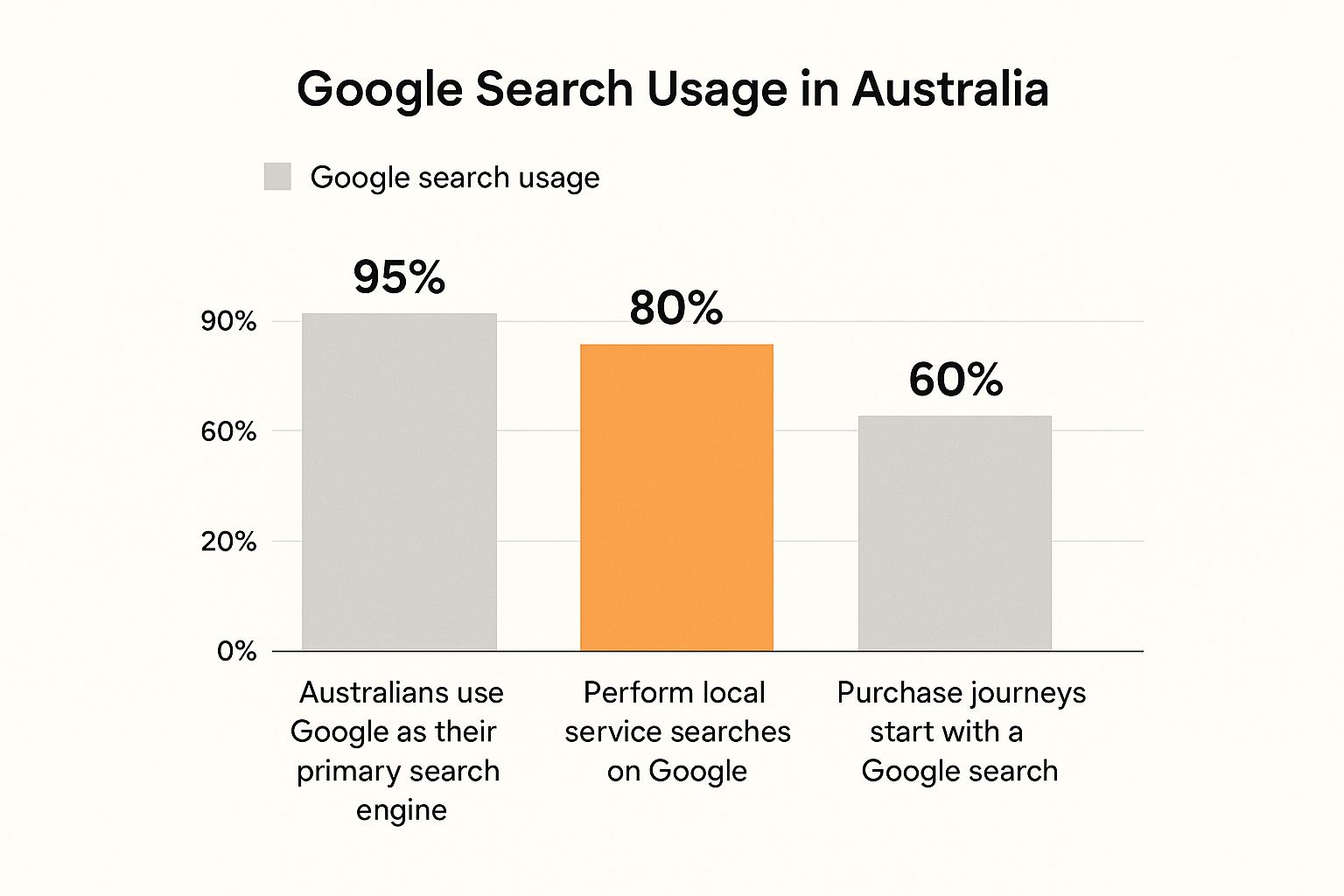
This data proves it: the vast majority of your ideal customers aren't just using Google, they're using it specifically to find and hire local service providers like you.
From Search Query to Paying Customer
Every single search is an opportunity knocking. When someone types "emergency electrician Brisbane" into Google, they aren't just browsing—they have an urgent, specific need. They're actively looking for a solution and are ready to pay for it.
Your Goal: Position your business as the most relevant, trustworthy, and accessible answer to that query. When you appear prominently on Google, you're not interrupting their day; you're providing the exact solution they're searching for at the precise moment they need it.
This direct connection to high-intent customers is what makes mastering the Google ecosystem so incredibly powerful. It’s not about shouting into the void and hoping someone hears. It’s about being the clear, helpful voice that answers when a customer calls out for help. This is the foundation of smart marketing for any service business today.
Mastering Your Google Business Profile
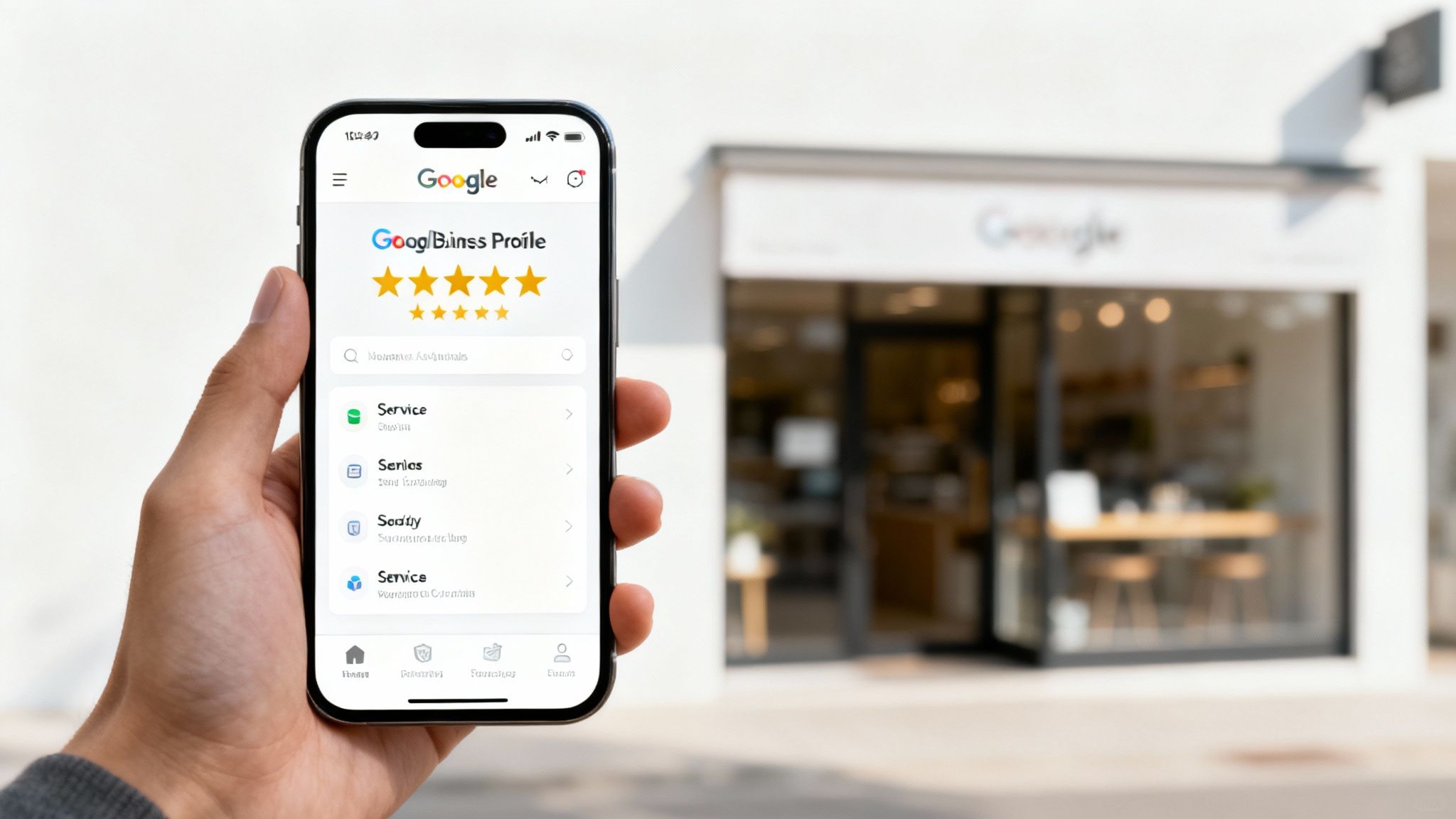
For any local service business, your Google Business Profile (GBP) is your digital front door. It’s often the very first impression a potential customer gets when they search for services in your area, popping up right there in Google Search and on the Map.
Think of it less as a simple listing and more as a living, breathing hub for your business. An unloved profile is a massive missed opportunity. A well-managed one, however, is one of the most powerful free marketing tools Google gives you, turning searchers into callers and callers into customers.
The Core Components of an Optimised Profile
Getting the basics right isn’t just important; it’s non-negotiable. Too many businesses set up a profile and then forget about it, which is a huge mistake. A complete profile is seen as more trustworthy, with businesses providing comprehensive info earning up to 70% more location visits.
Let’s break down what you absolutely have to nail from the get-go.
- Business Name, Address, and Phone Number (NAP): This information needs to be 100% consistent everywhere it appears online, especially on your website. Any inconsistencies will confuse Google and can seriously dent your local rankings.
- Categories: Don't be vague. Instead of just "Builder," choose "Custom Home Builder" or "Kitchen Renovator." Pick a primary category that sums up your main service, then add secondary ones for everything else you do.
- Service Area: Clearly define the suburbs and regions you cover. This is critical for showing up in "near me" searches, even if you don't have a physical shopfront customers visit.
Once these foundations are solid, you can start layering on the details that build trust and make you stand out. If you need a hand with the initial setup, our guide on how to list your business on Google walks you through every step.
Bringing Your Profile to Life
A complete profile is good. An active, engaging profile is what really wins the game. Google actively rewards businesses that use all the features because it creates a better, more helpful experience for its users.
Your business description is the perfect place to start. Ditch the generic fluff and tell a story. Who do you help? What problem do you solve? What makes you the go-to choice in your area?
Actionable Tip: Think of your Google Business Profile as a mini-website hosted directly on Google. Every photo you add, every review you respond to, and every update you post is fresh content that tells the search algorithm you are active, relevant, and engaged with your community.
High-quality photos and videos are another game-changer. Show off your team, your finished jobs, and your happy clients. According to Google, businesses with photos get 42% more requests for driving directions and 35% more clicks through to their websites. The proof is in the pictures.
Advanced Strategies for Maximum Impact
Once your profile is looking sharp, it’s time to use the more advanced features to keep the momentum going. These tools are designed to keep your profile fresh and give searchers timely, useful information.
Leverage Google Posts
Google Posts are like mini-updates that show up directly on your profile. They’re perfect for sharing:
- Special offers and promotions
- New service announcements
- Highlights from a recent project
- Company news or events
Posts usually expire after seven days, so using them consistently is key to showing Google you’re open and active.
Harness the Power of Reviews
Reviews are the lifeblood of any local business. They are a massive ranking factor and the ultimate social proof. Actively encourage your happy customers to leave you a review, and—this is crucial—respond to every single one. Acknowledging both the good and the bad shows you’re an engaged business owner who values customer feedback.
Utilise the Q&A Feature
The Questions & Answers section is where potential customers can ask you things directly. Don't wait for them to ask. Proactively add and answer the most common questions yourself. This lets you control the narrative and address any potential concerns before a customer even has to pick up the phone.
Using Google Search and SEO for Organic Growth
While your Google Business Profile is your digital storefront, showing up in the organic, non-paid search results is the real key to long-term, sustainable growth. This is where Search Engine Optimisation (SEO) comes in.
Think of it as the art and science of setting up your website so Google sees it as the most helpful and relevant answer when a customer comes asking.
Imagine Google is the world’s biggest, smartest librarian. When someone asks a question—like "best landscaper in Ballarat"—it scans millions of websites to find the perfect answer. SEO is how you organise your website, using clear page titles, genuinely useful content, and getting recommendations from other trusted sites, so the librarian confidently hands yours over first.
Understanding How Your Customers Search
The heart of good SEO isn't some technical secret handshake; it’s about getting inside your customer's head. You need to know the exact words and phrases they type into Google when they’re looking for what you do. This is called keyword research.
Don't guess. Think like your ideal client. They're probably not searching for "advanced horticultural solutions." It’s far more likely they’re typing in "lawn mowing services near me" or "how to fix a leaking tap Sydney." These longer, more specific phrases are called long-tail keywords, and they are gold because they signal someone is ready to buy.
- Brainstorm your core services: List out every single thing you offer.
- Add local flavour: Tack on your city, suburb, or region (e.g., "accountant Geelong").
- Think about their problems: What pain points are they trying to solve? (e.g., "emergency plumbing repair").
This simple list becomes the blueprint for all the content your website needs.
Creating Content That Google (and Customers) Love
Once you know what people are searching for, your next job is to create high-quality content that directly answers their questions. This isn’t about stuffing keywords onto a page; it’s about providing real, honest-to-goodness value.
Your website should have a dedicated page for each of your main services. A page called "Residential Painting Services" needs to spell out exactly what you do, showcase your work, and answer common questions about your process. This clarity helps both Google and your future customers understand what you’re all about.
SEO is a marathon, not a sprint. Every helpful blog post you write and every detailed service page you create is another asset that works for you 24/7, attracting potential clients long after you’ve hit ‘publish’.
Another powerful move is to write blog content that tackles your customers' problems head-on. A roofer could write an article called "5 Signs You Need a Roof Replacement." This move positions you as the expert, builds trust, and catches people who are still in the research phase. For a deeper dive, our guide on how to improve your Google rankings has more actionable advice.
Building Your Website's Authority
Authority is basically Google’s measure of how trustworthy your website is. And one of the strongest signals of trust is having other reputable websites link to yours. We call these backlinks.
Think of a backlink as a vote of confidence. If a well-respected local business association or an industry blog links to your website, it’s telling Google that you’re a legitimate and valuable resource worth paying attention to.
A strong SEO strategy is non-negotiable in the Australian market. The SEO industry here is valued at $1.5 billion, a figure driven by Google's massive 93% market share. This has pushed local businesses to get serious about search optimisation, especially with challenges like constant algorithm updates. The game is also changing with trends like voice search, now used by 57% of Aussies, showing just how much Google’s dominance shapes marketing down under.
For Aussie businesses looking to climb the rankings, a comprehensive guide on how to rank higher in Google Search provides strategies tailored to our local market. Building authority takes time, but it’s what separates the businesses you always see on page one from everyone else. When you focus on customer-first keywords, valuable content, and building trust, you create a powerful engine for organic growth.
Winning Customers Now With Google Ads
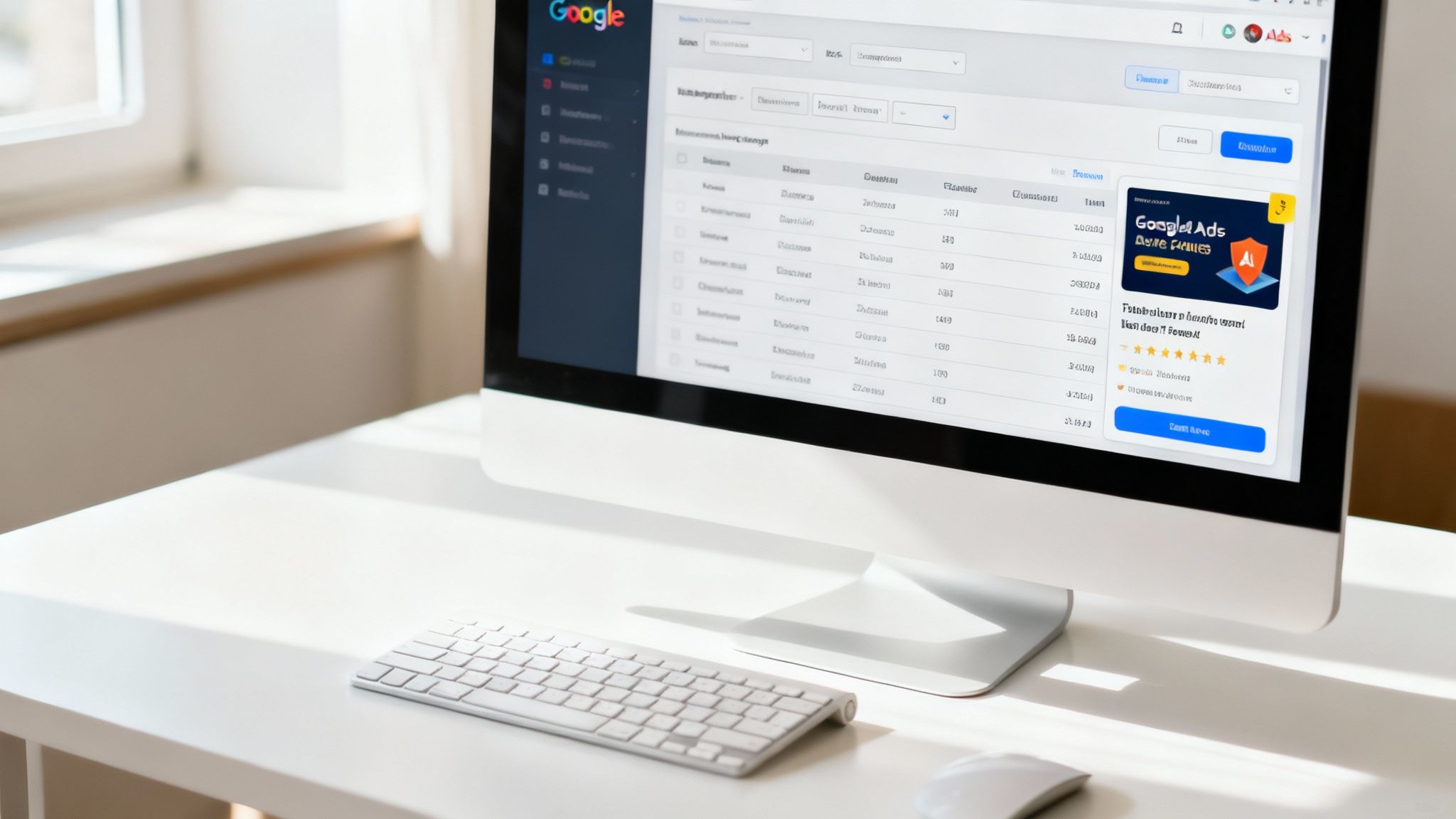
While SEO is your long game for building a powerful organic presence, sometimes you just need the phone to ring now. This is where Google Ads comes in. It’s the fastest, most direct way to get your business in front of customers at the exact moment they’re searching for your services.
Think of it like this: SEO is about earning a permanent spot on the city’s most popular street. Google Ads is like buying a massive, blinking billboard on the busiest digital highway, right at the exit for your specific service. You pay for the premium placement, and in return, you get immediate visibility with people who are actively looking to buy.
When managed correctly, it’s not about burning cash; it’s about making a calculated investment to generate immediate leads and revenue. The key is understanding the different tools Google offers and how to use them smartly.
Search Ads: Your Digital Billboard
When most people think of Google Ads, they’re thinking of Search Ads. These are the text-based results you see at the very top of a search page, usually marked with a small "Sponsored" tag.
Their power is in their precision. You bid on the specific keywords your ideal customers are typing into Google, like “emergency plumber Melbourne” or “buyers agent Sydney.” This means your ad only shows up when someone has a problem you can solve, making it a seriously effective way to capture high-quality leads.
Writing Ad Copy That Converts
Your ad is your first handshake with a potential customer. A weak, generic ad will get ignored, wasting your budget. Strong ad copy is clear, compelling, and speaks directly to the searcher's immediate need.
Here are a few principles for writing ads that actually get clicks:
- Mirror Their Search: If someone searches for "24/7 electrician," your headline needs to reflect that. It instantly confirms they’ve found what they're looking for.
- Highlight Your Unique Value: What makes you the best choice? Mention things like "Free Quotes," "Family-Owned," or "10-Year Warranty." Give them a reason to choose you over the next guy.
- Include a Strong Call to Action: Don't be passive. Tell them exactly what to do next with phrases like "Call Now for a Free Estimate" or "Book Your Consultation Online."
A well-crafted ad doesn't just get seen; it gets clicked by the right people, driving real business your way.
Local Services Ads: The Ultimate Trust Signal
For many Aussie service businesses, Local Services Ads (LSAs) are an absolute game-changer. These are the profile boxes that appear right at the very top of Google, often above even the regular Search Ads.
They feature your business name, review rating, and a "Google Screened" or "Google Guaranteed" badge.
This badge is a powerful symbol of trust. To earn it, Google verifies your business's licences and insurance, and for some industries, even runs background checks. It’s like getting a direct endorsement from Google itself, which can dramatically increase a customer's confidence to call you.
The best part? You only pay when a customer actually contacts you through the ad—not just for a click. This pay-per-lead model makes it a very low-risk, high-reward option, especially for trades and home service providers.
Smart Budgeting And Targeting
A common fear with Google Ads is that it’s a bottomless money pit. But you are always in complete control. You can set a daily or monthly budget, ensuring you never spend more than you're comfortable with.
Even better, the targeting options are incredibly powerful for local businesses. You’re not advertising to the whole country; you can narrow your focus with pinpoint accuracy.
You can target customers based on:
- Specific Suburbs: Show your ads only to people in the exact areas you service.
- Postcodes: A simple, effective way to define your service area.
- Radius Targeting: Draw a circle around your business and advertise to everyone within that zone.
This geographic targeting ensures your ad spend is only focused on potential customers you can actually serve, making every dollar you invest work that much harder for your business.
How to Measure Your Google Performance
https://www.youtube.com/embed/c7LrqSxjJQQ
You can't improve what you don't measure. Simple as that. After putting all that time, effort, and money into your Google Business Profile, your website's SEO, and your ads, you absolutely need to know what’s actually working. Flying blind is a surefire way to burn through your budget with nothing to show for it.
Thankfully, Google gives you two powerful—and completely free—tools that act as your performance dashboard. They take all the guesswork out of the equation, turning it into a clear, actionable strategy. These tools show you exactly how customers are finding you online and what they do once they get to your site.
Let’s dive into how you can use them to make smart, data-driven decisions that fuel real business growth.
Google Analytics: Your Website's Dashboard
Think of Google Analytics as the control panel for your website. It’s like having a CCTV system that tracks every visitor, giving you incredible insights into who your audience is and how they behave on your site. It answers the big questions that directly shape your marketing efforts.
Once it's hooked up to your website, it starts revealing:
- Audience Demographics: See the age, gender, and location of your visitors. This helps you paint a much clearer picture of your ideal client.
- Acquisition Channels: Pinpoint exactly how people found you. Was it through a specific Google search? A link from another website? A post on social media? Now you’ll know.
- User Behaviour: Find out which pages on your site are the most popular, how long people stick around, and the path they take before they decide to contact you.
This kind of information is pure gold. You can use it to fine-tune your website and make sure your marketing campaigns are hitting the mark.
The dashboard gives you a fantastic high-level overview of your website's health, just like in this example.
This snapshot gives you an immediate pulse check on key metrics like user numbers, engagement rates, and your best-performing pages. You can see what’s working at a glance.
Google Search Console: Your Direct Line to Google
While Analytics tells you what happens on your site, Google Search Console tells you what happens before anyone even clicks. It’s your direct line of communication with the search engine itself, pulling back the curtain on how Google sees and ranks your website.
This tool isn't about visitor behaviour; it’s all about your performance in the search results.
Google Search Console is the undisputed source of truth for your organic search performance. It gives you data you can't get anywhere else, showing you the exact search terms bringing people to your site and flagging any technical glitches that could be holding you back.
It lets you dig into some seriously crucial data points:
- Performance: See which keywords people are actually typing into Google to find you. You can also see how many times your site appeared in the results (impressions) and, most importantly, how many of those people clicked through to your site.
- Indexing: Check that Google can properly find, crawl, and understand all the important pages on your website. If a page isn't indexed, it's invisible to searchers.
- Mobile Usability: Identify any issues that could be hurting your rankings on mobile. This is critical, as the vast majority of searches now happen on phones.
By checking both tools regularly, you create a powerful feedback loop. Search Console points out the opportunities waiting for you in Google search, and Analytics shows you how effectively you’re turning that traffic into genuine leads. Of course, connecting these efforts to your bottom line is what really matters. You can learn how to measure SEO ROI to get a clear picture of how your investment is paying off.
Got Questions About Using Google for Your Business?
Trying to get your head around Google's tools can feel like a full-time job in itself. You're not alone. Here are some of the most common questions we hear from Australian service businesses, with straight-up answers to help you get clear.
How Much Does It Cost to Use Google for My Business?
This is the big one, and the answer isn't a single number—it's a mix of free and paid tools.
Getting your Google Business Profile set up and looking sharp is 100% free. Honestly, it's one of the most powerful marketing tools you can get without spending a cent. Same goes for Google Analytics and Google Search Console – both are free resources for tracking how you're performing online.
Where you invest is in SEO (either your time or hiring an expert) and Google Ads. With ads, you're always in control. It's a pay-per-click system, meaning you set the budget and only pay when someone actually clicks through.
How Long Does It Take to See SEO Results?
Patience is the name of the game here. Local SEO is a marathon, not a sprint. While a few tweaks to your Google Business Profile might get you some quick wins in a couple of weeks, climbing the ranks in the main search results takes time.
Think of SEO like building a great reputation in your local community. It doesn't happen overnight. You have to show up consistently, offer real value, and earn people's trust bit by bit.
For most service businesses, you’ll start seeing real, meaningful movement in your organic rankings within three to six months of consistent work. Stick with it.
Do I Need a Website for a Google Business Profile?
Technically, no. You can have a profile without a website. But should you? Absolutely, yes.
Think of your website as your business's online home base. It’s where you can go into detail about your services, show off your portfolio, and really build trust with potential customers in a way your profile can't.
More importantly, a solid website dramatically boosts your chances of ranking higher in Google's organic search results. Your profile gets people interested; your website closes the deal. They're a team, and you need both to win.
Ready to stop guessing and start getting real, measurable results from Google?
The team at Homer Digital Marketing has over 27 years of experience helping service businesses just like yours build a powerful online presence that attracts the right clients. We mix proven strategies with smart automation to deliver growth you can actually see.
Book a no-obligation discovery call with us today and let’s map out your path to success.
