

Struggling to get your small business noticed online? It can feel like you're shouting into a hurricane. If your website isn't optimized for search engines, it's like having the best shop in town hidden down a laneway with no sign—full of potential, but completely invisible to potential customers. This is where SEO services for small businesses come in, acting as the ultimate digital megaphone to help you compete with the big guys and attract high-intent customers. This guide will show you exactly how.
Why SEO Is a Game Changer for Small Businesses
For a small business, a powerful online presence isn't just a "nice-to-have"; it's critical for survival and growth. Search Engine Optimisation (SEO) is the process of making your website more appealing to search engines like Google. When you get it right, you become highly visible to the exact people who are already looking for your products or services.
Without SEO, you're effectively invisible to the vast majority of your potential customers.
Think of it like this: your website is your digital storefront. SEO is what moves that storefront to a prime location on the busiest high street on the internet, complete with flashing neon signs and a welcoming front door. When someone searches for "best local plumber for blocked drains" or "emergency dental clinic near me," a smart SEO strategy ensures your business appears right at the top, ready to solve their problem.
This infographic shows how SEO takes your business from being tucked away in a quiet alley to front-and-centre where customers can't miss you.
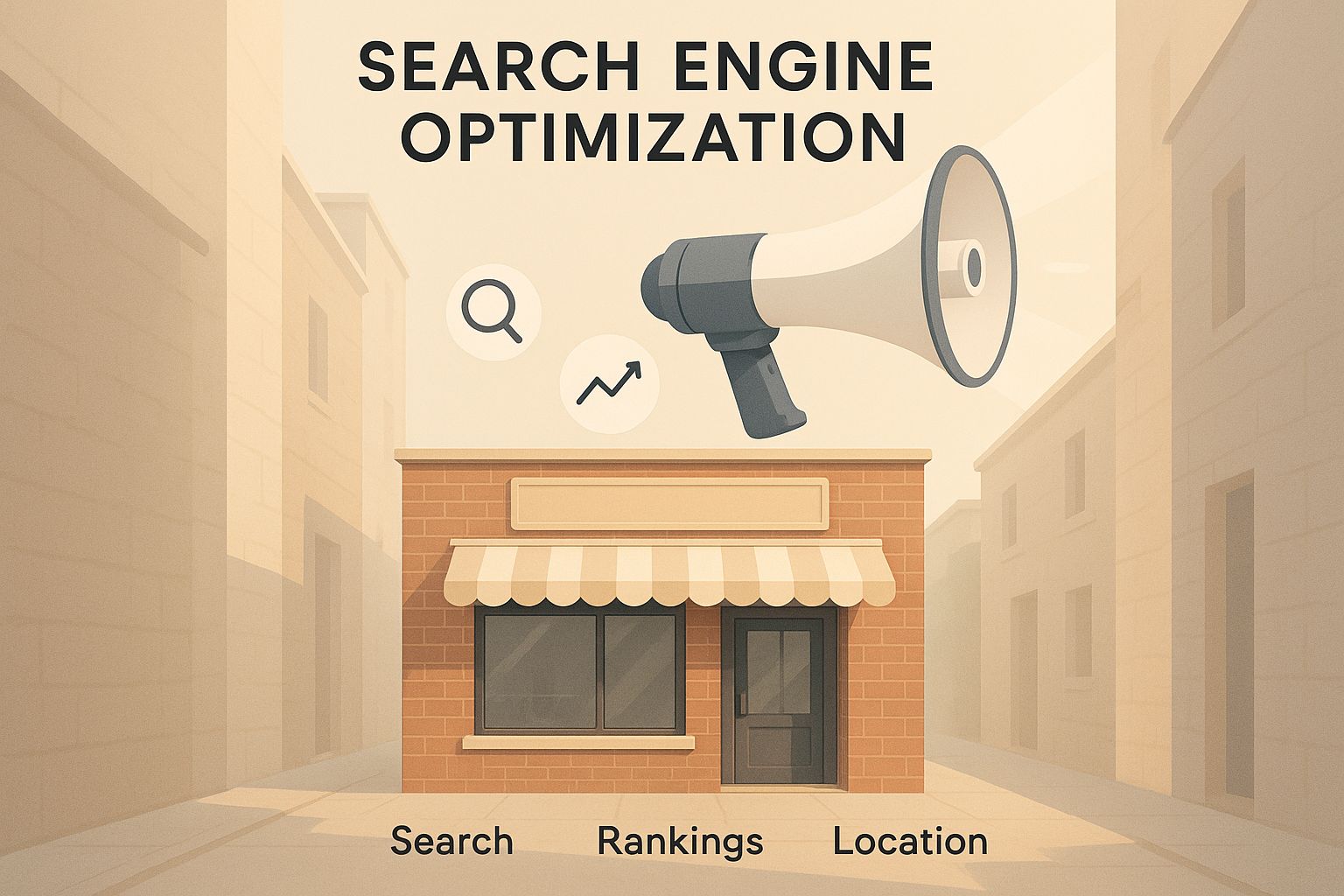
The bottom line? SEO connects your hidden-gem business directly with customers who are ready to buy, turning that quiet storefront into a bustling hub of activity.
Building Trust and Credibility
Ranking high on Google isn't just about getting clicks; it's about building trust. People instinctively trust search engines, and they perceive the businesses on the first page as more credible and reliable. A solid SEO plan helps stamp your authority all over your industry.
A consistent high ranking signals to both Google and your customers that you're a legitimate, trustworthy player. This digital authority is a massive asset that keeps paying you back for years.
Attracting High-Quality Leads
Old-school advertising is all about pushing your message out to anyone who will listen. SEO is different. It pulls in customers who are already looking for a solution you offer. That means the traffic you get is highly targeted and far more likely to convert into actual sales.
Here’s why SEO is so good for generating leads:
- Increased Visibility: Showing up for high-intent keywords puts your business directly in front of motivated buyers.
- Cost-Effectiveness: Over time, the organic traffic you get from SEO is essentially "free," delivering a much better return on investment than paid ads.
- Sustainable Growth: Once you've earned those top rankings, a little ongoing effort can keep them there, creating a steady, reliable stream of leads for your business.
What's Actually in an SEO Service Package?
The term 'SEO' gets thrown around a lot, and frankly, it can sound a bit technical and confusing. But at its heart, it's just a set of practices designed to make your website more appealing to search engines and the real people looking for your services.
When you invest in SEO services for your small business, you're not just buying clicks. You're paying for a structured process that turns your website from a quiet digital brochure into your hardest-working lead generator.
Let's pull back the curtain and look at the four fundamental pillars that make up any solid SEO strategy.
On-Page SEO: Your Digital Storefront
Think of on-page SEO as how you set up your physical shop. You wouldn't just dump all your products in a pile, would you? Of course not. You'd arrange everything logically, use clear signs, and make sure it's easy for customers to find what they need.
On-page SEO does exactly that for your website. It's all about organising your content so Google can instantly understand what each page is about and why it's the perfect answer for someone searching.
This includes things like:
- Keyword Research: Finding the exact long-tail keywords and phrases your ideal customers are typing into Google.
- Content Optimisation: Weaving those keywords naturally into your website pages, blog posts, and headings to signal relevance.
- Title Tags & Meta Descriptions: Writing the punchy headlines and short descriptions that show up in search results, making people want to click on your link, not your competitor's.
To give you a clearer picture, here's a quick breakdown of what goes into a typical small business SEO plan.
Core Components of a Small Business SEO Strategy
| SEO Component | Primary Goal | Example Activities for a Small Business |
|---|---|---|
| On-Page SEO | Make site content clear to users & search engines. | Adding keywords to service pages, writing helpful blog posts, optimising page titles. |
| Off-Page SEO | Build authority and trust across the web. | Getting featured in a local news article, being listed in an industry directory. |
| Technical SEO | Ensure a fast, secure, and easy-to-crawl site. | Improving page load speed, making the site mobile-friendly, fixing broken links. |
| Local SEO | Dominate search results in your local area. | Optimising your Google Business Profile, gathering customer reviews. |
As you can see, it's a multi-faceted approach where each part supports the others to build a powerful online presence.
Off-Page SEO: Building Your Street Cred
If on-page SEO is how you arrange your store, off-page SEO is the word-of-mouth that gets people talking about you. It's all about building your business's reputation and authority on the wider internet.
The biggest piece of this puzzle is earning backlinks—which are simply links from other websites pointing back to yours.
To Google, a backlink from a reputable website is like a five-star recommendation from a trusted friend. The more high-quality recommendations you collect, the more Google sees your business as a credible expert, pushing you higher in the rankings.
This isn't about spammy tricks. It's about creating content so genuinely useful that other businesses and publications want to link to it.
Technical SEO: The Foundations of Your Site
You wouldn't build a beautiful house on a crumbling foundation, and the same goes for your website. Technical SEO is the plumbing, wiring, and concrete slab that everything else is built on.
It's all the behind-the-scenes work that ensures your site is fast, secure, and a breeze for search engines to navigate. You could have the world's best content, but if your site takes forever to load or looks terrible on a phone, people will click away in frustration—and Google will notice.
Key parts of technical SEO are:
- Site Speed: Making sure your pages load in a snap. More than 50% of mobile users will ditch a page if it takes more than three seconds to load.
- Mobile-Friendliness: Ensuring your website works perfectly and looks great on any device, from a big desktop monitor to a small smartphone.
- Site Architecture: Organising your site logically so people (and search engines) can easily find what they're looking for.
- Security (HTTPS): Protecting your visitors' data. This is a non-negotiable for Google and a massive trust signal for customers.
Local SEO: Winning the Neighbourhood
For most small businesses, attracting local customers is the name of the game. That's where Local SEO comes in. It's a specialised type of SEO that focuses on making your business pop up in local search results, especially in that coveted Google "Map Pack."
If you have a physical location or service a specific area—like a cafe, a plumber, or a dentist—this is absolutely critical. The goal is to be the first business people see when they search for things like "coffee near me" or "emergency plumber in Chatswood."
This involves fine-tuning your Google Business Profile, actively managing online reviews, and making sure your business details are consistent everywhere online.
It’s also worth noting that SEO is constantly evolving. Many modern SEO services now lean on smart technology; knowing how to use the latest AI SEO tools can seriously speed up everything from content creation to technical audits.
By covering these four pillars, a proper SEO strategy ensures your business isn't just visible, but also credible, easy to use, and perfectly positioned to attract your ideal local customers.
Unlocking Growth with Local SEO
For most small businesses, local customers are the lifeblood. This is where Local SEO steps in, turning casual online searches into real-world foot traffic and paying clients. It’s one of the most powerful tools in your arsenal.

It’s the key difference between ranking for a broad term like 'electrician' and showing up first for 'emergency electrician in Parramatta'. That second search captures someone who needs help right now. The whole point is to make your business the obvious, easy choice for people in your community.
Your Google Business Profile Is Your New Front Door
Think of your Google Business Profile (GBP) as your most important digital asset for local visibility. It’s often the very first interaction a potential customer has with your business, showing up in Google Maps and the highly-visible 'map pack' at the top of search results.
An incomplete profile is like a shop with a broken sign and boarded-up windows—no one's stopping. But a fully optimised GBP acts as a powerful customer magnet, giving people every reason to choose you.
Here's what to focus on:
- Complete and Accurate Information: Your business name, address, and phone number (NAP) must be 100% consistent everywhere it appears online. No exceptions.
- Engaging Photos and Videos: Show off your products, your team, and your location. Let people see what you're all about before they even walk in.
- Services and Products: Clearly list what you offer so Google understands exactly who to show your profile to.
- Regular Posts: Use Google Posts to share updates, offers, and news. It keeps your profile looking fresh and active.
The Power of Online Reviews and Reputation
In local search, online reviews are basically digital currency. A steady flow of positive reviews is one of the strongest signals you can send to Google that your business is trustworthy and does great work.
A strong collection of recent, positive reviews not only boosts your map pack ranking but also directly influences a customer's decision to contact you. It's the modern-day word-of-mouth recommendation, amplified for the digital age.
Make it a habit to ask happy customers for feedback on your GBP. And make sure to respond to all reviews—good and bad. It shows you care and are committed to great service.
Building Consistent Citations Across the Web
A citation is any online mention of your business's name, address, and phone number (NAP). These pop up in online directories like Yelp, TrueLocal, and other industry-specific sites.
Think of each citation as a vote of confidence. When Google sees your business details listed consistently across multiple reputable websites, it reinforces that your information is accurate. This consistency is crucial; conflicting details will only confuse search engines and hurt your rankings.
Getting this right is a foundational step in any local SEO campaign.
Local SEO services have become essential for small businesses in Australia, especially with the rise of mobile and voice searches. Around 33% of Australians use voice search daily, often asking conversational, local questions. This is critical because nearly 8% of local searches are direct questions, like 'Where can I find the best coffee near me?'. This shift means you need to create content that directly answers what local customers are asking.
For entrepreneurs looking for practical strategies, this guide on how to do local SEO for small businesses is packed with tailored advice. By focusing on these core areas—your GBP, reviews, and citations—you’ll build a powerful local footprint that drives tangible results.
How to Choose the Right SEO Partner

Picking an SEO provider is less like hiring a contractor and more like choosing a business partner. You’re not just buying a service; you’re trusting someone with a huge part of your business’s future.
You need an expert who gets what you’re trying to achieve and is genuinely on your team. It’s all about finding someone who clicks, not just someone who ticks boxes.
This isn’t about you becoming an SEO whiz overnight. It’s about knowing enough to tell the difference between a real pro and someone selling you a story.
Vetting Potential SEO Providers
Before you even think about signing a contract, you’ve got to do your homework. A good SEO partner will be open, honest, and focused on results that actually matter to your bottom line—not just flashy numbers that look good in a report.
Get a list of sharp, direct questions ready before you start talking to agencies.
Here are a few must-ask questions for any potential SEO partner:
- Can you show me case studies from businesses like mine? Proof they’ve done it before in your industry or local area is a massive green flag. It means they already know the turf.
- How do you report on progress, and what numbers do you track? If their answer is just "more traffic," walk away. You want to hear about leads, phone calls, and rankings for keywords that bring in actual customers.
- What’s your communication like? Will you have a dedicated person to talk to? How often will you hear from them? Clear, consistent communication is a deal-breaker.
A great SEO partner is basically an extension of your own team. They should be as obsessed with your growth as you are, giving you clear insights and a collaborative plan, not just a monthly report full of confusing jargon.
Red Flags to Watch Out For
Knowing what to look for is only half the battle; knowing what to avoid is just as crucial. The SEO world has plenty of people who promise the world and deliver very little. Be sceptical of anyone making massive, unbelievable claims.
Think twice if a provider:
- Guarantees a #1 ranking on Google. Nobody can promise this. Google’s algorithm is a constantly shifting beast, and anyone who says they can guarantee top spot is lying.
- Is cagey about their methods. If they start talking about their "secret sauce" or techniques they can't explain, it’s a huge red flag. Good SEO is built on proven, ethical practices, not magic tricks.
- Only talks about backlinks. Backlinks are important, but an SEO strategy that ignores everything else—like your website’s technical health, content, and local presence—is a recipe for disaster.
Understanding SEO Pricing Models
The cost of SEO services for small business varies a lot, so it helps to get your head around the different ways agencies charge.
In Australia, the SEO game is shifting towards long-term, sustainable growth. While the average business might spend around $1,350 per month, the focus is on a mix of technical SEO, quality content, and building a solid reputation. Done right, many small businesses see a 40% to 60% jump in organic traffic within six months, making it a smart investment against ever-rising ad costs.
Here are the most common pricing models you'll see:
- Monthly Retainer: This is the standard. You pay a set fee each month for ongoing work. It’s perfect for a long-term, comprehensive strategy that builds over time.
- Project-Based Fees: You pay a one-off fee for a specific task, like a full website audit or setting up your local SEO. This is great for hitting a short-term, defined goal.
- Hourly Consulting: You pay by the hour for expert advice. This is best if you have a team to do the work but just need some strategic direction.
Finding the right SEO agency is about more than just technical skills; it's about finding a partner who shares your vision. If you’re looking for some guidance, our team is known as one of the best digital marketing companies for small businesses and we’d be happy to help you map out a strategy that delivers real growth.
Budgeting for SEO Services and Understanding Costs
Let's get straight to the question every business owner asks: "So, how much is this actually going to cost me?" It's usually the first thing on your mind, and the answer isn't a simple one-size-fits-all number.
Think of it like renovating a kitchen. A quick paint job and new cabinet handles will have a very different price tag than a full gut-and-rebuild with brand-new appliances. SEO works the same way.
The investment depends entirely on where you're starting from, where you want to go, and how fast you want to get there. A brand-new website in a crowded market like real estate needs a much bigger push than an established local business that just needs a bit of a tune-up.
Factors That Influence Your SEO Investment
Understanding what goes into the price helps you set a realistic budget. It’s not just a figure plucked out of thin air; it’s based on the time, expertise, and resources needed to get you results.
Here are the main things that move the needle:
- Industry Competitiveness: Trying to rank for "plumber in Sydney" is a whole different ball game (and budget) than ranking for "artisan dog treats in Ballarat." More competition means more work is needed to cut through the noise.
- Your Website's Current State: Is your site a well-oiled machine, or is it slow, clunky, and full of technical gremlins? A site that needs a major technical overhaul will require more work upfront.
- Scope of Work: A basic local SEO package to get you on the map is going to cost less than a full-blown national campaign that includes creating heaps of content and building high-quality links.
Viewing SEO as an Asset, Not an Expense
This is a crucial mindset shift. SEO isn't just another monthly bill you pay. It's a long-term investment in your most valuable digital asset: your website.
Paid ads are like renting. The moment you stop paying, the traffic stops. SEO is like buying property. The work you do today builds equity over time, bringing in a steady stream of organic leads for years to come.
SEO is about building a powerful digital asset that grows in value. The work done today keeps generating traffic and leads months, even years, down the line, delivering an incredible return on investment.
The Aussie SEO industry is booming, with a projected market value of around $1.5 billion. Small businesses are a huge part of that, with the average monthly spend now hitting roughly $1,350. This just shows that business owners across Australia are realising that SEO is no longer optional—it's essential for growth. You can dive deeper into the data and get more insights into the Australian SEO market.
At the end of the day, budgeting for SEO is really just planning for sustainable growth. It's an investment in your visibility, your credibility, and your long-term bottom line.
Measuring SEO Success with the Right KPIs
Investing in SEO services for a small business without tracking your numbers is like flying a plane with no instruments. You might be moving, but are you heading in the right direction? It's easy to get fixated on vanity metrics like "more traffic," but what you really need are Key Performance Indicators (KPIs) that connect directly to your bottom line.
Success isn't just a squiggly line on a graph going up. It's real, tangible business growth. It means measuring what actually matters so you can have clear, informed conversations with your SEO provider and see the genuine results of your investment.
Key Metrics That Actually Drive Business Growth
Instead of drowning in data, you need to focus on a handful of powerful KPIs that prove your SEO is doing its job. These are the metrics that bridge the gap between clicks and customers.
- Improved Keyword Rankings: Keep a close eye on your position for "high-intent" keywords—the exact phrases people type when they're ready to buy. Moving from page three to the top three for "emergency plumber Parramatta" isn't just a ranking change; it's a massive win that puts you right in front of paying customers.
- Increase in Organic Leads: This is the big one. It's the whole point, really. Track the number of phone calls, contact form submissions, and direct email enquiries coming straight from organic search. This is cold, hard proof that your SEO is attracting real, potential customers.
- Google Business Profile Engagement: For any local business, this is non-negotiable. You need to be watching the calls, direction requests, and website clicks that happen directly from your Google profile. It’s the clearest sign that you're capturing the attention of your local market.
Essential Tools for Tracking Your SEO Success
The good news is you don't need a heap of expensive software to see what's going on. Google provides powerful, free tools that give you all the data you need to measure the metrics that matter. Getting comfortable with these platforms is the key to holding any SEO partner accountable.
SEO data tells a story about what your customers want and how they find you. Learning to read that story empowers you to make smarter marketing decisions and calculate your real return on investment.
These two platforms are the absolute foundation for tracking your KPIs:
- Google Analytics 4 (GA4): Think of this as your website’s command centre. It tells you how many visitors are arriving from organic search, what pages they’re looking at, and—most importantly—what actions they're taking, like filling out a form or making a purchase.
- Google Search Console (GSC): This tool gives you a direct line to how Google sees your site. You can track your keyword rankings, discover which search terms are driving the most clicks, and spot any technical hiccups that might be holding you back.
By combining the insights from GA4 and GSC, you get a crystal-clear picture of your performance. Mastering these simple metrics and tools is what transforms SEO from a confusing expense into a predictable, reliable engine for business growth.
Got Questions About SEO? We've Got Answers.
Jumping into the world of SEO can feel a bit like learning a new language. There are a lot of terms, a lot of promises, and a lot of questions. We get it. To make things clearer, here are some straight-talking answers to the questions we hear most often from small business owners.
How Long Does It Really Take to See SEO Results?
This is the big one, isn't it? Everyone wants to know when the magic happens. The honest answer is that SEO is a long game – think of it as planting a tree, not flicking a light switch. It's a marathon, not a sprint.
You'll often see some early positive signs in the first 1-3 months, especially as we fix up technical glitches on your website. But the real, game-changing results? That takes a bit more patience.
Getting to the top of Google for the keywords that actually make you money and seeing a steady stream of organic leads typically takes 6 to 12 months of consistent, smart work. This is the time it takes to build real authority and earn Google's trust, which is what powerful, lasting rankings are all about.
Can I Just Do SEO Myself?
Absolutely. You can definitely get started with the basics of SEO on your own, and there are some simple tasks that can make a real difference.
A great place to start is with your Google Business Profile. Claiming it and filling it out completely is probably the single most powerful Local SEO move any business owner can make. But a full-blown SEO strategy gets complicated, fast.
A proper SEO campaign is a heavy lift. It requires deep-dives into technical audits, creating content that actually connects with customers, and building the kind of links that signal authority. Many business owners find a sweet spot by handling the basics themselves and bringing in a pro to handle the heavy lifting and scale their results.
This hybrid approach keeps you in the driver's seat while making sure you have an expert navigating the trickier parts of the journey.
Is SEO Better Than Paid Ads?
This isn't a case of "either/or." It's more of a "when and why." Think of SEO and paid ads (like Google Ads) as two different tools in your marketing toolkit. They work best together.
SEO is like buying a house. It’s a solid investment in an asset you own. It takes time and effort to build, but once you've earned those high rankings, the organic traffic that flows to your site is essentially "free." It builds sustainable, long-term trust and visibility that keeps paying you back.
Paid ads are more like renting a billboard on a busy highway. They get you instant visibility and are fantastic for a quick sales push or a new promotion. But the second you stop paying, that visibility vanishes. Poof. Gone.
A really sharp strategy uses both. You can run paid ads to get immediate leads and test out which keywords convert best, all while your long-term SEO foundation is being built brick by brick. This gives you the best of both worlds: quick wins now and lasting growth for the future.
Ready to stop being your industry's best-kept secret? Homer Digital Marketing builds powerful SEO strategies that get real, measurable results for service-based businesses like yours. We mix proven Google optimisation with smart marketing systems to grow your visibility and help you scale.
Book a discovery call today and let's talk about how we can help you own your local market.
