

Let’s be real… seeing your business buried on page five of Google is just plain defeating. You know there are customers out there looking for what you offer, but they just can’t find you. The good news? There’s a proven formula to climb the ranks and improve your Google rankings.
It all comes down to four essential pillars: a technically solid website, genuinely valuable content, sharp on-page optimisation, and building authority with off-page signals. Nailing these is how you stop being invisible and start capturing the traffic you’ve been missing. This guide will provide the solution for you to improve your Google rankings. Read on.
Why Your Google Rankings Are Mission Critical
In a competitive market like Australia, your spot on Google isn’t a vanity metric. It’s a direct line to your revenue. If you’re not visible online, you’re basically handing customers over to your competitors on a silver platter.
The goal isn’t just to get on Google; it’s to get to page one, where the real action happens. This means building a smart, comprehensive strategy that addresses how Google sees your website from every single angle.
So, what are the core areas that really move the needle? Let’s break it down.
To give you a high-level view of how these pieces fit together, here’s a quick summary of the framework we’ll be diving into.
The Four Pillars of Improving Google Rankings
| SEO Pillar | Primary Goal | Key Actions |
|---|---|---|
| Technical SEO | Make it easy for Google to find, crawl, and understand your site. | Site speed, mobile-friendliness, clean site structure, fixing crawl errors. |
| High-Value Content | Answer user questions and solve their problems better than anyone else. | Keyword research, creating in-depth articles, optimising for search intent. |
| On-Page Optimisation | Send clear signals to Google about what each page is about. | Title tags, meta descriptions, internal linking, header tags, image optimisation. |
| Off-Page Authority | Build trust and credibility for your brand across the web. | Earning backlinks from reputable sites, local SEO, managing online reviews. |
Think of these four pillars as a system. If one is weak, it brings the whole structure down. You can’t just have great content on a slow, broken website and expect to rank. It all works together.
This visual from Ahrefs shows just how critical factors like backlinks and content are in the grand scheme of things.

It reinforces that you need a balanced approach. Amazing content paired with strong authority signals is what gets you noticed.
The Undeniable Value of The Top Spot
The urgency to climb the ranks gets very real when you look at how people actually click. For any Australian business, the gap between the first and second search result is massive.
In Australia, recent data shows the #1 organic search result grabs somewhere between 29.5% to 39.8% of all clicks. The second spot? It gets less than half of that, pulling in only 12.8% to 18.7% of clicks.
That huge drop-off says it all. Investing in a proper SEO strategy isn’t just a “nice to have”—it’s absolutely vital for growth. That top position is where the lion’s share of potential customers are.
If you want to dig deeper into the numbers, you can discover more insights about local SEO statistics on redsearch.com.au.
This guide will walk you through the practical, actionable steps you need to take to claim a bigger piece of that pie. Let’s get started.
Mastering On-Page SEO for Maximum Impact

While your technical SEO sets the stage, your on-page SEO is where the real performance happens. This is your chance to explicitly tell Google what your content is about and who it’s for.
Think of it as connecting the dots for search engines so they can match your valuable content with the right audience. It’s far more than just scattering keywords across a page—it’s about building your content with purpose.
Effective on-page SEO means every single element, from your main title down to the tiniest image description, works in unison to boost your visibility. It’s the craft of making your content both human-friendly and machine-readable, which is fundamental to any strategy focused on how to improve google rankings.
Aligning Content with Search Intent
Before you write a single word, you have to decode search intent. What is a user really looking for when they type something into Google? Are they trying to learn something, compare products, or are they ready to pull out their wallet?
Getting this wrong is one of the most common mistakes I see, and it’s a surefire way to kill your rankings. If someone searches for “best running shoes for flat feet,” they want a detailed, helpful comparison—not a generic sales page.
- Informational Intent: The user wants answers. Think “how to fix a leaky tap.” Your job is to provide a comprehensive, educational solution.
- Commercial Intent: The user is in research mode. A query like “iPhone vs Samsung camera” means they want comparisons, reviews, and feature breakdowns to help them decide.
- Transactional Intent: The user is ready to buy. A search for “buy Nike Air Max online” should lead directly to a page where they can complete that purchase, with clear calls-to-action and zero friction.
Matching your page’s purpose to the user’s intent is one of the most powerful things you can do to satisfy both your visitors and Google.
Optimising Titles, Headers, and Metas
Your title tag is arguably the single most important on-page SEO element. It’s the first thing people see in the search results and a massive clue for Google.
A great title is compelling, includes your main keyword near the start, and stays under 60-70 characters so it doesn’t get awkwardly cut off.
Headers (H1, H2, H3s) are just as important for giving your content structure. They make it easier for people to read and for Google to understand the hierarchy of your information. Your H1 is your main page title, while H2s and H3s break down the key subtopics. Weaving keyword variations into these headers helps Google get the full picture.
Key Takeaway: Your meta description doesn’t directly impact rankings, but it’s your free ad space in the search results. A punchy meta description (around 150-160 characters) with a clear call-to-action can massively increase your click-through rate. And a higher click-through rate is a positive signal to Google.
Writing for People First, Search Engines Second
The days of stuffing keywords into your text are thankfully long behind us. The goal now is to write naturally while strategically placing keywords where they make the most sense. This is at the very core of what SEO in digital marketing truly is about.
This screenshot from Semrush shows how all the key on-page elements come together to create a well-optimised page that sends all the right signals.
As the image shows, a keyword-rich title, a clean URL, and well-written body copy all work together to signal relevance to Google.
Let’s look at a real-world example for a page targeting “emergency plumber Sydney”.
Poorly Optimised Approach:
- Title: Plumber in Sydney
- H1: Welcome to Our Plumbing Service
- Content: We are a plumbing company. We offer plumbing services. If you need a plumber, call our plumbing business.
High-Performing Approach:
- Title: 24/7 Emergency Plumber Sydney | Fast Response & Fixed Pricing
- H1: Need an Emergency Plumber in Sydney? We’re Here 24/7.
- Content: Facing a burst pipe or blocked drain in the middle of the night? Our licensed emergency plumbers in Sydney offer a rapid response to prevent water damage…
See the difference? The second example immediately speaks to the user’s urgent problem, uses keywords naturally, and screams value. That’s modern on-page SEO in a nutshell.
Getting Your Technical SEO Right: The Foundation of Good Rankings
Let’s be honest, the term “technical SEO” can sound a bit intimidating. But if you ignore it, even the most amazing content in the world won’t rank.
Think of it as the foundation of your house. You can have the best interior designer, but if the foundation is cracked, the whole structure is at risk. Technical SEO is exactly that for your website. It’s all about making sure search engines like Google can easily find, crawl, and understand your site. Get this right, and every other marketing effort you make becomes ten times more effective.
The good news? It boils down to a few core questions:
- Is my site fast and responsive?
- Is it secure for my visitors?
- Is it easy for Google’s bots to navigate?
This flowchart breaks down the essential steps for a solid technical SEO audit, from checking your site speed to ensuring your content is structured clearly.
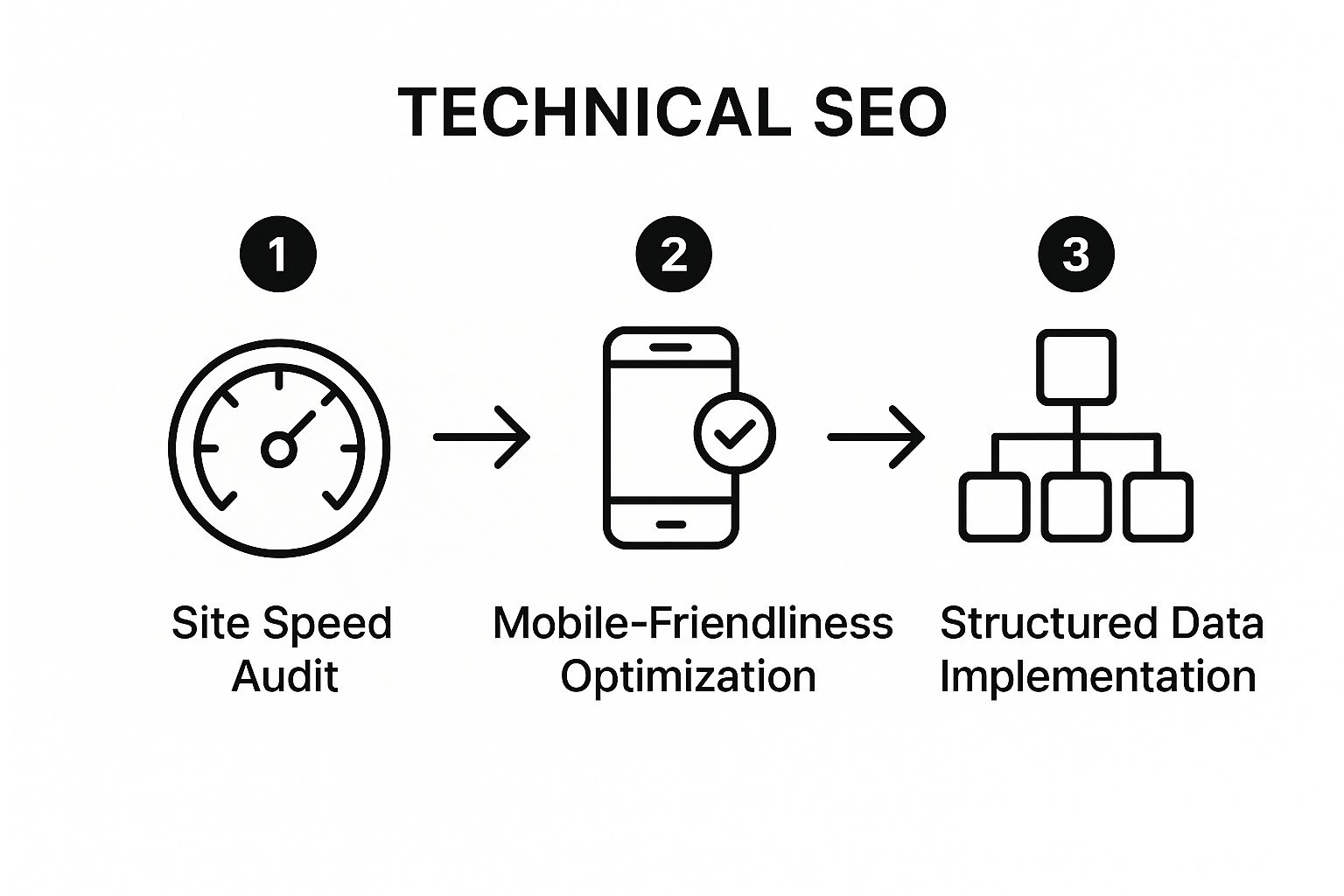
As you can see, the path is logical: start with speed, make sure it works on mobile, and then add structure. Nail these three, and you’ve built a powerful base for growth.
How Site Speed and Core Web Vitals Impact Your Ranking
In today’s world, patience is in short supply. A slow website isn’t just annoying for users; it’s a direct signal to Google that your site offers a poor experience. This is why Google introduced Core Web Vitals—a set of metrics designed to measure the real-world user experience of a webpage.
These vitals are non-negotiable for anyone serious about ranking. They focus on loading performance, interactivity, and visual stability.
Core Web Vitals Checklist
To help you get started, here’s a simple checklist to understand what Google is looking for and how you can improve each score.
| Core Web Vital | What It Measures | Actionable Tip to Improve |
|---|---|---|
| LCP (Largest Contentful Paint) | How quickly the main, most visible content on your page loads. A good score is under 2.5 seconds. | Compress your images before uploading and use modern formats like WebP. They look great but are much smaller. |
| INP (Interaction to Next Paint) | How fast your page reacts when a user clicks a button or taps a link. A fast response feels smooth. | Cut down on heavy JavaScript that runs in the background. Too much of it can bog down your page and delay responses. |
| CLS (Cumulative Layout Shift) | How much the page content unexpectedly jumps around while loading. This is super frustrating for users. | Always set the width and height for your images and videos. This tells the browser to save space, preventing layout shifts. |
Getting these scores into the green zone sends a strong message to Google that your site is user-friendly, which can absolutely help boost your rankings. Another quick win is using a Content Delivery Network (CDN), which stores copies of your site on servers around the world, delivering content faster to visitors no matter where they are.
Why You Need an XML Sitemap
An XML sitemap is basically a roadmap of your website that you hand directly to search engines. It lists all of your important pages, making it much easier for Google to discover and index your content efficiently.
Without a sitemap, you’re essentially hoping Google finds all your pages by following links from one to another. For new or large websites, this can be slow and unreliable.
By creating and submitting a sitemap through Google Search Console, you’re not leaving anything to chance. It ensures all your valuable pages get noticed.
A Few More Essential Technical Health Checks
Beyond the big two, a few other technical checks are critical for keeping your site in good health. Regularly monitoring these can stop small issues from turning into major ranking problems.
- HTTPS Security: Your site must use HTTPS. It’s a confirmed (though small) ranking factor, but more importantly, it builds trust. Modern browsers flag non-HTTPS sites as “Not Secure,” which is a surefire way to scare off potential customers.
- Mobile-Friendliness: Google now operates on a mobile-first index. This means the mobile version of your site is the primary one used for ranking. Your site has to look and work perfectly on a smartphone, period.
- Crawl Errors: Keep a close eye on the “Coverage” report in Google Search Console. It’s your early warning system, telling you if Google is having trouble accessing any pages on your site.
A single crawl error could mean your most important service page isn’t being indexed, making it invisible in search results. I’ve seen it happen. Fixing these errors quickly isn’t just good practice—it’s protecting your revenue.
By tackling these technical SEO tasks one by one, you’re building a rock-solid foundation that makes every other part of your SEO strategy—from content to link building—far more successful.
Creating Content That Google and Users Love

Let’s be blunt: high-quality content is the engine of your entire SEO strategy. While all the technical fixes and on-page tweaks lay the groundwork, it’s the value you deliver through your content that truly earns trust, authority, and those coveted top rankings.
But what is “great content”? It’s not just about writing well. It’s about deeply understanding what your audience needs and delivering the answer so effectively that they have no reason to hit the back button.
When you solve their problem completely, you send a powerful signal to Google that your page is the best result. It deserves its spot. This strategic approach is non-negotiable in Australia’s crowded market, where your next customer is almost certainly starting their journey with a Google search.
The numbers don’t lie. 62.5% of Australian internet users (aged 16 and over) turn to search engines to research brands. With digital ad spend hitting $14.5 billion out of a $19.9 billion total, visibility is everything. You’re not just chasing keywords; you’re competing for attention.
This is why a content-first approach to how to improve google rankings is the only way forward.
Uncover What Your Customers Are Really Searching For
Before you write a single word, you need to know what questions your audience is asking. This is where practical keyword research comes in. Forget just chasing high-volume terms; you need to find the high-intent, long-tail keywords that signal a specific need.
These are the detailed queries people type when they’re further along their buying journey. Think “best accountant for a small creative agency” instead of just “accountant Sydney.”
Tools like Google Keyword Planner are your best friend here. They let you dig into keyword ideas, check search volumes, and see how competitive a term is. This helps you find underserved topics where you can actually make a mark and build authority.
This is exactly what it looks like inside the tool—you can discover new keywords and get forecasts on the traffic you might expect.
These insights are gold. They help you prioritise which keywords offer the best shot at ranking without a soul-crushing fight.
Structure Your Content for Skimmers and Search Engines
Once you have your keywords, it’s time to build your content. But here’s the reality: no one reads a giant wall of text. It doesn’t matter how brilliant your advice is; if it looks intimidating, your visitors are gone.
Use clear, descriptive headings (H2s and H3s) to break your article into logical, skimmable sections. This helps readers find what they need fast, and Google loves it, too.
For maximum impact, follow these simple formatting rules:
- Keep paragraphs short. Seriously, stick to 2-3 sentences max. White space is your friend—it makes content easier to digest, especially on a phone.
- Use bullet points and lists. Got a complex idea or a series of steps? Break it down into a list. It’s perfect for summarising key points.
- Add visuals. Use relevant images, charts, and videos to illustrate your points and break up the text. Visuals can massively boost engagement and keep people on your page longer.
The Overlooked Power of Refreshing Old Content
Here’s one of the most effective SEO tactics that almost everyone forgets: regularly updating your existing content. Google rewards freshness. A post you published two years ago could get a huge ranking boost with a simple refresh.
Set a reminder to periodically review your most important older articles. Ask yourself:
- Is this information still 100% accurate?
- Are there new stats or research I can add?
- Can I add more detail, examples, or a video to make this more thorough?
- Could this content better align with what you should put on your Google Business Profile?
When you treat your content like a living asset instead of a “set and forget” task, you create a powerful flywheel. Updated content can reclaim lost rankings, attract new links, and keep driving traffic for years. It’s a genuine secret weapon for sustainable SEO success.
Dominating Local Search and Off-Page Signals
https://www.youtube.com/embed/8BdZ0dUu7VQ
While slick on-page optimisation and killer content get you in the game, it’s the off-page signals that tell Google you’re a genuine authority. For most Aussie businesses, this battle is won or lost at the local level.
This is where you build trust and credibility beyond your own website. It’s about creating a strong brand presence that sends powerful trust signals to Google, showing that you’re a legitimate, respected player in your local community and industry.
Your Most Powerful Local SEO Weapon
For any service-based business in Australia, your Google Business Profile (GBP) is your single most important local ranking asset. It’s the free, high-visibility listing that pops up in Google Maps and the local search results.
Neglecting it is like leaving money on the table. The statistics are staggering: around 80% of local searches in Australia lead to a conversion. Yet, an eye-opening 56% of Australian local businesses haven’t even claimed their GBP listing. This isn’t a mistake; it’s a massive opportunity for you to get ahead.
To get started, you’ll need to claim your profile through Google’s portal.
Once you’ve claimed it, the real work begins. The goal is to fill out every single section with meticulous detail, transforming it from a simple listing into a powerful conversion tool.
A fully optimised profile acts like a mini-website right inside Google’s search results, giving customers everything they need to know without even clicking through to your site. This includes your business name, address, phone number (NAP), hours, services, and photos.
Key Takeaway: A complete Google Business Profile isn’t just about visibility; it’s about reducing friction. When a potential customer finds all the information they need instantly, they are far more likely to take the next step and contact you.
Unsure how your business currently looks to customers online? You can get more details by checking out our guide on how to see your business in Google.
The Crucial Role of Customer Reviews
Reviews are the lifeblood of local SEO. They’re a direct, public signal of your business’s quality and trustworthiness. In fact, a whopping 88% of Australian customers read reviews before deciding to visit a local business.
A steady stream of recent, positive reviews does two critical things:
- It builds immense social proof, convincing potential customers that you are the right choice.
- It’s a direct ranking signal to Google, which prefers to show businesses that are well-regarded by their community.
The key is having a simple, repeatable process for generating feedback. Don’t be shy about asking satisfied clients for a review. You can make it easy for them by sending a direct link to your GBP review page via email or SMS right after a successful job.
Building Authority with Quality Backlinks
Beyond your GBP, the other side of off-page SEO is building backlinks. A backlink is simply a link from another website pointing to yours. Google views these as votes of confidence—the more high-quality votes you have, the more authoritative your site appears.
The emphasis here is on quality. One link from a highly respected, relevant Australian industry blog is worth more than 100 links from spammy, irrelevant websites.
Here are a few proven, white-hat tactics for earning valuable backlinks:
- Guest Posting: Write a genuinely helpful article for a well-regarded blog in your niche. For example, a buyers’ agent could write a piece for a popular Australian property investment blog.
- Local Directories: Get listed in reputable Australian business directories like TrueLocal or the Yellow Pages. Just make sure your Name, Address, and Phone number (NAP) are perfectly consistent across every single listing.
- Community Engagement: Sponsor a local sports team or a charity event. This often results in a link from their website, and it’s a fantastic way to build goodwill right in your own backyard.
These off-page signals—a perfectly optimised GBP, a strong review profile, and quality backlinks—all work together to solidify your authority. They prove to Google that you are not just another website, but a trusted and essential part of your local business community.
Your Top Questions About Google Rankings, Answered
Alright, let’s tackle some of the big questions that always come up when we talk about SEO. When you’re putting in the work, you want to know what to expect, where to focus, and how long it’s all going to take.
Here are the straight-up answers to the most common queries we hear from Aussie business owners.
How Long Does It Actually Take to See SEO Results?
This is the million-dollar question, and the honest answer is: it depends. If you’re starting with a brand new website, you’re realistically looking at 6 to 12 months to get any real traction for keywords that matter.
For a more established site that already has a bit of authority, you could see some positive movement in as little as 3 to 6 months.
A few things will speed this up or slow it down:
- How competitive your industry is, especially in your local area.
- The technical health of your website right now. Is it a mess or in good shape?
- How consistent you are with creating great content and building quality links.
SEO is a long game. There are no shortcuts that last, and building real authority comes from consistent, valuable effort over time.
I’m a Small Business. Where Should I Focus My Efforts First?
With limited time and even less budget, you have to be smart about where you put your energy. For almost every local service business in Australia, the best place to start is your Google Business Profile (GBP).
Honestly, getting your GBP fully optimised is the highest-impact thing you can do for local search. It’s your digital storefront on Google itself, and nailing it can bring in results faster than pretty much anything else.
Once that’s sorted, turn your attention to creating a few top-notch “pillar” pages for your main services. Make sure they are perfectly optimised and answer your customers’ questions better than anyone else online.
Is It Better to Create New Content or Update Old Content?
You need to do both, but so many businesses sleep on the power of updating what they already have. A content refresh can be a massive quick win, especially for older blog posts or service pages that have fallen off the radar.
Go find pages that used to rank well or target your most important keywords. Give them a facelift with new info, updated stats, better images, and add some fresh internal links. It’s often way less work than starting from scratch and can give you a serious bump in the rankings.
Do I Still Need Backlinks to Rank in 2025?
Yes, one hundred percent. Google’s algorithm is smarter than ever, but backlinks are still one of the most powerful signals of trust and authority. Think of them as a vote of confidence from another credible website in your space.
But the game has changed. It’s all about quality over quantity now. A single, relevant backlink from a respected Australian industry blog is worth more than a hundred dodgy links from spammy online directories. Your focus should be on earning links by creating fantastic content and building genuine relationships.
Ready to stop guessing and start getting real results? Homer Digital Marketing specialises in building proven, AI-powered marketing systems that drive visibility and attract your ideal clients. Let our 27+ years of experience building successful ventures work for you.
Discover how we can help you scale your service business by visiting homerdigitalmarketing.com
Article created using Outrank
