

Are you pouring money into ads but not seeing the sales or leads you expect? It’s a common frustration for Australian businesses. The problem often isn’t your traffic—it’s your website. This is where Conversion Rate Optimisation (CRO) becomes your most powerful tool.
Simply put, CRO is the process of fine-tuning your website to convert more visitors into actual customers. It’s not about attracting more traffic; it’s about getting more value from the traffic you already have. For any business trying to stay profitable in our competitive local market, this isn't just a nice-to-have—it's an essential strategy for sustainable growth. This guide will provide actionable steps to enhance your conversion rate optimisation in Australia.
Why CRO Is a Game Changer for Australian Businesses
Imagine your website is a physical shop in a bustling Melbourne laneway. You spend a fortune on ads to get people through the door, but once they're inside, the layout is confusing, the queue for the till is a mile long, and there’s no one around to help. What happens? Frustrated visitors walk straight back out.
That’s exactly what happens online, every single day, when a business ignores CRO.
CRO is the art and science of tweaking your digital storefront to make it as easy and appealing as possible for visitors to do what you want them to do—whether that’s buying a product, filling out a form, or booking a call. It’s a methodical approach to figuring out why your visitors aren’t converting and fixing the roadblocks getting in their way. If you want to dig deeper, there are some essential strategies for website conversion rate optimization that can completely reshape your business.

Maximising Your Marketing Spend
Too many Australian businesses fall into the "traffic trap," thinking more visitors will magically lead to more sales. While getting eyes on your site is the first step, without a focus on conversions, you're just pouring water into a leaky bucket. Every dollar you pour into Google Ads, SEO, or social media marketing is wasted if your website can't close the deal.
CRO flips this on its head. Instead of constantly paying more to find new customers, you make your current marketing budget work much, much harder.
Key Insight: By improving your conversion rate from just 1% to 2%, you literally double your leads or sales without spending a single extra dollar on ads. It's the most powerful lever you can pull to improve your marketing ROI.
Gaining a Competitive Advantage
In a crowded Aussie market, a killer user experience is what sets you apart. A website that’s fast, intuitive, and trustworthy doesn’t just convert better; it builds brand loyalty.
While your competitors are busy fighting over who can get the most clicks, you can be quietly creating a seamless customer journey that turns casual browsers into repeat buyers. This focus on the user provides a lasting advantage that’s incredibly hard for anyone else to copy.
At the end of the day, CRO isn't just a technical task—it's a core business strategy that hits your bottom line directly. It delivers a few key wins:
- Lower Customer Acquisition Costs (CAC): You get more customers from the same marketing spend, plain and simple.
- Increased Customer Lifetime Value (CLV): A smooth, positive experience keeps people coming back for more.
- Deeper Customer Insights: The optimisation process uncovers goldmines of data about what your audience actually wants and where they get stuck.
- Scalable Growth: CRO gives you a reliable way to grow that isn't totally dependent on an ever-increasing ad budget.
Understanding Unique Australian Customer Behaviour
Generic, one-size-fits-all advice just doesn’t cut it for conversion rate optimisation in Australia. The local market has its own distinct personality, shaped by unique cultural expectations and digital habits. If you want to succeed here, you first need to get inside the head of the Aussie online shopper.
They’re savvy, they expect transparency, and they have very little patience for a clunky user experience. Trying to apply a US-centric or European strategy without localising it is a surefire recipe for high bounce rates and abandoned carts. Understanding these nuances is the first step toward building a website that doesn't just attract visitors, but genuinely connects with and converts them.
The Intolerance for Slow and Expensive
Two things will kill a sale in Australia faster than almost anything else: a slow-loading website and surprise shipping costs. Aussies are used to fast, reliable internet, and their patience wears thin almost instantly.
It's been shown that even a one-second delay in page load time can slash conversions by up to 7%. For an Australian audience, a laggy site isn't just an inconvenience; it feels unprofessional and untrustworthy.
Likewise, high shipping fees are a massive deal-breaker. Australians are geographically isolated, and while we understand shipping takes time, getting hit with exorbitant or hidden costs at checkout is one of the biggest reasons people abandon their carts. Being upfront about costs isn't just nice—it's non-negotiable.
Local Trust Signals Are Paramount
Trust is the currency of online business, and Aussies look for specific local signals to feel secure. These small details make a huge difference in whether a user decides to stick around or click away.
Key trust-building elements for the Australian market include:
- .com.au Domain: This is the single most powerful signal that you’re a legitimate, local business operating in Australia. It immediately builds familiarity.
- Transparent AUD Pricing: Displaying prices clearly in Australian Dollars (AUD) is essential. Showing prices in USD or another currency creates confusion and forces the customer to do mental gymnastics, adding friction you can't afford.
- Genuine Customer Reviews: Aussies have a healthy scepticism for polished marketing speak. They want to see authentic reviews and testimonials from other Australians—it provides powerful social proof.
The Mobile-First Mentality
Australia has one of the highest smartphone penetration rates in the world. This isn't just a fun fact; it fundamentally changes how your audience interacts with your website. Many will discover your brand, browse your services, and even make an enquiry entirely on their mobile.
This means your website must be flawlessly responsive. A clunky mobile experience—with tiny text, buttons that are impossible to tap, and complicated forms—will actively drive away a huge chunk of your potential customers. The entire path from landing page to the “thank you” page needs to be seamless on a small screen. This is a core part of effective customer journey mapping, as it helps you pinpoint and iron out those mobile-specific frustrations that stop users in their tracks.
A winning strategy for conversion rate optimisation in Australia hinges on acknowledging these local behaviours. It’s all about making your audience feel understood, secure, and valued from the moment they land on your site.
Key CRO Metrics and Australian Benchmarks
If you’re not measuring, you’re just guessing. Effective conversion rate optimisation in Australia is all about the data—it tells you what’s working, what’s broken, and where your customers are getting stuck.
Think of these metrics as clues that turn a vague feeling of "my website could be better" into a clear, evidence-based roadmap. Once you know the numbers, you can stop tweaking things randomly and start making changes that actually move the needle.
Decoding Core CRO Metrics
Before you can improve anything, you need to know what to measure. While you could get lost in dozens of data points, a few key metrics tell most of the story. For Australian businesses, these are the numbers that really matter.
Here are the essentials to get your head around:
- Conversion Rate: This is the big one. It's the percentage of visitors who do what you want them to do—buy a product, fill out a form, or make a call. A low rate is a massive red flag pointing to a problem in your user journey.
- Bounce Rate: This shows you how many people land on a page and leave without clicking anything else. A high bounce rate often means your landing page isn't what they expected, or it's just plain confusing.
- Cart Abandonment Rate: Absolutely critical for e-commerce. It tracks how many shoppers add items to their cart but bail before paying. This usually points to nasty surprises with shipping costs, a clunky checkout, or a lack of trust.
- Average Session Duration: Simply put, how long do people stick around? Longer sessions can signal that your content is engaging, while super short ones suggest visitors aren't finding what they came for.
How Do You Stack Up? Australian Benchmarks
Knowing your own numbers is a great start, but it's only half the story. To really understand how you’re performing, you need to see how you stack up against other Aussie businesses. This context helps you set realistic goals and spot your biggest opportunities.
Recent data for 2024–2025 shows the average e-commerce conversion rate in Australia is 1.78% as of September 2024. That’s pretty low. The good news is that it’s expected to climb into the 2–4% range for 2025 as more businesses get serious about mobile experience and site performance. These figures, from broad industry analyses, also show that service-based and B2B businesses often convert at higher rates than retail. You can learn more about these Australian marketing statistics to see the full picture.
This data reveals something crucial for Aussie businesses.
The average Australian conversion rate leaves a lot of room for improvement. It’s a huge opportunity. Even small, focused changes can put you light years ahead of your local competitors.
This infographic sums up the pain points and preferences driving Aussie shoppers.
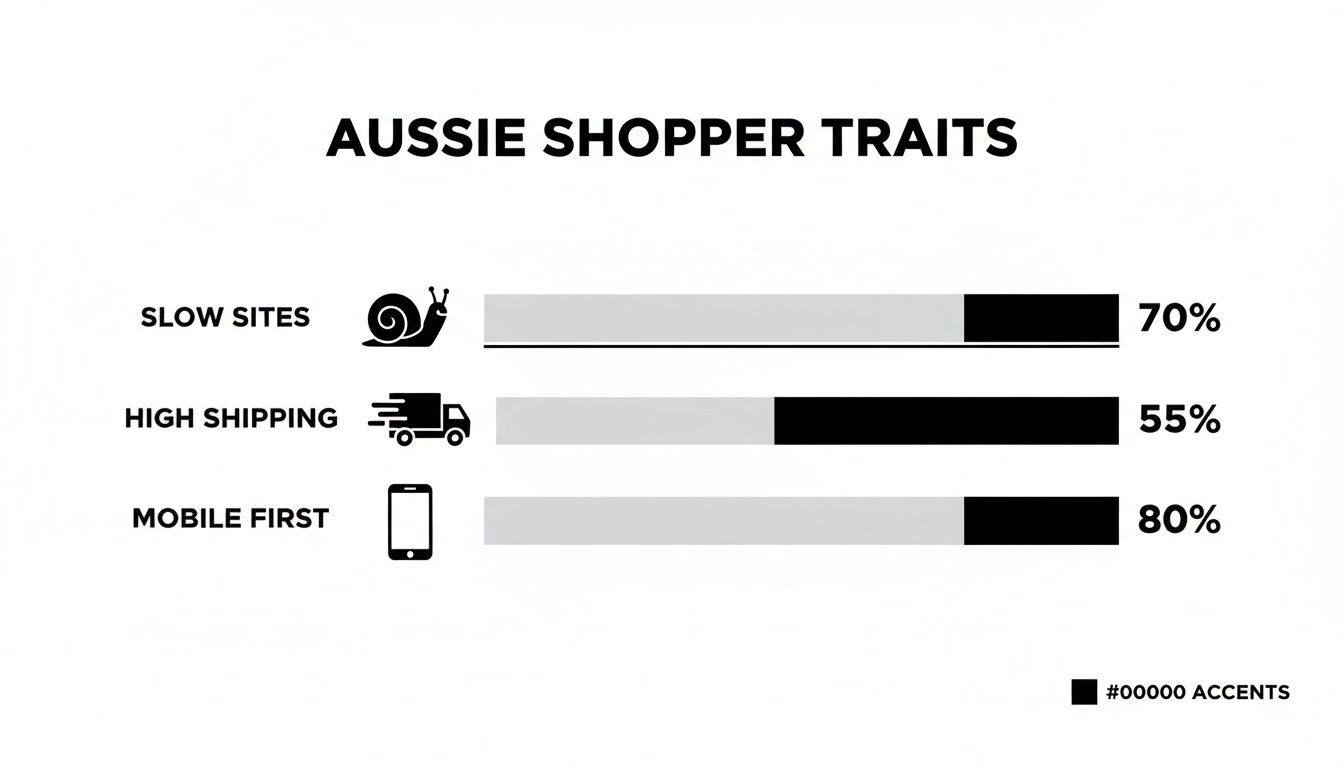
The message is clear: a fast site, transparent costs, and a slick mobile experience aren't just nice-to-haves. They're fundamental expectations. Get these wrong, and you’re leaking customers.
Australian Conversion Rate Benchmarks by Industry and Channel
To give you a clearer picture of what "good" looks like, here’s a breakdown of average conversion rates across different industries and traffic sources in Australia. Use this to see where you stand and what to focus on.
| Industry / Channel | Average Conversion Rate (Australia) | Key Optimisation Focus |
|---|---|---|
| Retail & E-commerce | 1.5% – 3.0% | Checkout process, shipping transparency, product page UX |
| B2B Services | 2.5% – 5.0% | Clear value proposition, trust signals, lead capture forms |
| Finance & Insurance | 4.0% – 8.0% | Form simplification, building trust, clear calls-to-action |
| Health & Wellness | 2.0% – 4.5% | Mobile experience, easy booking systems, social proof |
| Paid Search (Google Ads) | 3.0% – 6.0% | Landing page relevance, compelling ad copy, offer clarity |
| Organic Search (SEO) | 2.0% – 4.0% | Content quality, user intent matching, internal linking |
| Social Media | 0.8% – 1.5% | Visual appeal, clear offers, seamless mobile journey |
| Email Marketing | 3.0% – 5.5% | Personalisation, strong subject lines, targeted segments |
These benchmarks provide a starting point. Your goal should be to consistently test and improve, pushing your own numbers well past the average for your sector.
Your First CRO Strategy: A Step-By-Step Framework
Jumping into conversion rate optimisation in Australia can feel like a massive undertaking, but it doesn't have to be. Let's forget the complex theories for a second. At its heart, a good CRO strategy is just a structured way of making educated guesses and then using data to prove them right (or wrong).
This framework breaks the whole thing down into five clear, manageable steps. Think of it like a recipe. Follow the steps in order, and you'll move from guessing what works to knowing what works—ensuring every bit of effort you put in leads to real, measurable growth for your business.
Step 1: Set Clear Conversion Goals
Before you even think about changing a button colour or rewriting a headline, you need to define what success actually looks like. What is the one action you want a visitor to take on a specific page? That’s your conversion goal.
A "conversion" isn't always a sale, especially for Australian service businesses. Your main goals might be quite different.
- For a Sydney-based consultant: The goal is probably getting visitors to fill out a "Request a Consultation" form.
- For a buyers agent in Perth: A key conversion could be a user downloading your "Guide to Investing in WA" PDF.
- For a national coaching business: The most important action might be getting someone to book a 15-minute discovery call.
Your goal needs to be specific and measurable. "Get more leads" is a wish, not a goal. Instead, aim for something like, "Increase form submissions by 20% in the next quarter." This kind of clarity will guide every decision you make from here on out.
Step 2: Gather Your Insights and Data
Once you know your goal, it’s time to play detective. You need to figure out why visitors aren't converting right now. This step is all about gathering evidence, not jumping to conclusions based on a gut feeling.
You’ll get the best clues from two main sources:
- Quantitative Data (The 'What'): This is the hard numbers showing what is happening on your website. A tool like Google Analytics is perfect for this. Look for pages with high exit rates or places where users drop off during a process (like a multi-step form).
- Qualitative Data (The 'Why'): This data helps explain why people are behaving a certain way. Tools like Hotjar give you heatmaps to see where people click and scroll maps to show how far down a page they actually get. This visual proof can be a real eye-opener.
For instance, your analytics might show that your "Contact Us" page has a huge bounce rate. A heatmap could then reveal that heaps of mobile users are trying to click a phone number that isn't actually a link—a dead-end that’s clearly causing frustration.
Step 3: Form a Smart Hypothesis
Now that you have your data, you can form a hypothesis. This is just a fancy term for an educated guess about what change will produce a better result. A strong hypothesis isn't a vague idea; it follows a clear, simple structure.
A great hypothesis follows this formula: "By changing [X] to [Y], we believe [Z] will happen, because [reason]."
Let's stick with our "Contact Us" page example:
- The Observation: "Analytics shows a 70% exit rate on the contact page, and heatmaps show users are clicking the unlinked phone number."
- The Hypothesis: "By making the phone number a clickable 'tel:' link on mobile, we believe we will increase direct calls by 25%, because it removes the friction of users having to copy and paste the number."
See how that works? It’s clear, it's testable, and it connects directly to a business goal.
Step 4: Prioritise Your Tests
You’ll probably come up with a dozen great ideas and hypotheses. If you try to test them all at once, you’ll get nowhere fast. The key is to prioritise what's likely to have the biggest impact for the least amount of effort.
A simple way to do this is with the PIE framework:
- Potential: How much improvement could this change realistically make? A tweak to your checkout page has way more potential than changing the colour of a link in your footer.
- Importance: How valuable is the traffic on this page? Your main landing pages are more important than a rarely visited blog post from three years ago.
- Ease: How easy is this to actually implement? Changing a headline is simple. Redesigning your entire navigation menu is not.
Score each hypothesis from 1-10 for each factor. Add up the scores and start with the tests that rank the highest.
Step 5: Run and Analyse the Test
Finally, it's time to run the experiment. The most common way to do this is with an A/B test. You simply show one version of your page (the original 'control') to half your visitors, and the new version (the 'variation') to the other half.
Tools like Google Optimize, VWO, or Optimizely handle all the technical heavy lifting. You let the test run until you have enough data to be statistically confident in the results.
Once a winner is clear, you roll out that change permanently. But here's the most important part: you learn something from every single test, whether you win or lose. A "failed" test isn't a failure at all—it's a valuable insight that tells you what your customers don't want, which helps you form a smarter hypothesis next time.
This continuous cycle of testing, learning, and improving is the real heart of effective conversion rate optimisation in Australia.
Proven CRO Tactics That Work in Australia
Okay, enough with the high-level strategy. This is where the magic happens—turning theory into real, tangible changes on your website that Aussie customers actually respond to.
Let's get into the practical, battle-tested tactics that build trust, slash friction, and gently nudge your visitors toward that final, all-important click.

Build Unbreakable Local Trust
For Australian shoppers, trust isn't a nice-to-have; it's the price of entry. Generic trust signals just don't cut it. You need to prove you’re a legitimate local business that gets them and protects their details.
- Showcase Local Testimonials: A review from "Sarah from Sydney" is infinitely more powerful than one from "John D." in some unknown place. Even better? Video testimonials from real Aussies.
- Display Security Badges Clearly: Make sure familiar logos like Visa, Mastercard, and Afterpay are front and centre. Add SSL security badges to give visitors peace of mind that their data is safe.
- Be Upfront with Shipping and Pricing: Hidden fees are the number one conversion killer. Show shipping costs (or "Free Shipping over $X") on product pages, not just at the last checkout step. And make sure all prices are clearly marked in AUD.
Streamline the User Journey
Every extra click, every moment of confusion, is another chance for a potential customer to bail. The goal is to create a dead-simple, intuitive path from their first visit to the final conversion.
A smooth experience respects your user's time and makes it incredibly easy for them to say "yes."
The best user experience is one the user doesn't even notice. It just works. By removing obstacles, you make the decision to convert feel natural and effortless.
Think of it like a cluttered shop versus a clean, organised one. Your website navigation needs to be the latter—logical, simple, and a breeze to get around.
Optimise for Speed and Mobile Users
Like we’ve said, Aussies have zero patience for slow websites, especially on their phones. Site speed isn't some technical afterthought; it’s a massive part of the customer experience. A one-second delay can feel like an eternity and instantly erode your credibility.
And a clunky mobile site? It’s a direct message that you don’t care about your customers' convenience.
Actionable Speed and Mobile Fixes:
- Compress Images: Use tools to shrink image file sizes without losing quality. This is one of the fastest ways to improve load times.
- Simplify Mobile Forms: Make sure forms are easy to fill out on a small screen. Use bigger buttons and enable auto-fill options wherever you can.
- Test Your Mobile Experience: Don't just assume your site works on mobile. Actually go through the entire process on your own phone—from landing page to "thank you"—and fix every single frustrating bit you find.
Leverage Conversion Psychology Ethically
A little bit of human psychology can give you a powerful edge. Used ethically, these principles help guide users toward a decision without ever feeling pushy or manipulative.
- Social Proof: Go beyond testimonials. Show how many people have bought a product or signed up (e.g., "Join 1,500+ happy clients"). This puts new customers at ease.
- Urgency: Use time-sensitive offers or low-stock alerts ("Only 3 left!") to prompt immediate action. This has to be real—fake urgency will kill your trust in a heartbeat.
- Clarity Over Cleverness: Your headlines and calls-to-action (CTAs) need to be crystal clear. "Get Your Free Quote" will almost always beat a vague, clever phrase.
Putting these focused tactics into play can deliver some incredible results. In fact, many Aussie agencies report huge gains from targeted optimisation programs. By simply streamlining a checkout flow or adding the right trust signals, businesses often see conversion uplifts of 30%–100%. To see how these results stack up, you can explore more insights about Australian CRO performance.
This data proves that small, smart changes can deliver a massive return. Another powerful channel for nurturing these leads is email; check out our guide on what is EDM marketing to learn how it complements your CRO efforts.
Choosing the Right CRO Tools for Your Business
Having the right tech in your corner can turn your conversion rate optimisation in Australia from a guessing game into a data-driven science. A solid toolkit doesn’t have to cost a fortune; it’s about picking software that gives you clear answers to your most important business questions.
The goal is to build a simple but powerful stack that helps you understand what your users are doing, test your ideas for improvement, and actually measure the results. Many of the best tools have free or low-cost plans that are perfect for Australian businesses just getting started.
Understanding the “What”: Analytics Tools
Before you can fix a single thing, you need to know what’s actually happening on your website. Analytics platforms are your source of truth, giving you the hard numbers on traffic, user behaviour, and where your sales funnels are leaking.
- What they do: These tools track the numbers. They show you which pages get the most visitors, where people are leaving your site, and which marketing channels are bringing in genuine conversions.
- Key tool: Google Analytics is the non-negotiable starting point. It’s free, ridiculously powerful, and gives you all the essential data you need to find high-exit pages and spot hidden opportunities.
Seeing the “Why”: User Behaviour Tools
Analytics tells you what is happening, but user behaviour tools show you why. They add the human story behind the numbers, helping you see your website through your customers' eyes.
These tools are crucial for building empathy and coming up with smart ideas to test.
Watching real user recordings or seeing where clicks are clustered on a heatmap takes you from staring at spreadsheets to understanding actual human behaviour. This is where you’ll find those “aha!” moments that lead to massive improvements.
- What they do: They provide visual insights with heatmaps (where people click), scroll maps (how far they scroll), and session recordings (videos of real user visits).
- Popular options: Tools like Hotjar, Clarity (from Microsoft), and Crazy Egg let you visually diagnose friction points that the numbers alone could never reveal.
Proving Your Ideas: A/B Testing Platforms
Once you have a theory about how to improve something, you need a reliable way to test it. A/B testing platforms let you show different versions of a page to different groups of visitors and measure which one performs better.
- What they do: These platforms run the experiment for you, splitting your traffic and tracking the results to declare a statistically significant winner.
- Popular options: Platforms like VWO and Optimizely have long been industry standards, while many modern tools now include their own A/B testing features.
Picking the right mix of tools really comes down to your budget and specific needs. For businesses that want expert help to get results faster, this guide to finding the ideal Conversion Rate Optimisation agency is a fantastic resource.
Alternatively, if you want a more hands-on approach, our team at Homer Digital can help you choose and set up the perfect toolkit. Find out how a specialised conversion rate optimisation agency can sharpen your strategy.
Frequently Asked Questions (FAQ)
We get it. Conversion rate optimisation can sound complex, so let's clear up a few common questions we hear from Australian business owners.
What’s the Difference Between CRO and SEO?
Think of it like a physical shop. Search Engine Optimisation (SEO) is everything you do to get people to find your store and walk through the front door. It’s your signage, your location, your spot in the local directory – all designed to attract foot traffic.
Conversion Rate Optimisation (CRO) is what happens inside the store. It's the layout, the helpful staff, the clear pricing, and the easy checkout process that turns a browser into a paying customer.
You need both. SEO brings the people in, and CRO makes sure they don’t leave empty-handed. They’re two sides of the same coin.
How Long Does It Take to See Results From CRO?
This isn’t an overnight fix. While some simple tweaks might give you a quick bump, a proper CRO strategy is about making smart, sustainable gains over time.
You’ll need to gather data, form a solid hypothesis, and run tests long enough to get a clear winner. You might see some positive signs within the first 4–6 weeks, but the real, game-changing growth comes from a commitment to continuous improvement over several months. It’s a marathon, not a sprint.
Is CRO Only for E-commerce Websites?
Absolutely not. That’s one of the biggest myths out there. While online stores use CRO to sell more products, it’s just as powerful for service-based businesses in Australia.
A "conversion" is simply the most valuable action you want a visitor to take.
- For a consultant, it’s a booked discovery call.
- For a tradesperson, it’s a submitted quote request.
- For a real estate agent, it’s a property guide download.
If you have a website that needs to generate leads, enquiries, or clients, then CRO is for you.
Ready to stop guessing and start getting more out of your existing website traffic? Homer Digital Marketing builds data-driven CRO strategies specifically for Australian service businesses. We find the leaks in your funnel and turn more visitors into valuable clients.
Book a discovery call today and let’s build a website that doesn’t just look good—it gets results.
