

Ever felt that sinking feeling when you see plenty of website visitors but hardly any sales? That’s where a conversion rate optimisation agency comes in. Think of them as the expert team you bring in to solve that exact puzzle—turning the traffic you already have into paying customers.
What Does a Conversion Rate Optimisation Agency Do?

Let’s use an analogy. Imagine your website is a physical shop. You could spend a fortune on ads to get people through the door, but what if the layout is confusing, the aisles are messy, or the queue at the checkout is a mile long? Most people will just walk out.
A conversion rate optimisation agency isn’t focused on getting more people into your store. Instead, they meticulously redesign the layout—the user journey—to guide every single visitor smoothly towards making a purchase. They’re part data detective, part user experience architect.
Their mission is to hunt down and eliminate all the “friction points” on your site. These are the subtle (and sometimes not-so-subtle) roadblocks that stop people from taking action, whether that’s buying a product, filling out a form, or signing up to your newsletter.
The Science Behind the Strategy
A true CRO agency runs on hard evidence, not guesswork. They don't just throw ideas at the wall to see what sticks. Instead, they use a structured, scientific process to figure out what’s broken, suggest fixes, and then prove their solutions work through testing.
This process usually looks something like this:
- Deep-Dive Analysis: They use tools like heatmaps and session recordings to watch exactly how real people use your site. It’s like looking over their shoulder to see where they get stuck, confused, or frustrated.
- User Research: This involves getting inside your customers' heads through surveys, interviews, and usability tests to understand what they really want and what drives them crazy.
- Hypothesis-Driven Testing: They form an educated guess (a hypothesis) about a change that could boost conversions. Then, they put it to the test with methods like A/B testing to see if they were right.
This methodical approach means every change is backed by data, leading to real, sustainable growth—not just a few lucky wins. One of the biggest areas they focus on is improving key pages, and this guide to landing page conversion rate optimization is a great resource to learn more.
Why Benchmarks Matter
It’s crucial to know how you stack up against the competition. For instance, in 2025, the average eCommerce conversion rate in Australia is expected to be somewhere between 2% and 4%.
As of September 2024, the actual average was a little lower at 1.78%, which gives retailers a solid baseline to work from. These numbers show just how much room for improvement there is when you apply smart CRO strategies.
Ultimately, a CRO agency is there to close the gap between your business goals and what your users actually need. They create a seamless online experience that drives real results and gets the maximum value out of every single visitor.
Core Services That Drive Real Business Growth
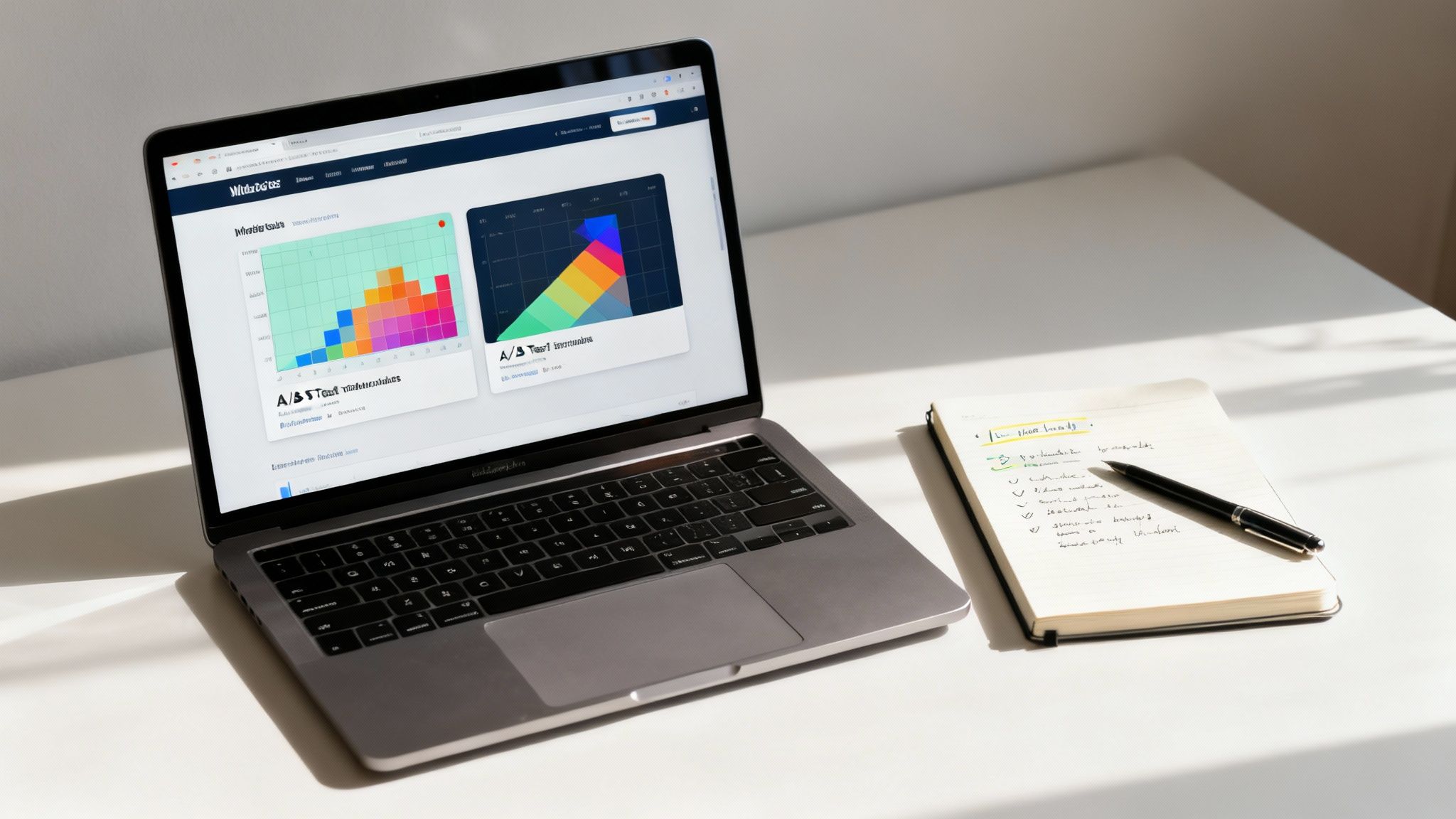
A top-tier CRO agency does a lot more than just tinker with button colours and call it a day. They offer a whole suite of interconnected services built to understand your audience on a much deeper level and systematically knock down any barriers that stop them from converting.
Think of it less like a simple checklist and more like an engine fine-tuned for sustainable growth. It's all about moving past guesswork and using cold, hard data to make decisions that actually boost your revenue.
Deep-Dive User Research and Analysis
Before a single change is even considered, a great CRO agency starts by listening. They essentially become detectives for your website, using powerful tools to figure out why your users behave the way they do. This isn't about hunches; it's about pure, observable evidence.
This deep-dive research phase usually includes:
- Heatmap and Scroll Map Analysis: These tools create a visual story of where users click, move their mouse, and how far they bother to scroll. You can see in an instant what grabs their attention and what they completely ignore.
- Session Recordings: It’s like looking over your user's shoulder. By watching anonymised recordings of real sessions, analysts can spot exactly where visitors get stuck, run into errors, or show signs of frustration.
- User Surveys and Feedback Polls: Sometimes, the easiest way to find out what's wrong is to simply ask. Quick on-site polls can capture real-time feedback on what's confusing or missing for your visitors.
This foundational research is everything. It makes sure every change is backed by real user behaviour, not just a marketer's gut feeling. It’s the difference between guessing what might work and knowing where the real opportunities are hiding.
Methodical A/B and Multivariate Testing
Once the research uncovers a problem, testing is how you prove the solution works. A conversion rate optimisation agency uses methodical experiments to confirm that a proposed change will actually improve your numbers. It’s where the scientific method meets marketing.
An A/B test (or split test) is simple: you create two versions of a page—the original (Control) and a new one (Variant). Traffic is split between them, and the agency measures which version gets a better conversion rate with statistical confidence. This data-first approach removes all bias and ensures decisions lead to real, measurable gains.
Strategic Landing Page Optimisation
Your landing pages are often your first and only shot to make a good impression. Optimising them isn't just about making them look pretty; it's about creating a clear, compelling, and totally frictionless path from the first click to the final conversion.
A huge part of this is refining every single element to serve one goal. From writing persuasive headlines and benefit-driven copy to simplifying forms and making sure your call-to-action is unmissable, every detail is put under the microscope. This is where knowing the best practices for landing pages really pays off.
It also connects directly to the customer's path. To get a better handle on this, check out our guide on what customer journey mapping is and see how it shapes the whole process.
To give you a clearer picture, here’s a breakdown of the core services and the impact you can expect.
Key CRO Services and Their Business Impact
| Service | What It Is | Expected Business Outcome |
|---|---|---|
| User Research & Analysis | Using tools like heatmaps, session recordings, and surveys to understand user behaviour. | Identifies friction points and uncovers "why" users aren't converting, providing a data-backed roadmap for improvements. |
| A/B & Multivariate Testing | Methodically testing variations of a webpage (e.g., headlines, buttons) against the original to find a winner. | Eliminates guesswork, validates changes with statistical proof, and ensures every update leads to higher conversion rates. |
| Landing Page Optimisation | Refining all elements on a landing page—copy, forms, layout, CTAs—to focus on a single conversion goal. | Increases lead generation and sales from paid campaigns, maximises ad spend, and improves overall campaign ROI. |
| Customer Journey Mapping | Visually mapping out every touchpoint a customer has with your business, from awareness to purchase. | Reveals drop-off points in the customer journey and helps create a more cohesive, seamless user experience that guides people to convert. |
Ultimately, these core services don’t work in isolation. They create a powerful, continuous loop of improvement: research gives you insights, testing proves what works, and optimisation implements those winning changes—all of which feed directly into your business's bottom line.
What's the Real Value of Working with a Specialist CRO Agency?
Hiring a conversion rate optimisation agency isn’t just about outsourcing a few tasks—it's a strategic move for serious, long-term growth. While your in-house team lives and breathes your brand, an outside agency brings a powerful mix of fresh eyes, specialised tools, and deep expertise that’s almost impossible to build internally without a huge budget.
For starters, you get immediate access to enterprise-level testing and analytics software. These platforms can set you back tens of thousands of dollars a year, which is a non-starter for most businesses. A good agency bundles this into their service, giving you world-class data capabilities from day one.
Even more importantly, you’re hiring a team of specialists who eat, sleep, and breathe optimisation. Their entire professional lives revolve around data, user psychology, and experimental design. This partnership dramatically shortens your learning curve and gets you results much, much faster.
An Objective, Data-First Perspective
One of the biggest wins of bringing in an agency is their objective viewpoint. It’s easy for internal teams to get too close to the product, leading to biases or "sacred cow" ideas that no one dares to question. A specialist agency doesn’t have that baggage.
Their only loyalty is to the data. This impartial stance means they can challenge assumptions and uncover uncomfortable truths about your user experience—the kind of things an internal team might overlook or even avoid. They simply follow the numbers to find out what actually makes your customers click, buy, and convert.
This data-driven approach is especially powerful in the Australian market. Top-tier Aussie firms lean heavily on deep analytics and A/B testing to deliver massive results. These data-backed CRO efforts often produce an average success rate of around a 25% improvement in conversion tests, which translates directly into more revenue. You can find more insights about how these specialised agencies create impact.
Building a Long-Term Competitive Edge
At the end of the day, working with a CRO agency is about more than just quick wins. It’s about building a culture of continuous improvement right into your company’s DNA.
By showing you the power of data-driven decisions, an agency helps shift your company's mindset from relying on hunches to demanding hard evidence. This cultural change becomes a powerful, long-term competitive advantage that keeps paying off long after the initial project is over.
The benefits just keep stacking up over time:
- Accelerated Learning: Every test—win or lose—gives you invaluable insights into how your customers think and behave.
- Increased Efficiency: You stop wasting time, money, and energy on marketing ideas that don't actually move the needle.
- Sustainable Growth: This iterative process builds a stronger, more resilient revenue engine that can adapt to whatever the market throws at it.
The real value isn't just in the conversions they deliver today. It's in the smarter, more effective business they help you become tomorrow.
How to Choose the Right CRO Agency for Your Business
Picking the right partner is hands-down the most important step you’ll take on your CRO journey. It’s easy to get dazzled by flashy case studies and smooth sales pitches, but the real key is looking past the surface. You need to find a conversion rate optimisation agency with a structured, repeatable process that actually lines up with your business goals.
A great agency doesn’t just throw around promises of big results; they show you how they get there. They should be able to walk you through their entire process—how they do their research, come up with ideas, decide what to test, and report back on what they find. A transparent, data-driven approach isn't just a 'nice to have'; it's non-negotiable.
Assess Their Methodology and Process
First things first, dig into how they actually work. Do they have a clear, documented framework for optimisation? A mature agency has moved way beyond just running random A/B tests. They follow a methodical cycle of research, hypothesis, testing, and analysis, making sure every single action is deliberate and builds towards a bigger strategy.
You also need to suss out their technical chops. The best agencies aren’t just marketing experts; they have serious technical skills. This means they can not only dream up smart tests but also implement them smoothly without breaking your website or slowing it down. Strong technical skills are especially critical for improving user experience, where even tiny tweaks can make or break your site's usability. To get a better feel for this, have a look at the key elements of modern website design and see how they feed into conversions.
Scrutinise Case Studies and Industry Experience
Case studies are your best peek into how an agency performs in the real world. But don’t just take them at face value. Look for proof of success in your specific industry or with businesses that have challenges like yours. A huge win for a big eCommerce retailer might not mean much if you’re a B2B service provider.
Pay close attention to the story behind the numbers in the case studies. Did they clearly explain the problem they started with? The hypothesis they tested? The data that backed up the result? Vague success stories are a major red flag. You want concrete proof that they can deliver uplifts you can actually measure.
Key Takeaway: The best case studies aren't just about the final percentage lift. They tell a story of strategic problem-solving, demonstrating how the agency used data to understand a user problem and implemented a creative, effective solution.
Platforms like Clutch are fantastic for vetting agencies, offering up genuine client reviews and verified project details.
Here's an example of what you might see when checking out top Australian agencies on Clutch.
This kind of snapshot gives you verified client reviews and a look at their main focus areas, helping you quickly spot agencies with proven expertise in your niche.
Evaluate Communication and Reporting
Partnering with a CRO agency is a long-term thing, so clear and consistent communication is absolutely essential. As you're having those initial chats, get a feel for how transparent they are. How will they keep you in the loop? What do their reports actually look like?
A great partner will provide regular, easy-to-digest reports that tie test results directly to your main business KPIs, like revenue and lead quality. They should be able to explain not just what happened, but why it happened and what the plan is for the next steps.
To help you cut through the noise, here are some critical questions to ask any potential agency:
- What’s your process for user research before you even think about testing? (You want to hear them talk about things like heatmaps, session recordings, user surveys, and deep dives into analytics).
- How do you prioritise which tests to run first? (They should mention a framework based on potential impact, confidence in the idea, and how easy it is to implement).
- Can you show us an example of a test that failed and what you learned from it? (This is a great test of their honesty and shows they’re committed to learning, not just showing off their wins).
- How will your team work with our developers or marketing team? (This helps clarify who does what and makes for a smoother workflow).
- What tools are included in your retainer, and are there any extra costs we should know about? (This ensures you have total transparency on your investment).
Asking these questions will help you get past the sales pitch and find a true strategic partner who is actually equipped to deliver meaningful results for your business.
Understanding Your Investment and Expected ROI
When you partner with a conversion rate optimisation agency, you’re not just buying another marketing service. Think of it as a capital investment—one aimed squarely at multiplying the revenue you get from the traffic you already have. The financial commitment is what fuels the entire process of discovery, testing, and improvement.
In Australia, most CRO agencies work on a monthly retainer model, though some might offer performance-based options. A retainer gives the agency the stability needed to do the deep research, strategic planning, and careful execution of controlled experiments. It’s a true partnership built on sustained effort, not a quick, one-off project.
Calculating the Financial Impact of CRO
The real magic of CRO is in its leverage. Even a tiny lift in your conversion rate can create a massive ripple effect, boosting your annual revenue and making the agency's fees look insignificant. The return on investment isn't some vague hope; it's something you can actually calculate.
Let’s run through a simple scenario:
- Average Monthly Visitors: 20,000
- Current Conversion Rate: 1.5% (which is 300 sales)
- Average Order Value: $150
- Monthly Revenue: $45,000
Now, imagine a good CRO agency gets your conversion rate up by just 0.5 percentage points to 2.0%. Suddenly, the numbers look very different. You’d be making 400 sales and generating $60,000 in monthly revenue. That’s an extra $15,000 a month, or a whopping $180,000 per year, all from the same amount of traffic.
To get these kinds of results, you need the right partner. This timeline shows you how to properly evaluate your options.
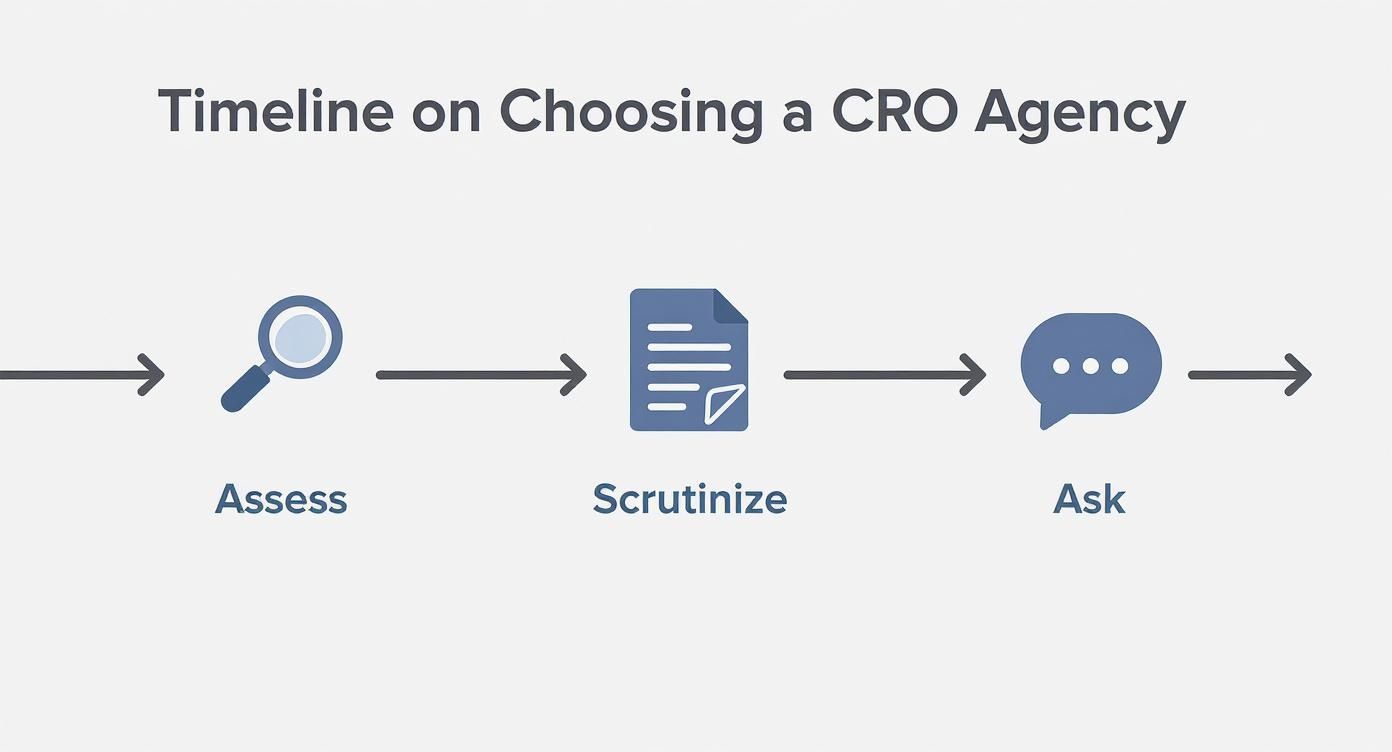
As the infographic shows, it's a structured process. You need to assess your own needs, demand real proof of past success, and ask the tough questions to make sure you find an agency that can deliver a tangible return.
Your First 90 Days with a CRO Agency
Knowing what to expect is key to a great partnership. The first three months are all about laying the groundwork—building a solid, data-backed strategy before a single major test goes live. This period isn't about chasing immediate wins; it's about setting you up for consistent, long-term growth.
Here’s what the first 90 days usually look like:
- Month 1: Discovery and Audit (Weeks 1-4): This is where the agency rolls up its sleeves and dives deep into your analytics, user behaviour, and customer feedback. They’ll use tools like heatmaps, session recordings, and heuristic analysis to pinpoint exactly where users are struggling and where the biggest opportunities lie.
- Month 2: Hypothesis and Prioritisation (Weeks 5-8): Armed with data from the audit, the team starts forming educated guesses (hypotheses) about what changes will work. They’ll then build a prioritised roadmap of experiments, focusing on the tests most likely to deliver the biggest impact for the least effort.
- Month 3: Initial Experimentation (Weeks 9-12): It’s time to get testing. The first A/B tests are designed, built, and launched. The agency will be watching the results like a hawk, gathering the crucial initial data that will shape all future optimisation work.
Of course, tracking all this isn't always simple. If you want to dig deeper into the complexities, check out our guide on why it is difficult to measure marketing ROI.
Your CRO Agency Questions Answered
Thinking about teaming up with a conversion rate optimisation agency? It’s natural to have a few questions. Let's run through the common ones so you can feel confident about your next move.
How Much Does a CRO Agency Cost?
The cost of hiring a CRO agency really depends on the project size and the team’s experience. Here in Australia, most agencies work on a monthly retainer, which can be anywhere from $3,000 to over $15,000. Some also offer fixed prices for one-off projects.
It’s better to think of this as an investment, not just another business cost. A smart CRO program should pay for itself and then some by boosting your revenue, making the initial spend well worth it.
How Long Until We See Results?
While you might spot a few 'quick wins' in the first month, getting solid, data-driven results from A/B testing usually takes around 3-6 months. CRO isn’t a quick fix; it’s a long-term play designed to build steady, sustainable growth.
A good agency will be upfront about this from day one. They’ll set clear timelines and keep you in the loop with regular progress reports.
The real aim is to learn and improve with every step. Each test—win or lose—teaches you something new about your customers. That knowledge builds up over time, leading to bigger, more lasting growth down the track.
What Does Our Team Need to Do?
The best results come from teamwork. Your main job will be to give the agency access to things like your website’s backend and analytics platforms. It’s also a huge help to have one person on your team as the main point of contact for approvals and catch-ups.
Your developers might need to step in to implement the winning test variations. A good agency, however, will do everything they can to make this process as smooth and easy as possible for your team.
Does CRO Help with Our SEO Efforts?
Yes, it absolutely does. CRO and SEO work hand-in-hand to create a powerful growth engine. When you improve the user experience on your site, people tend to stick around longer and bounce less often. Both of these are positive signals to search engines like Google.
At the end of the day, a website that’s optimised to convert visitors is exactly the kind of site search engines want to rank higher.
Ready to turn more of your website visitors into loyal clients? Homer Digital Marketing specialises in creating data-driven marketing systems that deliver real results. We combine decades of experience with proven strategies to help you grow your visibility and scale your service-based business.
Book a discovery call with us today to find out how we can help you achieve your growth goals.
