
Ever heard the term email marketing? In the professional world, it's often called EDM marketing, which stands for Electronic Direct Mail. Think of it as the digital equivalent of sending a personalised letter directly to someone who genuinely wants to hear from you. It's a powerful, direct method for connecting with your audience, right in their personal inbox.
This guide will give you a complete breakdown of what EDM marketing is, why it's a game-changer for businesses, and how you can build a strategy that delivers real results.
Understanding the Basics of EDM Marketing
So, what is EDM marketing, really? It's a digital marketing strategy where you send promotional or informational emails to a list of subscribers who have explicitly agreed to receive them. The name might sound a bit technical, but the core idea is simple: direct communication.
Let's use an analogy. Social media marketing is like putting up a massive billboard on a busy highway—you’re broadcasting a message and hoping the right people drive past and happen to notice it.
EDM marketing, on the other hand, is like sending a carefully crafted letter straight to a customer’s personal mailbox. They’ve given you the key. This direct line of communication makes it an incredibly personal and effective way to build genuine, lasting relationships with customers.
To give you a quick snapshot, here’s a simple breakdown of what EDM marketing covers.
EDM Marketing at a Glance
| Aspect | Description |
|---|---|
| Core Concept | Sending targeted emails to a list of opted-in subscribers. |
| Primary Goal | To nurture leads, engage clients, and drive business growth through conversions. |
| Key Strength | Builds direct, personal relationships with your audience at scale. |
| Common Uses | Newsletters, promotions, lead nurturing, and client updates. |
| Main Benefit | High return on investment (ROI) and full ownership of your audience list. |
This table shows just how focused and powerful this channel can be when used correctly.
What’s the Real Goal of an EDM Strategy?
The main objective here is to nurture potential clients and keep your existing ones engaged. This isn’t about one-off ads that shout for attention. A smart EDM strategy is about building a conversation over time, gently guiding people from being vaguely aware of your brand to becoming loyal advocates.
It’s all about delivering consistent value so that when they need your service, your business is the first one they think of.
And it works. This strategy is consistently one of the most profitable marketing channels out there. For every $1 spent on email marketing, businesses see an average return of a whopping $36. The Australian email advertising market is also set to hit AU$370.67 million in 2024, which shows just how much local businesses are relying on it. You can learn more about the powerful ROI of email marketing from recent analyses.
At its heart, EDM marketing is about creating a direct, one-to-one dialogue with your audience at scale. It transforms your contact list from a simple database into a community of engaged individuals who have given you permission to speak with them.
For Australian service-based businesses, this channel is an absolute game-changer. It gives you a reliable and cost-effective way to:
- Educate potential clients on your expertise and what makes your services unique.
- Announce special offers or promotions to get bookings in the door quickly.
- Share valuable insights through newsletters to establish yourself as an authority and build trust.
- Keep in touch with past clients to encourage repeat business and referrals.
Why Aussies Actually Welcome EDM Campaigns
In a world buzzing with social media noise and endless ads, the email inbox is one of the last personal spaces online. For Australians, it’s less like a chaotic public square and more like their own private letterbox. They decide who gets to drop a message in.
This sense of control is exactly why so many Aussies don’t just put up with email marketing—they actively welcome it when it’s done right.
Think about it. A social media feed is driven by algorithms, but an email subscription is a conscious choice. When a customer gives you their email, they’re giving you a direct line to them. It’s a powerful relationship built on permission from day one.
You’re not shouting into the void; you’re meeting your customers in a space where they’re ready to listen.
The Power of Permission and Preference
The numbers don't lie—Australians have a clear favourite when it comes to business communication. A huge 55% of consumers prefer to hear from businesses via email. That figure leaves social media (27%) and SMS (17%) in the dust, proving the inbox is where the real connection happens. You can dig into more of the data with these Australian email engagement statistics.
This isn’t just a preference; it’s a daily habit. An incredible 93% of email users check their inbox at least once a day, making it one of the most reliable ways to reach your audience.
EDM marketing works because it respects the customer's space. When you deliver relevant updates, exclusive offers, and genuinely useful content, you’re not interrupting their day—you’re adding to it.
This is a mindset shift. You're not just blasting out another promo. You’re building a relationship with someone who personally invited you in.
Building Trust, One Email at a Time
Ultimately, the success of EDM marketing in Australia boils down to a simple value exchange. A customer trusts you with their email address, and in return, you give them something worthwhile. That could be anything from industry insights to a heads-up on a sale.
Here’s why this exchange is so effective:
- It Feels Personal: A message sent straight to an inbox feels far more direct and exclusive than a public post for everyone to see.
- It’s Not Intrusive: People can open and read emails on their own terms. No pop-ups, no auto-playing videos, no pressure.
- It Delivers Real Value: From discount codes to expert advice, good EDM provides tangible benefits your customers can actually use.
By honouring this agreement and consistently delivering quality, service-based businesses can turn a simple email list into a loyal community. This isn’t just another marketing channel; it’s how you build lasting customer relationships based on mutual respect.
The Three Pillars of Effective EDM Marketing
To take your EDM marketing from a simple newsletter to a genuine growth engine, your strategy needs to stand on three core pillars: segmentation, personalisation, and automation. Get these three working together, and you can deliver the right message to the right person at the right time, every time.
And it’s a channel worth mastering. This infographic shows just how strongly Aussie consumers prefer email over other channels, highlighting why getting your strategy right is so critical.
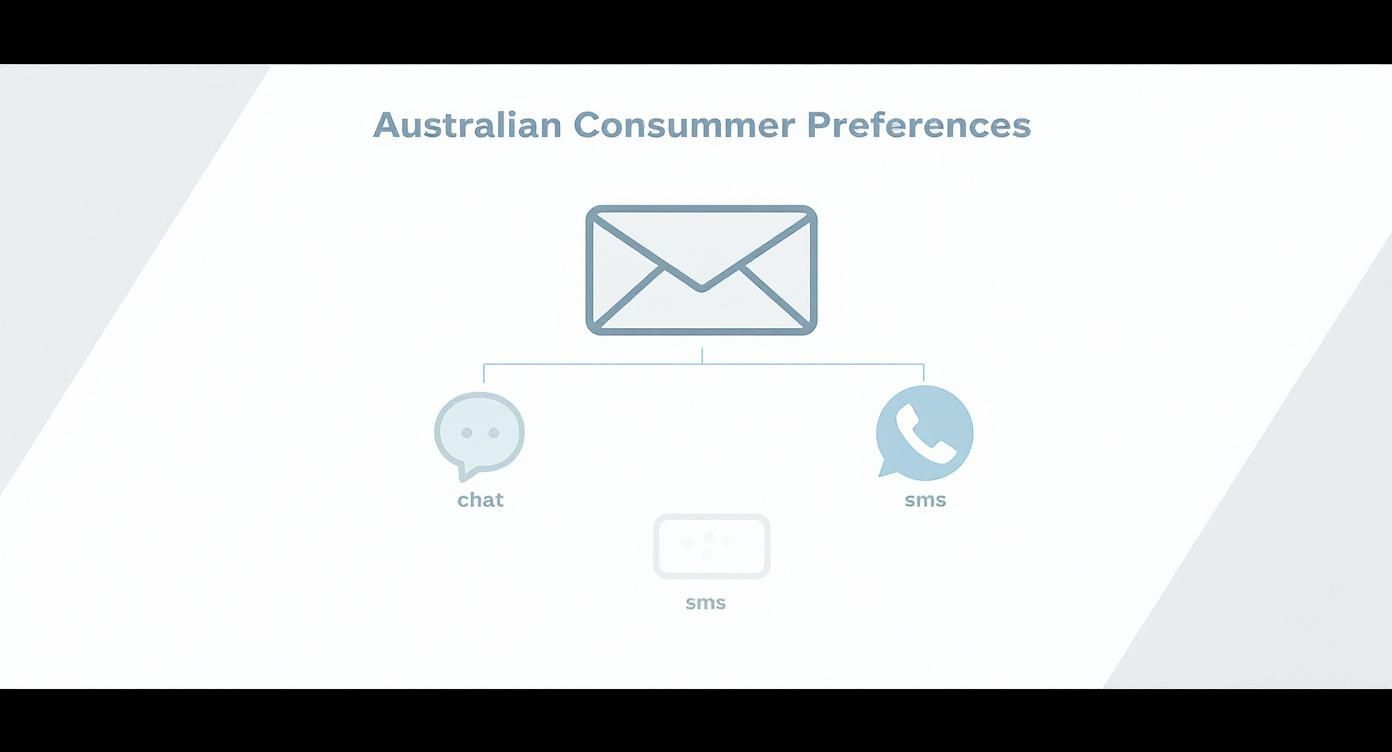
The numbers don't lie. Email is where your audience expects to hear from you, so it's essential to nail these strategic pillars to meet—and exceed—their expectations.
Pillar 1: Segmentation
Segmentation is simply the art of splitting your audience into smaller, more relevant groups based on who they are and what they’ve done. This isn't just about slicing up a list; it’s about truly understanding the different types of people you’re talking to.
Think of it like hosting a party. You wouldn't launch into the same conversation with a brand-new acquaintance as you would with a close friend you've known for years. In the same way, you should be communicating differently with fresh leads compared to your loyal, long-term clients.
To get this right, you first need to build a robust customer segmentation strategy that will let you personalise your campaigns properly.
Common ways to segment your list include:
- Demographics: Grouping people by things like their age, location, or industry.
- Behaviour: Segmenting based on past purchases, which pages they visited on your website, or how often they open your emails.
- Lifecycle Stage: Separating new subscribers from active clients, or even creating a list of past customers you want to win back.
Pillar 2: Personalisation
Personalisation is what makes your segments come alive. It’s where you use the data you’ve gathered to tailor your messages so they feel like they were written just for one person. And this goes way beyond just dropping a [First Name] tag into the subject line.
Real personalisation means sending content that speaks directly to a subscriber's specific interests, problems, or their history with your business. For example, a real estate agency could send market updates for a specific suburb only to clients who previously enquired about properties in that area.
By personalising your content, you’re showing your audience that you actually listen. This builds incredible trust and turns a generic email blast into a valuable, one-to-one conversation.
Pillar 3: Automation
Automation is the engine that makes all this work without you losing your mind. It lets you set up pre-defined email sequences, often called "workflows," that are automatically triggered by what your subscribers do (or don't do).
This means you can deliver timely, relevant messages around the clock without having to manually hit "send" every single time. It's your secret weapon for nurturing relationships at scale.
Australian marketers are going all-in on this. Marketing automation is now the top investment priority for Aussie marketers, with 58% identifying it as their primary focus for 2025. It’s easy to see why: automated emails get average open rates of 48.57%, crushing the 37.93% seen by standard, one-off campaigns.
Some of the most popular and effective automation examples include:
- Welcome Series: An automated sequence of emails sent to new subscribers to introduce them to your brand, build trust, and set expectations.
- Re-engagement Campaigns: A workflow triggered when a subscriber hasn't opened your emails in a while, designed to win them back with a special offer or a friendly nudge.
Essential EDM Campaigns for Service Businesses
Let's get practical. A solid EDM marketing strategy isn't about firing off a generic monthly newsletter and hoping for the best. It’s about building a playbook of specific, automated campaigns that get real results for Australian service businesses—from welcoming new clients to winning back the ones who've gone quiet.

Think of these campaigns as your core moves. Each one has a distinct job to do at a specific point in the customer journey, making sure you’re always sending the right message at exactly the right time.
The Welcome Series
You only get one chance to make a first impression. A Welcome Series is an automated sequence of three to five emails that goes out the moment someone joins your list. The goal here is simple: introduce your brand, build some early trust, and set the tone for a valuable relationship.
This is your opportunity to tell your story, flash a bit of your expertise, and give them something useful straight away. The final email can then gently nudge them towards a next step, like booking a call or checking out your service packages.
The Educational Nurture Sequence
Let's be real: not every lead is ready to buy the second they find you. The Educational Nurture Sequence is built for those prospects who are interested but still weighing their options. Over a series of emails, you deliver high-value, problem-solving content that cements you as the go-to expert in your field.
This campaign isn't a sales pitch; it's a masterclass. By educating your audience, you build incredible credibility. When they are ready to pull the trigger, your business is the only one they'll think of.
A buyer's agent, for instance, could send out a sequence on the "5 Mistakes to Avoid When Buying Your First Home." For agencies, getting this right is a huge part of client acquisition, a topic we cover in our guide on email marketing for agencies. This turns your EDM from a simple broadcast tool into a machine that actively warms up your leads.
To give you a clearer picture, here’s a quick look at how different campaign types align with what you're trying to achieve.
Campaign Type vs Business Goal
This table breaks down which campaign to use for specific business goals, helping you choose the right tool for the job.
| Campaign Type | Primary Business Goal | Example For a Service Business |
|---|---|---|
| Welcome Series | Build Trust & Engagement | An accounting firm sends a series introducing their team and offering a free tax checklist. |
| Nurture Sequence | Educate & Build Authority | A business coach sends weekly tips on scaling operations to leads who downloaded a guide. |
| Special Offer | Drive Immediate Bookings | A photographer promotes a 20% discount on headshot packages for a limited time to fill their calendar. |
| Re-engagement | Win Back Inactive Leads | A web design agency emails contacts who haven't opened emails in 90 days with a "Still interested?" message and a case study. |
Each campaign serves a strategic purpose, ensuring your marketing efforts are always aligned with your growth objectives.
The Special Offer Campaign
When you need to generate action now, the Special Offer Campaign is what you pull out. This is a short, sharp sequence promoting a time-sensitive discount, an exclusive package, or some kind of bonus. The secret sauce is creating a genuine sense of urgency and undeniable value.
Craft a subject line they can't ignore, spell out the benefits clearly, and make your call-to-action button the most obvious thing on the page. It's the perfect play for filling empty spots in your calendar or launching a brand-new service.
The Re-engagement Campaign
It happens. Over time, some of your subscribers will just stop opening your emails. A Re-engagement Campaign is your targeted mission to bring them back into the fold. It's an automated sequence that kicks in when someone hasn't engaged for a set period, like 90 days.
These emails usually start with a friendly, "Hey, are you still interested?" and often include a special offer as a little incentive to stick around. This is way more cost-effective than finding a new subscriber from scratch and it’s essential for keeping your email list healthy and engaged.
How to Measure Success and Stay Compliant
Launching a slick EDM campaign is one thing, but knowing if it actually worked—and making sure you’re playing by the rules—is what really separates the pros from the amateurs. A smart EDM strategy isn't just about sending emails; it's about sending the right emails, measuring what happens next, and building trust while you do it.
So, how do you know if your campaign was a hit or a miss? You look at the data. Let’s break down the numbers that matter.
Key Metrics for Your EDM Campaigns
Forget vanity metrics. Tracking the right Key Performance Indicators (KPIs) is how you stop guessing and start making data-backed decisions that make every future email better than the last.
Here are the three big ones you absolutely need to watch:
- Open Rate: This is simply the percentage of people who opened your email. A high open rate means your subject line hit the mark and your sender name is trusted. It's your first handshake.
- Click-Through Rate (CTR): Now we're getting somewhere. CTR measures the percentage of people who not only opened your email but also clicked on a link inside it. This tells you your content was compelling enough to make someone take the next step. If you want a quick way to figure this out, a handy click-through rate calculator can do the heavy lifting for you.
- Conversion Rate: This is the finish line. A conversion happens when someone clicks a link and then completes the action you wanted them to take, like booking a call or buying a service. This metric tells you if your campaign actually generated business.
While a high open rate feels good, CTR and Conversion Rate are where the money is. They prove your audience isn't just listening—they're acting. As a benchmark, Australian service businesses should aim for an open rate around 20-25% and a CTR of 2.5-5%. If you're hitting those numbers, you're on the right track.
Staying Compliant with Australian Law
Beyond the numbers, you have to operate ethically and legally. In Australia, that means following the Spam Act 2003. It sounds intimidating, but it boils down to three common-sense rules. While other places have different laws, like the GDPR email compliance guidelines in Europe, the Aussie version is pretty straightforward.
Your EDM marketing must always tick these three boxes:
- Consent: You need permission to email someone. This can be explicit (they signed up) or inferred (they're an existing client). Whatever you do, never, ever buy an email list.
- Identification: Your email has to make it crystal clear who it's from. No hiding behind vague company names—your business needs to be clearly identified.
- Unsubscribe: Every single marketing email must have a clear, functional unsubscribe link. When someone clicks it, you have to honour their request promptly.
Sticking to these rules isn't just about avoiding fines. It’s about showing respect for your audience and building a list of people who actually want to hear from you. That’s how you build a brand people trust.
Your Step-by-Step EDM Implementation Guide
Alright, you've got the theory down. Now for the fun part: turning that knowledge into real-world action. Launching your first EDM campaign can feel like a huge task, but it’s actually just a series of small, manageable steps.
Think of this as your pre-flight checklist. Follow it, and you'll have all your bases covered before you even think about hitting ‘send’.
1. Choose Your Platform
First things first, you need the right tool for the job. Your email marketing platform is your command centre, so pick one that fits your business needs without being overly complicated.
Look for a service with a user-friendly interface, decent automation features, and reporting that actually makes sense. In Australia, popular choices include Mailchimp for beginners, Klaviyo if you're in e-commerce, and ActiveCampaign for those who want to get serious with advanced automation.
2. Build Your Email List Ethically
Your email list is your single most valuable marketing asset. Treat it like gold. That means you should never, ever buy an email list—it's a fast track to spam folders and a ruined reputation.
Instead, grow it organically by giving people a good reason to sign up:
- Lead Magnets: Offer a free checklist, a handy guide, or a spot in your next webinar. Value for an email address is a fair trade.
- Opt-in Forms: Make it easy for people to join your list. Place clear sign-up forms on your homepage, at the end of blog posts, and on your contact page.
- In-Person Sign-ups: Met a potential client at an event? Ask them if they’d like to join your list. Serviced a client? Ask for their email to send follow-ups (with their permission, of course).
3. Define a Clear Campaign Goal
Before you write a single word, ask yourself: what do I want this email to actually do?
Pick one primary goal. Is it to drive bookings for a specific service? Announce a new offer? Or just welcome and educate your new subscribers? Having a clear objective steers every decision you make, from the subject line right down to the call-to-action.
A campaign without a goal is like a ship without a rudder. Knowing your destination ensures every element of your email works together to get you there, preventing wasted effort and confusing messages.
4. Create a Simple and Mobile-Friendly Template
Let’s be honest, most people are reading your email on their phone while waiting for a coffee. Your design needs to work for them.
Keep it clean, professional, and dead simple to read. Use a single-column layout, large fonts, and plenty of white space to let the content breathe. Your branding—logo and colours—should be consistent. This isn’t just about looking good; it builds recognition and trust with your audience over time.
5. Write Compelling Copy and Set Up Tracking
Now it’s time to write. Ditch the corporate jargon and write like a human. Use "you" and "your" to speak directly to the subscriber. Keep your paragraphs short and snappy.
End with a clear, compelling call-to-action (CTA) button that tells people exactly what to do next. Don’t be vague—"Book Your Consult Now" is much better than "Click Here."
And don’t forget to track your results! Make sure you can measure your open rates, click-through rates, and conversions. Using marketing automation for small business can handle a lot of this heavy lifting, freeing you up to focus on the strategy instead of the manual tasks.
One last thing: always, always send a test email to yourself. A final check for typos and broken links is the five-minute task that can save you from a world of embarrassment.
Common Questions About EDM Marketing
Alright, let's wrap this up by tackling some of the questions that always come up when businesses first dip their toes into EDM marketing. Think of this as the quick-fire round to give you the confidence to get started.
How Often Should I Email My List?
This is the golden question, and the honest answer is: it depends. But for most service-based businesses, a great starting point is once a week or fortnightly.
That frequency is usually enough to stay on your audience's radar without becoming that annoying person who clogs up their inbox. The real secret isn't frequency, though—it's consistency. Pick a schedule, stick to it, and let your audience know when to expect value from you. And always, always keep an eye on your open rates and unsubscribe numbers. They’ll tell you straight up if you need to pull back or ramp things up.
What’s the Best EDM Platform for a Small Business in Australia?
The number of platforms out there can feel a bit much, but a couple consistently stand out for Australian small businesses.
- Mailchimp: Perfect for beginners. It's incredibly easy to use and has a solid free plan to get you started without any financial risk.
- ActiveCampaign: This is a powerhouse for anyone serious about automation. If you want to build smart email sequences that nurture leads based on what they do, it's a fantastic investment.
How Do I Write a Subject Line That Actually Gets Opened?
Your subject line has one job and one job only: get the email opened. Forget the clickbait and focus on clarity and curiosity.
A great subject line makes a promise that the email content delivers on. It should be specific, relevant, and, where possible, personal.
Here are three simple approaches that work:
- Be Direct and Benefit-Driven: "Your Guide to Saving Time on Tax Returns"
- Create Curiosity: "The one thing most homeowners miss…"
- Use Personalisation: "John, here are some properties you might like"
At Homer Digital Marketing, we move beyond questions and straight to results. If you're ready to implement an EDM strategy that attracts ideal clients and scales your service business, we're here to help. Our proven, AI-powered systems are designed for growth. Learn how we can build your authority and automate your success at https://homerdigitalmarketing.com.
