

Are you an agency owner stuck on the project-to-project treadmill? If you're tired of chasing one-off jobs and dealing with low-margin services, adding email marketing isn't just another service to sell—it's your proven ticket to predictable, recurring revenue.
This actionable guide shows you how to stop being just another vendor and become an essential growth partner for your clients. We'll cover everything from structuring profitable service packages to running campaigns that deliver undeniable ROI, providing a complete playbook for any agency looking to master email marketing.
Why Email Is Your Agency's Next Big Win

Many agencies pour their energy into top-of-funnel services like SEO and paid ads. They're great for getting attention, but they often miss the most profitable part of the game: keeping customers coming back.
This is where you can step in with a powerful email marketing for agencies strategy and completely change the conversation.
Unlike social media algorithms that can change overnight, email is a direct, owned channel to a client’s best audience. It’s the engine that nurtures leads, closes sales, and builds real brand loyalty long after that first click.
A Proven Channel for Client Growth
Email marketing isn't a "nice to have" for Australian businesses; it's a core part of their growth strategy. In fact, 53% of small business owners use email as their number one tool for acquiring new customers and retaining the ones they have.
It gets better. A massive 87% of marketing leaders see email as critical to their company's success. It just works.
By adding email marketing solutions to your service list, you immediately solve some of the biggest headaches for agencies:
- Create Recurring Revenue: Ditch the unpredictable project work for stable, monthly retainers.
- Increase Client Stickiness: When you manage their most important communication channel, you become deeply embedded in their business, making you much harder to replace.
- Show Clear ROI: It's incredibly easy to track the dollars and cents generated from an email campaign, proving your value month after month without any guesswork.
The real power here is changing your agency's role. You're no longer just a service provider. You become the strategic partner in charge of a client's most valuable asset: their customer list.
To see what best-in-class looks like, it's always a good idea to check out what the top email marketing agencies are doing right. This playbook will give you the roadmap to build, package, and scale your own profitable email marketing service line, step by step.
Structuring Your Email Service Packages
To effectively sell email marketing for agencies, you need to stop selling services and start selling solutions. Clients don’t buy retainers; they buy clear, predictable outcomes. The best way to do this is by creating tiered packages.
This simple shift changes the entire sales conversation. Instead of a vague "what do you need?" discussion, you guide them with, "which of these outcomes are you trying to achieve?" It immediately positions you as a strategic partner, not just a service provider, which helps close deals faster.
Let's walk through three service tiers you can adapt for your own agency.
The Foundation Package: For Getting Started Right
This is your entry-level offer, perfect for clients who are either starting from scratch or have an inconsistent email setup. Their main goal is simple: build a solid foundation, look professional, and start capturing leads without the guesswork.
Here’s what you should deliver:
- ESP Setup & Configuration: A full setup of their email platform, including critical authentication and importing their existing list.
- Lead Capture Form: A single, well-designed opt-in form for their website that converts visitors.
- Welcome Email: One automated welcome email that goes out to every new subscriber, making a great first impression.
- Monthly Campaign: You’ll handle one to two broadcast email campaigns per month from start to finish—copy, design, and scheduling.
This package is a no-brainer for small businesses or startups. They know they should be doing email marketing but have no idea where to start. It’s a low-risk way for them to see your value, fast.
The Growth Package: For Smart Automation
Your Growth tier is for clients who have the basics sorted but are ready to make their email work for them 24/7. They’re getting leads but want to nurture them systematically and drive sales on autopilot. The focus here shifts from one-off campaigns to building automated money-making machines.
What to include in this mid-tier package:
- Everything in Foundation: All the essentials from the first package are included.
- Automated Welcome Series: A 3-5 part email sequence that onboards new subscribers, builds trust, and introduces the brand.
- Lead Nurture Sequence: A targeted automation designed to convert leads from a specific offer, like a downloadable guide.
- Advanced Segmentation: You’ll create key audience segments based on engagement or purchase history, making their campaigns far more relevant.
This is the sweet spot for businesses with consistent website traffic, like e-commerce stores. They have an audience and are ready to invest in converting it. Crafting great content for these sequences is a huge part of the puzzle, and it’s a skill that ties into a broader strategy. You can dive deeper into this with our guide to content marketing for agencies.
The Scale Package: For Deep Integration
This is your top-tier offer for clients who understand that email is the core of their customer relationship management. They need deep tech integration, slick personalisation, and a data-driven strategy to maximise customer lifetime value.
This is where you go from being an "email person" to an indispensable growth partner. Your work gets woven into the client's sales and customer data, making you incredibly hard to replace.
Key deliverables for the Scale package:
- Everything in Growth: It includes all services from the previous two tiers.
- CRM Integration: You’ll connect their email platform to their CRM (like HubSpot or Salesforce) so data flows seamlessly.
- Advanced Personalisation: This means using dynamic content and behavioural triggers to create emails that feel like they were written for an audience of one.
- A/B Testing & Optimisation: A structured testing plan to constantly improve results by tweaking subject lines, content, and send times.
- Strategic Consulting: You’ll run monthly strategy calls and deliver in-depth performance reviews to ensure email is hitting business goals.
This package is built for larger businesses, fast-growing e-commerce brands, and companies with a sales team. They have the budget and the data to justify a high-touch, results-obsessed partnership.
Email Marketing Service Package Comparison
Presenting your packages in a simple table can be a game-changer. It helps potential clients quickly self-select the tier that best fits their needs and budget, streamlining your sales process.
| Tier Level | Core Services | Pricing Model | Ideal Client Profile |
|---|---|---|---|
| Foundation | ESP setup, one lead capture form, single welcome email, 1-2 campaigns/month. | Fixed Monthly Fee | Small businesses, startups, local services. |
| Growth | Everything in Foundation, plus a 3-5 part welcome series, lead nurture flow, segmentation. | Fixed Monthly Fee | E-commerce stores, businesses with consistent web traffic. |
| Scale | Everything in Growth, plus CRM integration, A/B testing, personalisation, strategic consulting. | Custom Retainer | Larger businesses, high-growth brands with a sales team. |
This format lays everything out on the table, builds trust, and empowers the client to make an informed decision.
Choosing Your Agency's Tech Stack
Your agency's ability to deliver killer results in email marketing comes down to the tech you use. A solid tech stack does more than just send emails—it streamlines your workflow, automates tasks, and gives you the deep insights needed to prove your value.
Think of your tech stack as the engine room of your email operations. Get it right, and you can manage multiple clients efficiently, personalise campaigns at scale, and tie your work directly to your client's revenue. Without it, you’re just juggling disconnected tools and burning billable hours.
Selecting the Right Email Service Provider
The Email Service Provider (ESP) is the heart of your tech stack. Picking the right one isn’t about finding the “best” platform—it’s about finding the best fit for your client’s business model. A non-negotiable for agencies is a multi-client dashboard, allowing you to manage all accounts from one central login.
The classic e-commerce versus B2B divide is a perfect example.
-
For E-commerce Clients: You can’t go wrong with platforms like Klaviyo. It's purpose-built for online stores, integrating deeply with platforms like Shopify to pull in rich customer data like purchase history. This lets you build incredibly profitable automations like abandoned cart reminders and post-purchase flows.
-
For B2B & Service-Based Clients: Here, a tool like ActiveCampaign often shines. Its real power lies in its CRM capabilities, lead scoring, and complex automation builders. It’s ideal for nurturing leads through a longer sales cycle.
The goal is to pick a platform that not only solves today's problems but can also scale with the client's growth. An e-commerce brand will eventually need sophisticated product recommendations, while a B2B client will need deeper CRM integration. Thinking about this from day one is crucial.
Essential Lead Capture and Analytics Tools
Your ESP is just one piece of the puzzle. To build an email list, you need effective lead capture tools. Just sticking a basic "subscribe" form in the footer is a recipe for slow growth.
Instead, you need tools that give people compelling reasons to sign up:
-
Pop-up and Form Builders: Tools like OptinMonster or ConvertBox let you create targeted pop-ups and forms based on user behaviour, such as triggering an offer when a user is about to leave the site (exit-intent).
-
Landing Page Builders: For specific campaigns, a landing page builder like Leadpages or Instapage is indispensable. They help you create focused, high-converting pages for lead magnets like webinars or eBooks.
Integrating the Stack for Maximum Impact
The real magic happens when all your tools talk to each other seamlessly. This integration separates a professional agency from a freelancer juggling multiple logins. It’s about creating a unified system where data flows automatically.
Think about a real-world scenario for a client's Shopify store. By connecting their store to Klaviyo, you can set up an abandoned cart flow that automatically sends a reminder email 60 minutes after a shopper ditches their cart. This single, automated workflow can recover a massive chunk of lost revenue, giving your client a clear and immediate ROI.
That's the kind of tangible result that makes your agency indispensable.
Running Email Campaigns That Actually Convert
You've structured your packages and picked your tech stack. Now for the work clients actually see and get excited about. Running high-impact email campaigns is what separates a decent agency from a genuine growth partner. It’s about ditching generic newsletters and building smart, automated systems.
This is where you prove your worth. Every campaign is a chance to deliver measurable results, turning your email service into a critical part of your client's revenue engine.
The fundamental process is simple: capture a lead, nurture them with targeted messages, and analyse the results to make your next move even better.
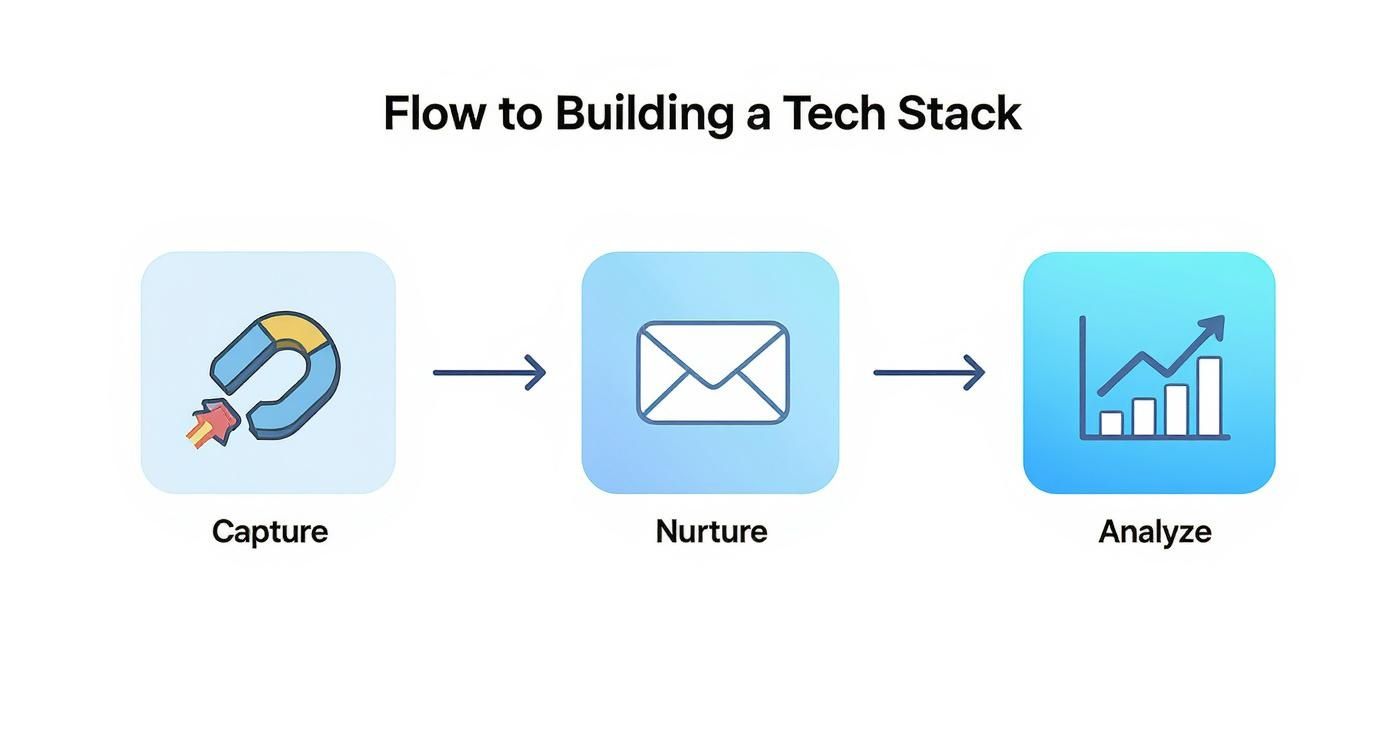
This simple flow—Capture, Nurture, Analyse—is the repeatable blueprint you'll use for every successful client campaign.
Nail These 3 Automated Flows First
One-off broadcast emails have their place, but the real money for your clients is in automation. These “set and forget” sequences work 24/7, engaging subscribers at the moments that matter most.
Your agency needs to master these three foundational flows:
- The Welcome Series: This is your client's first impression. A strong 3-5 email welcome series tells the brand's story, sets expectations, and guides new subscribers toward their first purchase.
- The Lead Nurture Sequence: Someone downloads a guide. What now? This sequence delivers value over several emails to build trust and position your client’s offer as the obvious solution.
- The Re-engagement Campaign: Every list has subscribers who go quiet. A strategic win-back campaign wakes up inactive users with a targeted offer, helping you clean the list and recover otherwise lost customers.
These automated sequences are the engine room of a great email service, delivering consistent results.
Design for Thumbs and Drive Action
Your campaign's design and copy are where strategy meets the subscriber's inbox. Lousy design or boring copy will kill even the cleverest automation.
In Australia, mobile is everything. Projections show that by the end of 2025, a huge 55% of all email opens will happen on a mobile device. Our impressive national email engagement—like the 46.34% open rate—is a direct result of smart, mobile-first campaigns.
Key takeaway: If your email looks terrible on a phone, you're losing half your audience. Prioritise single-column layouts, big fonts, and clear, tappable call-to-action buttons. Always.
Get Personal (Beyond Just the First Name)
Real personalisation goes way beyond plugging in [FirstName]. It’s about using data to send the right message to the right person at the right time. This is how you stop blasting emails and start having relevant conversations at scale.
The secret is segmentation based on actual user behaviour.
Here’s How Behavioural Segmentation Works:
Imagine your client is an online store selling running gear. Instead of sending the same "new arrivals" email to their entire list, you could create smart segments:
- Based on Browsing History: Create a segment of users who viewed "trail running shoes" three or more times but haven't bought. Send them a targeted email showcasing top-rated trail shoes.
- Based on Purchase History: Target customers who bought running shoes 6-8 months ago. An automated email with the subject line, "Time for a fresh pair?" will feel incredibly timely.
- Based on Engagement: Reward your most loyal subscribers—the ones who open and click regularly—with exclusive early access to a new product line.
This level of targeting sends conversion rates through the roof. Understanding the basics of what makes up an Electronic Direct Mail (EDM) campaign provides a solid foundation for these tactics. You can get a deeper dive in our guide on what an EDM is in marketing.
This is how you prove your agency isn't just sending emails; you're building intelligent marketing systems that generate real business outcomes.
Reporting That Proves Your Value

This is the moment of truth.
You can run brilliant campaigns, but if your client can’t see the direct impact on their bottom line, you're on shaky ground. Exceptional reporting is the final, critical piece of any successful email marketing for agencies service.
It’s how you shift the conversation from "what did you do?" to "look at the revenue we generated together."
Great reporting isn't about dumping a spreadsheet on your client. It’s about telling a compelling story of success, backed by hard numbers that prove your agency's return on investment (ROI). This turns a routine update into your most powerful client retention tool.
Moving Beyond Vanity Metrics
First, you need to educate your clients on what actually matters. Too many business owners are fixated on vanity metrics like open rates. While interesting, opens don't pay the bills.
Your job is to focus their attention on the key performance indicators (KPIs) that connect directly to business growth.
Your reports should champion these core business metrics:
- Conversion Rate: The percentage of people who actually took the desired action (e.g., made a purchase, filled out a form).
- Revenue Per Email (RPE): The total revenue from a campaign divided by the number of emails sent. This puts a clear dollar value on every email.
- Click-Through Rate (CTR): While opens can be misleading, CTR shows how many people were engaged enough to take the next step.
- List Growth Rate: This demonstrates the health of their primary marketing asset and proves you’re consistently attracting new leads.
By framing your reports around these KPIs, you’re not just showing activity; you’re demonstrating tangible business outcomes. This is how you justify your fees and build lasting trust.
Structuring a High-Impact Monthly Report
A powerful report tells a story in three parts: what happened, why it happened, and what we're doing next. Ditch confusing spreadsheets and build a clean, visual report that guides the client through this narrative.
Here’s a simple structure that works every time:
- The Executive Summary: Start with the highlights. A few bullet points summarising the biggest wins, like "Generated $5,200 in revenue from the abandoned cart flow" or "Grew the email list by 250 qualified subscribers."
- The KPI Dashboard: A clear, visual snapshot of the most important metrics (Conversion Rate, RPE, List Growth) compared to the previous month.
- The Campaign Breakdown: Detail the performance of individual campaigns. But don't just list numbers—explain the why. For example, "The 'Flash Sale' campaign had a 25% higher CTR because the subject line created urgency."
- Strategic Recommendations: This is the most crucial part. Based on the data, outline your plan for the upcoming month. "Next month, we will A/B test subject lines on the nurture sequence and launch a new lead magnet."
To really nail this, you need to master the key email marketing reporting strategies that ensure you're always presenting the most impactful data.
Here's a quick rundown of the most important KPIs to include in your reports.
Key Performance Indicators (KPIs) for Client Reporting
| Metric | What It Measures | Why It's Important for the Client |
|---|---|---|
| Conversion Rate | The percentage of recipients who took a desired action. | Directly links email activity to sales, leads, or sign-ups—the ultimate goal. |
| Revenue Per Email (RPE) | The average revenue generated for every email sent. | Puts a clear, tangible dollar value on your email marketing efforts. |
| Click-Through Rate (CTR) | The percentage of recipients who clicked on a link. | Shows how compelling and engaging your email content and offers are. |
| List Growth Rate | The speed at which the email list is expanding. | Demonstrates the health of their audience and your ability to attract new potential customers. |
| Unsubscribe Rate | The percentage of recipients who opted out of the list. | A key indicator of list health and audience relevance. |
Tracking these metrics gives your clients a 360-degree view of how your work is directly contributing to their business growth.
Turning Data Into Dialogue
Your report is a conversation starter, not the end of the conversation.
Use it as a tool to guide your monthly client meetings. Walk them through the results, explain the insights, and get their buy-in on your future plans. This proactive approach reinforces your role as a strategic partner who is deeply invested in their success.
Scaling Your Email Marketing Operations
Growing your email marketing service shouldn't mean drowning in manual work. Real scalability isn't about working longer hours; it's about building smart, repeatable systems. This is how you turn a new service into a profitable and efficient arm of your agency.
The aim is to build a foundation where you can sign more clients without your workload skyrocketing. It means ditching the ad-hoc approach for a systemised one, where your processes are documented and your workflow is predictable.
Systemise Everything with Standard Operating Procedures
The bedrock of any scalable agency service is a solid set of Standard Operating Procedures (SOPs). Think of these as detailed, step-by-step guides for every recurring task your team handles. Creating them is the single most important asset for delivering consistent, high-quality work as you grow.
Your SOP library needs to cover the entire client journey:
- New Client Onboarding: A complete checklist for everything from grabbing brand assets to getting ESP access.
- Campaign Launch Process: A detailed workflow from the initial brief and copywriting right through to design, testing, and sending.
- Monthly Reporting: A standardised template and process for pulling data and creating an understandable report.
- List Hygiene Checks: A regular procedure for cleaning a client's subscriber list to keep it healthy.
By documenting these processes, you slash errors, make training new hires a breeze, and guarantee every client gets the same high standard of service, no matter who on your team is doing the work.
Build a Library of Reusable Assets
Why reinvent the wheel for every new client? A huge part of scaling email marketing for agencies is creating a library of reusable templates and assets. This move alone will save you an incredible amount of time.
Your library should have pre-built, customisable templates for your most common campaigns—think welcome series, abandoned cart flows, and promotional blasts. Having these ready to go means you can launch campaigns faster and pour your creative energy into strategy and copy, not repetitive design tasks. You can learn more about how this ties into a broader strategy by exploring our guide on marketing automation for small business.
Frequently Asked Questions About Agency Email Services
Stepping into a new service like email marketing for your agency is a big move, and it’s normal to have questions. Let’s tackle the most common ones agency owners ask.
Getting your head around these points gives you the confidence to pitch, price, and deliver with authority.
Is Adding Email Marketing to My Agency Actually Profitable?
Absolutely. The true profitability of email services comes from its efficiency at scale and high client retention.
Once you’ve built your SOPs and templated your core campaigns, the time you spend managing each new client drops dramatically. That’s where your margins get healthy.
Better yet, email services make your agency incredibly "sticky." When you’re running a client’s main communication and revenue channel, you’re not just a vendor. You become essential to their business, which leads to much longer, more stable client relationships.
What's the Smartest Way to Price Our Email Services?
Stay away from hourly billing. It penalises you for being efficient. The most successful, scalable model is tiered, value-based retainers.
Structure your services into clear packages (like the Foundation, Growth, and Scale tiers we talked about earlier) with a fixed monthly fee.
This gives you predictable revenue and lets clients pick the level that matches their budget and ambition. It also changes the conversation from "how many hours did you work?" to "look at the results we’re getting."
Key Takeaway: Pricing on value, not hours, instantly positions you as a strategic partner. Your clients are investing in outcomes—like more revenue and a bigger list—not just your time.
How Do I Get a Sceptical Client to See the ROI in Email?
Let the numbers do the heavy lifting. Frame every conversation around business metrics that matter. Forget talking about open rates; talk about the potential revenue from a well-built abandoned cart flow or the value of converting leads with a solid nurture sequence.
Use case studies and industry benchmarks to paint a clear picture of what’s possible. For example, explain how a simple welcome series can boost initial customer engagement by over 50%.
Once they’re on board, make sure your reporting connects the dots. Your reports should scream "value" by directly linking your work to their sales figures and lead generation goals. This constantly reinforces why they hired you in the first place.
At Homer Digital Marketing, we specialise in building proven marketing systems that help service-based businesses attract their ideal clients and scale with confidence. If you're ready to add powerful, ROI-driven strategies to your growth plan, we can help. https://homerdigitalmarketing.com
