
Ever felt lost in a sea of marketing jargon? Let's cut through the noise. When you ask, "what is an edm in marketing," the simple answer is: it's a way to talk directly to your audience through email. Think of it as a digital letter sent straight to a customer's inbox—personal, direct, and far more intimate than a social media post everyone sees as they drive by. This guide promises to show you exactly how to leverage EDMs to grow your business.
What Is an EDM in Marketing, Really?
An EDM isn’t just another email. It's a strategic piece of communication designed to build relationships, promote your services, and gently guide potential clients toward taking the next step with you. The purpose of an EDM campaign is to nurture leads and build brand loyalty by delivering valuable, targeted content right where people are looking every day.
Here in Australia, EDM is still a powerhouse marketing channel. More than 90% of Australian adults check their email regularly, making it one of the most reliable ways to reach your ideal customer.
The numbers don't lie. For every dollar spent on email marketing, businesses see an average return of $38. That's an incredible ROI of 3800%, a figure that leaves many other digital marketing channels in the dust.
The Building Blocks of a Powerful EDM
To truly grasp what an EDM is, you need to understand its core components. While the message inside changes, every successful EDM campaign is built on the same foundational elements working together to grab attention and drive action.
For small businesses, getting these basics right is a game-changer. And thankfully, you don't have to do it all by hand. Our guide on marketing automation for small business shows you how to manage these campaigns without the manual headache.
Let's quickly break down the key components that make up a typical EDM campaign.
Key Components of an EDM Campaign at a Glance
This table gives you a snapshot of the essential parts of any EDM. Getting these four things right is the foundation for a campaign that actually works.
| Component | Description & Purpose |
|---|---|
| Subscriber List | This is your list of contacts who've agreed to hear from you. The quality of this list is everything—a small, engaged list beats a massive, uninterested one every time. |
| Subject Line | Your first impression. Its only job is to stand out in a crowded inbox and convince someone to click 'open'. |
| Email Body | This is the main event. It's where you combine great writing, strong visuals, and your branding to connect with the reader and offer them something of value. |
| Call to Action (CTA) | The clear, direct instruction telling the reader what to do next. Think "Book a Call," "Learn More," or "Download Now." Without a strong CTA, your email is just a nice read. |
Once you've got these fundamentals down, you're well on your way to creating EDMs that don't just get opened, but also get results for your business.
Why an EDM Strategy Is a Business Superpower
Knowing what an EDM is in marketing is one thing, but understanding why you need it is where the real power lies. An EDM strategy isn't just a nice-to-have; for any modern business, it's a non-negotiable tool, mainly because it's incredibly cost-effective and delivers a brilliant return on investment (ROI).
Think about it this way: with social media, you're basically just renting space. You're building an audience on a platform you don't own or control. Your email list, on the other hand, is a genuine business asset. You own it, outright.
This ownership makes you immune to the whims of algorithm changes that can suddenly crush your reach on other platforms. Your direct line to your audience is secure, stable, and completely yours. That control is the foundation of sustainable growth.
The Power of Personalisation
The real magic of EDM marketing kicks in with personalisation. You can't just blast the same generic message to everyone and expect people to pay attention. By segmenting your audience—based on their interests, what they've bought before, or where they are in their journey with you—you can send content that actually means something to them.
For example, a new lead could get a welcome series that introduces your brand, while a loyal, long-term client gets an exclusive offer as a thank you. This tailored approach makes your audience feel seen and understood, which sends engagement through the roof and gets them to take action. It transforms a simple broadcast into a meaningful conversation.
A well-segmented email campaign can lead to revenue increases of as much as 760%. This proves that sending the right message to the right person at the right time isn't just good practice—it's incredibly profitable.
Data-Driven Decisions for Growth
Finally, EDMs give you a treasure trove of data you can actually use. Metrics like open rates and click-through rates aren't just numbers on a screen; they're direct feedback from your audience. They tell you exactly what’s landing and what's falling flat.
This clear, immediate feedback loop lets you constantly tweak your messaging, test new ideas, and optimise your entire approach for better results. This data is the engine that fuels your continuous improvement and powers your business forward. If you want to learn more about turning this data into tangible results, explore our insights on effective lead generation and nurturing.
Digging Into the Different Types of EDMs
Now that you see the strategy behind Electronic Direct Mail, let's look at how flexible it is. Not all EDMs are created equal; knowing the different types is like having a toolkit where each tool is designed for a specific job.
You wouldn't use a sledgehammer to hang a picture frame, right? In the same way, a salesy promotional email isn’t the right tool for building long-term trust—that's a job for a great newsletter. Let's break down the most common types of EDMs you’ll find yourself using.
Promotional EDMs
When most people think of a "marketing email," this is it. The goal of a promotional EDM is crystal clear: drive sales or get someone to take action. These are the emails that announce new services, advertise a special offer, or push a limited-time discount. They’re all about creating a bit of urgency to get an immediate response.
- Example Subject Line: "20% Off Your Next Consultation – This Week Only!"
Newsletters
Newsletters are your relationship-builders. Unlike a punchy promo email that’s all about the sale, newsletters focus on giving value and keeping your brand front and centre in your subscribers' minds. They usually mix things up with industry insights, company news, helpful tips, or links to your latest blog posts.
The main goal here is to build a community and position yourself as the expert. A consistent, high-value newsletter builds the kind of trust that pays off big time when a subscriber is finally ready to make a move.
Automated and Nurturing EDMs
Think of these as the quiet achievers of your marketing system. Automated EDMs, often called sequences or drips, are a series of pre-written emails sent out automatically when a user takes a specific action, like downloading a free guide or signing up for a webinar. They walk a potential client through their buying journey, delivering the right info at exactly the right time.
A well-planned nurturing sequence educates your leads, speaks directly to their pain points, and gently guides them toward your service as the solution. It’s the perfect way to make sure no lead ever falls through the cracks.
Transactional EDMs
Transactional emails are the automated messages fired off after a specific interaction with your business. Common examples include appointment confirmations, welcome emails after someone signs up, or password reset instructions. While they seem purely functional, they are a massive (and often missed) branding opportunity.
- Example: A welcome email that doesn't just confirm a subscription but also injects some of your brand's personality and sets the stage for what they can expect from you.
EDM Types Compared
To help you decide which EDM is the right fit for your goal, here’s a quick comparison of the most common types.
| EDM Type | Primary Goal | Typical Frequency |
|---|---|---|
| Promotional | Drive immediate sales or action | Based on campaign schedule |
| Newsletter | Build relationships and brand loyalty | Weekly, bi-weekly, or monthly |
| Automated | Nurture leads through the funnel | Based on user triggers and timing |
| Transactional | Confirm actions and provide info | Immediately after a user action |
Choosing the right type of EDM at the right time ensures your message doesn't just get delivered, but actually connects and gets results.
How to Create a Successful EDM Campaign
Let’s be honest, a killer EDM campaign doesn’t just happen by accident. It's a deliberate process, not a guessing game. Building a campaign that actually gets results means starting with a solid foundation and then fine-tuning your approach with real data. From the initial idea to the moment it lands in someone’s inbox, every step builds on the last.
This visual guide breaks down the most common types of EDMs you can use, from quick promotional offers to more complex automated sequences.
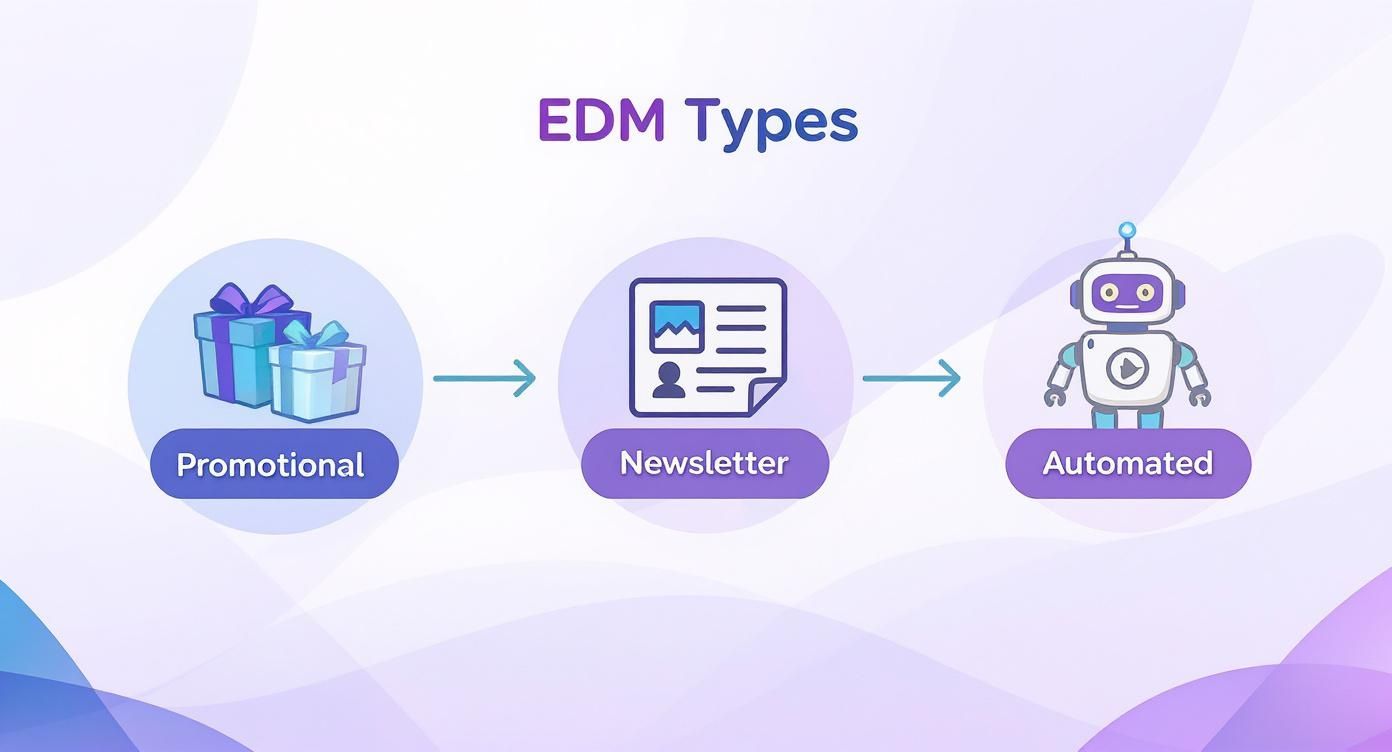
Knowing the difference helps you pick the right tool for the job, making sure your message always hits the mark.
Define Your Campaign Goals
Before you even think about writing, you need to know what you're trying to achieve. What does a "win" look like for this campaign? Are you chasing new leads, trying to sell a particular service, or just aiming to re-engage your existing clients?
Your goal shapes everything that comes next.
Clear goals might look like:
- Boosting website traffic by 15% this month.
- Generating 20 new consultations for a specific service.
- Hitting a 25% open rate on your next monthly newsletter.
Build and Segment Your List
Your email list is your golden ticket. The number one rule? Build it ethically. Never, ever buy a list. Instead, use lead magnets—things like free guides, checklists, or webinars—to attract subscribers who are genuinely interested in what you have to offer.
Once you have a list, segmentation is your superpower. Grouping subscribers based on their interests, past behaviour, or where they are in their journey with you lets you send super-targeted messages. It's the difference between shouting into a crowd and having a meaningful one-on-one conversation.
Craft Compelling Content
This is where the magic happens. To get people to even open your email, you need to nail your email subject line best practices. It's your first impression, so make it count.
The body of the email then needs to deliver on that promise. Give them valuable content, use clear visuals, and include a strong call-to-action (CTA) that tells them exactly what to do next.
A/B testing is your secret weapon here. Try out different subject lines, CTAs, or even send times on a small slice of your list. The data will tell you what works before you go all-in with the full campaign.
Analyse and Refine Your Performance
Hitting 'send' isn't the end of the job. It's the beginning of the learning process. You have to track your key metrics to see what’s working and what’s not. Despite all the noise from other platforms, a huge 44% of Australian marketers still rank email as their most effective channel.
Success comes down to understanding your data. For context, average conversion rates in Australia hover around 2.4% for B2B and 2.8% for B2C.
Keep a close eye on your open rate, click-through rate (CTR), and conversion rate. This data shows you what your audience is responding to, so you can keep getting better with every campaign you send. You can even use a click-through rate calculator to make measuring your link performance a breeze.
Don't Let Your EDMs Be a Lone Wolf
Your EDM strategy shouldn't be sitting on an island by itself. The most powerful marketing campaigns treat email as the central nervous system of a much bigger operation, connecting it with all your other channels to make everything stronger. Instead of thinking about your social media, your blog, and your emails as separate tasks, picture them working together to create one seamless experience for your customer.
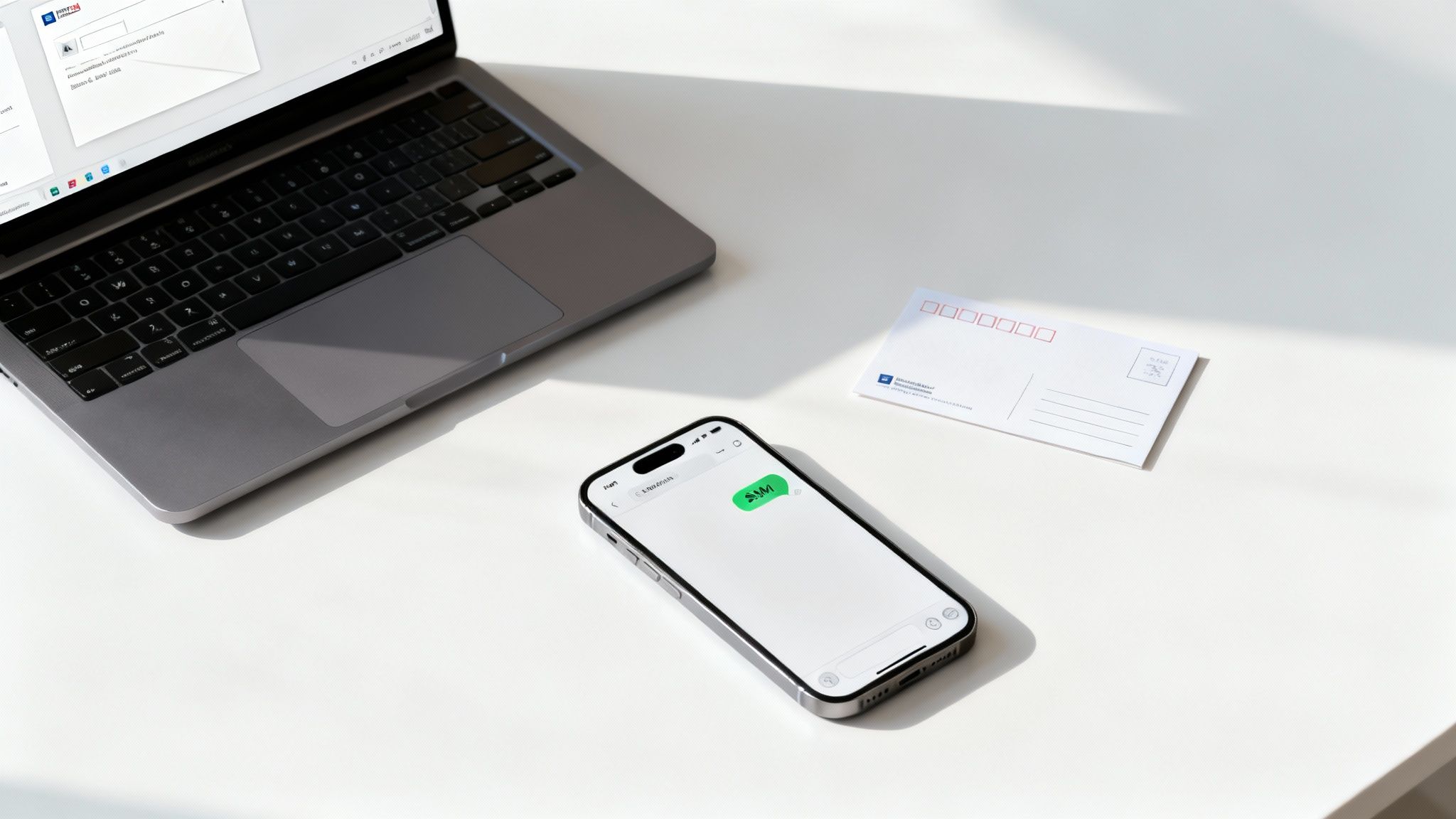
When you get this right, you create multiple touchpoints that reinforce your message and guide people smoothly from one platform to the next.
Creating a Multi-Channel Ecosystem
So, how does this actually work? A brilliant way to grow your email list is to use your social media accounts. Run a competition on Instagram or promote a super-valuable guide on LinkedIn that requires an email signup. Just like that, you turn casual followers into a long-term, engaged audience you actually own.
Once they're on your list, you can flip the script. Use your newsletters to send them to your latest blog post, which drives quality traffic to your website and gives your SEO a nice little boost. It’s a powerful cycle where every channel helps the others grow.
By combining the unique strengths of each platform, you can build a customer journey that just feels natural and effective. Think about how these channels can play together:
- EDM + Social Media: Use your most engaged email subscribers to create a lookalike audience for your next Facebook ad campaign.
- EDM + Content Marketing: Just published a new case study? Announce it in your newsletter to drive traffic and position yourself as the expert.
- EDM + SMS: Send a quick SMS reminder about a flash sale you just emailed out, making sure nobody misses the deadline.
A truly integrated strategy understands that your customers don't live in one place online. The goal is to make their journey between channels feel connected and logical, keeping your brand front-of-mind wherever they hang out.
While email is a powerhouse, pairing it with other direct channels is where the real magic happens. For example, Australian SMS marketing sees jaw-dropping open rates as high as 98%. And don't forget old-school direct mail, which still hits a 99% visibility rate in Australian homes. If you want to dive deeper, you can explore more Australian SMS marketing statistics here. It just goes to show that a multi-channel approach isn't just a nice idea—it's a proven way to blow your reach and engagement out of the water.
Common EDM Questions Answered
Even with a solid plan, a few questions always pop up when you’re getting your head around electronic direct mail. Here are some quick answers to the ones I hear most often.
What Is the Difference Between EDM and a Newsletter?
Think of 'EDM' as the big bucket that holds every marketing email you could possibly send. It covers everything from a quick sales announcement to your automated welcome series.
A newsletter is just one specific type of EDM. Its main job is to build a relationship by sharing news, updates, and helpful content on a regular schedule. So, all newsletters are a form of EDM, but not all EDMs are newsletters.
How Often Should I Send Marketing EDMs?
There's no magic number here. It really boils down to your industry and what your audience actually wants. For content-heavy newsletters, a weekly or bi-weekly send is a great starting point.
Promotional EDMs, on the other hand, should line up with your sales calendar. The most important thing is to stay consistent and make sure every single email delivers real value.
Pro Tip: Keep a close eye on your engagement and unsubscribe rates. Your audience’s behaviour is the best indicator of whether you’re sending too often or not enough.
What Are the Most Important EDM Metrics to Track?
It’s easy to get lost in the data, so just focus on the metrics that directly link back to your goals. For most businesses, these are the 'big four':
- Open Rate: The percentage of people who actually opened your email.
- Click-Through Rate (CTR): Measures who clicked on a link inside your email.
- Conversion Rate: Tracks who took the action you wanted, like making a purchase.
- Unsubscribe Rate: Tells you how many people opted out for good.
Tracking these will give you a clear, no-fluff picture of how your campaigns are really performing.
Ready to build an EDM strategy that attracts ideal clients and scales your business? Homer Digital Marketing uses proven content, authority, and automation systems to get real results. Let's build your marketing engine.
