

Let's be honest: relying on referrals and word-of-mouth is no longer enough to grow a modern practice. Digital marketing for accounting firms has become the primary battleground where today's clients find, vet, and ultimately choose who they'll trust with their finances. If your firm isn't highly visible online, you're invisible to a massive pool of potential clients actively searching for your exact expertise right now. This guide provides the proven, actionable roadmap to change that.
Why Your Firm Needed a Digital Marketing Strategy—Yesterday
The world of professional services has shifted permanently. Today’s clients, from solo entrepreneurs to established companies, begin their search for a new accountant on Google, not by asking a friend. To stand out in what’s become an incredibly crowded market, you need a deliberate and strategic online presence.
This goes far beyond just having a basic website. It’s about building a connected digital ecosystem that attracts the right kind of prospects, builds unshakable trust, and converts that initial interest into profitable, long-term client relationships.
The Australian accounting services market was valued at around USD 20.5 billion and is projected to hit USD 23.24 billion by 2030. That’s a clear signal that competition is only getting fiercer. A smart digital marketing approach is no longer a "nice-to-have"—it's essential for capturing your share of that growth.
Building Your Client Attraction System
A powerful digital strategy isn’t something you can just wing. It’s built on a few core pillars that work in harmony, guiding a potential client from the moment they first hear about your firm to the day they sign an engagement letter.
We can break this journey down into three simple stages: Attract, Trust, and Grow.
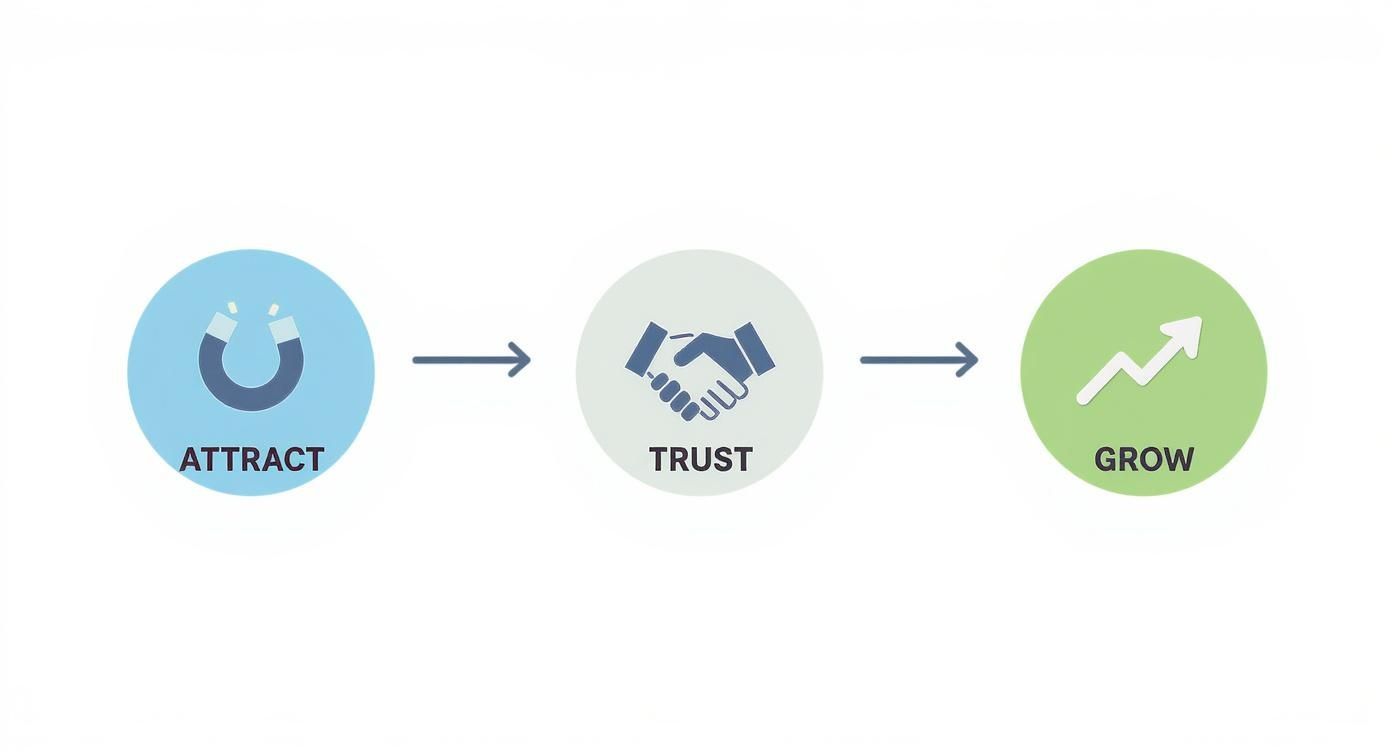
Each stage naturally flows into the next, creating a repeatable client acquisition engine for your practice.
Core Digital Marketing Channels for Your Firm
To give you a clearer picture of the tools at your disposal, here’s a quick overview of the essential digital marketing channels and how they specifically benefit accounting firms.
| Marketing Channel | Primary Goal | Key Benefit for Accountants |
|---|---|---|
| Search Engine Optimisation (SEO) | Get found on Google | Attracts local businesses actively searching for accounting services. |
| Content Marketing | Demonstrate expertise | Builds authority and answers client questions before they even ask. |
| LinkedIn Marketing | Network with decision-makers | Connects you directly with high-value B2B clients and referral partners. |
| Google Ads (PPC) | Generate immediate leads | Captures prospects with urgent needs who are ready to hire now. |
These channels are the foundation of a modern marketing strategy for any ambitious firm. When used together, they create a system that consistently brings in new business.
At its core, digital marketing for an accounting firm is about demonstrating your value and expertise long before a prospect ever picks up the phone. It completely flips the script from chasing down leads to attracting clients who already see you as a trusted advisor.
And where does this all start? With your website. It's the cornerstone of your digital presence and often the very first impression a potential client will have. Getting it right is non-negotiable, which is why we recommend diving into these expert accountant web design tips.
This guide will give you the actionable roadmap you need to build a powerful online presence—one that transforms your firm from just another option into a recognised authority in your field.
Build a Powerful SEO Foundation to Attract Local Clients
Search Engine Optimisation (SEO) is the engine that drives a consistent stream of high-quality leads to your firm. It’s not about bamboozling Google with technical tricks; it's simply about making it incredibly easy for local clients who need your exact services to find you.
When you get it right, SEO turns your website from a digital brochure into your most valuable, lead-generating asset.
The idea is straightforward: when a small business owner in your area searches for "tax advice for startups" or "BAS lodgement for cafes," you need to be at the top of that list. That's what a solid SEO foundation delivers.
Start with Local SEO
For most accounting firms, your best clients are right in your own backyard. This is where local SEO becomes your secret weapon. It's the art of fine-tuning your online presence to show up in relevant local searches.
The absolute first step is to claim and meticulously optimise your Google Business Profile (GBP). This is the info box that appears in Google Maps and on the right-hand side of a search page. It’s your digital front door.
- Complete Every Section: Don't skip a thing. Fill out your services, hours, address, phone number, and a detailed business description packed with the keywords your clients actually use.
- Upload High-Quality Photos: Show off your office, your team, and your logo. It builds trust and makes your profile far more engaging.
- Actively Request Reviews: Reviews are a massive ranking factor. Make it a standard part of your client offboarding to ask for a quick Google review.
Think of your GBP as the modern Yellow Pages ad, but infinitely more powerful. For a deeper dive, check out our detailed guide on local search optimisation.
This screenshot shows how a well-optimised Google Business Profile stands out in local search results, highlighting key info like reviews, location, and services.
Notice how customer reviews and clear contact details are front and centre? It makes it simple for a potential client to take that next step.
Target Keywords That Attract Ideal Clients
Generic keywords like "accountant" are wildly competitive and often bring in the wrong kind of tyre-kickers. The real gold is in targeting long-tail, high-intent keywords that reflect a very specific need.
These are the phrases your best clients are typing into Google right now.
Instead of chasing "accountant Sydney," a smarter approach looks like this:
- "Accountant for tradesmen in Parramatta"
- "SMSF setup advice for doctors"
- "Xero bookkeeper for retail businesses Melbourne"
These specific phrases attract people who are much further down the buying path. They have a clear problem and are looking for a specialist to solve it, making them far more likely to become high-value clients.
SEO is a long game. It's not about finding one 'magic' keyword. It's about consistently creating content and optimising your site around the many different problems you solve for your clients.
This requires a mental shift. You're not just an accountant; you're a specialist who solves financial problems for a certain type of client in a specific location. Your website has to shout that from the rooftops.
Create Content for Your Local Audience
Once you've identified your keywords, you need to create content that actually answers the questions behind them. This means writing blog posts, service pages, and FAQs that are genuinely useful to your local audience.
For example, a Brisbane-based firm could write an article titled, "Queensland's Payroll Tax Changes Explained for Small Businesses." This doesn't just target relevant keywords; it positions the firm as a local authority on a topic that matters right now.
Investing in SEO is no longer optional for professional services. With Australian businesses projected to spend $1.5 billion on SEO, it’s clear that digital visibility is a necessity for growth. You can find more insights on these digital marketing trends on rgcdigitalmarketing.com.au.
By focusing on these SEO fundamentals—mastering local search, targeting niche keywords, and creating valuable local content—you build a sustainable system that brings a steady flow of ideal clients straight to you.
Create Content That Builds Trust and Generates Leads
Great digital marketing for accounting firms isn’t about who shouts the loudest. It's about earning a potential client's trust long before they even realise they need your services. This is where your content becomes your most powerful asset. Forget selling for a minute and start solving your clients' biggest problems.

Think about what your ideal clients are typing into Google right now. It’s probably not “best accountant in Sydney.” More likely, it’s something specific to a problem they're facing, like “how to navigate Capital Gains Tax in Australia” or “what’s the right business structure for a new cafe?”
Your content strategy needs to answer those questions. When you provide clear, jargon-free advice, you stop being just another service provider and become their go-to educational resource. You become the expert.
Develop Your Core Content Pillars
Don’t just write random blog posts and hope for the best. A structured, strategic approach starts with identifying your content pillars. These are the big-picture topics or service areas where you want to be known as the authority. For most accounting firms, these line up perfectly with what you already do.
Your pillars could be:
- Tax Planning & Compliance: This covers everything from simple BAS lodgements to complex tax strategies for high-net-worth individuals.
- Business Advisory Services: Here, you'd focus on things like cash flow management, growth strategies, and business structuring.
- Self-Managed Super Funds (SMSF): Answering all the common questions about setting up, managing, and winding down an SMSF.
- Industry-Specific Accounting: Creating tailored content for niches you specialise in, like medical professionals, construction trades, or e-commerce businesses.
Once you have your pillars nailed down, you can start brainstorming specific topics for each. Under the "Business Advisory" pillar, you could create articles, videos, or checklists like "5 Common Cash Flow Mistakes Aussie Startups Make" or "A Practical Guide to Reading Your P&L Statement."
This method ensures your content is always relevant to the services you actually sell, creating a natural path from reader to paying client. To make sure people actually find it, effective SEO content optimization is critical for getting your content to rank well and attract the right audience.
Think Beyond the Blog Post
While blog articles are the foundation of any good content plan, your clients consume information in all sorts of ways. To really stand out, you need to mix up how you deliver your expertise.
Try creating a blend of these formats to appeal to different learning styles and keep people engaged:
- Downloadable Checklists: A "New Business Start-Up Checklist" is an incredibly valuable resource that also works brilliantly as a lead magnet to capture email addresses.
- Short Explainer Videos: Record a quick, two-minute video explaining a recent change in tax law. It’s perfect for sharing on LinkedIn and embedding in a related blog post.
- Infographics: Turn a complex topic, like the process of setting up a company, into a simple visual. These are easy to understand and get shared a lot.
- Webinars: Host a live Q&A session on a timely topic, like "Year-End Tax Planning Strategies," to connect directly with your audience.
This multi-format approach shows you’re a modern, dynamic firm that understands how people learn today.
Write for Humans, Not Robots
The single biggest mistake accountants make with their content? They write for their peers, not their clients. Your goal isn't to sound clever; it's to be understood. Drop the technical jargon, ditch the complex acronyms, and lose the overly formal tone.
The most effective content marketing strategy is built on empathy. You need to understand your client's fears, challenges, and goals, and then create content that speaks directly to those needs in a clear, supportive, and human way.
Imagine you're explaining a financial concept to a new client over a coffee. That’s the tone you want. Use analogies, real-world examples, and a conversational flow to make complex topics feel simple.
For instance, instead of a dense paragraph on asset depreciation, talk about how a new work ute loses value over time. That instantly makes the concept relatable and memorable for a small business owner.
This commitment to clarity is what builds the relationship. It shows potential clients that you're not just an expert, but an approachable advisor who genuinely cares about their success. And that’s how you generate leads who are already warmed up and ready to work with you.
Use LinkedIn to Network with High-Value Clients
For accounting firms, LinkedIn isn't just another social media platform—it's your single most powerful digital networking venue. Forget posting passive updates on your company page. The real power of digital marketing for accounting firms lies in turning your partners and key staff into recognised authorities who naturally attract high-value B2B clients.

This approach completely shifts the dynamic. You stop chasing leads and start building genuine relationships that evolve into business. It’s all about proving your expertise and building trust right where your ideal clients are already spending their time.
Optimise Personal Profiles for Authority
Before you can network effectively, your personal profile needs to scream "credible expert," not "salesperson." A classic mistake accountants make is treating their profile like a resumé, just listing past jobs and duties. Your profile should be completely client-centric, answering the silent question every visitor has: "What's in it for me?"
Here’s how to turn your profile from a CV into a client magnet:
- Headline: Ditch the generic "Partner at XYZ Accounting." Get specific about the value you deliver. Try something like, "Helping Medical Practices in Victoria Maximise Profitability & Minimise Tax | vCFO & Business Advisor."
- About Section: Use this space to tell your story. Don't just list services. Explain who you help, the problems you solve for them, and the results you deliver. Writing in the first person makes it far more personal and approachable.
- Featured Section: This is prime real estate on your profile. Pin your best content here—a link to a pillar blog post, a compelling client case study, or a video breaking down a complex tax concept.
A properly optimised profile works for you 24/7. It’s your silent salesperson, building your authority even when you're offline.
Develop a Consistent Engagement Routine
Consistency is everything on LinkedIn. You don’t need to live on the platform for hours a day. In fact, a focused 15-20 minute daily routine can deliver massive results over time. This isn't about aimless scrolling; it's about strategic actions that keep you top-of-mind.
Your daily routine should look something like this:
- Comment Thoughtfully: Find posts from industry leaders, potential clients, or referral partners. Leave insightful comments that actually add to the conversation. A simple "great post" is useless. A comment that offers a unique perspective or asks a smart question starts a real dialogue.
- Share Relevant Content: Found an article about a recent tax change or some financial news relevant to your niche? Share it. But here’s the crucial part: don't just post the link. Add your own two-to-three sentence commentary above it, explaining why it matters or offering your unique take.
- Engage with Your Network: Check your notifications and reply to everyone who has commented on your posts. This simple act of acknowledgement is how you nurture relationships.
This routine makes sure you are consistently visible and valuable without taking over your entire day.
Master the Art of the Connection Request
The biggest mistake people make on LinkedIn? Sending a generic connection request followed immediately by a sales pitch. It's the digital equivalent of walking up to a stranger at a conference and shoving a brochure in their face. It just doesn't work.
Your goal is to start a real conversation.
The most effective connection requests are personalised and have context. They show you've actually done your homework and have a legitimate reason for connecting beyond just wanting to sell them something.
For example, say you want to connect with the CFO of a local manufacturing company. Don't just hit "Connect." First, engage with their content. Then, send a personalised request mentioning a shared interest or a recent post of theirs.
Bad Request: "Hi John, I'd like to connect."
Good Request: "Hi John, I saw your recent post on supply chain challenges for manufacturers and found your insights on inventory management really interesting. I specialise in financial advisory for the manufacturing sector here in Melbourne and would be keen to connect and follow your content."
This personalised approach shows respect and starts a relationship built on mutual professional interest, not a sales quota. For firms wanting to scale this, tools like LinkedIn Sales Navigator can be a game-changer for finding and engaging with your ideal clients more efficiently.
Ultimately, using LinkedIn successfully is a long game. It's about planting seeds by consistently providing value, building your reputation as a trusted advisor, and nurturing relationships that will eventually blossom into your firm's most valuable clients.
Amplify Your Reach with Strategic Paid Advertising
While SEO and content marketing are fantastic for building your firm's long-term authority, sometimes you just need to get in front of the right clients now. This is where a smart paid advertising strategy comes in, letting you capture high-intent prospects precisely when they need your help.

Done right, paid ads aren't about burning through cash; they're a calculated investment in generating quality leads. By targeting powerful platforms like Google and LinkedIn, you can jump the queue and connect directly with decision-makers who are actively looking for a solution.
Master Google Ads for High-Intent Searches
Think of Google Ads as the ultimate tool for capturing "hand-raiser" leads. These are people with an immediate problem, and they're typing their needs directly into the search bar. The secret to success here is getting hyper-specific with your keywords.
Forget about broad, expensive terms like "accountant." You need to think like your client. Focus on long-tail keywords that signal a clear and urgent need, such as:
- "Accountant for medical practices in Perth"
- "Xero bookkeeper for construction business"
- "BAS lodgement services near me"
When you bid on these specific phrases, you ensure your ad is only shown to the most relevant searchers. This dramatically improves your conversion rates and makes every dollar of your ad spend work harder. To get a deeper understanding, it's worth exploring the fundamentals of Google Ads for professional services.
Target Decision-Makers with LinkedIn Ads
If Google Ads is about capturing active searchers, LinkedIn Ads is about proactively targeting your ideal client based on who they are professionally. For B2B-focused firms that serve specific industries or company sizes, this is an absolute game-changer.
On LinkedIn, you can zero in on prospects with incredible precision using criteria like:
- Job Title: Target CFOs, financial controllers, or managing directors.
- Industry: Show your ads exclusively to businesses in manufacturing, healthcare, or technology.
- Company Size: Focus your budget on firms with 10-50 employees, if that's your sweet spot.
- Location: Confine your campaigns to specific cities or regions in Australia.
This level of detail means your message lands directly in front of the people who have the authority to hire your firm. It's an essential part of any serious B2B marketing strategy.
Choosing Your Ad Platform Google Ads vs LinkedIn Ads
So, where should you put your ad budget? It really comes down to your primary goal. One platform is designed to catch people actively looking for a solution, while the other lets you target specific professional profiles.
| Feature | Google Ads | LinkedIn Ads |
|---|---|---|
| Primary Goal | Capture active search intent | Target specific professional roles |
| Best For | Local service-based leads (e.g., "tax return accountant") | High-value B2B client acquisition |
| Targeting | Based on keywords and location | Based on job title, industry, company size |
| Cost Per Click | Can be lower for local terms | Generally higher, but leads are often higher value |
For most accounting firms, the winning formula is a mix of both. Google Ads can bring in a steady flow of immediate-need leads, while LinkedIn Ads is brilliant for building brand awareness and nurturing relationships with larger, high-value clients over time.
Paid advertising is not a "set and forget" activity. It requires constant monitoring, testing, and optimisation. The firms that win are the ones that treat their ad spend like an investment, meticulously tracking which campaigns deliver a positive return and doubling down on what works.
The Non-Negotiable Landing Page
Here's the single biggest mistake I see firms make with their paid ads: sending traffic to their website's homepage. An ad click is expensive, and you can't afford to waste that investment by sending a potential lead to a generic page where they have to figure out what to do next.
Every single ad campaign must lead to a dedicated landing page.
This page has one job and one job only: to convert that visitor into a lead. It needs a clear headline that matches the ad's promise, concise copy that highlights the benefits of your service, and a single, obvious call-to-action—like "Book a Free Consultation" or "Download Our Guide." By removing all other distractions, you make it incredibly easy for the visitor to take that all-important next step.
Common Digital Marketing Questions from Accountants
Even with a clear roadmap, jumping into digital marketing can feel like learning a new language. You're not alone. Here are some of the most common questions we hear from accounting firm partners, along with straightforward answers to help you move forward.
How Much Should an Accounting Firm Budget for Digital Marketing?
There’s no one-size-fits-all answer, but a healthy benchmark to start with is 7-10% of your firm’s revenue.
A new firm just getting its feet wet might start with a few thousand dollars a month, focusing that spend on local SEO and a small, targeted Google Ads campaign. On the other hand, an established firm with aggressive growth goals will naturally need to invest more to get the traction it wants.
The real key is to set clear, measurable goals from the outset. Track your return on investment (ROI) for every single channel, and don't be afraid to double down on what’s working and cut what isn't. Always make sure your foundation—your website and SEO—is solid before you start pouring big money into paid ads.
What Is the Single Most Important Activity for a New Practice?
For a brand-new practice, your number one priority should be Local SEO. Full stop.
This means getting your Google Business Profile created and completely filled out, actively encouraging happy clients to leave reviews, and making sure your website is optimised for local search terms like ‘accountant in Parramatta’.
It’s the most cost-effective way to get on the map and connect with potential clients in your immediate service area who are right now looking for what you offer. For new firms, it’s the fastest path to a tangible return.
Should I Do This Myself or Hire a Marketing Agency?
You can absolutely handle the basics yourself. Claiming your Google Business Profile, sending a quick email to clients asking for a review, or writing a blog post on a tax topic you know inside out are fantastic first steps.
But let’s be honest, effective digital marketing quickly becomes a full-time job. A specialised agency doesn’t just bring technical skills; they bring deep expertise in SEO, paid ads, and content strategy that can speed up your growth far beyond what a DIY approach can achieve. It frees you up to do what you do best: serve your clients and run your firm.
"Hiring an agency isn't an expense; it's an investment in specialised knowledge and accelerated results. It allows you to leverage expert skills immediately, bypassing the steep learning curve and costly mistakes that often come with trying to do everything in-house."
How Long Does It Take to See Results from SEO?
SEO is a long game, not an overnight fix. While you might see some early movement in 3-4 months—like improved rankings for your local area—the really significant results often take 6-12 months of consistent, focused effort. We're talking about ranking on the first page for those valuable, competitive keywords that bring in high-quality leads.
Think of it like building an asset. The investment of time and resources you make today pays dividends for years to come in the form of sustainable, free traffic. SEO compounds, becoming more powerful the longer you stick with it.
Ready to stop guessing and start growing? At Homer Digital Marketing, we build powerful, AI-driven marketing systems that attract ideal clients and scale your firm. Book a no-obligation discovery call with us today to see how we can help.
