

Let’s be honest, effective SEO marketing for a small business isn’t about baffling tech jargon or secret tricks. It’s the proven process of making your website the most helpful and visible answer when your ideal customers are searching online for a solution to their problem.
This actionable guide will show you how to go from being practically invisible to becoming the first business they call.
Why SEO Is Your Small Business Growth Engine
Feel like you’re being drowned out by the big players with massive advertising budgets? So many service business owners I talk to feel the same way. They're struggling to get in front of local customers in what feels like an impossibly crowded online space.
Search Engine Optimisation (SEO) is what levels the playing field. Think of it as a powerful growth engine that’s working for you 24/7. Unlike paid ads that vanish the second you stop feeding them money, a smart SEO strategy builds real, long-term value for your business.
Every time you publish a useful blog post, fine-tune a service page, or get another glowing five-star review, you're strengthening a direct pipeline to your ideal customers. This consistent effort means you show up at the exact moment a potential client is looking for what you do, building trust and driving quality leads without breaking the bank.
Connect With Customers Actively Looking For You
This is where the real magic of SEO lies—it connects you with people who have high search intent. These aren't random people you’re interrupting with an ad; they’re actively searching for the exact solution you provide, like "how to fix a leaking tap fast" or "best electrician for home rewiring."
- Attract ready-to-buy leads: SEO puts you right in the path of people who have already decided they need your service.
- Build credibility and trust: When you rank high in search results, Google is essentially telling customers that you're a trusted authority.
- Get a measurable return: Leads from search engines have a 14.6% close rate—that's a world away from the results you get with old-school outbound marketing.
A Cost-Effective Path to Sustainable Growth
For a small business, every single marketing dollar has to count. SEO gives you one of the best returns on investment out there because it creates a compounding asset. The work you put in today will keep attracting customers for months, and often years, to come.
Of course, to really get this engine humming, you need to understand the nuts and bolts. For a great deep-dive into the fundamentals, check out this guide on What is Search Engine Optimization from the experts at OneNine. It's a solid foundation, especially since SEO fits so perfectly into broader strategies for digital marketing for small businesses, making sure all your hard work pulls in the same direction.
Understanding the Four Pillars of SEO
When you’re trying to get your head around SEO marketing for your small business, it’s easy to get lost in the technical jargon. The best way to tackle it is to break it down into four distinct parts.
Think of it like building a new shop from scratch. Each part has a specific job, but they all need to work together to bring customers through the door and keep them coming back. This simple shift in thinking makes the whole process feel much less intimidating. By getting a handle on these four core pillars, you can build a solid online presence that consistently brings in new clients.
The infographic below shows how all your SEO efforts funnel directly into what matters most: generating leads, building trust, and creating real, sustainable growth.
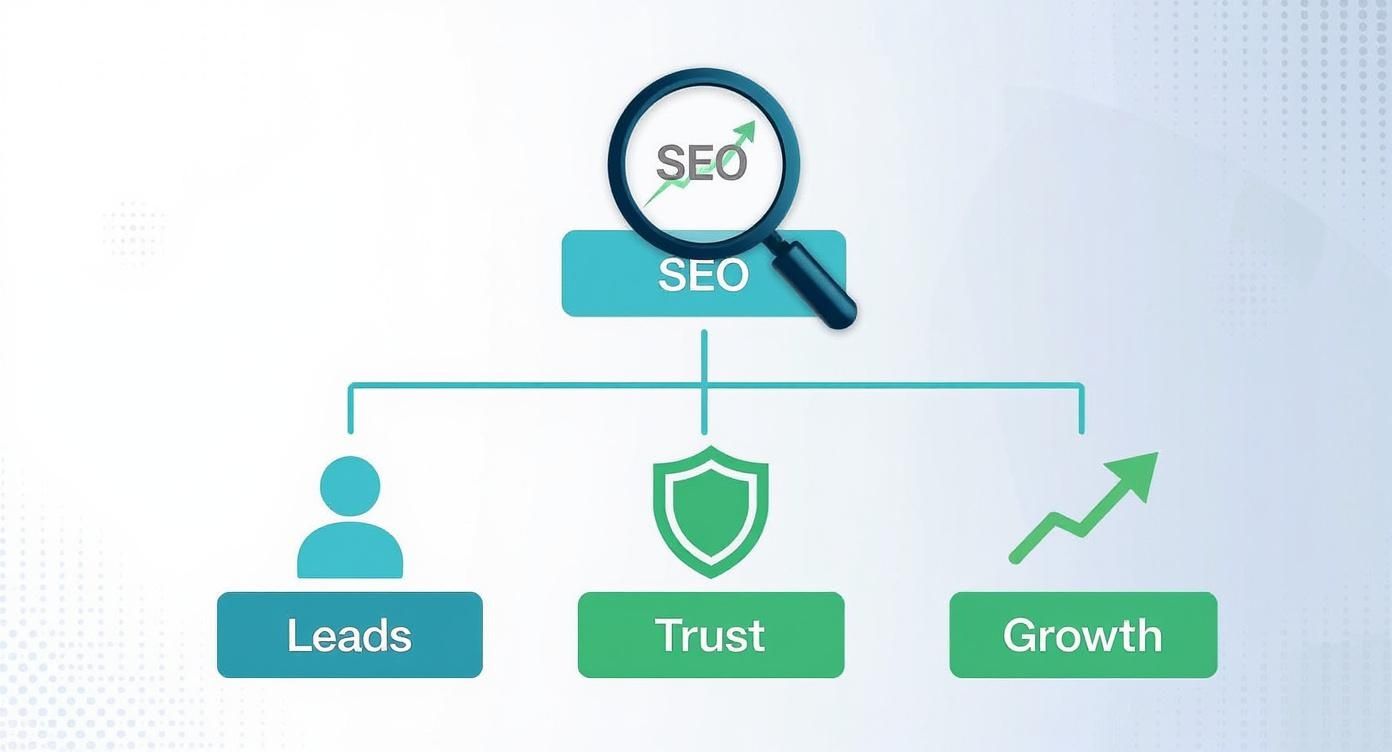
As you can see, every piece of the puzzle feeds into tangible business results. Let’s break down the four pillars that make it all happen.
Pillar 1: On-Page SEO
On-page SEO is everything you do on your actual website to signal to Google what your business is all about. In our shop analogy, this is your interior design and clear signage. It’s how you arrange your content and strategically place keywords to tell both search engines and human visitors they’re in the right place.
Good on-page SEO boils down to a few key things:
- Keyword Integration: Weaving relevant keywords naturally into your page titles, headings, and general content.
- Content Quality: Creating genuinely useful content that actually answers your customers' burning questions.
- User Experience: Making sure your site is a breeze to navigate, with intuitive menus and easy-to-read text.
Pillar 2: Off-Page SEO
Off-page SEO covers all the actions taken away from your website to build its authority and reputation online. This is basically your shop’s word-of-mouth reputation around town. When another respected business or industry blog links to your site, it’s like they’re giving you a public thumbs-up.
These signals tell search engines that your business is credible and trustworthy. The more high-quality “votes” you get from other reputable sites, the more authoritative your own website becomes in Google’s eyes.
The heart of off-page SEO is trust. Every quality backlink or positive mention is a digital endorsement that tells search engines your business is a reliable resource worth ranking higher.
This pillar is absolutely crucial for long-term success because it cements your status as a leader in your local market.
Pillar 3: Technical SEO
Technical SEO is the invisible foundation holding up your entire online presence. In our shop analogy, this is the building’s structural integrity, plumbing, and wiring. You could have the most beautifully designed shop in the world, but if the doors are locked and the lights don't work, no one's getting inside.
This pillar ensures your website is built so search engines can easily find, crawl, and understand its content. It has nothing to do with the words on your page and everything to do with your site's behind-the-scenes infrastructure.
The big three elements of technical SEO are:
- Site Speed: How fast your pages load. A slow site is a fast way to lose a potential customer.
- Mobile-Friendliness: Making sure your website works perfectly on a smartphone.
- Crawlability: Ensuring search engine bots can easily discover all the important pages on your site.
Pillar 4: Local SEO
Finally, we have local SEO. For any service business operating in a specific area, this pillar is non-negotiable. Think of it as the big, bright, flashing sign on your shopfront, right on the main street.
It’s all about optimising your online presence to show up when people in your area are searching for what you do. When someone types in "plumber near me" or "best cafe in Richmond," local SEO is what gets your business on the map—literally.
This involves things like managing your Google Business Profile, collecting local customer reviews, and keeping your business details consistent across online directories. It’s the absolute key to winning your local market.
Mastering Local SEO to Attract Nearby Customers
For any service business, your best customers are often right around the corner. This is where local search engine optimisation becomes your secret weapon. It’s not about taking on the big national chains; it’s about becoming the go-to choice for people in your community who are actively looking for what you do.
Good local SEO marketing for small businesses gets you into the Google "Map Pack" and at the top of local search results when it counts. Think of it as your digital shopfront—get it right, and you'll turn local searchers into loyal customers.
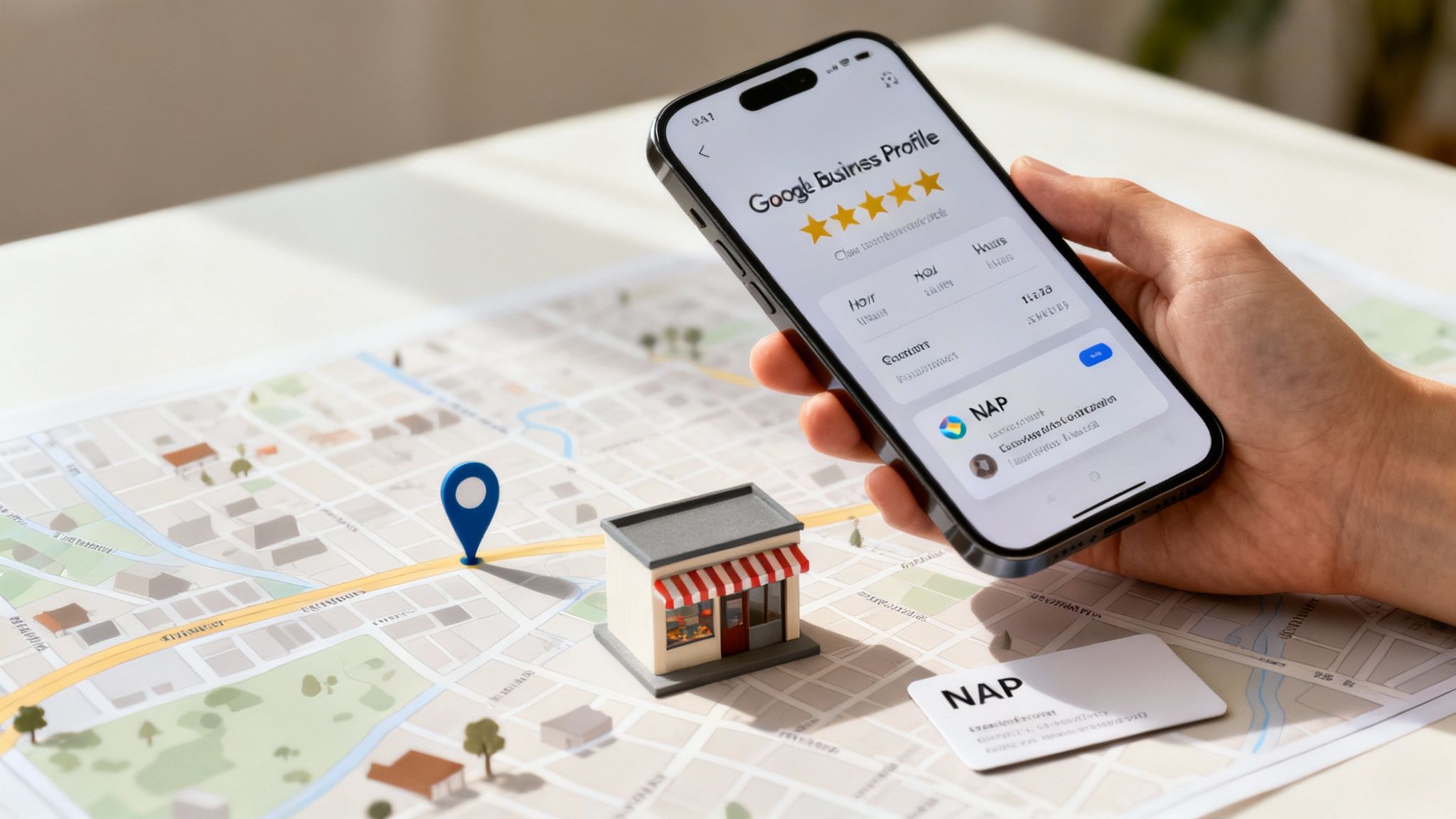
The numbers don't lie. Aussie small businesses that focus on local keywords see a 27% jump in leads. The ones who fully complete and manage their Google Business Profiles get up to 7 times more clicks. And when you realise that 46% of all searches in Australia have local intent—and a whopping 78% of those mobile searches lead to a store visit within 24 hours—you see just how critical this is.
Your Google Business Profile Is Your Local SEO Centrepiece
Your Google Business Profile (GBP) is easily your most valuable piece of online real estate. It's often the very first thing a potential customer sees. It gives them a snapshot of your services, location, hours, and reputation before they even think about clicking through to your website.
A properly optimised profile isn't just a directory listing; it’s a customer magnet. It’s a dynamic tool that builds trust and drives business straight from the search results page. If you want a full walkthrough, our guide to the Google Business Profile Manager breaks down every single step to get the most out of this powerful free tool.
To turn your GBP into a lead-generating machine, focus here:
- Complete Every Single Section: Don't leave anything blank. Fill out your services, attributes (like "women-led" or "online appointments"), accessibility info, and write a solid business description.
- Upload High-Quality Photos: Show off your work, your team, and your space. Profiles with photos get 42% more requests for directions and 35% more clicks to their websites.
- Use Google Posts: Share updates, special offers, and news directly on your profile. Posts keep your listing fresh, which signals to Google that you're active and open for business.
- Answer Questions Quickly: The Q&A feature lets people ask you questions directly. Answering them fast shows you’re on the ball and care about customer service.
To make this dead simple, here’s a quick checklist of where to focus your energy for the biggest impact.
Your Local SEO Priority Checklist
| Priority Action | Why It Matters | Quick Tip |
|---|---|---|
| Claim & Verify GBP | This is step one. Without a verified profile, you're invisible in local map searches. | Go to google.com/business and follow the steps. Verification is usually done via a postcard mailed to your address. |
| Complete 100% of Profile | A complete profile ranks higher and gives customers all the info they need to choose you. | Don't skip the small stuff—add business hours, service attributes, and a detailed description. |
| Ensure NAP Consistency | Google trusts businesses with consistent Name, Address, and Phone numbers across the web. | Pick one format for your address (e.g., "St." vs. "Street") and stick to it everywhere. |
| Actively Get Reviews | Reviews are a massive ranking factor and build social proof. More positive reviews = more trust. | Send a follow-up email with a direct review link after you've completed a job. |
| Upload Fresh Photos | Photos make your business real and inviting, increasing clicks and direction requests. | Add at least one new photo a week of your team, your work, or your happy customers (with permission!). |
Nailing these basics is non-negotiable. It’s the foundation that all your other local marketing efforts will build upon.
The Critical Importance of NAP Consistency
One of the most fundamental concepts in local SEO is NAP consistency. That stands for Name, Address, and Phone number. Google and other search engines are like digital detectives, constantly cross-referencing this information across the web—from your website to online directories like Yelp, TrueLocal, and industry-specific listings.
When your NAP details are identical everywhere, it sends a powerful signal of trust to Google. But inconsistencies, like using "St." in one place and "Street" in another, create confusion. That erodes Google's confidence and can seriously hurt your local rankings.
Think of consistent NAP as a digital handshake. Every time Google finds your business details matching perfectly across different platforms, it reinforces its confidence in your location and legitimacy, making it more likely to show your business to local searchers.
Encouraging and Managing Online Reviews
Reviews are the lifeblood of any local business. They provide powerful social proof to potential customers and are a huge ranking factor for Google. A steady stream of positive reviews tells search engines that you're a quality business that people trust.
Don't just sit back and hope for feedback. You need to actively encourage it:
- Just Ask: It sounds simple, but it’s the most effective method. When a customer is happy at the end of a job, ask them to leave a review.
- Email Follow-Ups: Send a polite follow-up email after a service is complete. Make it easy by including a direct link to your GBP review page.
- QR Codes: Put a QR code on your invoices or business cards that takes customers straight to your review page.
Creating Dedicated Service Area Pages
Does your business serve multiple suburbs or towns? If so, creating dedicated "service area" pages on your website is a game-changer. Instead of one generic "Services" page, build out unique pages for each key location you cover (e.g., "Plumbing Services in Bondi," "Electrician in Parramatta").
These pages let you target location-specific keywords and write content that speaks directly to that community. Mention local landmarks, talk about common problems you solve in that area, and feature testimonials from local clients. This hyper-local approach makes your content far more relevant to both users and search engines.
By mastering these local SEO tactics, you stop being just another business in the community and start becoming a visible, trusted part of it online. It’s this focused approach that underpins any successful SEO marketing small business strategy and drives real, measurable growth.
Creating Content That Your Customers Will Love
Technical fixes are one thing, but the real heart of SEO marketing for a small business is creating content that genuinely helps your customers. Your website needs to stop being a digital brochure and start being a trusted resource that solves their problems.
When you give people real value, you build authority, earn trust, and give Google a very good reason to show your site to more people. This isn't about trying to trick the system; it's a simple shift from selling to serving.

It all starts with getting inside your customer's head and understanding what they’re actually searching for. When your content directly answers their questions, you attract the right kind of traffic and position your business as the obvious expert they need.
Think Like Your Customer
The best content ideas come from putting yourself in your customer’s shoes. What’s going on in their life right before they type something into Google? What’s the problem that’s pushed them to look for help?
Often, their searches are simple, practical questions. If you can brainstorm content around these common query formats, you’ll have a pipeline of ideas that attract qualified leads.
Think about these common search patterns:
- Cost questions: "how much does a new roof cost in Melbourne?"
- Comparison searches: "best plumber for blocked drains Sydney"
- Urgent needs: "emergency electrician near me"
- How-to queries: "how to fix a leaking tap"
Building out blog posts or FAQ pages that tackle these questions head-on doesn’t just help your SEO—it builds instant credibility with a potential client.
Build Hyper-Local Landing Pages
For a service business, generic content just won't cut it. You have to speak directly to the communities you serve. This is where creating location-specific landing pages becomes a game-changer.
These pages are more than just a quick mention of a suburb. They are tailored resources that prove you understand the local area because you're part of it. A page for an "electrician in Chatswood" should look and feel completely different from one targeting an "electrician in Penrith."
A hyper-local landing page transforms your business from just another option into the local option. It tells both residents and Google that you are deeply invested in serving their specific community.
To make these pages sing, get specific. Mention local landmarks, talk about common problems unique to the homes in that area (like old wiring or specific plumbing issues), and plaster it with testimonials from clients in that exact suburb. That level of detail makes you far more relevant and trustworthy.
Showcase Your Expertise and Build Trust
Words are great, but people want proof. Your customers want to see your expertise in action, which is where case studies and project galleries come in. They turn your claims into tangible, believable results.
A detailed case study does more than just show off a finished project. It tells a story:
- The Problem: Kick things off by describing the client's initial challenge.
- Your Solution: Walk them through the exact steps you took to fix it.
- The Result: Show off the successful outcome with high-quality photos and, ideally, a glowing client testimonial.
This simple structure creates a powerful narrative that builds trust and helps potential customers see themselves getting the same great outcome.
Use AI as a Brainstorming Partner
Let's be real, sometimes the ideas just don't flow. This is where artificial intelligence tools can be an incredible assistant for busting through writer's block. You can use them to generate topic ideas, create blog outlines, or even suggest different angles for a case study.
But here’s the key: AI should be your starting point, not your final writer. The real connection comes from your unique voice, your firsthand experience, and your genuine expertise. Use AI for the grunt work of brainstorming, but always make sure the final content is infused with your authentic, human touch. That combination of efficiency and personality is what wins in modern SEO marketing for small business.
How to Measure Your SEO Success
So, how do you know if all this SEO hard work is actually paying off? Good SEO marketing for a small business isn’t about crossing your fingers and hoping for the best; it’s about tracking the right numbers to see what’s working and what isn’t. This is where we cut through the noise and focus on the metrics that truly matter.
You don't need to shell out for expensive software to get going. Google’s own free tools give you everything you need to connect your SEO efforts to real, tangible business growth. By zeroing in on a few key performance indicators (KPIs), you can start making smarter decisions and actually prove the value of your investment.
Key Metrics That Actually Matter
Forget drowning in dozens of confusing data points. For a service-based business, success really boils down to a handful of core metrics. These are the numbers that tell you if you're attracting the right people and, more importantly, if those people are doing what you want them to do.
Focus your attention on these three areas:
- Organic Traffic: This is simply the number of people finding your website through a search engine like Google, not from paid ads. A steady climb here is a clear sign your visibility is on the up.
- Keyword Rankings: Are you popping up on the first page for your most important keywords? Think service-specific and location-based terms like "plumber in Richmond." Tracking your position for these high-intent phrases is absolutely critical.
- Conversion Rate: Honestly, this is the big one. This metric tells you how many of your website visitors are taking a desired action—filling out a contact form, calling your business, or booking a consultation. It's the ultimate proof your SEO is working.
Think of these metrics as the dashboard for your business. They give you a crystal-clear view of your SEO engine's performance. The best part? You can track all of this for free using Google Analytics and Google Search Console. For a deeper look at what’s out there, check out our guide on the best free SEO tools to get you started.
Connecting SEO to Your Bottom Line
Getting more traffic is great, but what really matters is how that traffic impacts your revenue. This is where measuring your return on investment (ROI) comes in. You need to know if the time and money you’re sinking into SEO are actually generating results for your business.
SEO isn’t just another marketing expense; it’s a direct investment in your business’s growth engine. When you track conversions, you can draw a straight line from someone typing a search query to a new paying customer walking through your door.
The ROI for SEO here in Australia can be massive. Research shows the average return for local campaigns can hit 500%, with every dollar spent bringing back over $22. On top of that, businesses that nail their local intent see conversion rates three times higher than general organic search, and a whopping 28% of local searches lead to a purchase. These numbers don't lie—a smart, well-executed strategy directly fuels your bottom line.
Your 90-Day SEO Implementation Plan
Feeling swamped by all the moving parts of SEO marketing for a small business is completely normal. The secret isn't trying to do everything at once. It’s about building momentum with a clear, step-by-step plan that stacks small wins.
This roadmap breaks it all down into manageable, high-impact actions over the next 90 days. It's designed to be practical, focusing first on the foundational stuff that delivers the quickest returns before you move on to building authority.
Budget-Friendly Tools to Get You Started
You don't need a huge budget to get this right. In fact, some of the most powerful SEO tools are completely free. Before we dive into the 90-day plan, make sure you have these essentials set up:
- Google Search Console: This is your direct line to Google. It shows you exactly which keywords people are using to find you and flags any technical hiccups on your site.
- Google Analytics: This tool tells you what visitors do once they land on your website. You can track where they came from, see which pages are most popular, and measure if they’re taking action.
- Google Business Profile: As we've covered, this is your non-negotiable tool for local SEO. Think of it as your digital shopfront and a massive driver of local leads.
These three free tools give you all the data you need to make smart decisions and track your progress.
Month 1: The Foundation
The first 30 days are all about locking down the basics and grabbing some quick wins. Your goal is to build a rock-solid foundation for everything that comes next.
- Perfect Your Google Business Profile (GBP): Go through your profile with a fine-tooth comb. Make sure every single section is 100% complete—services, photos, Q&A, and business description.
- Conduct Keyword Research: Identify the top 5-10 "money" keywords for your most important services (e.g., "emergency plumber Bondi" or "bookkeeper for tradies Sydney").
- Perform a Basic On-Page SEO Audit: Use your keyword list to check if your main service pages have optimised title tags, meta descriptions, and H1 headings.
Month 2: On-Page Optimisation
Now it's time to put that keyword research to work. Month two is all about fine-tuning your core service pages to make them as relevant and persuasive as possible for both search engines and actual humans.
A well-optimised service page does more than just rank; it acts as your best salesperson, answering customer questions and guiding them toward taking action 24/7.
Your main job this month is to rewrite and beef up your most critical service pages. Make sure they clearly answer common questions, use your target keywords naturally, and have a strong call to action. As you map this out, you might find an ultimate SEO marketing checklist for strategic content planning helpful for making sure nothing gets missed.
Month 3: Content and Authority Building
With your foundation secure, the final month of this kick-starter plan is about building long-term authority. This is where you start creating content that positions your business as the go-to expert in your field.
Your focus is to write and publish your first two blog posts. Don't overthink it—base them on the most common questions your customers ask you. This approach guarantees your content is genuinely helpful and starts attracting people who are actively looking for solutions you provide. This consistent effort is what separates the businesses that thrive online from those that just exist.
Common Questions About Small Business SEO
Jumping into the world of SEO marketing for a small business always brings up a bunch of questions. So, let’s clear the air and tackle some of the most common ones we hear from owners just like you. Getting straight answers is the first step to feeling confident enough to move forward.
This section gives you quick, no-fluff responses to demystify SEO and lock in the key takeaways from this guide.
How Long Does SEO Take to Show Results?
Here’s the thing: SEO is a marathon, not a sprint. While you can get some quick wins—like optimising your Google Business Profile, which can show results in weeks—real, sustainable growth takes time. Generally, you can expect to see noticeable movement in your traffic and rankings within three to six months.
That timeframe gives Google enough time to crawl, index, and actually understand the improvements you’ve made. Every piece of quality content and every step you take to build your authority compounds over time, delivering long-term value that paid ads just can't touch.
Can I Do SEO Myself Without an Agency?
Absolutely. Plenty of small business owners successfully manage their own SEO, especially when they're starting out. If you focus on the fundamentals we've covered here—local SEO, on-page basics, and consistent content—you can make a huge impact without a massive budget.
The real secret is consistency. Just set aside a few hours each week to chip away at it. Tools like Google Search Console and Google Analytics are free and give you all the data you need to make smart decisions and see what's working.
As your business grows, you might decide outsourcing makes more sense, but the foundational knowledge you’ll gain by doing it yourself is priceless.
What Is the Single Most Important First Step?
If you only do one thing after reading this guide, make it this: Claim and completely fill out your Google Business Profile (GBP). It is, without a doubt, the single highest-impact action a local service business can take.
Think of your GBP as your digital shopfront. It’s often the very first interaction a potential customer has with your business, giving them your location, hours, services, and reviews before they even click through to your website. A fully optimised profile is a powerful magnet for local leads.
How Is SEO Different From Paid Ads?
It really comes down to owning versus renting. Paid ads (like Google Ads) are like renting a billboard on the busiest highway in town—the moment you stop paying the rent, your ad comes down and your visibility vanishes. It gets you traffic now, but it has zero lasting value.
SEO, on the other hand, is like buying the land and building your own asset. The effort you put into creating great content and earning authority is an investment that pays dividends for months, and even years, to come. It keeps attracting organic traffic and generating leads long after the initial work is done, making it a far more cost-effective way to grow sustainably.
Ready to stop being invisible online and start attracting the clients you actually want? The team at Homer Digital Marketing specialises in building proven marketing systems that drive real growth for service businesses. We combine Google optimisation, LinkedIn authority, and smart automation to get you the results you deserve.
Book a discovery call today to see how we can build your growth engine.
