

Feeling overwhelmed by digital marketing for small businesses? You're not alone. It can feel like a complex puzzle of search engines, social media, and endless jargon. But what if you could turn that chaos into a clear, actionable plan to find more customers and grow your brand?
This guide is your blueprint. We’re cutting through the noise to give you a straightforward, proven framework designed specifically for small business owners. My promise is simple: you’ll walk away with a solid strategy, not just another pile of information.
In today's market, your customers are online. For example, as of early 2024, a staggering 95% of Australians are active internet users. This massive audience isn’t just for big corporations; it’s waiting for local businesses like yours to connect with them.
To make it simple, let’s think of your digital marketing strategy like building a house:
- SEO (Search Engine Optimisation): This is your foundation. It’s what ensures your business gets found on Google the moment someone is looking for a solution you provide.
- Social Media: This is your open house. It’s where you showcase your brand’s personality, build a community, and have authentic conversations with customers.
- Email Marketing: This is your direct line. It’s an incredibly powerful tool for nurturing relationships and turning interested leads into loyal clients.
This diagram illustrates how these core pillars support your entire marketing effort.
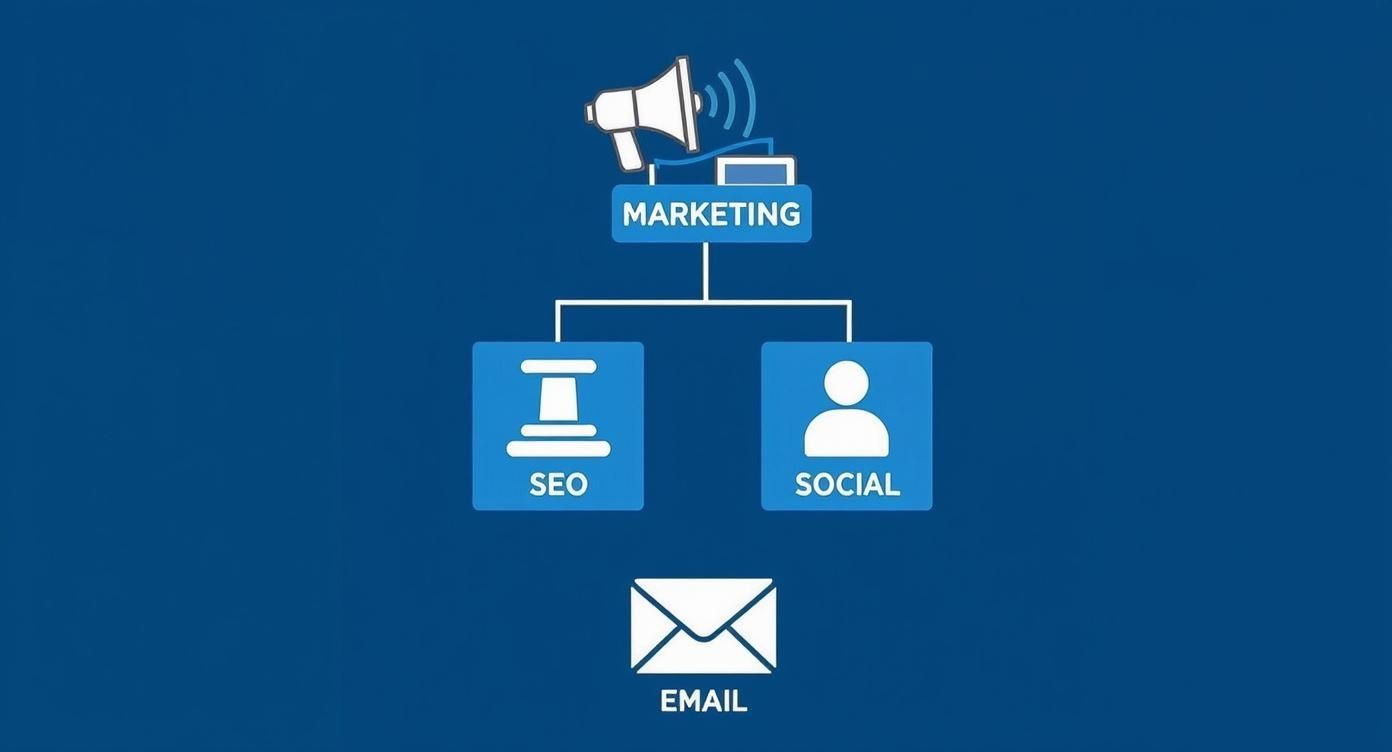
As you can see, a strong marketing strategy is built on getting found (SEO) and building a community (social media), while email gives you a direct way to talk to your best prospects.
To give you a quick snapshot, this table breaks down the main channels, what they’re for, and who they work best for. It’s a great way to see where you should focus first.
Key Digital Marketing Channels at a Glance
| Channel | Primary Goal | Best For Businesses That… |
|---|---|---|
| SEO | Get found in search engines like Google when customers are actively looking for a solution. | Are service-based, local, or rely on customers searching for their specific offerings. |
| Social Media | Build a community, showcase brand personality, and engage directly with customers. | Have a visual product or service, a strong brand story, or target a specific demographic. |
| PPC Ads | Drive immediate, targeted traffic and leads by paying for ad placement on search engines. | Need quick results, have a clear offer, and want to test different marketing messages fast. |
| Email Marketing | Nurture relationships with leads and existing customers to drive repeat business and loyalty. | Have a longer sales cycle or want to stay top-of-mind with their audience through valuable content. |
Each of these channels has its own strengths, and the right mix will depend entirely on your business and your goals.
Finding Your Starting Point
The secret is to figure out which channels are going to give you the biggest bang for your buck. A local plumber, for instance, will get massive value from local SEO, while a boutique clothing store might see its best results from Instagram.
If you’re right at the beginning of your journey, our guide on how to start digital marketing is a fantastic place to start.
And as the online space keeps changing, staying on top of new tech is crucial. A big part of being visible now involves AI. This helpful AI Search Visibility guide explains how you can get found when people use AI-powered search.
Throughout this guide, we’ll dive deep into each of these areas, so you can choose wisely and put your time and money where it will make the biggest difference.
Building Your Foundation with SEO
Ever tried finding a book in a library without a catalogue system? It’s chaos. Search Engine Optimisation (SEO) is the process of cataloguing your website so that search engines like Google—the world's biggest library—can find you, understand what you do, and recommend you to people looking for your services.
SEO is the absolute foundation of solid digital marketing for small businesses. Why? Because it brings customers to your digital doorstep the exact moment they need what you offer. This is what we call "high-intent traffic"—people who are actively searching for a solution and ready to act.
Think of SEO as having three core pillars. If one is weak, the whole structure wobbles.
- On-Page SEO: This is everything on your website. It’s about using the right keywords in your text, creating genuinely helpful content, and ensuring your pages are easy for both people and Google to read.
- Off-Page SEO: This is all about building your reputation off your site. The biggest factor here is getting other credible websites to link back to yours. Think of these as votes of confidence that boost your authority.
- Technical SEO: This pillar is the engine room. It ensures your website runs smoothly—it’s fast, works perfectly on mobile phones, and has a secure connection. A clunky site sinks rankings, fast.
For small businesses, getting these pillars right doesn't have to be overwhelming. We break down exactly how to build a winning strategy in our SEO for small businesses guide.
Mastering Local SEO to Attract Nearby Customers
For any service business, getting found by customers in your area is the name of the game. Local SEO is a specialised part of SEO that helps you show up for searches like "plumber near me" or "best accountant in Sydney." This is where you can seriously outplay bigger, national competitors.
The undisputed king of local SEO is your Google Business Profile (GBP). This free listing is what gets you on Google Maps and in the local search results pack. A fully filled-out and active profile isn't just a good idea—it's non-negotiable.
Here’s a look at the dashboard where you can manage all your business info directly on Google.

From this screen, you can update your hours, add photos of your work, and reply to customer reviews. Every action you take sends a signal to Google that your business is active, engaged, and trustworthy.
Your Practical Local SEO Checklist
Getting started with local SEO can feel like a huge task, but a few key actions deliver the biggest results. Use this checklist to build a rock-solid local foundation so potential customers can find you without a fuss.
- Claim and Fully Optimise Your Google Business Profile: This is step one, always. Fill out every single section you can—services, products, opening hours, and a detailed description packed with relevant keywords.
- Gather Consistent Customer Reviews: Reviews are a massive ranking factor and they build trust before a customer even clicks. Get into the habit of asking happy clients for a review and make sure you respond to every single one, good or bad.
- Ensure NAP Consistency: Your Name, Address, and Phone number (NAP) need to be identical everywhere online. Check directories like Yelp, TrueLocal, and any industry-specific sites. Even a small difference can confuse search engines.
- Use Location-Specific Keywords: Weave your city, suburb, or service area into your website copy. Don't just stuff them in; make it sound natural, especially on your homepage and service pages.
- Create Local Content: Write blog posts about jobs you’ve completed in specific suburbs, share news about local community events you're involved in, or create guides that are useful for locals. This screams local authority.
Actionable Tip: By consistently working on these local SEO elements, you're doing more than just pleasing Google. You're building trust with the people in your community before they've even picked up the phone.
Engaging Customers with Social Media Marketing
Think of social media as your digital town square. It’s not just a billboard for your ads; it’s where you build a community and have real conversations with the people who matter most to your business. For a busy small business owner, the trick is turning this channel from a daily chore into a powerful growth engine.
That starts with a smart, sustainable strategy.

The goal isn’t to be everywhere at once. It’s about choosing the right spots where your ideal customers are already hanging out and showing up consistently with content that actually helps, entertains, or inspires them.
Choosing Where to Build Your Community
The first step is deciding where to focus your precious energy. Chasing every new, shiny platform is a one-way ticket to burnout. Instead, you need to match the platform to your audience and your business type.
A classic mistake is just signing up for the biggest networks because you feel you should. The real key is figuring out where your specific customers are most active and what kind of content they love to see.
To help you narrow it down, here’s a quick look at the top platforms for Australian small businesses.
Choosing the Right Social Media Platform for Your Business
Finding the perfect platform means understanding who uses it and what they're looking for. This table breaks down the essentials to help you make a smarter choice.
| Platform | Primary Audience | Best Content Format | Ideal for… |
|---|---|---|---|
| Broad demographic, strong for local communities and ages 30-65+. | Community updates, events, customer reviews, and links to your blog posts. | Local service businesses, community-focused brands, and those needing a versatile "home base." | |
| Visually-driven audience, primarily ages 18-45. | High-quality photos, Reels (short-form video), and behind-the-scenes Stories. | Businesses with strong visual appeal like cafes, designers, real estate, and wellness practitioners. | |
| Professionals, B2B decision-makers, and corporate clients. | Industry insights, company news, professional articles, and case studies. | Consultants, coaches, recruitment agencies, and any business selling to other businesses (B2B). | |
| TikTok | Younger demographic (under 30), but growing across all age groups. | Short, engaging, and often entertaining videos that tap into current trends. | Brands targeting a younger audience or those who can create fun, personality-driven content. |
Remember, it's about connecting with the right people, not just shouting into the void.
Key Insight: The most successful social media strategies focus on mastering one or two channels rather than being mediocre on five. Go deep, not wide.
Creating a Sustainable Content Plan
Once you’ve picked your platforms, you need a simple plan for what to post. A great rule to live by is the 80/20 rule.
This means 80% of your content should be valuable, helpful, or entertaining, while only 20% should be directly about selling something. This approach builds trust and keeps your audience hooked, so when you do share an offer, they're ready to listen.
Your content mix could look something like this:
- Educational Posts: Share quick tips, answer common questions, or break down a tricky topic from your industry.
- Behind-the-Scenes: Show your team at work, the process behind your service, or a day in the life. It humanises your brand like nothing else.
- User-Generated Content (UGC): Reshare photos or reviews from happy customers. This is gold-standard social proof.
- Community Highlights: Feature a local event or another local business you admire. It shows you’re a genuine part of the community.
Tools and Tips for Efficient Management
Managing social media doesn't have to eat up your entire day. With the right tools, you can schedule posts in advance, see what’s working, and keep a consistent presence without being glued to your phone.
Platforms like Buffer or Hootsuite let you plan and schedule your content in batches, which can save you hours every single week. That consistency is exactly what the algorithms love to see.
To keep things engaging, especially on visual platforms like Instagram and TikTok, you have to stay on top of what’s current. Keep your content fresh by exploring the latest short-form video trends. This will help you create posts that grab attention and really connect, turning your social media from a chore into a powerful tool for building real customer loyalty.
Driving Sales with Email Marketing Automation
While SEO and social media are brilliant for getting in front of new faces, email marketing is your direct line to the people who’ve already put their hands up and said, “I’m interested.” It consistently delivers one of the highest returns on investment in digital marketing for small businesses, making it a tool you simply can’t afford to ignore.
Think of your email list not as a database, but as a room full of warm leads who’ve given you permission to chat with them directly. This isn’t about blasting inboxes with promotions. It’s about building real relationships, delivering genuine value, and gently guiding subscribers toward becoming loyal, paying customers. It all starts with building a quality list.
You can do this by offering a little something valuable in exchange for an email address. A discount code, a helpful checklist, or access to an exclusive video are all great ways to attract people who are genuinely keen on what you offer.
Crafting Emails That Actually Get Opened
Once you have a list, the real work begins: creating emails people want to read. And that starts with a killer subject line. Keep it short, spark some curiosity, and for goodness sake, don't sound like every other sales email clogging up their inbox.
Inside, the content needs to be focused and helpful. Whether you’re sharing a quick tip, a company update, or a special offer, make it scannable with short paragraphs and a crystal-clear call to action.
- Make It Personal: Using a subscriber's name is the bare minimum. Make the email feel like it was written just for them.
- Give Before You Ask: Share useful info before you push for a sale. This builds trust and shows you know your stuff.
- Keep It Simple: Use a clean layout with one clear goal for each email. Is it to read a blog post, check out a new product, or book a call? Pick one.
The Power of Automation for Small Businesses
Now, imagine having a tireless assistant who works for you 24/7. This assistant welcomes every new person, follows up with those who showed interest but got distracted, and even remembers their birthday. That’s exactly what email automation does for you.
Automation lets you set up email sequences that are automatically triggered by specific customer actions. It’s an absolute game-changer for saving time while delivering a highly personalised experience.
Key Insight: Automation turns your email list from a simple broadcast tool into a dynamic, responsive sales engine. It allows you to nurture leads, recover lost sales, and build customer loyalty without lifting a finger for each interaction.
A fantastic place for any small business to start is with a welcome sequence. This is a series of 3-5 automated emails sent to new subscribers over a few days. The goal? Introduce your brand, set expectations, and provide immediate value to make a cracking first impression. For a deeper dive, our article on marketing automation for small business walks you through it step-by-step.
Another incredibly effective tactic is the abandoned cart sequence. For e-commerce businesses, if someone adds an item to their cart but doesn't finish the purchase, an automated email can give them a gentle nudge, often bringing back what would have been a lost sale.
The tech behind this has never been more accessible. AI-powered personalisation is a cornerstone of success for Australian small businesses. In fact, recent reports show that marketers leveraging AI for personalisation see significantly better engagement. Platforms like ActiveCampaign and HubSpot are giving small businesses affordable and powerful automation tools. By embracing automation, you can turn your email marketing from a manual chore into a smart, sales-driving machine that works for you around the clock.
Creating a Realistic Marketing Budget and Measuring ROI
Figuring out how much to spend on digital marketing can feel like you're just throwing numbers at a wall, but it doesn’t have to be a guessing game. A realistic budget is your first step towards proper growth, and knowing your return on investment (ROI) makes sure every dollar you spend is actually pushing your business forward.
Without a clear budget and a way to track what’s working, you're flying blind. You could be pouring cash into a channel that brings in zero leads or, worse, missing out on a golden opportunity somewhere else. A smart approach turns your marketing spend from a hopeful expense into a predictable investment.
How to Set a Smart Marketing Budget
There's no magic number for what you "should" spend, but there are a few proven ways to work it out. The trick is to pick an approach that matches where your business is at right now and where you want it to go.
Here are two of the most common ways small businesses tackle their budget:
- Percentage of Revenue: This one is simple and straightforward. Most businesses set aside between 5% and 10% of their total revenue for marketing. If you’re a new business just trying to get your name out there, you’ll probably want to lean closer to the 10-12% mark to build that initial momentum.
- Goal-Based Budgeting: This is the more strategic way to do it. You start with a clear goal (like, "I need 20 new clients this quarter") and then you work backwards. Figure out how many leads you need to hit that number and what the average cost per lead is for the marketing channels you’re using. This tells you exactly what you need to invest to hit your target.
Actionable Tip: The best strategy is often a mix of both. Use the percentage of revenue model as a guardrail to make sure you don't overspend, then use goal-based planning to put that budget to work on the channels most likely to get you the results you want.
Measuring What Matters Most: Your ROI
Once your budget is locked in, the real work begins: tracking your results. Your Return on Investment (ROI) is the ultimate scorecard. In plain English, for every dollar you put into your marketing, how many dollars in profit did you get back?
To figure this out, you need to keep an eye on a few key numbers:
- Cost Per Acquisition (CPA): This is simply what it costs you to land one new paying customer. If you spent $500 on Google Ads and got 10 new clients from it, your CPA is $50. Easy.
- Conversion Rate: This is the percentage of people who take the action you want them to, whether that’s filling out your contact form or buying something. A higher conversion rate means your marketing message is hitting the mark.
- Customer Lifetime Value (CLV): This is the total profit you expect to make from a single customer over the entire time they do business with you. Knowing your CLV is huge because it helps you justify spending a bit more to acquire a customer, knowing the long-term payoff is there.
Tools like Google Analytics are non-negotiable for tracking your website traffic, seeing what visitors do, and measuring how your campaigns are performing—all without costing you a cent.
This screenshot from Google Analytics shows a typical dashboard where you can see how many users are visiting your site and where they're coming from.
This is the kind of data that helps you spot which channels (like organic search or social media) are bringing in the best traffic, allowing you to make much smarter decisions with your budget.
Your Simple 90-Day Digital Marketing Plan
Theory is great, but a plan without action is just a document gathering dust on your desktop. This is where it all comes together. Let’s map out a simple, manageable strategy you can start today to build real momentum for your business.

The focus here isn’t about doing everything at once. It’s about starting small, being consistent, and letting small wins stack up over time. A 90-day sprint is the perfect timeframe—long enough to see results, but short enough to stay focused and not get overwhelmed.
Month 1: Laying the Groundwork (Days 1-30)
The first month is all about getting your foundations right. Forget perfection; just focus on getting the essentials in place so you have a solid base to build upon.
- Week 1: Set a Real Goal. Don't just say "get more clients." Get specific. Your goal should be "sign 3 new clients." That clarity is everything.
- Week 2: Define Your Audience. Whip up a simple one-page profile of your ideal client. Who are they, what keeps them up at night, and where do they hang out online looking for solutions?
- Week 3: Pick ONE Channel. Choose one primary channel to own. If you’re a local tradie, this is your Google Business Profile. A business consultant? Get on LinkedIn.
- Week 4: Create Foundational Content. Create two or three core pieces of content. This could be as simple as optimising your service pages or writing a helpful blog post that answers a common client question.
Key Insight: Your goal in the first 30 days isn't to see a flood of new business. It's to build the essential assets and habits that will drive growth in the months to come.
Month 2: Building Consistency (Days 31-60)
With your foundation set, month two is about finding your rhythm. This is where you establish a consistent presence and start actively talking to your audience. Consistency builds trust and signals to search engines and social platforms that you’re a reliable authority in your space.
Your simple plan for this month is a weekly rinse-and-repeat cycle:
- Publish One Piece of Content: A new blog post, a short case study, or even a quick video will do the trick.
- Share It on Your Chosen Channel: Post about your new content and make sure you engage with any comments or questions that pop up.
- Send One Email: Let your email list know you've created something helpful for them.
Month 3: Measuring and Refining (Days 61-90)
The final month of your sprint is about looking at the data and making small, smart adjustments. Jump into your Google Analytics or social media insights to see what’s actually working. Which blog post got the most traffic? What social post had the best engagement?
Use these insights to double down on what resonates. This data-driven approach is what ensures your digital marketing for small businesses strategy gets more effective over time, turning your initial efforts into a predictable system for attracting your ideal clients.
Burning Questions? We’ve Got Answers
Stepping into digital marketing can feel like learning a new language. You've got questions, and that's a good thing—it means you're on the right track. Here are some straightforward answers to the queries we hear most often from small business owners.
How Much Should a Small Business Actually Budget for Digital Marketing?
There’s no one-size-fits-all answer here, but a solid rule of thumb is to set aside 5-10% of your total revenue. If you're a new business just getting off the ground, you might want to aim a bit higher to build that crucial initial momentum.
The trick is to start smart, not big. Test the waters with a modest budget on one or two channels that look promising, like some targeted local Google Ads or a boosted Facebook post. This lets you see what actually works and put more money behind the winners. It's about making sure every dollar you spend is pulling its weight.
What's the Best Marketing Channel if I’m Crunched for Time?
When time is your scarcest commodity, don't try to be everywhere at once. That’s a fast track to burnout. Instead, pick the one channel where your ideal customers hang out the most and go all-in on that.
For most local service businesses, that channel is Local SEO. Getting your Google Business Profile in top shape is a high-impact, low-cost move that puts you right in front of people actively searching for what you do. But if you’re in a visual industry, like a cafe or a boutique clothing store, a focused Instagram strategy will probably serve you better.
Do I Absolutely Need a Website to Get Started with Digital Marketing?
Honestly, you don't need one to get started, but you'll definitely want one for long-term success. You can absolutely get the ball rolling and find your first customers without it.
A well-optimised Google Business Profile or a complete Facebook Business Page can work as your digital front door for a while. They give customers a place to find your details, read reviews, and see what you offer.
Key Insight: Think of social media profiles and business listings as rented land—they are fantastic for getting started and building an audience. However, your website is the property you own, giving you complete control over your brand, customer data, and long-term SEO success.
Ultimately, while those other platforms are great launchpads, a professional website should be high on your to-do list as you grow. It cements your credibility and becomes the central hub for all your marketing—an asset that you own and control completely.
Ready to stop guessing and start growing? Homer Digital Marketing provides proven strategies to help service-based businesses enhance their online visibility and attract ideal clients. Discover how our targeted LinkedIn, Google, and AI-powered systems can scale your business by visiting us at https://homerdigitalmarketing.com.
