

Feeling invisible online? You're not alone. Think of SEO services for small business as grabbing the best shopfront on a bustling digital high street, right where your ideal customers are already looking. This is your proven, actionable game plan for turning online searches into real, paying customers.
Why SEO Is the Ultimate Growth Engine for Your Small Business
In a crowded market, just having a website isn't enough to get you noticed. It’s like owning the best café in town, but tucking it away in a hidden alley with no signs. No matter how incredible your coffee is, people will walk right past, completely clueless that you even exist. That’s what it's like for a business without solid Search Engine Optimisation (SEO).
SEO is the art and science of making your website more visible and appealing to search engines like Google. When you get it right, it puts your business front and centre at the exact moment a potential customer is searching for what you offer. It’s not just another marketing trick; it's a core strategy for survival and growth.
Beyond Clicks to Customers: Attracting High-Intent Traffic
A common mistake business owners make is thinking SEO is just about getting more traffic to their website. While traffic is a piece of the puzzle, the real win is attracting the right kind of traffic. Professional SEO services focus on pulling in qualified leads—people who are actively looking to solve a problem that you can fix.
This means zeroing in on high-intent keywords that signal someone is ready to buy. For example, ranking for a long-tail keyword like "emergency plumber in Parramatta" is infinitely more valuable than ranking for "how to fix a tap." One search comes from a customer in need, the other from a DIYer on a Sunday afternoon.
Key Takeaway: A well-oiled SEO strategy doesn’t just bring you random visitors; it brings you potential customers who are ready to act, dramatically boosting your chances of making a sale.
Building a Sustainable Asset That Works 24/7
Here's the beautiful part. Unlike paid ads, where your visibility vanishes the second you stop paying, SEO builds a long-term, sustainable asset for your business. Every blog post you write, every backlink you earn, and every technical tweak you make adds to your website's authority and ranking power over time.
This creates a powerful compounding effect. The work you do today continues to deliver results for months, even years, generating a steady stream of organic traffic and leads without that constant cost-per-click drain. It turns your website from a simple online brochure into a tireless, 24/7 sales engine that consistently drives revenue and builds your brand’s credibility.
Investing in SEO services for your small business isn't an expense; it's laying the foundation for lasting online success.
So, What SEO Services Does a Small Business Actually Need?
The world of SEO services for small business can feel like a maze of jargon, but it really boils down to four key areas that all work together. Think of it like running a popular local cafe. You need a solid building (Technical SEO), great signage and an easy-to-read menu (On-Page SEO), a stellar reputation around town (Off-Page SEO), and a clear, easy-to-find address for locals (Local SEO).
If you neglect one part, the whole thing suffers. This is how you bridge the gap between your business and the customers looking for you right now.
As you can see, SEO isn't just some tech task you tick off a list. It's the engine that connects your solutions directly with the people actively searching for them. Let's break down the core services that make that connection happen.
H3: Technical SEO: The Engine Under the Hood
Technical SEO is all the work that happens behind the scenes to make sure your website is fast, secure, and dead simple for Google to understand. If your website was a car, this would be its engine, transmission, and electricals—all the critical bits that guarantee a smooth, reliable ride.
You won't see this work directly, but you'll definitely feel its impact when your site loads in a flash and search engines can crawl every page without a hitch. Google rewards technically sound websites with better visibility. It's that simple.
Key jobs here include:
- Improving Site Speed: Making sure your pages load quickly, because almost 50% of people will leave if a site takes longer than 2 seconds.
- Mobile-Friendliness: Ensuring your site works perfectly on a smartphone. No weird formatting, no tiny text.
- Site Architecture: Organising your site logically so search engines can find and index your content efficiently.
- Security (HTTPS): Protecting your visitors’ data is a huge trust signal for both them and Google.
Without a solid technical base, even the most brilliant content will struggle to get seen. This is step one, and it’s non-negotiable.
H3: On-Page SEO: Your Shopfront and Signage
Once the engine is tuned, it's time to focus on what your visitors actually see. On-Page SEO is all about optimising your individual web pages to be clear, relevant, and genuinely helpful.
Think of it like setting up your physical shop. You need clear aisles (navigation), helpful signs (headings), and detailed product descriptions (content) that tell customers exactly what they're looking at and why it's for them.
Pro Tip: Effective on-page SEO is really about one thing: proving your relevance. You’re telling Google, "This page is the absolute best answer for someone searching this keyword."
This involves more than just stuffing keywords into your text. It's about creating quality content that truly solves the searcher's problem and placing your main keywords in the spots that matter most, like page titles and headings. For a deeper look at getting your content right, our guide on how to rank higher on Google is a great next step.
H3: Off-Page SEO: Your Reputation Around Town
Off-Page SEO covers all the actions you take outside of your website to boost your rankings. If On-Page SEO is what you say about your business, Off-Page SEO is what everyone else says about you. It's your digital word-of-mouth.
The biggest piece of this puzzle is backlinking. A backlink is simply a link from another website pointing to yours. Google sees these as votes of confidence. When a respected, authoritative site links to you, it signals that your content is trustworthy and valuable.
This is why building a strong profile of quality backlinks is essential for establishing authority and climbing past your competitors in the search results.
H3: Local SEO: Becoming the Neighbourhood Go-To
For most small businesses with a physical location or service area, this is the big one. Local SEO is focused on making you hyper-visible to customers in your immediate area. It’s what gets your business to show up when someone nearby searches for "best coffee near me" or "plumber in Fitzroy."
The heart of Local SEO is your Google Business Profile. Optimising this, gathering positive customer reviews, and making sure your business name, address, and phone number are consistent everywhere online is key. It turns your website into the go-to local option, driving real foot traffic and phone calls from customers just around the corner.
To wrap it up, here’s a quick overview of how these core services fit together to support your small business.
Key SEO Services for Small Businesses at a Glance
| SEO Service Type | Primary Function | Main Benefit for Your Business |
|---|---|---|
| Technical SEO | Optimises your site's backend for speed, security, and crawlability. | Ensures Google can find and rank your site, creating a great user experience. |
| On-Page SEO | Creates high-quality, relevant content targeting specific keywords. | Tells Google exactly what your pages are about, attracting the right audience. |
| Off-Page SEO | Builds authority and trust through backlinks from other reputable sites. | Boosts your site's credibility, leading to higher search rankings. |
| Local SEO | Increases visibility in local search results and on Google Maps. | Drives foot traffic and phone calls from customers in your geographic area. |
Each of these pillars is essential. A great SEO strategy doesn't just focus on one; it integrates all four to build a powerful online presence that delivers real, measurable results for your business.
Winning Locally with Powerful Local SEO
For most small businesses, the battle for customers isn't won on a national stage—it's won right in your own backyard. While chasing big rankings is tempting, the real, tangible growth comes from attracting people in your immediate community who are ready to buy. This is where Local SEO comes in, and it's arguably the most powerful tool for any service-based or brick-and-mortar business.
It’s not just about being online; it’s about being the first and best answer when a local customer needs you.
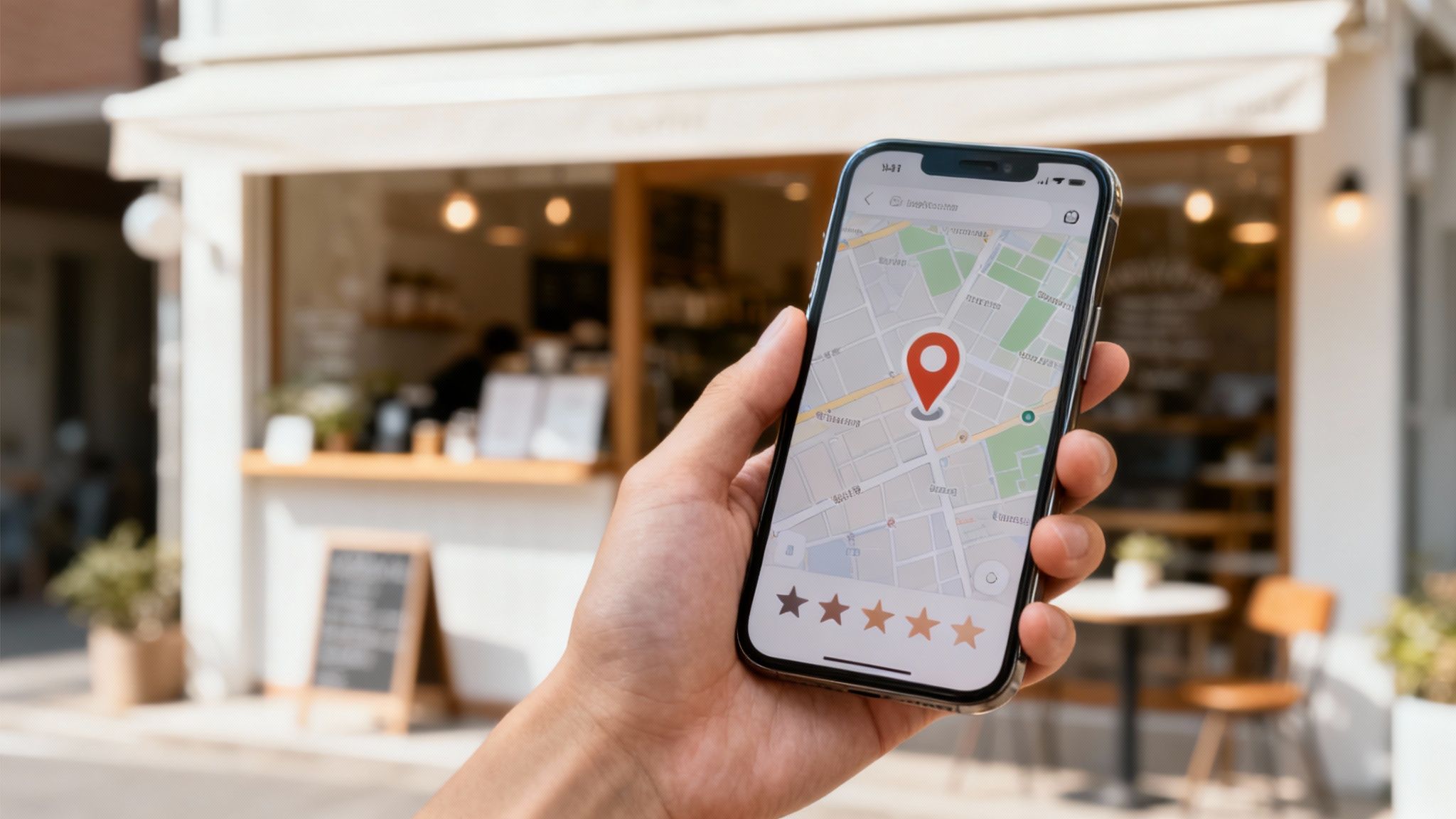
Think of it this way: a potential customer has a burst pipe. Are they going to search for "best plumber in Australia"? Not likely. They’re whipping out their phone and typing "emergency plumber Parramatta". Your entire goal is to be the first name they see.
This isn’t just a guess; it reflects a massive shift in how people find local services. Since 2015, searches including the phrase 'near me' have exploded by over 500%. Today, around 46% of all Google searches in Australia have local intent. Even more critically, 76% of those local mobile searches lead to a visit to a physical store within 24 hours. That's not just traffic; that's foot traffic.
Your Google Business Profile Is Your Local Shopfront
The absolute cornerstone of any local SEO strategy is your Google Business Profile (GBP). This free listing is your digital shopfront on Google Search and Maps. For many, it's the very first interaction they'll have with your brand. Leaving it incomplete is like having a shop with no sign on the door.
A fully optimised GBP gives customers everything they need to make a decision at a glance:
- Accurate Information: Your business name, address, and phone number (NAP) must be perfectly consistent everywhere online.
- Operating Hours: Keep them updated, especially around public holidays. No one likes showing up to a closed door.
- Services and Products: Detail exactly what you offer. This helps you appear for more specific, relevant searches.
- High-Quality Photos: Show off your work, your team, and your location. It builds instant trust and familiarity.
A well-managed GBP doesn't just inform; it actively converts searchers into callers and visitors.
The Power of Local Reviews and Reputation
Reviews are the modern-day word-of-mouth, and they're a massive ranking factor for local searches. Google wants to recommend businesses that provide excellent service, and a steady stream of positive reviews is the strongest signal you can send.
Actionable Tip: Your online reviews are a direct reflection of your offline customer experience. Encouraging happy customers to share their feedback is one of the most effective ways to build trust and improve your local visibility.
Picture a café in Fitzroy. When a tourist searches for "best coffee Fitzroy," Google’s map pack will likely show three top contenders. The one with more recent, positive reviews and a higher star rating will almost always get the click. This is where an effective plan focuses heavily—building a system to consistently generate authentic customer feedback.
If you're keen to understand the nuances of local visibility, you can find a complete guide on https://homerdigitalmarketing.com/what-is-local-seo-optimization/ here.
Creating Content That Speaks to Your Community
Finally, great Local SEO means creating content that actually resonates with your local audience. This goes way beyond just mentioning your service area on your homepage. It's about proving you're an active, valuable part of the community.
This could involve:
- Location-Specific Service Pages: Create dedicated pages for each suburb you serve (e.g., "Plumbing Services in Bondi," "Landscaping in Geelong").
- Community-Focused Blog Posts: Write about local events, sponsor a local sports team, or create guides to your neighbourhood.
- Case Studies of Local Projects: Showcase the successful work you've done for other clients in the area.
This approach not only helps you rank for specific local searches but also builds a genuine connection with your community. For those looking to really dominate their local area, exploring specific local boost SEO strategies can provide a serious competitive edge. It’s how you show that you're not just a business in a town—you're a part of it.
How to Choose the Right SEO Partner
Finding a trustworthy SEO provider can feel like you’re wading through a minefield of big promises and confusing jargon.
The right partner becomes a genuine extension of your team, someone who’s actually invested in your growth. But the wrong one? They can burn through your budget and leave you in a worse spot than when you started. Getting this choice right is absolutely critical.
This isn’t just about hiring another supplier; it’s about finding a strategic partner. You need someone who takes the time to understand your business, communicates clearly, and focuses on results that actually move the needle—not just fluffy vanity metrics. Your goal is to find an expert who delivers effective SEO services for small business growth, not just pretty reports.
Key Questions to Ask Any Potential Provider
Before you even think about signing a contract, you need to ask the right questions. Their answers (or lack of them) will tell you everything you need to know about their style, honesty, and actual expertise.
Arm yourself with this list to cut through the sales pitch and find out what they’re really about.
- What does your strategic process look like? A good partner will have a clear, logical answer. They should be able to walk you through how they audit your site, size up the competition, and build a strategy that’s customised for you. Vague answers are a warning sign.
- Can you show me case studies from businesses like mine? Proven success in your industry is a massive plus. Ask for specific examples and results they’ve delivered for other service-based businesses in Australia.
- How do you measure success and what will my reports include? Look for answers that go beyond just website traffic. A great partner will talk about tracking leads, phone calls, keyword ranking improvements for high-intent terms, and local map visibility.
- What’s your approach to link building? This one is huge. You want to hear about earning high-quality, relevant backlinks through genuine outreach and great content—not buying dodgy links that could get your site penalised by Google.
- How often will we communicate and who will be my main point of contact? Clear, consistent communication is non-negotiable. Make sure you know exactly who you’ll be speaking with and how often you'll get updates on your campaign.
Red Flags to Watch Out For
Just as important as knowing what to look for is knowing what to run from. Some SEO providers use questionable tactics or make wild promises to get you to sign on the dotted line.
Spotting these red flags early can save you a world of pain down the track.
Important: A reputable SEO expert will never guarantee a #1 ranking on Google. The algorithm is far too complex and always changing for anyone to make that kind of promise. A focus on sustainable growth and proven strategies is a much healthier sign.
Be extremely cautious if a provider:
- Guarantees top rankings. This is the oldest and biggest red flag in the industry. Run.
- Is secretive about their methods. If they call their techniques "proprietary" or won’t explain what they’re actually doing, it's a major problem.
- Focuses only on backlinks. A solid strategy is holistic, covering technical SEO, on-page content, and off-page authority building.
- Offers suspiciously cheap packages. Quality SEO takes time, skill, and resources. Prices that seem too good to be true almost always are, and often lead to shoddy work that can do more harm than good.
Choosing the right partner is a foundational step in your business's online journey. To help you stay organised and compare your options fairly, use the simple checklist below. It’ll help you systematically score each potential provider and make a confident, informed decision.
Evaluating Potential SEO Providers Checklist
| Evaluation Criterion | Provider A | Provider B | Provider C |
|---|---|---|---|
| Industry Experience | |||
| Transparent Process | |||
| Clear Reporting | |||
| Client Testimonials | |||
| Realistic Promises | |||
| Communication Plan |
Once you've filled this out, the right choice often becomes much clearer. Take your time, do your homework, and you'll find a partner who can genuinely help your business grow.
Understanding SEO Service Costs in Australia
Alright, let's talk about the dollars and cents. When you start looking into SEO services for your small business, one of the first questions is always, "How much is this going to cost?" It’s easy to feel a bit lost. You’ll see everything from dirt-cheap offers that seem too good to be true (they usually are) to eye-watering agency fees.
The trick isn’t to find the cheapest price tag. It's about understanding what you're actually paying for and seeing it for what it is: a strategic investment in your business’s future. Once you shift your thinking from 'cheap vs. expensive' to 'value and return', you can find a partner who can deliver real, measurable results, not just empty promises.
Common Pricing Models in Australia
In the Aussie market, SEO providers generally structure their fees in a few standard ways. Getting your head around these will help you compare apples with apples when you're looking at quotes.
- Monthly Retainers: This is the most popular model by far. You pay a fixed fee each month for an ongoing SEO strategy. It usually covers everything from creating content and technical tune-ups to building links.
- Project-Based Fees: Perfect for a specific, one-off job. Think a deep-dive website audit, setting up your local SEO from scratch, or recovering from a Google penalty. You pay one price for a clearly defined task.
- Hourly Consulting: Some freelancers or consultants charge by the hour. This is great for strategic advice, team training, or helping you troubleshoot a tricky problem.
For steady, long-term growth, a monthly retainer is almost always the way to go. SEO is a marathon, not a sprint, and it needs consistent effort.
What Should You Expect to Pay?
Setting a realistic budget is a must. Prices can swing wildly depending on how competitive your industry is and the amount of work needed, but there are some general benchmarks for Australia. The good news is that small businesses are increasingly seeing SEO as a non-negotiable part of their marketing.
Data Insight: The average SEO budget for a small business in Australia now sits around AUD 1,350 per month, which is a noticeable jump from previous years. This shows a growing confidence in SEO's power to deliver a real return, especially when you consider that 46% of all online searches in Australia are for something local.
This figure gives you a solid baseline for what a proper, results-focused campaign might cost. Cheaper services often cut corners on the important stuff—like high-quality content or authoritative link building—which can end up hurting your site more than helping it. To get a bigger picture of what goes into these costs, check out our breakdown of the cost to hire a digital marketing company.
Ultimately, you want to find a provider whose pricing makes sense for the value they bring. A well-run SEO strategy doesn't just cost money; it makes money by driving a steady stream of qualified customers straight to your digital front door.
Measuring SEO Success and Real Results
So you’ve decided to invest in SEO services for your small business. That’s a massive step, but how do you actually know if it’s paying off? Success isn’t just a spike in website visitors; it’s about tangible growth that shows up on your bottom line.
It’s easy to get distracted by vanity metrics like total website visits or social media likes. These numbers might look good in a report, but they don’t pay the bills. The real measure of success is drawing a straight line from your SEO efforts to genuine business growth.

Key Performance Indicators That Really Count
A great SEO partner won’t just send you a spreadsheet full of jargon. They’ll help you track the Key Performance Indicators (KPIs) that are directly tied to your business goals. These are the numbers that prove your strategy is delivering a clear return on investment.
Here are the critical metrics you should be watching:
- Increase in Qualified Organic Leads: This is the big one. How many new phone calls, form submissions, or enquiries are you getting directly from search engines? This tells you if you're attracting the right kind of people.
- Improved Keyword Rankings for High-Intent Terms: It's not about ranking for thousands of random keywords. It's about climbing the search results for phrases that signal a customer is ready to buy, like "emergency electrician in Bondi" or "best buyers agent in Melbourne".
- Increased Local Map Pack Visibility: For any local business, cracking the top three results on Google Maps is a game-changer. Tracking your visibility here is crucial for driving foot traffic and local calls.
- Growth in Organic Traffic: While it's not the only metric, a steady, sustained rise in non-paid website traffic is a powerful sign that your overall visibility and authority are growing.
What a Valuable Monthly Report Looks Like
Transparency is everything. A valuable monthly report from your SEO provider should be easy to understand and clearly connect their actions to your results. It’s more than just a data dump; it should tell the story of your progress.
Expert Tip: A good SEO report doesn't just show you what happened; it explains why it happened and what the plan is for next month. It should empower you, not confuse you.
Look for a report that outlines the work they completed, highlights improvements in your KPIs with clear graphs, and offers insights into what it all means for your business. To get this level of detail, most SEO partners use comprehensive software; a good SE Ranking review can show you what these tools are capable of.
This level of reporting keeps your provider accountable and gives you the confidence that your investment is working hard. When you have a transparent partner, you'll see the clear benefits: better traffic, stronger map visibility, higher keyword rankings, and most importantly, more direct customer enquiries. This is how you confirm your strategy is delivering genuine growth, month after month.
Got Questions About Small Business SEO? We've Got Answers
Stepping into the world of SEO services for small business can feel a bit like learning a new language. There are a lot of terms, a lot of promises, and it's easy to feel overwhelmed.
Let's cut through the noise. Here are some of the most common questions we hear from business owners, answered in plain English.
How Long Does SEO Actually Take to Work?
This is the big one, isn't it? While you might see some small wins pop up early, real, meaningful SEO isn't a quick fix. Think of it as building a valuable asset for your business, not just flipping a switch for instant traffic.
Generally, you should expect to see significant, needle-moving results within 4-6 months. That timeline can shift depending on how competitive your industry is, the history of your website, and how much firepower you're putting behind your strategy.
Should I DIY My SEO or Hire an Expert?
For most small business owners, the best answer is a bit of both. You can absolutely handle some of the basics yourself. Things like updating your Google Business Profile with new photos, hours, and posts are crucial and totally manageable.
Our Recommendation: Focus on running your business—the thing you're an expert at—and let an SEO pro handle the complex, time-consuming work. A good expert will get you results faster and help you sidestep expensive mistakes.
When it comes to the heavy lifting—technical fixes, strategic keyword research, and building quality links—that’s where the pros come in. That side of SEO takes deep expertise and a serious time commitment. Hiring someone to manage it almost always delivers a much better return.
Is SEO Better Than Paid Ads Like Google Ads?
It's a common question, but it's not really an "either/or" situation. Think of them as different tools in your marketing toolkit. They do different jobs, and they work brilliantly together.
Here’s the simplest way to look at it:
- Paid Ads (Google Ads): This is your tap for instant traffic. You pay for every click, and as soon as you turn off the spend, the traffic disappears. It's like renting an audience.
- SEO: This is how you build a long-term, sustainable asset. The effort you put in today can keep bringing in organic traffic for years to come, without you paying for every single visit. It's like owning your audience.
The most powerful marketing strategies use both. Paid ads are fantastic for short-term campaigns or getting immediate traction, while SEO builds that lasting growth and authority that pays dividends for years.
Ready to stop being invisible online and start attracting the clients you deserve? At Homer Digital Marketing, we build proven systems that drive real, measurable growth for service-based businesses.
