

At its core, SEO for real estate is about making your website and online listings appear first when potential clients search for properties or agents in your area. An effective SEO strategy ensures you are seen by high-intent local buyers and sellers, generating a consistent stream of qualified leads without the constant need for paid advertising.
Why SEO Is No Longer Optional for Real Estate Agents
In the competitive Australian property market, simply having a website is not enough. Without a robust SEO plan, your website is like a "For Sale" sign hidden down a quiet laneway—it exists, but no one will find it by accident. The days of relying solely on letterbox drops and newspaper ads are over. Today, a staggering 95% of property searches begin online, making your digital storefront far more crucial than your physical one.
Effective SEO is not about tricking Google. It’s about demonstrating that you are the most relevant, trustworthy, and knowledgeable agent in your local area. When a homeowner in your suburb types "best real estate agent in [Your Suburb]" into Google, SEO determines whether you appear at the top of the results or get lost on page five, where visibility plummets.
This is achieved through a few key activities working in synergy:
- Local SEO: This ensures you appear in Google Maps and for location-based searches like "real estate agent near me."
- On-Page SEO: This involves optimizing your website's pages and content with the specific keywords and phrases that buyers and sellers are actively using.
- Content Marketing: This includes creating helpful blog posts, suburb guides, or market updates that answer your clients' most pressing questions and establish you as the local authority.
The ultimate goal is to build a powerful online presence that works for you 24/7, attracting motivated clients even while you sleep.
This diagram illustrates the direct path from a well-executed SEO strategy to tangible business growth.

As you can see, increased online visibility directly fuels your lead pipeline, which in turn leads to more listings, more sales, and a healthier bottom line.
Simply put, SEO connects you with clients at the exact moment they need your expertise. It transforms your website from a passive online brochure into an active, lead-generating machine that consistently drives your business forward.
For Australian agents, mastering SEO means you can stop chasing every lead. Instead, the right leads begin to find you. By implementing a targeted SEO approach, you build a sustainable marketing engine that delivers a significant return on investment and cements your reputation as the go-to expert in your community. This guide provides the actionable roadmap you need to achieve just that.
Dominate Your Suburb with Local SEO Mastery
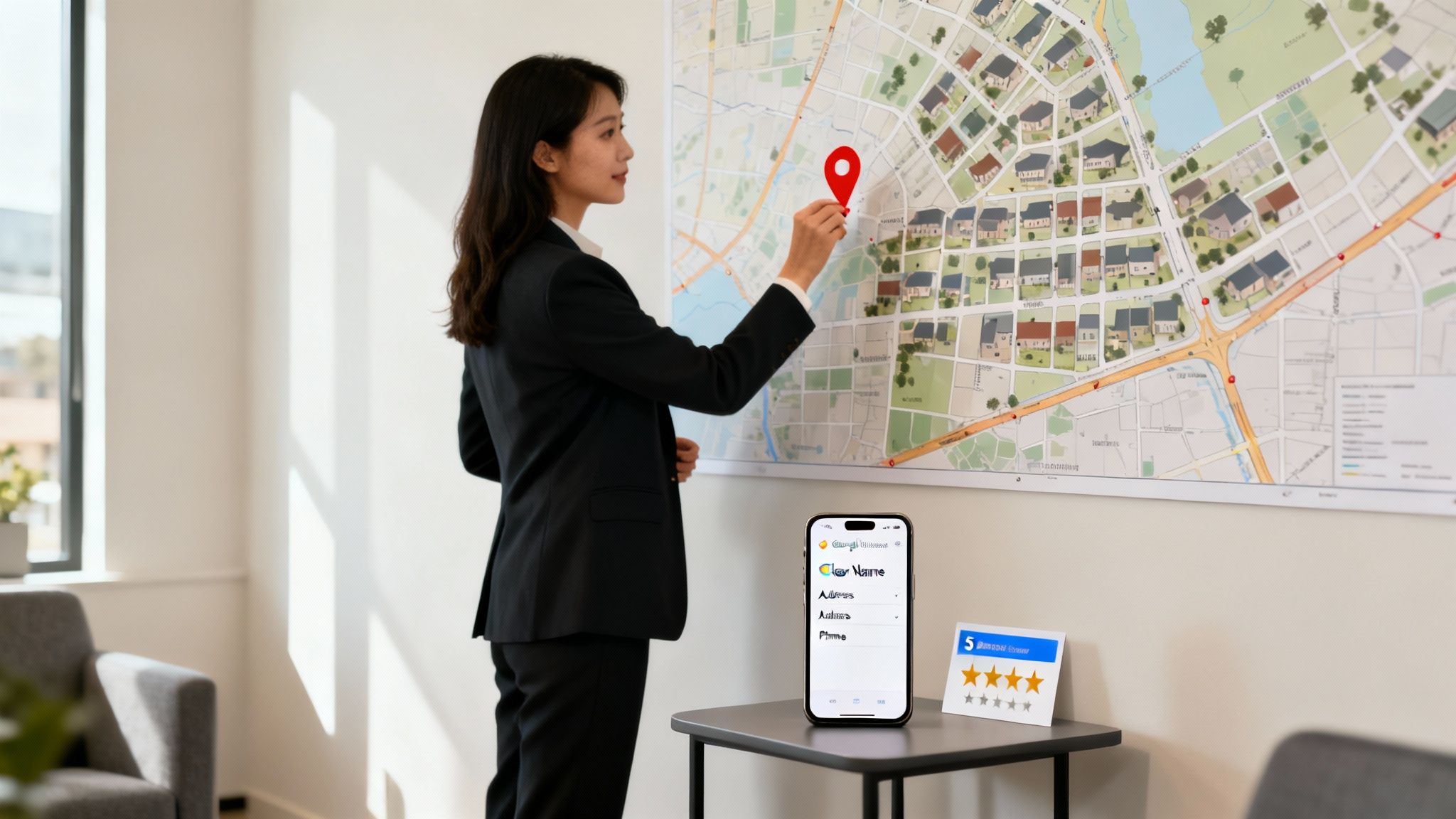
As a real estate agent, you don’t need to be visible everywhere. You need to be visible to the right people in the right suburbs.
That's where local SEO for real estate becomes your most powerful tool. It’s the strategy that puts your name in front of a potential client the moment they search for "agent in [your suburb]" or "houses for sale near me."
Think of it as digital word-of-mouth. It’s how you become the go-to agent in your area, ensuring you’re the first person local homeowners and buyers think of.
Your Google Business Profile Is Your Digital Shopfront
Your Google Business Profile (GBP) is unquestionably the most critical component of your local SEO strategy. It’s the information box that appears in Google Search and on Maps when someone looks you up.
An unoptimised profile is like a neglected shop with peeling paint—it deters visitors. But a well-managed profile? That’s a welcoming front door, inviting clients to step in and discover what you offer.
Getting this right is non-negotiable. For a deeper dive, you can learn more about local SEO optimisation in our comprehensive guide.
Here’s where to focus first:
- Claim and Verify It: First, you must prove to Google that you own the business. This quick verification step is the key to unlocking all profile features.
- Ensure NAP Consistency: Your Name, Address, and Phone Number (NAP) must be identical everywhere online—your website, GBP, and all other directories. A minor difference like "St" versus "Street" can confuse Google and negatively impact your ranking.
- Select the Right Categories: Your primary category should be "Real Estate Agency." Then, add secondary ones like "Real Estate Agent" or "Property Valuer" to appear in a broader range of searches.
Turn Happy Clients into Ranking Power
Reviews are the lifeblood of your local reputation. They serve as powerful social proof for potential clients and are a significant ranking factor for Google.
A consistent stream of recent, positive reviews signals to Google that you are an active and trusted expert in the community.
Google has stated that businesses with positive reviews receive more attention. Asking a satisfied client for a review is not just good for your brand; it’s a direct signal to search engines that you deliver high-quality service.
Don't overcomplicate the process. Simply ask for a review after a successful sale or settlement. Send them a direct link to your Google review page via email or text to make it effortless. And remember to respond to every review—good or bad—to show you are engaged and value client feedback.
Your Local SEO Action Plan for Real Estate
To bring this all together, you need a clear plan. This table outlines the essential tasks and explains why they are critical for attracting homeowners and buyers in your target suburbs.
| Action Item | Why It Matters for Agents | Quick Implementation Tip |
|---|---|---|
| Optimise Google Business Profile | It’s your digital "For Sale" sign and the first thing local searchers see. | Fill out every single section—services, photos, business hours, and Q&As. |
| Maintain NAP Consistency | Builds trust with Google. Inconsistent details create ranking confusion. | Create a master document with your exact NAP and use it for all online listings. |
| Actively Request Reviews | Social proof wins listings. More positive reviews lead to higher local rankings. | Send a direct Google review link via email the day a sale settles. |
| Build Local Citations | Acts as a vote of confidence, proving you're a legitimate local business. | Get listed on major Australian directories like Yellow Pages and TrueLocal. |
| Target Suburb-Specific Keywords | Helps you appear in high-intent searches like "agent in Cremorne." | Create dedicated pages on your website for each core suburb you service. |
This isn't just a checklist; it's the foundation for becoming the most visible and trusted agent in your area. Start with these steps, remain consistent, and watch your local authority grow.
Build Authority with Local Citations
Beyond Google, you need to build local citations. These are mentions of your business's NAP on other trusted websites, such as Australian business directories (Yellow Pages, TrueLocal) or real estate portals.
Every consistent citation reinforces to Google that you are a genuine, established part of the local community. The more high-quality citations you have, the more authority you build in the eyes of search engines.
The payoff is significant. Around 85% of Australians search online for local businesses before making a decision. This behaviour is only increasing, with a massive 200% increase in "near me" searches this year alone.
Real estate is hyper-local. Buyers and sellers search by suburb. By optimising for your area, you gain a massive advantage over competitors who are still shouting into the void.
Optimising Your Website for People and Search Engines
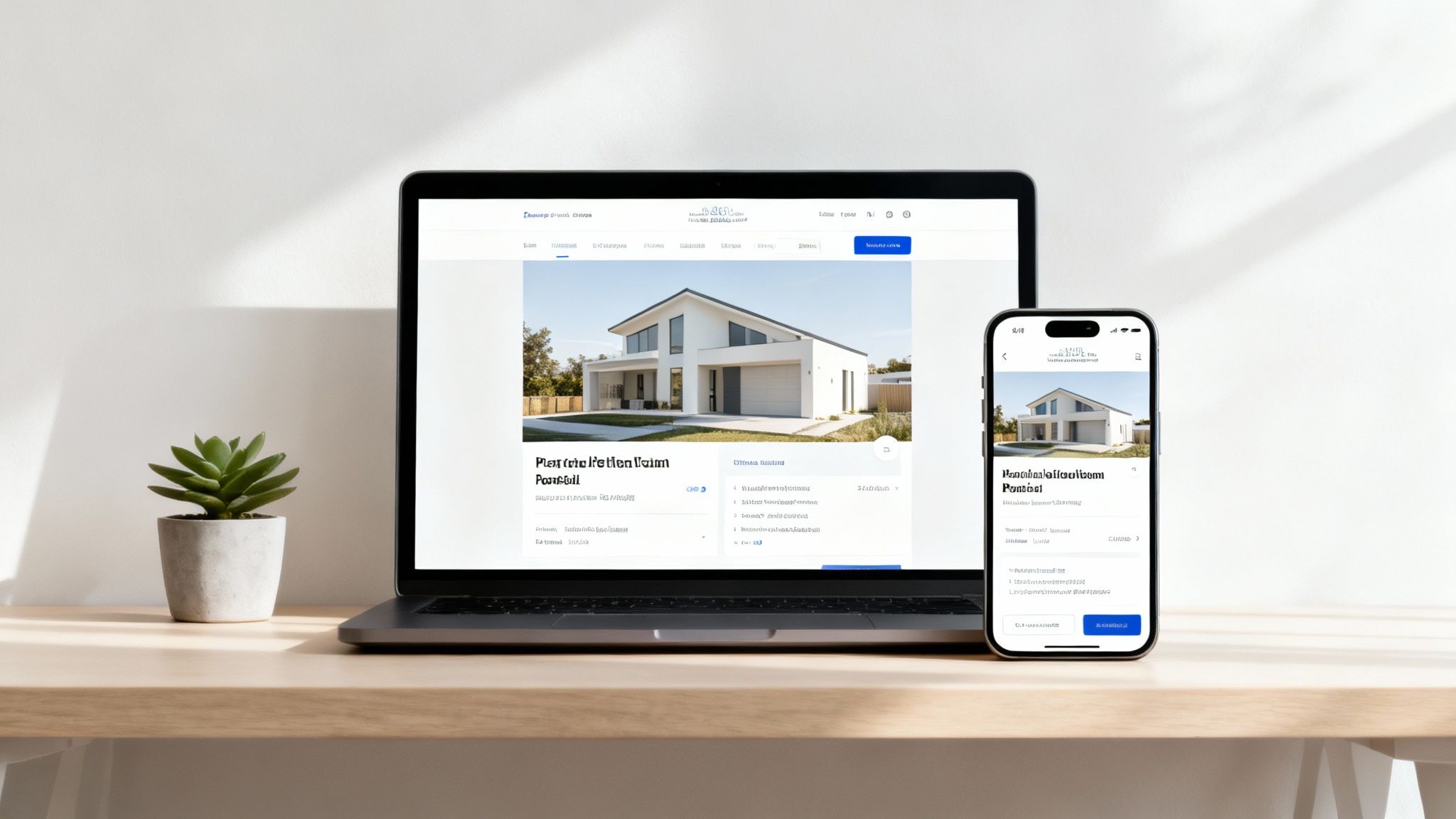
Think of your website as your digital office. Like a physical office, it needs to be welcoming, easy to navigate, and designed to convert casual visitors into serious clients. This is where on-page SEO comes into play.
It’s all about fine-tuning individual web pages to rank higher in search results and attract the right kind of traffic. It covers everything from the words on the page to the technical elements operating behind the scenes.
Imagine your website is a filing cabinet. If documents are thrown in randomly, no one can find what they need. But if every folder is clearly labelled and neatly organised, you can retrieve information in seconds. Good on-page SEO does the same for Google—it tells the search engine exactly what each page is about, making it simple to connect your listings with genuine buyers and sellers.
For real estate agents, this means ensuring every page, from property listings to suburb guides, is a magnet for high-intent clients.
Speaking Your Client’s Language with Keyword Research
Before you can optimise, you need to know the exact words and phrases your ideal clients are typing into Google. This is keyword research, and it is the absolute foundation of any effective SEO for real estate strategy. You’re not guessing; you’re using data to understand what your clients actually want.
Forget broad terms like "houses for sale." You need to think like a local buyer. They use long-tail keywords—longer, more specific phrases—that indicate they are much further along in their property journey.
Here are a few examples of high-intent long-tail keywords:
- "three-bedroom house with garden in Richmond"
- "best real estate agent for units in Parramatta"
- "cost of selling a home in Geelong"
These phrases signal serious intent. Someone searching for them isn’t just browsing; they are seeking specific answers and are far more likely to become a qualified lead.
Optimising Your Website's Core Elements
Once you have your keywords, it’s time to weave them into the fabric of your website. This is how you signal to search engines what each page should be ranking for.
1. Title Tags and Meta Descriptions
Your title tag is the clickable headline that appears in Google search results. It must include your main keyword (ideally near the beginning) and be compelling enough to entice a click. The meta description is the short summary underneath—think of it as a mini-advertisement for that page.
2. Headers (H1, H2, H3)
Headers give your content structure, which benefits both human readers and search engines. Your main page title should always be an H1 tag containing your primary keyword. Use H2s and H3s for subheadings to break up your text and incorporate related keywords.
3. Image Alt Text
Every image on your site, especially property photos, needs descriptive alt text. This text helps visually impaired users understand the image and also tells Google what the picture is about. It’s another perfect opportunity to add relevant keywords, like "modern kitchen in a two-storey Paddington home."
The Critical Role of Mobile Experience and Site Speed
Today, how your website performs on a smartphone is far more important than how it looks on a desktop. This isn't a passing trend; it's a fundamental shift in how people search for property. In fact, more than 75% of homebuyers now begin their property search on a mobile device.
Google is aware of this, which is why it now uses the mobile version of a site for indexing and ranking. A clunky, slow, or difficult-to-use mobile site will directly harm your search rankings. Period. You can find out more about the key elements of modern website design in our detailed article to get this right.
Australians are also increasingly using voice search, with 33% now using it daily—often for local queries like, “best real estate agent near me.” These conversational searches mean your website content needs to answer questions directly and naturally.
A slow website is a deal-breaker. If your listings take more than a few seconds to load, potential clients will hit the back button and go straight to your competitor. Making your site fast and mobile-friendly isn't just a technical task; it’s a fundamental part of providing an excellent client experience.
Creating Content That Attracts and Converts Clients
Having a technically sound website is a great start, but it's only half the battle. To truly succeed with SEO for real estate, you need content that does more than just fill space. It must build trust, answer your clients' burning questions, and cement your reputation as the local property expert.
Think of great content as the engine driving your entire SEO strategy. It gives Google a solid reason to show your site to searchers and provides those searchers with a compelling reason to stay and trust what you have to say.
This is how you transition from being just another agent online to becoming a genuine resource for your community.
Go Beyond Basic Property Listings
Property listings are obviously crucial, but they have a very short lifespan. Once a home is sold, that page loses its value. To build real, lasting authority, you need to create "evergreen" content—material that remains relevant and useful long after a contract is signed.
This is your opportunity to showcase your deep local knowledge. What are the questions you are asked every single day? Those are absolute goldmines for content ideas.
By consistently publishing high-quality, informative content, you build a powerful asset that generates leads long-term. You're not just selling homes; you're providing the expert guidance that helps people make one of the biggest decisions of their lives.
Hyper-Local Content Ideas That Work in Australia
Generic blog posts like "5 tips for buying a home" won't get you very far. Your content needs to be deeply rooted in the suburbs and communities you serve.
Here are a few proven ideas to get you started:
- In-Depth Suburb Profiles: Create a comprehensive guide for each of your key suburbs. Cover everything—the best schools, hidden-gem cafes, parks, public transport options, and the overall neighbourhood vibe. This is invaluable for anyone considering a move to the area.
- Answer Urgent Client Questions: Create blog posts that solve real problems. Think titles like, "How to Prepare Your Sydney Home for Sale in Winter" or "The Biggest Mistakes First-Home Buyers Make in Melbourne."
- Create Local Market Updates: Produce quarterly or bi-annual reports that break down recent sales data, price trends, and your predictions for the local market. This instantly positions you as a data-savvy expert people can rely on.
Beyond optimising your website for search engines, creating compelling content is paramount for attracting and converting real estate clients. For a comprehensive guide on building your brand and attracting leads through valuable content, consider exploring strategies for content marketing for real estate agents.
Diversify Your Content Formats
Written content is the foundation, but don't stop there. People consume information in different ways, and varying your formats can significantly boost engagement. When visitors spend more time on your site, Google interprets that as a very positive signal.
Video is an absolute powerhouse for real estate. A well-produced walkthrough video gives a potential buyer a far better feel for a home than static photos ever could.
Consider adding these powerful formats to your content mix:
- Property Walkthrough Videos: Professional videos showcasing your listings can dramatically increase interest and enquiries.
- Client Testimonial Videos: There is nothing more powerful than social proof. A short clip of a happy client sharing their experience is marketing gold.
- Community Spotlight Videos: Interview a local café owner or showcase a popular community event. This reinforces your connection to the area and shows you are truly part of the neighbourhood.
Ultimately, a strong content strategy transforms your website from a simple business card into a trusted resource. You can explore a detailed roadmap for this in our guide to content marketing for real estate agents. When you provide genuine value, you attract organic traffic, build lasting relationships, and turn casual readers into loyal, high-quality clients.
Building Your Authority with Off-Page SEO

If on-page SEO is how you arrange your shopfront, then off-page SEO is what the rest of the community is saying about you. It’s your digital reputation, built on the trust that other websites place in your business. Think of it as powerful, digital word-of-mouth.
When a reputable website links to yours, it sends a strong signal to Google that you are a credible expert in your field. This is called a backlink, and it is one of the most influential factors in any SEO for real estate strategy.
But here’s the key: not all backlinks are created equal. A single, high-quality link from a respected local source is worth more than a hundred spammy links from irrelevant sites. The goal is to earn genuine votes of confidence, not just collect random links.
Earning Backlinks the Right Way
Forget the outdated, spammy tactics of the past. Today, earning backlinks is about building genuine relationships and providing real value within your community. This approach not only boosts your rankings but also strengthens your brand both online and offline.
For Australian real estate agents, this means getting involved locally and sharing your expertise where it counts.
Here are a few powerful (and ethical) ways to earn high-quality backlinks:
- Sponsor a Local Team or Event: Supporting a local football club, school fete, or community festival is a classic goodwill gesture. It often comes with a link back to your site from theirs, signalling your local commitment to search engines.
- Partner with Local Businesses: Build relationships with complementary businesses like mortgage brokers, conveyancers, or home stylists. You can cross-promote each other with guest blog posts or feature one another as a trusted partner on your websites.
- Become a Source for Local Media: Local journalists and property bloggers are always looking for expert opinions. Reach out and offer your insights on market trends or provide a quote for a story on your suburb. A link from a local news site is pure gold for local SEO.
A strong backlink profile tells search engines that you are not just another website, but a recognised authority in the local property market. It’s the digital equivalent of a trusted referral from a respected community figure.
Why Local Backlinks Matter Most
While a link from a national news outlet is fantastic, for real estate agents, links from websites with a strong local footprint are incredibly valuable. They reinforce your connection to the specific suburbs you serve, telling Google you are a key player in that geographical area.
When a local business directory, community blog, or neighbourhood association links to your website, it solidifies your E-E-A-T (Experience, Expertise, Authoritativeness, and Trustworthiness) right where your clients are.
Ultimately, off-page SEO is about proving your value beyond your own website. By actively participating in your community and sharing your knowledge, you will naturally attract the kind of high-quality backlinks that drive real, long-term ranking improvements and cement your status as the go-to local agent.
What AI Means for the Future of Real Estate SEO
The search landscape is evolving, with AI at the heart of this transformation. For agents engaged in SEO for real estate, this is not a cause for alarm. Instead, view it as an opportunity to work smarter and emphasize what makes you irreplaceable: your genuine, on-the-ground local expertise.
AI tools can be powerful allies. They can handle the heavy lifting of keyword research or brainstorming content ideas, freeing you up to focus on strategy. However, they cannot replicate your firsthand knowledge of a suburb's unique character or the trust you've built with clients over years. The real victory lies in blending AI's efficiency with your authentic human touch.
E-E-A-T in the Age of AI
As AI-generated content becomes more prevalent, Google is placing an even greater emphasis on its E-E-A-T principles—Experience, Expertise, Authoritativeness, and Trustworthiness. Search engines are becoming increasingly adept at identifying generic, soulless content that offers no real value.
This is where you have a significant advantage. You can demonstrate your Experience by creating content that an AI could never produce, showcasing real-world successes and deep local insights.
Google’s focus on E-E-A-T is your cue to fully embrace authenticity. Showcase your successful sales, share glowing client testimonials, and write content that answers the nuanced questions only a seasoned local agent would know. This is how you build unbreakable trust with both search engines and potential clients.
Blending AI Efficiency with Your Human Touch
AI and automation are rapidly reshaping the Australian real estate industry. While traditional search remains vital—Australians aren't abandoning Google anytime soon—they are adding tools like ChatGPT to their research process. Ignoring AI-powered search is no longer an option if you want to remain competitive, especially when a staggering 67% of Australian companies admit they have a skills gap in this area.
To stay ahead, high-quality, locally relevant content backed by genuine client reviews is more crucial than ever.
As AI models continue to influence search results, knowing how to optimize your content for these new systems is paramount. For a deeper dive into this evolving field, check out this guide on LLM SEO and AI Search Ranking. The key is to use AI to generate data-driven ideas and outlines, then inject them with your unique voice, stories, and local knowledge. This hybrid approach ensures your content is not only optimized for modern search but also deeply resonant and trustworthy for your human audience, future-proofing your business.
Common Questions We Hear About SEO for Real Estate
Diving into SEO for real estate can feel like a big step. It’s a seriously powerful strategy, but it’s totally normal to have questions about how it all works on the ground. Here are the clear, no-fluff answers to the queries we hear most often from Aussie agents.
How Much Should I Be Budgeting for SEO?
Look, there’s no magic number here. An SEO budget really depends on how competitive your market is and what your growth goals look like. A small agency in a regional town is playing a different game than one fighting for turf in a hot Sydney suburb.
The best way to think about it is as an investment, not just another business cost. Unlike paid ads that vanish the second you stop paying, good SEO builds a genuine asset—one that keeps generating leads for years to come. A solid starting point is to set aside a consistent monthly budget that covers quality content, technical tune-ups, and building your authority online.
How Long Until I Actually See Results?
SEO is a marathon, not a sprint. While you might notice some early traction within the first few months—like more traffic from your Google Business Profile—the really significant, game-changing results typically take six to twelve months to kick in.
That timeframe gives us the space to get the foundations right:
- Initial Audits and Fixes: First, we need to get under the hood and sort out any technical gremlins on your website.
- Content Development: This is where we create and publish valuable, optimised local content that your ideal clients are actually searching for.
- Authority Building: We work on earning quality backlinks and building that all-important trust with Google.
Patience and consistency are your two best mates in SEO. The momentum you build in that first year starts to compound, delivering a steady stream of qualified, organic leads that makes the initial investment look tiny. Chasing quick fixes almost always ends in disappointment and wasted cash.
How Do I Know If My SEO Is Actually Working?
This is the big one. Measuring your success is critical. While more listings and closed deals are the ultimate prize, you need to track the right leading indicators to know you’re heading in the right direction.
Keep a close eye on these key performance indicators (KPIs):
- Organic Traffic: Are more people finding your site through Google searches? That’s your first win.
- Keyword Rankings: Where are you showing up for key local searches like "real estate agent in [your suburb]"?
- Lead Generation: Are you getting more phone calls, form submissions, and direct enquiries from your website?
- Google Business Profile Insights: Check how many people are finding you via Maps and what they do next (calls, website clicks, direction requests).
By tracking these metrics, you get a clear picture of the return you're getting and can make smart, data-backed decisions to tweak your strategy.
Ready to turn your website into a lead-generating machine that works for you 24/7? Homer Digital Marketing specialises in helping Australian real estate agents dominate their local market with proven SEO strategies. Book a discovery call with us today and let's map out a plan to attract your ideal clients.
