

So, what is marketing automation? Struggling to keep up with every lead and customer? You're not alone. At its heart, marketing automation is about using smart software to handle repetitive marketing jobs, from email campaigns and social media posts to ad management. But it’s much more than a simple scheduler; it’s a proven system for nurturing potential customers with personalised, relevant content at exactly the right time, guiding them on their journey with you. This guide will show you how to make it work.
Unpacking The Role Of Automation In Modern Marketing

Forget seeing marketing automation as just another tool. It's the engine that lets you scale your marketing, work more efficiently, and stop sending generic messages that nobody reads. It’s like having a digital team member working 24/7, running workflows triggered by what your audience actually does.
A huge part of this is automated lead generation, a game-changer for growing businesses. For example, when someone downloads a guide from your website, the system can instantly send a thank-you email, add them to a follow-up sequence, and even ping your sales team. All of this happens automatically, letting you connect with leads while they’re still hot.
How It Works In Practice
The whole system runs on simple "if this, then that" logic. For instance, if a user looks at your pricing page three times this week, then the system can send them an email with a special offer or a convincing case study. This reactive approach makes sure your messages are always on point and arrive at the perfect moment.
To give you a clearer picture, here’s a quick rundown of what marketing automation really does for you.
Quick Reference Marketing Automation Core Concepts
| Core Concept | Primary Function | Business Impact |
|---|---|---|
| Audience Segmentation | Grouping contacts by behaviour, demographics, or engagement. | Delivers highly relevant content, boosting engagement and conversions. |
| Lead Nurturing | Sending automated, personalised follow-ups to guide prospects. | Builds trust and moves leads closer to a sale without manual effort. |
| Lead Scoring | Ranking leads based on their actions to identify sales-readiness. | Helps sales teams focus on the hottest prospects, increasing efficiency. |
| Workflow Automation | Creating "if-then" sequences for tasks like emails and updates. | Saves countless hours and ensures no lead ever falls through the cracks. |
| Performance Analytics | Tracking campaign metrics to see what’s working and what’s not. | Provides clear data to optimise your strategy and prove marketing ROI. |
As you can see, the real power of automation is in managing complex customer journeys without needing a huge team. A good platform lets you handle it all.
By taking these repetitive tasks off your plate, your team can finally step back from the grunt work. Instead, they can focus on big-picture strategy, creative ideas, and actually analysing the data to make smarter decisions. It’s the foundation for growing your business in a way that’s both scalable and sustainable.
Why Automation Is a Priority for Modern Marketers
Marketing automation has gone from a niche tool to an essential part of the modern marketing toolkit. It’s no longer about getting an edge over the competition; it’s about keeping up with a market that expects instant, personal interactions. Businesses are quickly realising that manual efforts just can’t scale to meet these new demands.
This isn't a fleeting trend. It’s a fundamental shift in how marketing gets done. The pressure to achieve more with less—to boost efficiency while delivering hyper-relevant experiences—has made automation a strategic necessity. It's the engine that powers sustainable growth, freeing up teams to focus on strategy instead of getting bogged down in repetitive tasks.
The Driving Forces Behind Automation Adoption
A few key market forces are pushing businesses to put automation at the top of their list. Understanding these drivers makes it clear why it’s become non-negotiable for success.
- The Demand for Personalisation at Scale: Today’s customers expect brands to know them. Automation lets you send tailored content and offers based on actual user behaviour, moving you far beyond generic "batch-and-blast" emails.
- The Need for Greater Marketing Efficiency: With budgets getting tighter, marketing teams need to prove their return on investment (ROI). Automation streamlines workflows, cuts down on human error, and frees up precious time for high-impact planning.
- Rising Consumer Expectations: Buyers now want immediate, relevant engagement. Automation makes sure that the moment a lead shows interest, they get a timely follow-up. This nurtures them through their journey without any awkward delays.
A Clear Shift in Marketing Investment
The strategic importance of automation is showing up in how marketing budgets are being spent across Australia. It has shot up the priority list, becoming a central focus for growth and operational excellence. This isn't just a small tweak; it’s a major strategic pivot.
In fact, a recent report puts this dramatic shift into perspective. In 2025, marketing automation is the top investment priority for Australian marketers, with a massive 58% of respondents naming it their key focus. That’s a huge jump from just 17% in 2023 and 49% in 2024, showing a widespread recognition that scalable delivery is now a core requirement. You can dive deeper into these findings in the full Australian Marketers Benchmarking Report.
This data confirms the question is no longer "what is marketing automation?" Instead, businesses are asking, "How quickly can we get it set up?" The focus has moved from understanding the concept to executing the strategy to stay competitive and give customers what they want.
Exploring Core Features of Automation Platforms
To really get what marketing automation is, you have to look under the bonnet at the features that make these platforms tick. These aren't just glorified email schedulers; they're complex systems built to manage the entire customer lifecycle, from their first look to becoming a loyal fan. Each feature has a specific job, and they all work together to create a powerful marketing engine.
This diagram shows why automation is a top priority for smart businesses, highlighting how it boosts personalisation, drives efficiency, and meets the expectations of today's customers.
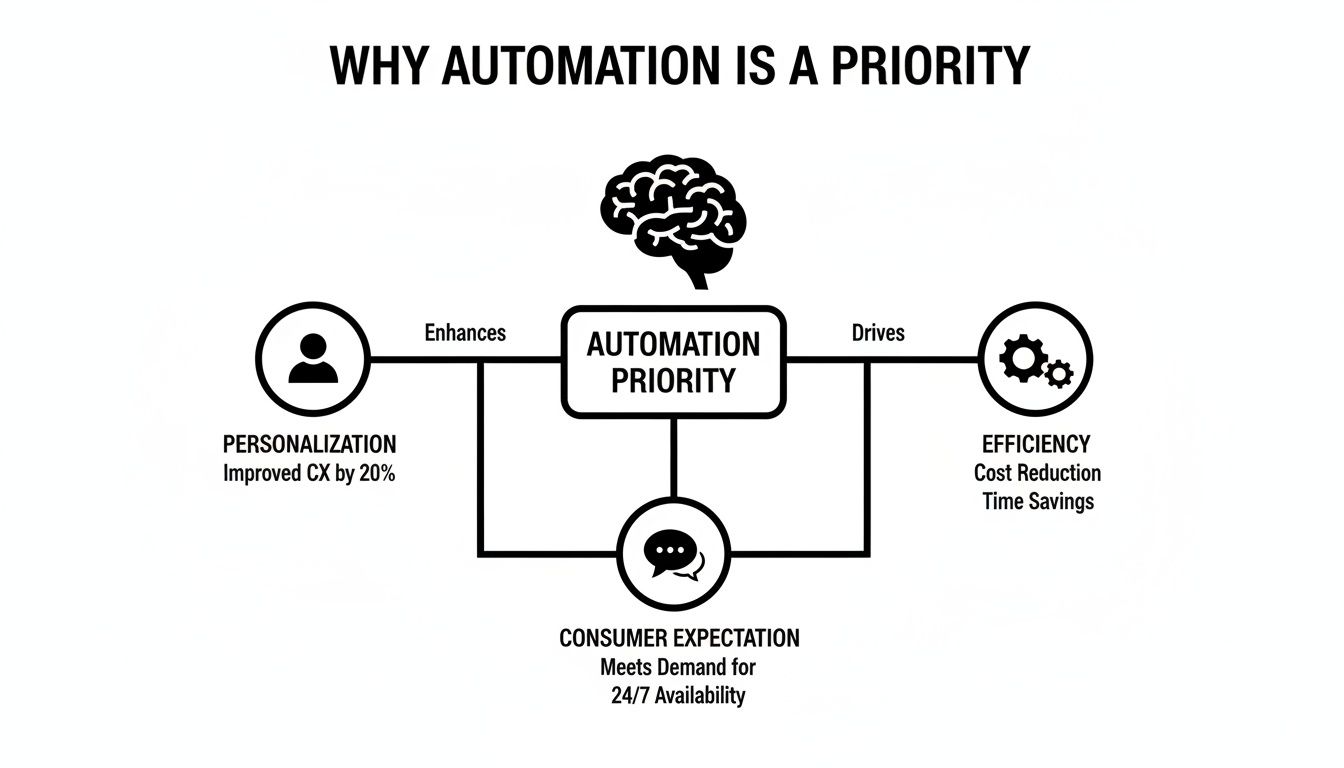
As you can see, it’s the way these elements connect that builds the case for investing in automation. Let's dig into the specific functions that make it all happen.
Automated Email Marketing
While it’s often the first thing people think of, automated email marketing is so much more than just sending newsletters. It’s about creating triggered email sequences, or drip campaigns, that go out automatically based on what a user does or doesn't do. This means your communication is always timely and relevant, without you having to lift a finger.
For instance, a new subscriber could get a welcome series over their first week, introducing them to your brand. Or, if a customer leaves items in their shopping cart, an automated reminder email can pop up in their inbox a few hours later, nudging them to finish the purchase.
Comprehensive Lead Management
Good lead management is the backbone of any marketing automation strategy worth its salt. It’s all about attracting, qualifying, and nurturing potential customers until they’re genuinely ready to talk to your sales team.
Two key parts of this are lead scoring and lead grading.
- Lead Scoring: This is where you automatically assign points to leads based on their actions. Someone might get 5 points for opening an email, 10 points for visiting your pricing page, and 20 points for downloading a whitepaper. Once a lead hits a set score (say, 100 points), they’re flagged as a Marketing Qualified Lead (MQL) and passed over to sales.
- Lead Grading: While scoring tells you how interested a lead is, grading tells you how good a fit they are for your business. Leads get a grade (like A, B, C, or D) based on factors like their industry, company size, or job title. An "A" grade lead with a high score? That’s a hot prospect you need to prioritise.
Dynamic Campaign Management and CRM Integration
Modern automation platforms are the central command for running multi-channel campaigns. You can map out complex workflows that bring together email, social media, SMS, and ads, making sure your message is consistent everywhere your customers are. Understanding what is customer journey mapping is absolutely vital here, as it helps you build campaigns that align perfectly with how people actually buy from you.
Seamless integration with a Customer Relationship Management (CRM) system is completely non-negotiable. This two-way data sync ensures both marketing and sales teams have a complete, real-time view of every lead and customer interaction. It breaks down the old-school data silos and gets everyone on the same page.
Robust Analytics and Reporting
At the end of the day, the ability to measure what you’re doing is what separates strategy from guesswork. Automation platforms give you detailed analytics dashboards that track the metrics that matter across all your campaigns.
You can monitor everything from email open rates and click-throughs to conversion rates and, most importantly, the actual revenue your marketing efforts are generating. This data-first approach lets you see what's working, fix what isn't, and clearly show the return on investment (ROI) to your stakeholders.
The Real-World Payoff: What Marketing Automation Actually Does for Your Business
Sure, streamlining workflows is nice, but the real reason businesses are adopting marketing automation is its direct, measurable impact on the bottom line. This isn't just about being more efficient; it's a strategic move that turns your marketing from a cost centre into a predictable revenue engine.
The benefits are felt right across the business, from boosting team productivity to creating a customer experience that keeps people coming back. By automating the right things, you unlock a level of growth that’s simply impossible to hit with manual effort alone.
More Efficiency, More Productivity
One of the first things you’ll notice is a massive jump in operational efficiency. Marketing teams spend a huge amount of time on repetitive, manual tasks—think sending follow-up emails, posting to social media, or segmenting contact lists.
Automation takes over these jobs, freeing up your team to focus on high-value work like strategy, creative campaigns, and digging into the data. In fact, studies show it can slash the time spent on manual email tasks by as much as 80%. That means your skilled marketers can finally use their expertise where it counts.
When you cut out the repetitive grind, your team can stop being reactive and start being proactive. That shift is the key to scaling your business properly.
Better Lead Nurturing and Higher Conversion Rates
Turning a curious visitor into a paying customer is all about effective lead nurturing, but doing it by hand just doesn't scale. This is where automation really shines, letting you deliver personalised content at exactly the right moments in a buyer's journey.
A good system can automatically send relevant case studies, helpful blog posts, or special offers based on what a lead actually does, like visiting your pricing page or downloading a guide. This consistent, relevant contact keeps your brand top of mind and builds trust over time. It's no surprise that businesses using automation often see a big lift in conversions, with some reporting that automated lead follow-up can boost qualified leads by 30% or more. For a closer look at this, our guide on lead generation and nurturing dives into the details.
This structured approach means no potential customer ever slips through the cracks. It guides them smoothly from initial interest to being genuinely ready to talk to sales.
Finally, Get Marketing and Sales on the Same Page
The disconnect between marketing and sales is a classic business problem. Marketing generates leads, but sales often complains they’re low-quality or not ready for a conversation. Marketing automation is the bridge that connects these two vital departments.
Using features like automated lead scoring, the system can objectively figure out which prospects are most engaged. Once a lead hits a certain score, they are automatically passed to the sales team along with a full history of every interaction they’ve had with your brand.
This data-driven handover gives salespeople powerful context, leading to smarter, more effective conversations. It makes sure your sales team is spending their time on the hottest opportunities, which leads to:
- Higher close rates: Salespeople are talking to genuinely qualified leads.
- Shorter sales cycles: Leads are already warmed up and educated.
- Shared goals: Both teams are working from the same playbook to drive revenue.
This alignment creates one cohesive revenue team, transforming a historically fractured process into a well-oiled machine built for growth.
How AI Is Transforming Marketing Automation

If you think of traditional marketing automation as a reliable engine, then Artificial Intelligence (AI) is the supercharger bolted onto it. The fusion of AI and automation is pushing marketing beyond simple, rule-based workflows and into an era of predictive, self-adjusting strategy.
It's no longer just about sending the right email after someone clicks a link. Now, it's about anticipating what a customer might need before they even know it themselves. AI takes every part of automation and makes it smarter, turning reactive tasks into proactive opportunities.
From Rule-Based to Predictive Marketing
The real magic happens when AI starts to learn. Traditional platforms are brilliant at following "if this, then that" commands, but they can't think outside the rules you give them. AI, on the other hand, crunches massive amounts of data to spot subtle patterns, predict what people will do next, and make smart decisions in real-time.
This shift allows for a level of hyper-personalisation that was once the stuff of science fiction, creating genuinely unique customer journeys at scale.
Here's where it really makes a difference:
- Predictive Lead Scoring: AI doesn't just add up points based on actions. It digs into complex behavioural data and historical trends to pinpoint which leads are actually ready to convert, with far greater accuracy.
- Generative AI for Content: Creating personalised content used to be a painful, manual job. Now, generative AI can whip up email subject lines, body copy, and social posts tailored to different audience segments, driving much higher engagement.
- Dynamic Campaign Optimisation: AI algorithms can watch how a campaign is performing and automatically tweak things like send times, content, or even the channel it's delivered on to get the best results. It ensures your marketing budget is always working as hard as possible.
Australian small marketing businesses are all over this. A huge 91% are already using AI in 2025, and another 6% have plans to jump on board soon. What’s more, 87% of these businesses say AI is important or very important for their daily operations.
AI isn't some future trend—it’s the new standard for building an efficient, proactive, and deeply personal marketing machine.
To get a clearer picture of this shift, let's compare the old way with the new.
Comparing Traditional vs AI-Powered Automation
The table below breaks down exactly how AI upgrades core marketing automation functions, moving them from static rules to dynamic intelligence.
| Functionality | Traditional Automation (Rule-Based) | AI-Powered Automation (Predictive) |
|---|---|---|
| Lead Scoring | Assigns points based on predefined user actions (e.g., +5 for email open). | Analyses thousands of data points to predict conversion likelihood with high accuracy. |
| Personalisation | Uses basic merge tags like [First Name] and segments based on simple criteria. | Creates hyper-personalised content and product recommendations based on predictive behaviour. |
| Email Campaigns | Sends emails based on rigid "if-then" triggers (e.g., cart abandonment). | Optimises send times, subject lines, and content for each individual to maximise engagement. |
| Content Creation | Requires manual creation of all content for every segment and campaign. | Generates tailored copy, headlines, and even images for different audiences automatically. |
| Campaign Optimisation | Relies on manual A/B testing and analysis by a marketer to make improvements. | Continuously self-optimises campaigns in real-time by analysing performance data and making adjustments. |
As you can see, AI doesn't just do the same tasks faster; it changes how the tasks are done, leading to smarter decisions and better outcomes without needing constant human oversight.
For a deeper dive into this integration, you can explore more about AI for marketing automation. By blending intelligent insights with automated execution, businesses can build stronger customer relationships and drive real, sustainable growth.
Your First Steps with Marketing Automation
Jumping into marketing automation can feel like a massive project, but a smart plan makes it surprisingly straightforward. Forget trying to do everything at once. The key is a "crawl-walk-run" approach.
This is all about getting small, early wins that build momentum and prove the value of your investment right from the start.
First up, get crystal clear on what you actually want to achieve. Are you aiming to generate more qualified leads, boost customer retention, or just free up your team's time? Vague goals will only lead to vague results, so define specific, measurable targets before you do anything else.
Define Your Goals and Map the Journey
Before you even think about software, you need a strategy. This starts with understanding exactly how your customers interact with your business. Mapping out the customer journey will shine a light on the key touchpoints where automation can make the biggest difference.
Once you have that map, you can easily spot the best opportunities. Is it a welcome email sequence for new subscribers? Maybe it’s an automated follow-up for abandoned shopping carts? Start with the low-hanging fruit—the tasks that promise the biggest reward for the least amount of effort.
These early successes will build confidence and get everyone on board for more complex projects down the track.
Adopting automation is more than just a tech upgrade; it’s a strategic shift. The whole point is to align your marketing with real customer needs, delivering the right message at exactly the right moment. This customer-first view is the secret to getting it right.
Choose Your Platform and Prepare Your Data
With your goals sorted and your journey mapped out, you can start looking at automation platforms. Find a solution that fits what you need today but also has the power to grow with you tomorrow. You’ll want to consider things like how easy it is to use, how well it connects with your other tools (especially your CRM), and the quality of their support.
Remember, your data is the fuel for your automation engine. Before you launch anything, take the time to clean up and organise your contact lists. That means getting rid of duplicates, fixing errors, and segmenting your audience into logical groups.
Clean data is what makes your automated campaigns accurate, personal, and effective. A big part of this is getting the basics of Electronic Direct Mail right, which you can dive into with our guide on what is EDM marketing.
Launch a Pilot Campaign to Test and Learn
Finally, don't try to automate your entire business overnight. Pick one of those high-impact opportunities you found earlier and launch a small pilot campaign. This kind of controlled test is the perfect way to learn the software and see what actually works with your audience.
Measure everything, get feedback, and use what you learn to improve your approach. This cycle of testing, learning, and refining is how you truly master what marketing automation can do for your business. It turns a huge, scary project into a series of small, manageable steps toward real, scalable growth.
Common Questions About Marketing Automation
When businesses first start looking into marketing automation, a few questions always pop up. Getting straight answers is the best way to cut through the jargon and see how this tech can actually work for you, especially if you're new to the whole idea.
Most of the time, these questions are about the cost, how complicated it is, and whether it’s even right for a business of your size. Let’s clear up the confusion and tackle the big ones.
Is Marketing Automation Just Fancy Email Marketing?
This is a huge misconception, but the answer is a hard no. While smart email campaigns are a big part of it, they’re just one piece of a much larger puzzle.
Think of it this way: basic email marketing is like sending letters. Marketing automation is the entire postal service—sorting, tracking, and all the delivery logistics included.
Automation platforms manage the whole customer journey across different channels, from social media and SMS to what people do on your website. They handle things like lead scoring, audience segmentation, and linking up with your CRM, creating one cohesive system. Email is just one tool in a much bigger toolkit designed to nurture leads from day one all the way to the sale.
Is This Technology Only for Big Companies?
Not anymore. It used to be that only huge companies with massive budgets could afford marketing automation, but that’s completely changed. The market is now full of flexible and affordable options built specifically for small and medium-sized businesses (SMBs).
Many platforms offer tiered pricing, so you can start small and add more features as your business grows. This means even a one-person show can access powerful tools to compete with the big players, automating tasks to save time and drive growth without needing a huge team or budget.
What Is the Typical Pricing Model?
Marketing automation software pricing usually follows a couple of common structures. The most popular is a subscription based on how many contacts you have in your database. This makes sense because the cost scales directly with the size of your audience.
Other models include tiered plans that unlock more advanced features—like predictive analytics or A/B testing—at higher price points. Some providers might also charge based on the number of emails you send each month. It's important to look at these models not just for their upfront cost, but for the potential return on investment (ROI) they can deliver through better efficiency and more conversions.
At Homer Digital Marketing, we build AI-powered marketing systems that help you attract ideal clients and scale your service-based business. Learn how our proven strategies can deliver real results for you.
