

Feeling like you're shouting into the void on LinkedIn? You spend hours crafting the perfect profile, share what you think is great content, but your inbox remains empty. It’s frustrating when you know your ideal clients are on the platform, but you just can't seem to connect with them.
An unoptimized profile and a haphazard strategy are like having a shop with no sign on the door—potential customers scroll right past without a second thought. This is where a proven strategy for LinkedIn lead generation becomes your most powerful asset. This guide provides an actionable blueprint to turn your LinkedIn presence from a passive resume into a predictable lead-generating machine.
Turn Your Profile Into a High-Converting Lead Magnet
Your LinkedIn presence is often the first interaction a potential client has with your brand. Every element, from your headline to your company page, must work together to build trust and scream value. The goal is to make it painfully obvious to your ideal client that you are the exact solution they’ve been searching for.
For businesses, especially in markets like Australia, this isn't just a "nice-to-have." It’s a strategic imperative. LinkedIn absolutely dominates the B2B space, responsible for a staggering 80% of all B2B leads originating from social media. That statistic alone tells you why a passive, set-and-forget approach is a recipe for failure if you want to connect with other companies.
Craft a Benefit-Driven Headline
Your headline is the most valuable real estate on your entire profile. Don't waste it with just a job title like "Marketing Consultant." Flip it around and make it a client-focused value proposition. Ask yourself: "What problem do I solve, and for whom?"
- Before: "Financial Advisor at XYZ Wealth"
- After: "Helping Service-Based Business Owners in Australia Build Generational Wealth Without Complex Jargon"
That small tweak instantly tells the right people you're for them and communicates the tangible outcome they can expect. It stops the scroll and invites them to learn more. For a deeper dive, check out our guide on creating a standout LinkedIn profile that pulls in your ideal clients.
Write a Compelling 'About' Section
The 'About' section is where you drop the corporate mask and connect with people on a human level. Ditch the stiff, third-person narrative. Write in the first person and use storytelling to guide your reader from their problem straight to your solution.
A simple, powerful structure I always recommend is:
- The Hook: Kick off with a question or a bold statement that hits on your ideal client’s biggest headache.
- Empathise: Show them you get it. You understand their challenges and frustrations.
- Introduce the Solution: Briefly touch on your unique approach or how you do things differently.
- Show Credibility: Drop in key results, years of experience, or a notable achievement.
- Call to Action: Finish with a clear next step. Tell them exactly what to do, whether it’s booking a call or visiting your website.
Key Takeaway: Your 'About' section should feel less like a CV and more like the start of a real conversation. It's your chance to build that crucial rapport and trust before you even click "connect."
This flow shows the critical steps to getting your LinkedIn profile set up to convert.
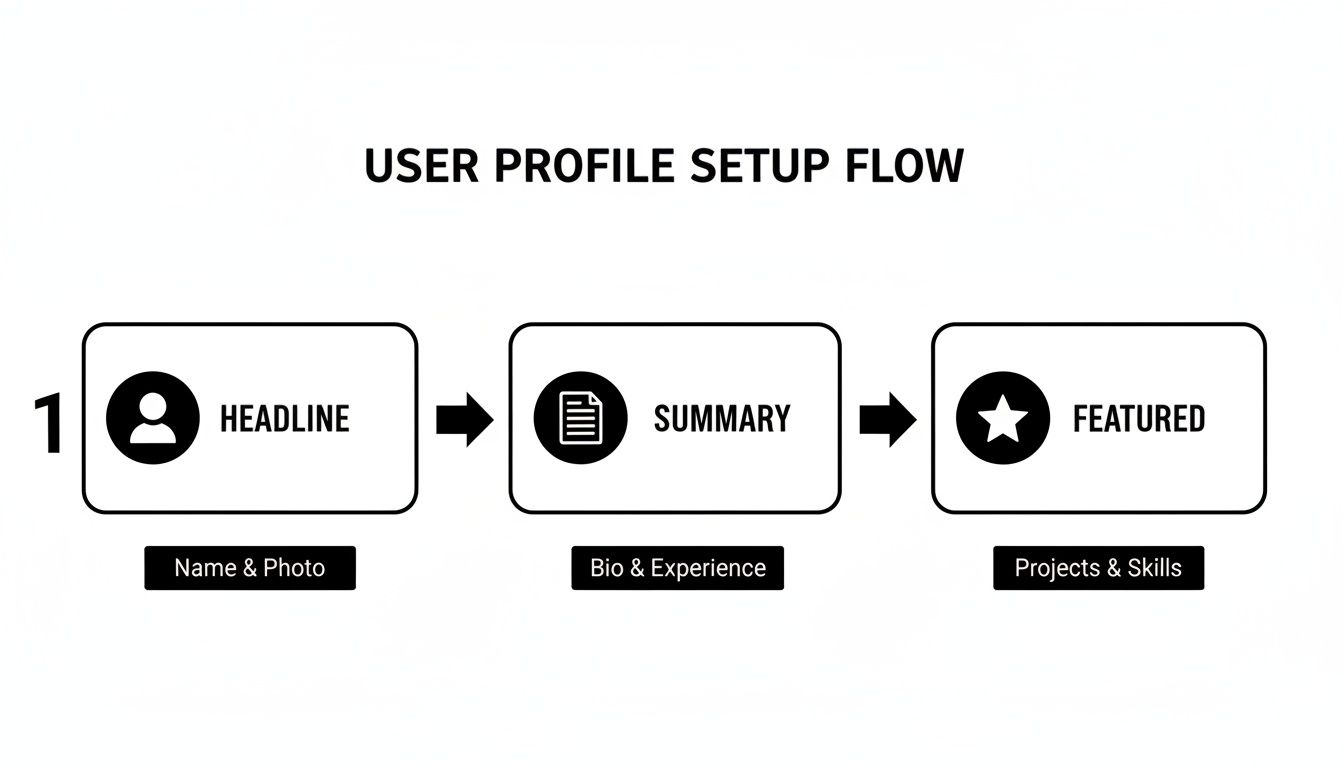
By focusing on a magnetic headline, a story-driven summary, and a strong featured section, you create a smooth journey for potential leads.
Showcase Your Best Work in the Featured Section
Think of the 'Featured' section as your personal portfolio. It’s a visual, interactive way to provide social proof and really show off your expertise. Don't let this prime space go to waste.
Use it to highlight your most valuable assets, like:
- Case Studies: Real stories of how you helped a client get specific, measurable results.
- Testimonials: Short video clips or links to glowing reviews from happy clients.
- Lead Magnets: Free guides, checklists, or webinar recordings that offer genuine value.
- Keynote Speeches or Podcast Interviews: Anything that positions you as an authority in your field.
Of course, a great profile is only half the battle. To ensure it actually generates leads and starts conversations, you need to master prospecting on LinkedIn effectively. It's about combining a powerful profile with smart, proactive outreach. When you get that right, you create a system that consistently brings in high-quality leads.
Developing a Content Strategy That Attracts Buyers
A perfectly optimized profile is your foundation, but a smart content strategy is the engine that actually drives your LinkedIn lead generation. Posting on a whim or without a clear goal is a fast track to being ignored. You need a system that builds your authority, educates your audience, and consistently brings in qualified leads who are ready to talk business.
The opportunity in Australia is massive. Aussies are incredibly active, spending more time on LinkedIn than almost anyone else globally. This high engagement ranks them in the top five countries for Android app usage at 1 hour and 6 minutes per month.
That means your ideal clients are already there, actively scrolling through their feeds. You just need to give them a compelling reason to stop.
The Four Pillars of High-Converting Content
Instead of guessing what to post, it's far more effective to build your content calendar around four strategic pillars. This framework ensures you’re always delivering value, building trust, and gently moving prospects closer to a conversation.
Here's a simple way to structure your thinking and ensure you're covering all the bases.
LinkedIn Content Pillar Framework for Service Businesses
| Content Pillar | Primary Goal | Content Format Examples |
|---|---|---|
| Educational & How-To | Build Authority | – "Here's how to solve X in 5 steps." – Checklist for achieving Y. – Answering a common client question. |
| Behind-the-Scenes | Build Relatability | – A look at your team's process. – A challenge you overcame recently. – Your workspace or "day in the life". |
| Social Proof & Case Studies | Build Credibility | – Client testimonial with specific results. – "Before and after" story of a project. – Screenshot of a happy client's email. |
| Personal Stories & Beliefs | Build Connection | – Sharing your "why" or business mission. – A lesson learned from a past failure. – Your take on a recent industry trend. |
By rotating through these four pillars, you create a balanced feed that educates, connects, and converts without feeling repetitive or overly salesy.
Crafting Posts That Stop the Scroll
With so much noise on the feed, you have to grab attention in the first line. The key is to start with a strong hook that speaks directly to a pain point or sparks curiosity.
Pro Tip: Your first sentence does all the heavy lifting. Don't waste it. Start with a sharp question, a bold statement, or a surprising statistic to immediately hook the reader.
Once you have their attention, keep your paragraphs incredibly short — one to two sentences is perfect. Use formatting to make your content easy to scan.
- Bullet points are great for breaking down complex ideas.
- Numbered lists work perfectly for step-by-step processes.
- Strategic bolding makes your key takeaways impossible to miss.
This approach makes your content digestible, especially for the 70% of users who are browsing LinkedIn on a mobile device. For Australian audiences, engagement tends to peak mid-week, so try scheduling your most valuable posts between Tuesday and Thursday during business hours to boost your reach.
Leveraging LinkedIn's Native Features
To really squeeze the most out of your content, you need to use the tools LinkedIn gives you. The algorithm loves native features because they keep users on the platform longer.
- Carousels (PDFs): These are fantastic for sharing educational content. You can easily turn a blog post, a slide deck, or a short guide into a multi-page visual document that encourages engagement as people click through.
- Polls: Polls are one of the easiest ways to start a conversation and gather valuable feedback from your market. Ask a simple question relevant to your industry and invite people to share their thoughts in the comments.
- Video: Video consistently gets more engagement than static posts. Short, authentic videos shot on your phone often perform better than big-budget productions because they feel more personal and real.
By consistently applying this framework and using native features, you stop being just another connection and start becoming a trusted authority. It's that authority that makes getting noticed on LinkedIn with your content so much easier, turning your feed into a reliable source of inbound leads.
Mastering Outreach That Actually Gets Replies
Great content pulls prospects toward you, but smart, personalized outreach is what turns them into clients. This is where your LinkedIn lead generation efforts go from passive to proactive. It’s all about building relationships, creating campaigns that feel human, and getting replies without ever sounding spammy.
Forget generic templates. Real success on LinkedIn comes from building hyper-targeted lead lists and crafting messages that actually resonate with a real person. The goal isn’t just to connect; it’s to start a genuine conversation that naturally leads to business.
Building a Hyper-Targeted Lead List
The quality of your list dictates the quality of your outreach. Simple as that. Sending the perfect message to the wrong person is just a waste of everyone's time. So first, get crystal clear on who you're trying to reach.
This is where LinkedIn Sales Navigator becomes a non-negotiable. It lets you slice and dice data with filters that the free version of LinkedIn just can’t match. If you're serious about lead generation, it's a must-have investment. To get the most out of it, check out an in-depth guide to using LinkedIn Sales Navigator and unlock its full power.
Here are a few of the most powerful filters I use:
- Recent Job Changes: A new role often means a new budget and a fresh perspective. These are prime prospects.
- Company Growth: A business that's expanding is almost always investing in new services and tools to support that growth.
- Keywords in Profile: Find people who are literally describing the problems you solve right in their profile summary.
- Posted Content: Target prospects who are already talking about topics relevant to your services.
To really zero in on the right people, focus on mastering LinkedIn Advanced Search functions. This level of precision ensures every message you send has the highest possible chance of landing with someone who actually needs your help.
The Art of the Connection Request
Your connection request is your first impression. Don't waste it. Sending the default, blank request is a missed opportunity. A quick, personalized note can dramatically increase your acceptance rate and sets a positive tone right away.
Keep it short, genuine, and make it about them, not you. All you’re doing is opening the door.
Weak request (don't do this):
"Hi Jane, I'd like to connect."
Strong request (do this instead):
"Hi Jane, I saw your recent post on scaling service businesses in Australia – great insights on client retention. Would love to connect and follow your work."
See the difference? The second one shows you’ve paid attention, found common ground, and value what they have to say. It’s a compliment, not a sales pitch.
Crafting a Value-First Messaging Sequence
Once they accept, the real work starts. The single biggest mistake I see people make is jumping straight into a pitch. It’s the fastest way to get ignored, or worse, removed as a connection. Your focus should be on building rapport and providing value first.
Here’s a proven sequence that works.
Message 1: The Thank You & Value Add (Day 1)
- Goal: Acknowledge them and offer something genuinely useful, no strings attached.
- Example: "Thanks for connecting, John. Appreciate it. Given your interest in marketing automation, I thought you might find this recent case study on how we helped a similar consulting firm save 10 hours a week useful. No opt-in required, just a quick read."
Key Insight: Notice there’s no "ask." You're giving before you take. This immediately positions you as a helpful expert, not just another salesperson.
Message 2: Gentle Follow-Up & Engagement (Day 4-5)
- Goal: Re-engage by referencing their content or asking a thoughtful question.
- Example: "Hi John, saw you shared that article on AI in recruitment yesterday. I'm curious, what's the biggest challenge you're seeing your clients face when implementing new tech? I'm hearing a lot about adoption friction."
This moves the conversation forward. It shows you’re still paying attention and invites their professional opinion, making it a collaborative exchange.
Message 3: The Pivot to a Call (Day 7-10)
- Goal: If they've engaged positively, now you can gently suggest a chat.
- Example: "John, your point about adoption friction really resonates. It’s something we've helped a few firms solve recently. If you're open to it, I'd be happy to share what's working for them on a quick 15-minute call next week. No pressure at all."
This approach respects their time and frames the call around their specific problem, not your service. By leading with value, you earn the right to ask for a meeting. It makes your LinkedIn lead generation outreach far more effective and, frankly, a lot more enjoyable.
Scaling Your Efforts with Smart Automation and Ads
Consistent content and manual outreach will get you high-quality leads, but to really grow, you need to scale your LinkedIn lead generation without losing that personal touch. This is where a smart combo of safe automation and targeted ads becomes a game-changer, turning your efforts into a predictable, scalable system.
Manual follow-ups are a massive time-sink and it's easy for things to fall through the cracks. Smart automation tools can handle the repetitive stuff, like sending follow-up messages, freeing you up to focus on real conversations with people who are actually interested.
Using Automation Without Sounding Like a Robot
The secret to good automation is using it for scale, not to fake personalization. Seriously, never automate a connection request or the very first message. That first touchpoint has to be genuine and written for that specific person.
But once you’re connected, tools can definitely streamline your follow-up sequence.
- Custom Fields are a Must: Use placeholders for
{FirstName}and{CompanyName}as a bare minimum. A really effective message will also reference their industry or a pain point specific to their role. - Set Realistic Delays: A machine can fire off a hundred messages in a minute, but a human can't. Set sensible time delays (2-3 days) between follow-ups to mimic a natural conversational pace.
- Monitor and Jump In: The second a prospect replies, all automation must stop. Instantly. That’s your cue to jump into the conversation yourself with a thoughtful, human response. The goal is to let the tool handle the silence, not the conversation itself.
Critical Best Practice: Always choose tools that are cloud-based and designed to mimic human behaviour. This drastically reduces the risk of your account getting flagged by LinkedIn, protecting your most valuable networking asset.
Supercharging Leads with LinkedIn Ads and Lead Gen Forms
While your organic efforts build authority, paid ads give you a predictable, scalable flow of leads. For service-based businesses, the most powerful tool in LinkedIn's ad arsenal is the Lead Gen Form.
These forms are brilliant because they pre-fill a user's contact details straight from their profile. This removes all the friction of sending them off to a separate landing page. It's no surprise that LinkedIn Lead Gen Forms have an average conversion rate of 13% — more than five times higher than the typical 2.35% you see on website landing pages.
Setting Up a High-Converting Campaign
To get the best results from your ad spend, you need a tightly focused campaign built around a compelling offer. Don't just promote your service; offer a high-value lead magnet that solves an immediate problem for your ideal customer.
Here’s a simple way to structure your first campaign:
- Define Your Audience: Get super specific with LinkedIn’s targeting options. Narrow down your audience by job title, industry, company size, and location (e.g., "Business Consultants in Sydney with 1-10 employees").
- Create an Irresistible Offer: Your lead magnet has to be something they actually want. Think checklists, short video guides, industry benchmark reports, or a free tool. The value needs to be high enough for them to happily hand over their contact details.
- Write Compelling Ad Copy: Kick off with a hook that speaks directly to their pain point. Keep the text short and sharp, use bullet points to list the benefits, and finish with a crystal-clear call to action like "Download the Free Guide Now."
By pairing safe automation for your follow-ups with highly targeted LinkedIn Ads, you create a powerful, two-pronged system. This strategy not only fills your pipeline with qualified leads but also gives you the bandwidth to nurture them properly, turning prospects into profitable clients.
How to Measure and Optimize Your Results
Let’s be honest. All the effort you put into polishing your profile, creating content, and sending outreach messages means nothing if you can’t tell what’s actually working. A solid LinkedIn lead generation system isn't built on guesswork; it's built on data.
You can't improve what you don't measure. This is where you switch from just doing the work to strategically refining your entire approach. By keeping an eye on a few key numbers, you’ll quickly spot the bottlenecks in your process and make smart tweaks to get better results, week after week.
Your Essential LinkedIn Metrics Dashboard
Forget getting distracted by vanity metrics like post views or likes. When it comes to lead generation, only a handful of numbers truly matter. These are the metrics that tell the real story of how well you're turning connections into actual conversations.
Here are the core KPIs you need to be tracking. I recommend checking these weekly to stay on top of your performance and make quick, informed decisions.
A simple spreadsheet is all you need to get started. By tracking these key metrics, you can diagnose problems in your LinkedIn funnel and make targeted improvements.
Essential LinkedIn Lead Generation KPIs
| Metric | What It Measures | Good Benchmark |
|---|---|---|
| Connection Acceptance Rate | The percentage of your connection requests that get accepted. This reveals how effective your profile and personalized message are. | 25% – 40%+ |
| Message Reply Rate | The percentage of your first messages (after connecting) that get a response. This measures the strength of your opening pitch. | 15% – 30% |
| Positive Reply Rate | The percentage of replies that are positive or neutral, showing genuine interest. This filters out the "not interested" responses. | 10% – 20% |
| Meetings Booked | The total number of discovery calls or meetings you schedule from LinkedIn each month. This is your ultimate output metric. | 5 – 10+ per month |
If your connection acceptance rate is low, it’s a clear sign you need to rework your profile headline or the copy in your connection request. If you’re getting connections but the reply rate is poor, your follow-up message isn't hitting the mark. This data gives you clear, actionable feedback.
Crucial Insight: Your data tells a story. A low acceptance rate points to a weak first impression. A high acceptance rate but a low reply rate means your profile is great, but your follow-up message is falling flat. Pinpoint the weak link and fix it.
Moving Conversations to Your Sales Pipeline
The goal here isn't to have endless small talk on LinkedIn. It's to move qualified people into your sales process. This transition is the most critical step and it needs a delicate touch.
Once you’ve had a positive back-and-forth exchange, the next move is to suggest a call. The trick is to frame it around their needs, not yours.
Here’s an effective way to make the transition:
"Based on what you've said about [their specific challenge], it sounds very similar to a problem we helped [a similar company] solve. I'd be happy to share what worked for them on a quick 15-minute call. Would you be open to that next week?"
This approach is so effective because it’s not a sales pitch. It’s an offer to share valuable insights, framed as a helpful conversation. By focusing on solving their problem, you make the decision to jump on a call an easy one, successfully turning a LinkedIn connection into a genuine business opportunity.
Common LinkedIn Lead Generation Questions
Even with a killer strategy, questions always pop up when you're in the trenches. Here are the most common ones I get from business owners, with quick, actionable answers to help you stay on track.
How Much Time Should I Realistically Spend on LinkedIn Each Day?
This is the big one, and the answer isn't "as much as you can." It's about being smart and consistent, not just busy. For most service-based business owners, a focused 30-45 minutes a day is the sweet spot.
Here’s how you can break that down for maximum impact:
- 10 Minutes on Engagement: Jump into your feed. Leave thoughtful comments on posts from your ideal prospects and industry peers. One meaningful comment beats a hundred mindless likes, every time.
- 15 Minutes on Outreach: This is your core money-making activity. Send out your personalized connection requests and follow-up messages without distraction.
- 5-10 Minutes on Replies: Keep the momentum going. Reply to new messages and comments on your own content.
- 5 Minutes on Posting: If it’s a content day, get your post live. Stick around for a few minutes to engage with the first comments as they come in.
The key isn't to spend hours scrolling aimlessly. It’s about having a focused, repeatable plan and executing it every single day. Consistency will always beat intensity.
Is Sales Navigator Really Worth the Investment?
Short answer: yes. If you’re serious about generating leads on LinkedIn, Sales Navigator is non-negotiable.
Trying to do targeted outreach with the free version is like trying to find a specific book in a library with no catalog. It’s clunky and the filters are frustratingly limited.
Sales Navigator unlocks incredibly detailed filters. You can build hyper-targeted lists based on triggers like company growth, recent job changes, or specific keywords in someone’s profile. That precision alone is worth the monthly fee because it guarantees you’re only spending your valuable time talking to high-potential prospects.
How Do I Know if My Strategy Is Actually Working?
You need to track the right numbers. Forget vanity metrics like profile views—they don't pay the bills. As we covered earlier, you need to focus on the KPIs that directly impact your bottom line.
Your core metrics are:
- Connection Acceptance Rate: This tells you how strong your profile and connection request are.
- Message Reply Rate: This measures how well your opening messages are landing.
- Meetings Booked: The ultimate measure of success. Did your efforts lead to a real conversation?
Track these numbers weekly in a simple spreadsheet. If one of them is lagging, you know exactly which part of your process needs a tune-up. A low acceptance rate points to a weak headline or connection note. A low reply rate means your follow-up messages aren't hitting the mark. This data-driven approach takes the guesswork out of the equation and lets you constantly improve your system.
Ready to stop guessing and start implementing a predictable lead generation system on LinkedIn? At Homer Digital Marketing, we build proven, AI-powered marketing strategies that attract your ideal clients and scale your service business. Book a discovery call today and let's create a plan that delivers real results.
