

Right, let's get straight to it. You're a small business owner, you're flat out, and you keep hearing about this 'SEO' thing. Feeling like you're trying to solve a Rubik's Cube in the dark? You're not alone. Effective SEO services for small businesses are designed to do one thing brilliantly: get you found by local customers on Google the moment they need what you offer. It's not about tech wizardry; it's about making your business the obvious choice so you can stop relying purely on referrals.
This guide will show you exactly what works, what's a waste of money, and how to pick a partner who won't fleece you.
Your No-Nonsense Guide To Small Business SEO
Let’s be honest, as a small business owner, your plate is already overflowing. You're the CEO, the head of sales, the bookkeeper, and probably the one who unjams the printer. The last thing you need is another complicated acronym to decipher.
But here's the thing about SEO (Search Engine Optimisation): it's the silent sales engine that works for you 24/7, even when you’re asleep.
Think of it this way. When a potential customer in your suburb needs a plumber, an accountant, or a massage therapist, what's the first thing they do? They pull out their phone and type it into Google. SEO is the art and science of making sure your business shows up right at that moment of need.
Of course, before diving in, you need to know where you stand. A critical first step is understanding a comprehensive website audit for peak performance. This uncovers any hidden technical issues that could be holding you back without you even realising it.
The Core Components That Actually Matter
For a local, service-based business, a solid SEO strategy isn't about chasing a million different keywords. It's about dominating your local patch. The key is focusing on what moves the needle for businesses like yours.
For example, local SEO is responsible for driving 28% of total search traffic for Australian small businesses. That traffic also converts at three times the rate of general organic searches. It’s a massive opportunity.
Here’s a quick overview of the essential services that form the foundation of any good small business SEO plan.
Core SEO Services For Small Businesses At A Glance
This table breaks down the key components into simple terms, so you can see exactly what each one does and why it’s so important for attracting local customers.
| SEO Component | What It Is In Simple Terms | Why It Matters For Your Business |
|---|---|---|
| Local SEO | Making you visible on Google Maps and in "near me" searches. | Connects you with customers in your immediate service area who are ready to buy. |
| On-Page SEO | Optimising your website's pages with the right words and structure. | Tells Google exactly what you do and where you do it, helping you rank for relevant services. |
| Google Business Profile | Your free business listing on Google that shows your hours, reviews, and location. | The single most powerful tool for local visibility. We have a great guide on optimising your Google Business Profile. |
| Technical SEO | Ensuring your website is fast, secure, and mobile-friendly. | A slow or broken site frustrates users and gets penalised by Google, making you invisible. |
| Link Building | Getting other reputable local websites to link back to your site. | Acts like a vote of confidence, boosting your website's authority and credibility. |
Each of these elements works together. You can't just do one and expect magic to happen; a strong, visible local presence relies on getting all these fundamentals right.
Decoding The Different Types Of SEO Services
Alright, so you’ve decided to get serious about SEO. You ask for a few quotes, and suddenly your inbox is flooded with terms like "on-page," "off-page," "technical," and "local." It feels less like marketing and more like you’re trying to assemble flat-pack furniture with instructions written in another language.
Don’t stress. At its core, SEO is just a few key disciplines working together. Understanding them is the difference between nodding along cluelessly and making a smart investment in your business's growth.
Let's break down the main types of SEO services so you know exactly what you're paying for.
This visual shows the three pillars of a solid SEO foundation.
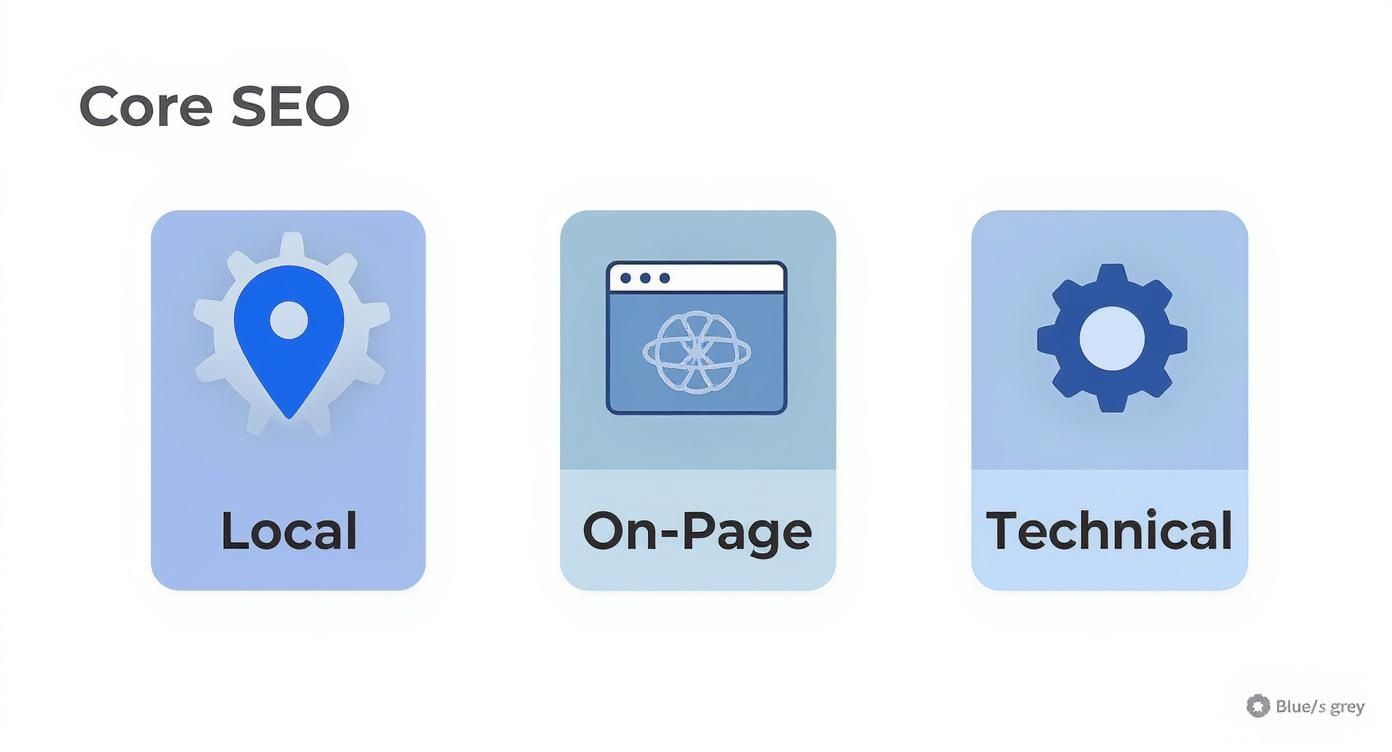
As you can see, a winning strategy relies on mastering your local presence, optimising your website's content, and ensuring the technical engine is running smoothly.
Local SEO: Getting Found Around The Corner
For most service-based businesses, this is the big one. It’s all about showing up when someone in your neighbourhood searches "plumber near me" or "best coffee in Richmond." It’s about winning your own backyard.
Local SEO is the difference between being invisible and being the first business someone calls. For many small businesses, local SEO services are paramount, connecting them with customers right on their doorstep and tapping into a crucial market segment.
Core activities include:
- Google Business Profile (GBP) Optimisation: This is your digital shopfront. A well-managed GBP with plenty of positive reviews, regular posts, and accurate info is non-negotiable.
- Local Citations: This just means getting your business name, address, and phone number (NAP) listed consistently across relevant online directories.
- Localised Content: Creating content that speaks directly to your service area, like blog posts titled "Choosing the Right Builder in the Sutherland Shire."
On-Page SEO: Speaking Google’s Language
If your website is your digital employee, on-page SEO is the training you give it to be brilliant at its job. It involves structuring your website’s content so that Google can easily understand what each page is about and who it’s for.
This includes optimising:
- Page Titles and Meta Descriptions: The first thing people see in search results.
- Headers (H1, H2, etc.): This is how you organise your content logically for both readers and search engines.
- Keyword Integration: Naturally weaving in the terms your customers are actually searching for.
- Internal Linking: Connecting your pages to guide users and search engines through your site.
It might sound complicated, but there are plenty of resources to get you started. In fact, checking out some of the best free SEO tools can give you a massive head start on understanding your on-page performance.
Technical SEO: Lifting The Bonnet
Technical SEO is everything happening behind the scenes to make sure your website is healthy, fast, and easy for search engines to crawl. A site can look beautiful, but if it’s a technical mess, it’s like a Ferrari with a lawnmower engine—it’s not going to win any races.
It was this kind of gritty, under-the-hood work that got my first commercial cleaning business off the ground. I was out there at 1 am cleaning toilets, doing the unglamorous work nobody sees, just to get the business from $2k to $8k a month. Technical SEO is the digital equivalent of that—it’s the foundational work that makes all the shiny stuff possible.
Key Takeaway: You can have the best content in the world, but if Google can't find, crawl, and index it properly due to technical issues, you're invisible.
This covers things like site speed, mobile-friendliness, site security (HTTPS), and a clean site structure. You don't need to be a coding genius, but your SEO provider absolutely needs to be on top of this.
Ultimately, these aren't separate, competing services; they're interconnected parts of one engine. Great local SEO needs solid on-page content, and both are useless without a technically sound website.
How Much You Should Really Pay For SEO
Alright, let's get straight to it: the money talk. When you start looking into SEO services for small businesses, the quotes can feel all over the place. You'll see offers from $300 a month right up to $3,000 a month, and it’s completely baffling trying to figure out what’s fair.
Here’s the honest truth. SEO isn’t a one-off expense; it's an investment in a long-term business asset. The price is a direct reflection of the expertise, the hours involved, and the depth of the strategy you're actually getting.
Think of it like building a house. You could hire a cheap handyman who cuts corners and uses dodgy materials, or you can bring in a master builder who lays a solid foundation designed to last for decades. SEO is exactly the same. A rock-bottom price usually means you're paying for shortcuts—like spammy links or rubbish AI content—that will get you penalised by Google down the track.
Deconstructing SEO Pricing Models
Before you can work out what you should be paying, you need to understand how agencies charge. There are three common models you’ll come across.
-
Monthly Retainer: This is the most popular option. You pay a set fee each month for a bundle of ongoing services, which usually includes content, technical checks, link building, and reporting. It’s the best model for a sustainable, long-term growth plan.
-
Project-Based Fee: This is for a specific, one-time job with a clear start and finish. Think of a deep-dive website audit, a full local SEO setup, or getting you out of a Google penalty. The price is fixed upfront based on the scope of work.
-
Hourly Consulting: Here, you pay an hourly rate for strategic advice or specific tasks. It works well if you have an in-house team that just needs some expert guidance, but it's not a scalable way to run a full SEO campaign.
What To Expect At Different Price Points In Australia
So, what's a realistic budget for a small service business in Australia? Let’s break it down. And be warned: anything below this first tier is almost certainly a red flag.
Key Insight: "Affordable" SEO isn't about finding the cheapest price. It’s about getting the absolute best return on every dollar by investing in high-impact activities that drive real visibility and leads, not just fluff metrics.
-
$500 – $1,000 per month (The "Getting Started" Tier): At this price, you're getting the basics. This will likely cover Google Business Profile management, some on-page tweaks for your main service pages, and simple reporting. It’s a foot in the door, but it won’t include deep strategy or much content creation.
-
$1,000 – $2,500 per month (The "Growth" Tier): This is the sweet spot for most serious small businesses. This budget allows for a proper strategy that includes consistent, high-quality content (like blog posts), local link building, ongoing technical SEO, and reporting that tracks what actually matters—calls and enquiries.
-
$2,500+ per month (The "Dominator" Tier): If you're in a highly competitive industry or service area, this level of investment funds a much more aggressive strategy. This can include more content, a dedicated outreach campaign for link building, and a granular, data-led approach to winning market share.
These numbers aren't just pulled out of thin air. The amount Australian small businesses are investing in SEO is growing because it delivers results. New data shows the average small business in Australia spends about $1,350 per month on SEO, with the industry projected to hit $1.5 billion in 2025. You can read the full research about these Australian SEO spending trends to see why it’s fast becoming a non-negotiable part of the marketing budget.
Ultimately, you get what you pay for. Investing wisely in a proper SEO strategy is the difference between spinning your wheels and building a predictable lead-generation machine that fuels your business for years to come.
How To Choose The Right SEO Partner
Choosing the right SEO partner can feel like trying to find a good mechanic. You know you need one, but you're terrified of getting ripped off by someone who speaks a different language and charges a fortune for a "blinker fluid" top-up. Finding trustworthy SEO services for small businesses is genuinely the hardest part of the whole game.

This process is personal for me. I’ll never forget the early days of my commercial cleaning business. Every single dollar was earned through sheer grit, so I couldn't afford to waste a cent on marketing that didn't deliver. That's why you need to arm yourself with the right questions. Think of this as your shield against the cowboys and your compass to find a true growth partner.
Your Vetting Checklist: The Critical Questions
Before you sign any contract, you need to turn the tables and interview them. A good SEO provider will welcome these questions; a dodgy one will squirm.
Here are the non-negotiables to ask any potential agency:
- "Can you show me a case study from a similar business in my industry?" Vague promises are worthless. You need to see proof they’ve successfully ranked a business like yours. If they can't show you relevant results, that's a massive red flag.
- "What does your monthly report look like?" Ask for a sample report. If it's filled with fluffy "vanity metrics" like impressions or clicks, run away. You want to see business-focused metrics like phone calls, contact form submissions, and keyword rankings for terms that actually drive sales.
- "How do you define success for your clients?" Their answer should be about your bottom line, not just search rankings. A great partner will talk about lead quality, conversion rates, and return on investment.
- "What's your approach to link building?" This is a big one. Ask them to explain their strategy. If they mention "bulk links," "link packages," or can't give you a clear answer, they're likely using spammy tactics that will get your site penalised.
Key Takeaway: A trustworthy SEO partner will be transparent about their process, focus on metrics that matter to your business goals, and have a proven track record of helping businesses like yours succeed.
How to Scrutinise Case Studies Like a Pro
Anyone can slap a logo on a slide and call it a case study. Your job is to dig deeper. When they present their "wins," don't just nod along—ask clarifying questions.
Look for these key elements:
- The Starting Point: Where was the client before they started? What were their rankings, traffic, and lead numbers? Without a baseline, the "after" picture is meaningless.
- The Specific Strategy: What did the agency actually do? Did they focus on local SEO, content, technical fixes? A good case study details the specific actions taken to achieve the result.
- The Tangible Results: Look for real numbers. "We increased traffic" is vague. "We increased organic traffic by 150% in six months, leading to a 40% increase in qualified phone enquiries" is proof.
Red Flags That Scream 'Run for the Hills'
Some promises sound too good to be true because they are. SEO is a long-term strategy, and anyone selling instant magic is selling you a lemon.
Watch out for these classic red flags:
- "Guaranteed #1 Rankings": No one can guarantee this, not even Google employees. It’s the oldest trick in the book and a clear sign of a dodgy operator.
- Proprietary "Secret Sauce": A good agency is an open book. If they refuse to explain their methods because they're "proprietary," it's often code for spammy tactics they don't want you to see.
- Locked-in 12-Month Contracts: While SEO takes time, a reputable provider will be confident enough in their work to offer some flexibility, often with a 3-month or 6-month initial term. Long, rigid contracts can be a way to lock you in regardless of performance.
Choosing a partner is a massive decision. But armed with this checklist, you’re no longer a sitting duck. You’re an informed business owner ready to find someone who will genuinely champion your growth.
Go on, put them to the test. You've got this.
Realistic Timelines For SEO Success
Let's get one thing straight about SEO: it demands patience. So many small business owners get tripped up here, expecting a flood of new customers overnight. If Google isn't sending you leads by Friday, it's easy to think you've been sold a lemon.

Here’s the reality: SEO is a marathon, not a sprint. It’s about building a long-term, sustainable asset for your business, not chasing the quick high of a paid ad. Understanding this from the start is key to avoiding frustration and seeing the powerful, compounding return on your investment.
The First Three Months: The Foundation
The first 90 days are all about laying the groundwork. This is the unglamorous, behind-the-scenes stuff that sets you up for future wins. Think of it like pouring the concrete slab before you start building the house.
During this initial phase, the focus is on:
- Technical Fixes: Your SEO partner will be deep in the weeds of your website, fixing crawl errors, improving site speed, and making sure Google actually wants to send its users there.
- Keyword Research & Strategy: Pinpointing the exact search terms your ideal customers are typing into Google to find services like yours.
- On-Page Optimisation: Rewriting page titles, meta descriptions, and beefing up your service pages so they clearly communicate what you do to both users and search engines.
You probably won't see a huge jump in leads just yet. The key performance indicators (KPIs) to watch here are improvements in your site's technical health and maybe some early ranking movement for less competitive keywords.
Months Four To Six: Gaining Momentum
By the six-month mark, the seeds you planted should start to sprout. With the foundational work done, the focus now shifts to building authority and creating genuinely helpful content.
This is where you’ll start seeing real, tangible progress:
- Improved Keyword Rankings: You should see more of your target keywords climbing onto the first few pages of Google's search results.
- Organic Traffic Growth: Your website analytics should show a noticeable and steady increase in visitors coming from search engines.
- First Page Visibility: Some of your more specific, long-tail keywords might even hit page one, bringing in those first few organic enquiries.
Months Seven To Twelve: The Compounding Effect
This is where the magic really starts to happen. From month seven onwards, all your previous efforts begin to compound. Your content has had time to mature, your links are building your site's authority, and Google starts to see you as a credible, trustworthy player in your local market.
In this phase, the KPIs shift towards tangible business results:
- Consistent Lead Flow: You should be getting a predictable number of phone calls and contact form submissions from your website each month.
- High-Value Keyword Rankings: You’ll now be in the running for more competitive, high-traffic keywords that your competitors are all fighting for.
- Increased Conversion Rates: As your traffic quality improves, so should the percentage of visitors who actually take action and contact you.
Good things take time. Don't pull the plug after two months because you're not swimming in cash yet. Stick with a solid strategy, and you’ll build an asset that pays you back for years to come.
If you’re keen to get a head start, check out our guide on how to improve your Google rankings.
A Few Common Questions About Small Business SEO
Still got a couple of questions rattling around? You’re not the only one. When it comes to SEO services for small businesses, there’s a fair bit to get your head around.
Here are the most common queries I get from business owners, answered straight up—no fluff, no jargon.
Can I Do My Own SEO for My Small Business?
You absolutely can, but be warned: it’s a massive commitment. Getting the basics of on-page SEO right and managing your Google Business Profile are brilliant places to start, and you can definitely make some progress on your own.
But the deeper you go, the more time and specialist knowledge it demands. Things like technical SEO, building quality links, and creating a steady pipeline of strategic content are huge time-sinks. Most business owners quickly find their time is better spent running the business, leaving the SEO heavy lifting to a specialist who lives and breathes this stuff daily.
How Long Does SEO Actually Take to Show Results?
In the world of SEO, patience really is a virtue. You can often spot some early movement in your rankings and a small trickle of traffic within 3-4 months, especially if you're targeting less competitive local keywords.
But for the kind of results that really drive your business—like a steady, predictable stream of good leads—you should realistically plan for at least 6-12 months of consistent, focused work. Anyone promising you a spot on page one in a week is selling you a fantasy.
Is SEO Better Than Paying for Google Ads?
Ah, the classic question! The truth is, they’re different tools for different jobs, and they actually work brilliantly together. Google Ads gets you instant visibility at the top of the search page, which is fantastic for a quick boost, but you have to pay for every single click. The second you turn off the spend, your traffic disappears.
SEO, on the other hand, builds a long-term, organic asset for your business. The traffic you earn is essentially "free," and it builds on itself over time, creating a solid foundation. A smart strategy often uses ads for quick wins while the SEO work builds your sustainable, long-term growth engine. It’s not an either/or; it’s a "yes, and" situation.
What’s the Most Important Part of Local SEO?
If I had to pick just one thing, it’s your Google Business Profile (GBP). Hands down. For a local service business, it’s the absolute epicentre of your online presence—your digital shopfront on Google Search and Maps.
A fully optimised, active GBP with a tonne of great reviews, regular posts, and meticulously accurate information is the cornerstone of local search success. It's the lowest-hanging fruit with the highest possible impact.
And if you’re feeling a bit lost in the sea of Google-speak, you might find my weekly emails helpful. Subscribe to my LinkedIn Newsletter — weekly systems, stories & strategy. https://homerdigitalmarketing.com/lm/newsletters
Now stop reading and go get famous in your postcode.
