

At its core, SEO for law firms is about one thing: being the first answer someone finds when they're searching for legal help online. It's the whole process of getting your firm’s website to show up on the first page of Google, right when potential clients are actively looking for a lawyer. The goal isn't just traffic; it's about attracting high-quality leads—like individuals searching "emergency child custody lawyer near me"—and cementing your firm’s reputation as the authority in your practice area. This guide provides an actionable roadmap to achieve just that.
Building Your Law Firm's SEO Foundation
Think of your website as your digital office. Before you can expect a steady stream of the right clients to walk through the door, you need to build a solid foundation that both Google and your visitors can trust. A winning SEO for law firm strategy isn't just about stuffing keywords onto a page. It's about creating a logical, user-friendly experience that guides people from a broad legal question straight to your specific expertise.
Get this foundation right, and every other SEO effort you make becomes exponentially more powerful. Skip it, and you're building on sand.
Architecting a Logical Site Structure
Your website’s structure is its blueprint. A clean, well-organised site doesn't just help visitors find what they need; it helps search engines understand exactly what you do and how your different services relate to each other. For law firms, one of the most effective models is the "silo" structure.
Imagine your main practice areas—Family Law, Commercial Litigation, Estate Planning—as individual filing cabinets.
- Top-Level "Pillar" Pages: These are your main practice area pages (e.g.,
yourfirm.com.au/family-law). Each one needs to be a comprehensive hub covering that entire area of law. - Supporting "Cluster" Content: These are the specific sub-topics or blog posts that live inside that filing cabinet. For example, under your "Family Law" pillar, you'd have pages on "divorce proceedings," "child custody disputes," and "binding financial agreements." Each of these links back up to the main pillar page.
This approach signals to Google that you have real depth and expertise in a specific niche, which is exactly what builds topical authority.
Mastering On-Page Optimisation
On-page SEO is where you refine the details on each individual page to make it crystal clear to search engines what that page is about. This is where your keyword research meets the real world, ensuring every single page is perfectly tuned to attract its ideal audience.
A well-optimised page doesn't just rank better; it converts better. A sharp, compelling title gets the click from Google, and well-structured content keeps that potential client engaged once they land on your site.
This simple flowchart breaks down the foundational process into three key stages: structure, on-page optimisation, and building trust.
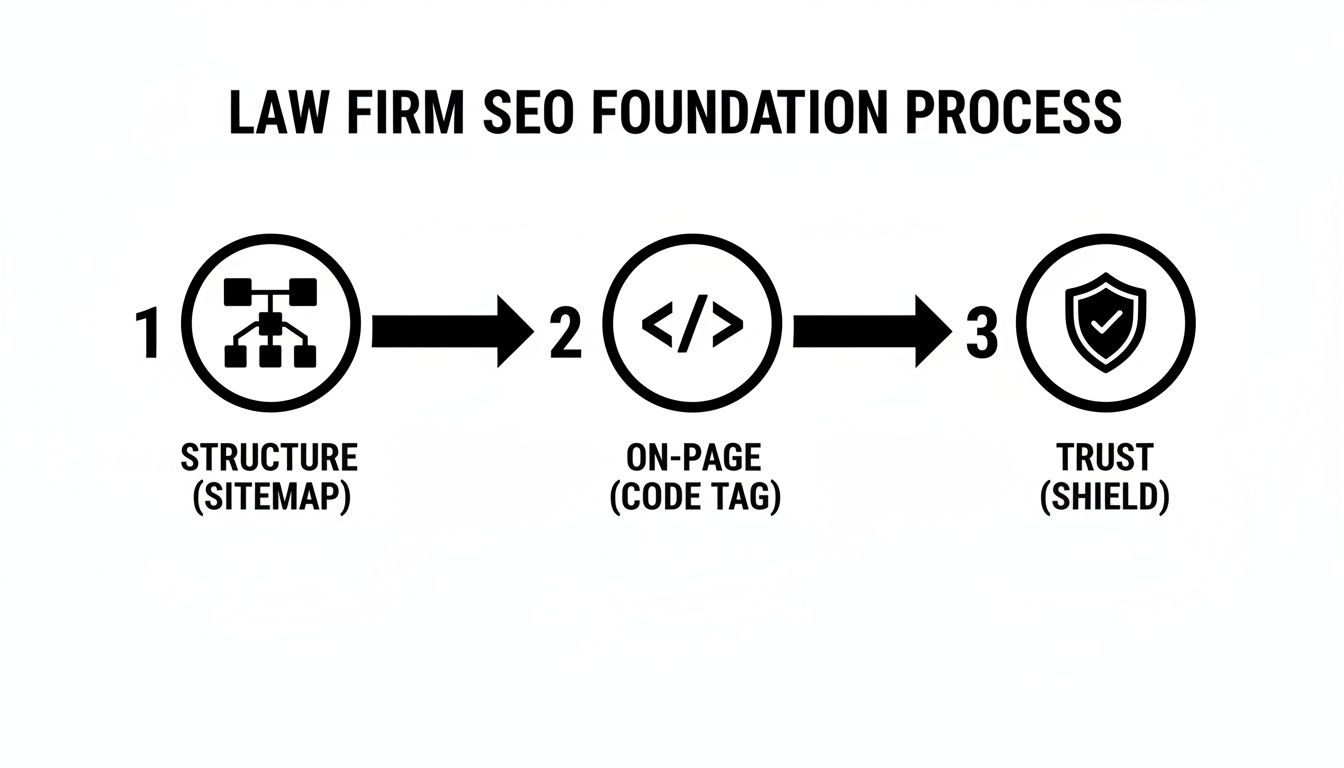
It all starts with a logical site structure, followed by optimising the on-page elements, with the ultimate goal of establishing your firm's trustworthiness online.
Here are the key on-page elements you need to nail:
- Title Tags: This is your headline in the search results. Keep it under 65 characters and lead with your primary keyword (e.g., "Expert Family Lawyers in Sydney | Smith & Co").
- Meta Descriptions: The short blurb underneath the title. While not a direct ranking factor, a great description (under 160 characters) acts like an ad and massively improves your click-through rate.
- Header Tags (H1, H2, H3): Use one H1 for your main page title. Then, use H2s and H3s to break up your content into logical sections, working in keyword variations naturally.
- URL Structure: Keep your URLs clean and descriptive.
yourfirm.com.au/family-law/child-custodyis far better thanyourfirm.com.au/page-id=123.
If you want to go deeper on establishing your firm's authority, check out this complete guide to SEO legal marketing for law firms. It gives great context on how these foundational pieces fit into a broader, client-winning strategy.
Dominating Local Search with Google Business Profile
For most law firms, the fight for new clients is won or lost on a local map. A polished website is essential, but your single most powerful tool for attracting people in your area is your Google Business Profile (GBP). This is your digital front door on Google Search and Maps, and getting it right is a non-negotiable part of modern SEO for law firms.
Think about it from a potential client's perspective. When they search "family lawyer near me," Google’s job is to show them the most relevant and trustworthy options nearby. A complete, active, and well-reviewed GBP is the strongest signal you can send that your firm is the right choice. It’s often the very first interaction someone has with your brand.

The opportunity here is massive. Australia's SEO industry is booming, with spending projected to hit $1.5 billion in 2025. A huge slice of that is aimed squarely at local search, where a staggering 47% of Google's top ten organic results are local business websites. For law firms, this means serious lead generation potential. An analysis of over 13 million Australian keywords in 2024 showed the first search result gets a click-through rate of 29.5%.
Beyond The Basics of GBP Optimisation
Just claiming your profile and walking away isn’t enough. You need to treat it like a dynamic, living part of your marketing. This means going way beyond just listing your name and address and actively using its features to build trust and show you know your stuff.
A fully optimised profile comes down to meticulous detail. Every single field should be filled out with accurate, keyword-rich information that perfectly reflects your practice areas and service locations. This includes choosing the most precise categories for your firm (e.g., "Family Law Attorney" and "Divorce Lawyer" instead of just the generic "Lawyer").
To really nail your GBP, you need to complete every relevant section with care. This table breaks down the essentials.
Key Elements for Google Business Profile Optimisation
| GBP Element | Optimisation Tactic | Why It Matters |
|---|---|---|
| Business Name | Use your exact, registered business name. No extra keywords. | Builds brand recognition and trust. Keyword stuffing here is a penalty risk. |
| Categories | Select a primary category (e.g., "Family Law Attorney") and relevant secondary ones. | This is the #1 factor for telling Google what you do and who to show your profile to. |
| Service Area | Define the specific suburbs or cities you serve. | Critical for "near me" searches, ensuring you appear for relevant local queries. |
| Services | List every specific legal service you offer, with detailed descriptions. | Informs both users and Google about your expertise, helping you rank for long-tail keywords. |
| Photos & Videos | Add high-quality, recent photos of your team, office, and branding. | Humanises your firm, builds immediate trust, and increases engagement. |
| Google Posts | Regularly share updates, blog links, or event information. | Keeps your profile active, which Google loves. It's a free way to promote your content. |
| Q&A Section | Proactively add and answer common client questions. | Addresses potential client concerns upfront and lets you control the narrative. |
Getting these elements right transforms your GBP from a simple listing into a powerful client-acquisition tool.
Proactively Engaging Potential Clients
One of the most overlooked features of GBP is the Questions & Answers section. Don't sit around waiting for people to ask things; seed this section yourself with the questions you hear every day.
By proactively answering questions like "Do you offer a free initial consultation?" or "What documents do I need for my first meeting?", you address client concerns before they even have to ask, showcasing your expertise and controlling the conversation.
Here are a few more advanced tactics to turn your GBP into a client-generation machine:
- Consistent Google Posts: Use Google Posts to share firm news, link to new articles on your blog, or promote free guides. Think of it as a mini-blog right on your search listing that keeps your profile fresh.
- Detailed Service Listings: Don't just list "Family Law." Break it down in the "Services" section. Create entries for Divorce, Child Custody, Property Settlements, and Binding Financial Agreements, each with its own detailed description.
- High-Quality Photos & Videos: Regularly upload professional photos of your office (inside and out), your team, and even short video introductions from your solicitors. This makes your firm feel approachable and builds instant trust.
The Critical Role of NAP Consistency and Citations
Google rewards consistency. Your firm's Name, Address, and Phone number (NAP) must be identical everywhere it appears online—on your website, your GBP, and every directory you're listed in. Even a tiny difference, like "St." versus "Street," can confuse search engines and weaken your local authority.
This consistency is the foundation of citations—mentions of your firm's NAP on other websites. Getting listed in reputable Australian legal directories (like your state's Law Society directory) and key local business directories acts as a powerful vote of confidence. Each consistent citation confirms your location and legitimacy, helping to cement your position in local search results. For a deep dive, this ultimate guide to creating and optimizing Google Business Profiles for lawyers is an excellent resource.
Finding Keywords That Attract High-Value Clients
Good SEO for law firms isn't about getting thousands of random visitors; it's a game of precision. You don't want people looking for free advice. You want a targeted stream of potential clients with a serious legal problem, ready to pick up the phone and hire a solicitor. This all comes down to focusing on high-intent keywords—the exact phrases people type into Google when their need is urgent and real.
The difference is subtle but absolutely critical. Someone searching "what is a binding financial agreement" is just kicking tyres in the research phase. But the person searching "binding financial agreement Perth" is actively looking for a local professional to help them. Your job is to show up for that second search.
Moving Beyond Broad Keywords
Trying to rank for a vague, broad term like "lawyer" is a fool's errand. It’s nearly impossible to rank for, and even if you did, it would attract a completely mixed bag of low-quality traffic. The smart money is on long-tail keywords that reveal a user's specific problem and, crucially, their location. These are longer, more descriptive phrases that might have lower search volumes but convert at a much, much higher rate.
Think about how a real person in a bind would search:
- Instead of "car accident lawyer," they’ll search for something like "compensation lawyer for car accident Sydney."
- Instead of "business law," they’re more likely to type "commercial lease dispute lawyer Melbourne."
- Instead of just "will," a motivated person might search "how to contest a will in Queensland."
These long-tail variations are a clear signal that the user is past the information-gathering stage and is now looking for someone to solve their problem.
Uncovering High-Intent Keywords
So, how do you find these gold nuggets? It starts with a simple brainstorm of your core services. Then, you layer on what we call "intent modifiers"—words that signal a user is ready to make a move.
Common High-Intent Modifiers:
- Location-Based: "Sydney," "near me," "in Melbourne"
- Service-Specific: "lawyer for," "solicitor for," "attorney for"
- Urgency/Action: "emergency," "help," "advice," "consultation"
When you combine these, you create powerful, high-converting phrases. A family law practice, for instance, could target "emergency child custody lawyer Brisbane" to connect with clients who have an immediate, critical need.
The real secret to effective keyword research for law firms is empathy. Put yourself in the shoes of a potential client at 2 AM. What specific words would they use to describe their urgent legal problem?
In the hyper-competitive Australian legal market, getting this right pays dividends. Law firms that secure a spot on Google's first page for high-intent keywords can attribute up to 60% of their leads directly to their website. Take 'personal injury lawyer Sydney'—this keyword cluster gets over 3,600 searches every month, with a Google Ads cost-per-click of a staggering $84.88 AUD. Ranking organically for terms like this isn't just a marketing win; it's a massive financial advantage.
Using SEO Tools for Deeper Insights
While brainstorming is a great starting point, professional tools give you the hard data you need to make informed decisions. Platforms like SEMrush and Ahrefs let you see exactly what keywords your competitors rank for, uncover related search terms, and analyse search volume and difficulty.
Don't feel like you need to shell out for expensive tools right away. There are plenty of powerful free options to get you started. If you're working with a tight budget, you can explore some of the best free SEO tools available to uncover keywords and track your progress without a big investment.
One of the most effective tactics is running a competitor keyword gap analysis. This is where you use a tool to compare the keywords your site ranks for against the keywords your top three competitors are ranking for. The goal is to find valuable, relevant keywords they're getting traffic from that you're missing out on entirely. It’s often the quickest way to find proven, high-intent keywords for your practice areas and strategically capture market share.
Creating Authoritative Content and Building Ethical Links
In the world of SEO for law firms, your website’s content is your digital expert witness. It’s what you present to both potential clients and search engines to prove you know your stuff. At the same time, ethical links from other reputable websites act like credible character references, telling Google that others in the legal community vouch for you.
When these two elements work together—powerful content and a strong backlink profile—your firm doesn't just show up in search results; it starts to dominate them.
Developing Content That Answers Urgent Questions
Let's be blunt: your potential clients aren’t Googling generic legal definitions. They’re searching for answers to urgent, often stressful, problems. Your content needs to meet them right there, in that moment of need. The goal is to become the go-to resource they trust before they even think about hiring a solicitor.
A great way to start is by creating in-depth content pillars for each of your main practice areas.
- Practice Area Guides: Go way beyond a simple service description. Create a comprehensive guide on "Family Law in NSW" or a "Complete Guide to Commercial Leases in Victoria." These pages should answer every fundamental question a potential client might have.
- FAQ Pages: You know those top 10-15 questions you hear from every new client? Compile them and create a dedicated FAQ page for each service. This is gold for both your audience and for targeting those specific, long-tail keywords.
- In-Depth Blog Posts: Get hyper-specific. Instead of a generic post on "Car Accident Claims," write an article titled, "What to Do If You're in a Car Accident with an Uninsured Driver in Perth."
The most effective legal content doesn't just state the law; it explains the implications and provides clear, actionable next steps. It shows empathy and expertise, turning a worried searcher into an informed potential client.
This focus on creating genuinely helpful resources is the core of any modern strategy. In fact, many successful campaigns are built on well-structured content marketing for agencies that focuses on building authority through pure value.
The Art of Ethical Link Building
While brilliant content is your foundation, link building is what signals to Google that your content is worth paying attention to. But be warned, not all links are created equal. Buying links or using spammy tactics is a fast track to a Google penalty. The only sustainable approach is earning high-quality, relevant backlinks from trusted sources.
Think of this process as less about technical wizardry and more about digital public relations. It's about building real relationships and creating assets that other organisations actually want to reference.
Proven Link Building Strategies for Law Firms
- Legal Associations and Directories: First things first, make sure your firm is listed in all relevant state and national legal directories. These are high-authority, highly relevant links that Google absolutely expects to see.
- Local Community Engagement: Sponsoring a local charity fun run, hosting a free legal info session, or offering a scholarship can often lead to natural links from local news outlets, community groups, and universities.
- Guest Contributions: Offer to write an article for a reputable industry journal or a local business publication. For example, a commercial litigation lawyer could write a piece on "Avoiding Contract Disputes" for a local Chamber of Commerce blog. It positions you as an expert and gets you a valuable link.
- Resource Link Building: Create something genuinely useful that isn't a sales pitch, like a "Small Business Legal Compliance Checklist." Then, reach out to business associations and blogs that serve that audience and let them know about your free resource.
Building links this way is a slow burn, not an overnight fix. But each high-quality link you earn is a powerful vote of confidence that solidifies your website's authority, drives valuable referral traffic, and significantly boosts your search rankings over time.
Future-Proofing Your SEO for AI and Compliance
The digital marketing rulebook is being rewritten in real-time. What worked to attract clients last year is already becoming outdated, and your law firm's SEO strategy needs to evolve just to keep up.
It’s no longer just about ranking in a list of blue links. Now, it's about making sure your firm’s expertise shows up in AI-generated summaries and conversational search results—all while navigating Australia's strict legal advertising regulations. This is how you build a strategy that’s not just effective today, but resilient for tomorrow.

Optimising for AI-Powered Search
The way potential clients find legal help is changing fast. Instead of digging through pages of search results, they're now asking AI chatbots direct, conversational questions. This shift demands a whole new layer of optimisation.
The reality is that by 2025, a game-changing 35% of Australians are expected to use AI assistants for initial legal research before they even think about contacting a lawyer. Queries like ‘How do I contest a Will in Victoria?’ now spit out AI-summarised answers, completely bypassing the traditional results page. You can read more about this shift in legal SEO trends in Australia.
To get your content featured in these AI-driven answers, you have to structure it to directly address these specific, natural-language questions.
- Answer Questions Directly: Use clear headings (H2s, H3s) that frame the exact questions your clients are asking. Right underneath, give a short, sharp answer before you dive into the details.
- Use Natural Language: Ditch the rigid, formal legal jargon. AI models are trained on human conversation, so writing in a more conversational tone makes your content far more likely to get picked up and featured.
- Leverage Structured Data: Get Schema markup implemented on your website. It’s a bit of code that tells search engines exactly what your content is about, making it much easier for them to pull your firm’s info for rich snippets and AI summaries.
Navigating the Compliance Tightrope
An ambitious SEO for law firm campaign is non-negotiable, but it absolutely must operate within the strict ethical boundaries of legal advertising in Australia. Get this wrong, and you could face serious repercussions that undermine the very trust you’re trying to build.
Every state and territory has its own set of rules, usually governed by its Law Society or Legal Practice Board. These rules often crack down on unsubstantiated claims, the use of testimonials, or advertising "no win, no fee" arrangements without crystal-clear conditions.
Your marketing needs to be powerful without being misleading. The goal is to demonstrate expertise and attract clients ethically, ensuring every single claim on your website is verifiable, professional, and compliant.
Building a Compliant Yet Powerful SEO Strategy
Staying compliant doesn't mean your marketing has to be timid. It just means you have to be strategic and completely transparent.
Key Compliance Checkpoints:
- Review All Claims: Go through your website with a fine-tooth comb and hunt down any superlatives like "best," "leading," or "expert." Unless you can back these up with objective proof (like official industry awards), swap them out for more descriptive language about your firm's experience and unique approach.
- Handle Testimonials with Care: While client reviews on third-party sites like Google are gold, be extremely careful about how you display testimonials directly on your website. Make sure they aren't misleading and strictly follow your jurisdiction's rules.
- Be Clear About Costs: If you mention fee structures like "no win, no fee," you are legally required to clearly and prominently state all the conditions. This includes any liability for disbursements or other costs. There's no room for ambiguity here.
By baking these compliance checks into your regular SEO audits, you build a digital presence that not only attracts high-value clients but also reinforces your firm’s reputation for integrity. This is what truly future-proofs your firm against both algorithm updates and regulatory scrutiny.
Frequently Asked Questions About SEO for Law Firms
Even with a solid plan, it’s natural to have questions about how SEO actually works for a law firm in the real world. Here are the answers to the queries we hear most often from solicitors, designed to give you clarity and confidence.
How Long Does SEO Take to Show Results for a Law Firm?
Let’s be direct: SEO is a long-game, not an overnight win. For a competitive field like law in Australia, you can expect to see the first signs of positive movement in rankings and traffic within 3 to 6 months of consistent, focused effort.
Actually securing those valuable first-page spots for high-intent keywords—think 'family lawyer Sydney' or 'commercial litigation Melbourne'—often takes closer to 6 to 12 months. The timeline really depends on a few key factors.
- Practice Area Competition: It's a different ball game trying to rank for personal injury law in a major city versus a niche practice like intellectual property in a smaller town.
- Website Authority: A brand-new website is starting from scratch and will naturally take longer to build trust with Google than an established firm with some history.
- Content Quality: The depth, expertise, and consistency of your content are huge signals to Google that you're an authority worth ranking.
Patience is key. The real goal here is to build sustainable, long-term growth that delivers a steady stream of quality client enquiries, not just a fleeting spike in traffic.
Can I Do My Law Firm's SEO Myself or Should I Hire an Agency?
While you could technically do your own SEO if you have a huge amount of time to learn the ropes, the sheer complexity of legal marketing makes it impractical for most busy solicitors. The reality is, most successful firms find that partnering with a specialist agency is a much smarter use of their resources.
An expert agency brings proven systems, deep industry knowledge, and dedicated resources to the table. This allows you to focus on practicing law while they focus on growing your client base through strategic digital marketing.
A good agency already understands the nuances of keyword research for different practice areas, the technical demands of site architecture, and the critical ethical guidelines for legal advertising. This expertise doesn't just get you results faster; it helps you sidestep costly mistakes that could set your firm back months. Ultimately, the right partnership frees you up to do what you do best: serving your clients.
What Is the Single Most Important Part of SEO for a Law Firm?
If we had to boil it down to one thing, Local SEO provides the biggest and most immediate impact for the vast majority of law firms. Why? Because nearly all of your potential clients are looking for legal help right in their local area.
Mastering your Google Business Profile, generating a steady flow of positive client reviews, and creating content that speaks to your specific location will capture the highest-intent clients—the ones who are ready to pick up the phone. A strong local foundation isn’t just part of the strategy; it’s the cornerstone. It ensures that when someone in your community needs a solicitor, your firm is the first one they find.
Ready to stop being invisible online and start attracting the high-value clients you deserve? At Homer Digital Marketing, we build powerful, compliant SEO strategies that establish your authority and drive measurable growth for your firm.
Book a no-obligation strategy session with us today to see how we can help.
