

Are you pouring money into ads and SEO only to watch potential clients click away from your website without a trace? You're not alone. Many service businesses struggle to turn website traffic into tangible leads. The problem often isn't getting visitors—it's convincing them to act. This is where conversion rate optimisation services come in, offering a structured way to make your existing traffic work harder for you.
Instead of just chasing more visitors, CRO focuses on perfecting the user journey to turn more of your current browsers into genuine, qualified leads.
Understanding Conversion Rate Optimisation Services
Conversion Rate Optimisation (CRO) is the systematic process of increasing the percentage of website visitors who take a desired action. A "conversion" is simply any valuable action you want a visitor to complete. Think of it this way: SEO and advertising get people to your digital front door, but CRO is the art and science of welcoming them inside and guiding them to become a client.
For businesses that sell services, a conversion isn't always a direct purchase. It’s any meaningful step that moves a potential client closer to you.
What’s a Conversion for a Service Business?
- Booking a Consultation: A financial advisor optimising their calendar page to get more initial meetings booked.
- Requesting a Quote: A web design agency tweaking its project form to encourage more quote requests.
- Filling an Enquiry Form: A local tradesperson simplifying their contact page to drive up job enquiries.
- Downloading a Resource: A marketing consultant offering a free e-book to capture high-quality email leads.
CRO services dig into user behaviour to find the "friction points"—all those little (and big) roadblocks that cause people to leave your site. A confusing menu, a form that’s too long, or a slow-loading page can all send potential clients running. By fixing these issues, you create a smoother, more persuasive experience that guides people toward conversion.
Given the average website conversion rate hovers around a tiny 2.35%, even small, smart improvements can make a huge difference to your bottom line.
Key CRO Concepts at a Glance
To truly grasp what CRO is all about, it helps to know the lingo. Here’s a quick rundown of the core ideas you’ll encounter.
| Concept | Definition | Example for a Service Business |
|---|---|---|
| Conversion Rate | The percentage of visitors who complete a desired goal. | The percentage of website visitors who fill out your "Request a Free Quote" form. |
| A/B Testing | Comparing two versions of a webpage to see which one performs better. | Testing two different headlines on your homepage to see which one results in more clicks to your services page. |
| User Experience (UX) | The overall experience a person has when interacting with your website. | Ensuring your site is easy to navigate on a mobile phone, so potential clients can book a call without frustration. |
| Call-to-Action (CTA) | A prompt on a website that tells the user to take some specified action. | A button that says "Book Your Discovery Call Now". |
These concepts are the building blocks of any effective optimisation strategy, helping to turn guesswork into a clear, data-backed plan.
The Core Pillars of CRO
Effective CRO isn’t about throwing random ideas at the wall and hoping something sticks. It’s a data-driven process built on three key pillars that work together to deliver real, measurable results. And because so much of CRO revolves around messaging and value, it’s deeply connected to your overall content strategy. To get that right, you need to understand the essential content marketing best practices.
This methodical approach ensures every change is based on solid evidence of what your audience actually wants and needs, paving the way for sustainable, long-term growth. We’ll break down each of these pillars in more detail throughout this guide, showing you how they come together to create a powerful client-generating machine.
The Business Impact and ROI of CRO
Investing in conversion rate optimisation isn't just another marketing expense—it's a direct investment in your bottom line. The real power of CRO is that it makes all your existing marketing efforts work harder. It’s about turning the traffic you already have into genuine business growth.
Even tiny improvements in your conversion rate can lead to huge jumps in revenue. For a service business, lifting your conversion rate from 1% to just 1.5% is a massive 50% increase in qualified leads from the exact same amount of website traffic. That alone makes CRO one of the most profitable marketing activities you can undertake.
Lower Costs and Higher Value Clients
One of the first things you'll notice with a solid CRO strategy is a drop in your Customer Acquisition Cost (CAC). By converting more of the visitors you've already paid to attract through ads or SEO, you spend less to get each new client. This directly boosts your profit margins without increasing your marketing budget.
CRO also provides incredible insights into what your clients actually want. When you understand their motivations and pain points, you can refine your messaging and user experience to attract and retain higher-value clients. This doesn't just improve conversions; it sets you up for a much higher Customer Lifetime Value (CLV).
By optimising the user journey, you don't just get more clients—you get better clients. These are people who truly understand your value from the start, leading to stronger and more profitable long-term relationships.
The Strategic Value of Data
Beyond the immediate financial wins, conversion rate optimisation services provide an asset that’s arguably even more valuable: actionable data. Every test you run, whether it wins or loses, teaches you something crucial about your audience.
- Understand what motivates them: Find out which headlines, images, and offers truly resonate.
- Identify friction points: Pinpoint exactly where potential clients are dropping off in your sales funnel and why.
- Inform your entire strategy: Use what you learn to make smarter decisions everywhere, from your ad copy to your email campaigns.
This feedback loop turns your website into a powerful research tool, helping you build a more client-centric business. While it can feel complex, getting a grip on marketing ROI is a foundational first step. You can read our guide on why it is sometimes difficult to measure marketing ROI for a deeper perspective.
Ultimately, CRO puts your business in a position for sustainable, scalable growth by ensuring every decision is backed by evidence, not guesswork.
The Proven CRO Process Step by Step
Working with a conversion rate optimisation services provider isn't about guesswork or making random changes to your website. It’s a methodical, scientific process designed to deliver real, measurable improvements by understanding exactly how your users behave and, more importantly, why.
Think of it as a continuous cycle of discovery, testing, and refinement that builds on itself over time. Each insight feeds the next step, creating a flywheel of growth.
This visual breaks down how a structured CRO process delivers tangible business benefits, moving from lower costs to a much deeper understanding of your customers.
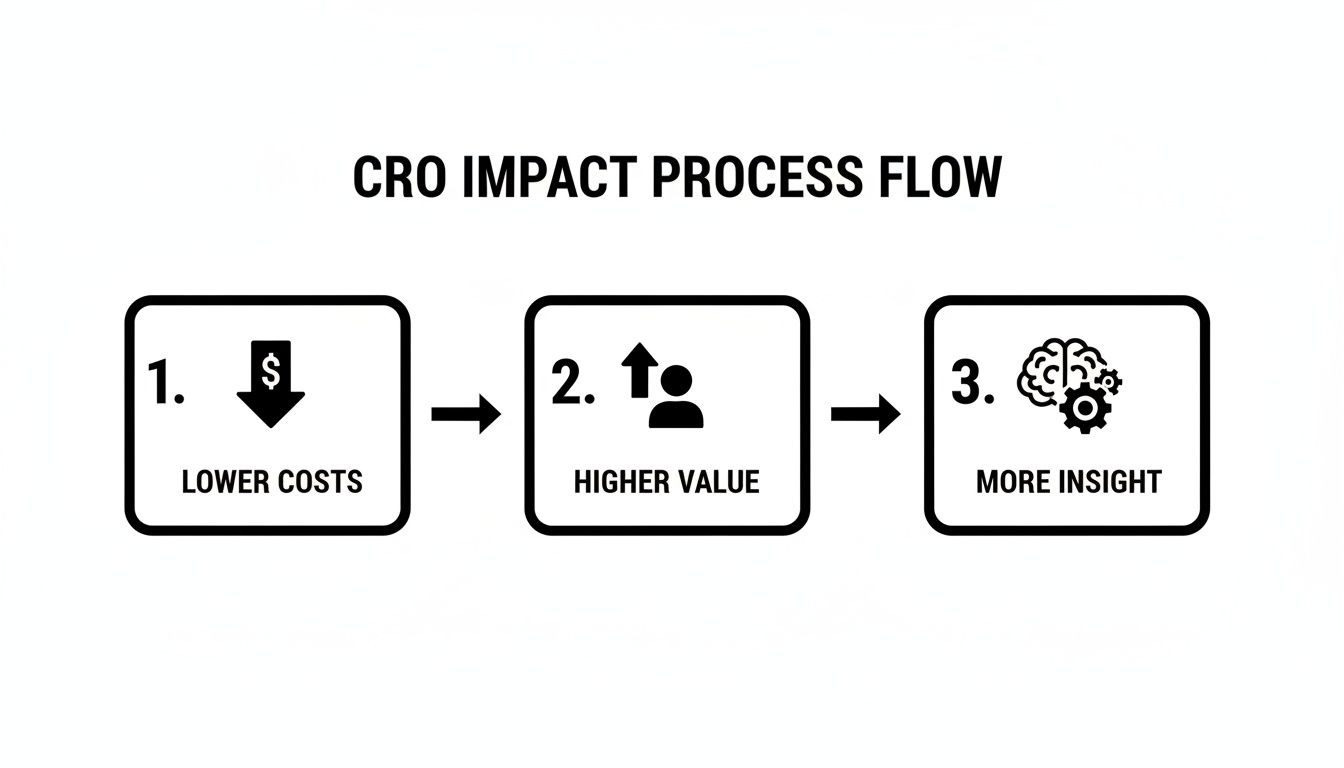
The key takeaway? True optimisation is a cycle. It systematically lowers your client acquisition costs while simultaneously boosting the value you get from each one.
Phase 1: Data Analysis and CRO Audit
The journey always kicks off with a deep dive into your existing data. A thorough CRO audit analyses your website analytics to pinpoint exactly where potential clients are dropping off. This is quantitative research—answering the crucial "what" and "where" questions.
Experts will analyse key metrics like bounce rates on your most important pages, exit rates at different stages of your enquiry form, and how performance differs across devices. The goal is to find the biggest leaks in your conversion funnel, creating a data-backed foundation for everything that follows.
Phase 2: Qualitative User Research
Once the data shows us what's happening, the next job is to figure out why. This is where qualitative research comes into play, using tools that reveal the human experience behind the numbers.
- Heatmaps: These show where users are clicking, moving their cursors, and how far they scroll down a page. It's a brilliant way to see what grabs their attention and what gets completely ignored.
- Session Recordings: Watching anonymised recordings of real user sessions gives you a direct window into how people navigate your site, where they get stuck, and what’s causing frustration.
- User Surveys and Polls: Sometimes, the best way to get an answer is to just ask. Directly polling visitors can uncover objections or missing information that analytics would never show you.
This phase is all about developing real empathy for your users. It helps map their journey and get inside their heads. You can learn more about this by reading up on what customer journey mapping is and how it works.
Phase 3: Hypothesis and A/B Testing
Armed with a clear picture of the problems, the CRO team develops data-backed hypotheses. A good hypothesis is a clear, testable statement. For example: "By simplifying the enquiry form from ten fields to five, we will increase form submissions by 20% because it reduces user effort."
That hypothesis is then put to the test using A/B testing (or split testing). The original page (the control) is run against a new version (the variation), splitting traffic between the two. The results are tracked to see which one performs better, ensuring every change is based on hard evidence, not just a hunch.
Phase 4: Implementation and Continuous Optimisation
When a test produces a clear winner with enough data to be statistically significant, the successful changes are rolled out to the live website. But the work doesn't stop there. CRO is an ongoing cycle of improvement.
Insights from one test fuel the ideas for the next, creating a powerful loop of continuous optimisation. This iterative approach is where the real, long-term value comes from. To dig deeper into the nuts and bolts, check out this practical guide on increasing website conversion rate, which covers everything from audits to optimisation.
What You Actually Get and How You’ll Pay For It
When you engage a conversion rate optimisation service, you need clarity on two things: what you’re actually getting for your money, and how the billing works. A good CRO partner won’t just give you vague promises; they’ll provide tangible reports and roadmaps that show you exactly what’s happening and why it’s a smart investment.
Getting clear on these points from the start helps you sort through proposals and find a provider that genuinely fits your business. Let’s break down what you should expect to see and the pricing models you’ll come across.
What You Should Expect to Receive
The whole point of CRO is to get clear, data-driven insights into how your website is performing and a practical roadmap to make it better. While the exact documents might vary between agencies, you should expect to receive a combination of these:
- Detailed Audit Reports: This is a deep dive into your website’s current state. It pinpoints friction points, identifies where you’re losing customers, and highlights the biggest opportunities for quick wins and long-term growth.
- User Research Findings: This is the "why" behind your user behaviour. Think summaries of heatmap data, session recordings, and survey results that explain user actions in plain English.
- A/B Test Plans and Results: Structured documents that outline the hypothesis for each test, the different versions being tested, the metrics being measured, and a full breakdown of the results—whether the test won, lost, or was inconclusive.
- Performance Dashboards: Forget complicated spreadsheets. You should get a customised, easy-to-read dashboard that tracks the metrics that matter most, showing you the direct impact of the CRO work on your conversions over time.
These deliverables keep the entire process transparent and make it easy to see the value you're getting.
Common CRO Pricing Models
So, how much does it all cost? Most CRO services are priced in one of three ways, and the right one for you really depends on your business needs and what you’re trying to achieve.
Here’s a quick look at the most common pricing structures you'll find when looking for CRO services.
Comparing CRO Service Pricing Models
| Pricing Model | How It Works | Best For |
|---|---|---|
| Monthly Retainer | You pay a set fee every month for continuous optimisation work—research, testing, analysis, and reporting. This is the most popular model by far. | Businesses looking for a long-term partner to steadily improve conversions month after month. It's about consistent growth. |
| Project-Based Fee | You pay a one-off fee for a specific, clearly defined job. This could be a full website audit or optimising a single, high-stakes landing page. | Companies that have a very specific, short-term goal in mind or want to test the waters with CRO before committing to something bigger. |
| Performance-Based | The agency's payment is tied directly to the results they get for you. This is often a percentage of the increase in conversions or revenue. | Businesses with high traffic and a very clear handle on their numbers. It’s a good fit if you prefer a model where the agency shares the risk. |
Ultimately, the best model really comes down to your budget, your timeline, and how ambitious your optimisation goals are. Be sure to discuss this upfront with any potential provider.
How to Choose the Right CRO Partner
Choosing a partner for your conversion rate optimisation services is a critical decision. Get it right, and it can completely transform your growth trajectory. The best agencies don’t just run A/B tests; they become a true extension of your team, digging deep to understand your customers and unlock your business's real potential.
But not all providers are created equal. A thorough vetting process is non-negotiable. You’re looking for a partner with serious technical skills who also understands the unique challenges of your industry. A proven track record isn't just a nice-to-have, it's essential. This is about finding a partnership built for long-term wins, not just quick fixes.
Evaluating Expertise and Track Record
The first thing you need to see is tangible proof. Any CRO agency worth its salt will be proud to show you detailed case studies outlining the problem, their process, and the specific results they delivered. Don’t get distracted by vague promises of “more conversions.” You want hard numbers and real client testimonials.
Ask to see their work with businesses like yours. While CRO fundamentals apply everywhere, industry-specific insights can fast-track results. A partner who already understands the service-based business model will come up with much smarter hypotheses from day one.
A great CRO partner doesn’t just show you winning tests; they explain the strategic thinking and user insights that led to those wins. Their process is just as important as their results.
Here’s a pro tip: ask them about a test that failed. A skilled team will be completely transparent about tests that didn't work out and, more importantly, what they learned from them. This single question reveals their commitment to genuine learning and improvement—the absolute core of what makes CRO work.
Key Questions to Ask Potential Providers
To properly vet a potential partner, you have to dig deeper than surface questions. How they answer will tell you everything about their strategic depth and approach. Get a list of questions ready that really probes their process, communication, and how they define a "win."
Here’s a checklist of questions you absolutely must ask:
- What’s your research and discovery process? A strong answer should cover both quantitative (analytics) and qualitative (user behaviour) research methods.
- How do you develop and prioritise test ideas? Look for a clear, data-driven framework that ranks tests based on potential impact, confidence, and how easy they are to implement.
- How do you measure and report on success? They should be talking about business metrics that matter to you (like qualified leads or revenue), not just vanity metrics like conversion rates.
- Who from your team will actually be working on my account? You need to know the experience level of the people who will be in the trenches with you.
- What’s your communication and reporting rhythm? Clear, regular communication is vital. Make sure their process lines up with how you expect to be kept in the loop.
Finding the right conversion rate optimisation agency is as much about a good cultural fit as it is about technical skill. The right partner will be curious, a great communicator, and genuinely invested in helping your business grow.
Future Trends in Conversion Optimisation
The world of conversion rate optimisation services is constantly evolving, driven by new technology and changing user expectations. Keeping an eye on what’s next isn't just about being prepared; it's about seizing opportunities before your competitors do. The fundamentals of understanding why people click (or don't) remain the same, but the tools we use are becoming incredibly advanced.
For service-based businesses, this opens up new ways to connect with potential clients and make their online journey smoother and more persuasive. The future isn't about casting a wide net anymore. It's about precision, personalisation, and showing up wherever your customers are.
AI and Machine Learning in CRO
Artificial intelligence (AI) and machine learning are rapidly becoming a massive part of CRO. This isn't just about automating simple tasks. We're talking about sophisticated personalisation engines that can crunch thousands of data points in real time. Instead of manually testing a couple of different website versions, AI can show each visitor the specific combination of headlines, images, and buttons most likely to get them to convert.
This shift means we can create a one-on-one experience that was just a dream a few years ago. Imagine your website automatically changing its messaging based on a visitor's industry, location, or past interactions with your brand. That's the power AI is bringing to the table, turning every visit into a unique, optimised journey.
The Rise of New Digital Channels
Optimisation is also breaking out of the traditional website and landing page box. As user habits change, CRO strategies must adapt. Two areas, in particular, are becoming non-negotiable:
- Voice Search Optimisation: With smart speakers and voice assistants in nearly every home, optimising for spoken questions is critical. This means structuring your content to provide direct answers and ensuring your business details appear for "near me" searches.
- Social Commerce: More and more people are discovering and engaging with services directly on social media. Optimising your social profiles, service listings, and in-app chat funnels is now a core part of a holistic CRO strategy.
These new channels represent the next frontier for turning prospects into paying clients. You can already see this shift happening in the Australian digital market. Projections show that local eCommerce conversion rates could jump from 1.78% to as high as 4% by 2025, largely thanks to better user experiences and AI-driven personalisation. This growth is also fuelled by slicker payment systems and the explosion of social commerce, a market set to hit $2.9 trillion globally by 2026. You can dive deeper into Australian conversion rate trends on RankingCo.com.au.
Real-World CRO Case Studies and Results
Theory is great, but it’s the real-world results that demonstrate the true power of conversion rate optimisation services. Seeing how other service businesses have transformed their websites from static online brochures into lead-generating powerhouses gives you a clear idea of what’s possible.
The aim isn't just a small bump in conversions. It’s about creating significant, measurable growth in the metrics that count—like qualified leads and booked consultations.
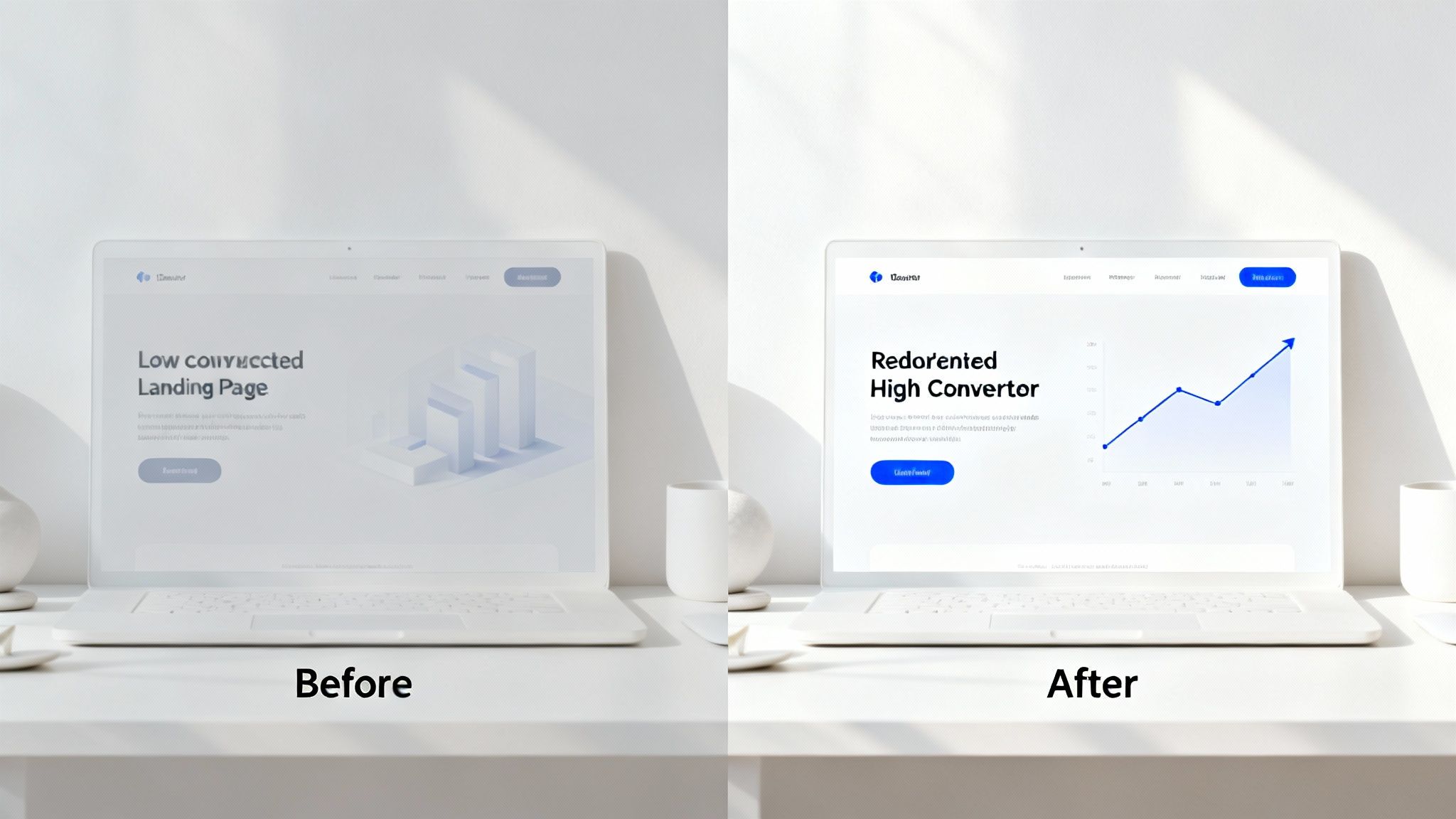
From Confusion to Clarity: The IT Company Homepage Redesign
An IT consultancy was hemorrhaging visitors from its homepage. The bounce rate was sky-high, and analytics showed people were leaving in seconds, completely baffled by a wall of technical jargon and a messy layout that failed to explain what the company actually did.
The CRO team hypothesised that a clearer value proposition and a single, obvious call-to-action (CTA) would encourage more demo requests. They A/B tested a new homepage with a few key changes:
- A simple headline: "IT Support That Helps Your Business Grow" replaced the old, confusing one.
- Trust signals up front: They moved client logos and a powerful testimonial right to the top of the page.
- One clear CTA: The "Book a Free Demo" button was made impossible to miss, and other distracting links were removed.
The result? A massive 42% increase in demo sign-ups in the very first month. The new page didn't just look cleaner; it spoke directly to the visitor's problems and showed them exactly what to do next.
This case study is proof that clarity beats cleverness, every single time. By removing guesswork and instantly answering "what's in it for me?", the business opened up a huge new pipeline of qualified leads.
Simplifying the Path to Enquiry: The Buyer's Agent Success Story
A buyer's agent was pulling in good traffic but getting almost no genuine enquiries. Their contact form was hidden on a separate page and demanded over 12 mandatory fields—a massive roadblock for anyone considering reaching out.
A quick CRO audit pinpointed the form as the main problem. The new game plan was simple: make it as easy as possible for people to get in touch.
The agency tested a new approach, embedding a much shorter, three-field form ("Name," "Email," "Phone") directly onto the main service pages. They also added a headline right above it: "Start Your Property Search in 60 Seconds." This small tweak completely changed the dynamic by reducing effort and managing expectations.
This streamlined process led to an incredible 78% uplift in qualified consultation requests. It’s a classic example of a core CRO principle: every extra field you add or click you demand will cost you conversions.
This is especially true in Australia, where there’s so much room for improvement. The average local eCommerce conversion rate is a tiny 1.78%, but service businesses can blow that away by fixing their funnels. For instance, one Brisbane business saw a 37% uplift just by rethinking its client intake process. You can find more stats on the Australian digital marketing landscape on Eloquent.com.au.
FAQs About Conversion Rate Optimisation Services
Thinking about conversion rate optimisation? You’ve probably got a few questions. To make things clearer, here are some straight answers to the most common queries we get from business owners looking to get more out of their website.
How Long Does It Take to See Results From CRO?
While you might see some quick wins early on, real, sustainable results from CRO services typically start showing up in about three to six months. Why the wait? Because the first phase is all about deep-dive data collection and analysis to genuinely understand how users behave on your site.
Only then can we form smart hypotheses and set up proper tests. Running A/B tests to get statistically significant data takes patience—you need enough traffic to make confident decisions. Remember, CRO isn’t a one-off fix; it's an ongoing process of improvement that builds a powerful client acquisition engine for your business over time.
Is CRO the Same as SEO?
No, but they work together perfectly. Think of them as two different jobs with the same goal: growing your business.
- SEO (Search Engine Optimisation): This is all about getting more of the right people to your website from search engines like Google. It boosts the quantity and quality of your traffic.
- CRO (Conversion Rate Optimisation): This focuses on improving the experience for the visitors you already have, convincing a higher percentage of them to take the next step.
In short, SEO gets people in the door. CRO convinces them to become a client. When you do both well, your marketing ROI skyrockets.
Can I Do CRO Myself or Do I Need to Hire an Agency?
It’s possible to learn the basics and run simple tests yourself, but getting meaningful results is another story. Proper optimisation is a specialised skill that demands expertise in data analysis, user psychology, UX design, and statistical testing. It's a lot to master.
A professional CRO agency brings a dedicated team, access to advanced tools, and years of experience from working with businesses just like yours. For most established service businesses, hiring an agency is far more effective and delivers a much stronger return than trying to juggle the complex, time-consuming process in-house.
What Conversion Goals Matter for a Service Business?
For a service business, a "conversion" isn't usually a direct online sale. The most important goals—what we call macro-conversions—are actions that generate qualified leads.
Key examples include:
- Submitting a contact or enquiry form.
- Booking a consultation call.
- Requesting a detailed quote.
- Registering for a webinar or demo.
But don’t forget about micro-conversions. These are smaller actions that show a prospect is highly engaged and moving down the funnel, like downloading a free guide, watching a case study video, or subscribing to your newsletter. A smart CRO strategy optimises for both to build a rock-solid client pipeline.
Ready to turn more of your website visitors into genuine, qualified leads? At Homer Digital Marketing, we specialise in creating data-driven CRO strategies that deliver real results for service-based businesses. Let's unlock your website's true potential together. Book a discovery call today to get started.
