
Are you frustrated with your website being buried on page 10 of Google? You're not alone. For many small business owners, good SEO feels like a complex, expensive puzzle. But what if I told you it doesn't have to be? The truth is, effective search engine optimisation for small business isn't about massive budgets; it's about having a clear, actionable strategy.
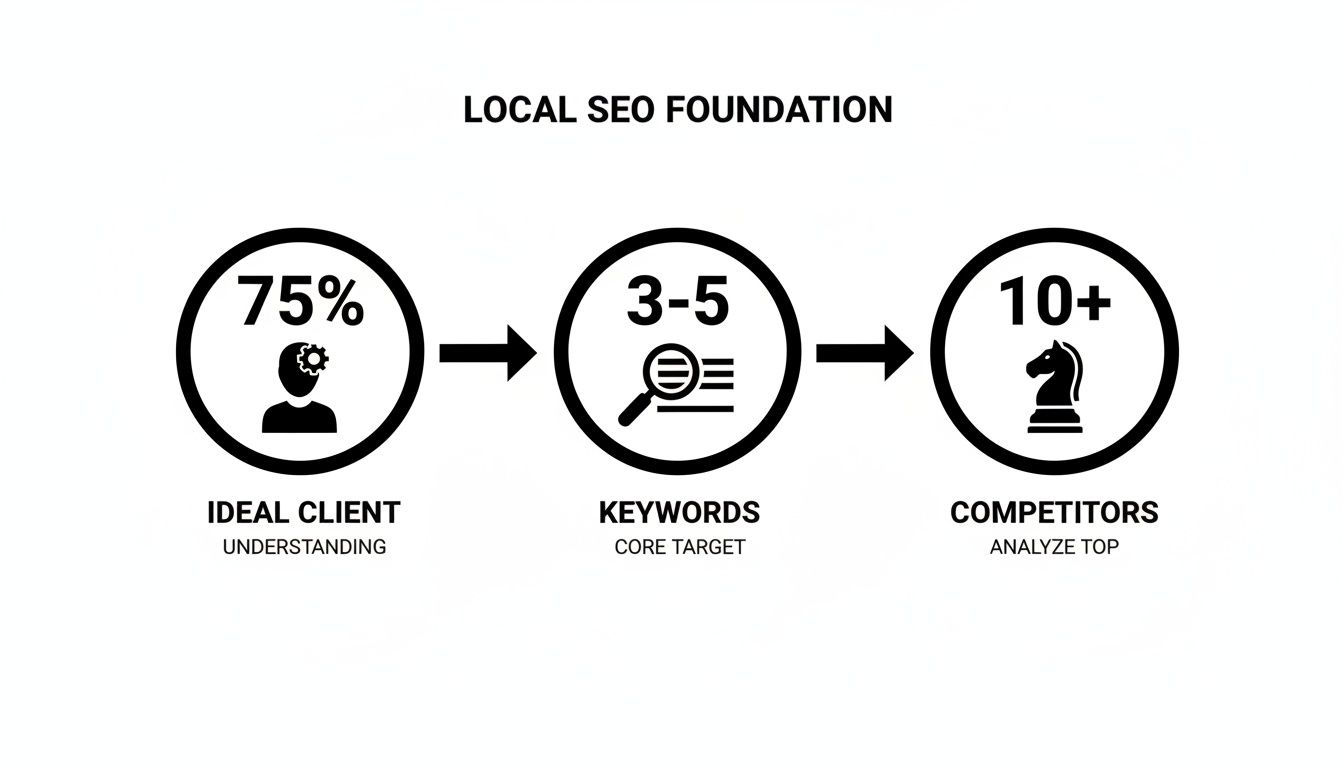
It all starts with a simple foundation: knowing your ideal client inside and out, uncovering the exact words they use to find solutions like yours, and taking a smart look at your local competitors to find your opening. This guide will give you a proven, step-by-step roadmap to boost your visibility and start winning on Google.
Building Your Foundation for Local SEO Success
Before you touch your website or write a single word of content, the most critical work needs to happen. Getting found on Google is built on a solid foundation, not just guesswork.
Skipping this foundational stage is like building a house without blueprints. It might look okay for a little while, but it’s not going to be stable or get you the results you want in the long run.
The goal is to stop hoping the right clients find you and start strategically putting your business right in front of them the moment they need you. This initial planning ensures everything you do later—from a blog post to a Google profile update—is sharp, targeted, and actually works.
Defining Your Ideal Client Avatar
You can't be everything to everyone. The most successful service businesses know exactly who they’re for. So, before you even think about keywords, you need to get crystal clear on your ideal client.
I don't just mean demographics. We need to get inside their head.
For example, a local plumber in Perth. Their ideal client isn't just "homeowners." A much more useful avatar is: "Jane, a 35-year-old working mum in Subiaco. She's time-poor, values reliability over the cheapest price, and needs clear communication. When a pipe bursts, she’s grabbing her mobile and searching for an 'emergency plumber Subiaco'."
Getting this specific helps you understand:
- Their Pain Points: What’s the real problem? For Jane, it’s the stress of a flooded kitchen and needing someone trustworthy, right now.
- Their Search Language: What words will she actually type into Google? Phrases like "best plumber near me" or "24-hour plumber Perth".
- Their Values: What convinces her to pick up the phone? She'll be looking for great reviews, a professional-looking website, and a business that promises a fast response.
Uncovering High-Intent Keywords
Once you know who you're talking to, finding the right keywords is so much easier. You're not just guessing anymore; you're using the words your ideal client would use.
High-intent keywords are the phrases people type when they're ready to buy, not just browse.
Key Takeaway: For a service business, the magic combination is service + location. These are the searches with the highest potential to turn into a paying customer. A search for "plumbing tips" is someone doing research. A search for "blocked drain plumber Fremantle" is someone with a credit card in hand.
For example, a recruitment agency in Melbourne shouldn't waste time on a broad term like "recruitment." They need to focus on high-intent, long-tail keywords that lead to actual enquiries, like:
- "executive search firms Melbourne"
- "best tech recruitment agency Victoria"
- "how to find a sales manager Melbourne"
These are the searches that make the phone ring.
Analysing Your Local Competitors
Finally, you need to know who you're up against. Just do a simple Google search for your main services and see who pops up. Don't just look at who is ranking; dig into why they're ranking.
Check out the top 3-5 businesses in the map pack and the regular search results. Ask yourself:
- What services do they highlight on their homepage?
- How many Google reviews do they have? Are they good, bad, or mixed?
- Does their website look modern and easy to use on a phone?
- Are they creating any content, like a blog, that answers common customer questions?
This isn't about copying what they do. It's about finding the gaps. Maybe the top guy has amazing reviews but a terrible, outdated website. Perhaps another one ranks well but has zero helpful content.
These gaps are your opportunities. This is where you can stand out, offer something better, and get a strategic edge right from the start.
Optimising Your Google Business Profile And Local Signals
Now that you've got a handle on your ideal client, what they search for, and who you're up against, it's time to roll up your sleeves. The single most powerful tool you have for attracting local customers isn't your website—it's your Google Business Profile (GBP).
Think of your GBP as your digital shopfront. For many potential clients, it’s the very first—and sometimes only—interaction they'll have with your business. A well-oiled GBP can make your phone ring without anyone ever clicking through to your site. It’s the absolute cornerstone of search engine optimisation for small business, especially if you rely on a local customer base.
Ignoring this free tool is like having a shop on the main street but keeping the shutters down. Your competitors are almost certainly using it, and if you're not, you're handing them business on a silver platter.
Turning Your Profile Into a Client Magnet
A bare-bones profile with just a name and number won't cut it. To really stand out, every single section needs to be filled out thoughtfully and strategically. This isn't just about ticking boxes; it's about telling a story that convinces a searcher you're the right person for the job.
Start with your business description. This is your elevator pitch. Weave in the keywords you identified earlier, but write for a real person. Explain what you do, who you help, and what makes you the best choice.
Instead of a flat "We do plumbing," try something like, "We're Perth's trusted emergency plumbers, offering 24/7 service for busy families who need fast, reliable solutions." For a deeper dive into perfecting every section, check out our guide on maximising your Google My Business profile.
The Power of Categories and Services
Choosing the right categories is crucial. Your primary category should be the one that best sums up your core business (e.g., "Recruitment Agency" is much better than a vague "Consultant"). From there, add every other relevant secondary category that applies.
But don't stop there. The "Services" section is where you can really get specific. List out every single service you offer, complete with a short description. This gives Google more ammo to match you with super-specific searches like "executive tech recruitment Melbourne," boosting your chances of showing up.
Expert Tip: Put yourself in your customer's shoes. If you're a mechanic, don't just list "Car Service." Get specific with high-value services like "European Car Logbook Service," "Brake and Clutch Repair," and "Roadworthy Certificate Inspection." Each one is another hook in the water.
To keep you on track, here's a quick checklist to make sure you've covered all the essentials for a fully optimised profile.
Google Business Profile Optimisation Checklist
| Optimisation Area | Action Item | Why It Matters |
|---|---|---|
| Core Information | Verify your business name, address, and phone number (NAP) are 100% accurate. | Inconsistent details confuse Google and customers, damaging your local ranking. |
| Categories | Select the most specific primary category and add all relevant secondary categories. | This is a primary ranking factor that tells Google exactly what you do. |
| Business Description | Write a compelling, keyword-rich description of what makes you unique. | Your chance to sell your value proposition directly in the search results. |
| Services/Products | List every individual service or product with detailed descriptions and pricing. | Helps you rank for specific, long-tail searches and informs customers. |
| Photos & Videos | Upload high-quality, real images of your team, work, and premises regularly. | Builds trust and visually showcases the quality of your work. Stock photos don't cut it. |
| Reviews | Actively request reviews from happy clients and respond to every single one (good or bad). | Strong social proof is a huge ranking signal and conversion driver. |
| Q&A Section | Pre-populate the Q&A with common customer questions and your own clear answers. | Addresses customer pain points upfront and shows you're proactive. |
| Google Posts | Regularly share updates, offers, and news using the Google Posts feature. | Keeps your profile fresh and signals to Google that your business is active. |
Working through this list ensures you're not leaving any opportunities on the table. A complete, active profile is one of Google's strongest signals for local relevance.
Showcasing Your Work With Photos and Videos
Photos are non-negotiable. People want to see who they’re hiring and the results you deliver. Always use high-quality, real photos—not generic stock images.
- Team Photos: Put a friendly face to the name.
- Work in Action: Show your team on-site or delivering your service.
- Completed Projects: Before-and-after shots are incredibly persuasive.
- Your Premises: A professional shot of your office, workshop, or even your branded vehicle.
Pro tip: Before you upload your images, geotag them with your location data. It’s a simple step that adds another powerful local signal for Google, reinforcing exactly where you operate.
Building Trust Through Reviews and Responses
Reviews are the lifeblood of any local service business. A steady stream of positive, recent reviews is one of the most powerful ranking factors for getting into the Google "Map Pack." Make it a habit to encourage every happy client to leave you some feedback.
But responding is just as important. Make sure you reply to every single review, good or bad. It shows you're engaged and that you care about your customers' experience. Honestly, a thoughtful, professional response to a negative review can often win over more new clients than a dozen glowing ones.
Ensuring NAP Consistency Across the Web
Your business NAP (Name, Address, Phone number) needs to be identical everywhere it shows up online. Any inconsistencies, even small ones, can confuse Google and hurt your rankings. This includes your website, social media profiles, and especially online business directories.
Speaking of directories, getting listed in key Australian sites like Yellow Pages and TrueLocal sends strong trust signals to Google about your legitimacy and service area. This consistency is a simple but critical piece of building local authority.
The impact here is enormous. Local SEO is a goldmine for Aussie small businesses, driving 28% of total search traffic that converts at three times the rate of standard organic traffic. With 46% of all Google searches having local intent and 'near me' queries surging 500% since 2015, the opportunity is massive. Yet a surprising 56% of local businesses still haven't even claimed their Google Business Profile, leaving the door wide open for you to get ahead.
Crafting On-Page SEO That Converts Visitors
So, you’ve sorted your local signals and laid the groundwork. Now it's time to make sure your website isn't just a pretty brochure, but a well-oiled machine designed to convert visitors into clients. This is what on-page SEO is all about—refining your actual web pages to make both Google and your customers happy.
Think of it like this: your Google Business Profile is the sign outside your shop, getting people to the front door. Your on-page SEO is how you merchandise the store inside. It’s about creating clear aisles, helpful signage, and a compelling layout that guides people straight to the checkout. Without this piece, all that hard-earned traffic won't turn into actual business.

Mastering Titles And Descriptions
Your page title and meta description are your first impression in the search results. They’re your digital billboard, and getting them right is non-negotiable for getting clicks from the right people.
- Title Tags: This is the clickable blue headline in a Google search. Keep it under 60 characters, cram in your main keyword, and add a local touch if it makes sense.
- Meta Descriptions: This is the little blurb of text underneath. It doesn't directly influence your rank, but a persuasive description (around 150-160 characters) is what convinces someone to click your link instead of your competitor's.
A generic title like "Recruitment Services" is lazy and won't get you anywhere. A much stronger, optimised version would be: "Expert Tech Recruitment Agency in Sydney | Find Top Talent". It's specific, packs in the keyword and location, and screams value.
Structuring Content With Clear Headings
Once someone lands on your site, they need to find what they're looking for—fast. People don't read websites; they scan them. That’s why headings (H1, H2, H3, etc.) are so critical.
Your H1 is the main headline for the page. Use it only once. Then use H2s and H3s to break down the rest of your content into logical, bite-sized sections. Sprinkling your keywords into these headings helps Google quickly understand what the page is about and how it's structured.
Key Insight: A well-structured page with clear headings doesn't just make for a better user experience. It dramatically increases your chances of being featured in Google's "featured snippets"—those valuable answer boxes at the very top of the search results.
This structured approach is fundamental. It’s no surprise that Australian businesses are projected to pour $1.5 billion into SEO services by 2025. Organic search drives a whopping 53% of all website traffic for small businesses, and the top three results get 50-60% of all clicks. The competition is fierce, which is why every single on-page detail matters.
The Art Of Internal Linking
Internal links are just links from one page of your website to another. They seem simple, but they are incredibly powerful for a few key reasons:
- They help Google find your stuff: Links create a roadmap for search engine crawlers to discover all your content.
- They pass authority around: Linking from a powerful page (like your homepage) to a newer service page shares some of that SEO clout.
- They guide your visitors: A smart internal link can lead someone from a helpful blog post directly to a relevant service page, pushing them one step closer to making an enquiry.
For example, if an electrician writes a blog post on "Signs You Need a Switchboard Upgrade," they absolutely must link to their "Switchboard Upgrade Services" page using descriptive text like "professional switchboard upgrade services."
Optimising Images For Speed And Search
Huge, unoptimised images are one of the biggest reasons websites load slowly. And a slow website is an SEO killer. Before you upload any image, make sure you compress it for the web without turning it into a pixelated mess.
Just as important is the alt text. This is a short description that tells search engines what an image is about. It's also crucial for accessibility, as it’s what screen readers use to describe images to visually impaired users. Good alt text for a photo of a finished job could be: "Modern kitchen renovation with stone benchtops in Melbourne."
Getting these details right creates a seamless user experience and sends all the right signals to Google. And remember, it’s not just about optimising your core service pages. Learning how to write SEO articles that consistently rank is your ticket to driving ongoing organic traffic and building real authority.
Building Authority With Local Content And Backlinks
Authority is the currency of modern SEO. Once you’ve nailed your Google Business Profile and website pages, the next frontier is proving to Google that you’re a genuine expert in your local market.
You do this with two things: creating genuinely helpful local content and earning high-quality backlinks from other reputable websites.
Think of it this way: content shows off your expertise, while backlinks act as votes of confidence from others. Together, they send a powerful signal to search engines that you're a trustworthy and authoritative choice for customers in your area. This is a non-negotiable step in any effective search engine optimisation for small business strategy.
A Practical Content Strategy For Busy Owners
Content creation can feel like a massive time-suck, but it doesn't have to be. The goal isn’t to become a full-time publisher; it’s to strategically answer your clients' most pressing questions.
Your content should be laser-focused on showing off your local knowledge and service expertise. This builds trust with potential customers long before they even think about picking up the phone.
Here are a few content ideas that work wonders for service businesses:
- Hyper-Local Service Pages: Instead of one generic page for "Recruitment Services," create dedicated pages for "Tech Recruitment Sydney CBD" or "Executive Search North Sydney." This lets you target specific neighbourhood searches.
- Project Case Studies: Show, don't just tell. Showcase your best work with before-and-after photos and a quick story. A real estate agent could detail a successful sale in a specific suburb, highlighting the challenges and how they solved them.
- "How-To" Guides & Checklists: An automotive shop could create a "Winter Car Maintenance Checklist for Melbourne Drivers." This positions you as a helpful expert, not just another salesperson.
- Answering Common Questions: Turn your most frequently asked client questions into detailed blog posts. This saves you time on repeat explanations and captures search traffic from people actively looking for answers.
Earning Backlinks The Right Way
Backlinks are simply links from other websites back to yours. They are one of the most powerful ranking factors because they signal to Google that other sites vouch for your credibility.
Forget the spammy, paid tactics of the past. The best links are earned through real-world relationships and by providing genuine value.
A strong backlink profile is a game-changer. In Australia, where Google commands a staggering 93.95% of the search market, standing out is essential. Top-performing local businesses have, on average, 35 times more backlinks than their lower-ranking competitors, which has a massive impact on their traffic and visibility. You can explore more data on Australian search trends from SearchScope's 2025 report.
The good news? You don't need thousands of links. A handful of high-quality, relevant links is far more valuable than hundreds of rubbish ones.
Finding Local Link Building Opportunities
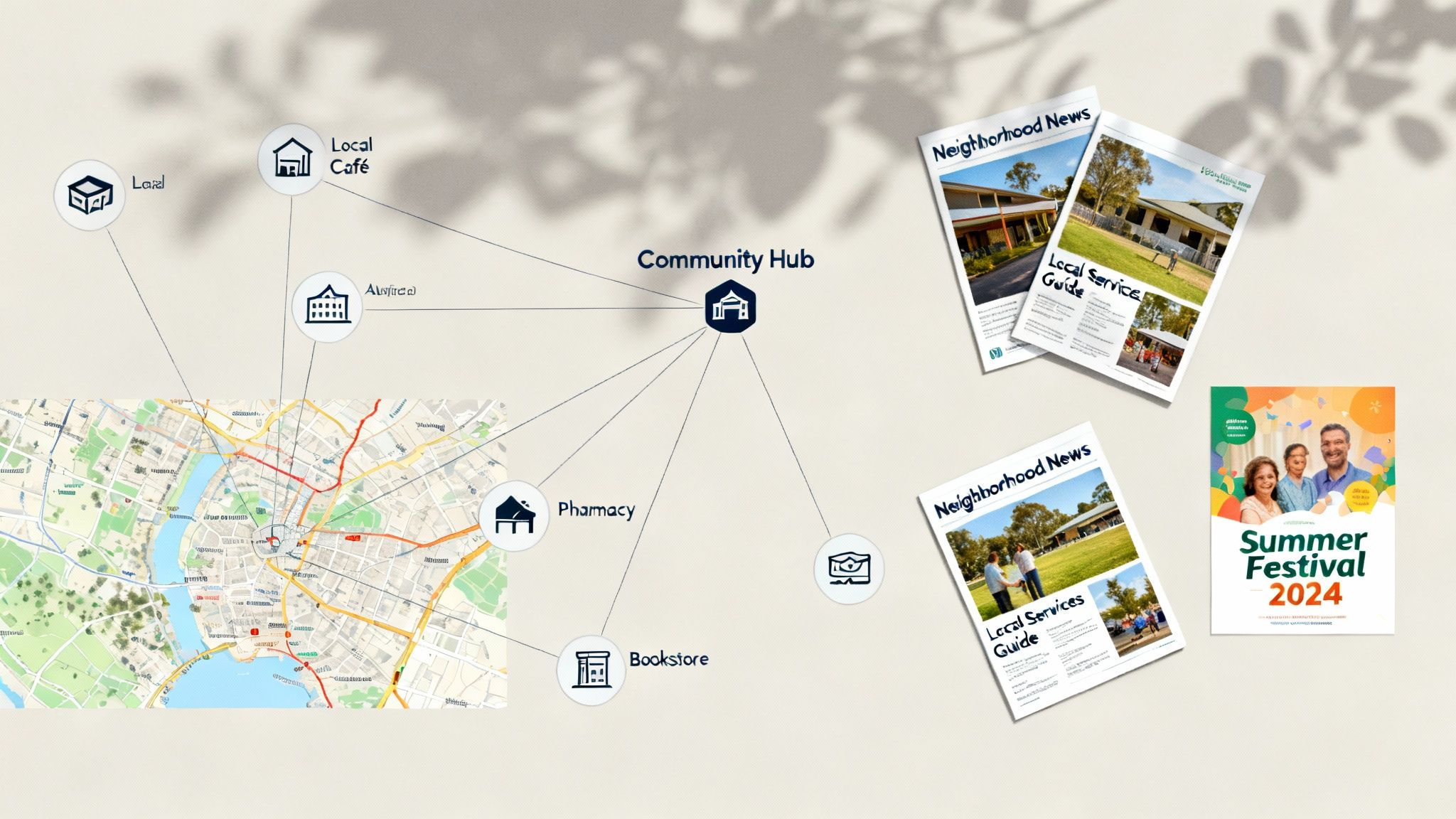
Building authentic local links is all about community engagement, both online and off. It’s about being a visible, helpful part of your local business ecosystem. Start by thinking about the organisations and businesses you already interact with—that’s the foundation of a natural link-building strategy.
For a more detailed breakdown, our guide to local SEO for business offers more actionable steps.
Below is a quick comparison of some of the best strategies for earning those valuable local links.
Local Link Building Opportunities
This table compares different strategies for earning high-quality local backlinks to boost your website's authority.
| Strategy | Effort Level | Potential Impact | Example |
|---|---|---|---|
| Local Directories | Low | Medium | Being a member of the local Chamber of Commerce with a link in their directory. |
| Event Sponsorships | Medium | High | Sponsoring a local sports team or community fair, which often includes a website link. |
| Business Partnerships | Medium | High | A bridal shop and a wedding photographer linking to each other as preferred vendors. |
| Local Media/Podcasts | High | Very High | Offering your expertise for a local blog or podcast, earning a mention and a backlink. |
The key is to focus on strategies that feel authentic to your business. Partnering with other local businesses you already know and trust is often the easiest and most effective place to start.
By consistently creating helpful local content and actively building relationships in your community, you’ll establish an authoritative presence that both search engines and customers will reward.
Tracking Your SEO Performance And Planning For Growth
You can't improve what you don't measure. Getting a solid search engine optimisation for small business strategy in place is a massive first step, but without tracking your results, you're just flying blind. This final piece of the puzzle is all about turning your hard work into a predictable, profitable marketing channel by making decisions based on data, not guesswork.
Let's be clear: SEO is a marathon, not a sprint. Great results take time, and it’s not unusual to wait six months or more before seeing serious traction. The trick is to watch the right signals from day one, so you know your foundational work is paying off and can tweak your approach when needed.
Setting Up Your Measurement Tools
To see what’s going on, you need the right tools. The good news? The most critical ones are completely free. You absolutely must have these two set up for your website.
- Google Search Console (GSC): Think of this as your direct line to Google. It tells you exactly which keywords are bringing people to your site, how many times your pages are shown in search (impressions), and where you're ranking on average.
- Google Analytics 4 (GA4): This tool picks up where GSC leaves off. It shows you what happens after someone clicks on your site—how many visitors you get from organic search, what pages they look at, and how long they stick around.
These two platforms give you all the raw data you need to figure out what's working and where you can improve. If you want to dig deeper, you can check out our list of the best free SEO tools for small businesses to add more to your toolkit.
Key Metrics That Actually Matter
It’s way too easy to get lost in a sea of data. Instead of obsessing over every little fluctuation, focus on the handful of metrics that truly signal business growth.
- Organic Traffic: Is the number of people finding you through non-paid search going up over time? This is the clearest sign that your SEO efforts are gaining momentum.
- Keyword Rankings for High-Intent Terms: Are you climbing the ladder for those crucial "service + location" keywords you found earlier? GSC is your best friend here. Seeing a keyword jump from page three to page one is a huge win.
- Leads and Conversions: This is the bottom line. Are you actually getting more phone calls, form fills, or bookings from organic traffic? You have to set up conversion tracking in GA4 to connect your SEO work directly to revenue.
Key Takeaway: While climbing the rankings feels great, the real goal is to make the phone ring. A number one ranking for a keyword that brings zero business is just a vanity metric. Always prioritise the numbers that lead to actual customers.
An Ongoing Plan For Sustainable Growth
SEO isn't a "set it and forget it" job. To keep your visibility and grow it over time, you need a simple, ongoing maintenance plan. Just block out a few hours each month for these core tasks.
Your Monthly SEO Checklist
- Review Your Rankings: Jump into Google Search Console. Have any important keywords slipped? Are there any new ones popping up that you could target with fresh content?
- Check Your Google Business Profile: Keep it active. Add a new Google Post, upload a recent photo from a job, and make sure you respond to any new reviews or questions.
- Identify One Content Opportunity: Could you write a quick blog post answering a common client question? Or maybe create a detailed case study of a recent project?
- Look for One Link Building Opportunity: Is there a local business partner you could reach out to for a link? Or a small community event you could sponsor?
This consistent, focused effort is what separates the businesses that get lasting results from those that fade away after a few months. By tracking your performance and sticking to a simple growth plan, you’ll transform your SEO from a one-off project into a powerful, long-term asset for your business.
Your Top Small Business SEO Questions Answered
If you're diving into the world of search engine optimisation, you've probably got a few questions. That's a good thing. Below, I’ve answered some of the most common ones we hear from service-based business owners across Australia to give you a bit more clarity.
How Long Does SEO Realistically Take To Show Results In Australia?
This is the big one, and the honest answer is: it depends. The timeline for seeing real, tangible SEO results varies a lot. For a service business in a low-competition regional town, you could start seeing some positive movement in your keyword rankings and traffic within 3 to 6 months.
But if your business is in a hyper-competitive market like Sydney or Melbourne, or you're in a crowded industry like real estate or finance, you're looking at a longer game. It can easily take 6 to 12 months or even more to gain serious traction. SEO is all about consistency. Those first few months are for laying a solid foundation, and the results really start to build on each other over time.
Can I Do SEO Myself Or Should I Hire An Agency?
Doing SEO yourself is definitely an option, especially for the foundational stuff we've covered in this guide, like sorting out your Google Business Profile and creating helpful content. The real trade-off here comes down to two things: your time and your expertise.
A good agency brings years of experience, specialised tools, and the ability to roll out more advanced strategies—like technical SEO fixes and strategic link building—far more efficiently.
Our Take: If you’ve got more time than money and you're genuinely keen to learn the ropes, a DIY approach can get you started. But if you need to stay focused on running your business and want faster, more predictable results, partnering with an expert is usually the smarter investment.
What Is The Most Important Part Of SEO For A Local Service Business?
For any local service-based business, the single most critical element is absolutely nailing your local search presence. And that journey starts with a perfectly optimised Google Business Profile (GBP).
Think about it: your GBP is often the very first interaction a potential customer has with your business on Google. Making sure it’s complete, accurate, and kept active with fresh posts and a steady stream of positive reviews will give you the biggest and fastest return on your effort.
While things like on-page SEO and backlinks are vital for long-term success, a dominant GBP can start generating phone calls and leads almost straight away. For anyone new to this, getting your head around What is Search Engine Optimization (SEO)? is the perfect first step to boosting your visibility online.
Ready to stop guessing and start getting real, measurable results from your marketing? At Homer Digital Marketing, we build proven systems that attract your ideal clients through Google, LinkedIn, and smart automation. Let's create a strategy that turns your online presence into your most valuable asset. Book a no-obligation strategy session with us today and discover how we can help you scale.
