

Think of your website as your digital shopfront. Right now, it might be tucked away on a quiet side street. This ultimate guide to SEO for small business is your map to moving that shopfront onto the busiest high street in town—right where your ideal customers are already looking for the exact services you offer.
Are you tired of seeing your competitors dominate Google while your phone stays silent? This article promises a solution. By following these proven, actionable steps, you will learn how to turn your website into a powerful lead-generation machine without needing a massive budget or a team of tech wizards.
Why SEO for Small Business is Non-Negotiable
In a world where almost every customer journey starts with a search engine, if you're not visible, you're invisible. Without a clear strategy for SEO for small business, you're essentially handing over leads to your competitors.
Good SEO isn't about baffling code or technical wizardry. It’s about creating a direct line between the services you provide and the people actively trying to find them.
When you get this right, you attract high-intent customers. These aren't just tyre-kickers; they're people who are ready to make a decision, giving you the best possible return on your marketing efforts.
The Three Pillars of Small Business SEO
A solid SEO plan isn’t a random checklist of tasks. It's a machine with three core parts working together to turn your website from a passive online brochure into an active, lead-generating powerhouse. Understanding these pillars is the first step toward real, measurable growth.
Here’s a simple breakdown of what that looks like:
| SEO Pillar | What It Means for You | Key Activities |
|---|---|---|
| Local Dominance | Winning your immediate service area and showing up first for nearby customers. | Optimising your Google Business Profile, getting local citations, targeting location-specific keywords. |
| Customer-Focused Content | Answering the questions your ideal clients are asking before they even contact you. | Creating helpful service pages, blog posts, and guides that solve their problems. |
| Online Authority & Trust | Building a rock-solid reputation that Google and customers can rely on. | Gathering positive reviews, getting featured in local media, and earning links from other trusted sites. |
Getting these three pillars working in harmony is what separates the businesses that thrive online from those that just exist.
Investing in Visibility
Australian businesses are catching on. Organic search isn't just a "nice-to-have"; it drives a massive 53% of all website traffic.
The numbers tell the story: average monthly spending on SEO is projected to hit $1,350 by 2025. Yet, despite this, only 36% of small businesses in Australia are actually using SEO effectively. This gap creates a huge opportunity for anyone ready to take it seriously.
Mastering these fundamentals is the key to sustainable growth. For a deeper look at the nuts and bolts, our guide on how to rank higher on Google lays out the actionable steps you can take to boost your visibility.
Mastering Local SEO to Win Your Service Area
If you run a service-based business, local search isn't just a part of your strategy—it’s everything. When someone in your neighbourhood needs a plumber, consultant, or real estate agent, their first move is almost always a "near me" search on Google. Winning that moment is the key to a steady stream of local leads, making SEO for your small business a powerful, hyper-local tool.
The absolute centrepiece of this local universe is your Google Business Profile (GBP). Don't just think of it as a listing. It's your digital shopfront, and it's often the very first impression a potential customer will have of your business. A fully optimised profile can completely change how you attract local clients.
Optimise Your Digital Storefront
Your Google Business Profile is so much more than a name and number in a directory. It’s an interactive platform where customers find your hours, see photos of your work, read reviews, and even ask questions directly. Getting this right is non-negotiable for local success.
This visual guide shows the three core stages of building your online presence, and it all kicks off with a rock-solid local foundation.
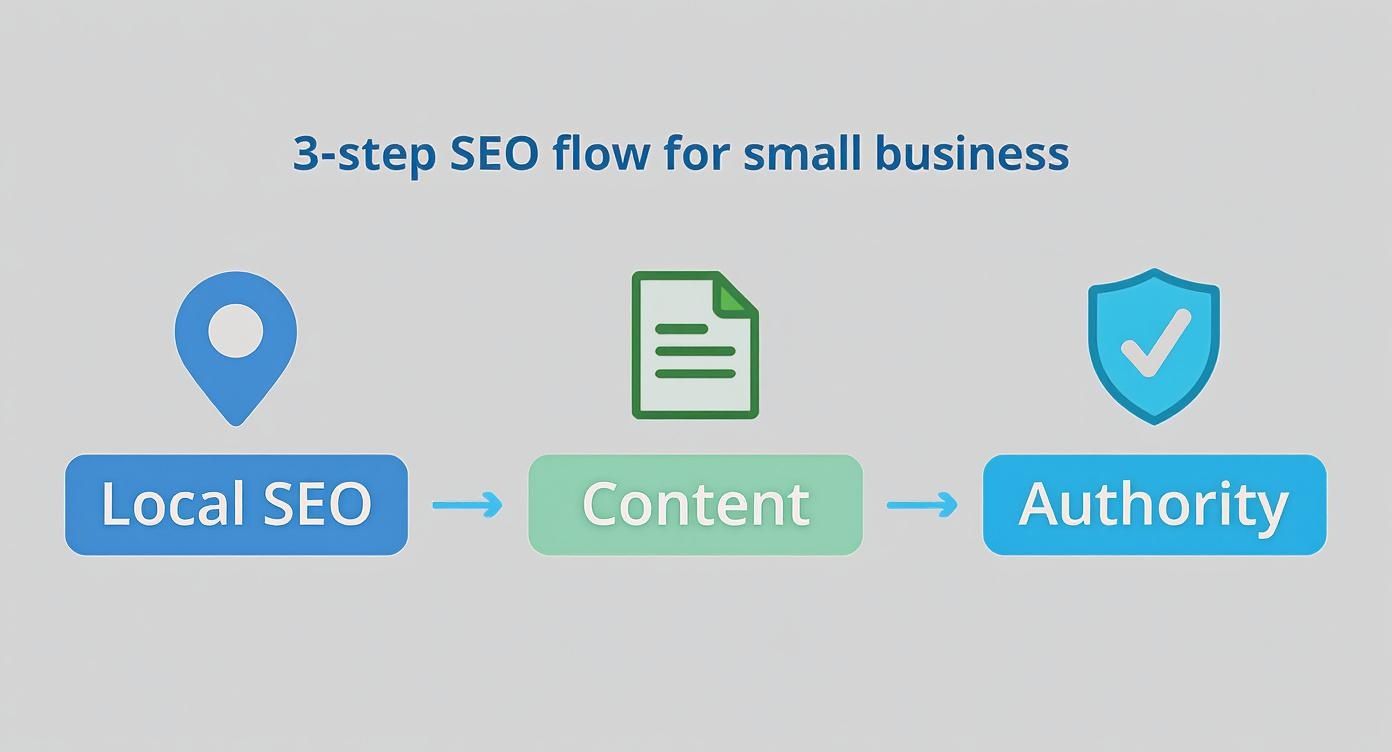
The flow is simple but powerful: master local SEO first, then build out your content, and finally, establish your authority. Nail these three, and you've created a genuine growth engine.
Start by making sure every single section of your profile is meticulously filled out. I’m talking detailed service descriptions, accurate business hours, and a precise service area map. And don’t forget photos! High-quality images of your team, your work in progress, and finished projects help to humanise your brand and build instant trust.
Build Trust with Social Proof
Reviews are the lifeblood of local SEO. It's not just a hunch; recent data shows that 88% of consumers trust online reviews as much as a personal recommendation from a friend. A profile buzzing with positive, recent reviews signals to both Google and potential customers that your business is trustworthy and delivers quality service.
Make it a habit to actively encourage your happy customers to leave a review. The easier you make it, the more likely they'll do it—send a direct link right after you've completed a job. It's also crucial to respond to all reviews, both the glowing ones and the not-so-great ones. It shows you're engaged and that you actually care about customer feedback.
A consistent stream of recent, positive reviews is one of the most powerful ranking factors for the local map pack. It's direct proof to Google that you are an active, reputable business in your community.
Maintain Consistency Across the Web
Here's a critical piece of the puzzle that often gets missed: NAP consistency. This stands for Name, Address, and Phone number. Google acts like a detective, cross-referencing this information across dozens of online directories (like Yelp, TrueLocal, and industry-specific sites) to verify that your business is legitimate.
Even tiny inconsistencies, like using "St." in one place and "Street" in another, can confuse search engines and water down your local authority. Do a quick audit to ensure your NAP details are absolutely identical everywhere they show up online. This simple clean-up job solidifies your digital footprint and gives your local ranking signals a serious boost.
To go deeper on attracting nearby customers and dominating local search, check out this comprehensive local strategy marketing guide. Mastering these fundamentals is what ensures that when locals are searching, your business is the one they find, trust, and ultimately, call.
How to Find Keywords That Attract Paying Customers
Guessing what your customers are searching for is a surefire way to waste time and money. The real key to effective SEO for a small business is digging into the exact phrases people use when they urgently need what you sell. This is all about moving past broad, ego-boosting terms and zoning in on keywords that scream "I'm ready to buy."
Think about it. A word like "plumber" is incredibly vague. That search could be from a student doing research, someone looking for a job, or a DIYer watching YouTube videos. But a phrase like "emergency hot water repair Northern Beaches"? That's a flare gun signal from someone who needs help now and has their wallet out.
These are the golden nuggets we’re hunting for.
Start with a Simple Brainstorm
You don’t need fancy, expensive tools to get started. Your biggest asset is your own deep knowledge of your customers and their problems. Grab a pen and paper, or open a fresh doc, and start jotting down ideas using a simple formula.
Just combine these three elements to build a solid list of high-intent keywords:
- Your Core Service: What do you actually do? (e.g., "electrical repair," "buyers agent," "bookkeeping")
- The Specific Problem: What pain point are you solving right now? (e.g., "faulty switchboard," "first home buyer," "overdue BAS")
- Your Service Location: Where do you do business? (e.g., "Perth CBD," "Adelaide Hills," "Gold Coast")
When you put it all together, you get powerful, targeted phrases like "faulty switchboard repair Perth CBD" or "accountant for overdue BAS Gold Coast". These longer keywords might get fewer searches, but the people who do search for them are much, much more likely to become paying customers.
From Broad Searches to Buyer Keywords
Here's how this shift in thinking looks for different service businesses. The goal is to move from attracting general traffic to attracting genuine leads.
| Your Business Type | Broad Keyword (More Traffic) | Buyer Keyword (More Leads) |
|---|---|---|
| Local Electrician | "electrician Sydney" | "emergency switchboard repair Chatswood" |
| Financial Advisor | "financial advice Melbourne" | "superannuation advice for over 50s Carlton" |
| IT Support Company | "business IT support" | "small business server setup Brisbane" |
| Landscaper | "landscaping ideas Perth" | "backyard paving contractor Fremantle" |
See the difference? The "Buyer Keywords" are specific, problem-focused, and local. They capture the attention of people who are much further down the buying journey.
Use Free Tools to Find Hidden Gems
Once you’ve got a brainstormed list, it's time to see what the data says. And you don't need to break the bank to do it. Google’s own tools are surprisingly powerful for figuring out what real customers are typing into that search bar.
A great place to start is Google Keyword Planner. It was built for advertisers, but it’s a goldmine for SEO. You can find related terms you might have missed and check which phrases get a decent number of searches each month without being ridiculously competitive. For even more options, our guide to the best free SEO tools is a perfect starting point for any small business owner.
Here's a quick look at the Keyword Planner interface, where you can discover new keywords or get the data on the ones you already have.

The screenshot shows how you can pop in a "seed" keyword and get back a whole list of related ideas, complete with their average monthly searches and how competitive they are. This data is exactly what you need to decide which keywords to go after first.
The goal isn't just to find keywords; it's to understand the intent behind them. A high-intent keyword is a question that your service page or blog post directly answers, positioning you as the clear solution to the searcher's problem.
By following this process, you create a targeted keyword list that becomes the blueprint for your website content. Every page and post will be laser-focused on attracting qualified leads, making sure your SEO efforts actually grow your business.
Optimising Your Website Pages Without Tech Headaches
Okay, so you’ve found the keywords that your ideal customers are actually typing into Google. What now? The next step is putting them to work on your website. This is what we call on-page SEO, and you absolutely do not need to be a web developer to get it right.
Think of it as setting up your digital shopfront. You want Google—and your customers—to walk in and instantly understand what you sell, where everything is, and why they should buy from you.
The goal is simple: make it painfully obvious what each page on your site is about. By placing your best keywords in a few key spots, you’re sending strong signals to Google that your page is the best answer for a specific search. It's less about technical wizardry and more about clarity and common sense.
When you get this right, someone searching for "emergency hot water repair" will find your page dedicated to exactly that. It's that direct.
Your On-Page SEO Checklist
Let's break down exactly where your keywords need to go. If you focus on just these four areas for each of your main service pages, you'll have covered over 80% of what matters for on-page SEO. Seriously.
- Page Title (or Title Tag): This is the blue, clickable link people see in the Google search results. It’s the single most important place to put your main keyword. Make sure it's compelling and keep it under 70 characters.
- Meta Description: This is the little snippet of text under the title in the search results. While it doesn't directly help you rank, a good one convinces people to click on your link instead of a competitor's. Pop your keyword in and add a clear benefit.
- Main Heading (the H1 Tag): Every page should have one—and only one—main heading. This is the big headline your visitors see when they land on the page. It should line up nicely with your Page Title and include your primary keyword.
- Subheadings (H2, H3 tags): These break up your content and make it easy to scan. It's the perfect place to weave in different versions of your main keyword or answer related questions.
This structured approach doesn't just help Google; it makes your pages far easier for actual humans to read and digest. For a deeper dive into creating a site that both users and search engines love, explore the key elements of modern website design to ensure your on-page efforts are built on a solid foundation.
A Real-World Example
Let's say you're a buyers agent in Brisbane and your golden keyword is "buyers agent for first home buyers Brisbane."
Here’s how you’d apply that checklist:
| SEO Element | On-Page Application |
|---|---|
| Page Title | Buyers Agent for First Home Buyers Brisbane | Homer Advisory |
| Meta Description | Looking for your first home in Brisbane? Our expert buyers agents specialise in helping first home buyers find the perfect property. Get professional help today. |
| Main Heading (H1) | Expert Buyers Agent for First Home Buyers in Brisbane |
| Subheading (H2) | How We Help You Navigate the Brisbane Property Market |
See how it all lines up? It tells Google precisely what the page is about and speaks directly to what the searcher needs, making them far more likely to click through.
The secret to great on-page SEO isn't just about stuffing keywords in. It's about matching what a person is searching for with compelling, customer-focused content that answers their question and nudges them to take the next step.
Writing Content That Actually Converts
Getting Google's attention is only half the battle. Your page content has to be written for the human on the other side of the screen. Your SEO for a small business strategy truly works when a visitor lands on your service page and thinks, "Yep, this is exactly what I was looking for."
Use your subheadings to answer common questions and address their pain points. Write in short, punchy paragraphs. Most importantly, finish with a strong call to action that tells them exactly what to do next—whether it's to call for a quote, fill out a form, or book a chat.
Building Online Authority and Trust with Customers
Modern SEO is really just a digital trust game. Google’s whole mission is to spot genuine, credible businesses and show them to searchers. It’s not about stuffing keywords anymore; it's about proving you’re the real deal.
This is where you’ll hear SEO pros talk about E-E-A-T. It stands for Experience, Expertise, Authoritativeness, and Trustworthiness. Think of it as Google's sniff test for figuring out which businesses actually deserve the top spots. For a small service business, this is your secret weapon against bigger, faceless competitors.
What E-E-A-T Means for Your Business
Forget the technical jargon. E-E-A-T is just about showing up online the same way you do in the real world—as a credible, experienced professional. You’re proving to Google and your customers that you know your stuff and can be trusted to deliver.
Here’s how you can put it into action:
- Experience: Show your work. This is all about case studies, before-and-after photos, and project stories that prove you've been there and done that.
- Expertise: Share what you know. Write blog posts answering common customer questions, create simple how-to guides, or film a quick video explaining a complex topic. This makes you the go-to expert, not just another option.
- Authoritativeness: Get other people to vouch for you. Think of this as digital word-of-mouth. Backlinks from other local businesses, a feature in a community newsletter, or a mention from a local influencer all count.
- Trustworthiness: Make it obvious you're reliable. Clear contact details, customer testimonials, and positive online reviews are massive trust signals.
E-E-A-T isn't a quick hack. It's a long-term strategy for building a brand that both customers and search engines respect. Every good review and local partnership adds another brick to your wall of authority.
Earning Your Reputation One Link at a Time
One of the most powerful ways to build authority is by earning backlinks—which is just a fancy term for a link from another website to yours. Google sees these as votes of confidence. When a reputable site links to you, it’s a massive signal that you’re a trusted resource.
But you don’t need a feature on a national news site. For a local service business, the best links often come from right in your own community.
Try these strategies:
- Partner up with complementary businesses. If you're a wedding photographer, why not write a joint blog post with a local florist or venue? A real estate agent could team up with a mortgage broker. It’s a natural fit and provides real value to everyone’s audience.
- Get involved in the community. Sponsor the local footy team, participate in a charity event, or offer a free workshop. These things often get you mentioned on local news sites or community blogs—and those links are pure gold for local SEO.
Mastering Your Online Reviews
Your online reviews are the foundation of your digital reputation. They have a direct impact on your search rankings and, more importantly, a customer's decision to pick up the phone. Research shows that over 90% of consumers read online reviews before even thinking about contacting a business.
A steady stream of positive reviews tells a powerful story. Make it a non-negotiable part of your process to ask happy customers for feedback. A simple follow-up email with a direct link to your Google Business Profile is often all it takes.
And what about that inevitable bad review? Don't panic. How you respond is what really matters. Always reply professionally and quickly. Acknowledge their issue, offer to resolve it offline, and show other potential customers that you actually care. This can turn a negative into a huge positive for your brand.
Using AI Tools to Supercharge Your SEO Efforts
Trying to nail your SEO for small business strategy doesn't mean you need a huge team or an endless budget anymore. Artificial intelligence (AI) has stepped in as a powerful ally, offering smart tools that can automate the tricky stuff, give you data-backed insights, and save you a massive amount of time.
AI-powered platforms can peek at what your competitors are doing, find keyword gaps you’re missing, and even help you outline content that actually connects with your ideal customers. It’s a massive leveller, letting you make smarter, faster decisions that lead to real growth.
By letting the tech handle the heavy data analysis, you’re freed up to focus on what you do best—running your business and serving your clients. It’s all about working smarter, not harder.
Automating Keyword Research and Content Optimisation
One of the first places you’ll see AI make a huge difference is in your keyword research. Instead of manually digging through spreadsheets for hours, AI tools can pinpoint high-intent keywords, group them into logical clusters, and even predict what people will be searching for next. This data-first approach makes sure your content strategy is built on solid ground from day one.
AI is quickly becoming a non-negotiable for SEO success. We’re seeing more and more Australian businesses using AI tools for everything from finding keywords to creating content. To give you an idea of the impact, some businesses using AI for keyword clustering have seen 40% traffic increases. The results speak for themselves.
But these tools don't just find the keywords; they help you use them properly. Many platforms give you real-time feedback as you write, checking your drafts for:
- Keyword integration: Are your target phrases woven in naturally?
- Readability: Is your content clear and easy to read, or is it a wall of text?
- Topical relevance: How does your content stack up against the top-ranking pages? What are you missing?
This kind of guidance helps you create content that ticks the boxes for both search engines and your customers.
AI isn’t here to replace your expertise; it’s here to amplify it. Think of it as a data-savvy assistant that handles the repetitive tasks. That way, you can focus on creating authentic, valuable content that builds real trust with your audience.
AI-Powered Tools for Enhanced Customer Engagement
Beyond content and keywords, AI is also changing how you can interact with visitors on your website. Smart tools can dramatically improve the user experience, which is a massive signal to Google. A happy visitor tells Google your site is valuable, helping you climb the rankings.
For instance, AI-driven chatbots can give instant answers to common questions 24/7, keeping potential customers engaged long after you’ve clocked off. That immediate support can be the difference between someone leaving your site or becoming a paying customer. To give your business a boost, it's worth exploring the best chatbot for small business options to see how you can automate engagement effectively.
Common Questions We Hear from Business Owners
Even with the best roadmap, getting stuck into SEO for your small business can feel like wading through mud. The internet is flooded with jargon and advice that often contradicts itself, so it’s completely normal to have a few questions.
Here are the big ones we get from Australian business owners, with clear, no-fluff answers to get you moving.
How Long Until I See Results from SEO?
This is always the first question, and the honest answer is: it depends. SEO is a long-game. You’re building a valuable business asset for the long haul, not just flicking a switch on an ad campaign.
Generally, you’ll start to see the needle move within 3 to 6 months. This might look like a few more calls coming through your Google Business Profile, ranking for more keywords, or a noticeable lift in website traffic.
But the really significant, business-changing results—like a consistent stream of quality leads turning into paying clients—usually take 6 to 12 months to properly kick in. This is especially true if you’re in a competitive industry.
Think of it like planting a garden. You prepare the soil (technical fixes), plant the seeds (on-page SEO), and water them regularly (content and authority building). You don’t get a harvest overnight, but with patience and consistent effort, the growth is inevitable.
Can I Actually Do My Own SEO?
Yes, absolutely. For a small business owner, especially when you’re starting out, DIY-ing your SEO is a fantastic way to understand what actually drives your business forward online.
If you just focus on the fundamentals in this guide—nailing your Google Business Profile, targeting the right local keywords, and writing clear service pages—you can get incredible results.
SEO isn’t an all-or-nothing game. The trick is to start with the high-impact tasks you can manage yourself. A well-optimised local presence and clear website can easily outperform a competitor who is overcomplicating everything.
The only catch is time. As your business grows, you'll likely find your time is better spent working with clients than digging through keyword data. When you hit that point, you can bring in a specialist or an agency to scale things up. The best part? You’ll be doing it from a position of knowledge, not confusion.
What's the Single Most Important First Step?
If you have time to do only one thing, make it this: perfect your Google Business Profile (GBP).
For any Australian service business, your GBP is hands-down your most powerful local marketing tool. It’s also where you’ll get the fastest return on your time.
A complete profile is your digital shopfront, your customer review platform, and your direct connection to local customers, all rolled into one. Before you even think about backlinks or blog posts, make sure every single section of your GBP is filled out accurately with great photos. This one move lays the foundation for everything else and can start bringing in leads almost immediately.
Ready to stop guessing and start growing? The strategies in this guide are the exact ones we use to help service businesses like yours build a powerful online presence. If you're ready for expert help to implement these systems and scale your business, Homer Digital Marketing is here to partner with you.
