

SEO for dentists is the critical practice of ensuring your clinic appears prominently when local patients search on Google. It's a strategic blend of optimizing your website, building a powerful Google Business Profile, and leveraging genuine patient reviews to rank higher for high-intent searches like "emergency dentist near me" or "Invisalign cost in [Your City]".
When this online visibility is achieved, it translates directly into more phone calls, new patient bookings, and sustainable practice growth. This guide provides an actionable roadmap to make that happen.
Your Digital Front Door: Mastering Dental Local SEO
Let's be honest, for most new patients, their journey to your clinic doesn't start by walking through the physical door—it starts with a Google search. That first impression? It’s almost always your Google Business Profile (GBP).
Think of it as your digital front door. If it’s not welcoming, informative, and easy to find, you’re basically invisible to the very people actively looking for your services. This is why mastering local SEO for dentists isn’t just a good idea; it’s non-negotiable for attracting a steady stream of new patients.
Turning your GBP into a patient-attraction machine isn’t a one-off task. It’s a cycle of optimising, engaging, and building trust over time.
This visual flow shows exactly what that cycle looks like—from the initial setup to ongoing reputation management that keeps you on top.
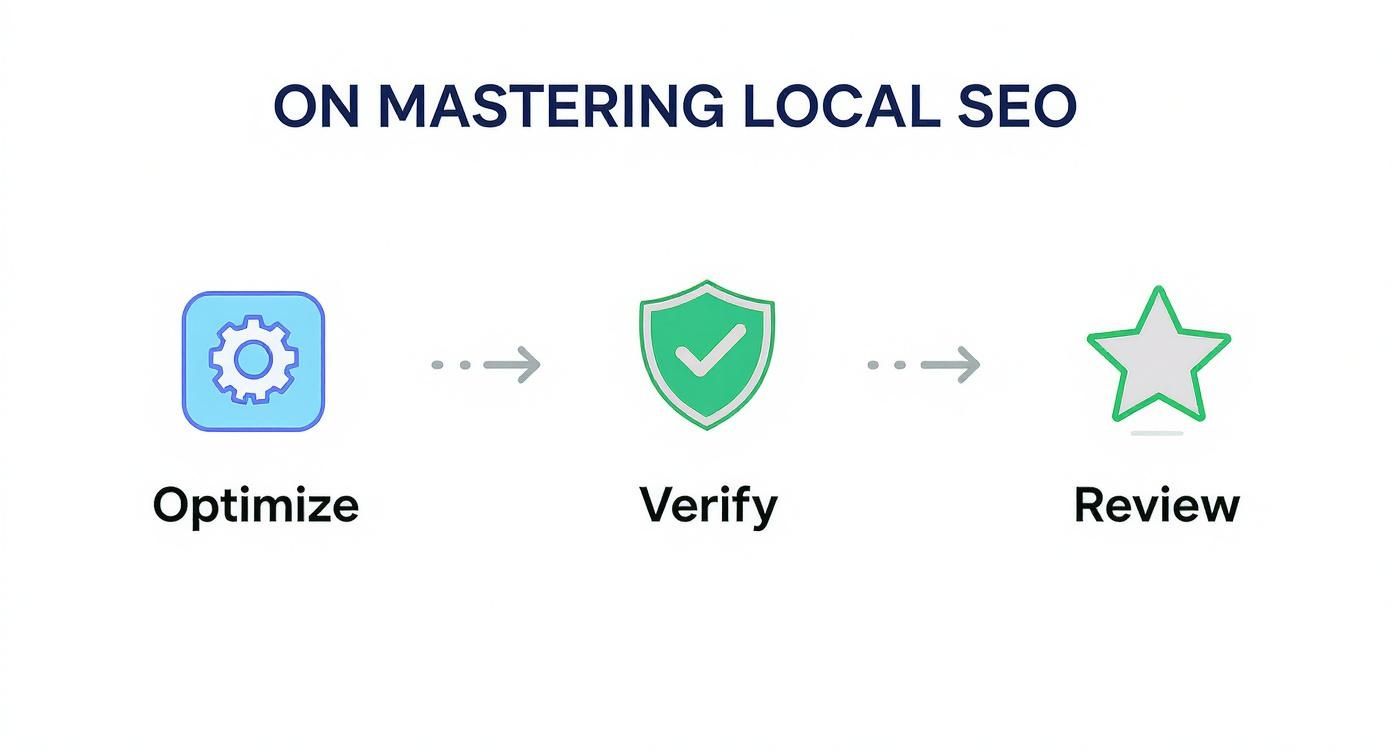
The main takeaway here? Local SEO is a continuous loop. It's about constant refinement, verification, and engagement that builds both your visibility and your credibility.
Choosing Your Core Categories
First things first, you need to tell Google exactly what you do. This sounds simple, but getting your categories right is a massive signal to the search engine.
Your primary category must be "Dentist." After that, add secondary categories that highlight your specialities. Are you a "Cosmetic Dentist," a "Paediatric Dentist," or an "Orthodontist"? Get specific.
This precision is what helps you show up in those high-intent searches. A patient looking for an "Invisalign specialist" is far more likely to find your clinic if "Orthodontist" is one of your listed categories. You can learn more about dialling in these details in our full guide to optimising your Google Business Profile.
Crafting a Compelling Business Description
Your business description is your chance to stop being just another listing and start connecting with potential patients. Sure, you need to include keywords like "family dentistry" or "teeth whitening," but the real goal is to address patient needs and calm their anxieties.
A great description doesn’t just list what you do; it communicates empathy and expertise. It tells patients why they should trust you with their oral health, turning a quick search into the start of a long-term patient relationship.
Skip the generic corporate-speak. Try something that speaks directly to a patient's worries: "We provide gentle, modern dental care for the whole family, focusing on creating a comfortable and stress-free experience for even our most anxious patients."
Here’s a quick checklist to make sure your profile is firing on all cylinders. This table covers the essential elements you need to complete for a fully optimised GBP that pulls in local patients.
Google Business Profile Optimization Checklist
| Element | Action Required | Impact on Ranking |
|---|---|---|
| Business Name | Ensure it matches your official practice name exactly. | High |
| Primary Category | Set to "Dentist." | High |
| Secondary Categories | Add all relevant specialities (e.g., Cosmetic Dentist). | Medium-High |
| Address & Service Areas | Verify your physical address and define your service radius. | High |
| Phone Number | Use a consistent, local phone number. | High |
| Website | Link to your practice’s homepage or booking page. | High |
| Business Description | Write a patient-focused description with keywords. | Medium |
| Photos & Videos | Upload high-quality images of your team, clinic, and work. | Medium-High |
| Services | List all specific services with descriptions and prices. | Medium |
| Reviews | Actively request and respond to all patient reviews. | High |
| Google Posts | Regularly share updates, offers, and practice news. | Medium |
| Q&A Section | Proactively add and answer common patient questions. | Medium |
Completing every item on this checklist sends powerful trust signals to Google and gives potential patients all the information they need to choose you over a competitor.
The Power of NAP Consistency and Citations
One of the cornerstones of local SEO is keeping your Name, Address, and Phone Number (NAP) identical everywhere online. Even tiny discrepancies—like "St." vs. "Street"—can confuse search engines and weaken your local authority.
This consistency has to extend to online directories, which we call citations. Building out solid profiles on high-authority sites like Yelp, Yellow Pages, and health-specific directories like Healthdirect Australia reinforces your location and proves your credibility to Google.
Turning Patient Feedback into a Marketing Asset
Reviews are the currency of trust for any local business. A steady stream of positive, recent reviews is one of the most powerful ranking factors for showing up in the Google local map pack. You need a simple, consistent way to ask happy patients to share their experiences online.
Just as important is how you handle them. Responding to all reviews—good and bad—shows you’re listening and that you value patient feedback. It turns every comment into a public demonstration of your commitment to outstanding care. If you're looking to build a dominant local presence, developing a practical small business SEO strategy is non-negotiable.
The results of a well-run local SEO campaign can be huge. We’ve seen Australian dental practices using these strategies report incredible growth, with some seeing over 600% more monthly calls and contact form submissions. One clinic even saw a 48% jump in website traffic in just two months after getting their local signals right, directly fuelling their patient pipeline.
Designing a High-Converting Dental Website
Getting people to your website is only half the job. The real challenge? Turning those clicks into actual appointments. That’s where a high-converting website design comes in, and frankly, it makes all the difference.
Your website isn't just a digital brochure. It’s your hardest-working marketing asset, pulling in and securing new patients 24/7. Too many practices get caught up in aesthetics alone, but a truly effective site blends sharp design with smart, strategic functionality. It’s all about creating a smooth journey that guides a potential patient from their first glance to booking a consultation.
Nail Your Value Proposition—Fast
When someone lands on your homepage, you’ve got about three seconds to convince them they’re in the right place. Your value proposition needs to instantly answer their unspoken question: "Why should I choose this dental practice over all the others?"
This message has to be front and centre, spelling out what makes you unique. Do you specialise in gentle care for nervous patients? Offer the latest cosmetic treatments? Provide flexible family scheduling? Whatever your special sauce is, make it impossible to miss.
A weak or buried value proposition is one of the main reasons people bounce. A strong one, on the other hand, creates an instant connection and invites them to look around. This single element is a cornerstone of effective SEO for dentists because it directly improves key metrics like bounce rate and how long people stick around.
Speak to the Patient, Not Just the Procedure
Let’s be honest: choosing a dentist is a personal, often stressful, decision. Patients are worried about pain, cost, and feeling judged. Your website’s messaging has to meet these fears with empathy and reassurance.
Stop talking about your services as clinical procedures and start framing them as solutions to your patients' problems. Instead of just listing "Root Canal Therapy," explain how it gets them out of pain and saves their natural tooth. This simple shift turns a dry, technical list into a compassionate, helpful conversation.
The most successful dental websites speak directly to patient emotions. They build trust by acknowledging anxieties and positioning the practice as a safe, supportive, and expert solution.
Sprinkle in patient testimonials or case studies that showcase positive experiences, especially from those who were anxious at first. This kind of social proof is incredibly powerful for calming nerves and building the confidence someone needs to pick up the phone.
The Must-Have Features for a Modern Dental Website
A high-converting site is more than just nice photos and convincing words; it needs a solid technical foundation. Some features are no longer just "nice-to-haves"—they're essential for meeting patient expectations and ranking well in Google.
- Responsive Mobile Design: The vast majority of your potential patients will find you on their phone. Your site must work flawlessly on any screen, with big, easy-to-tap buttons and text that doesn’t require pinching and zooming.
- Speedy Page Loads: If your site takes longer than three seconds to load, you’re losing people. It’s that simple. Optimised images and clean code are non-negotiable for keeping visitors from clicking away.
- Seamless Online Booking: Modern patients expect convenience. A prominent, easy-to-use online booking system is an absolute conversion machine. In fact, Australian data shows that 94% of top-performing dental websites have online booking, leading to a massive +412% increase in their conversion rates.
- Clear Calls-to-Action (CTAs): Every single page should have a clear, compelling CTA like "Book Your Appointment" or "Schedule a Free Consultation." Don't make visitors guess what to do next.
These features all work together to create a frictionless experience for your visitors. For a deeper look, our guide covers the key elements of modern website design in much more detail.
When you analyse the top-performing dental websites in Australia, the gap between the best and the rest is staggering. The top 1% achieve an 11.4% conversion rate—that’s a whopping 38 times higher than the 0.3% average. These elite practices effectively capture 73% of all online patients in their local area.
Once your site's design and functionality are dialled in, you can explore other proven ways to improve website conversions to make sure your practice is turning every possible click into a new patient.
Creating Content That Attracts New Patients
Great content is the engine of any dental SEO strategy that actually works. It does more than just get you found on Google; it answers the real, pressing questions your potential patients are asking, calms their anxieties, and builds enough trust for them to finally pick up the phone.
It's time to ditch the generic service descriptions and build a content plan that’s laser-focused on patient acquisition.
This all starts by digging deep into what your ideal patients are actually typing into that search bar. They aren't just looking for a "dentist near me." They’re asking specific, high-intent questions that tell you they're ready to make a decision.
Uncovering What Patients Really Want to Know
The secret to powerful content is understanding the intent behind the keywords. Someone searching for "dental implant cost" has a completely different need from someone searching for "sore gums." Your content has to nail these specific queries to be effective.
Using tools like SEMrush or even the free Google Keyword Planner, you can uncover a goldmine of long-tail keywords. These are the longer, more specific phrases that show you exactly what a person needs. They’re less competitive and, frankly, convert much better because they target patients who are much further down the decision-making funnel.
The goal isn't just to get traffic; it's to attract the right traffic. Focusing on high-intent keywords means the people finding your website are the ones most likely to become new patients for your high-value services.
Instead of only targeting a broad term like "teeth whitening," you might find people searching for "cost of Zoom whitening in Sydney" or "how to whiten sensitive teeth at home." This insight is everything—it lets you create hyper-relevant content that speaks directly to their concerns.
Building High-Value Service Pages That Convert
Think of your service pages for treatments like dental implants, Invisalign, or veneers as your digital sales team. They need to be comprehensive, persuasive, and perfectly optimised. A thin page with a few bullet points and a stock photo just won't cut it anymore.
A truly effective service page must include:
- A Clear Explanation: Break down the treatment in simple, patient-friendly language. No technical jargon allowed.
- Benefits, Not Just Features: Don't just list what it is; explain how it solves their problem—restoring their smile, boosting confidence, or ending their pain.
- The Treatment Process: Walk them through every single step. This is huge for easing anxiety.
- Frequently Asked Questions (FAQs): Answer their questions before they even have to ask. Cover cost, recovery time, pain, and who makes a good candidate.
- Social Proof: This is non-negotiable. You need before-and-after photos and genuine patient testimonials to build credibility and show off your results.
For example, a top-tier dental implants page should cover everything from the first consultation to the final restoration, including financing options and long-term care. That level of detail signals expertise to both Google and your potential patients.
Driving Engagement with Problem-Solving Blog Content
While your service pages target patients who are ready to book, your blog is where you build relationships with everyone else. This is your chance to become the go-to educational resource in your local community.
Your blog lets you rank for a huge range of informational keywords, catching patients early in their research journey. This is a fundamental part of a strong SEO for dentists strategy because it establishes your authority long before someone needs an emergency root canal.
So, what should you write about? Just think about the common problems and questions you hear in the clinic every single day. Those are your best content ideas, right there.
The table below shows how you can turn a patient's problem into a specific keyword and a blog post that pulls them into your world.
High-Intent Patient Keyword Ideas
| Patient Need | Example Keyword | Content Idea |
|---|---|---|
| Cosmetic Improvement | "veneers vs composite bonding" | A detailed comparison post with pros, cons, costs, and longevity for each treatment. |
| Addressing Fear | "how to overcome dental anxiety" | A compassionate guide with practical tips and an explanation of the sedation options you offer. |
| Financial Concerns | "Invisalign payment plans Sydney" | A dedicated page breaking down your financing options, insurance coverage, and payment schedules. |
| Urgent Care | "what to do with a chipped tooth" | An emergency guide explaining immediate steps and when to see a dentist, positioning you as the solution. |
When you create content that genuinely helps people, you're building a powerful digital asset for your practice. Each blog post is another opportunity to connect with a potential patient, answer their questions, and gently guide them toward scheduling a consultation when they're ready.
This approach transforms your website from a static online brochure into a dynamic, patient-generating machine.
Building Authority with Off-Page Dental SEO
In healthcare, trust is everything. While your on-page and technical SEO are busy fine-tuning your website, your off-page SEO is out there building your practice's reputation across the web. This is all about earning signals of trust from other reputable online sources, proving to Google that you're a genuine authority.
This process, often called link building, isn't a numbers game. Forget collecting as many links as you can. It’s about earning high-quality "votes of confidence" from other relevant websites. Think of each quality backlink as a professional referral that boosts your digital standing and tells search engines your practice is a credible leader.
Forge Meaningful Local Partnerships
One of the most authentic ways to build authority is by connecting with your local community. Your best link-building opportunities often come from professional relationships you already have or can easily build right in your neighbourhood.
Start by thinking about other healthcare providers whose services complement yours. This could be local GPs, physiotherapists, or specialist medical centres. A simple but effective strategy is to offer to write a guest article for their blog on a topic like "The Connection Between Oral Health and Overall Wellbeing." In return, you get a valuable backlink from a relevant, trusted local source.
Extend this outreach to other community pillars:
- Local Sports Clubs: Sponsoring a junior footy or netball team can often score you a link from their website's sponsors page. It's a fantastic way to build goodwill and a powerful local backlink at the same time.
- Community Organisations: Get involved with local charities or schools. Participating in a health fair or giving a talk on dental hygiene can lead to features and links on their event pages or newsletters.
- Business Associations: If you haven't already, join your local chamber of commerce or business improvement association. These memberships almost always include a listing in their online directory with a link back to your site.
Gain Visibility Through Media and Publications
Securing mentions in local media or contributing to health-focused publications can seriously amplify your authority. Local journalists and bloggers are always on the hunt for expert sources to comment on health-related stories.
Position yourself as the go-to dental expert in your area. You can use services like SourceBottle to connect with journalists looking for quotes. Contributing a professional opinion on a trending topic can result in high-authority media backlinks that are incredibly valuable for SEO.
A single, high-authority backlink from a respected health publication or local news site is worth more than dozens of low-quality links. It's a powerful signal to Google that your practice is a legitimate and trustworthy leader in the dental field.
And don't forget the power of patient feedback. While reviews on your Google Business Profile are crucial, encouraging patients to leave reviews on other platforms like Yelp or specialised health directories builds a much broader reputation. Our detailed guide on how to get more Google reviews has tactics you can apply across the web.
The goal here is to create a natural, diverse, and authoritative backlink profile. It tells a consistent story to search engines: your dental practice isn’t just another business—it’s a respected, integral part of the community’s healthcare network. This is the kind of digital authority that drives higher rankings and attracts high-value patients.
Getting the Technical SEO Right for Your Practice Website
Great content and local reviews are fantastic, but they’re only half the story. If your website's 'foundations' are shaky, all your other marketing efforts will be fighting an uphill battle. This is what we call technical SEO—making sure search engines like Google can easily find, crawl, and understand your site.
Don't let the word "technical" scare you. You don't need to be a coding whiz to get the basics right, and these fundamentals pack a serious punch when it comes to getting more patients through your door.
Security and Trust Starts with HTTPS
First things first: your website absolutely must be secure. Look at your URL. Does it start with HTTPS? That 'S' stands for secure, meaning any information shared between a patient's browser and your site is encrypted.
Google has used this as a ranking signal for years, but for a dental practice, it’s about more than just SEO. Patients are trusting you with their personal health information. If they see a "Not Secure" warning in their browser, that trust is broken before they’ve even had a chance to book. It’s a non-negotiable for building credibility.
Your Website Must Work Flawlessly on a Phone
Think about how people find you. They’re searching on their phone during a lunch break, looking up directions on the way to their appointment, or scrolling while on the couch. The patient journey almost always starts on a mobile device.
That’s why Google uses mobile-first indexing. It ranks your site based on how well it works on a phone, not a desktop.
A website that’s a pain to use on mobile—with text that’s too small to read or buttons you can’t tap—isn’t just annoying for visitors. It's actively telling Google that you don't offer a good experience, which will tank your rankings.
A slick mobile design does more than just keep Google happy; it directly leads to more bookings. When you combine a responsive website with clear calls-to-action, you can see conversion rates jump by 30% or more. Modern tools like live chat or AI receptionists take this even further, helping you capture leads 24/7. We’ve seen this boost patient acquisition time and time again.
Page Speed: Every Second Counts
How fast your website loads can make or break a new patient lead. We live in an impatient world. If your site takes more than a few seconds to appear, that potential patient is hitting the 'back' button and heading straight to your competitor.
What usually causes a slow site?
- Massive image files: Those beautiful, high-res photos of your clinic need to be compressed for the web.
- Clunky code or too many plugins: A bloated website is a slow website.
- Cheap, slow web hosting: Your server's performance is the engine of your site. Don't skimp on it.
Jump onto Google's PageSpeed Insights tool. It’s free and will show you exactly what’s slowing your site down and how to fix it. Faster site = happier patients and better rankings. Simple as that.
Tell Google Exactly What You Do with Structured Data
Structured data, or Schema markup, is a bit like adding labels to the information on your website so search engines can understand it perfectly. Instead of just seeing a block of text, Google can identify your address, opening hours, and the specific services you offer.
For a dental practice, this is incredibly powerful. You can use specific Schema to highlight:
- LocalBusiness: Clearly states your practice name, address, phone number (NAP), and hours.
- MedicalProcedure: Describes services like teeth whitening, dental implants, or Invisalign.
- Review: Pulls in your patient ratings so they can appear as gold stars right in the search results.
When you get this right, Google might reward you with rich snippets—those eye-catching search listings with star ratings, FAQs, or other details. They take up more space, grab attention, and seriously improve the chances of someone clicking on your practice instead of the one above or below it.
Common Questions About SEO for Dentists
When it comes to digital marketing, a lot of questions come up. We hear the same ones from practice owners all the time, so let's get you some clear, straight answers on SEO for dentists.
How Long Does SEO Really Take to Show Results for a Dental Practice?
SEO is a long game. It’s about building a solid foundation for your practice's growth, not flipping a switch for overnight results.
You can usually expect to see some early positive signs within 4 to 6 months of consistent work. This might be a bump in rankings for less competitive local searches or more calls coming from your Google Business Profile.
But for the big wins—think first-page rankings for high-value terms like "dental implants Sydney" and a predictable stream of new patient enquiries—you're typically looking at 6 to 12 months. Factors like how fierce the local competition is, the state of your website when you start, and the intensity of the strategy all play a big role in this timeline.
Should I Focus on Local SEO or General SEO?
For any dental clinic, local SEO is the absolute priority. Full stop. Your patients live and work in the surrounding suburbs, so winning the search battle in your backyard is everything.
That means your first job is to nail your Google Business Profile, consistently gather patient reviews, and target keywords with local intent (like "emergency dentist in Newtown"). This is what gets you found by people who are physically nearby and ready to make a booking.
Think of local SEO as getting your practice on the map. General SEO, like creating authoritative blog content on dental topics, is what proves you're the best destination on that map.
The two are a team. Strong general SEO will absolutely boost your local efforts, but your foundation must always be local.
Can I Handle My Dental SEO In-House or Should I Hire an Agency?
It’s tempting to try and manage it yourself, and a tech-savvy practice manager can certainly handle basic tasks like updating your Google Business Profile. But true SEO is a complex, full-time discipline where the goalposts are always moving.
A specialised dental SEO agency brings a few things to the table you just can't replicate in-house:
- Expert Knowledge: They live and breathe this stuff. They know about Google's updates before they even happen.
- Expensive Tools: Professional agencies invest in powerful software for keyword research, competitor analysis, and rank tracking that would be far too costly for a single practice.
- Proven Strategies: They’ve seen what actually works for dentists, saving you months of painful and expensive trial and error.
For almost every busy practice owner, partnering with a reputable agency delivers a far stronger return on investment. It frees you and your team up to do what you do best—looking after your patients.
Ready to stop wondering and start ranking? Homer Digital Marketing builds proven SEO systems that attract your ideal patients and grow your practice. We combine decades of experience with smart automation to deliver results you can see.
