

Think your LinkedIn profile is just a digital resume gathering dust? For Australian professionals, it's so much more. This platform is an active, dynamic career ecosystem where your next client, job, or business partner is waiting—if you know how to connect with them. Getting your LinkedIn strategy right is crucial, and this guide will show you exactly how.
Why Your LinkedIn Presence Matters in Australia

Let's be honest—many service-based business owners see LinkedIn as an afterthought. It's often a place to park your career history and just hope for the best.
But in Australia, this "set and forget" approach means leaving huge opportunities on the table. The platform has evolved far beyond its roots as a job-seeking site. It’s now the primary hub for professional branding, networking, and yes, generating real leads.
The sheer scale of its adoption down under tells the story. As of early 2025, LinkedIn had around 17.02 million users in Australia—that’s nearly 62% of the country's population. A massive chunk of these users, almost 7.9 million, are in the prime professional age group of 25 to 34. This isn’t a niche platform; it’s a fundamental part of Australia’s professional fabric. You can find more detail on LinkedIn user demographics in Australia here.
This guide is designed to shift your perspective. We'll move beyond the basics and give you a clear, actionable roadmap to transform your profile from a static placeholder into an active engine for business growth.
More Than Just a Digital CV
In the competitive Australian market, your reputation is everything. A well-optimised LinkedIn profile is your digital handshake, building credibility long before you ever meet someone.
It’s where potential clients vet your expertise, where peers validate your skills, and where industry leaders share the insights you need to know. Neglecting it is like showing up to a networking event without business cards—you're just not in the game.
Your LinkedIn profile works for you 24/7. It’s your most powerful personal branding asset, showcasing your expertise and building trust while you focus on actually running your business.
The Tangible Business Benefits
For service-based businesses—from consultants and coaches to real estate agents and tradies—the return on investing time in LinkedIn is real. It gives you a direct line to decision-makers and lets you build relationships based on value, not cold pitches. This guide will show you exactly how to do that.
Here's what a strategic LinkedIn presence can actually do for your business:
- Generate High-Quality Leads: Connect directly with your ideal clients by showing them you understand their problems and have the solutions.
- Build Authority and Trust: Consistently sharing valuable content positions you as the go-to expert in your field. People buy from those they know, like, and trust.
- Expand Your Professional Network: Cultivate meaningful relationships that lead to referrals, partnerships, and doors you didn't even know existed.
- Increase Your Visibility: An active profile makes you discoverable to people who are actively searching for the services you offer.
Throughout this guide, we will cover everything from crafting a magnetic profile to publishing engaging content and generating real business leads—all tailored for the unique Australian professional landscape.
Let’s get started.
Building a LinkedIn Profile That Gets Noticed

Think of your LinkedIn profile as your digital storefront. First impressions are made in seconds, and for a service-based business owner, this isn't just an online resume—it's the home base for your professional credibility.
A killer profile doesn't just list what you do. It tells a story about why you do it and, more importantly, who you help. It's working 24/7 to pull in your ideal clients, build trust, and open doors you didn't even know existed.
Let's break down exactly how to craft each piece for maximum impact.
Crafting a Magnetic First Impression
When someone lands on your profile, they make a snap judgment. It all comes down to three things: your photo, your banner, and your headline. Getting these right isn't just important; it's non-negotiable.
Your profile photo needs to be a professional headshot. Look at the camera, smile, and let your confidence and approachability shine through. Ditch the blurry pictures, group shots, or holiday snaps.
Your banner image is prime real estate, so don't leave it as the default blue background. Use it to flash your value proposition. Add your logo, a sharp tagline, or a picture of you in your element—speaking at an event or consulting with a client.
Writing a Headline That Sells
Your headline is probably the single most important bit of text on your entire profile. It follows you everywhere—in search results, when you comment, and in every connection request you send. It has to do more than just state your job title.
A great headline clearly spells out:
- Who you help: e.g., "Helping Service-Based Businesses…"
- What you help them achieve: e.g., "…Attract Ideal Clients & Scale with AI Marketing"
- Your expertise: e.g., "LinkedIn & Google Optimisation Specialist"
Treat it like your elevator pitch. It needs to be loaded with the keywords your dream clients are typing into the search bar.
Pro Tip: Drop the generic "Founder" or "CEO." Focus on the result you deliver. A headline like "Helping Accountants Streamline Operations with Automated Systems" is far more powerful and searchable than "Director at ABC Consulting."
Weaving Your Story in the About Section
The "About" section is your chance to really connect with your audience. This is where you go beyond what you do and dive into why it matters. But you have to make it readable.
Start with a hook that speaks directly to your reader's biggest pain point. Then, lay out how you solve that problem and what makes your approach different.
Use short paragraphs, bullet points, and maybe even a few well-placed emojis to break up the text. And always, always end with a clear call to action. Tell people what to do next, whether it’s booking a call, visiting your website, or connecting with you.
Showcasing Skills and Securing Endorsements
The skills section is a keyword goldmine for the LinkedIn algorithm. It helps the platform understand what you're an expert in. Pin your top three, most critical skills right at the top of the list.
Then, encourage your connections—especially past clients—to endorse you for those specific skills. An endorsement is a quick thumbs-up that adds a layer of social proof. While they don't have the same punch as a written recommendation, a high endorsement count for relevant skills definitely boosts your credibility.
Speaking of which, we dive much deeper into this in our guide on what to include in your LinkedIn profile.
The Power of Recommendations and Custom URLs
Written recommendations are pure gold. They are powerful testimonials that build a massive amount of trust. Be proactive here—ask your happy clients to write a brief recommendation for you. A great way to get the ball rolling is to offer to write one for them first.
Lastly, grab your custom profile URL. A default URL looks messy (e.g., linkedin.com/in/john-smith-a1b2c3d4). Change it to something clean and professional, like linkedin.com/in/yourname or linkedin.com/in/yourbusinessname. It's a small detail that makes you look polished and makes your profile much easier to share.
Remember, Australians spend only about 11 minutes on LinkedIn per session, so your profile has to hit hard and fast. Despite that short window, the platform is a beast—globally, about 6 people are hired every minute. It just goes to show you need a profile that isn't just complete, but truly compelling.
Developing Your LinkedIn Content Game Plan
An optimised LinkedIn profile is a great start, but it's only half the battle. Think of it like a beautiful shopfront—if the doors never open, no one will come inside. Your content is what opens those doors, inviting your ideal clients in to see what you're all about.
This isn't about becoming a full-time content creator or posting for the sake of it. It’s about building a smart, sustainable plan to share your expertise, solve real problems for your audience, and start valuable conversations. Forget the pressure to be everywhere at once; quality beats quantity every single time.
Understanding the Content Landscape
On LinkedIn, not all content formats are created equal. Each one serves a different purpose, and knowing which tool to pull from your toolkit is what separates the pros from the amateurs. You wouldn't use a hammer to turn a screw, right?
The best part is, the variety of formats lets you connect with different people in different ways. Some of your audience will love quick, scannable text posts, while others prefer the deep dive of an article or the personal touch of a video. By mixing it up, you cast a wider net.
This infographic shows a clear link between the type of content you post and the engagement it gets, as well as how consistency drives follower growth.
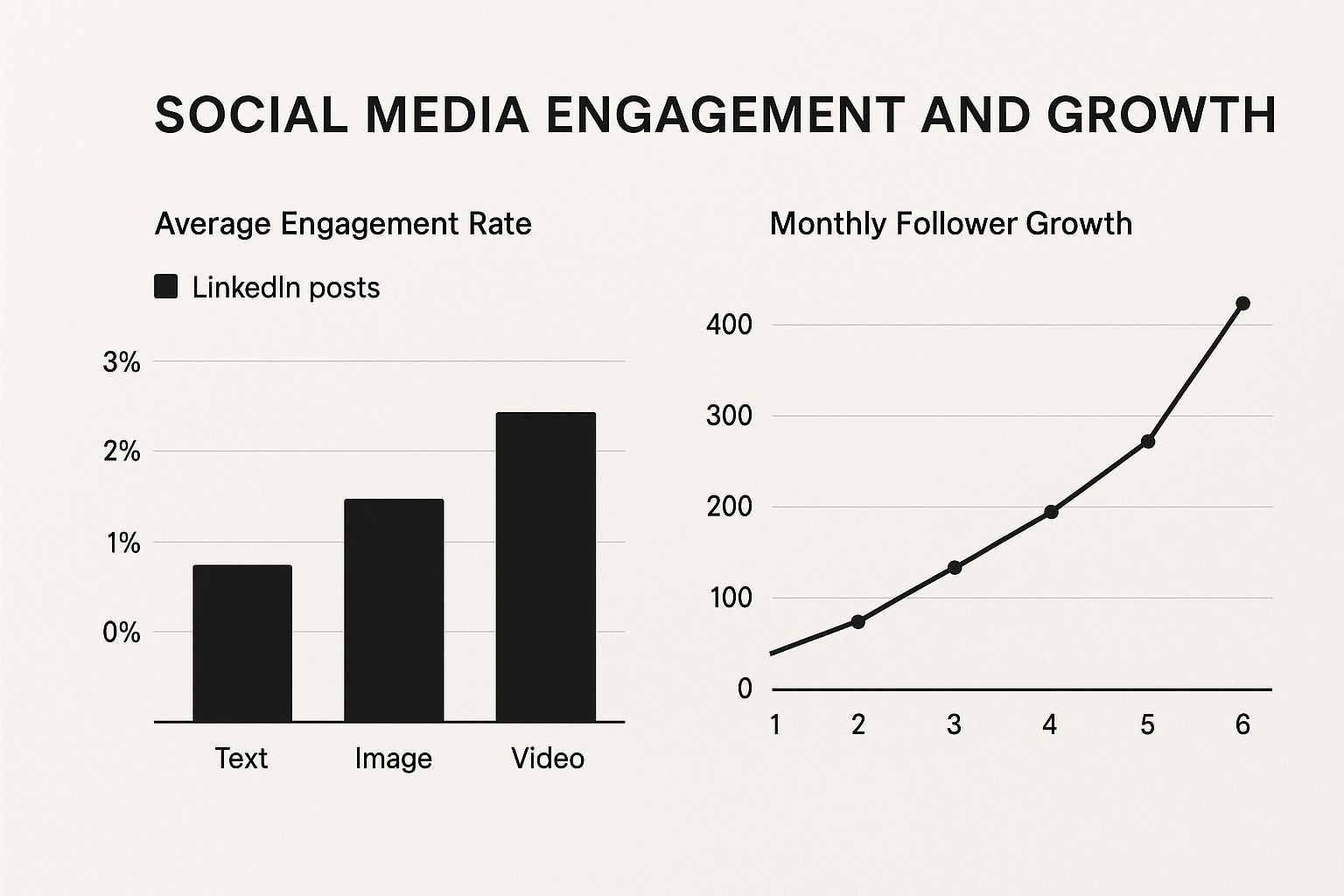
As you can see, visual content like images and videos are brilliant for grabbing attention, while a steady publishing rhythm is what builds your audience over the long haul.
Choosing the Right Format for Your Message
Let's break down the most popular content types and where they fit into your strategy.
-
Text-Only Posts: These are your bread and butter. They’re perfect for sharing a quick insight, asking a thought-provoking question, or telling a short, punchy story. The best thing about them? They are fast to create and super easy for people to digest while scrolling.
-
Image Posts: A powerful image or a well-designed graphic can literally stop the scroll. Use them to visualise data, highlight a killer quote, or give a behind-the-scenes peek at your business. Fun fact: posts with images get, on average, twice as many comments as text-only posts.
-
Video Content: Nothing builds connection and trust faster than video. Short-form videos (think under 90 seconds) are brilliant for sharing tips, answering common questions, or offering a personal take on an industry trend. It lets your audience see and hear the real you.
-
LinkedIn Articles: When you've got more to say than a short post allows, an article is your best friend. This is the place for in-depth guides, detailed case studies, or sharing your unique perspective on a bigger topic. Plus, they're indexed by Google, giving your expertise a much longer shelf life.
-
Polls: Don't underestimate the power of a simple poll. They are a fantastic, low-effort way to spark engagement and do a bit of sneaky market research. Ask your audience about their biggest challenges or get their opinion on a hot topic to kickstart a great conversation in the comments.
A common mistake is trying to do everything at once. Pick one or two formats that feel natural for you and just focus on getting consistent with those. It’s far better to master a couple of formats than to be mediocre across all of them.
To help you decide, here’s a quick breakdown of how different content types work best.
LinkedIn Content Type Effectiveness
| Content Type | Best For | Key Tip for Success |
|---|---|---|
| Text-Only Posts | Sharing quick insights, asking questions, and storytelling. | Keep it concise and add a clear call-to-action to encourage comments. |
| Image Posts | Visualising data, sharing quotes, and behind-the-scenes content. | Use high-quality, branded images. Avoid generic stock photos. |
| Video | Building personal connection, tutorials, and answering FAQs. | Add captions! Most users watch videos with the sound off. |
| Articles | In-depth analysis, case studies, and establishing thought leadership. | Break up text with subheadings, images, and bullet points for readability. |
| Polls | Driving quick engagement and gathering audience feedback. | Keep the question simple and the options clear (max 4). |
Choosing the right format for your message ensures it lands with the right impact, helping you connect more effectively with your target audience.
Creating a Content Pillar Strategy
Feeling a bit overwhelmed by the idea of creating content every week? You need a content pillar strategy. It's a game-changer.
Instead of waking up and thinking, "What on earth do I post today?", you'll have 3-5 core themes or "pillars" that are central to your expertise and directly address your audience's pain points.
For an Australian business consultant, these pillars might be:
- Business Scalability: Sharing tips on how to grow without the burnout.
- Team Leadership: Practical strategies for hiring and managing A-players.
- Financial Management: Simple advice for improving cash flow and profitability.
- Client Success Stories: Showcasing real-world results and transformations.
Now, every piece of content you create—whether it's a text post, a video, or a long-form article—stems from one of these pillars. This approach keeps your messaging consistent, relevant, and focused.
More importantly, it makes creating content a thousand times easier. You're never starting from a blank slate. You just ask yourself, "What can I share about business scalability today?" This framework gives you direction and helps you build a rock-solid reputation as the go-to expert in your niche.
Networking That Builds Real Relationships

It’s easy to get caught up chasing connection numbers on LinkedIn. But let's be honest, a network of 5,000 strangers is nowhere near as valuable as 50 genuine, professional relationships.
Real networking isn’t about collecting contacts like trading cards. It's about cultivating connections that actually open doors, spark collaborations, and lead to real business opportunities. The goal is to shift your mindset from "What can I get?" to "What can I give?". When you lead with value, you build trust and lay the groundwork for a relationship that goes way beyond a single transaction.
The Art of the Personalised Connection Request
That default "I'd like to connect with you on LinkedIn" message? It’s the digital equivalent of a limp, awkward handshake. It shows zero effort and gives the other person absolutely no reason to accept.
To stand out, every single connection request you send needs to be personal. Your aim is to quickly find some common ground or show you’ve actually paid attention. It’s not complicated, but it does take a moment of thought. Before you hit that ‘connect’ button, take 30 seconds to scan their profile for a hook.
Here are a few simple frameworks that work wonders:
- Mutual Connection: "Hi [Name], I see we're both connected to [Mutual Connection's Name]. I'm looking to expand my network with other professionals in the [Your Industry] space and would love to connect."
- Shared Group: "Hi [Name], I noticed we're both in the [LinkedIn Group Name] group. I really enjoyed your recent comment on [Topic] and thought it would be great to connect."
- Recent Activity: "Hi [Name], I just read your excellent article on [Article Topic]. Your point about [Specific Point] really hit home. I'd love to follow your work more closely."
- Shared Experience: "Hi [Name], I saw from your profile that you also went to [University/Event]. It would be great to connect with a fellow alum!"
These simple, personalised notes dramatically boost your acceptance rate. Why? Because they show you’re interested in them as a person, not just another number.
A personalised connection request is your first chance to show you bring value. It says, "I see you, I've paid attention, and I think we have a real reason to connect." This immediately sets you apart from the 90% of users who don't bother.
From Connection to Conversation
Once someone accepts your request, the real work begins. The goal isn't to immediately pitch your services—that’s a huge turn-off. It’s about gently nurturing that new connection.
A simple "Thanks for connecting, [Name]. Looking forward to seeing your insights," is a decent start. But you can do better. Try offering something of value with no strings attached.
For example: "Thanks for connecting, [Name]. I noticed you're in the [Their Industry] sector. I recently came across this insightful report on [Relevant Topic] and thought you might find it interesting. [Link to report]. Cheers!"
This simple act positions you as a helpful resource, not a pushy salesperson.
Nurturing Relationships in LinkedIn Groups
LinkedIn Groups are powerful but so often overlooked. Think of them as virtual conference rooms filled with professionals from specific industries or with shared interests. Joining and participating in the right groups puts you directly in front of your ideal clients and peers.
But just joining isn't enough. The key is active participation.
- Find the Right Groups: Use the search bar to find groups relevant to your industry and, just as importantly, your clients' industries. Look for active communities where people are actually talking.
- Listen First: Before you jump in, spend some time just observing the conversations. What are people asking? What challenges are they facing? What gets a good reaction?
- Add Value: Don’t just drop links to your own content. Answer questions, offer your perspective, and share genuinely helpful resources. When you become a trusted voice in a group, you build authority and start attracting inbound leads without even trying.
By consistently showing up and being helpful, you build a reputation that makes people want to connect with you. That’s the secret to building a network that actually works for you.
Using LinkedIn for Business and Lead Generation
For Aussie entrepreneurs, consultants, and anyone in sales, LinkedIn is so much more than just a place to network—it's a goldmine. Having a polished profile and a decent content plan is the starting point, but the real magic happens when you turn your presence into a predictable lead-generation machine.
This means switching from a passive observer to an active, strategic prospector.
It’s a total mindset shift. Instead of just shouting about your services and hoping someone bites, you need to get focused on identifying your ideal clients and building genuine connections. It's a methodical process that turns cold contacts into warm conversations and, eventually, happy clients.
Pinpointing Your Ideal Clients
First things first: get laser-focused on who you want to reach. LinkedIn's own search function is a surprisingly powerful tool for this. You can filter users by their job title, industry, company size, and location.
Think about your perfect client.
- What’s their job title? (e.g., "Marketing Manager," "Founder," "HR Director")
- What industry are they in? (e.g., "Financial Services," "Real Estate," "SaaS")
- Where are they located in Australia? (e.g., "Sydney," "Melbourne Area")
Using these specific filters helps you cut through all the noise and build a targeted list of high-potential leads. This isn't about spamming everyone; it's about precision.
The Organic Outreach Workflow
Once you have your list, the goal is to build a connection based on value, not a sales pitch. This organic approach takes a bit of patience, but it builds much stronger, more authentic relationships.
- Engage Before Connecting: Before you even think about sending a request, go and interact with their content. Like or comment on a post they've shared. This simple step makes your name familiar before you land in their inbox.
- Send a Personalised Request: When you do connect, reference that interaction or a shared interest. A simple, "Hi [Name], I really enjoyed your recent post on [Topic] and would love to connect," is miles better than the generic default message.
- Transition to Conversation: After they accept, send a low-pressure direct message. Do not pitch. Instead, ask a question or offer a genuinely helpful resource to keep the conversation going.
This whole workflow is about playing the long game. You're positioning yourself as a helpful expert, which is absolutely crucial for building the trust you need to eventually make a sale.
Investing in Advanced Tools Like Sales Navigator
For those who are serious about scaling up their lead generation, investing in a tool like LinkedIn Sales Navigator can be a total game-changer. It unlocks far more advanced search filters, lead recommendations, and organisational tools to manage your pipeline right inside the platform.
This screenshot shows the Sales Navigator interface, highlighting just how deep you can go with its filtering capabilities for precise lead targeting.
As you can see, the tool lets you build super-specific lead lists based on criteria that go way beyond what the standard search offers. It’s a massive time-saver.
Sales Navigator is like switching from a standard fishing rod to a sophisticated sonar system. It helps you find exactly who you're looking for, understand their needs through their activity, and engage at the perfect time.
While it’s not essential for beginners, it quickly becomes invaluable as you scale your outreach. It helps you stay organised and makes sure no high-value lead slips through the cracks. In our experience, it can seriously streamline the process, something we cover in our analysis of leveraging LinkedIn for business growth.
It's also worth noting that approximately 54% of Australian LinkedIn users are male, a demographic tilt that can be relevant if you're prospecting in industries like finance, tech, or engineering. With an advertising reach of 71.7% in Australia as of 2024, the platform's value as a B2B marketing tool is undeniable. You can find more insights about social media trends in Australia at Sprout Social. This data just underscores why you need a clear strategy to connect with the right decision-makers.
Got Questions About LinkedIn? We’ve Got Answers
Even with a great strategy, you’re bound to have questions as you start using LinkedIn more. Here are some of the most common ones we get, with straightforward answers to help you stay on track.
How Often Should I Post on LinkedIn?
This is a big one. The key is consistency, not just sheer volume. While some gurus will tell you to post every single day, that’s a fast track to burnout and flimsy content.
Instead, aim for 2-3 high-quality posts per week. It’s a sustainable pace that keeps you visible in your network’s feed without driving them crazy or watering down your message. Focus on posts that are genuinely useful to your audience.
Remember, one thoughtful, engaging post is always better than five rushed, generic ones. Quality beats quantity every time when you’re building authority.
Should I Accept Every Connection Request That Comes My Way?
Definitely not. Think of your LinkedIn network as a curated community, not just a numbers game. A massive but irrelevant network does nothing for lead generation or building real professional relationships.
Before you hit 'accept', do a quick mental check:
- Is this person in my target industry or a field that complements it?
- Could they be a future client, a strategic partner, or a valuable peer?
- Does their profile look legitimate and professional?
If the answers are mostly 'no', it's perfectly fine to ignore the request. A focused network is a powerful one.
What Is the Best Time to Post Content?
While the perfect time can depend on your specific audience here in Australia, there are definitely some clear patterns for engagement.
Generally, the sweet spots are during standard business hours. Think mid-morning (9-11 am) and early afternoon (1-3 pm) on weekdays. Tuesdays, Wednesdays, and Thursdays are usually the strongest days. Posting late at night or over the weekend is often a waste, as professional engagement drops off significantly.
Can I Have More Than One LinkedIn Account?
No, LinkedIn's rules are very clear on this: one person, one personal profile. Trying to maintain multiple accounts will just confuse your network and could get both of your profiles shut down.
If you’re running a business, the right way to do it is to create a dedicated LinkedIn Company Page. This page is then linked to and managed from your personal profile. For a full rundown on what to include to make your profile a powerhouse, check out our guide on optimising your LinkedIn profile elements. This keeps everything professional and ensures you're playing by the platform's rules.
Ready to turn your LinkedIn presence into a powerful lead-generation engine? Homer Digital Marketing specialises in helping service-based businesses attract ideal clients and scale with proven LinkedIn and Google optimisation strategies. Learn how we can help you grow.
