

Let's be clear: LinkedIn is no longer just a static online resume. It's a dynamic, breathing ecosystem where Australian businesses can build powerful connections, establish themselves as industry authorities, and generate high-quality leads. Are you leveraging it to its full potential?
Think of it less like a job board and more like a 24/7 virtual industry conference. The best part? Your ideal clients and partners are always there, actively looking for solutions. This guide will provide actionable steps to transform your LinkedIn presence.
Why LinkedIn Is Your Ultimate Business Growth Engine

The image above gets right to the heart of it: LinkedIn's mission is to connect professionals to make them more productive and successful. For service-based businesses in Australia, this is a golden opportunity to find, connect with, and nurture relationships with high-value clients in one dedicated space.
A Thriving Professional Network
LinkedIn has grown far beyond its roots as a recruitment platform. Today, it’s the definitive online hub for professional development, industry discussions, and B2B marketing. Its real power lies in the user's mindset—people are on LinkedIn to do business, learn, and network.
This creates a unique environment where your content and outreach are welcomed by an audience actively looking for solutions. Your ideal clients aren't just scrolling for entertainment; they're searching for experts who can solve their problems.
For Australian businesses, this isn't some niche market; it's a mainstream channel for serious growth. The professional context filters out the noise you find on other social networks, letting you have meaningful conversations that lead to real business outcomes.
The Scale of Opportunity in Australia
This isn't just a global trend; it's deeply woven into the Australian professional landscape. The numbers speak for themselves. As of 2024, there are around 13 million LinkedIn users in Australia, and that figure is tipped to hit nearly 13.9 million by 2028. You can discover more about Australian social media trends on sproutsocial.com.
This user base isn't just big; it's incredibly targeted. You can connect with decision-makers, industry leaders, and potential partners with a level of precision you just can't find anywhere else.
Key Pillars of a Powerful LinkedIn Strategy
So, how do you turn all this potential into profit? Success on LinkedIn comes down to four core activities, which we'll dive into throughout this guide:
- A Powerful LinkedIn Profile Makeover: Your profile is your digital shopfront. It must be optimized to attract and convert ideal clients by clearly communicating the problems you solve.
- Strategic LinkedIn Content: Publishing valuable, consistent content cements your authority and keeps you top-of-mind. It’s about helping your audience, not just selling.
- Authentic LinkedIn DMing: The inbox is where relationships are forged. A value-first approach to direct messaging can turn cold outreach into warm, genuine business conversations.
- Value-Driven LinkedIn Commenting: Engaging in relevant discussions showcases your expertise to a wider audience, attracting inbound interest and growing your network organically.
By mastering these four areas, you can build a reliable system for generating leads and growing your service-based business, one connection at a time.
Executing a Powerful LinkedIn Profile Makeover

Let’s be honest. Most professionals treat their LinkedIn profile like a dusty, digital resume. It’s a list of past jobs and skills that sits there, doing nothing. This is a massive missed opportunity.
Your profile is your digital handshake, your sales page, and your credibility builder, all rolled into one. To attract high-value clients, it needs to stop being about you and start being about them.
It must answer your ideal client’s biggest question in seconds: “What’s in it for me?” Shifting your profile from a passive history lesson to an active client magnet is what a real LinkedIn profile makeover is all about. The goal is to turn it into a resource that speaks directly to the problems your audience faces, positioning you as the only logical solution.
Craft a Client-Focused Headline
Think of your headline as the most valuable real estate on your entire profile. It follows you everywhere on LinkedIn—popping up in search results, next to your comments, and on every connection request you send.
A generic headline like "Founder at ABC Company" tells people what you are, but it doesn't tell them what you can do for them. It’s a dead end.
A powerful headline is your mini-elevator pitch. It needs to instantly signal who you help and the results you deliver. Making this one change can dramatically boost the number of relevant people who view your profile and want to connect.
Headline Makeover Example:
- Before: "Marketing Consultant"
- After: "Helping Australian Service Businesses Land High-Ticket Clients with Proven LinkedIn & Google Strategies | SEO & Content Authority"
The 'After' version immediately tells you the target audience (Australian service businesses), the outcome (high-ticket clients), and the methodology (LinkedIn & Google).
Write a Compelling 'About' Section
This is where you tell your story. The 'About' section (or summary) is your chance to move beyond job titles and make a genuine human connection. Ditch the stiff, third-person corporate speak. Write in the first person and frame your experience around the problems you solve for your clients.
A simple, effective structure works best:
- The Hook: Kick off with a sentence that hits on a major pain point your ideal client is experiencing.
- The Solution: Briefly explain how your approach solves that exact pain point.
- Credibility: Add social proof. Mention your years of experience, a key metric, or the types of clients you’ve helped.
- Call to Action: Tell them exactly what to do next. Should they connect with you? Book a call? Visit your website?
Your 'About' section should feel less like a corporate bio and more like the beginning of a helpful conversation. It’s your opportunity to build trust and show empathy before you ever speak to a potential client.
This simple shift turns your summary from a boring list of achievements into a story that actually resonates with your ideal clients.
Optimise Your Experience Section for Results
Please, don't just copy and paste your resume into the 'Experience' section. Each role you list is another chance to showcase tangible results and prove your expertise.
Instead of just listing your day-to-day responsibilities, use bullet points to highlight specific, measurable achievements. Think outcomes, not duties.
For example, instead of "Managed social media accounts," try "Grew client's LinkedIn engagement by 150% in six months, resulting in a 30% increase in inbound leads." See the difference? One is a task; the other is a result that screams value.
Leverage the 'Featured' Section
Right at the top of your profile is a visual portfolio called the 'Featured' section, and it’s one of the most underused features on the entire platform. This is prime real estate to pin your best content and show off your expertise from the get-go.
Give profile visitors immediate value by featuring things like:
- A link to your most popular blog post or article.
- A powerful client case study or a short testimonial video.
- A downloadable checklist or guide (this is great for lead generation).
- A link to your company’s services page or an introductory video.
When you use the 'Featured' section strategically, you guide visitors straight to your most valuable resources, building authority and credibility the moment they land on your page.
Developing Your Winning LinkedIn Content Strategy

Posting randomly on LinkedIn gets you random results. A smart LinkedIn content strategy, on the other hand, turns your profile from a static page into a powerful lead-generation machine. It’s what drives your visibility, builds trust with the right people, and pulls in ideal clients by consistently proving you know your stuff.
Forget the stiff corporate announcements or the endless sales pitches. A strategy that actually works is built on a single, powerful idea: create content that genuinely helps your audience solve their problems. Every single post should aim to teach, inspire, or share a new way of thinking that cements you as the go-to expert in your field.
This isn’t about chasing viral hits or posting five times a day. It’s about deeply understanding what your audience needs and showing up for them, consistently and authentically.
The Four Pillars of High-Impact LinkedIn Content
Your content needs to be a balanced mix that connects with your audience no matter where they are in their journey with you. A simple framework can help you organise your thoughts and make sure you’re always adding value.
Think of your content falling into four key categories:
- Educate: These are your "how-to" posts. Break down a complex idea, offer a few quick tips, or share an industry insight. The goal is to answer your audience's burning questions.
- Inspire: Share a success story—yours or a client's. Talk about a failure and what you learned. This is how you show the human behind the brand and build a real connection.
- Promote: Yes, you can sell on LinkedIn! The trick is to do it smartly. This is where you might announce a new service, share a powerful case study, or invite people to a webinar.
- Engage: Ask a question. Run a poll. Start a conversation about a recent industry shift. These posts are all about sparking a discussion and getting your audience to chime in.
Think of your content mix like a balanced diet for your brand. A good rule of thumb is to make 80% of your content educational and inspirational, leaving just 20% for direct promotion. This builds trust and ensures your audience doesn't tune you out.
Choosing the Right Content Formats
LinkedIn gives you a whole toolbox of content formats, and the pros know how to use each one for maximum impact. Mixing things up keeps your feed from getting stale and appeals to how different people like to consume information.
A simple text post can work wonders, but switching between formats is the best way to grab—and hold—attention.
Popular LinkedIn Content Formats:
- Text-Only Posts: Short, sharp, and easy to read. They're perfect for sharing a quick tip, a strong opinion, or telling a short story.
- Image Posts: A great photo or a simple graphic can literally stop the scroll. Use them to show data visually or give a behind-the-scenes look.
- Carousels (PDFs): Currently one of the most powerful formats for engagement. Carousels let you break down a big idea into a series of easy-to-digest slides.
- Articles: This is your long-form content that lives permanently on your profile, brilliant for deep dives into a topic and proving your expertise.
- Polls: A super quick and easy way to get people engaged and do a little market research.
Building Your Content Rhythm
Here’s the secret: consistency beats frequency every single time. You don’t need to post daily to get results.
Showing up with 2-3 high-quality posts per week is far more effective than posting every day for a week and then burning out. That steady rhythm keeps you top-of-mind and tells the LinkedIn algorithm that you're an active, valuable member of the community.
If you want to pour some fuel on the fire, paid options can amplify your reach. You can learn more about that in our guide to running effective LinkedIn ads.
Ultimately, a predictable schedule builds anticipation and trust. Before you know it, your audience will actually start looking forward to what you have to say next.
Mastering High-Value LinkedIn DMing and Outreach
So, you’ve built a client-focused profile and you’re getting into a consistent rhythm with your content. What’s next? It’s time to be proactive. Effective LinkedIn DMing is where the real magic happens—it’s where genuine relationships are built and high-value deals get done.
But this is also where most people fall flat. They resort to spammy, automated pitches that burn bridges before they’re even built. It’s a huge mistake.
The key is to flip your mindset from "selling" to "helping." Real connection has to come first. Your goal isn't to land a client with the first message; it's to start a real conversation with another human being. This value-first approach is what turns cold outreach into warm, productive relationships.
The Anatomy of a Connection Request That Gets Accepted
Your connection request note is your first impression. A generic, empty request is easy to ignore, and a salesy one is an instant turn-off. A personalised note that shows you’ve actually looked at their profile? That’s what gets accepted.
The winning formula is surprisingly simple:
- Personalise it: Mention something specific you noticed on their profile. Did you like a post they shared? Do you have a mutual connection?
- State your intent: Briefly explain why you want to connect. Are you impressed by their work? Do you share a professional interest?
- Offer value (implicitly): The value here is the connection itself. You’re showing up as a relevant professional in their field, not just another salesperson.
Instead of a generic request, try something like this: "Hi [Name], I saw your recent post on [Topic] and really appreciated your insights on [Specific Point]. I'm also passionate about this space and would love to connect and follow your work."
Nurturing Conversations Without the Hard Sell
Once they accept your request, the real work begins. Don't immediately pivot to a sales pitch—that’s the fastest way to kill the conversation. The goal here is to nurture it naturally. Think of it as a dance of giving and receiving value.
Start by thanking them for connecting and ask an open-ended question about their work or something they recently posted. Then, listen more than you talk. Your objective is to understand their world—their challenges, their goals, their perspective. Only after you've built genuine rapport should you think about mentioning what you do.
This chart shows just how powerful consistent, value-driven activity is. When you combine authentic outreach with great content, your impressions, engagement, and new connections all start to climb.
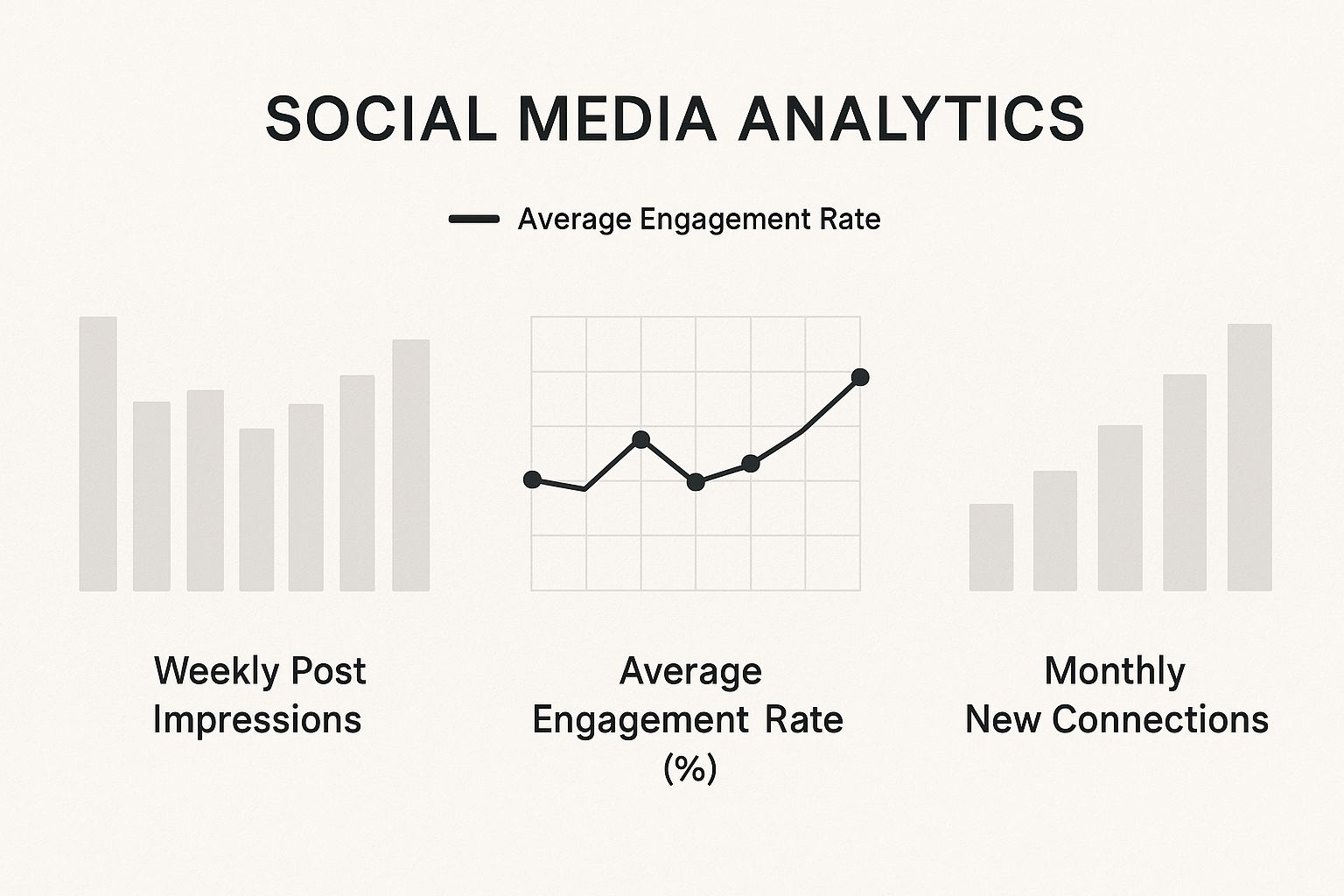
As you can see, when post impressions and engagement go up, the number of new connections follows. This creates a steady stream of new opportunities for meaningful outreach.
From Conversation to Client
The shift from a friendly chat to a business conversation needs to feel organic, not forced. If you’ve done the work of building rapport and truly understanding their needs, this next step becomes much easier.
When you spot a clear opportunity where your services could genuinely solve a problem for them, you can make a soft offer.
"Based on what you've mentioned about [Their Challenge], I have a few ideas that might help. Would you be open to a brief 15-minute chat next week to explore them? No pressure at all."
This approach respects their time and positions you as a helpful expert, not a pushy salesperson. It puts the control in their hands, making them far more likely to say yes.
LinkedIn Outreach Effectiveness Comparison
The difference between a generic pitch and a personalised, value-first message is night and day. One gets ignored, while the other starts relationships. Here’s a quick breakdown.
| Element | Generic Sales Pitch | Personalised Value-First Approach |
|---|---|---|
| Opening | "Hi, I see you're a [Job Title] and wanted to introduce my services." | "Hi [Name], I was impressed by your article on [Topic] and wanted to connect." |
| Focus | Immediately highlights the sender's products or services. | Focuses on the recipient's work, content, or shared interests. |
| Ask | Pushes for a demo or sales call in the first message. | Aims to start a conversation with no immediate ask. |
| Outcome | High probability of being ignored, deleted, or marked as spam. | Higher acceptance rate and opens the door for a genuine conversation. |
As the table shows, leading with genuine interest completely changes the dynamic. It’s not about tricking someone into a sale; it’s about finding people you can genuinely help and starting the conversation from a place of respect and mutual interest.
Using Strategic LinkedIn Commenting to Build Your Brand
Creating your own high-value content is a fantastic way to build authority on LinkedIn, but it’s not the only way. One of the most overlooked strategies for getting noticed is strategic LinkedIn commenting.
It’s your chance to jump into active conversations, show off your expertise, and connect with ideal clients—all without having to write a single new post.
Think of it like networking at an industry conference. Instead of standing in the corner hoping someone talks to you, you’re joining relevant discussions and making a memorable impression. A single, thoughtful comment can often drive more profile views than a post that falls flat.
This isn’t about dropping a lazy “Great post!” Strategic commenting means adding real value, sparking more discussion, and positioning yourself as a go-to expert.
Finding the Right Conversations
First things first: you need to find where key influencers, industry leaders, and potential clients are hanging out. You have to be where your ideal audience is already listening.
Your daily LinkedIn feed is a decent starting point, but you need to be more intentional. Pull together a list of 10-15 influential people in your niche whose content consistently gets good, quality engagement.
Follow them and make a point to interact with their posts regularly. This targeted approach means your commenting efforts are focused where they’ll have the biggest impact, putting your expertise right in front of a relevant audience.
The Art of the Value-Add Comment
Once you’ve found the right conversations, your goal is to write a comment that actually stands out. A great comment doesn’t just agree; it expands on the original idea.
Here’s a simple framework for writing comments that get noticed:
- Acknowledge and Agree: Start by mentioning a specific point from the post that you liked. It shows you’ve actually read it.
- Add Your Insight: This is the most important part. Add a unique perspective, ask a follow-up question, or share a quick personal story that builds on the topic.
- Keep it Concise: Your comment should be easy to scan. A couple of well-written sentences are much more powerful than a huge, rambling paragraph.
When you consistently add thoughtful insights to popular posts, you're essentially borrowing the author's stage to showcase your own expertise. It’s a seriously efficient way to build credibility and attract people who are already keen on what you have to say.
This deliberate approach works especially well when you consider how people use the platform. In Australia, LinkedIn is expected to hit over 15 million profiles by 2025, with users spending about 11 minutes per session. That tells us visits are purposeful, so your high-value comments are more likely to be seen by professionals actively looking for industry knowledge. You can discover more about Australian LinkedIn usage on smperth.com.
A Sustainable Daily Routine
The best part? This strategy doesn't need hours of your time. Its power is in its consistency. All you need is 15 minutes every day.
In that time, scroll through your curated list of influencers, find 2-3 posts where you can add genuine value, and write your comments. This simple, repeatable habit will steadily build your authority, grow your network, and bring in a consistent flow of the right kind of profile views. Before you know it, commenting will become one of your best lead-generation tools.
Turning Your LinkedIn Activity Into Business Results
Real success on LinkedIn isn't about finding one magic trick. It's about consistently pulling all the right levers together as part of a smart, well-rounded strategy.
Think about it this way: your optimised profile is your digital shopfront, your value-packed content builds your authority, your genuine outreach opens doors, and your strategic commenting gets you noticed. Each piece makes the others work harder.
The secret to turning all this online activity into actual business outcomes is consistency. It’s about showing up regularly, not with a hard sell, but with a real commitment to helping your audience. That’s how you go from having a passive profile to owning a powerful asset for your business.
Tying It All Together
Imagine your LinkedIn efforts as a flywheel. Each element you've learned about—the profile makeover, content creation, DMs, and commenting—gives it another push, adding momentum.
- Your Profile: This is your foundation. A client-focused profile ensures that every new person who finds you immediately understands how you can help them.
- Your Content: This is your magnet. It pulls in your ideal clients by consistently talking about their problems and proving you have the solutions.
- Your Outreach: This is your direct line. It lets you build real relationships with high-value leads in a way that feels human, not like a sales pitch.
- Your Commenting: This is your amplifier. It puts your expertise in front of fresh, relevant audiences every single day, driving traffic straight back to your profile.
When these four pillars are working in sync, they create a self-fuelling system that generates visibility and attracts inbound leads. A sharp profile makes your commenting more effective. Great content makes your outreach feel warmer and more welcome. You need every component to build long-term momentum.
Success isn't found in a single viral post or a clever DM template. It's built through the disciplined, daily practice of showing up, adding value, and proving you're the expert your audience has been searching for.
Your 30-Day Challenge
It's time to stop just using LinkedIn and start putting it to work for you. The best way to see progress is to take focused action. Don't try to master everything at once—that’s just a recipe for getting overwhelmed.
Instead, pick one key strategy from this guide and commit to doing it consistently for the next 30 days.
Whether it’s finally optimising your profile, posting twice a week, or commenting on five relevant posts a day, focused effort is what will deliver real results.
For a deeper dive into making all these activities work together, our comprehensive guide on building a holistic LinkedIn strategy offers more frameworks and tips. The main thing is to start now, build the habit, and turn your LinkedIn activity into your most reliable engine for business growth.
Your Top LinkedIn Questions, Answered
Alright, you've got the big picture. But when you start putting a LinkedIn strategy into practice, the real-world questions pop up. Getting these small details right is what separates the people who get results from those who just spin their wheels.
Let's tackle the most common questions we hear from business owners trying to make LinkedIn work for them.
How Often Should I Be Posting on LinkedIn?
This one trips everyone up. You see influencers posting multiple times a day and think you need to do the same. You don't.
Consistency beats frequency, every single time. Churning out daily posts is a fast track to burnout and, frankly, boring content.
For most service-based businesses in Australia, 2-3 high-quality posts a week is the sweet spot. It's sustainable, keeps you visible, and gives your audience valuable content without drowning them in noise. Remember, one post that makes someone think is worth more than five they scroll right past.
Is LinkedIn Premium Really Worth the Money?
Short answer: not at the start. You can build a powerful presence and attract clients using the free version of LinkedIn, no doubt about it. Get your foundations right first.
But once your strategy is working and you're getting some traction? Upgrading to a tool like Sales Navigator can be like pouring fuel on the fire.
Think of it this way: the free version is your trusty ute, perfect for getting the job done. Sales Navigator is the upgraded engine that helps you get there faster. Its advanced search filters and outreach tools let you find your ideal clients with pinpoint accuracy. It’s not essential, but it’s a brilliant accelerator once you know what you’re doing.
The biggest mistake people make is treating their LinkedIn profile like a resume. It should be a resource for potential clients. Your headline and summary must focus on the problems you solve and the results you deliver, shifting the focus from "me" to "them."
What's the Best Way to Grow My LinkedIn Network?
Slow and steady wins this race. Firing off hundreds of generic connection requests is a waste of time and makes you look like a spammer.
Instead, aim to add 5-10 relevant, targeted connections each day. And here's the crucial part: personalise every single request. Mention something you have in common, a post of theirs you liked, or a mutual connection. This simple, thoughtful approach builds a network of genuine contacts who actually want to hear from you.
The opportunity here in Australia is massive. By early 2025, there were around 17.02 million users on the platform—that’s over 61% of the population. The most active group, people aged 25 to 34, makes up nearly 7.9 million of them. You can discover more LinkedIn user statistics on napoleoncat.com. This isn't just a sea of profiles; it's a huge audience of professionals ready to connect with real experts.
Ready to turn these insights into a predictable client acquisition system? At Homer Digital Marketing, we build proven LinkedIn, Google, and AI-powered marketing strategies that deliver real, measurable growth. Book a discovery call today to start attracting your ideal clients.
