

Is your dental practice invisible online? If local patients can't find you on Google, you're missing out on a constant stream of high-value appointments. A sharp dentist SEO marketing plan is the lifeblood of any modern practice. It transforms your website from a simple online brochure into a powerful magnet for patients actively seeking your services right now. This guide provides actionable, proven tactics to get you there.
Why SEO Is Your Most Valuable Patient Magnet
Think about the last time you needed a local service. You pulled out your phone and searched, right? Your potential patients do the exact same thing, whether they need an "emergency dentist in Sydney" or the "best cosmetic dentist in Melbourne."
They aren't digging through the Yellow Pages. They're typing what they need into Google, and the practices that show up first are the ones that get the call.
This isn't a fleeting trend; it's a fundamental shift in how people find healthcare providers. A staggering 88% of consumers now turn to online searches to find local businesses, making dental SEO non-negotiable for growth. With thousands of dentists competing for attention, standing out requires more than just clinical excellence—it demands a dominant online presence. You are not just competing with other dentists; you are competing for visibility.
The Power of the Local Pack
When someone searches for a local dentist, the first thing Google usually shows is the "Local Pack" or "Map Pack." It’s that prominent map with the top three local dental practices listed, complete with their contact details, star ratings, and directions.
Here's what it looks like in action.
Getting your practice into this prime real estate instantly makes you a top contender. It often leads directly to a phone call or a click through to your website, bypassing the organic results below.
This kind of visibility builds immediate trust. Being one of the first options a patient sees creates a powerful impression of authority and relevance. A solid SEO strategy is the only reliable way to consistently land a spot in this high-traffic zone.
Building Digital Trust Before They Even Book
Good SEO is about more than just rankings; it’s about building a foundation of trust before a patient even considers booking an appointment.
When your website appears for helpful searches like "are dental veneers worth it?" or "how to fix a chipped tooth," you position your practice as an expert resource. This type of content answers their questions, calms their anxieties, and starts building a relationship long before they pick up the phone.
Key Insight: By the time a patient finds your contact details, a strong SEO and content strategy means you’ve already proven your expertise and shown you understand their needs. It makes the decision to book with you, rather than a competitor down the road, so much easier.
This process of earning authority and providing real value is at the heart of modern marketing. To get a broader view of why this works so well, exploring the benefits of SEO for small business provides excellent context.
Ultimately, investing in dentist SEO marketing isn't just about being found—it's about becoming the clear, obvious choice for patients in your local area.
Nailing Your Local and Technical SEO Foundation
Before you can attract a steady stream of new patients from Google, your digital practice needs a rock-solid foundation. A winning dentist SEO marketing plan is built on two pillars: local SEO, which gets you seen by patients in your area, and technical SEO, which makes it easy for Google to find and trust your website.
Think of it like building your actual clinic. You wouldn't skip the plumbing or the foundation, right? It's the same online. If you ignore these digital basics, any other marketing you do is built on unstable ground. Getting this right from day one is what separates the clinics that pop up everywhere online from the ones nobody can find.
This is exactly how a potential patient goes from a quick search to a booked appointment. It shows that critical moment where your online visibility determines if you're even an option.
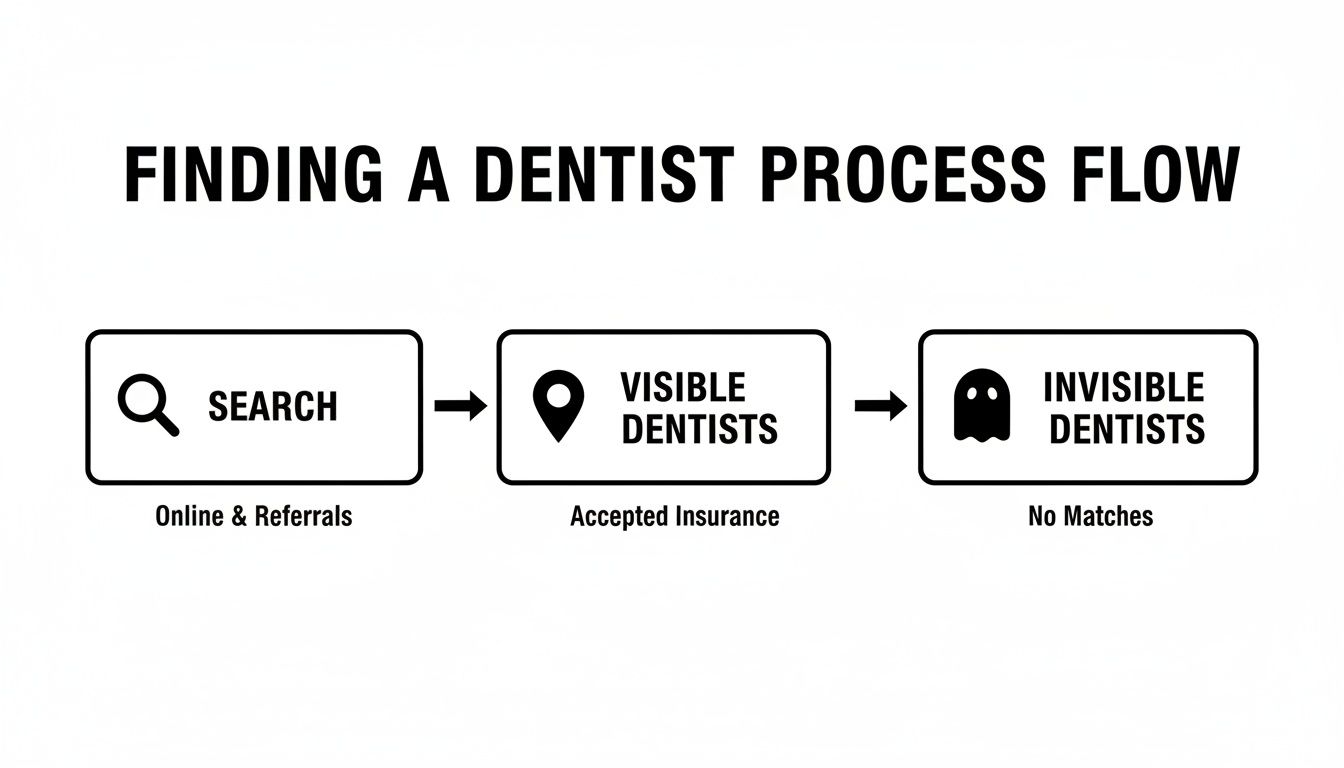
As you can see, without a strong local and technical SEO setup, your practice remains stuck in the 'invisible' zone, missing out on new patients completely.
Maximize Your Google Business Profile
Your Google Business Profile (GBP) is hands down the most powerful free tool you have for local SEO. It's the listing that populates the Google Maps "Local Pack"—the prime real estate at the top of search results.
A fully optimized profile acts as your digital storefront, giving potential patients all the information they need to choose you in a single glance.
To get the most out of it, ensure every single section is completed:
- Services: Don't just list "dentist." Be specific. Add everything you do, from 'teeth whitening' and 'dental implants' to 'emergency dental care' and 'pediatric dentistry'.
- Photos: Upload high-quality, recent photos of your team, the clinic's interior and exterior, and happy patients (with their permission, of course).
- Q&A: Proactively add and answer common questions about parking, payment options, insurance, or specific procedures. This pre-empts patient concerns.
- Reviews: Actively encourage reviews and respond to every single one—good or bad. It shows you're engaged and value patient feedback.
Get Your NAP Consistency Spot-On
NAP stands for Name, Address, and Phone number. Google uses this information across the web to verify your practice is a legitimate, local business. Even minor inconsistencies can confuse search engines and harm your rankings.
For example, if your GBP says "Main St." but your website says "Main Street," that's a red flag for Google.
Pro Tip: The goal here is absolute, boring consistency. Pick one official format for your practice's name, address, and phone number, and use that exact format everywhere online. No exceptions. It’s a simple move that builds massive trust with search engines.
Build Up Your Local Citations
Citations are simply online mentions of your NAP on other websites. Think of them as digital references. The more high-quality, relevant citations you have on reputable sites, the more confident Google becomes about your location and legitimacy.
Start with the major directories for your region:
- Yelp
- Local business directories
- Yellow Pages
- Health-specific directories like Healthdirect
After that, look for niche directories such as dental association listings or local business hubs. The aim is to create a consistent, authoritative footprint all over the web. For more ideas on boosting your local presence, check out this guide to Local SEO for Medical Practices.
Demystifying Technical SEO for Dentists
Technical SEO sounds complex, but for a dental practice, it boils down to a few key elements that make your website easy to use for both patients and search engines.
Site speed is a huge one. If your website takes forever to load, especially on a phone, potential patients will leave. Just as important is mobile-friendliness; your site must be easy to navigate on any device.
A real-world example: One dental clinic optimized its site speed and built 30 hyper-local citations. Within just 5 months, they ranked #2 on Page 1 for 'Dentist in [Their Suburb]' and boosted new-patient calls from organic search by a massive 78%.
Finally, using schema markup helps Google understand exactly what you offer. This is a snippet of code that tells search engines you provide services like "Dental Implants" or "Cosmetic Dentistry," which can help your practice show up with more detailed, eye-catching results.
Creating Content That Attracts High-Value Patients
Effective dentist SEO marketing isn't just about technical tweaks. It’s fueled by content that answers the exact questions your ideal patients are Googling.
Forget generic blog posts about brushing techniques. Your real goal is to become the go-to digital resource for people considering high-value cosmetic, restorative, or specialized procedures. This means you need to shift your thinking from just being a dentist to being a trusted online authority. Your website’s content is your digital handshake—it builds trust long before a patient ever walks through your clinic door.
When people search online, they aren't just looking for a service. They're looking for solutions to problems that impact their confidence and quality of life. Your content must meet them at that moment.
Uncovering What High-Value Patients Search For
If you want to attract patients for services like dental implants or Invisalign, you have to think like them. They aren't searching for "endosteal implant surgery." They're typing real-world questions into Google, driven by cost, pain, and potential results.
This is where your keyword research needs to get specific, focusing on "high-intent" long-tail keywords. These are the queries that show someone is moving from casual curiosity to actively looking for a provider.
Here are examples of high-intent keywords that bring in valuable patients:
- Cost-related queries: "cost of Invisalign in Perth" or "dental implant prices Melbourne"
- Comparison queries: "veneers vs crowns for front teeth" or "Invisalign vs traditional braces"
- Problem-solving queries: "how to fix a gummy smile" or "best treatment for missing teeth"
- "Is it worth it?" queries: "are porcelain veneers worth the money?" or "do teeth whitening treatments last?"
When you build content around these specific phrases, you attract a much more qualified audience. These are people already considering the exact treatments you want to provide.
Strategic Tip: Every single piece of content you publish needs a clear purpose. Ask yourself: "What patient problem does this solve?" If you can't answer that, it's probably not worth creating. It's all about quality and strategic intent, not just churning out articles.
Structuring Service Pages That Convert
Think of your service pages as your digital sales team. They can't just list what a procedure is; they must guide a potential patient from curiosity to booking a consultation. A high-converting service page is organized, persuasive, and completely patient-focused.
Take a page for "Dental Implants," for example. It needs to be structured to answer every single question a nervous patient might have.
Key Elements of a Powerful Service Page:
- A Clear, Benefit-Driven Headline: Start with what the patient gets, like "Restore Your Smile Permanently with Dental Implants."
- Relatable Problem Introduction: Briefly touch on the struggles of missing teeth. Show them you understand their pain points.
- Detailed 'What Is It' Section: Explain the procedure in simple, easy-to-understand language. Ditch the clinical jargon.
- 'Who Is a Good Candidate' Section: Help readers self-qualify and see if the treatment is right for them.
- The Step-by-Step Process: Outline the entire journey, from the first consultation to the final result. This demystifies the experience and reduces anxiety.
- Before-and-After Gallery: Visual proof is everything. Use high-quality photos of real patient results (with their permission, of course).
- Frequently Asked Questions (FAQ): Tackle the big concerns head-on. Address questions about pain, cost, recovery time, and longevity right there on the page.
This structure turns a basic page into a comprehensive resource that builds serious confidence and pushes the visitor to take that next step.
Beyond Service Pages: Creating Expert Blog Content
While service pages target patients who are ready to book, blog content is for those still in the research phase. This is your chance to establish deep expertise and build that all-important trust. A single, well-written blog post can rank for dozens of related search terms, acting as a magnet for new, qualified traffic.
Think about the questions your patients ask you during consultations. Those are your blog topics. If one person asks, "Does teeth whitening hurt?" or "How long do veneers last?", you can bet hundreds more are asking Google the same thing.
To help you organize this, we’ve put together a simple planner. It connects common patient problems to high-intent keywords and the right content format, making your content strategy much more effective.
High-Intent Dental Content Topic Planner
A template for mapping patient search intent to valuable content topics for your dental practice website.
| Patient Problem/Question | High-Intent Keyword | Content Format (Service Page, Blog, FAQ) | Call to Action |
|---|---|---|---|
| "I'm embarrassed by my crooked teeth." | invisalign vs braces cost sydney | Blog Post | "Compare your options. Read our guide." |
| "Can I replace a missing tooth?" | dental implant cost melbourne | Service Page | "Book a Free Implant Consultation" |
| "My teeth are stained and yellow." | professional teeth whitening cost | Service Page / FAQ | "View Our Smile Gallery & Pricing" |
| "Are veneers permanent?" | how long do porcelain veneers last | Blog Post / FAQ | "Learn about veneer care. Download our guide." |
Writing content that directly answers these questions positions your practice as the go-to expert. The numbers don't lie—over 92% of searchers never click past the first page of Google. For dentists, this highlights why a strategic dental SEO approach is a non-negotiable.
A well-optimized site can pull in thousands of visitors and generate a steady stream of new patient enquiries every month, directly boosting your practice's bottom line. For more on this, you can read the full breakdown of these findings.
Building Authority With Local Links And Patient Reviews
Getting your dental practice to show up in search results is a huge win, but visibility alone doesn't put new patients in the chair. The real game-changer in any dentist SEO marketing strategy is building authority.
This is all about proving to Google—and more importantly, to prospective patients—that your practice is trustworthy, respected, and the obvious choice in your local area.
Google primarily measures this trust in two ways that carry enormous weight in local rankings: backlinks from other reputable local websites and a consistent stream of positive patient reviews. Think of backlinks as professional referrals and reviews as powerful word-of-mouth. Get them both right, and you're golden.

Earning Local Backlinks That Matter
So, what’s a backlink? It's simply a link from another website to yours. But not all links are created equal. A link from a local community organization or a relevant health blog is SEO gold. A link from a spammy, irrelevant directory? Not so much.
Your mission is to earn links that cement your practice as a genuine part of the local community. The good news is, it's less complicated than it sounds. It really just comes down to getting involved locally in ways that naturally create these digital handshakes.
Actionable Local Link Building Ideas:
- Sponsor a local sports team: That junior soccer club or community sports team almost always has a website where they thank their sponsors with a link. It’s an easy, high-quality local backlink that shows you support the community.
- Partner with neighbouring businesses: Team up with non-competing businesses nearby, like a pharmacy or a specialist medical clinic. A simple cross-promotion on a "community partners" page on each other's websites works wonders.
- Host a community event: Offer a free dental health seminar at the local library, school, or community centre. These organizations will often link back to your site when they promote the event.
- Join local business associations: Groups like the Chamber of Commerce usually have online member directories that link out to each business. It's another authoritative local signal for Google.
These aren't just SEO tactics; they build real-world reputation and strengthen your presence right in your suburb.
Turning Patient Feedback Into A Ranking Powerhouse
Positive reviews are arguably the most powerful social proof you have. We know that nearly 75% of patients now use online reviews as their first step when choosing a new healthcare provider. Google sees this behavior, which is why the quantity, quality, and freshness of your reviews directly impact how high you appear in the local map pack.
The trick is making it ridiculously easy for your happy patients to leave a review. Most people are willing to help, but they won't jump through hoops. You need a simple, repeatable system.
The Secret to More Reviews: Don't just hope for reviews to trickle in. Proactively and politely ask for them at the peak of a patient's positive experience—right after a successful treatment when they’re feeling fantastic about their smile. Shifting your timing can completely change your results.
A great first step is creating a direct link to your Google review page. From there, you can weave it into your follow-up process. A simple post-appointment email or SMS thanking the patient for their visit, with a line like, "We'd be so grateful if you could share your experience with a quick review," is incredibly effective. For a deeper dive, check out this guide on how to get more Google reviews.
And don't forget to respond to every review, good or bad. It shows you're engaged and that you genuinely care about patient feedback—a massive trust signal for anyone checking you out online.
How To Measure Your SEO Success and ROI
Marketing without measurement is just guesswork. Pouring time and money into a dentist SEO marketing strategy without knowing the results is like flying blind. The real goal isn't just to see your name at the top of Google; it's to get more high-value patients calling your practice and booking appointments.
This is where you connect your digital efforts to actual business outcomes. You need a straightforward way to see what’s working, what isn’t, and most importantly, what the return on your investment (ROI) really is. Forget vanity metrics like "impressions"—we're talking about tangible results that grow your practice.
Setting Up Your Measurement Toolkit
To track your SEO success properly, you need two essential (and free) tools from Google. Getting these set up is completely non-negotiable.
- Google Analytics 4 (GA4): Think of this as your website's command centre. It tells you who is visiting your site, how they found you, which pages they look at, and whether they take the actions you want them to.
- Google Search Console (GSC): This is your direct line of communication with Google. It shows you which keywords your site is ranking for, how often people click on your listings in the search results, and flags any technical hiccups holding you back.
Getting these two platforms connected to your website is the first, most critical step. Without them, you’re just operating in the dark.
Focusing on Metrics That Actually Matter
Once your tools are running, it’s easy to get lost in a sea of data. The trick is to ignore the noise and focus on a handful of key performance indicators (KPIs) that directly tie back to patient acquisition.
Reporting Tip: Your monthly report shouldn't be a 20-page document filled with charts nobody understands. It should be a one-page snapshot that answers a single question: "Did our SEO efforts bring in more potential patients this month than last month?"
Here are the core metrics to keep your eyes on:
- Organic Traffic Growth: This is the number of people who find your website through a non-paid Google search. A steady, month-on-month increase shows your visibility is improving and more people are discovering your practice online.
- Keyword Rankings for High-Value Services: Are you climbing the rankings for terms like "dental implants Melbourne" or "emergency dentist near me"? Tracking these specific, money-making keywords is absolutely vital.
- Google Business Profile (GBP) Actions: Your GBP insights are a goldmine. They show you exactly how many people clicked to call your practice from the map listing, requested driving directions, or clicked through to your website. These are high-intent actions from local searchers ready to book.
- Conversion Tracking: This is the big one—the most important metric of all. A "conversion" is any valuable action a user takes on your site. For a dental practice, the most critical conversions to track are phone calls and appointment form submissions.
By setting up conversion goals in GA4, you can see precisely how many new patient enquiries came from your organic search traffic. This is how you prove ROI. Learning how to properly connect marketing activities to financial outcomes is crucial, and you can explore more about why measuring marketing ROI is essential for any business.
From SEO Metrics to Business Outcomes
The final piece of the puzzle is translating this data into a language everyone understands: practice growth. Your reporting should clearly connect the dots between your SEO activities and the real-world results they generate.
This table breaks down how to think about the data you're collecting, linking the technical metric to what it actually means for your front desk.
Key SEO Metrics vs Business Outcomes for Dentists
| SEO Metric to Track | What It Means For Your Practice | Tool to Use |
|---|---|---|
| Increase in Organic Traffic | More potential patients are discovering your practice online. | Google Analytics 4 |
| Higher Keyword Rankings | You are becoming the top choice for valuable dental services. | Google Search Console |
| Clicks-to-Call from GBP | Patients are finding you on Google Maps and calling directly. | GBP Insights |
| Form Submission Conversions | You are generating a measurable number of new patient leads. | Google Analytics 4 |
When you focus on these core areas, your dentist SEO marketing stops being an expense and becomes a predictable engine for growing your practice. You can confidently see that for every dollar you invest, you're generating a clear, measurable return in new patient opportunities.
Common Questions About Dental SEO
Even with a clear plan, stepping into dentist SEO marketing can feel like learning a new language. It’s completely normal to have a few questions before you commit your time and resources.
Here are the straight-up, no-fluff answers to the questions you're probably thinking right now.
How long does it take to see results from dentist SEO?
This is always the first question, and the honest answer is: it’s a marathon, not a sprint. SEO isn’t about flipping a switch for instant patients; it’s about methodically building trust with Google.
You can usually expect to see some positive signs—like better rankings and a bit more traffic—within 3 to 6 months. But the real, practice-changing results, like consistently showing up on page one for valuable keywords, often take closer to 6 to 12 months.
What affects this timeline?
- Your Local Competition: Trying to rank in a packed metro area is a tougher fight than in a smaller regional town.
- Your Website’s History: A brand-new site is starting from zero. An older, established website often has a head start and can see results faster.
- Your Investment & Consistency: The more consistent you are with creating helpful content, building local links, and fine-tuning your site, the quicker you'll gain traction.
Think of it like this: SEO is planting a tree. The initial work is just getting the roots in place. The real growth happens over time, compounding until you have a reliable source of new patients, year after year.
Can I do dental SEO myself?
Technically, yes. You can absolutely get the basics in place on your own. Things like claiming and optimizing your Google Business Profile, starting a blog, or making sure your website works well on mobile are all achievable.
The real challenge isn't the what, it's the when. Running a busy dental practice doesn't leave much time for the relentless demands of serious SEO—we’re talking technical website audits, deep-dive competitor analysis, and strategic link building. DIY efforts are a great starting point, but they often hit a wall where progress stalls.
Many practices find a middle ground works best. You can handle the day-to-day tasks you’re comfortable with, like asking patients for reviews, and then partner with an agency to handle the heavy lifting.
What is the difference between SEO and Google Ads?
This is a big one. It's vital to understand that SEO and Google Ads (also called PPC, or pay-per-click) are two different tools in your dentist SEO marketing toolkit. They work best together.
| Feature | SEO (Organic Search) | Google Ads (Paid Search) |
|---|---|---|
| Cost | You don't pay per click. Your investment is in time and expertise. | You pay Google every single time someone clicks your ad. |
| Placement | Shows up in the "organic" search results and the local map pack. | Appears right at the top of the search results with a little "Ad" label. |
| Timeline | Results are gradual and build momentum over months. | Results are instant. Your ad shows up as soon as you start paying. |
| Longevity | Results are durable. Once you earn a top spot, you can hold it. | Visibility vanishes the second you turn off your ad spend. |
A smart strategy uses both. SEO builds your long-term authority and a sustainable flow of organic traffic. Google Ads, on the other hand, are perfect for getting immediate leads, especially for urgent, high-value services like "emergency dentist near me" or "dental implant consults." This one-two punch ensures you’re capturing patients no matter how they’re searching.
Ready to stop guessing and start getting real, measurable growth? At Homer Digital Marketing, we build marketing systems that turn your online presence into a predictable stream of high-value patients. We'll handle all the SEO complexities so you can focus on what you do best—providing exceptional dental care.
Schedule your free strategy session with us today and let's build your authority!
