
Picture this: your ideal customer is online right now, searching for the exact service you offer. Who do they find? Is it you, or the competitor just down the road?
For most Aussie small businesses, the answer is, frustratingly, the other guy. This is why smart SEO services for small businesses aren’t just a nice-to-have; they’re essential for survival and growth. This guide will give you a proven, actionable roadmap to turn your website from an invisible brochure into a lead-generating machine.
Why Your Small Business Is Invisible and How SEO Fixes It
Think of the internet as a massive, bustling city. Without a decent online presence, your business is like a fantastic little shop tucked away in a quiet back alley with no sign. You could offer the best service in the country, but if no one can find you, you might as well be closed.
This is the reality for so many service-based businesses in Australia. Relying purely on word-of-mouth or old-school marketing methods leaves you completely invisible to the 92% of consumers who start their search for a service on Google. Your website just sits there like a digital brochure nobody ever reads, instead of being a machine that brings in new leads.
The Digital Visibility Gap
The problem isn't that your service isn't good enough; it's that people can't find you. Your ideal clients are actively looking for what you do, typing in things like "plumber near me" or "best local accountant." When your competitors pop up on the first page of Google and you don't, they get the call. Every single time.
This creates a huge visibility gap. A 2023 study by NetStripes, which looked at 700 Australian SMEs, found that only 36% of them use SEO effectively. That leaves a massive 64% of SME owners who are either unaware of how powerful SEO is or have no idea how to make it work for them.
Key Insight: SEO is the big, bright floodlight that shines down your alleyway, guiding a steady stream of ready-to-buy customers right to your door. It turns your passive website into an active, 24/7 sales tool that works its tail off for you.
Turning Clicks into Clients
Good SEO closes that gap. It’s not about trying to trick Google; it’s about making your business the most relevant, helpful, and authoritative answer to what a potential customer is looking for. One of the best ways to get seen is by boosting online visibility with search engine optimization.
Here’s how effective SEO services for small businesses completely change the game:
- You get qualified leads: SEO connects you with people at the exact moment they need you, which means the leads are much higher quality.
- You build trust and credibility: Ranking high on Google is like getting a massive thumbs-up. It tells potential customers that you’re a legitimate and respected business in your field.
- You get sustainable growth: Unlike paid ads, which stop the second you stop paying, a solid SEO foundation brings in a consistent flow of free, organic traffic for the long haul.
At the end of the day, investing in SEO is investing in being seen. It makes sure that when your next best customer is searching, they find you.
The Core SEO Services Your Business Actually Needs
SEO isn't a single magic button you press. It’s a well-oiled machine with a few critical parts all working in sync. For most small business owners, the sheer number of acronyms and buzzwords can feel completely overwhelming.
Let's simplify it. Think of your online presence as your new flagship store.
You wouldn't build a beautiful shop on a shaky foundation, right? Of course not. Every great store needs a solid base, a smart layout that guides customers, and a prime location where people can find you. The same logic applies directly to the SEO services small businesses need to get found and grow.
Your Digital Storefront Analogy
Breaking down SEO using this storefront model makes it crystal clear what you're investing in and why each piece is so important for attracting your ideal customers.
Technical SEO is the Foundation: This is the bedrock of your building—the plumbing, the wiring, and the structural integrity. Technical SEO ensures your website is stable, fast, and easy for Google to crawl, making sure your "store" is safe, sound, and open for business 24/7.
On-Page SEO is the Store Layout: Think of this as your interior design, product placement, and clear signage. On-page SEO is all about strategically organising your website's content with the right keywords and a logical structure, guiding customers (and Google) straight to what they’re looking for.
Local SEO is the Prime Location: This is your glowing "Open" sign, your street address, and your listings in local directories. For any service business, this is non-negotiable. Local SEO makes you unmissable to customers searching in your immediate area, putting you right on their digital main street.
This diagram shows how these three core pillars work together to build your digital flagship store.
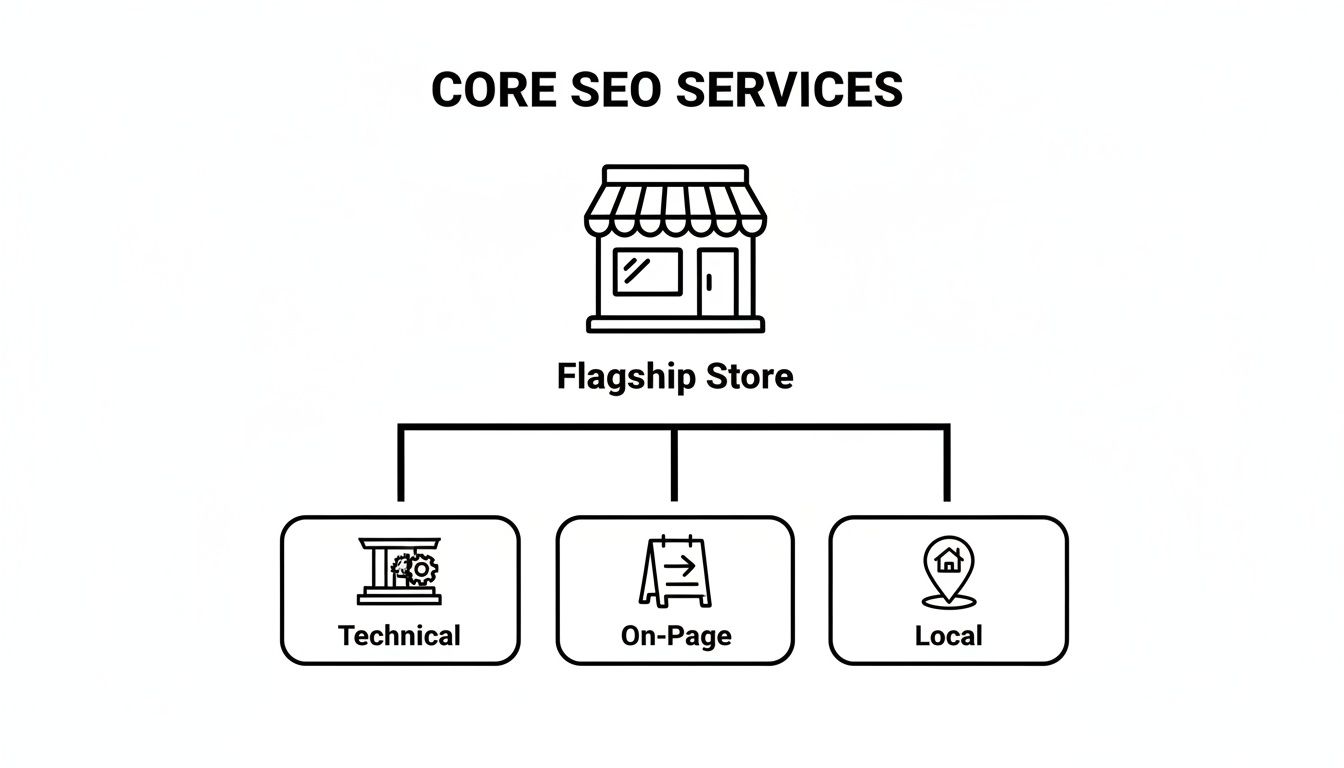
As you can see, it all starts with a rock-solid technical foundation, gets organised with smart on-page strategy, and becomes visible through targeted local efforts.
The Services That Drive Real Growth
While the analogy gives you the big picture, let's drill down into the specific services that make it all happen. A good SEO partner will bundle these into a cohesive strategy where each one supports the others.
The table below breaks down the essential components of a powerful SEO strategy. Think of these as the engine parts that work together to drive consistent growth for your business.
| Your SEO Growth Engine Components | ||
|---|---|---|
| SEO Service | Simple Analogy | Why Your Business Needs It |
| Technical Audit & Fixes | A building inspection | Finds and fixes hidden issues (like slow speed) that turn customers away. |
| Keyword Research | Market research | Discovers the exact phrases real customers use to find services like yours. |
| On-Page Optimisation | In-store merchandising | Organises your site to guide visitors and Google, making it easy to find info. |
| Content Creation | Your expert advice | Builds trust and authority by answering customer questions and solving problems. |
Each of these services is crucial. They're not just line items on an invoice; they're the building blocks of a predictable lead generation system.
A Closer Look at the Key Services
1. Technical SEO Audit and Fixes
Before anything else, a professional needs to inspect your website’s "foundation." A technical audit uncovers problems like slow page speed, broken links, or mobile-unfriendly design that silently kill your rankings. Given that over 50% of users will ditch a site if it takes more than three seconds to load, this is a non-negotiable first step.
2. Keyword Research and Strategy
This is the market research for your digital store. It’s all about identifying the exact phrases your potential customers are typing into Google when they need your help. The goal isn't just traffic; it's finding high-intent keywords that bring in qualified leads who are ready to buy. Using competitor AI analysis tools can give you a massive edge here, helping you see what’s working for others and where the opportunities lie.
3. On-Page Optimisation
This is where your keyword research gets put into action. It’s a hands-on service that includes:
- Optimising Meta Titles and Descriptions: Crafting compelling, keyword-rich snippets that make people want to click on your site in the search results.
- Structuring Content with Headers (H1, H2s): Organising your page content logically so both users and search engines can quickly understand what it's about.
- Internal Linking: Connecting related pages on your site to spread authority and guide users to other valuable information, keeping them engaged for longer.
Pro Tip: Think of on-page SEO as creating a seamless customer journey. Just as you'd place related products together in a physical store, you link related content to create a logical and helpful experience for visitors.
4. Content Creation and Marketing
Content is the high-quality product on your shelves. This service focuses on creating valuable blog posts, service pages, and guides that answer your customers' biggest questions and establish you as the go-to expert in your field. It's a proven strategy: businesses that consistently blog generate 67% more leads than those that don't.
Each of these core services builds on the last, creating a powerful strategy that turns your website from an invisible shop in a back alley into a bustling flagship store on the main digital highway.
Local SEO: Your Unfair Advantage in the Community
For service businesses, your next big customer isn't halfway across the country. They're probably just down the road, searching for exactly what you offer right now. This is where Local SEO becomes your most powerful tool—a digital magnet pulling nearby, ready-to-buy customers straight to your door.
Think about the "Google Map Pack," that little block of three businesses you see at the top of local search results. Getting your business in there is like snagging the best shopfront on the busiest street in town. It gives you immediate visibility, credibility, and the first shot at winning over that customer.
Mastering Your Digital Main Street
Local SEO isn’t about ranking nationally; it's about owning your local patch. The entire goal is to show up for searches like "electrician in Parramatta" or "best hairdresser near me." It’s a specific set of strategies designed to make you the obvious choice for customers in your service area.
A solid local strategy is built on a few key pillars that work together, signalling to Google that you're a relevant, active, and trusted local authority.
The core parts of a winning local SEO plan include:
- Google Business Profile (GBP) Optimisation: Your digital shopfront and the absolute cornerstone of local search.
- Online Reputation Management: Actively gathering positive reviews to build trust and social proof.
- Local Citation Building: Keeping your business name, address, and phone number (NAP) consistent everywhere online.
- Localised Content Creation: Writing content that speaks directly to the needs of your local community.
Your Google Business Profile Is Everything
Your Google Business Profile (what used to be called Google My Business) is hands-down the most critical piece of your local marketing puzzle. It’s often the very first interaction a potential customer has with your brand. A fully optimised profile is like a mini-website that lives directly inside Google's search results.
Actionable Advice: An incomplete or neglected Google Business Profile is like having a shop with a broken sign and no opening hours on the door. It tells potential customers you might not be reliable or even open for business.
To turn your profile into a lead-generating machine, you have to treat it with care. This means going beyond just listing your address and using every available feature to show off what you do best. For a deep dive, our guide on Google Business Profile optimisation gives you an actionable checklist.
The Power of Local Signals
It's hard to overstate the impact of a targeted local strategy, especially here in Australia. A huge 46% of all Google searches have local intent, which makes being visible in your community non-negotiable.
What's more, Australian local businesses targeting multiple locations see an average of 557% more organic traffic than those with just one location. This shows the massive power of scaling your local footprint.
Effective SEO services for small businesses will focus relentlessly on these local signals. That means building a web of trust around your physical location through consistent citations on directories like Yellow Pages and TrueLocal. It also involves encouraging a steady stream of positive customer reviews and creating service pages that specifically mention the suburbs and regions you serve.
This combination of your profile, your reputation, and your content is what launches you into that coveted Google Map Pack, driving a real, measurable increase in phone calls, quote requests, and new clients.
How to Budget for SEO Services in Australia
Every smart business owner wants to get straight to the bottom line. So, when it comes to SEO services for small businesses, figuring out what to actually invest can feel like a guessing game. It doesn't have to be.
Let's pull back the curtain on SEO pricing in Australia with a straightforward, no-fluff breakdown of what you should expect to spend.
First up, you need to know how most agencies structure their fees. You'll generally run into two models. The most common is the monthly retainer, which is an ongoing fee for consistent work like creating content, keeping an eye on technical stuff, and building links. The other is a project-based fee—a one-off cost for a specific job, like a technical website audit or getting your local SEO sorted.
This push for online visibility is getting more and more attention. By 2025, Aussie businesses are on track to pour $1.5 billion into SEO services. For small businesses, that breaks down to an average budget of around $1,200 per month. It's clear that SEO is no longer a "nice-to-have" but a core part of any serious growth plan.
Understanding Common Pricing Models
Before you can set a budget, you need to know what you’re paying for. A monthly retainer gives your SEO momentum, which is exactly what you need for long-term success. It means your strategy is always adapting and improving. This model is perfect for any business committed to steady, sustainable growth.
Project-based work, on the other hand, is great for tackling specific, urgent problems. Need to fix your site's technical glitches fast? A project fee is a great fit. Want to get your Google Business Profile perfectly optimised once and for all? That's another ideal use for a one-off investment.
Defining Your Investment Tier
To make a confident decision, you need to match your budget with realistic outcomes. We can break down typical SEO investments into three clear tiers, each designed for a different stage of business growth. This simple framework helps you spot overpriced agencies and avoid underfunded campaigns that are doomed to fail.
Here’s what you should expect to get at each level:
Foundation Tier (Under $1,000/month): Think of this as getting the absolute essentials right. You should expect services like a full technical audit, Google Business Profile optimisation, and solid on-page SEO for your most important service pages. The goal here isn't world domination—it's about fixing the critical errors and establishing a clean, professional online footprint.
Growth Tier ($1,200 – $2,500/month): This is where you shift from fixing problems to actively growing. Your investment should cover everything in the Foundation tier, plus consistent content creation (like one or two blog posts a month), building local citations, and starting some basic link acquisition. The outcome? A real, noticeable improvement in local search rankings and a steady climb in organic traffic over the next 6-12 months.
The Sweet Spot: This tier is the sweet spot for most small service businesses. It's enough cash to actually move the needle and generate a positive return, creating a sustainable engine for new leads without breaking the bank.
- Accelerator Tier ($2,500+/month): A budget at this level is for businesses that want to dominate their local market. It funds a more aggressive content strategy, advanced link-building campaigns, conversion rate optimisation (CRO) to turn more visitors into customers, and in-depth performance reporting. At this tier, the goal is to become a leading voice in your niche and start capturing serious market share from your competitors.
Choosing the Right SEO Partner and Avoiding Red Flags
Finding a trustworthy SEO provider can feel like you’re navigating a minefield. So many Aussie small business owners have been burned by slick sales pitches and empty promises, leaving them with poor results and a lighter wallet. It’s a frustrating experience that, understandably, makes you wary of trusting anyone with your website.
Think of this section as your practical playbook for finding an SEO partner who is effective, transparent, and actually driven by results. Getting this decision right is one of the most important things you can do for your business’s growth. The aim is to find a genuine expert who wants a partnership, not just a quick sale.
Key Questions to Ask Any Potential SEO Provider
Before you even think about signing a contract, you need to come armed with the right questions. A good SEO pro will welcome your curiosity and give you clear, detailed answers. If they get defensive or hit you with vague jargon, that’s your first major warning sign.
Here are the essentials to ask:
- “How will you measure success for my specific business goals?” Their answer needs to go way beyond just “more traffic.” A great partner will immediately start talking about qualified leads, phone calls, quote requests, and other metrics that actually put money in your bank account.
- “Can you walk me through a case study for a client similar to mine?” They should be able to show you a real, relevant example of their work. Ask them to explain the strategy, what they did, and the tangible business results they delivered for another service business like yours.
- “What does your communication and reporting process look like?” You need to know how often you’ll hear from them and what their reports actually show. Look for clarity and a focus on the numbers that matter to your bottom line, not just vanity metrics.
- “What specific strategies will you focus on in the first 90 days?” A competent agency always has a plan. They should be able to clearly outline their initial priorities, whether that’s a technical audit, a local SEO blitz, or beefing up your on-page content.
Major Red Flags to Watch Out For
Just as important as knowing what to look for is knowing what to run from. Some providers use dodgy tactics to lock you into expensive contracts that go nowhere.
Warning: The most dangerous SEO providers are the ones who sell certainty. In a field that is constantly changing, anyone who guarantees a specific outcome, like a #1 ranking, is not being truthful. Real SEO is about strategy and consistent effort, not magic tricks.
Keep your eyes peeled for these big red flags:
Guarantees of "#1 Rankings"
No one can ethically guarantee a number one spot on Google. The algorithm is far too complex and always changing. A promise like this is the oldest trick in the book and usually means they’ll use risky, "black-hat" tactics that could get your site penalised by Google.A "Secret Sauce" or Lack of Transparency
If they tell you their methods are “proprietary” and refuse to share what they’re actually doing, run. A true SEO partner is an open book. You should never be left in the dark about the work being done on your website.Focus on Low-Quality "Bulk" Services
Be very cautious of offers promising hundreds or thousands of backlinks for a cheap, fixed price. When it comes to SEO, quality is always more important than quantity. These cheap links almost always come from spammy websites and can do more harm than good to your site’s reputation.No Access to Your Own Accounts
You must always have full ownership and admin access to your Google Analytics, Google Search Console, and Google Business Profile. An agency that sets these up under their own name and locks you out is essentially holding your digital assets hostage.
By asking the right questions and knowing how to spot these red flags, you can confidently choose a partner who will help you achieve real, sustainable growth for your business.
Measuring SEO Success with Metrics That Matter
It’s easy to get excited about high traffic numbers, but let's be honest—they don't pay the bills. Leads, sales, and new clients do. It’s time to stop chasing superficial vanity metrics and start focusing on the Key Performance Indicators (KPIs) that actually signal business growth.

Think of your SEO data like your car's dashboard. A dozen different lights and gauges might be flashing, but only a few—like the fuel gauge and speedometer—tell you if you’re actually getting closer to your destination. This is the mindset you need to understand the real return on your SEO services for small businesses.
Focusing on Impact Metrics
Vanity metrics, like total website visits or social media likes, feel good but often have zero connection to real business outcomes. They don't tell you if the right people are finding your site or if they're taking the actions that put money in your pocket.
Impact metrics, on the other hand, are tied directly to your bottom line. They measure the actions that generate leads and sales, giving you a crystal-clear picture of your SEO campaign's financial success.
Mindset Shift: The most crucial mindset shift for any business owner is moving from asking, "How much traffic did we get?" to "How many qualified leads did our traffic generate?" This one change aligns your SEO strategy with what truly matters: growth.
From Vanity Metrics to Real Business Impact
So, how do you tell the difference between a number that just looks good on paper and one that actually builds your business? This table breaks it down. A good SEO partner will always report on the impact metrics.
| Vanity Metric (Looks Good) | Impact Metric (Means Growth) | Why It Matters to Your Bottom Line |
|---|---|---|
| Total Website Traffic | Organic Conversion Rate | Tells you the percentage of visitors who become actual leads, proving traffic quality. |
| Keyword Rankings (Any Keyword) | Rankings for High-Intent Keywords | Tracks your visibility for terms used by customers ready to buy right now (e.g., "emergency plumber near me"). |
| Page Views | Goal Completions (Calls & Forms) | Directly counts the number of new business enquiries generated from your site. No guesswork. |
| Social Media Likes | Google Business Profile Actions | Measures clicks-to-call, direction requests, and website visits—actions that drive local customers to you. |
Looking at this, it's pretty clear which side of the table you want your reports to focus on.
Key Performance Indicators to Track
To truly measure success, your SEO reporting should revolve around a few core KPIs. These are the non-negotiable numbers that prove your investment is paying off by attracting the right kind of attention and turning it into tangible business opportunities.
Your essential SEO dashboard should include:
- Organic Lead Volume: This is the big one. It’s the total number of phone calls from your website, form submissions, and direct email enquiries that came from organic search. If this number is going up, your SEO is working.
- Keyword Ranking for Buying-Intent Terms: Don't just track your business name. You need to monitor your position for phrases that signal a customer is ready to hire someone, like "local accountant for small business" or "roof repair quotes."
- Google Business Profile Interactions: For any local service business, this is critical. Track how many people call you directly from your profile, ask for directions, or click through to your website. These are hot leads.
- Conversion Rate from Organic Traffic: This metric shows you how effective your website is at turning visitors into leads. An improving conversion rate means you're not just getting more traffic—you're getting better, more qualified traffic.
By focusing on these impact-driven metrics, you move beyond guesswork. You gain a clear, data-backed understanding of how your SEO services for small businesses are fuelling real, measurable, and sustainable growth.
Your Small Business SEO Questions Answered
Diving into search engine optimisation can feel like a minefield of jargon and confusing advice. It’s no wonder so many Aussie business owners feel overwhelmed. To clear things up, we’ve answered the most common—and critical—questions we hear every day.
How Long Does It Take to See Results from SEO?
This is the big one, and the honest answer is: it takes patience. You might see some quick wins from technical fixes within the first 1-3 months, but real, game-changing results usually take 6-12 months to properly kick in.
Think of it like getting fit. You don't walk out of the gym with a six-pack after one session. The initial improvements come from fixing the easy stuff—the low-hanging fruit. But sustainable growth in rankings and leads is built over time through consistent, high-quality effort. This long-term mindset is what separates a temporary ranking blip from a powerful, lead-generating machine.
Can I Do SEO Myself or Do I Need to Hire an Agency?
You can absolutely get your hands dirty with the basics, and you should! Things like optimising your Google Business Profile or tweaking your page titles are great starting points. But let’s be real—as a busy business owner, your time is better spent serving clients, not trying to become a full-time SEO expert.
A professional agency brings years of experience, specialised tools, and proven strategies that just get results faster. They help you sidestep common but costly mistakes, delivering a far better return on your investment than trying to figure it all out on your own.
Is SEO a One-Time Project or an Ongoing Investment?
SEO is never a "set and forget" task. It's a continuous investment. Google’s algorithm is always changing, your competitors are constantly trying to outrank you, and what your customers are searching for evolves. Think of your website as a living, breathing part of your business, not a static brochure.
To stay on top, you need ongoing effort in:
- Content Creation: Regularly publishing fresh, helpful content that answers your customers' questions and builds your authority.
- Technical Monitoring: Keeping your website healthy, fast, secure, and easy for Google to crawl.
- Authority Building: Consistently earning quality backlinks to strengthen your online reputation and prove your expertise.
Treating SEO as a core, ongoing marketing activity is the only way to achieve and maintain long-term growth. It’s the engine that keeps your digital doors open for business.
What Is More Important: Local SEO or General SEO?
For most Australian service businesses with a physical location or a defined service area, Local SEO delivers the fastest and most direct return. It’s all about targeting customers who are right there, in your neighbourhood, actively searching for what you do. This is your quickest path to getting the phone to ring.
But the smartest strategies use both. Local SEO gets you on the map for immediate business, while broader on-page and technical SEO builds your website's overall authority. This powerful combination helps you become the go-to expert in your industry, attracting better clients from a wider area over time.
Ready to stop being invisible and start attracting your ideal clients? The team at Homer Digital Marketing has over 27 years of experience helping service-based businesses like yours achieve real growth through proven Google optimisation and AI-powered marketing systems. Schedule a consultation with us today and let's build a strategy that gets results.
