

Having amazing products is just the start. Think of professional SEO services for ecommerce as the sustainable engine that drives ready-to-buy shoppers to your online store. It moves you beyond those temporary traffic spikes from paid ads to build lasting brand authority and a solid foundation for long-term revenue.
Why Your Online Store Needs More Than Just Great Products
In Australia's jam-packed ecommerce market, fantastic products alone won't guarantee success. It’s a frustrating reality for many store owners: you have the best gear, but your website traffic is flat, your products are buried on page ten of Google, and the cost of paid ads just keeps climbing.
If potential customers can't find you, you're basically invisible. This is where a powerful ecommerce SEO strategy becomes your most valuable asset. It’s not about quick fixes; it's about building a reliable, long-term channel that connects you directly with shoppers actively searching for what you sell. This guide will provide the solution you need.
Building a Foundation for Sustainable Growth
Good SEO is the digital equivalent of setting up shop in the busiest spot in a bustling shopping centre. It puts your brand right in front of customers with their wallets out, ready to buy. The data backs this up, big time.
Here in Australia, organic search drives a massive 53% of all website traffic to online stores, easily beating social media and email marketing combined. It's no wonder Australian businesses are projected to invest a huge $1.5 billion in SEO services this year—a 12% jump from 2024—as more small and medium businesses realise they need sustainable growth, not just expensive ad campaigns.
A well-oiled SEO strategy delivers on several critical fronts:
- More Visibility: It pushes your product and category pages higher up the Google rankings, which means more clicks.
- Targeted Traffic: You stop attracting random browsers and start pulling in high-intent shoppers who are far more likely to convert.
- Brand Authority: When you consistently show up in search results, you build trust and become known as a leader in your niche.
- Cost-Effectiveness: Unlike paid ads, organic traffic doesn’t vanish the second you stop paying. This delivers a much healthier ROI in the long run.
Of course, a killer SEO strategy and great products are only part of the puzzle. To keep customers happy and coming back, you also need your operations dialled in, with things like reliable e-commerce shipping solutions.
Ultimately, investing in SEO services for your ecommerce store is an investment in its future, giving you a competitive edge that lasts.
The Four Pillars of a Winning Ecommerce SEO Strategy
Think of your online store like a real, physical shop. You wouldn't just scatter products on the floor and cross your fingers, would you? A successful retail space needs a solid building, a logical layout, clear signs, and a great reputation. It's the exact same for ecommerce SEO.
A winning strategy is built on four core pillars. When they're all working together, they do more than just help you rank higher on Google; they create a smooth path for customers, guiding them from their first search all the way to checkout. Any decent seo services for ecommerce will focus on getting these four areas right to drive real, sustainable growth.
Let's break them down using our shop analogy.
Ecommerce SEO Pillars Explained
This table shows how each of the four pillars functions, much like the different parts of a physical retail store.
| SEO Component | Analogy (Like a Physical Store) | Key Focus Areas |
|---|---|---|
| Technical SEO | The Foundation & Wiring | Site speed, mobile usability, security (HTTPS), crawlability. |
| Site Architecture | The Store Layout & Aisles | Logical navigation, category structure, URL organisation. |
| On-Page SEO | The Product Labels & Signs | Keywords, product descriptions, title tags, image optimisation. |
| Off-Page SEO | Word-of-Mouth & Reputation | Backlinks, brand mentions, online reviews. |
Getting these four elements dialled in is the difference between a deserted online store and one that’s buzzing with the right customers.
Technical SEO: The Foundation and Wiring
Before you even think about what to put on the shelves, you need a building with a solid foundation, working power, and doors that actually open. That's your technical SEO. It’s all the crucial behind-the-scenes stuff that lets search engines like Google find, crawl, and understand what your site is all about.
If your website is slow, insecure, or a confusing mess for Google's bots, it’s like having a shop with a permanently locked front door. Shoppers—and Google—will just move on.
A few non-negotiables for technical SEO include:
- Site Speed: A slow-loading page is a sales killer. Seriously. Just a one-second delay in load time can slash your conversions by 7%.
- Mobile-Friendliness: Most online shopping now happens on a phone. Your site absolutely must look and work flawlessly on any device, no excuses.
- Security (HTTPS): Having an SSL certificate isn't optional anymore. It encrypts customer data, builds trust, and Google has confirmed it's a direct ranking signal.
Site Architecture: The Store Layout
With a solid foundation in place, it's time to plan your store's layout. Site architecture is simply how you organise your pages—from the homepage down to categories, subcategories, and individual products. A great structure is like a well-designed supermarket, with clear aisles that guide people straight to what they're looking for without any friction.
For an online store, this means a clean, simple navigation path. A customer should be able to get from your homepage to any product in three clicks or less. This doesn't just make for happy users; it helps search engines map out your site and understand which pages are the most important.
On-Page SEO: The Product Labels and Signage
Now, imagine walking through that well-organised shop. How do you find the exact brand of coffee you want? You look at the signs on the aisles and the labels on the products. That's your on-page SEO.
This is all about optimising the elements on each individual page—like your product titles, descriptions, and images—to tell both customers and search engines precisely what that page is about. Every single product and category page needs clear, descriptive "signage" to have any chance of ranking for the right search terms.
A classic mistake we see all the time is businesses just copying and pasting the manufacturer's generic product description. This creates duplicate content all over the web, which Google hates. Writing your own unique, keyword-focused descriptions is one of the fastest ways to stand out.
Off-Page SEO: Your Reputation Around Town
Finally, no matter how amazing your store is, you need a strong reputation to get people through the door. Off-page SEO covers everything you do outside of your website to build authority and trust. Think of it as word-of-mouth marketing, glowing customer reviews, and getting featured in popular publications.
In the digital world, the most powerful signal of a good reputation is backlinks. These are simply links from other credible websites pointing to your store. Every high-quality backlink acts like a vote of confidence, telling Google that your store is a trustworthy and valuable place to send its users.
To pull all this together, it's vital to implement the most effective SEO best practices for your online store and keep adapting as things change. Master these four pillars, and your digital shopfront won't just be visible—it’ll become the go-to destination for your ideal customers.
How Technical SEO and Site Speed Create a Competitive Edge
In the world of online shopping, speed isn't just a feature—it's everything. A fast, smooth user experience is the absolute foundation of a successful e-commerce store, and that’s where technical SEO comes in. Think of it as the high-performance engine under the bonnet of your website. It’s all the behind-the-scenes work that makes your site fast, secure, and dead simple for search engines to crawl and understand.
Any decent e-commerce SEO service will tell you this technical health is priority number one. Why? Because it directly impacts your search rankings, your conversion rates, and your bottom line. If your site is slow or broken, customers won't wait around, and Google won't bother sending them your way in the first place.
This concept map shows how all the different parts of e-commerce SEO fit together.
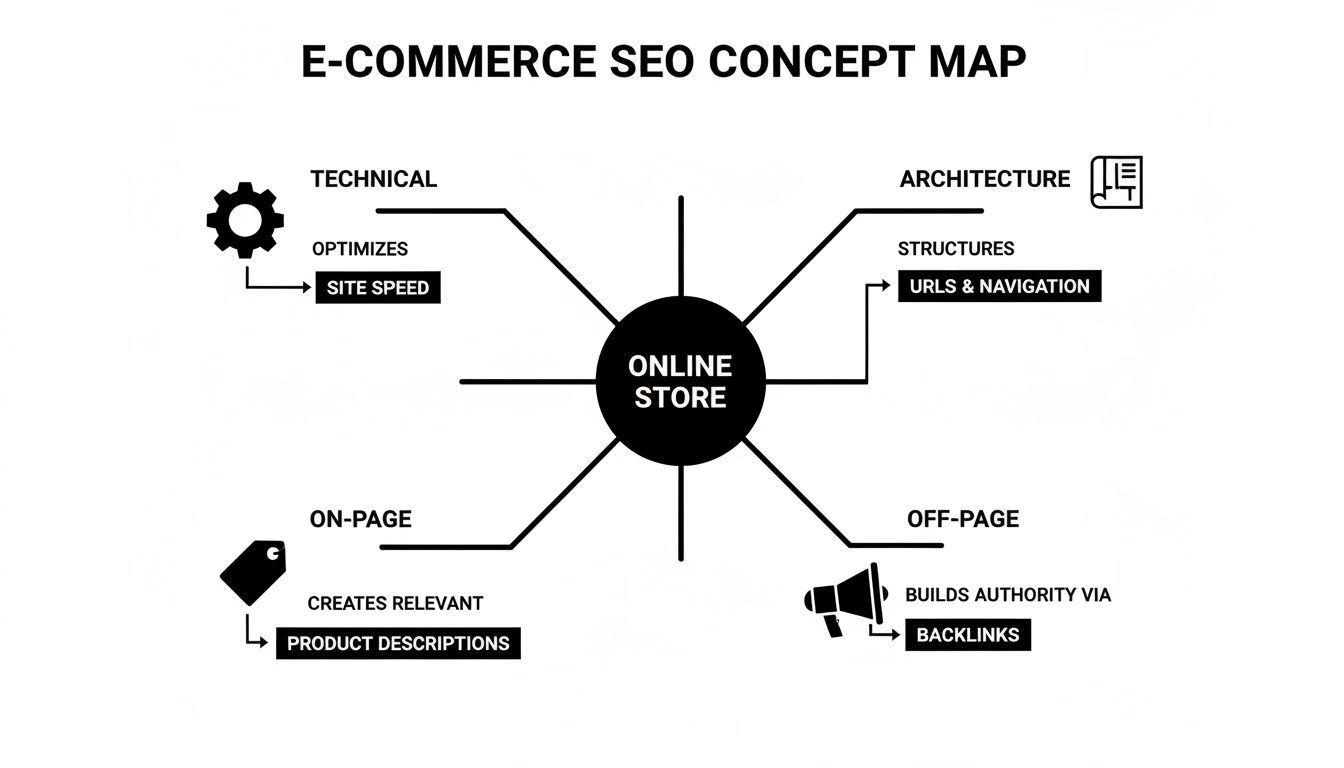
As you can see, solid technical health is the bedrock that supports everything else, from your site's structure to how well your on-page and off-page marketing performs.
The Critical Role of Mobile Optimisation and Speed
For any Australian online store, a mobile-first approach isn't optional anymore. A massive 70% of local e-commerce traffic now comes from mobile devices, so your site absolutely must work flawlessly on a small screen. Younger shoppers, in particular, have zero patience for clunky, slow-loading mobile sites.
Australia’s mobile internet is among the fastest globally, which means our shoppers have sky-high expectations. The data shows just how brutal the consequences of a slow site are: a load time of just 3-5 seconds can increase your bounce rate by a staggering 90%. If your site takes over 5 seconds to load, that jumps to a disastrous 123% bounce rate. For an online store, that’s a huge amount of lost revenue walking out the door.
Core Technical Elements You Cannot Ignore
To build a technically sound website that both shoppers and search engines love, you need to nail these critical elements. These are non-negotiable parts of a modern, high-performing site. You can also learn more about the key elements of modern website design in our article.
- Core Web Vitals: These are Google's own metrics for measuring a page's real-world user experience. They look at loading speed (Largest Contentful Paint), how quickly a user can interact with the page (First Input Delay), and whether the layout shifts around unexpectedly (Cumulative Layout Shift). Passing these vitals is now a direct ranking signal.
- HTTPS Security: Having an SSL certificate is essential. It encrypts the data between a customer's browser and your server, protecting sensitive payment information and building trust. Google Chrome even flags sites that aren't secure, which is an instant conversion killer.
- Clean URL Structure: Your URLs should be simple, logical, and easy for a human to read. For example,
yourstore.com.au/womens-shoes/leather-bootsis far better for users and SEO than a messy URL full of random numbers and symbols.
Key Takeaway: Technical SEO isn't just about pleasing Google's algorithm. It's about creating a fundamentally better, faster, and more secure shopping experience for your customers—which is exactly what Google wants to reward.
How Structured Data Gives You an Edge
Structured data, often called schema markup, is a seriously powerful technical SEO tool that helps your products stand out in search results. It’s a special kind of code you add to your website to give search engines more detailed information about what you’re selling.
For instance, you can use schema to tell Google your product’s price, whether it’s in stock, and its average customer rating. Google can then pull this information and display it directly in the search results as a "rich snippet."
Imagine a customer searching for a "linen quilt cover." A search result showing a 5-star rating, the price, and an "in stock" label is far more compelling and likely to get the click than a plain old blue link. This gives you a direct competitive advantage, driving more qualified traffic and, ultimately, more sales.
Using AI to Enhance Your Ecommerce SEO
Artificial intelligence is changing the game for ecommerce SEO, but it's not here to replace the experts. Think of AI as a powerful co-pilot, not the pilot. It’s a tool that can automate the grunt work, find hidden insights, and help you execute strategies at a scale that was impossible just a few years ago.
When you bring AI into your ecommerce SEO services, you’re helping your team work smarter, not harder. It can chew through massive datasets in minutes, giving you a serious edge over the competition.
Automating Research and Analysis
One of the biggest wins with AI is how it handles time-sucking research. Instead of your team spending days manually digging through competitor websites or brainstorming keywords, AI-powered tools can do the heavy lifting in an instant.
This frees up your SEO experts to focus on big-picture strategy instead of getting bogged down in repetitive tasks. That means more time for creative problem-solving and strategic planning.
Here’s how AI supercharges the research phase:
- Competitor Analysis: AI systems can crawl your competitors' sites to pinpoint their best-performing keywords, content gaps, and backlink strategies, then serve up the findings in a clear, actionable report.
- Keyword Discovery: It uncovers long-tail keywords and related phrases that a human might easily miss, making sure your content speaks the exact language your customers are using.
- Trend Prediction: AI can analyse market data and search trends to predict what's about to take off, helping you get ahead of the curve with new products or content.
Optimising Content and Product Listings
Beyond research, AI is a game-changer for creating and fine-tuning content. It helps ensure every product description, category page, and blog post is optimised to meet both search engine rules and customer expectations.
AI-powered SEO is already delivering huge results for Australian businesses. Companies are reporting up to a 45% increase in organic traffic and a 38% rise in conversion rates. And with 68% of businesses seeing a better ROI from AI-integrated strategies, it's clear this tech is essential in a market where organic search drives over half of all ecommerce sales. You can see more powerful ecommerce SEO statistics on Supple Digital's infographic.
Crucial Insight: The goal isn't to let AI write everything for you. Low-quality, robotic-sounding text will kill your brand and your rankings. The best approach is always human-led, where AI generates data-driven outlines and first drafts that a skilled writer then refines for authenticity, tone, and real value.
This "human-in-the-loop" approach ensures your content stays engaging and trustworthy. To learn more about how AI is being used for content creation in SMBs, check out our detailed guide.
Ultimately, using AI in your ecommerce SEO is about blending machine efficiency with human creativity. It lets you make smarter, faster decisions, optimise your store with incredible precision, and stay one step ahead of everyone else. By embracing this technology thoughtfully, you can unlock new levels of growth and profit.
Choosing the Right Ecommerce SEO Partner
Picking the right support for your online store is one of the most important calls you’ll make. Get it right, and you unlock steady, sustainable growth. Get it wrong, and you’re looking at wasted time, money, and a whole lot of frustration.
So, where do you start? The first step is figuring out what kind of help you actually need by looking at your options—from hiring in-house to bringing on a specialist agency. The best path forward really boils down to your business size, budget, and where you want to be in the next few years.
In-House vs Freelancer vs Agency
Hiring an in-house SEO specialist means you get one dedicated expert who lives and breathes your brand. This is a great move for larger businesses that need someone deeply embedded in their products and can justify the significant investment in salary, training, and tools. For smaller stores, though, it’s often out of reach.
A freelancer offers more flexibility and is usually a more affordable option. They can be perfect for one-off projects or ongoing help without the commitment of a full-time employee. The real challenge is finding a freelancer with genuine ecommerce runs on the board who can handle all the moving parts of a complex campaign.
Working with a specialised ecommerce SEO agency often gives you the best of both worlds. You're not just hiring one person; you're getting access to an entire team of strategists, technical wizards, content writers, and link-building pros for one consolidated fee. This model is built to scale and brings a wealth of experience from working across dozens of online stores.
An experienced ecommerce SEO partner does more than just chase keyword rankings. They understand the entire customer journey, from the moment someone types a search query to the final click at checkout. Their job is to optimise every single touchpoint to drive revenue.
When you're vetting potential partners, transparency and proven results are non-negotiable. Don't get distracted by flashy promises of "#1 rankings." Instead, ask for clear, data-backed proof of their success with businesses just like yours.
To help you weigh up your options, here’s a quick comparison of the three main models.
Agency vs In-House vs Freelancer: A Comparison
Deciding on the right SEO resource comes down to balancing cost, expertise, and your specific business needs. This table breaks down the pros and cons of each option.
| Option | Best For | Average Cost (AU) | Key Advantage |
|---|---|---|---|
| Agency | Businesses needing a full team of specialists and a scalable, results-driven strategy. | $2,500 – $10,000+/month | Access to a diverse team of experts (technical, content, link building) and broad industry experience. |
| In-House | Larger businesses with the budget for a full-time salary and the need for deep brand integration. | $80,000 – $150,000+/year | A dedicated expert focused solely on your business, ensuring deep product and brand knowledge. |
| Freelancer | Startups and small businesses needing project-based help or specialised skills on a budget. | $80 – $200+/hour | Flexibility and cost-effectiveness for specific tasks without long-term commitment. |
Ultimately, the right choice aligns with your growth stage. An agency provides a comprehensive solution for scaling, in-house offers total dedication for established brands, and a freelancer delivers targeted support for smaller operations.
Your Vendor Evaluation Checklist
Asking the right questions is how you separate the genuine experts from the pretenders. A reputable partner will welcome your questions and give you straight answers. Use this checklist to guide your conversations and make sure you cover all the important bases. For some extra tips, our article on choosing SEO companies for small business is a great resource.
Key Questions to Ask Potential Partners:
- Case Studies & Results: Can you walk me through case studies from ecommerce clients in my industry? What specific metrics did you move the needle on—organic revenue, conversion rates, rankings for money-making keywords?
- Strategic Approach: What does your process look like for the first 90 days? How do you decide what to tackle first: technical fixes, content, or link building?
- Technical Expertise: How do you handle common ecommerce headaches like faceted navigation, duplicate content from product variants, or slow site speed?
- Reporting & Communication: What do your reports actually show? How often will we connect, and who will be my day-to-day contact? Show me how you tie your SEO work directly to our sales figures.
- Tools & Technology: What SEO tools are in your stack for audits, keyword research, rank tracking, and backlink analysis?
- Team Structure: Who exactly from your team will be working on our account? What are their roles, and what’s their experience in ecommerce?
Finding a partner who gets the unique rhythm of your online business is everything. They should feel like an extension of your own team, giving you the strategic direction and hands-on execution needed to turn search engine visibility into actual sales. A thorough vetting process is your best defence against a bad investment and ensures you find a partner ready to help you grow.
Measuring SEO Success and Planning Your Next Steps
So, you've invested in seo services for ecommerce. How do you actually know if it’s working? The answer is in the numbers—but not just any numbers. Forget vanity metrics. We’re talking about tangible results that directly fatten your wallet.
Real SEO success isn’t about chasing rankings for keywords that don't convert. It's about connecting every optimisation effort directly to your cash register and using that data to decide what to do next.
Key Metrics That Truly Matter
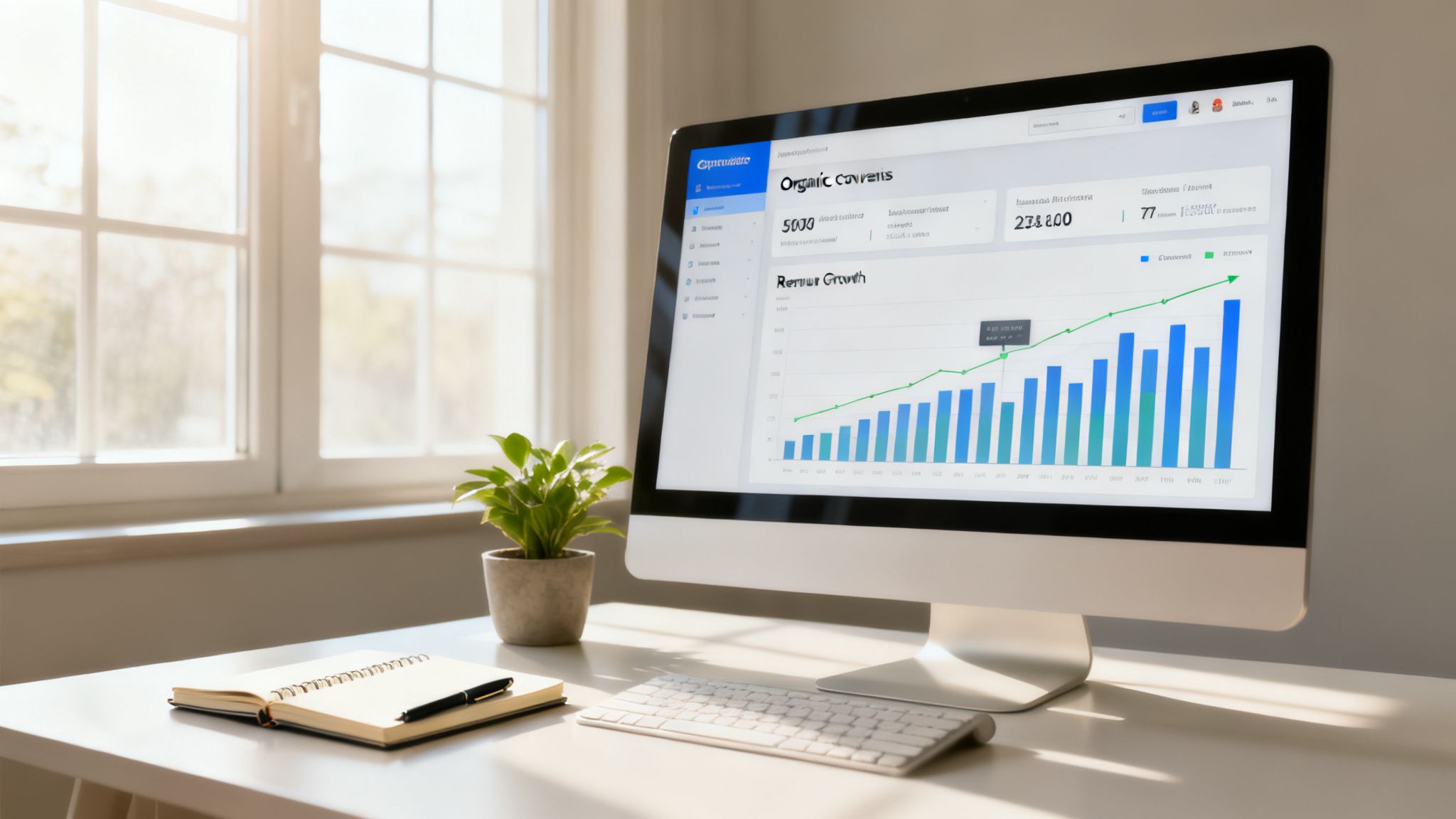
To see the real-world impact of your SEO, you need to look past the surface-level traffic stats. These are the key performance indicators (KPIs) that tell you whether your organic channel is healthy and, more importantly, profitable.
- Organic Revenue: This is the big one. How much cold, hard cash is your store making from customers who found you on Google without you paying for an ad?
- Organic Conversion Rate: What percentage of those free visitors from search engines actually pull out their credit card and buy something? If this number is climbing, you’re attracting better, more qualified shoppers.
- Rankings for Transactional Keywords: Are you showing up for searches with high buying intent, like "buy black leather boots" or "men's running shoes sale"? These are the search terms that drive sales, not just clicks.
- Average Order Value (AOV) from Organic Traffic: Are the customers coming from Google spending more per order than your average customer? This is a great sign your SEO is attracting buyers looking for higher-value products.
Key Takeaway: The goal isn't just more traffic; it's the right traffic. You want to bring in shoppers who are ready to buy, leading to a direct, measurable lift in your overall sales.
Your Simplified 90-Day SEO Roadmap
Jumping into an SEO campaign can feel like a lot, but a clear plan makes all the difference. The first three months are all about building a solid foundation and banking some early wins. Here’s a roadmap that breaks down the priorities for any new ecommerce SEO push.
Month 1: Foundation and Technical Fixes (Days 1-30)
- Comprehensive SEO Audit: Start with a deep dive to find all the technical gremlins, on-page gaps, and your competitors' weak spots.
- Keyword Strategy Development: Pinpoint the core transactional and informational keywords that matter for your top-selling categories and products.
- Implement Critical Fixes: Tackle the high-priority technical issues first—things like site speed, mobile-friendliness, and indexing errors that are holding you back.
Month 2: On-Page Optimisation and Content (Days 31-60)
4. Optimise Key Pages: Rewrite titles, meta descriptions, and product details for your most important category and product pages. This is low-hanging fruit.
5. Develop Foundational Content: Create one or two high-value blog posts or buying guides targeting those crucial informational keywords you found.
6. Begin Link Building Outreach: Start identifying and reaching out to relevant websites to score your first few backlinks.
Month 3: Scaling and Performance Review (Days 61-90)
7. Expand Optimisation: Move on to optimising the next tier of your product and category pages.
8. Analyse Early Data: Jump into Google Analytics and Search Console to see what’s working and what’s not.
9. Refine Strategy: Use what you’ve learned from the 90-day review to tweak your content and link-building plans, doubling down on what actually drives results.
This roadmap gives you a clear path forward. By focusing on these core activities, you build momentum and start seeing a real return on your SEO investment sooner rather than later.
Your Ecommerce SEO Questions, Answered
Diving into ecommerce SEO can feel a bit like learning a new language. You've probably got a bunch of questions floating around. Let's tackle the most common ones business owners ask so you can get some clear, straight-up answers.
How Long Until I Actually See Results From Ecommerce SEO?
This is the big one, right? The honest answer is that real, lasting SEO isn't an overnight fix. It’s a marathon, not a sprint. While you might see some quick wins from fixing major technical glitches in a few weeks, don't expect the floodgates to open immediately.
Most good agencies will tell you to expect a 4 to 6-month window before you see a real, measurable jump in your organic traffic, keyword rankings, and—most importantly—your sales. That timeframe gives them enough runway to do the job properly: deep technical audits, creating content that actually helps people, and building links that Google respects.
Think of it like building a house. The first few months are all about laying the foundation. It's not glamorous, but without it, the whole thing will crumble.
What's a Realistic SEO Budget for an Ecommerce Store in Australia?
There's no magic number here. Your SEO budget is an investment, and it needs to match your ambition and the battleground you’re fighting on. For a small to medium-sized online store in Australia, you should be looking at a monthly budget somewhere between $2,500 and $7,000.
What pushes that number up or down? A few things:
- The size of your store: Optimising a site with 10,000 products is a much bigger job than one with 100.
- How competitive your niche is: Trying to rank for "women's shoes" is a heavyweight fight compared to ranking for "handmade leather dog collars."
- What's included: A full-service campaign with technical SEO, content, and link building will naturally cost more than just the basics.
A word of warning: you get what you pay for. Super-cheap SEO services often cut corners with dodgy tactics that can get your site slapped with a Google penalty later on. It’s just not worth the risk.
Can I Just Do My Own Ecommerce SEO?
Absolutely. If you've got more time than money, DIY SEO is a great place to start. There are tons of free guides and tools out there to help you write better product descriptions, kick off a blog, or fix simple technical errors.
But let's be real—effective ecommerce SEO is a full-time job that demands some serious expertise. As your store grows, things get complicated fast. You'll be juggling technical audits, mapping out complex keyword strategies, and running link-building campaigns. These are tasks that need expensive tools and years of hands-on experience to get right.
Working with an agency frees you up to do what you're best at—running your business—while a team of specialists handles the heavy lifting of your organic growth.
Ready to turn clicks into customers? At Homer Digital Marketing, we build proven, AI-powered marketing systems designed to attract your ideal clients and scale your business. Book a discovery call today!
