

Finding the right SEO company for your small business isn’t just about boosting your rankings. It's about securing a strategic partner who understands how to transform your online presence into a predictable, lead-generating machine that consistently attracts customers ready to buy.
Why SEO Is a Non-Negotiable for Small Business Growth
For a small business in Australia, being invisible online is the same as not existing. Search Engine Optimisation (SEO) is the critical bridge connecting you to the very people actively searching for the solutions you provide. This isn't about outsmarting Google; it's about becoming the most trusted and visible answer when a local customer has a problem you can solve.

Imagine a local plumber in Brisbane or an accountant in Sydney. When a potential customer types "emergency plumber near me" or "small business accountant Sydney," a robust SEO strategy ensures your business appears at that exact moment of need. This is how your website evolves from a static digital brochure into a tireless, 24/7 sales engine.
The Power of Local Search Intent
The data is clear: the way Australians discover local businesses has fundamentally shifted, and it all revolves around local search.
Staggering research reveals that a massive 46% of all Google searches carry local intent. What’s more, 72% of consumers who conduct a local search will visit a business within eight kilometres. Even better, a significant 28% of those searches result in a purchase.
But here's the crucial gap: a surprising 56% of local businesses still haven't claimed their free Google Business Profile. This is a huge opportunity that your competitors are eagerly capitalizing on. A quality SEO service closes this gap, ensuring that when customers are ready to spend, they find you first.
Building Authority and Trust
Effective SEO goes far beyond just keywords and clicks. It’s about strategically positioning your business as a credible authority in your industry. This is achieved through a blend of smart technical optimization, the creation of genuinely valuable content, and the cultivation of a stellar online reputation. You can learn more about how small business SEO builds this crucial foundation.
A significant component of this is building credibility through backlinks. Understanding core SEO link building strategies is vital, as this directly influences how Google perceives your authority and determines your ranking position.
For service-based businesses, authority is everything. When a potential client sees your business consistently appearing with helpful content and positive reviews, it builds an immense amount of trust before they even pick up the phone.
Ultimately, investing in the right SEO partner is one of the most intelligent growth decisions you can make. It’s an investment in sustainable, long-term visibility that continues to deliver value long after a paid advertising campaign has ended.
Defining Your Business Goals Before You Start Searching
Typing “SEO companies for small business” into Google without a clear plan is like walking into a supermarket starving and without a shopping list. You’ll be tempted by many shiny-looking options but will likely end up with the wrong things and an empty wallet.
Before you even think about hiring an SEO partner, you must get crystal clear on what success genuinely looks like for your business. This simple step fundamentally shifts the power dynamic. It ensures you lead the conversation with potential agencies, making certain they align with your vision—not the other way around.
From Vague Ideas to Tangible Objectives
Every small business is unique. An auto repair shop in Perth has entirely different needs than a business coach pursuing clients across the country. Your specific goals will dictate the entire SEO strategy.
So, start by asking yourself: what do I really want to achieve in the next 12 months? Get specific.
- More qualified leads: Don't just say "more calls." Aim for "15 calls per month from clients looking for high-end kitchen renovations."
- Increase online bookings: A concrete goal would be to "boost online appointment bookings for my wellness clinic by 25%."
- Boost local foot traffic: A local shop might want to "increase in-store visits from local Google searches by 40%."
- Attract higher-value clients: A B2B firm could aim to "land three new retainer clients with a project value over $10,000 each."
Having these hard numbers makes it easy to measure your return on investment (ROI) down the track. A good SEO agency won't just send you reports about rankings; they'll show you how they're helping you hit these business targets.
Identifying Your Ideal Customer
Once you know what you want to achieve, you need to know who you want to attract. SEO isn't about reaching everyone; it's about reaching the right people. Any competent agency will need to understand your ideal customer to build a keyword and content strategy that genuinely resonates and converts.
A real estate agent targeting first-home buyers uses completely different language, content, and keywords than one targeting luxury property investors. Knowing your audience is everything.
Map out your ideal customer profile. Consider their demographics, their most significant pain points, and the exact questions they are typing into Google. This clarity is the bedrock of a campaign that truly connects.
Understanding the Different Types of SEO
SEO is not a one-size-fits-all service. Knowing the main types helps you identify what is critical for your business versus what's just a "nice to have." This is your cheat sheet for evaluating what different SEO companies for small businesses are actually offering.
Here’s a quick rundown:
- Local SEO: This is non-negotiable for any business with a physical address or service area (think plumbers, dentists, cafes). It’s all about optimising your Google Business Profile and showing up in those crucial "near me" searches.
- Technical SEO: This represents the foundational health of your website. It covers elements like site speed, mobile-friendliness, and ensuring Google can easily crawl and understand your pages.
- Content Marketing & SEO: This is where you create genuinely helpful blog posts, guides, and articles that answer your audience's questions. It builds trust, positions you as an expert, and attracts people who are researching solutions.
- E-commerce SEO: A completely different discipline designed for online stores. This focuses on optimising product pages, category pages, and the overall site architecture to drive sales.
Once you’ve got this sorted, you can walk into a conversation and say, "My main goal is to increase local bookings, so local SEO is my top priority." That kind of clarity ensures you invest in the services that will actually move the needle for your business.
Picking Your SEO Partner: Freelancer, Boutique, or Big Agency?
Once you’ve nailed down your business goals, the next big question is: who’s going to help you achieve them? The world of SEO companies for small business isn’t one-size-fits-all. You’ve got options, and choosing between a freelancer, a boutique agency, or a full-service agency will seriously impact your budget, communication, and results.
Getting this wrong is a classic mistake. I’ve seen fast-growing e-commerce stores hire a freelancer only to outgrow their capacity in three months. I've also seen local plumbers get completely lost in the shuffle at a massive, impersonal agency.
The key is to understand what each model offers and find the right fit for where your business is right now.
This decision tree can help you visualise how your primary goals point towards a certain type of partner, whether you’re chasing leads, online sales, or client bookings.
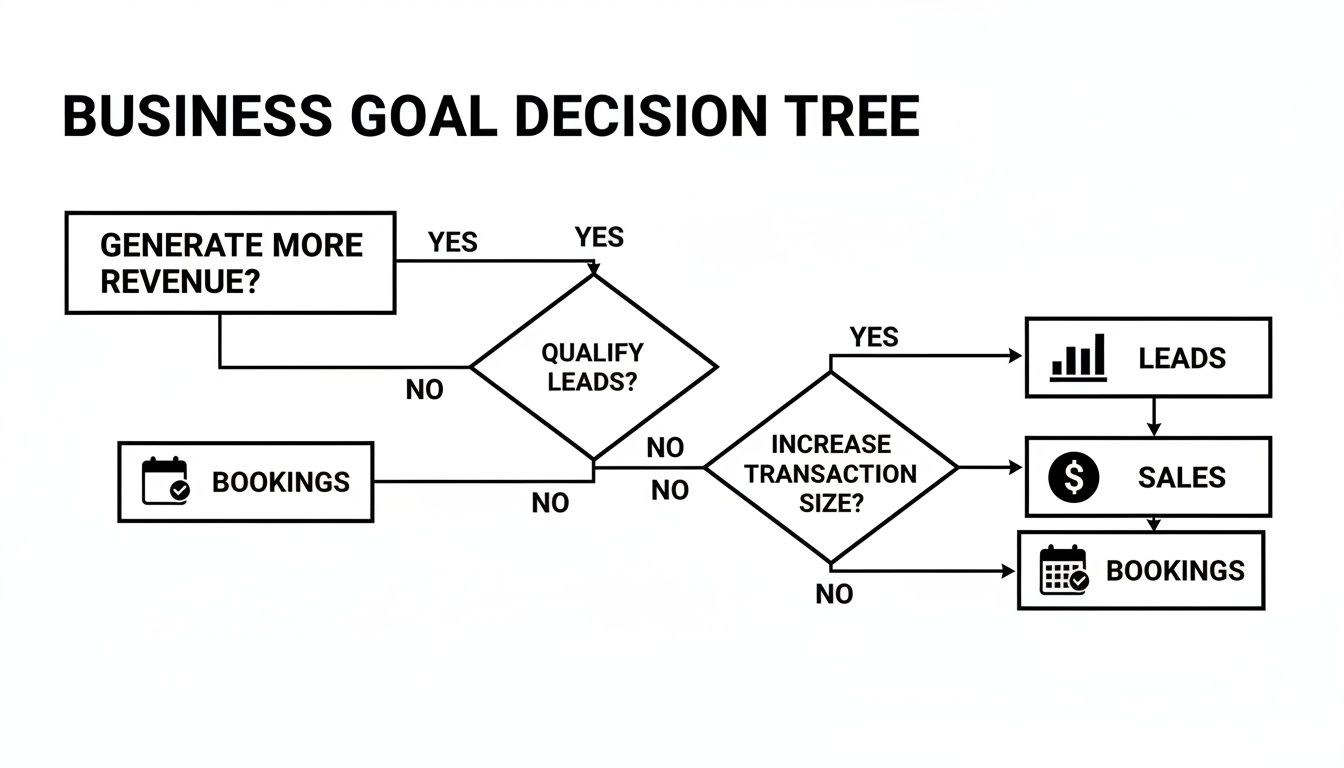
As you can see, different business goals naturally demand different SEO priorities. This helps you line up what you need with the right kind of professional support from the get-go.
The Independent SEO Freelancer
An SEO freelancer is a one-person show. They’re a specialist who handles every part of your campaign personally. This is often the perfect setup for small businesses with very specific needs or those just starting out with SEO.
Think of a solo business coach who just needs sharp blog content and some on-page optimisation, but not a massive technical audit. A freelancer gives you that direct, expert touch. The person you hire is the person doing the work, which keeps communication simple and direct.
But that’s also their biggest weakness. One person has a limited number of hours in the day and a specific set of skills. They might be a genius at content but not so hot on technical SEO or high-level link building. If your needs suddenly ramp up, their limited capacity can become a real bottleneck.
The Specialised Boutique Agency
Boutique agencies are small, tight-knit teams, usually fewer than 15 experts. They give you the focused attention you’d get from a freelancer, but with the collective brainpower and wider skillset of a proper team.
Honestly, this is the sweet spot for a lot of service-based businesses. A boutique agency is big enough to manage a full strategy—from technical deep dives to content and local SEO—but small enough that you’re not just another number. If you want a partner who will get to know your business inside and out, a boutique is a brilliant choice. You can see how this model works by looking into dedicated local SEO agencies, which often fit this description perfectly.
The biggest win with a boutique agency is strategic depth. You get a dedicated account manager backed by a team of specialists. This means a well-rounded strategy that one freelancer would struggle to pull off alone.
The only thing to watch for is that their specialisation can be a double-edged sword. A boutique that crushes it for tradies might not be the right fit for a national e-commerce brand. Their niche expertise is their strength, so make sure their niche lines up with yours.
The Full-Service Digital Agency
Large, full-service agencies are the department stores of the marketing world. They offer everything under one roof—SEO, PPC, social media, web design, you name it. They’re built for scale and are really designed for bigger businesses with complicated marketing needs and deep pockets.
Their main selling point is integration. They can run a unified campaign across every channel, making sure your SEO strategy is working hand-in-glove with your paid ads and social media. They also have huge resources, fancy software, and big teams ready to handle massive projects.
For most small businesses, though, this is overkill. You can end up paying for overheads and services you don’t actually need. Worse, your account might get handed off to a junior manager, and that close, strategic partnership you need to grow can get lost in their corporate processes.
Comparing SEO Providers: Freelancer vs. Boutique vs. Agency
To make it even clearer, here’s a straightforward breakdown to help you decide which SEO provider is the best match for your small business needs, budget, and goals.
| Provider Type | Best For | Typical Cost (AU) | Pros | Cons |
|---|---|---|---|---|
| Freelancer | Businesses with specific, limited needs (e.g., content creation, on-page SEO) or those on a tight budget. | $800 – $2,000/month | Direct communication; highly specialised skills; cost-effective for targeted tasks. | Limited capacity and skill set; potential single point of failure; may lack strategic depth. |
| Boutique Agency | Small to medium-sized businesses needing a comprehensive, personalised strategy and a close working relationship. | $2,000 – $5,000/month | Team of specialists; strategic depth; personalised service; agile and responsive. | Higher cost than a freelancer; may have a niche focus that doesn't fit all businesses. |
| Full-Service Agency | Larger businesses with complex, multi-channel marketing needs and substantial budgets. | $5,000+/month | Integrated services; extensive resources and tools; can handle large-scale campaigns. | Higher costs; less personal attention; potential for junior staff to manage your account. |
Ultimately, the right choice depends on your specific situation. A freelancer is great for targeted help, a full-service agency works for large-scale operations, but for many small businesses, a boutique agency offers the ideal balance of expertise, attention, and strategic partnership.
Your Vetting Checklist for Spotting a True SEO Expert
Alright, you know what type of SEO partner you’re looking for. Now it's time to get tactical. This is where you separate the genuine experts from the slick sales reps. A polished presentation doesn't pay the bills, but asking the right questions will quickly reveal who really knows their stuff.
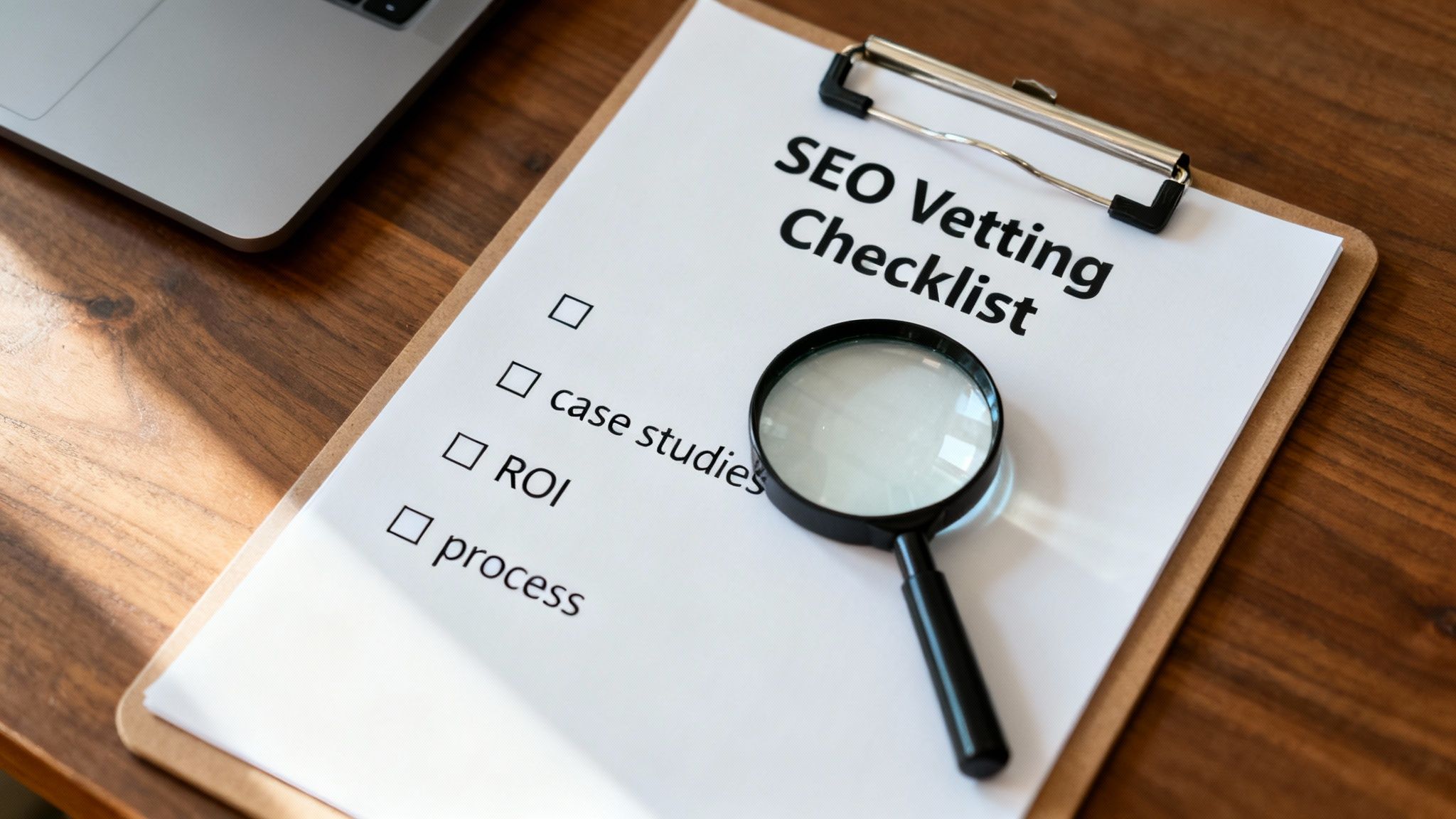
Think of this checklist as your game plan. It’ll help you cut through the jargon and zero in on what actually matters: sustainable growth for your business.
Scrutinise Case Studies for Real Results
Any half-decent SEO provider will have case studies ready to go, but they’re not all created equal. Your job is to look past the flashy numbers and find hard evidence of real business impact. A 300% jump in website traffic means absolutely nothing if none of those visitors turned into actual leads or sales.
When you're digging into their past work, look for these things:
- Business-Centric KPIs: Are they talking about more leads, better quality enquiries, or a lower cost to acquire a new customer? Those are the metrics that really move the needle.
- Industry Relevance: Have they worked with other service-based businesses like yours? Getting results for a national e-commerce brand is a completely different ball game to getting the phone to ring for a local plumber.
- A Clear Narrative: A good case study tells a story. It should lay out the client’s problem, the strategy they put in place, and the tangible business results they delivered.
Pro Tip: Ask for a case study from a client who was in a similar spot to you—maybe a brand-new website with zero authority, or an older site with traffic that had flatlined. This shows they can adapt their approach.
If all they show you are charts of keyword rankings and traffic graphs, push back. Ask them, "That's a great traffic increase, but can you show me how that translated into more client bookings for that business?"
The Must-Ask Questions for Your Consultation
The initial chat is your chance to interview them, not the other way around. Don't be afraid to ask direct, specific questions that force them to show their strategic thinking. Coming prepared with a list like this shows you’re serious and helps you compare the different SEO companies for small business you speak with.
Here are a few essential questions to have ready:
"How will you integrate SEO with our other marketing?" A great SEO strategy doesn't live on an island. A smart agency will ask about your email marketing, social media, and any ads you're running to build a plan where everything pulls in the same direction.
"What’s your process for building authority beyond just rankings?" This question is a great test. Real authority today is built through quality content, genuine industry connections, and a strong brand reputation—not just by gaming the system.
"How do you measure success and what will my monthly report look like?" Ask to see a sample report. It needs to be clear, easy to digest, and focused on the business goals you talked about, not just a data-dump of numbers.
"Who will be my day-to-day contact and who is actually doing the work?" This clarifies their team structure. You need to know if you'll be speaking directly with the strategist or just an account manager who’s passing on messages.
It’s also smart to get a feel for their communication style. After all, solid Client Communication Best Practices are the foundation of any good partnership.
Spotting the Major Red Flags
Knowing what to look for is only half the battle; you also need to know what to run from. Some SEOs use outdated or harmful tactics that can get your site penalised by Google. If you hear any of these, it's a clear sign to end the conversation.
Guarantees of #1 Rankings
Nobody can ethically guarantee a number one ranking. Google's algorithm is a complex beast that changes constantly. An honest pro will talk about growth, visibility, and hitting your business targets—not promising the top spot.
A Secretive or "Proprietary" Strategy
Transparency is everything. If an agency claims their methods are a secret recipe, it’s usually because they’re doing risky "black-hat" stuff like buying dodgy links or churning out low-quality AI content. A real partner will be an open book about their process.
A One-Size-Fits-All Approach
If they jump straight into pitching their standard package without asking deep questions about your business, your goals, and your customers, they aren't looking for a partnership. They're just trying to sell you a box. Your business is unique, and your SEO strategy should be too.
No Focus on Your Business Goals
Finally, if the whole chat revolves around technical jargon like "domain authority" and "crawl budget" but never connects back to your main goal (like getting more clients), they’ve missed the entire point. Technical SEO is crucial, but it’s a means to an end. And that end is growing your business.
Understanding SEO Pricing and Measuring True ROI
When you're looking for SEO companies for small business, it's easy to get hung up on the monthly price tag. But that's the wrong way to look at it.
SEO isn't just another bill to pay. It's a strategic investment in what is likely your most important channel for generating leads. The first step is to get your head around how agencies actually charge for their work, so you can make a smart decision.
From there, you need to know how to measure what you're actually getting back. Forget the smoke-and-mirrors jargon and vanity metrics. True ROI is about connecting SEO activity directly to your bank account.
Common SEO Pricing Models in Australia
Most SEO providers in Australia use one of three main pricing structures. There isn’t a single “best” model; what’s right for you will depend on your goals, the scope of work, and your budget.
Here’s a quick rundown of what you'll likely come across:
- Monthly Retainer: This is the most common setup. You pay a set fee each month for ongoing SEO work, which could include anything from content creation and link building to technical site health checks. It’s perfect for a consistent, long-term strategy and usually starts from $1,500 to $5,000+ per month.
- Project-Based Pricing: Got a specific, one-off job? This is the model for you. Things like a full website audit or a local SEO setup from scratch fall into this bucket. It’s great when you have a clearly defined need with a start and an end date.
- Hourly Consulting: Some experts charge by the hour for high-level strategic advice, team training, or digging into a tricky technical issue. This is best for businesses that need targeted guidance rather than a fully managed campaign.
Measuring What Really Matters: Business KPIs
The biggest mistake I see small business owners make is getting distracted by metrics that don't actually reflect business growth. Sure, seeing your keyword rankings go up is nice, but it doesn't pay the bills.
A good SEO partner will immediately steer the conversation toward Key Performance Indicators (KPIs) that prove the investment is paying off.
Stop asking, "Where do I rank for this keyword?" Start asking, "How many qualified leads did our SEO investment generate this month?" That shift in focus is the key to measuring true ROI.
Your monthly reports should be all about business-critical numbers like these:
- Lead Quality and Volume: Are you getting more phone calls and form submissions? And more importantly, are they from the right type of customer?
- Conversion Rate: What percentage of people visiting your site are actually taking the next step, like booking a call or filling out your contact form?
- Customer Acquisition Cost (CAC): How much are you spending on SEO to land one new customer? Over time, this number should be going down.
This approach makes your SEO partner accountable for delivering results that you can see in your bottom line, not just a bunch of fancy-looking charts. You can explore a variety of search engine optimisation packages to see how different levels of investment can target these specific goals.
The link between consistent effort and real results is undeniable. Research that tracked 36 Australian businesses found that those publishing two or more pages of content per month averaged 326% more traffic than businesses with no content plan. It’s a perfect example of how ongoing SEO pays real, measurable dividends.
Common Questions About Hiring an SEO Company
Even after doing all your homework, pulling the trigger and hiring an SEO partner can feel like a massive leap. It’s completely normal to have a few lingering questions. Let's tackle the most common ones we hear from business owners, so you can move forward with total confidence.
How Long Does It Take to See Real SEO Results?
This is the big one, and the only honest answer is: it takes time. SEO is a long game.
You might see some early green shoots—like a bump in traffic or better keyword rankings—within 3-4 months. But the results that actually impact your bottom line? That takes a bit longer.
For significant, lasting results like a steady stream of qualified leads or a real jump in online sales, you're typically looking at 6 to 12 months. Think of it as building momentum. It's a marathon, not a sprint.
Be extremely wary of anyone promising instant, page-one rankings. These claims are almost always propped up by risky "black-hat" tactics that can get your site slapped with a Google penalty, doing far more harm than good. The goal is steady, sustainable growth.
What Is the Difference Between Local and National SEO?
Getting this right is crucial because it dictates your entire strategy. They serve completely different goals and need totally different approaches.
- Local SEO is for businesses with a physical footprint or a defined service area. Think a plumber in Brisbane or a dental clinic in Perth. The entire strategy is laser-focused on showing up in location-based searches (like "mechanic near me") and hinges heavily on a perfectly optimised Google Business Profile.
- National SEO is for businesses that aren't tied to a specific location, like an e-commerce store that ships Australia-wide or an online business coach. Here, the strategy is much broader, targeting more general keywords to build authority across the entire country.
Choosing the right lane from the get-go makes sure your investment is actually working to attract the right kind of customers.
Can I Do SEO Myself Instead of Hiring a Pro?
Absolutely, and many business owners dip their toes in the water this way. Learning the basics of on-page SEO or managing your own Google Business Profile are fantastic first steps.
But the reality is, for a busy owner, SEO is a massive time-suck. It’s not a set-and-forget task. It means keeping up with Google's constant algorithm changes, running technical audits, creating a pipeline of optimised content, and building your site's authority.
When you hire one of the expert seo companies for small business, you're buying back your time and tapping into their experience, specialised tools, and focused effort to get you better results, faster. It frees you up to do what you do best—run your business.
How Much Should a Small Business in Australia Budget for SEO?
SEO costs vary wildly based on how competitive your industry is, what your goals are, and the scope of the work involved. Still, you need a realistic ballpark.
In Australia, a proper monthly retainer for a comprehensive SEO campaign with a reputable agency or consultant generally starts somewhere between $1,500 to $2,500. For tougher industries, that figure can easily climb past $5,000 per month.
If you're quoted a price that's dramatically lower, treat it as a red flag. Rock-bottom pricing usually means you're getting superficial work, outsourced tasks with zero oversight, or tactics that simply don't move the needle. It's better to see SEO as a core investment in your growth, not just another monthly bill.
Ready to stop guessing and start growing your service business with a proven SEO strategy? At Homer Digital Marketing, we build marketing systems that attract your ideal clients and scale your business.
