

Are you tired of the constant, exhausting hunt for new customers? Traditional marketing can feel cold and transactional, but what is relationship marketing? It's the strategic approach of building genuine, long-term connections with your clients. It’s the art of turning a one-time buyer into a loyal advocate who not only stays with you but also becomes your best source of new business.
This guide will show you exactly why this shift from transactions to relationships is critical and provide a proven framework to implement it.
The Shift From Transactions to Lasting Connections

In a crowded marketplace, especially for service-based businesses, simply being good at what you do isn't enough to stand out. You have to be memorable. The old model, known as transactional marketing, focused entirely on the immediate sale. It’s a numbers game built on short-term wins, leading to a relentless and costly cycle of customer acquisition.
Relationship marketing flips that script entirely. It shifts the focus from what you're selling to who you're serving. This strategy is about creating deep, trust-based connections that extend far beyond a single invoice. Think of it as becoming the go-to expert everyone in your community recommends, not just another faceless online entity.
This approach is built on a powerful principle: your most profitable customers are the ones you already have. Research from Bain & Company shows that increasing customer retention by just 5% can boost profits by 25% to 95%.
This isn't just about providing good customer service; it's a complete business philosophy. It requires truly understanding your clients' evolving needs, delivering consistent value, and maintaining open lines of communication. By doing so, you build a foundation of loyalty that creates a stable and predictable revenue stream.
How Does This Differ From The Old Way?
At its core, the difference between these two approaches lies in the primary objective. One chases volume, while the other cultivates value. Transactional marketing views each sale as a finish line. For relationship marketing, that same sale is merely the starting point of a long-term, mutually beneficial partnership.
To make it crystal clear, let's break down the two approaches.
Transactional vs Relationship Marketing
This quick comparison table highlights the fundamental differences in strategy, focus, and desired outcomes.
| Aspect | Transactional Marketing (The Old Way) | Relationship Marketing (The Smart Way) |
|---|---|---|
| Primary Goal | Maximise the number of individual sales | Nurture and retain existing clients |
| Time Horizon | Short-term, focused on immediate revenue | Long-term, focused on client lifetime value |
| Client Interaction | Minimal and often one-way (e.g., ads) | Frequent, personalised, and two-way |
| Business Focus | Centred on the product and its features | Centred on the client and their success |
| Client Commitment | Low; clients easily switch to competitors | High; clients become loyal brand advocates |
For any service business, this distinction is critical. When clients trust you, they don’t just return for more business—they become your most effective marketing channel through powerful word-of-mouth referrals. This strategic shift moves your business from a constant struggle for new leads to a sustainable model built on genuine human connection.
Why Service Businesses Thrive on Relationships
If you're in a business built on expertise—such as consulting, real estate, or professional services—trust isn't just a bonus. It's the entire foundation of your enterprise. This is where relationship marketing evolves from a smart tactic into a non-negotiable strategy for growth. Unlike a business selling a physical product, your service is intangible. Its true value is only proven through the client's experience and the results you deliver.
When someone hires you, they aren't just buying a service; they are investing in your expertise, your process, and your promise. That level of commitment requires a degree of confidence that flashy ads alone can never build. For a service business, authentic connections are your currency, and they translate directly into tangible business outcomes.
The Real Value of Building Connections
Focusing on relationships provides a powerful competitive advantage that price-slashing rivals simply cannot replicate. It shifts your business model away from the exhausting cycle of one-off projects and into a sustainable ecosystem of repeat business and enthusiastic referrals.
The core benefits are crystal clear and directly impact your bottom line:
- Higher Client Lifetime Value: When clients feel genuinely valued and understood, they stick around for the long haul and are far more likely to invest in your higher-value services. A huge reason service businesses succeed is their focus on improving customer lifetime value.
- A Steady Stream of Referrals: A happy client is your most powerful salesperson. Word-of-mouth referrals from a trusted source are invaluable—they bring you warm, pre-qualified leads that convert at a significantly higher rate.
- A Rock-Solid Market Reputation: Consistent, positive client relationships build an unshakeable reputation for reliability and excellence. This is what establishes you as the go-to expert in your field.
This focus on nurturing the clients you already have is central to a strong business. In fact, many successful service providers find that mastering effective client retention strategies is the single biggest driver of their profitability.
The Untapped Digital Opportunity
Despite these clear benefits, many businesses are failing to build these connections where their clients spend the most time—online. In Australia, a massive 79% of the population is active on social media, yet only 47% of SMBs have a presence. That represents a huge amount of potential left on the table.
This gap is critical. Recent data reveals that 64% of consumers trust brands more if they interact with them positively online. That’s a significant statistic, highlighting just how much genuine digital engagement can forge lasting bonds.
In short, relationship marketing isn't just about being nice; it's about being strategic. It’s about building a business where every satisfied client becomes a cornerstone for future growth, creating a powerful, self-sustaining engine for success.
Your Framework for Building Strong Client Connections
Knowing that relationship marketing works is one thing; putting it into practice is another. To move from theory to action, you need a simple, repeatable framework. We utilize a powerful three-pillar approach with our clients that consistently builds strong connections and drives real, measurable growth.
Think of it as a three-legged stool—if one leg is weak, the entire structure becomes unstable. The three essential pillars are Visibility, Credibility, and Automation.
The Three Pillars of Relationship Marketing
This framework stops you from merely hoping for connections and empowers you to actively build them at every stage of the client experience. It organizes your efforts into a logical flow, from the first moment of awareness right through to long-term loyalty. Understanding the complete client experience is key. You can dive deeper into this with our guide on what is customer journey mapping.
Let’s break down each pillar:
-
Pillar 1: Visibility: This is all about being seen by the right people in the right places. It’s not about shouting the loudest; it’s about strategically appearing where your ideal clients are already searching for solutions. Optimizing your presence on platforms like LinkedIn and your Google Business Profile ensures you are visible the moment a potential client needs you.
-
Pillar 2: Credibility: Once they see you, you must prove you are an expert. This pillar focuses on building trust by demonstrating your value before asking for a sale. You achieve this by creating genuinely helpful content—articles, case studies, videos—that solves real problems for your audience and positions you as the go-to authority in your field.
-
Pillar 3: Automation: Building relationships takes time, but smart systems can help you scale your efforts without losing that personal touch. This pillar involves using tools like a CRM and marketing automation to nurture leads, follow up consistently, and manage client communications efficiently. It frees you up to focus on the high-value conversations that truly matter.
This diagram illustrates how building trust through these pillars leads to the outcomes every service business desires: value, referrals, and a stellar reputation.
As you can see, everything rests on a foundation of trust. Get that right, and you will fuel the three results that guarantee long-term success.
Putting the Framework into Practice
Imagine a financial advisor using this model. First, she boosts her Visibility by overhauling her LinkedIn profile to attract high-net-worth individuals and sharpening her local Google ranking.
Next, she builds Credibility by publishing weekly articles on retirement planning and hosting webinars on smart investment strategies.
Finally, she implements Automation with a CRM that sends personalized follow-up emails after each webinar and schedules annual review reminders for all her existing clients.
This integrated approach means she’s not just another option in a crowded market. She becomes the trusted, obvious choice for her ideal clients. Each pillar supports the others, creating a powerful, self-sustaining engine for attracting and keeping high-value relationships.
The Essential Tools for Your Marketing Toolkit
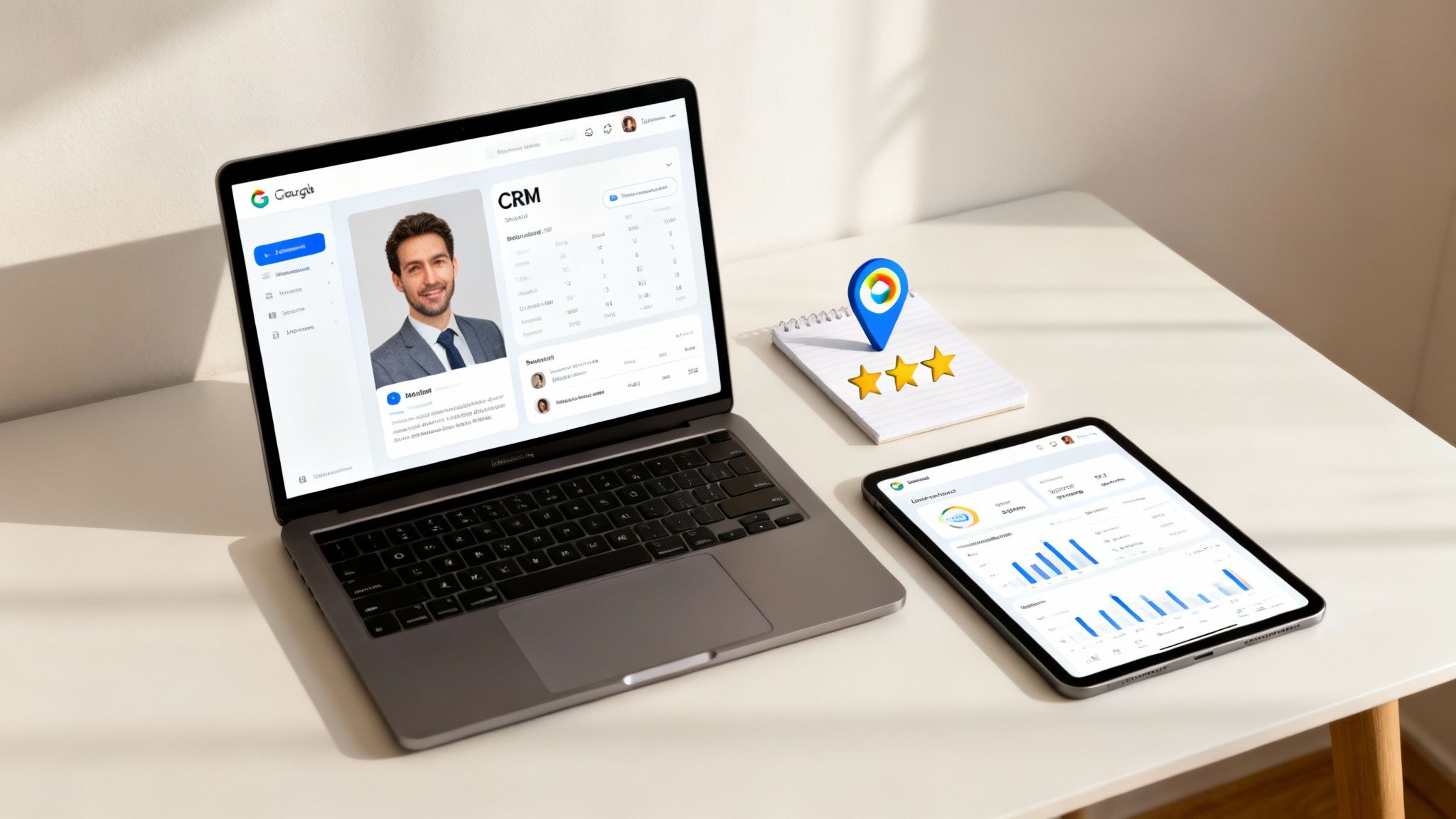
A great strategy is only as powerful as the tools you use to bring it to life. For modern relationship marketing, this means selecting technology that helps you connect with clients, build trust, and manage the process efficiently.
Without the right toolkit, even the best intentions can fall flat.
This isn’t about investing in a complicated or expensive setup. It’s about being smart and using the right platforms to support your visibility, credibility, and automation. When these tools work in harmony, they create a seamless system for building and nurturing those crucial client connections.
LinkedIn The B2B Relationship Hub
For most service-based professionals in Australia, LinkedIn is the undisputed champion of B2B relationship building. It's far more than a digital resume; it’s a dynamic platform for showcasing your expertise, connecting with your ideal clients, and participating in meaningful conversations.
To make it work, however, you must be active, not passive. Here’s where to start:
- Optimise Your Profile: Think of your profile as a landing page for potential clients. Use a professional headshot, write a compelling headline that speaks directly to your ideal client's problems, and use your "About" section to tell a story about the value you deliver.
- Share Valuable Content: Consistency is key. Post content that genuinely helps your audience, such as short tips, insightful articles, case studies, or quick videos that answer common questions.
- Engage Authentically: Don’t just post and ghost. Participate in the comments on others' content, get involved in relevant group discussions, and always send personalized connection requests.
Google Business Profile and Online Reviews
While LinkedIn is your networking engine, your Google Business Profile (GBP) is your digital front door for local clients. It's often the very first impression someone has of your business, making it a non-negotiable credibility tool.
A well-managed GBP, filled with positive reviews, provides powerful social proof. It tells potential clients that others have trusted you and had a great experience. Simply encouraging satisfied clients to leave a review is one of the most effective relationship marketing moves you can make. While you're nailing the basics, it's also worth exploring more advanced strategies like search marketing intelligence to get a deeper read on what your customers are really looking for.
CRM and Marketing Automation The Engine Room
This is where everything comes together. A Customer Relationship Management (CRM) system acts as your central hub for every client interaction, ensuring no valuable connection ever falls through the cracks. It provides a single place to track conversations, key dates, and client needs.
When paired with automation, a CRM becomes a powerhouse. Marketing automation handles the repetitive but essential tasks that nurture relationships. Learning what is marketing automation can free you up to send personalized follow-ups, remember client birthdays, or share relevant content without lifting a finger.
The Australian CRM market is booming for a reason, valued at USD 4.5 billion (when combined with Canada). Businesses recognize it as the key to personalizing the client journey. With product and interaction experiences driving 36% and 30.4% of customer loyalty shifts respectively, these tools are no longer a luxury. This technology makes a personal touch possible, even as you scale your business.
How to Measure Your Relationship Marketing Success
Investing time and energy into building client connections feels rewarding, but how do you prove it’s actually growing your business? Moving beyond gut feelings requires tracking the right metrics. This is how you demonstrate the real financial return of putting relationships first.
Successful relationship marketing isn't measured in vague terms like ‘brand awareness’. It’s measured in tangible results that directly impact your bottom line and long-term stability. When you know your numbers, you can confidently double down on what works.
Key Metrics for Service Businesses
So, how do you truly know if your efforts are paying off? You need to focus on a few core key performance indicators (KPIs). These metrics cut through the noise and tell the real story of client loyalty and its impact on your revenue.
Here are the essential KPIs you should be tracking:
-
Client Lifetime Value (CLV): This is the most critical metric. It represents the total revenue you can expect from a single client over the entire course of your relationship. A rising CLV is a clear sign that clients are staying longer and investing more in your services.
-
Client Retention Rate: A simple yet powerful percentage that shows how many of your clients remain with you over a specific period. High retention is the backbone of any stable service business and proves your relationships are strong.
-
Net Promoter Score (NPS): This metric gets to the heart of client satisfaction. It asks one simple question: "How likely are you to recommend our business to a friend or colleague?" It then categorizes clients into Promoters, Passives, and Detractors, giving you a crystal-clear benchmark for loyalty.
These numbers provide a data-driven view of your success, transforming it from a 'feeling' into a verifiable fact.
Tracking Referrals and Calculating Your ROI
Beyond these internal metrics, it is absolutely essential to have a system for tracking where your new business originates. The process is simple. When a new client inquiry comes in, make it standard practice to ask, "How did you hear about us?"
By consistently tracking the source of new leads, you can directly attribute new revenue to referrals from happy clients. This allows you to calculate the direct Return on Investment (ROI) of your relationship-building activities, turning a 'soft' strategy into hard numbers.
This simple process transforms relationship marketing from a 'nice-to-have' into a core driver of your profitability. And the proof is in the data. In the Australian market, businesses have seen a 1.5-2.9x uplift in revenue just by using client data to create more personal initiatives. The data is clear: the experience you provide accounts for over 36% of loyalty changes, while your interactions drive another 30.4%. You can learn more about these Australian loyalty statistics here.
Key Metrics for Relationship Marketing Success
Track these key performance indicators (KPIs) to measure the true impact of your relationship-building efforts on your business's bottom line.
| Metric | What It Measures | Why It's Important for Service Businesses |
|---|---|---|
| Client Lifetime Value (CLV) | The total revenue generated from a single client over time. | Shows the long-term value of keeping clients happy and engaged. |
| Client Retention Rate | The percentage of clients you keep over a specific period. | A direct indicator of client satisfaction and business stability. |
| Net Promoter Score (NPS) | Client willingness to recommend your business to others. | Measures loyalty and predicts future growth through word-of-mouth. |
| Referral Rate | The percentage of new business that comes from existing clients. | Directly links relationship-building efforts to new revenue generation. |
Ultimately, measuring your success isn’t complicated. It’s about zeroing in on the numbers that reflect loyalty, satisfaction, and repeat business. These KPIs provide the hard proof you need to justify your investment in building lasting client connections.
Got Questions About Relationship Marketing? Let's Clear Things Up.
Even when a strategy makes perfect sense, it’s normal to have a few questions before diving in. Let’s tackle some of the most common hesitations business owners have about what relationship marketing is—and what it definitely isn’t.
Clarifying these points is key to understanding how this philosophy works in the real world for busy service providers like you.
"This Sounds Like a Lot of Work. How Much Time Will It Really Take?"
This is perhaps the biggest concern, especially for small business owners already juggling numerous responsibilities. And yes, there is an initial time investment required to set up your systems, such as optimizing your LinkedIn profile or implementing a simple CRM.
But the long-term goal is to save you time, not add more to your plate.
By automating parts of your follow-up and focusing only on high-value clients, you spend far less energy on cold prospecting that leads nowhere. Instead, that time is redirected into conversations with people who are already warmed up and genuinely interested in your services.
Consistency beats intensity every time. A few focused hours each week will deliver far better results than sporadic, all-out efforts.
True relationship marketing isn't about adding more to your to-do list. It's about shifting your energy to the activities that deliver the highest return. It’s about building a system that keeps working for you, even when you’re not actively hunting for leads.
This is how you break the exhausting cycle of constantly chasing new business and build a sustainable model where your ideal clients start coming to you.
"Will Relationship Marketing Actually Work for My Industry?"
Absolutely. In fact, this approach is most powerful in industries where trust and expertise are the primary factors in a client's decision-making process.
If your clients are making a considered purchase—not an impulse buy—and they value a long-term partnership over a quick, transactional fix, then this strategy isn't just helpful; it's essential for growth.
It’s a game-changer for industries like:
- Consultants and Coaches: Where personal trust is the entire foundation of the engagement.
- Real Estate and Buyer's Agents: Your whole business is built on relationships, referrals, and repeat clients.
- Financial Advisors and Accountants: Where long-term client confidence is completely non-negotiable.
- Wellness Practitioners: Who rely on deep client connections to get positive outcomes.
- IT Service Providers: Where ongoing support and reliability are what set you apart.
Put simply: if you’re selling your expertise, you’re in the relationship business. Period.
"Isn't This Just a Fancy Name for Email Marketing?"
Not at all. This is a common misconception, but it’s like comparing a single ingredient to a complete, gourmet meal. Email marketing is an important tool, but it's just one component of a much larger strategy.
Real relationship marketing is an entire business philosophy that touches every point where a client interacts with your brand. It's a mindset focused on building trust and delivering value at every touchpoint, not just in their inbox.
This holistic approach includes:
- Your social media presence and the helpful content you share.
- Your online reputation and what past clients are saying in reviews.
- The entire follow-up and onboarding experience you create.
- The way you communicate and actually deliver your services.
It's a complete business strategy, not just another marketing tactic to add to your list.
Ready to stop chasing leads and start building a business powered by genuine relationships? Homer Digital Marketing provides the proven strategies and systems that service businesses need to attract their ideal clients and scale with confidence. Discover how we can help you grow.
