

Struggling to stand out in a crowded market? Have you heard the term 'thought leadership' thrown around and wondered what it actually means for your business growth? It's more than just a buzzword.
It’s the critical difference between having expertise and becoming the recognised voice people actively seek out for fresh ideas, deep insights, and clear direction. This guide will show you exactly what thought leadership is and how to use it to attract your ideal clients.
What Is Thought leadership Exactly? A Simple Definition

Here's a simple way to define it: an expert knows the answers to today's questions. A thought leader is already asking the questions of tomorrow. They don’t just join the conversation; they start it by offering a new, forward-thinking perspective.
For Australian service businesses—whether you’re a consultant, real estate agent, or IT provider—understanding what thought leadership is isn't just fluffy marketing talk. It’s a powerful strategy to cut through the noise and stop being just another name on a long list of options.
The Core of the Concept
So, what does it take to become a thought leader? At its heart, thought leadership boils down to three key things:
- Credible Expertise: You genuinely have to know your stuff, backed by real-world experience.
- A Unique Perspective: You need to offer a fresh angle or a new way of solving old problems.
- Consistent Generosity: You must be willing to share your insights freely and regularly to build genuine trust.
Putting these together elevates you from a simple service provider to an indispensable advisor. Think about the difference between a real estate agent who just lists properties and one who publishes a quarterly market analysis that every local investor waits for. That’s the shift.
A true thought leader doesn't just sell a service. They sell clarity and a vision for the future, making themselves an essential resource for their audience.
Why It Matters More Than Ever
We live in a world saturated with sales pitches and generic "5 tips for…" blog posts. Authentic authority is what grabs attention and builds the kind of client relationships that last.
The data backs this up. The Edelman-LinkedIn B2B Thought Leadership Impact Report found that a massive 70% of decision-makers in the Australian business world trust thought leadership content more than traditional marketing.
This signals a huge shift in how people buy. Your potential clients are actively hunting for credible voices to help them make smarter decisions. When you become that voice, your business becomes the obvious choice. If you want to see what this looks like in action, checking out different thought leadership content examples is a great way to get inspired.
Why Authentic Thought Leadership Drives Real Business Growth
So, how does this all translate into actual business growth? It’s not just theory.
Think of it this way: you’re the only fishing guide in town who consistently puts out a free, accurate map of where the fish are biting. Pretty soon, you’re not just a guide—you’re an essential resource. Serious anglers won't even think about hiring anyone else.
This kind of authority completely changes how you find and sign clients. Instead of chasing leads, you attract them. Prospects come to you already convinced of your value because they’ve already learned from you. They show up educated, engaged, and ready for you to solve their problem.
Shorten Your Sales Cycle
When a potential client has been reading your insights for weeks or months, they already get your approach and trust your judgement. That trust is gold—it dramatically shortens the sales cycle.
The conversation flips from, "Why should I choose you?" to, "How soon can we start?". Your content has already done the heavy lifting, proving you know your stuff. This means less time trying to convince people and more time closing deals with clients who are a perfect fit. It’s a straight line to a more efficient, profitable business.
Command Premium Pricing
Being the go-to expert in your field means you can stop competing on price. When you’re the recognised authority, you’re not just selling a service; you're selling certainty and better outcomes.
That perceived value gives you the power to set premium prices for your work. Clients will happily pay more for a trusted advisor than for a simple service provider. Your thought leadership builds an economic moat around your business, making you far less vulnerable to market slumps and low-cost competitors.
Drive Strategic Improvement
Good thought leadership doesn’t just boost sales; it makes businesses run better. For instance, publications from The Governance Institute of Australia have been adopted by over 200 public sector entities.
The result? 78% of governance professionals reported it led to better strategic decision-making. That’s a clear example of how sharing expert knowledge directly leads to smarter, more effective business practices.
At the end of the day, that’s the real point of what is thought leadership. It's not about fluffing up your brand. It’s a powerful commercial strategy that creates a steady stream of high-quality leads, justifies higher fees, and cements your spot as the only real choice in a crowded Australian market.
The Three Pillars of a Powerful Thought Leadership Strategy
A powerful thought leadership strategy doesn't just happen by accident. It's built on a solid foundation, much like a well-designed building. If you want to create an influential platform that pulls in your ideal clients, you need to focus on three core pillars that work together.
This approach gives you a structured, repeatable process. It stops you from just creating random content and starts you on the path to strategically building your reputation as the go-to authority in your field.
This diagram shows exactly how establishing thought leadership becomes the foundation for driving leads, closing sales, and commanding better pricing.
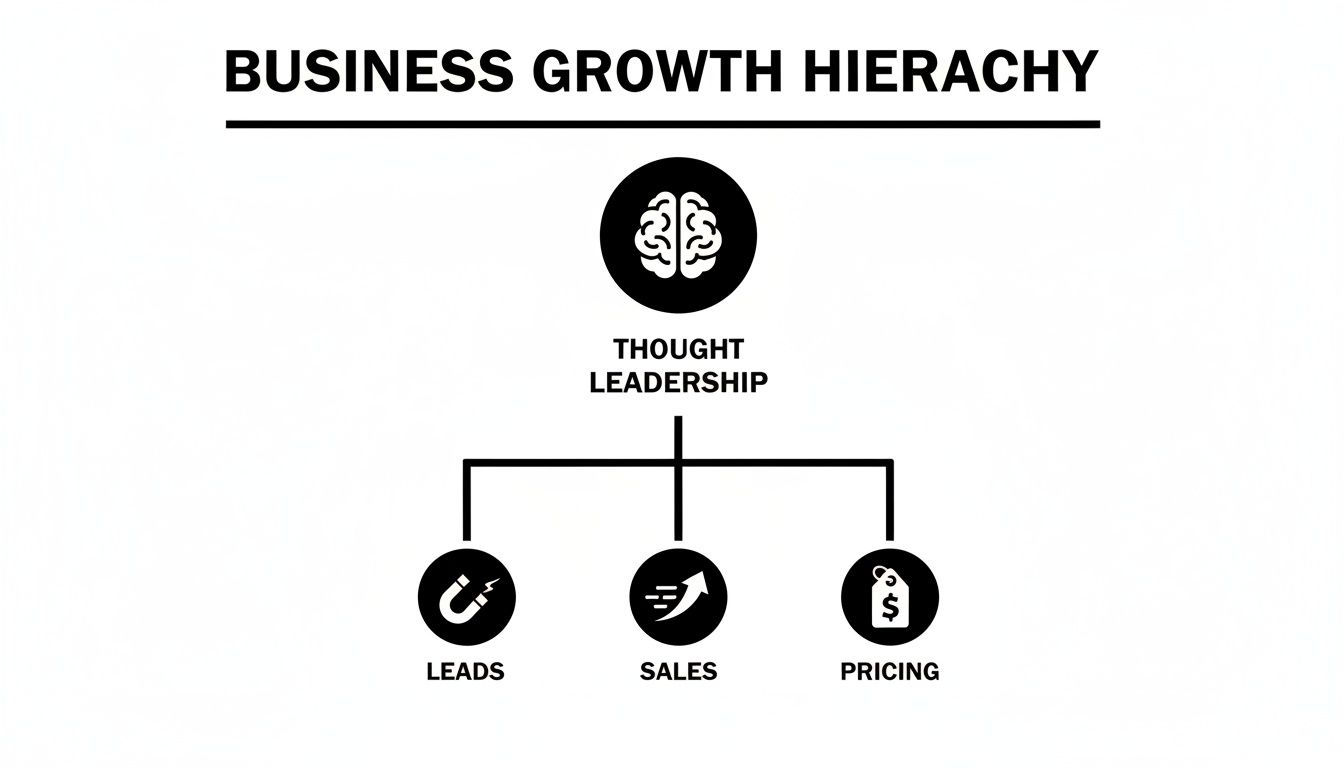
As you can see, positioning yourself as an authority directly influences the commercial outcomes that matter most for business growth.
Pillar 1: Find Your Unique Niche and Perspective
First up, you need to define your territory. Trying to be an expert on everything makes you an expert on nothing. The real key is to find a specific niche where you can genuinely own the conversation.
Are you an IT consultant? Don't just talk about "IT solutions." Get specific. Focus on something like "cybersecurity resilience for Australian accounting firms." That sharp focus makes your insights immediately more relevant and valuable to the right people.
Your unique perspective is your competitive advantage. It's not just what you know, but how you see the problems and solutions in your industry differently from everyone else.
Once you’ve nailed your niche, you need a unique point of view. What do you believe that others don't? What common industry advice do you disagree with? This is what will make people sit up and pay attention.
Pillar 2: Choose Your Primary Channel
Next, you need to decide where you'll build your platform. A classic mistake is trying to be everywhere at once—it's a fast track to burnout and a messy, inconsistent message. Instead, pick one or two primary channels where your ideal clients are already active and looking for answers.
For many Australian service businesses, the most effective channels are a straightforward choice:
- LinkedIn: Perfect for B2B professionals, consultants, and anyone looking to connect with decision-makers and share professional insights.
- Google (via your website/blog): Essential for capturing clients who are actively searching online for solutions, positioning your own website as a trusted resource.
By focusing your energy, you can build momentum and become a recognised voice on that platform far more effectively than spreading yourself thin.
Pillar 3: Create Consistently High-Value Content
Finally, the engine of your strategy is the content itself. This is where you deliver on the promise of your expertise. Your content has to be consistently valuable, insightful, and generous.
This means moving beyond generic tips. You need to create content that genuinely solves problems, challenges assumptions, or offers a new way of thinking. Whether it’s a detailed blog post, an insightful LinkedIn article, or a weekly email newsletter, consistency is what builds trust and keeps your audience coming back for more.
For a deeper dive into crafting your approach, check out the great insights on a modern thought leadership content strategy.
Now, let's break down how these pillars look in practice across different content types.
Thought Leadership Content Pillar Comparison
Choosing the right type of content for your business and channel is critical. This table breaks down the most common pillars for service-based businesses, helping you decide where to focus your efforts.
| Content Pillar | Description | Best For (Business Type) | Primary Channel |
|---|---|---|---|
| Data-Driven Insights | Publishing original research, survey results, or analysis of industry data to reveal trends. | B2B Consultants, Financial Services, SaaS, Market Research Firms | Website Blog, LinkedIn, White Papers |
| Contrarian Viewpoints | Challenging a commonly held belief or "best practice" with a well-argued, alternative perspective. | Coaches, Strategists, Industry Disruptors, Creative Agencies | LinkedIn, Opinion Editorials, Podcasts |
| Educational Frameworks | Creating proprietary models, how-to guides, or step-by-step processes that simplify complex topics. | Training Providers, IT Services, Marketing Agencies, Business Coaches | Website Blog, YouTube, Webinars |
| Personal Storytelling | Sharing lessons learned from personal experiences, successes, and failures to build connection and trust. | Solopreneurs, Personal Brands, Health & Wellness Practitioners | LinkedIn, Email Newsletter, Public Speaking |
Ultimately, the best content pillar is one you can commit to consistently. Start with one, master it, and then consider expanding your approach once you've built momentum.
How to Create Content That Builds Authority

Turning what you know into content that actually builds authority can feel like a massive job, especially when you’re already flat out running your business. The good news? It doesn’t have to be complicated.
It’s really just about packaging your expertise in a way that positions you as the go-to expert.
Great thought leadership content always starts with a unique idea. It pushes back against the status quo, offers a fresh take on a tired problem, or gives a forward-thinking view on an industry shift. You're not just reporting the news; you're explaining what it really means for your clients.
This is the shift from being just another voice to becoming a trusted guide. The goal is to create assets that make your ideal clients see you as the only solution to their problems.
Brainstorm Ideas That Challenge the Norm
The best content almost always starts with a question that goes against the grain. Stop rehashing the same advice everyone else is spouting. Instead, ask yourself what the common wisdom gets wrong or what big shift is on the horizon that nobody is talking about yet.
Here are a few prompts to get the ball rolling:
- What’s a “best practice” in my industry that I secretly think is rubbish?
- What’s the one thing my clients get wrong about my field, over and over again?
- If I had a crystal ball, what would I tell my clients to get ready for in the next 12 months?
Answering these questions gives you the foundation for content that gets noticed because it offers a genuinely new way of thinking. This is how you start to own a conversation.
Use Simple Research to Add Credibility
Your personal experience is gold, but backing it up with hard data makes your arguments undeniable. You don’t need to fund a massive academic study—a little bit of simple research can add a huge amount of credibility.
Look for industry reports, government stats, or reputable surveys that support your point of view. For instance, a leadership survey from the Australian Institute of Management found a powerful link between effective thought leadership and a leader's ability to motivate their teams.
The study showed that top-performing leaders shared insights three times more often, which directly correlated with a 25% higher employee retention rate in hybrid work environments. It proves that sharing knowledge isn't just a soft skill; it's a measurable leadership trait. You can explore the full AIM study to see how leadership is evolving.
Integrating a single, powerful statistic can transform a personal opinion into a compelling, fact-based argument that builds immediate trust with your audience.
Structure Your Content with Storytelling
Facts tell, but stories sell. It’s a cliché for a reason. The most powerful content weaves data and insights into a narrative, making complex ideas much easier for people to understand and, more importantly, remember.
A dead-simple storytelling structure you can use right away is the Problem-Agitate-Solve formula:
- Problem: Kick off by clearly defining a pain point your ideal client is wrestling with.
- Agitate: Dig into the consequences of not solving this problem. What are the frustrations, the costs, the missed opportunities?
- Solve: Introduce your unique perspective or solution as the clear, obvious way forward.
This framework turns a dry explanation into a compelling journey. It connects with your readers on an emotional level and makes your insights hit that much harder. For many service professionals, their LinkedIn profile is a key part of this story. Check out our guide on how a powerful LinkedIn profile can amplify your authority and become the central hub for your thought leadership.
Common Mistakes That Undermine Your Authority
Building a reputation as a thought leader is a slow burn, but you can destroy it surprisingly fast. Most efforts fail not because the expertise is lacking, but because of a few simple, avoidable traps that kill trust and credibility.
Knowing what not to do is just as critical as creating brilliant content. If you can steer clear of these common pitfalls, you'll build genuine authority instead of just adding to the noise.
Being Overly Promotional
The quickest way to make your audience tune out? Make everything a sales pitch. If every article, post, or video feels like a flimsy excuse to hawk your services, people will see right through it. True thought leadership is about genuinely helping your audience, not just helping yourself to their wallets.
Stop talking about what you sell and start focusing on what you know. Frame your expertise around solving a real industry problem or offering a perspective they haven't heard before.
Solution: Stick to the 90/10 rule. Make 90% of your content purely educational and valuable, with no strings attached. The other 10% can then gently point people toward your solutions.
This approach builds goodwill and positions you as a generous expert, not just another vendor. It’s a huge part of building a solid public image, and you can dig deeper into why that’s so important by reading our guide on what is reputation management.
Publishing Generic Content
Another classic mistake is churning out content that says absolutely nothing new. Rehashing the same five tips every other blog has already covered won’t make you a leader. It makes you a follower.
Your content has to have a point of view. It needs to challenge, inform, or inspire your audience in a way that feels fresh and original.
- Don't: Publish another "5 Obvious Tips for…" article.
- Instead: Write something like, "Why This Common Industry 'Best Practice' Is Actually Holding You Back."
That’s the kind of angle that makes people sit up, take notice, and remember your name. It proves you're not just repeating what you've heard—you're generating real insights.
Creating Great Content That Nobody Sees
This is the most painful mistake of all: spending hours crafting a brilliant piece of content, only for it to gather digital dust. Hitting "publish" isn't the finish line. Without a clear plan to get it in front of people, even the most groundbreaking article will have zero impact.
Your content needs a distribution strategy. That means actively sharing it where your audience hangs out, engaging with comments, and encouraging others to pass it on. Treat getting the word out with the same energy you put into creating it, and your authority will finally have the platform it deserves.
How to Measure Your Thought Leadership ROI
Let's get straight to the question every business owner asks: is this actually working? To justify putting your time, money, and energy into thought leadership, you need to know if it's bringing a real return.
The trick is to look past the easy numbers. Likes, shares, and follower counts feel good, but they don't pay the bills. These are vanity metrics—they might signal that people are seeing your content, but they don't tell you if your authority is actually growing your business.
Instead, we need to focus on the key performance indicators (KPIs) that connect directly to your bottom line.
Focusing on Business-Centric KPIs
A simple dashboard is all you need to see the real-world impact of your strategy. When you track the right numbers, you can make smarter decisions about where to double down and what to drop. It’s a common hurdle, and you can get a broader perspective by reading our guide on why it is difficult to measure marketing ROI in the first place.
Here are the essential metrics you should be tracking:
-
Increase in Qualified Inbound Leads: Are more of your ideal clients finding you and reaching out? This is the clearest sign that your content is hitting the mark and attracting the right audience.
-
Speaking and Collaboration Requests: Are industry peers, event organisers, or podcasters knocking on your door? When others want to borrow your authority for their platform, you know your reputation is on the rise.
-
Organic Search Visibility: Keep an eye on your Google rankings for the topics you’re known for. When you start showing up on the first page for key phrases, it’s a massive signal that search engines now see you as an expert source.
-
Lead-to-Client Conversion Rate: Of the leads coming from your thought leadership content, how many are turning into paying clients? These leads should be much warmer and easier to convert because they already trust your expertise. If this number goes up, your strategy is working.
Key Takeaway: Measuring thought leadership isn't about counting likes. It’s about connecting your content efforts to tangible business outcomes like better leads, improved conversions, and increased industry recognition.
Got Questions? Here Are Your Answers
Alright, we’ve walked through the what, why, and how of thought leadership. But there are always a few lingering questions that stop business owners from taking that first step. Let’s tackle them head-on.
How Much Time Does This Actually Take?
Look, consistency beats intensity every single time. You don't need to quit your day job to do this.
Aim for a solid 2-4 hours per week. Use that time to create and share one genuinely useful piece of content. This isn't a flash-in-the-pan marketing campaign; you're building a reputation brick by brick. A steady, valuable presence over months will always outperform short, frantic bursts of activity.
Can I Really Be a Thought Leader in a "Boring" Industry?
One hundred percent, yes. No industry is boring to the people who rely on it.
Your clients in logistics, compliance, or accounting have complex, expensive problems. Your job is to make those confusing topics simple and show them a clear way forward. When you can do that, you become indispensable. Your unique insight is what matters, not how exciting your industry sounds at a dinner party.
Isn't This Just Content Marketing?
It's a common mix-up, so let's clear it up.
Think of it this way: content marketing is the car, and thought leadership is the destination. Content marketing is the broad practice of creating stuff to attract people. Thought leadership is a specific type of content marketing, laser-focused on establishing your authority and unique point of view.
So, all thought leadership is content marketing, but not all content marketing (like a basic "how-to" post) is true thought leadership.
Ready to stop being just another name on a long list and become the first person your ideal clients call? Homer Digital Marketing specialises in building powerful thought leadership platforms for service-based businesses using proven Google and LinkedIn strategies.
Book a discovery call with us today and let's map out a plan to make you the go-to authority in your field.
