

Is your business website just an online brochure, collecting dust while your competitors get all the calls? You're a master at what you do, but if local customers can't find you on Google, you're practically invisible. For many small business owners, this is a frustrating reality that leaves a huge amount of money on the table.
This guide will demystify what a real SEO service for small business owners actually does. We’ll ditch the jargon and give you an actionable roadmap to transform your website from a sunk cost into your hardest-working sales tool, consistently attracting qualified, ready-to-buy customers. The solution to your online visibility problem is right here in this article.
Why SEO Is Your Greatest Untapped Advantage
Imagine this: your ideal customer in Sydney or Melbourne is searching for the exact service you provide. Instead of finding you, they find your competitors. This is the reality for thousands of Aussie small businesses—from talented wellness coaches and real estate agents to expert mechanics—who are masters of their craft but practically invisible online.
Too many business owners see Search Engine Optimisation (SEO) as some kind of complicated, technical beast. It’s not. In reality, it’s the most powerful way to show up for customers at the exact moment they need you. It isn't about trying to trick Google; it’s about clearly communicating your value so that search engines can confidently recommend you to qualified, ready-to-buy customers.
The Untapped Opportunity in the Australian Market
The digital playing field isn't exactly level, and for a savvy business owner, that’s a massive opportunity. A staggering 64% of Australian small businesses are either completely unaware of SEO or are seriously underutilising it, even though organic search drives the majority of all website traffic. That gap means a smart, strategic investment in SEO can give you a powerful edge over the competition.
A recent survey cited by LocaliQ and the National Retail Association found only 36% of Australian small businesses are using SEO effectively. This hands a golden opportunity to service pros like wellness practitioners, automotive specialists, and coaches to completely dominate their local search results.
This isn’t just about getting more website clicks. It’s about attracting the right kind of traffic—people in your local area who are actively looking for a solution to a problem you solve. A great SEO strategy ensures that when they search, your business is the most visible, credible, and helpful answer they find.
Turning Your Website Into Your Best Salesperson
Your website should be working for you 24/7. It should be attracting and pre-qualifying potential clients even while you’re busy with existing ones. A properly optimised website does exactly that.
It builds trust, establishes your authority, and gently guides visitors toward taking the next step, whether that’s booking a consultation, requesting a quote, or making a purchase. Ultimately, the biggest advantage of SEO for a small business is its power to drive consistent organic traffic. Understanding the proven ways to increase organic traffic is the key to long-term success. By the end of this guide, you’ll know exactly how to do it.
Understanding the Core Components of an SEO Service
An effective SEO service for small business owners isn't a single magic bullet. It’s more like a well-oiled machine with several critical parts working together to build your online presence. Think of it like building a house: you need a solid foundation, clear signage out front, a great reputation in the neighbourhood, and strong referrals from others.
This infographic shows how all these moving parts connect, turning a simple website into a powerful engine for visibility and growth.
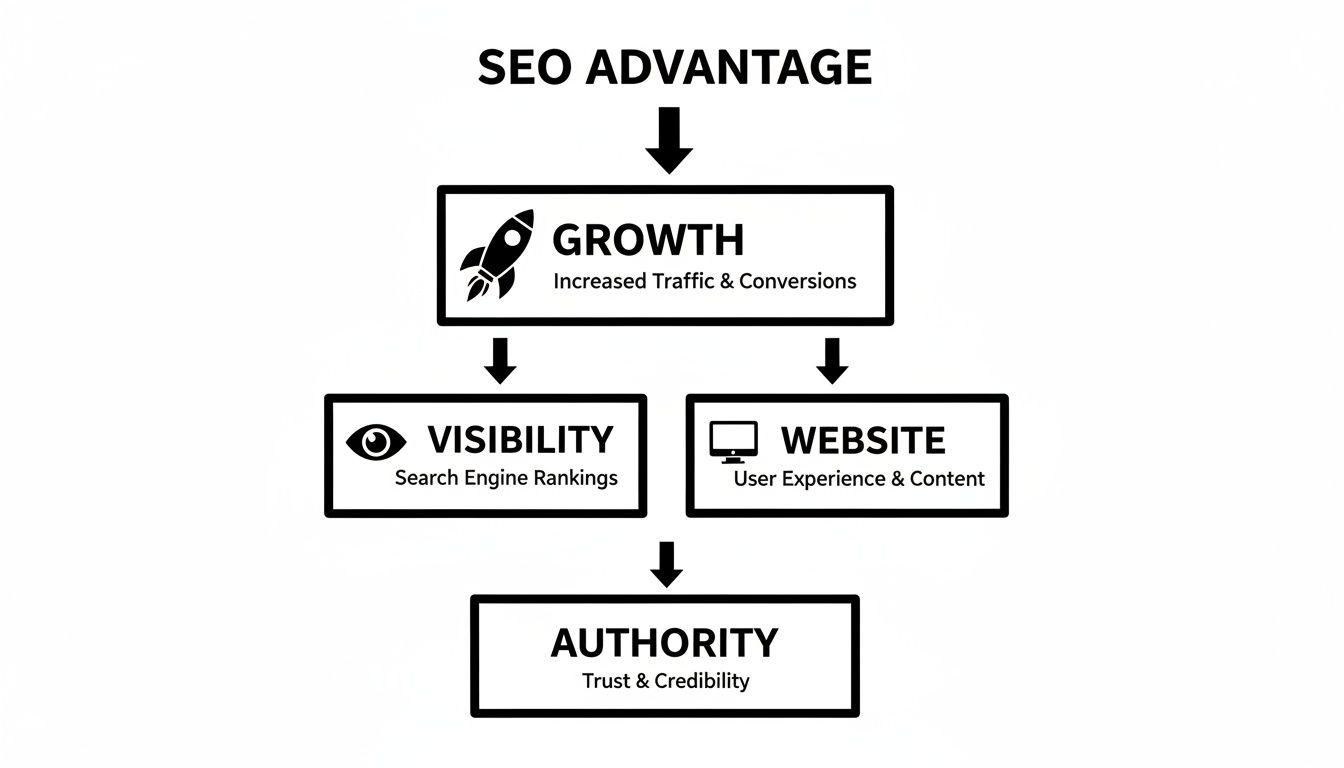
As you can see, real business growth is the end result of a strong website and better online visibility. Each component plays its part to attract more of your ideal clients.
Technical SEO: The Foundation of Your Digital Storefront
Before you even think about attracting visitors, you need to make sure your website is structurally sound. Technical SEO is the blueprint and foundation of your digital property. It’s all about optimising the backend of your website so search engines like Google can crawl, understand, and index your pages without hitting any roadblocks.
Imagine building a beautiful shop but forgetting to put in a front door. That’s what happens when you ignore technical SEO. No matter how amazing your content is, if Google can't get inside to see it, you're practically invisible.
Key tasks in technical SEO include:
- Improving Site Speed: Making sure your website loads lightning-fast is non-negotiable. A Google study found that a one-second delay in mobile load times can slash conversion rates by up to 20%.
- Mobile-Friendliness: Most searches now happen on a phone. Your site absolutely must look great and work perfectly on any screen size.
- Creating a Sitemap: This is essentially a map that helps search engines understand your site’s structure and find all your important pages.
Without a solid technical base, any other SEO work is just built on shaky ground.
On-Page SEO: Your Signage and Interior Design
Once your foundation is solid, it's time to work on what your customers actually see. On-Page SEO is the art of optimising the content and code of your individual pages. Think of it as your digital shopfront, your product displays, and the helpful signs that guide customers around your store.
The whole point is to make it crystal clear to both people and search engines what each page is about. When someone searches for a "wellness coach in Brisbane," on-page SEO makes sure your page screams, "Yes, that's me!"
On-page optimisation is about more than just stuffing in keywords. It’s about creating such a great user experience that you answer the searcher’s question so well they have no reason to click the 'back' button.
This involves several key elements working together:
- Keyword Research and Integration: Finding the exact phrases your ideal clients are typing into Google (e.g., "local accountant for tradies") and weaving them naturally into your page titles, headings, and text.
- High-Quality Content: Creating genuinely valuable and engaging content that solves your audience's problems and answers their questions.
- Meta Tags: Writing compelling title tags and meta descriptions that make people want to click on your link in the search results.
Done right, on-page SEO turns casual browsers into engaged visitors.
Off-Page SEO: Building Your Reputation and Authority
Finally, we have Off-Page SEO. This covers all the actions taken outside of your own website to boost your rankings. Think of this as building your business's reputation around town. The biggest piece of this puzzle is backlinking.
A backlink is just a link from another website to yours. In Google’s world, every backlink from a reputable, relevant site is like a vote of confidence—a strong referral from a trusted colleague. The more high-quality "votes" you collect, the more authoritative and trustworthy your website appears.
For example, if a well-respected Australian real estate blog links to your buyer's agent website, it sends a powerful signal to Google that you're a credible expert. This authority is a massive ranking factor and is essential for standing out in a crowded market. It’s the final piece that takes your business from just being online to being a recognised leader.
Winning Your Local Market with Hyper-Focused SEO
For most Aussie service businesses, from a buyer's agent in Melbourne to a wellness practice in Sydney, the best customers are just around the corner. While broad digital marketing has its place, local SEO is the engine that drives real, neighbourhood-level growth.
It’s all about being the first and best answer when someone nearby searches for what you do. This isn’t just theory; it's a proven way to attract clients who are ready to buy.

Think about that Melbourne buyer's agent. Instead of targeting the entire city, they create dedicated pages for high-value suburbs like Richmond and South Yarra. This targeted approach lets them speak directly to the needs of clients in those areas, turning their website into a local customer magnet.
Mastering Your Google Business Profile
Your Google Business Profile (GBP) is the single most important tool for winning locally. It's that free listing that pops up in Google Maps and the super-visible "Map Pack" in search results. Getting this right is non-negotiable for any business wanting local clients.
A solid GBP isn't just a static listing; it’s your dynamic digital storefront. It needs consistent attention to keep it packed with helpful, current information that builds trust with both potential customers and Google. To dig deeper, check out this complete guide to optimising your Google Business Profile.
Think of your GBP like the best-located shop on the high street of the internet. It catches the eye, gives instant answers, and makes it dead simple for customers to walk through your digital door.
Key actions to master your profile include:
- Complete Every Section: Fill out every single field—services, hours, photos, and a detailed business description.
- Use High-Quality Photos: Regularly upload clear, professional photos of your work, your team, and your premises.
- Answer Questions Promptly: Engage with people by answering any questions they post on your profile.
- Publish Regular Posts: Use Google Posts to share updates, offers, and news. It keeps your profile active and fresh.
The Power of Location-Specific Pages
While your GBP gets you on the map, location-specific pages on your website are what close the deal. These are dedicated pages optimised for each suburb or area you serve. They signal to Google that you are a relevant authority for that exact spot, massively improving your chances of ranking for searches like "accountant in Parramatta."
This strategy turns your website from a generic brochure into a highly targeted resource. It’s the difference between casting a wide, ineffective net and using a precision tool to catch your ideal clients. For a closer look at this approach, you can refer to this practical small business SEO strategy guide.
The difference this multi-location strategy makes is huge. Original research tracking 36 Australian businesses across 28 industries found that those targeting multiple locations drive a massive 557% more organic traffic on average than businesses focused on just one spot.
To put that in perspective, have a look at the data below.
Local SEO Impact Single vs Multi-Location Strategy
| Metric | Single-Location Business (Average) | Multi-Location Business (Average) | Performance Uplift |
|---|---|---|---|
| Organic Traffic | 12,186 Sessions | 80,022 Sessions | +557% |
| Keyword Rankings | 1,200 Keywords | 7,500+ Keywords | +525% |
| Lead Generation | 45 Leads/Month | 280+ Leads/Month | +522% |
As you can see, the numbers speak for themselves. Expanding your digital footprint to cover all the areas you serve doesn't just add a little bit of traffic; it creates an exponential increase in visibility and leads.
Generating Positive Reviews Systematically
Online reviews are today's word-of-mouth. A steady flow of positive reviews on your GBP is one of the strongest trust signals you can send. In fact, 95% of consumers say they trust online reviews, making them a critical piece of the puzzle.
The key is to have a system for asking for them. Don't just leave it to chance. A good SEO service will help you set up a simple, automated process to encourage happy clients to share their positive experiences. This builds social proof and directly boosts your local search rankings.
How to Choose the Right SEO Partner for Your Business
Hiring an SEO service for your small business is a huge decision. Think of it less like a line item on your expense sheet and more like forming a genuine partnership.
The right partner becomes an extension of your team, driving real, measurable growth. But the wrong one? They can burn through your time, waste your money, and even trash your online reputation. You need a clear framework for picking the right people, knowing what to demand, and spotting the red flags that tell you to walk away.
Demand Proof, Not Promises
A good SEO provider won't make promises they can't keep. Instead, they’ll show you the receipts—concrete evidence of their past wins. Vague assurances are worthless; what you need are real results that make sense for your industry.
Here’s what you should insist on seeing:
- Industry-Relevant Case Studies: Ask for examples of work they've done for businesses like yours. If you're a local plumber, seeing results for a national e-commerce store isn’t going to cut it.
- Transparent Reporting Examples: Get your hands on a sample monthly report. It should clearly connect their SEO activities to your business goals, like leads and phone calls, not just vanity metrics like keyword rankings.
- A Clearly Articulated Strategy: They must be able to explain their proposed strategy for your business in simple terms. If it sounds overly complicated or like a "secret sauce," that’s a major warning sign.
Vetting an SEO partner is just like hiring a key employee. You wouldn't hire a salesperson without checking their track record, and you shouldn't hire an SEO agency without seeing proof they can deliver measurable growth for businesses like yours.
Questions That Uncover the Truth
During your initial calls, asking the right questions quickly separates the real experts from the pretenders. Go beyond the surface and dig into their process, communication style, and how they actually define success.
Your goal is to understand how they think and operate. When you're evaluating top digital marketing companies, these questions will reveal who is truly a strategic partner.
Here are a few essential questions to get you started:
- "What does your process for the first 90 days look like for a business like mine?" This tells you if they have a structured, methodical approach or if they just "wing it."
- "How do you measure success and what KPIs will you report on?" Their answer should be all about business metrics (leads, conversions) rather than just SEO metrics (rankings, traffic).
- "Can you explain your approach to link building?" This is a critical one. Quality link building is strategic and difficult; low-quality methods can get your site penalised by Google.
- "Who will be my main point of contact, and how often will we communicate?" Clear and consistent communication is the backbone of any successful partnership.
Red Flags to Watch Out For
Knowing what to look for is only half the battle; you also need to know what to avoid. Certain claims and behaviours are common among low-quality providers who are more interested in a quick sale than your long-term success.
Spotting these red flags early can save you from a very costly mistake. Be wary of anyone who relies on pressure tactics or hides their methods.
Watch out for these classic warning signs:
- Guaranteed #1 Rankings: This is the oldest trick in the book. No one can guarantee specific rankings on Google, period.
- Secretive or "Proprietary" Methods: A good partner is an open book. Secrecy is usually a cover for outdated or risky practices that could get you into trouble.
- A Focus on Quantity Over Quality: Promises of "hundreds of backlinks" for a rock-bottom price are a dead giveaway for low-quality, potentially harmful link schemes.
- Long-Term Contracts with No Escape Clause: Reputable agencies are confident they can deliver results. They don't need to lock you into an inflexible 12-month contract from day one.
Decoding SEO Pricing and Measuring Your Return on Investment
So, how much should an SEO service for a small business really cost, and how do you even know if it’s working? These are the million-dollar questions. Get the answers right, and SEO stops being an expense and starts becoming your best investment.
Understanding the typical pricing structures in Australia is the first step to making a smart decision for your business's growth.

And let’s be clear, this is a non-negotiable investment now. Australian businesses are pouring $1.5 billion into SEO services every year, a jump of 12% from the previous year. This isn't just random spending; it shows that smart operators see SEO as the key driver for organic growth, especially when you realise organic search delivers 53% of all website traffic.
Common SEO Pricing Models in Australia
When you start shopping around for an SEO partner, you’ll quickly run into three main pricing models. Each has its place, depending on what you need to achieve.
- Monthly Retainer: This is the most common and, frankly, the most effective for long-term results. You pay a fixed fee each month for ongoing work like content creation, technical fixes, and backlink building. A serious campaign usually starts around $1,200+ per month.
- Project-Based Pricing: Got a specific, one-off job? This is your model. It’s perfect for things like a full website audit, setting up your local SEO from scratch, or a targeted campaign to build authority. You pay one price for a clearly defined outcome.
- Hourly Consulting: If you need expert advice or training for your team but plan to do the work yourself, hiring a consultant by the hour is a great move. Rates vary hugely based on their experience and track record.
For sustained, meaningful growth that actually moves the needle, a monthly retainer is almost always the way to go. It’s about building momentum, not just getting a one-time fix.
Moving Beyond Vanity Metrics to Real KPIs
It’s so easy to get fixated on hitting that #1 spot on Google for one keyword. But here’s the hard truth: rankings are a vanity metric. They don't pay the bills. The real measure of success is found in Key Performance Indicators (KPIs) that directly impact your bottom line.
True SEO success isn’t about topping a search results page. It’s about making the phone ring, filling up your booking calendar, and seeing a steady stream of qualified leads coming directly from your website.
It’s time to shift your focus to the metrics that actually matter:
- Growth in Qualified Organic Traffic: Are more of the right people finding your website? Not just anyone, but people ready to buy.
- Increase in Website Lead Generation: How many visitors are actually filling out your contact form, downloading a guide, or booking a call?
- Direct Calls from Google Business Profile: Your GBP is a lead-generation machine in disguise. Tracking calls that come directly from it is one of the purest measures of local SEO success.
Calculating Your SEO Return on Investment
This is where the magic happens. Calculating your ROI turns SEO from a "cost" you're not sure about into a measurable, profit-driving machine. You don't need a complicated spreadsheet, just a simple framework to see if your investment is paying off.
We break it down further in our guide to calculating the ROI of your digital marketing, but for a quick start, just follow these steps:
- Calculate Your Total Investment: Add up your monthly SEO retainer and any other related costs (like content writing fees).
- Track Your Leads from Organic Search: Use a tool like Google Analytics to see exactly how many new leads came from organic traffic.
- Determine Your Lead-to-Customer Rate: Be honest. Out of every 10 leads, how many actually become paying customers?
- Know Your Average Customer Lifetime Value (LTV): How much is one new customer really worth to your business over time? Not just the first sale.
Once you plug these numbers into a simple formula, you get a crystal-clear picture of the financial return your SEO is generating. This data-driven approach lets you make informed decisions and confidently scale up what’s working.
Got Questions About SEO? Let’s Get Them Answered.
Navigating the world of SEO can feel like trying to solve a puzzle with half the pieces missing. This final section is all about giving you direct, no-fluff answers to the most common questions we hear from Australian small business owners. My goal here is to cut through the jargon and give you the clarity you need to make a confident decision for your business.
How Long Does It Take to See SEO Results?
Look, anyone promising you overnight results is selling snake oil. The truth is, while you can often see positive movement within 3 to 6 months, real, sustainable SEO is a long game. Think of it like planting a tree—the first few months are spent preparing the soil and nurturing the roots.
Meaningful results—the kind that bring a steady stream of qualified leads—typically start showing up between 6 to 12 months. The initial phase is all about groundwork: fixing technical issues, understanding your competitors, and getting your local presence dialled in.
Be very wary of guarantees for "page one rankings in 30 days." True SEO builds lasting authority with Google, creating an asset that pays you back for years. Those quick-fix methods are often risky shortcuts that can get your site penalised down the track.
Solid growth comes from methodically improving your site, creating genuinely helpful content, and earning trust. It’s a steady process, but the results you get are stable and they compound over time.
Can I Do SEO Myself, or Should I Hire a Professional?
Absolutely, you can get started with DIY SEO! In fact, there are foundational tasks that every business owner should be doing. Taking control of your Google Business Profile, making sure your contact details are correct everywhere online, and actively asking for customer reviews are high-impact activities you can manage right now.
But when you’re ready to seriously compete and grow, bringing in a professional is a game-changer. A dedicated expert comes with advanced tools, deep technical knowledge, and the strategic experience a busy business owner simply doesn't have the time to learn from scratch.
Here’s a simple way to think about it:
-
DIY-Friendly Tasks:
- Uploading new photos and posts to your Google Business Profile.
- Requesting reviews from happy clients.
- Writing basic page titles and descriptions for your website.
- Sharing your website content on your social media channels.
-
Tasks Best Left to a Pro:
- Running in-depth technical website audits to find hidden problems.
- Conducting complex keyword research and competitor analysis.
- Building a strategy for high-quality, relevant backlinks.
- Optimising your website’s structure and loading speed.
- Creating a long-term content plan that actually attracts clients.
Just as your clients hire you for your expertise, hiring an seo service for your small business ensures the job is done right and delivers a much stronger return on your investment.
Is Local SEO or National SEO More Important?
For almost every service-based small business in Australia, the answer is simple: Local SEO is exponentially more important. Your customers aren't just searching for "plumber"; they're searching for "plumber near me" or "accountant in Brisbane." They need someone in their specific area.
Local SEO is designed to capture exactly that kind of high-intent search. It’s all about getting you found in Google Maps, showing up in the local "Map Pack" results, and dominating geographically targeted searches. This is what makes the phone ring.
National SEO is for businesses without geographic limits, like a national e-commerce store. For a local service provider, winning the battle for your suburb, city, and region is the key to generating consistent, high-quality leads. Focusing your efforts locally will always give you a faster and higher return.
How Does LinkedIn Support My SEO Strategy?
This is a very savvy question. A strong LinkedIn profile is a massive amplifier for your SEO efforts, especially if you’re in B2B or professional services. It creates a powerful synergy that builds both your personal brand and your website's authority.
First, your LinkedIn profile itself ranks high on Google for your name. This gives you direct control over what people see when they search for you, establishing your authority right there on the results page.
Second, LinkedIn is the perfect place to share the expert content you create for your website's blog. Every time you share an article, you drive relevant, high-quality traffic back to your site—a strong positive signal to Google.
Most importantly, it builds your topical authority. When you consistently share insights and publish content on LinkedIn, you're proving your expertise. Google sees this activity and starts to recognise you as a credible voice in your field, which can positively influence your website’s overall rankings.
Ready to stop being invisible online and start attracting the clients you actually want? At Homer Digital Marketing, we build the systems that turn your expertise into a predictable stream of leads. We combine proven Google optimisation, powerful LinkedIn authority-building, and smart automation to help your service business scale.
Discover how we can grow your business by visiting us at homerdigitalmarketing.com
