

If you’re running a service-based business in Australia, trying to ignore LinkedIn for lead generation is like trying to fish in a desert. It’s the source of a staggering 80% of all B2B social media leads, making it a non-negotiable for consultants, coaches, and agencies looking for a direct line to high-value clients. This guide provides proven techniques for LinkedIn B2B marketing and client acquisition.
Why LinkedIn Is a Goldmine for Australian B2B Leads
Too many Australian businesses still see LinkedIn as just a digital resume. That’s a massive mistake. It's a living ecosystem where decision-makers are actively hunting for solutions, making it a prime platform for effective lead generation in LinkedIn.
Unlike other social platforms built for casual chats, LinkedIn’s entire DNA is professional. This means every connection and piece of content has more weight. You’re not interrupting someone’s downtime; you’re meeting them where they’re already in a business mindset.
The Power of a Professional Audience
Here's what really sets LinkedIn apart: user intent. People are there to solve business problems, grow their careers, and connect with peers. This creates a rare environment where your professional expertise isn't an ad—it's a valuable resource they're actually looking for.
When you share insights, you’re hitting your target audience right when they need it most. It’s the difference between shouting into the void and having a meaningful conversation with someone who's ready to listen.
For a deeper dive, explore guides that cover proven strategies for B2B lead generation on LinkedIn.
This visual drives home the scale we're talking about in Australia.
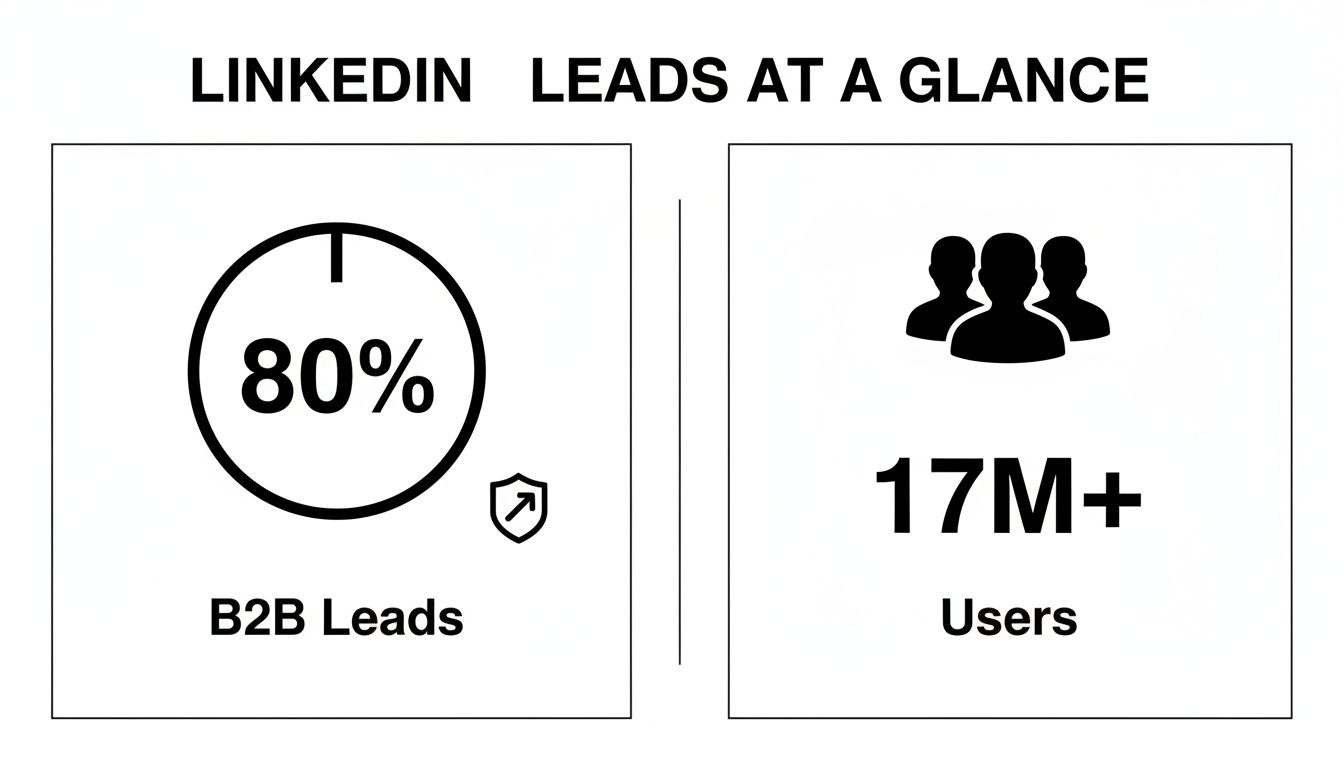
The numbers don't lie. With that many professionals in one place, your ideal clients are almost certainly there, waiting for you to connect.
LinkedIn Versus Other Platforms For Service Businesses
Still not convinced? Let's break down why LinkedIn is the heavyweight champion for professional lead generation, especially when compared to consumer-focused platforms.
| Feature | Facebook/Instagram | |
|---|---|---|
| Audience Mindset | Professional, career-focused, problem-solving | Casual, social, entertainment-driven |
| Targeting | Job title, company size, industry, seniority | Interests, demographics, behaviours |
| Lead Quality | High-intent B2B decision-makers | Broad consumer base, lower B2B intent |
| Content Focus | Industry insights, case studies, expertise | Lifestyle, visual content, community building |
| Outreach | Direct, personalised messaging is expected | Unsolicited business messages often ignored |
For service-based businesses, the choice is clear. While Facebook and Instagram have their place, LinkedIn is where serious business conversations happen.
By focusing your efforts here, you are fishing in the most well-stocked pond available. The combination of a professional user base, high engagement rates, and powerful targeting tools makes lead generation in LinkedIn incredibly efficient.
Understanding this is the first step toward building a predictable client acquisition machine. You can also explore our guide on how to leverage LinkedIn for your business for more advanced techniques.
Building a Client-Attracting LinkedIn Profile
First things first: your LinkedIn profile isn't a resume. It’s a dedicated landing page for your ideal client. Think of it as your 24/7 sales rep. It’s often the first impression a prospect has of you, so lead generation in LinkedIn lives or dies right here.
Most people just list their job history. To attract clients, you need to flip that script. Your profile must be relentlessly client-centric, answering one critical question for every visitor: "What's in it for me?" This means shifting the focus from what you do to how you solve their specific problems.
Craft a Headline That Stops the Scroll
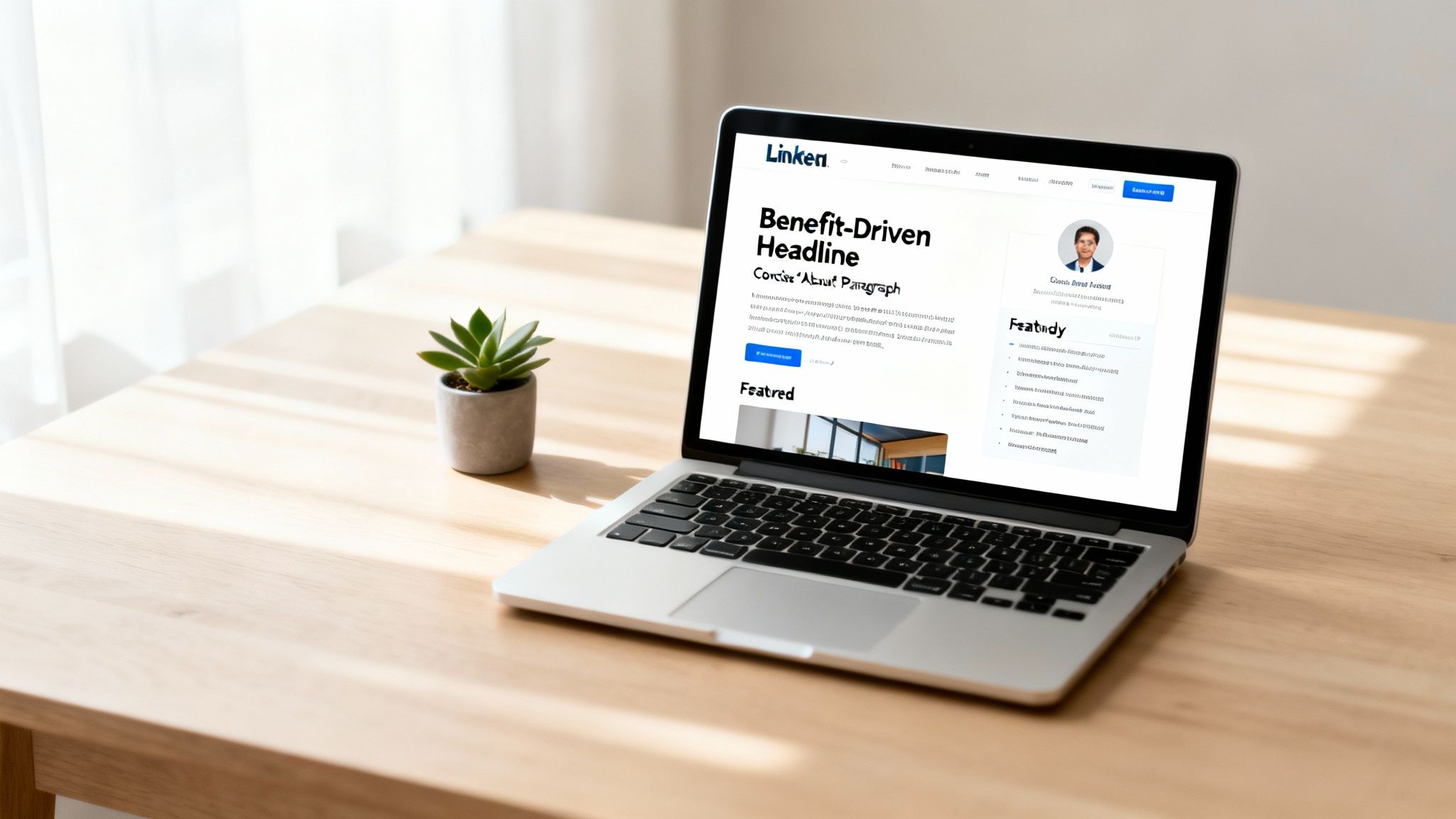
Your headline is the most valuable real estate on your profile. It follows you everywhere—in search results, comments, and connection requests. It must do more than state your job title; it must be a magnet for your ideal client.
Forget "Founder at [Your Company Name]". Try a benefit-driven formula instead:
- I Help [Target Audience] Achieve [Desired Outcome] Through [Your Method].
- Example: "I Help Australian Real Estate Agents Double Their Listings Using The Authority Content System."
- Example: "Helping Wellness Practitioners Attract High-Ticket Clients via AI-Powered Marketing Automation."
This formula instantly qualifies you in the eyes of the right people and repels those who aren't a good fit. It's a powerful filter working for you around the clock.
The profile below gets this exactly right, using the banner and headline to send a crystal-clear message.
See how the headline speaks directly to a specific audience and promises a tangible result? It's immediately obvious who he helps and how.
Write an About Section That Builds Trust
The 'About' section is where you convert curiosity into genuine trust. This isn’t the place for a dry, third-person bio. It’s your chance to tell a story that connects with your prospect's pain points and positions you as the expert they need.
Here’s a simple structure that works every time:
- Start with their Problem: Kick off with a sentence that shows you deeply understand your ideal client's biggest challenges. This builds immediate rapport.
- Introduce Your Solution: Briefly explain how you solve this problem. Frame it as your unique process or methodology.
- Provide Proof: Sprinkle in social proof. Mention the types of clients you've helped or the results you've delivered (e.g., "I've helped over 50 consultants…").
- End with a Clear Call-to-Action (CTA): Tell them exactly what to do next. Whether it's booking a call, downloading a guide, or visiting your website, make it obvious.
A great 'About' section doesn't just list your skills. It builds a bridge from your prospect's problem to your solution, making a conversation feel like the natural next step.
For a deeper dive, we have a detailed guide covering every part of a solid LinkedIn profile optimisation strategy.
Showcase Your Best Work With the Featured Section
The 'Featured' section is a visual portfolio at the top of your profile. Ignoring it is a massive missed opportunity. Use this space to give people tangible proof of your expertise and guide them deeper into your world.
Here’s what you should be featuring:
- Client Testimonials: Short video clips or graphics with powerful quotes from happy clients are pure gold.
- Case Studies: Link directly to detailed case studies on your website showing a client's journey from A to B.
- Lead Magnets: Offer a valuable freebie like a checklist, eBook, or webinar recording to capture their details.
- Links to Your Website/Calendar: Make it simple for them to take the next step with direct links to book a call or view your services.
To ensure your profile is working for you, you need to optimize your LinkedIn profile from top to bottom. A strong, optimised profile is the foundation for everything else. Without it, you're building on sand.
Developing a Content Strategy That Converts
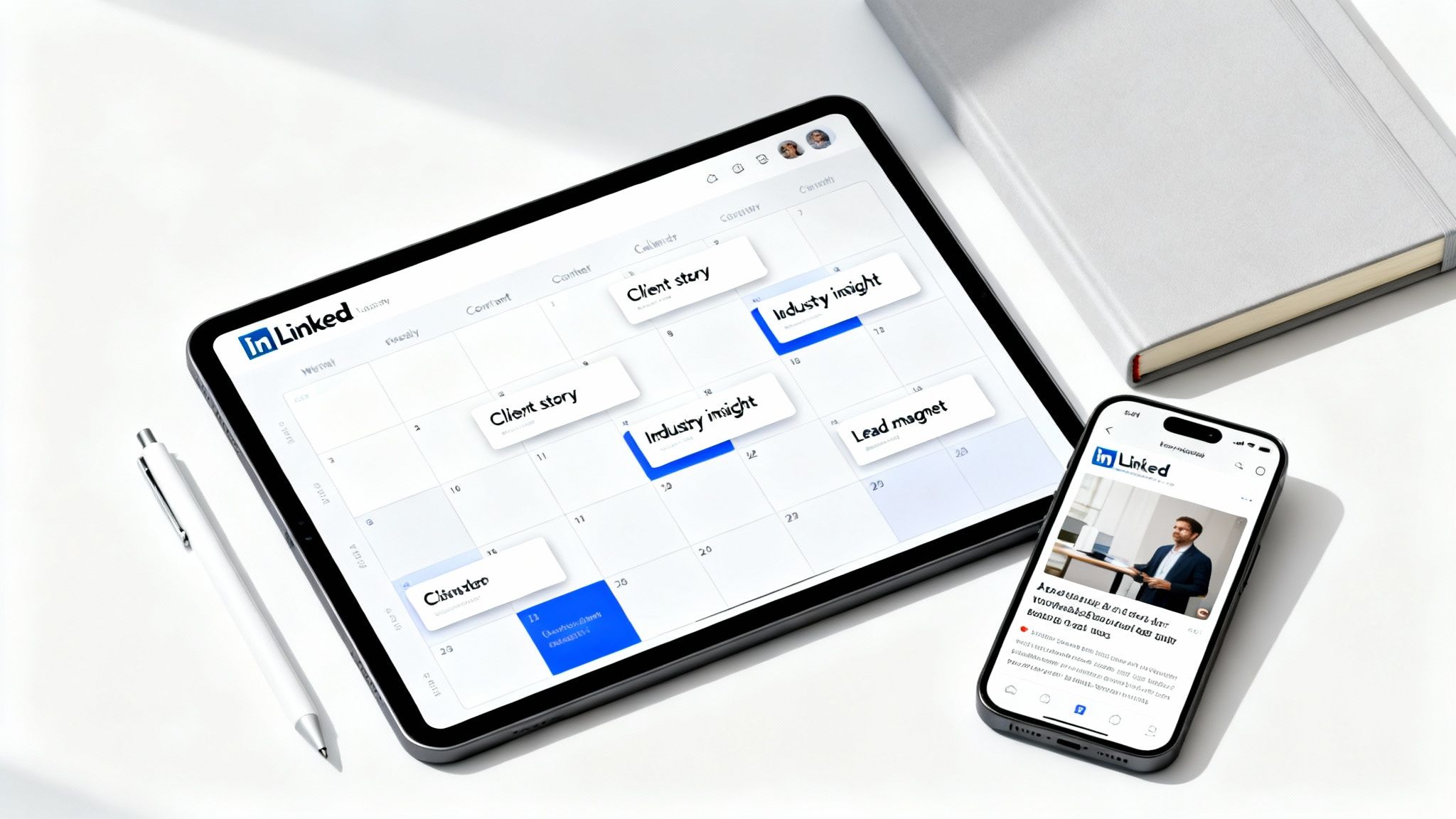
A polished profile is your digital storefront, but content gets people in the door. Without a smart content plan, even the slickest profile will gather dust. For busy Australian professionals, effective lead generation in LinkedIn isn't about posting for the sake of it; it's about posting with purpose.
The whole game is to stop sounding like everyone else and become the go-to authority in your space. Your content should act like a magnet, pulling in your ideal clients by proving you understand their world and have the answers they're looking for. This happens when you shift your mindset from "selling" to "serving".
The Three Pillars of High-Converting Content
To build real trust and get prospects to start a conversation, your content needs to do three things. Think of this as a framework to ensure you're not just adding to the noise, but building a case for why you're the expert they need.
- Educate: Share something that teaches your audience about a problem they’re grappling with. Break down a confusing industry trend or offer a new way to think about an old challenge.
- Engage: Don't just talk at people. Ask sharp questions, run polls, and share personal stories. This makes you human and starts two-way conversations that lead to real relationships.
- Empower: Give away actionable tips, simple frameworks, or resources that help your audience score a small win. When you help them solve a minor problem for free, they’ll trust you to handle the big ones.
Juggling these three content types keeps your feed dynamic and valuable. It positions you as a helpful guide, not just another person trying to sell something.
Crafting Content That Builds Authority
Forget generic, fluffy updates. Your content needs to be specific, insightful, and hit on the exact pain points of your Australian target market. Consistently showing up with posts that deliver real value is the fastest way to build the authority you need for proper lead generation in LinkedIn.
Here are a few content formats that work wonders for service-based businesses:
-
Dissect a Client Pain Point: Pick a common frustration your ideal client has and pull it apart. Explain why it happens and offer a unique insight or a quick tip to help them see it differently. This shows you're not just an expert; you're empathetic.
-
Share a "Micro" Case Study: Tell a quick story about a client win. Frame it simply: "A client was stuck with [Problem X]. We did [Your Solution], and they got [Specific, Measurable Result]." This is powerful, bite-sized social proof.
-
Offer a Contrarian Viewpoint: Politely challenge a popular belief in your industry. A post that starts with, "Everyone says you need to [Common Advice], but what if that's actually holding you back?" is a proven scroll-stopper and positions you as a thought leader.
The best content on LinkedIn isn't about you—it's about your client. Before you post anything, ask yourself: Does this help my ideal client feel smarter, more capable, or better understood? If the answer is no, scrap it.
This keeps your content focused squarely on the client, which is the secret to building trust and getting those inbound enquiries.
Maximising Your Reach Without Burnout
Creating high-quality content takes time. The key to staying consistent isn't about creating more content; it's about getting more mileage from the content you already have through smart repurposing. A single great idea can fuel multiple pieces of content in different formats.
Here’s what that looks like in practice:
| Original Content | Repurposed Into |
|---|---|
| A 10-minute video explaining a key concept. | 1. A long-form LinkedIn article summarising the video. |
| 2. Three short text posts, each diving into one key takeaway. | |
| 3. An image carousel breaking down the main points visually. | |
| 4. A poll asking your audience about their experience with the topic. |
With this method, one recording session can generate a whole week's worth of valuable content. By working smarter, you can maintain a strong, consistent presence that fuels your lead generation without taking over your schedule.
Mastering Personalised Outreach That Builds Relationships
So, your profile is sharp and you have a content plan. That’s the foundation. But to actually generate leads, you need to turn passive views into real, meaningful conversations. This is where personalised outreach comes in—it’s the engine of your entire lead generation in LinkedIn strategy.
Forget blasting out hundreds of generic sales messages. That’s the fastest way to get ignored. The real goal is to build genuine rapport. You do that by leading with value, showing you’ve done your homework, and treating every person like a potential professional relationship, not a number.
The Art of the Non-Spammy Connection Request
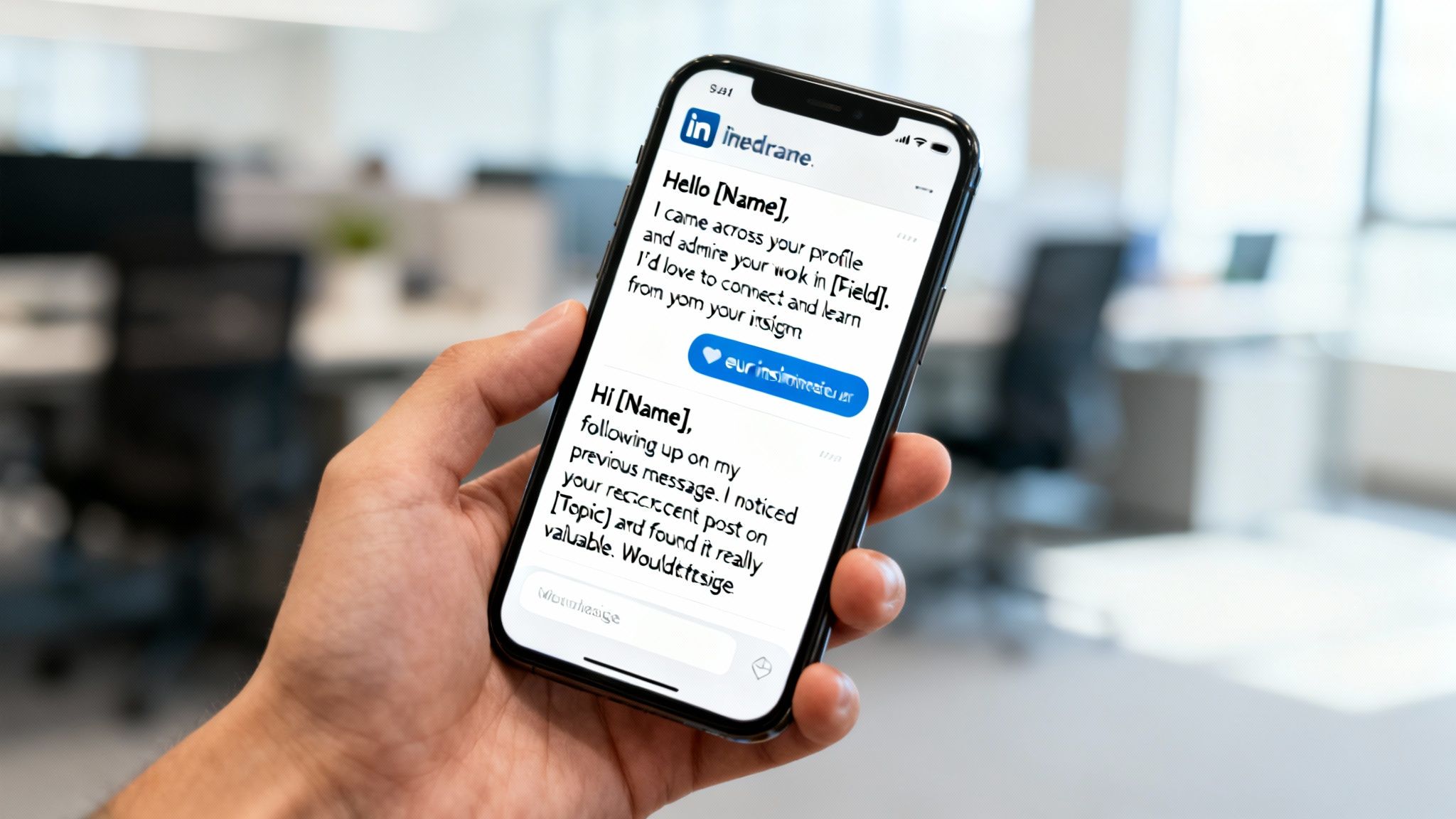
Your connection request is your first impression. It needs to be short, sharp, and all about them. That default "I'd like to add you to my professional network" message is a wasted opportunity. Instead, go for relevance and a light touch of personalisation.
Here are a few approaches that actually work:
- The Mutual Connection: "Hi [Name], I saw we’re both connected with [Mutual Connection's Name]. I'm always looking to connect with other [Their Role] in the [Their Industry] space here in Australia. Looking forward to seeing your posts."
- The Content Appreciator: "Hi [Name], really enjoyed your recent post on [Topic]. Your point about [Specific Insight] was spot on. Would love to connect and follow your work."
- The Group Member: "Hi [Name], I saw your comment in the [LinkedIn Group Name] discussion on [Topic]. It’s great to connect with others who are passionate about that. Cheers."
See the pattern? None of these mention your services. The only goal is to open the door for a conversation later, in a way that feels natural and respectful.
Nurturing the Connection with Value-First Follow-Ups
Once someone accepts your request, the real work starts. The biggest mistake is jumping straight in with a sales pitch. Your first follow-up should be a simple thank-you that keeps the focus on giving, not taking.
Your outreach should feel like a welcome conversation, not an unwelcome interruption. The secret is to provide value at every single touchpoint before you ever think about asking for their time.
This approach builds immediate trust and positions you as a helpful expert. Remember, over 80% of LinkedIn users drive business decisions. These are influential people who can spot a lazy, generic pitch from a mile away.
Scaling Outreach with Smart Automation
Sending every connection request and follow-up by hand is a massive time sink. This is where smart automation tools can be a lifesaver, but you must use them responsibly. The point of automation isn't to replace the human element; it's to handle repetitive tasks so you can focus on having real conversations.
Think of it this way: automation can send the initial personalised connection request and the first value-driven follow-up. But the second a prospect replies, the automation stops. That’s when you step in to engage one-on-one.
This hybrid approach allows you to scale your outreach without sacrificing the personal touch that actually builds relationships.
For those serious about precision targeting, tools like LinkedIn Sales Navigator can be a complete game-changer.
The Power of Hyper-Targeted Campaigns
The better your targeting, the more effective your outreach will be. LinkedIn’s advertising audience in Australia exploded by 13% year-on-year, on track to hit 17 million users by 2025. That now covers over 80% of Aussies aged 18+.
For businesses chasing professionals with real spending power, this creates huge opportunities for hyper-targeted campaigns that deliver high-quality leads at a 28% lower cost than traditional Google Ads.
Imagine a Sydney real estate firm targeting only buyer's agents in the Eastern Suburbs, or an Adelaide recruitment agency searching for automotive engineers. That precision is what makes a well-run outreach strategy so potent. Your message lands with people who are actually interested, turning your lead generation in LinkedIn from a numbers game into a strategic, relationship-building machine.
Measuring Your LinkedIn Success and Optimising for Growth
You can't improve what you don't measure. An effective lead generation in LinkedIn strategy isn't about guesswork; it's about data. But getting lost in "vanity metrics" like likes and follows is a common trap. To create a predictable flow of clients, you need to focus on Key Performance Indicators (KPIs) that directly link your activity to revenue.
This means tracking the small steps that lead to the ultimate goal: booked sales calls with qualified prospects. Without this feedback loop, you're just throwing content and connection requests into the void. A data-driven approach, however, turns your efforts into a scalable, repeatable system for business growth.
Identifying Your Core Funnel Metrics
Think of your LinkedIn lead generation process as a funnel. Your job is to track how people move from one stage to the next. Ditching vanity metrics for these core KPIs will give you a clear picture of what's actually working.
These are the numbers that really matter:
- Profile Views: How many people are checking you out? More importantly, are they the right people from your target industry? LinkedIn’s own dashboard gives you a quick pulse check on whether your content and outreach are attracting the right eyeballs.
- Connection Acceptance Rate: This is the percentage of your outbound connection requests that get accepted. A high rate (above 40%) is a great sign your targeting and messaging are on point. A low rate tells you there's a problem with your initial approach.
- Message Reply Rate: Of the new connections you message, how many actually respond? This metric cuts right to the chase, revealing how effective your follow-up sequence is. Are you starting real conversations, or are you just getting ignored?
Tracking these numbers week-on-week helps you spot trends fast. A sudden drop in your acceptance rate, for example, might mean your connection request message needs a refresh.
Connecting Activity to Bottom-Line Results
While the metrics above are vital for diagnosing the health of your outreach, they don't pay the bills. The most important KPI is the one that directly impacts your bottom line.
The ultimate goal of your LinkedIn activity isn't just to get replies. It's to move those conversations off the platform and into a sales call. Every other metric is simply a stepping stone toward this outcome.
This is the final piece of the puzzle. You must track how many of your positive message replies convert into actual discovery calls or meetings booked in your calendar. This is your Lead-to-Call Conversion Rate.
Let's break it down with an example. Imagine you send 100 connection requests:
- 40 people accept (40% Acceptance Rate).
- Of those 40, 10 reply to your follow-up message (25% Reply Rate).
- Of those 10 replies, 2 agree to a sales call (20% Lead-to-Call Conversion Rate).
Now you have a predictable system. You know that for every 100 connection requests, you can expect two qualified sales calls. This is powerful—it allows you to reverse-engineer your goals and scale your efforts with confidence.
Creating a Simple Tracking Framework
You don't need fancy, complicated software to get started. A simple spreadsheet is all it takes to track your progress and hold yourself accountable. This simple act of measurement is often the single biggest driver of optimisation.
Here’s a basic structure for your weekly tracking sheet:
| Metric | Week 1 | Week 2 | Week 3 | Week 4 |
|---|---|---|---|---|
| Connection Requests Sent | 100 | 120 | 100 | 150 |
| Acceptance Rate (%) | 42% | 38% | 45% | 41% |
| Positive Replies | 11 | 9 | 14 | 15 |
| Sales Calls Booked | 2 | 2 | 3 | 4 |
This simple dashboard gives you an at-a-glance view of your performance. It empowers you to make informed decisions, double down on what works, and systematically improve your lead generation in LinkedIn over time.
Your Top Questions About LinkedIn Lead Generation, Answered
When you start digging into lead generation in LinkedIn, the questions pile up fast. Getting straight answers is the only way to build a strategy that works without burning through your time. This section tackles the most common questions from Australian service-based business owners.
How Much Time Should I Actually Spend on LinkedIn Each Week?
For busy business owners, consistency beats intensity every single time. It's far better to show up for a focused 30-45 minutes a day, four or five times a week, than to blitz it for five hours on a Monday and then ghost the platform for a month.
The trick is to break it down into a daily habit you can stick to.
- 10 minutes: Jump into your feed and leave thoughtful comments on your network's posts.
- 15 minutes: Send out a handful of personalised connection requests and follow-up messages.
- 10 minutes: Share a quick insight, a piece of your content, or a valuable tip.
This isn't about spending hours on the platform. It's about making it a non-negotiable part of your routine. This daily rhythm is what creates a predictable flow of leads.
Is LinkedIn Sales Navigator Really Worth the Money For a Small Business?
For any service business that's serious about growth, it's non-negotiable. While you can start with the free version, Sales Navigator is an absolute game-changer for finding the right people, fast. Its advanced search filters are where the magic happens. You can zero in on your ideal clients with scary precision—filtering by industry, company headcount, specific job titles, and even recent company news.
Don't think of it as just another subscription. It’s an investment in pure efficiency. If Sales Navigator helps you land just one or two more high-value clients this year, it’s paid for itself many times over.
Plus, you can build targeted lead lists and get alerts when they post or change jobs, giving you the perfect excuse to reach out. We always tell clients to grab the free trial and see for themselves before committing.
What Are the Biggest Outreach Blunders People Make on LinkedIn?
The absolute number one mistake? Hitting someone with a hard sales pitch in the very first message. It’s the digital version of a cold call, and it gets ignored, deleted, or worse, reported as spam.
Another classic error is firing off generic, copy-paste connection requests. People can smell a lazy template a mile away, and it tanks your credibility before you've even started a conversation. Finally, don't forget your own backyard. Sending a great message only for them to click back to a half-finished profile is a huge own-goal. Your outreach is only as strong as the profile it’s coming from.
The golden rule is simple: lead with value, personalise every single time, and treat every connection like the start of a real relationship, not just a sales number. This patient, value-first approach is the bedrock of successful lead generation in LinkedIn.
Ready to stop guessing and start getting real, predictable results from LinkedIn? These strategies are the foundation, but a fully optimised system can completely change how you find new clients. At Homer Digital Marketing, we build AI-powered marketing systems that turn your LinkedIn activity into a lead generation machine. Find out how we can help you scale your service business today.
