

When discussing SEO for lawyers, we are referring to a strategic methodology for increasing your law firm's visibility in search engine results. The objective is straightforward: to make it exceptionally easy for potential clients to find you when they are searching online. This isn't about exploiting short-term loopholes; it's an actionable, long-term strategy that builds your firm's digital authority, attracts high-quality traffic, and ultimately drives more cases through your door directly from Google.
Why Your Firm Needs a Modern SEO Strategy
Relying solely on referrals and word-of-mouth is no longer sufficient. Your next major client isn't just asking a friend for a recommendation—they are actively on their phone, searching for a lawyer who specialises in their exact legal problem. This is where a sharp SEO for lawyers strategy becomes your most powerful business development asset, transforming your website into a dependable lead-generation machine. Before delving into the specifics, it is beneficial to understand what search engine optimization is and why it is so fundamental for your practice.
For any firm pursuing local clients, the impact of SEO is profound. A significant 93% of Australians now search online to find local businesses. With nearly half of all first-page Google results being for local queries, visibility is not optional.
Furthermore, ranking at the top is paramount. The first organic result on Google receives an average click-through rate of 29.5%. This means if your firm ranks number one for a search term like 'family lawyer Sydney', you can anticipate nearly a third of those searchers clicking through to your website.
The Modern Client Journey
The process by which a potential client finds a lawyer has undergone a complete transformation. It now commences with a search query, progresses to an evaluation of your online presence, and, if executed correctly, culminates in a consultation.
This digital-first journey signifies that your entire online footprint—from your website's mobile experience to the quality of your Google reviews—serves as your new front door. The infographic below illustrates this modern client acquisition path perfectly.
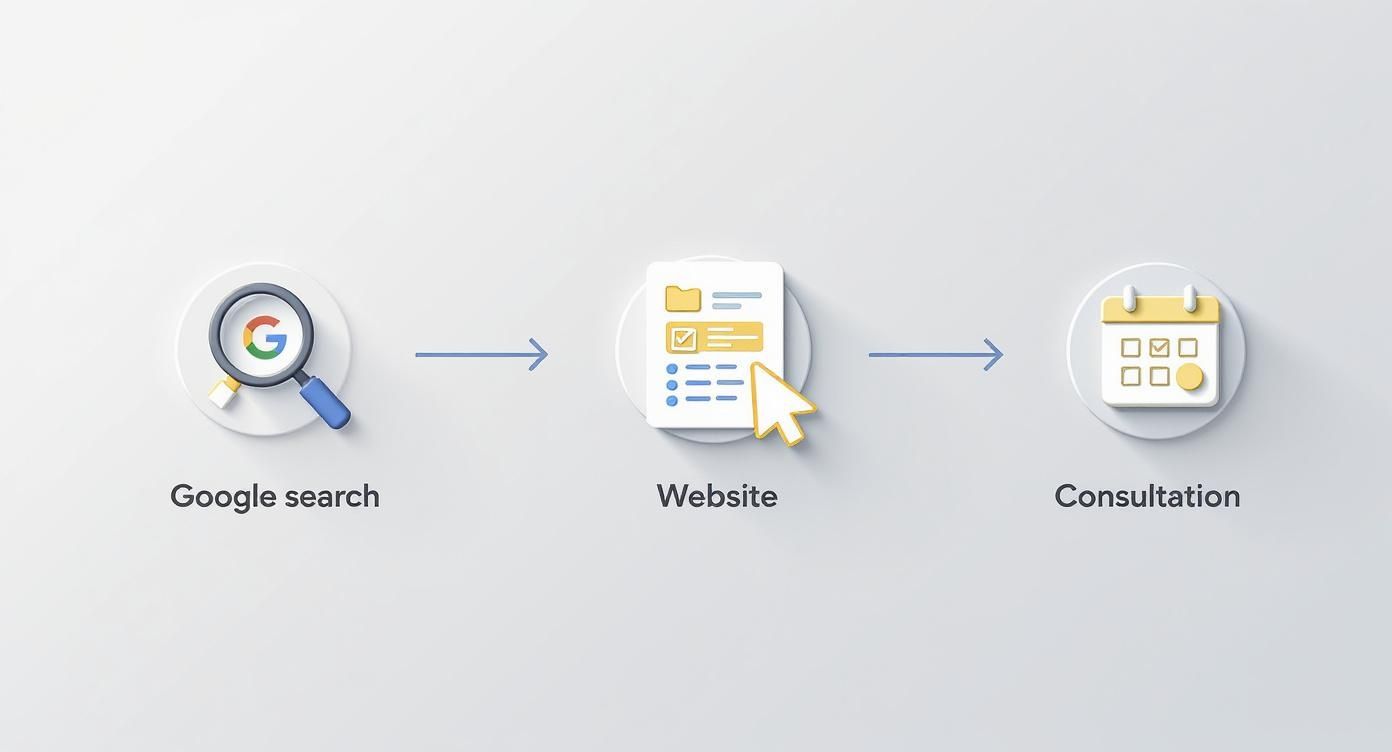
As you can see, SEO places your firm directly in front of individuals at the precise moment they require assistance, making it one of the most efficient methods for marketing your legal services.
The real goal of SEO for law firms isn't just about being found—it's about being chosen. You're building digital trust and proving your expertise before you've even spoken to a prospect, making your firm the clear and obvious choice in a very competitive market. To get there, you need a smart, organised plan for your online presence.
Winning the Local Battle with Google Business Profile
For most Australian law firms, the competition for new clients is won and lost at the local level. While a national reputation is advantageous, the reality is that your highest-value clients are searching for an expert within their immediate vicinity. This is where your Google Business Profile (GBP) becomes your single most powerful local SEO asset.

Consider your GBP less as a simple directory listing and more as your digital storefront. It is often the very first interaction a potential client has with your firm, appearing prominently in the Google Map Pack and local search results.
Executing this correctly is not merely about visibility; it's about generating client calls.
Optimising Your Profile for Maximum Impact
A complete, thoughtfully optimised profile sends strong trust signals to both Google and potential clients. Simply claiming your listing is insufficient. You must treat it as a dynamic marketing tool that requires regular attention.
A common mistake is setting it up once and then neglecting it. This is a significant missed opportunity. Google rewards active profiles with enhanced visibility because it perceives them as more relevant and trustworthy.
Nailing the Essentials
First, your firm's core information must be perfectly accurate and consistent across all online platforms. This is known as NAP (Name, Address, Phone number) consistency, and it is a non-negotiable component of local SEO. Any inconsistencies can confuse Google and diminish trust with potential clients.
Here are the key elements to get right from day one:
- Business Name: Use your exact, official law firm name. Avoid adding keywords like "Best Personal Injury Lawyer," as this violates Google's guidelines and can lead to profile suspension.
- Categories: Be specific. Instead of just "Lawyer," select a primary category such as "Family Lawyer" or "Criminal Justice Attorney," then add secondary categories like "Conveyancer." The more precise you are, the better Google can match you with relevant searches.
- Service Area: Clearly define the suburbs and cities you serve. This is crucial for appearing in "near me" searches, even if the searcher is not physically located next to your office.
- Services: Utilise the services section to list every legal service you offer. For a family law practice, this would include items like "divorce proceedings," "child custody agreements," and "property settlements."
The power of local search cannot be overstated. With 81% of Australians searching for local businesses every week, securing the top result for 'divorce lawyer Melbourne' can be the difference between a full calendar and an empty one.
A well-managed Google Business Profile does more than improve your ranking; it builds immediate credibility. When a potential client sees a complete profile with recent reviews, photos, and helpful posts, it signals professionalism and active engagement.
A Real-World Example: A Perth Conveyancing Firm
Let's consider a small conveyancing firm in Perth. Their primary objective is to attract clients buying or selling property in specific northern suburbs like Joondup and Wanneroo. A generic profile will not stand a chance against larger, city-wide firms.
Their strategy must be hyper-local.
Instead of a generic business description, they should craft one that speaks directly to their ideal client: "Your local property law experts in Joondalup, specialising in smooth and stress-free conveyancing for first-home buyers and investors in Perth's northern suburbs."
They could use Google Posts to share articles such as "5 Things to Check Before Buying a Home in Wanneroo" or "Understanding Settlement Costs in WA." This demonstrates expertise and targets very specific search terms.
Another intelligent move is to proactively complete the Questions & Answers section. They can ask and answer common queries like, "What are your conveyancing fees for a standard property in Clarkson?" This provides potential clients with immediate value and helps manage their expectations from the outset.
By focusing on these suburb-specific details, the firm positions itself as the go-to local expert. For more in-depth advice, it's worth reading up on optimizing your Google Business Profile. This targeted approach ensures that when someone searches for "conveyancer near Joondalup," their highly relevant profile stands out, making them the obvious choice.
To maintain a strong local SEO presence, a consistent plan of action is required. Here is a simple checklist to help you stay on track and ensure your GBP is working effectively for your firm.
Your Local SEO Action Plan
| Task | Frequency | Impact on Ranking | Key Tool |
|---|---|---|---|
| Add new, high-quality photos/videos | Weekly | High | Google Business Profile |
| Publish a new Google Post | Weekly | Medium | Google Business Profile |
| Respond to all new reviews | Weekly | High | Google Business Profile |
| Check and update business information | Monthly | High | Google Business Profile |
| Answer new Q&As | Weekly | Medium | Google Business Profile |
| Analyse GBP Insights for trends | Monthly | Medium | Google Business Profile |
Adhering to a schedule like this ensures your profile remains active and relevant, which is precisely what Google values. It signals that you are an engaged, trustworthy local business ready to assist new clients.
Creating Content That Attracts and Converts Clients
Consider your website's content its most powerful sales tool. It must do more than simply list your services; it needs to build trust, demonstrate expertise, and guide a potential client from a state of stress and uncertainty to taking that first, decisive step for help. The most effective SEO for lawyers is always built upon a solid foundation of content that solves real problems for real people.

This is not about filling your pages with generic legal jargon. It is about focusing with laser precision on what your ideal clients are actually typing into Google when they are in a difficult situation. When you achieve this, your website transitions from a passive digital brochure into an active, client-generating machine.
Structuring Core Service Pages for Conversion
Your core service pages are the digital equivalent of that initial client meeting. They must be constructed not only to rank for valuable terms like 'commercial litigation Melbourne' but also to persuade a visitor that you are the right choice, right now.
Every service page should tell a clear story:
- Address the Pain Point First: Begin by describing the problem the client is facing, using their own language. For a family law page, this might involve the emotional turmoil and financial stress of a separation.
- Explain Your Solution Clearly: Outline your legal services and the process involved. Avoid overly technical language. For example, instead of just stating "litigation," explain how you represent clients in court to protect their interests and achieve a fair outcome.
- Showcase Your Expertise: Integrate short case studies, powerful testimonials, or brief attorney bios directly on the page. This builds immediate credibility and trust.
- Provide a Clear Call to Action (CTA): Conclude with a simple, unambiguous next step. Something like "Book a Confidential Consultation" or "Download Our Property Settlement Checklist" works perfectly.
Your service pages aren't just for Google; they're for distressed people looking for a trusted advisor. Structure them to answer their immediate questions, calm their fears, and make it incredibly easy to reach out.
Creating High-Intent Blog Content
While your service pages target clients who are ready to hire, your blog content is your secret weapon for capturing them much earlier in their journey. This is where you truly establish your authority and become a go-to resource by answering the specific, often complex questions they have.
Consider the actual queries people search for. Someone navigating a divorce isn't just looking for a "divorce lawyer." They are desperately searching for answers to questions like "what are the first steps in a property settlement in NSW?" or "how is superannuation split in a divorce WA?"
Answering these long-tail keywords with helpful, in-depth content positions your firm as the expert. You build trust long before they are even ready to pick up the phone.
Mastering On-Page SEO Essentials
On-page SEO encompasses all the details that ensure both search engines and potential clients can quickly understand what your content is about and why it is valuable. Getting these technical elements right is non-negotiable for visibility.
Magnetic Title Tags and Meta Descriptions
The title tag and meta description are your one-two punch in the search results. In a crowded field of competitors, they are your only opportunity to earn that crucial click.
- Title Tag: This is a major ranking factor. Keep it under 60 characters, lead with your primary keyword, and add something compelling.
- Poor Example: Law Firm Services
- Great Example: Expert Family Lawyers Sydney | Free Consultation | [Your Firm Name]
- Meta Description: This does not directly affect rankings, but it has a significant impact on your click-through rates. It needs to be a concise summary (around 155 characters) of the page's value and must include a call to action.
- Example: Need help with a property settlement in NSW? Our expert family lawyers offer clear guidance and compassionate support. Contact us for a confidential chat today.
The Importance of Header Tags
Header tags (H1, H2, H3) are your best friend for organising content. They make your pages scannable for busy readers and help Google understand the information hierarchy.
Your page title should always be the H1. Use H2s for main sections and H3s for sub-points, incorporating keyword variations naturally. This simple structure dramatically improves user experience and helps search engines categorise your content correctly.
Getting Ahead of the Pack with Advanced SEO
Once you have mastered the local SEO fundamentals and have a solid content plan in place, it is time to truly pull ahead of your competitors. The top-tier law firms are not just doing SEO; they are mastering advanced strategies that build serious online authority. This is where we move beyond the basics and begin to dominate the search rankings.
We will break down the technical side of SEO, examining critical elements such as your site's loading speed and its performance on mobile devices. You will also learn how to use schema markup to make your firm stand out in search results with eye-catching review stars and quick-answer snippets.
Mastering Technical SEO for a Flawless Client Experience
Technical SEO involves all the behind-the-scenes work that makes it easier for search engines to find, understand, and rank your website. While it may sound complex, the objective is simple: to ensure your website provides every visitor with an outstanding experience. A site that is fast, secure, and easy to navigate will always be favoured by Google.
Think of it like a courthouse. If the building is clean, the signs are clear, and everything operates efficiently, people find what they need without any difficulty. If it is slow, confusing, and disorganised, they will leave frustrated. Your website is exactly the same.
Technical SEO isn’t just for Google; it's a direct investment in your client experience. A fast-loading, mobile-friendly website signals professionalism and respect for a potential client's time, building trust before you've even spoken.
The Need for Speed and Mobile-First Design
In today's fast-paced world, no one has time to wait. Page speed is a confirmed ranking factor, but more importantly, it is a conversion killer. If your website takes too long to load, potential clients will hit the back button and go straight to your competitor. It is that simple.
Equally critical is ensuring your site functions perfectly on a phone. Google now operates on a mobile-first indexing system, meaning it primarily considers the mobile version of your site when determining your ranking. A clunky mobile experience is not just an annoyance; it is a direct penalty to your visibility.
Here are the absolute non-negotiables for a modern law firm website:
- Fast Loading Times: Your pages should load in under three seconds. Use free tools like Google's PageSpeed Insights to identify and fix what is slowing you down.
- Responsive Design: Your website must automatically adjust to fit any screen, whether it's a desktop, tablet, or smartphone.
- Clear Navigation: Your menus should be simple, and your contact details must be incredibly easy to find, especially on a mobile device.
Standing Out with Schema Markup
Schema markup is a snippet of code added to your website that acts as a translator for search engines, helping them better understand your content. When you implement this, Google often rewards you with "rich snippets"—those enhanced search results that instantly capture a user's attention.
For law firms, the most valuable types of schema are:
- Review Schema: This is how you get those gold star ratings to appear directly under your name in search results, providing instant social proof.
- FAQ Schema: If you have a page answering common client questions, mark it up with FAQ schema, and you could see those Q&As appear as a dropdown directly in Google.
- LegalService Schema: This specific markup communicates all the important details about your firm to Google, such as practice areas, location, and key attorneys.
These are not merely cosmetic adjustments. They dramatically improve how often people click on your link and build instant credibility before anyone even lands on your site.
The Growing Influence of AI on Legal SEO
Looking ahead, artificial intelligence is already changing how potential clients find legal help. In 2025, AI is reshaping how Australian law firms approach their SEO. Industry reports show that around 35% of Australians now use AI assistants to research legal questions before they even think about visiting a law firm’s website.
This new behaviour impacts traditional SEO, as search results increasingly feature AI-generated summaries that can reduce the number of clicks through to your site. To stay relevant, firms need to integrate AI-powered techniques like AI-driven keyword research and dynamic content creation to capture and convert these users. You can discover more insights about these emerging SEO trends for 2025 on our blog.
Turning Your Website Traffic Into Real Cases
Attracting traffic to your website is a great start, but traffic alone does not pay the bills. The true goal of any SEO for lawyers strategy is to convert those anonymous website visitors into actual, signed cases. This is where we shift focus from clicks to clients.
This is not about simply having a "Contact Us" page and hoping for the best. It is about building trust quickly and making the next step so obvious and easy that a potential client does not have to think twice.
Designing for Action with Strategic CTAs
Every single page on your website needs a clear purpose. A visitor should never land on a page and be left wondering, "Okay, now what?" This is where a strong Call-to-Action (CTA) comes in.
Forget generic, ineffective CTAs like "Click Here" or "Submit." They are uninspired and do not work. Your CTAs need to be specific, compelling, and directly address what the visitor is looking for.
- On Service Pages: Use direct, action-focused language like "Book a Confidential Consultation" or "Get a Free Case Evaluation." This speaks to their immediate problem.
- On Blog Posts: Offer something valuable in return for their contact information. Consider "Download Our Property Settlement Checklist" or "Watch Our Free Webinar on Your Rights."
Placement is just as critical as the wording. Ensure your CTAs are visible "above the fold" (the part of the screen you see before scrolling), interspersed within the content, and repeated at the very end. No matter where someone is on the page, the path forward should always be in sight.
Optimising Your Contact Forms for More Leads
Think of your contact form as the final gateway between a website visitor and a potential new client. If that form is long, complicated, or confusing, you are creating a massive roadblock. People will simply give up.
Simplicity is key here.
All you really need to initiate a conversation is their name, email, phone number, and a short message box. A form with ten different fields feels like an interrogation and will significantly reduce your conversion rates.
Your contact form should be an invitation, not an obstacle. Every additional field you add increases the friction and lowers the probability that a potential client will complete it. Keep it simple, clear, and focused on making that initial connection.
For a deeper dive, seeking professional guidance on conversion rate optimisation can ensure your website is working as effectively as possible to generate new leads.
Measuring What Truly Matters
To prove your SEO is actually working, you must track the right metrics. It is far too easy to get distracted by "vanity metrics" like a jump in website traffic or a few keyword ranking improvements. While these are nice, they do not tell the whole story.
The only metrics that truly matter are those tied directly to your firm's bottom line.
Using free tools like Google Search Console and Google Analytics 4 (GA4), you can track the Key Performance Indicators (KPIs) that show real business growth.
Focus on tracking:
- Contact Form Submissions: How many people are actually filling out your forms?
- Phone Calls from Organic Search: How many calls are coming straight from your website?
- Live Chat Engagements: Are potential clients starting conversations through your chat widget?
- Goal Completions in GA4: This is where you track specific actions, like consultation bookings or checklist downloads.
This is the data that matters. Now, you're not just saying "we got more traffic." You're saying, "our SEO efforts generated 15 new qualified leads last month." That’s how you prove ROI and make smarter decisions about where to allocate your marketing budget.
Essential SEO KPIs vs Vanity Metrics
Here's a quick breakdown to help your firm focus on the metrics that actually drive new cases, not just feel-good numbers.
| Metric Type | Examples | Why It Matters for Your Firm |
|---|---|---|
| Essential KPIs | Form Submissions, Phone Calls, Qualified Leads, Conversion Rate, New Client Acquisitions | These metrics directly measure business impact and show a clear return on your investment. They represent real people seeking help. |
| Vanity Metrics | Total Traffic, Keyword Rankings, Social Media Likes, Bounce Rate, Time on Page | While useful for diagnosing issues, these numbers don't guarantee new cases. High traffic with zero leads isn't a win. |
By focusing on the essential KPIs, you can connect your SEO activities directly to the firm's growth and stop wasting time on numbers that don't translate into new clients.
Common SEO Questions from Law Firms

Diving into the world of digital marketing always brings up questions, especially in a specialised field like SEO for lawyers. We get asked these all the time by Australian law firms, so let's clear them up with some straightforward answers.
How Long Does SEO Really Take to Work for a Law Firm?
Patience is crucial. SEO is a marathon, not a sprint, especially in hyper-competitive legal markets like Sydney or Melbourne. Realistically, you should expect to see significant momentum in organic traffic and quality leads within 6 to 12 months of consistent effort.
However, this does not mean complete silence until then. You will often see early wins—such as improved rankings in the Google Map Pack or for specific, long-tail keywords—within the first 3 to 6 months.
The timeline is contingent on several factors:
- Your Market: Attempting to rank for "personal injury lawyer Sydney" is a much greater challenge than "conveyancer in a regional town."
- Your Starting Point: A brand-new website faces a steeper climb than an established site with some history and authority.
- Your Investment: The time and resources dedicated to content creation and link building will directly accelerate your results.
Can I Do My Own SEO, or Should I Hire an Agency?
You can certainly handle foundational SEO tasks yourself. Activities like optimising your Google Business Profile, writing regular blog posts, and requesting client reviews are both manageable and highly effective. This hands-on approach helps maintain your firm's authentic voice.
However, the more technical aspects of SEO for lawyers are a different matter. This demands significant time and highly specific expertise, including technical site audits, competitor analysis, strategic link building, and detailed performance tracking—all of which are complex and incredibly time-consuming.
Most lawyers find their time is far more valuable when spent on billable work rather than becoming a part-time digital marketer. The opportunity cost of learning and executing advanced SEO can be substantial.
A hybrid approach often proves to be the most effective. You or your team can manage the content and client-facing elements, while a specialised legal SEO agency handles the technical strategy and heavy lifting.
What Is the Single Most Important Part of SEO for Lawyers?
For nearly every law firm serving clients in a specific geographic area, local SEO is the absolute cornerstone. The primary goal for most practices should be to dominate the Google Map Pack for high-intent searches like "[practice area] lawyer near me."
Achieving this comes down to three core pillars:
- A perfectly optimised Google Business Profile.
- A steady stream of positive client reviews.
- Accurate and consistent business listings across the web (these are your citations).
While technical SEO, content, and backlinks are all crucial components of a comprehensive strategy, mastering your local search presence is the most direct path to acquiring high-quality client enquiries. It is the foundation upon which everything else should be built.
What Should a Realistic SEO Budget for a Law Firm Be?
SEO budgets for Australian law firms vary widely. The appropriate investment depends on your firm's location, size, and the competitiveness of your practice areas.
A small firm in a regional area might invest a few thousand dollars per month. Conversely, a firm in a major city targeting high-value, fiercely contested keywords (such as class actions or personal injury) could invest significantly more to gain a competitive edge.
It is more beneficial to view SEO as a core business investment, not merely an expense. The real focus should be on the return on investment (ROI). A reputable SEO provider will be transparent about costs, but more importantly, they will be able to demonstrate exactly how their efforts are translating into tangible results, such as new consultations and signed cases.
At Homer Digital Marketing, we build marketing systems that deliver real, measurable results for service-based businesses like yours. We specialise in Google optimisation and AI-powered strategies designed to attract your ideal clients and scale your firm.
Ready to turn your website into a reliable source of new cases? Learn more about our proven strategies and book a consultation today.
