

In a packed marketplace, being invisible online means you're losing customers every single day. Search engine optimization services for small business are the ultimate key to turning this problem into your biggest advantage and driving real, measurable growth.
Think of it like this: a proven SEO strategy is your ticket to securing the best shopfront location in a massive digital mall. Without it, you’re stuck down a back alley where ready-to-buy customers will never find you. This guide will provide actionable steps to get you on the main street.
Why Your Business Needs SEO Services Now: A Proven Path to Growth
For most small business owners, SEO feels like a complicated, techy puzzle. But really, it’s all about one simple thing: connecting you with customers who are already online, actively searching for what you sell. Without a solid SEO strategy, you’re completely invisible to this huge audience of potential buyers.
Investing in your online visibility isn't just an option anymore; it's essential for survival and growth. The SEO industry in Australia hit $1.5 billion in 2025, growing a massive 12% in just one year. Small businesses are now putting around AUD 1,350 a month into SEO—a big jump from AUD 1,200—proving just how vital it has become for local business marketing.
Turning Searches into Sales: The SEO Advantage
Good SEO has a direct, powerful impact on your bottom line. By getting your website to rank higher on search engines like Google for high-intent keywords, you massively increase the chances of being the first business a potential customer sees. This visibility delivers real, tangible results.
- More Website Visits: Better rankings bring in more clicks from qualified customers ready to buy.
- Increased Customer Calls: Local SEO helps people in your area find you instantly when they search for services "near me."
- Greater Sales Revenue: By attracting the right people, you turn more visitors into paying customers and get a much better return on your investment.
The real goal of SEO isn't just to rank higher—it's to be the clear, obvious answer to your customer's problem the moment they start searching. This is how you transform search engine visibility into reliable business growth.
This guide will break down the whole process, showing you how different SEO strategies lead directly to business growth. If you’re new to all this or just wondering where to begin, understanding these 5 essential SEO basics is the perfect first step. Let's get started.
Building Your Digital Foundation with On-Page & Technical SEO
To get real results from search engine optimisation services for small business, you need to build a solid digital foundation first. Think of your website like a physical shop. Its success depends on what customers see inside and the strength of the building itself. This foundation has two crucial parts: On-Page SEO and Technical SEO.
First up, On-Page SEO is all about optimising what your visitors see and interact with. It's about creating an inviting digital storefront with clear signs (headings), engaging displays (images), and helpful product descriptions (your content).
Every single element on your page, from the title right down to the text, should be clear, valuable, and organised logically. This makes sure both visitors and search engines can instantly figure out what your page is all about.
Optimising Your On-Page Experience
On-Page SEO is where you make your content directly relevant to what people are actually searching for. When someone lands on your site, they should immediately feel like they've found the right place.
Key elements of On-Page SEO include:
- High-Quality Content: Your content has to answer your customers' questions and provide genuine value. This is how you establish yourself as an expert they can trust.
- Strategic Keyword Use: Weaving relevant keywords naturally into your headings, paragraphs, and even your image descriptions helps search engines connect your page to what people are typing into Google.
- Clear Headings and Structure: Using H2 and H3 tags to organise your content makes it easy for readers to scan and understand, which massively improves their experience.
Strengthening Your Technical Backbone
While On-Page SEO is the visible part of your shop, Technical SEO is the essential work going on behind the scenes. Think of it as your building’s electrical wiring and solid foundation—it has to function perfectly for everything else to work.
Technical SEO makes sure your site is fast, secure, and easy for search engines to crawl and index. A slow or broken site frustrates users and tells Google it’s not worth recommending.
A strong technical foundation makes every other SEO effort more effective. Without it, even the best content can fail to rank because search engines can't properly access or understand it.
Key technical factors include a mobile-friendly design that works perfectly on any device and simple, descriptive URLs that are easy to read. This infographic shows how a solid SEO foundation drives real business outcomes.
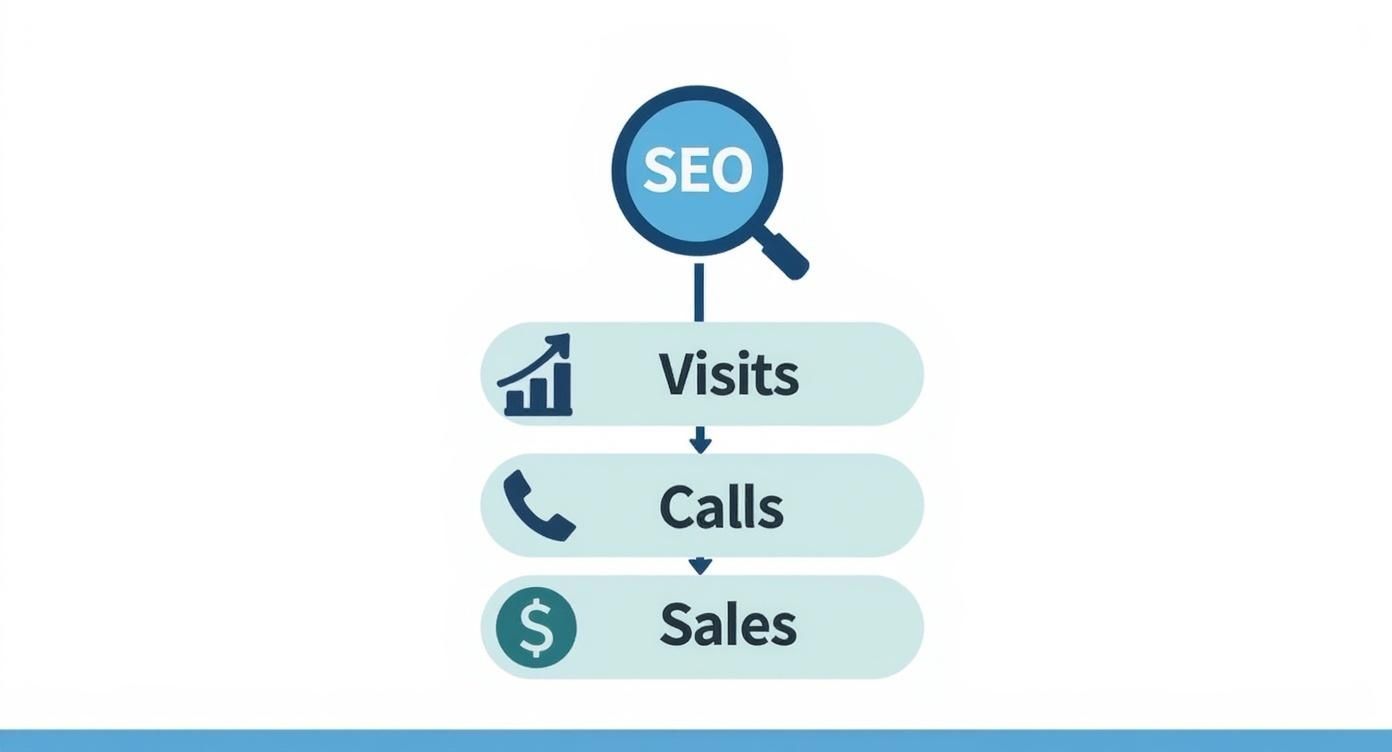
As the diagram shows, a foundational SEO strategy directly translates into measurable growth, like more website visits, more customer calls, and ultimately, more sales. By mastering both On-Page and Technical SEO, you create a powerful base for sustainable online growth.
Winning Customers with Local SEO for Small Business
For a lot of small businesses, your best customers aren't halfway across the country—they're just around the corner. While general SEO casts a wide net, local SEO is all about getting you in front of people searching in your immediate area. It’s what turns a "plumber near me" search into a ringing phone and a new job.
The absolute heart of any local strategy is your Google Business Profile (GBP). Seriously, think of it as your digital shopfront. A well-managed profile, packed with current photos, opening hours, and glowing reviews, is your ticket to showing up in Google Maps and the coveted "Local Pack"—that box of three businesses you see at the very top of local search results.
And showing up there has never been more important. Since 2015, those 'near me' searches from mobile phones have skyrocketed by a massive 500%. This isn't just window shopping, either. Over 50% of people who make one of these searches end up visiting a physical store. Nailing your local SEO means you're the one capturing these customers the very moment they're ready to spend money.
Mastering Your Local Presence
Getting to the top of local search results is more than just setting up a GBP and hoping for the best. It's about building a consistent, trustworthy signal across the web that tells Google you're a legitimate and reliable choice for local customers.
Here are the key things to get right:
- NAP Consistency: This is a big one. Your business Name, Address, and Phone number (NAP) needs to be identical everywhere it appears online. From your website to Facebook to industry directories, any inconsistency confuses search engines and can drag your rankings down.
- Localised Keywords: Start thinking like your customers. They're not just searching for "cafe," they're searching for "cafe in Richmond" or "best coffee near South Yarra." Weaving these location-specific terms into your website tells Google exactly who you serve.
- Online Reviews: Don't be shy about asking happy customers for a review. Good feedback doesn't just build trust with potential clients; it's also a huge ranking signal for Google.
Consistency is the currency of local SEO. Every time your correct business information appears online, you're making a deposit that strengthens your local authority and trustworthiness in Google's eyes.
A Practical Plan for Local Dominance
Getting these elements working together creates a powerful engine for bringing nearby customers straight to your door. To help you get started, here's a quick checklist of the essentials.
Your Essential Local SEO Checklist
This simple table breaks down the key tasks and why they're so critical for getting seen by local customers.
| Local SEO Task | Why It Matters | Quick Tip |
|---|---|---|
| Claim & Optimise Your GBP | It's your digital storefront and the #1 factor for appearing in Google Maps. | Fill out every section, add high-quality photos, and use the Q&A feature. |
| Ensure NAP Consistency | Inconsistent details confuse Google and erode trust, hurting your rankings. | Use a tool to audit your listings across major directories and fix any errors. |
| Target Local Keywords | This tells search engines which geographic areas your business serves. | Add your city or suburb to your website's page titles, headings, and service descriptions. |
| Gather Customer Reviews | Positive reviews build social proof and are a major local ranking signal. | Send a follow-up email or SMS to happy customers with a direct link to leave a review. |
| Build Local Citations | Listings in relevant local directories reinforce your location and legitimacy. | Get listed in industry-specific and city-specific directories, not just the big ones. |
Following a structured approach ensures you cover all your bases and don’t leave any opportunities on the table. For a more detailed guide, this comprehensive Local SEO checklist is a fantastic resource.
At the end of the day, winning at local SEO means being the best and most visible answer for customers right in your neighbourhood. If you’re keen to learn more about the specific techniques involved, have a look at our guide on what is local SEO optimisation. Get this right, and your local online presence can become your most powerful tool for attracting new business.
Earning Trust Through Link-Worthy Content & Backlinks
So, how do search engines figure out if your small business is the real deal? Simple. They look for votes of confidence from other trusted websites. These votes come in the form of backlinks.
Think of link building as getting a digital thumbs-up from respected peers in your industry. When an authoritative site links to yours, it’s basically telling Google, "Hey, these guys know their stuff. You can trust them."

This process is absolutely central to any effective search engine optimisation services for small business. But it’s not a numbers game. You don't want as many links as possible; you want high-quality links from relevant, reputable sources. A single link from a well-regarded industry blog can be worth more than dozens of links from sketchy, low-quality sites.
And the most sustainable way to get these valuable links? Create content that’s so good, people can't help but link to it.
Creating Content That Earns Links Naturally
Your content strategy should be laser-focused on making things that other people genuinely want to share and reference. When you get this right, link building stops being a chore and becomes a natural result of your great work.
Here are a few content formats that work wonders:
- In-depth "How-To" Guides: Solve a common problem for your customers with a detailed tutorial. For example, a local landscaping company could create "The Ultimate Guide to Drought-Resistant Gardening in Victoria."
- Original Research or Data: Survey your customers or analyse industry data to uncover unique insights. A local accounting firm might publish a report on "The Top 5 Financial Hurdles for Aussie Startups in 2024."
- Helpful Local Resources: Build something that serves your local community. For instance, a real estate agent could create an interactive map of the "Best Primary School Catchments in Melbourne's Eastern Suburbs."
This kind of high-value content is a magnet for backlinks because it becomes a go-to resource that others in your field will want to cite.
The Power of Backlinks: A Proven Ranking Factor
The connection between quality backlinks and showing up in search results is undeniable. The data shows that backlinks have an 81.6% correlation with organic traffic, making them one of the most powerful ranking factors out there.
Want more proof? The top-performing websites have, on average, 547 referring domains. The lowest performers? Just 15. That's a staggering 35-fold difference. You can dig into more data on Australian SEO performance to see just how critical this is.
Think of each high-quality backlink as a trusted referral. The more credible referrals you have, the more Google sees your business as the go-to expert, rewarding you with higher rankings and, ultimately, more customers.
At the end of the day, creating standout content and earning authoritative backlinks go hand-in-hand. This powerful combination builds your online reputation, pushes your website up the search rankings, and wins the trust of both Google and the customers you’re trying to reach.
How to Choose the Right SEO Partner for Your Business
Picking a provider for search engine optimisation services for small business is a massive decision. Get it right, and it can completely change your online trajectory. This isn't just about hiring a contractor; it’s about finding a strategic partner who genuinely gets your vision and is invested in helping you hit your goals. A great partner turns all that technical SEO stuff into real, tangible business results.
Get it wrong, though, and you’re looking at wasted budgets, zero growth, and a whole lot of frustration. The best way to avoid that headache is to arm yourself with the right knowledge before you even start talking to agencies. That way, you can make a confident, informed decision.
Vetting Potential SEO Agencies: Key Questions to Ask
To find a true partner, you need to dig a lot deeper than their slick sales pitch. A transparent and competent agency will welcome the tough questions and give you clear, evidence-based answers. Their whole approach should feel collaborative, always connecting their work back to your actual business goals.
Here are a few non-negotiable questions to ask anyone you’re considering:
- Can you show me relevant case studies? Ask for success stories from businesses like yours, either in size or industry. This proves they have real-world experience and know how to get results in your specific market.
- What does your reporting look like? Get them to send over a sample report. It should be easy to understand and focus on metrics that actually matter—like organic traffic growth, lead generation, and keyword ranking improvements—not just fluff.
- How do you approach strategy and communication? A good partner will lay out a clear, customised strategy from the get-go and set up a regular communication schedule to keep you in the loop on progress and results.
Identifying Red Flags to Avoid
Knowing what to look for is only half the battle. You also need to know what to run away from. Certain promises and behaviours are immediate red flags that scream "lack of expertise" or "zero transparency."
Be extremely wary of any agency that guarantees a #1 ranking on Google. No one can promise this. Search engine algorithms are complex beasts that are always changing. Legitimate experts focus on proven, sustainable growth strategies—not impossible guarantees.
Here are some common warning signs to watch out for:
- Secretive or "Proprietary" Methods: If an agency won’t explain its techniques, that’s a massive concern. Transparency is the bedrock of a healthy partnership.
- A Focus on Vanity Metrics: Be cautious if all they talk about is link counts or keyword stuffing. The conversation should always circle back to measurable business results, like leads and sales.
- High-Pressure Sales Tactics: A reputable partner will give you the space and information you need to make a thoughtful decision. They won't try to rush you into signing a contract on the spot.
Making the right choice comes down to a careful evaluation of skills, transparency, and whether they feel like a good cultural fit. For a broader look at picking the right agency, you might find our guide on what is the best digital marketing company useful in your search.
Tracking SEO Success and Measuring ROI
SEO is an investment, not just another business expense. You need to know if that investment is actually working for you.
Success isn't just about spotting your website on the first page of Google. It's about tracking real results that directly impact your bottom line. Forget the vanity metrics that look good on paper but don't translate to genuine growth. The goal is to focus on Key Performance Indicators (KPIs) that prove your search engine optimisation services for small business are delivering a measurable return.
Key Metrics That Actually Matter for Your Business
You don't need fancy, expensive tools to get started. Free platforms like Google Analytics and Google Search Console give you all the data you need to see what’s working and what isn't. By tracking the right numbers, you can draw a straight line from your SEO efforts to business growth.
Focus on these essential KPIs:
- Organic Website Traffic: This is the most straightforward indicator of SEO success. A steady rise in visitors from non-paid search results means more potential customers are finding you online.
- Keyword Rankings: Keep a close eye on your position for keywords that have commercial intent. Moving up the ranks for a term like "electrician in Ballarat" puts you directly in front of customers who are ready to buy.
- Conversion Rate: Are your website visitors taking the action you want them to? Track how many people fill out a contact form, sign up for a newsletter, or make a purchase. This tells you if you're attracting the right kind of traffic.
- Leads from Google Business Profile: For local businesses, this is huge. Monitor the number of phone calls, requests for directions, and website clicks coming straight from your local listing in Google.
Measuring your return on investment isn't just about traffic; it's about profit. The ultimate goal is to see a clear connection between your SEO spend and an increase in qualified leads and sales.
When you track these metrics effectively, you can make smarter decisions. It shows you which strategies are paying off and where you might need to make a few tweaks, ensuring your SEO investment is constantly fuelling your business's growth. To dig deeper into this, check out our detailed guide on how to calculate the ROI of your digital marketing.
We Get It—You’ve Got Questions About SEO Services
Diving into search engine optimisation services for small business can feel a bit like learning a new language. Don't worry, we've heard all the questions before. Here are some straight answers to the things business owners like you ask us most.
How Much Should I Budget for SEO?
This is the big one, right? For a small business in Australia, a realistic monthly investment in SEO is anywhere from $500 to over $2,500. Where you land depends on how competitive your industry is, what your goals are, and how much heavy lifting is needed.
Think of it less as a cost and more as an investment in your future visibility. A smaller budget might be perfect for getting your local SEO foundations right, while a larger one could fuel a national campaign with serious content creation and link building.
How Long Until I See SEO Results?
SEO is a marathon, not a sprint. While you might spot some positive signs within a few months, it typically takes a good 6 to 12 months to see a significant, lasting impact on your organic traffic and leads.
Patience is your superpower here. SEO works by building momentum. Those early technical fixes and on-page tweaks are laying the groundwork for serious growth, creating a powerful asset that keeps paying you back for years.
Is SEO Really Necessary for Every Business?
Look, while almost any business can benefit from being easier to find online, SEO is absolutely critical if your customers are looking for you on Google. If someone is typing "plumber near me" or "business coach Sydney" into a search bar, you need to be there.
This goes for local tradies, cafes, professional consultants, e-commerce stores—you name it. A solid SEO strategy makes sure you show up at the exact moment a potential customer is ready to buy.
Ready to stop being invisible and start attracting the clients you actually want? At Homer Digital Marketing, we build no-fluff SEO strategies that deliver real, measurable results for service-based businesses. Let's make a plan to get you seen.
