

Content marketing for agencies isn't just about churning out blog posts. It’s the single most powerful asset you can build to drive authority, pull in qualified leads, and create genuine, sustainable growth. It’s the difference between chasing clients and becoming the sought-after expert they come looking for, and this guide will show you exactly how to do it.
Why Content Is Your Agency’s Strongest Growth Lever
In a market flooded with agencies that all look the same, what really separates the ones that thrive from those that just get by? A smart content marketing strategy for your agency is the engine that turns your team's expertise into a magnet for high-value clients.
Think about it. Traditional advertising interrupts people. Great content attracts them. Instead of shouting about how great you are, you’re busy demonstrating it. This shift builds trust and credibility at scale, and it has a brilliant side effect: it shortens your sales cycle. Prospects show up already warmed up, already convinced you know what you're doing.
Turning Expertise into Revenue
The most valuable thing your agency owns is the collective brainpower of your team. Content marketing is how you package that knowledge and turn it into a lead-generation machine that works for you 24/7. Every deep-dive article, insightful case study, or helpful guide acts like a digital salesperson, answering questions and handling objections while you sleep.
This approach is absolutely critical here in Australia. The local digital advertising agency industry is on track to hit $3.7 billion in revenue in 2025, after growing at a blistering 7.4% each year for the last five years. With search marketing (SEM) still the biggest piece of that pie, getting seen and respected through smart content is non-negotiable. You can read more about the growth of the Australian digital agency industry to see just how competitive it's getting.
The Direct Impact on Your Bottom Line
So, how does all this "value" and "trust" actually translate to the numbers that matter? It's simple. Great content directly moves the needle on the key performance indicators (KPIs) that define your agency's health and profitability. We’re not talking about vanity metrics here; we’re talking about real, measurable growth.
Let's break down how a focused content strategy directly feeds into your core business goals.
Table: How Content Marketing Directly Impacts Agency KPIs
This table shows exactly how putting strategic content out into the world translates into the metrics that really matter for an agency's growth and bottom line.
| Key Agency Goal | Content's Direct Contribution | Example Tactic in Action |
|---|---|---|
| Higher Quality Leads | Content addresses specific pain points, filtering out tyre-kickers and attracting ideal clients. | A detailed guide on "Local SEO for E-commerce" attracts retailers ready to invest in that exact service. |
| Lower Client Acquisition Cost (CAC) | Organic traffic from evergreen content provides a steady stream of "free" leads over time, reducing reliance on paid ads. | A blog post ranking #1 for a high-intent keyword like "seo services for plumbers" brings in consistent leads months or even years after it's published. |
| Increased Client Lifetime Value (LTV) | Ongoing value through newsletters, webinars, and reports builds loyalty, reduces churn, and creates upsell opportunities. | A monthly client-only webinar sharing industry trends keeps your agency top-of-mind and indispensable. |
Ultimately, a strong content plan means you get better leads, spend less to get them, and keep them around for longer. It's a win-win-win.
Content reframes your marketing from an operational cost into a revenue-generating asset. It’s the most scalable way to prove your expertise and build a brand that clients not only choose but champion.
Building Your Agency’s Content Foundation
Great content marketing for agencies isn't about random acts of content. A powerful program that pulls in your ideal clients starts with a solid foundation, not just firing off blog posts and hoping for the best. This is where you stop making noise and start building a genuine asset for your business.
It all begins with deliberate, focused planning. Before a single word gets written, you need to be crystal clear on who you are, who you serve, and where you can actually win. Getting this groundwork right means every piece of content you create has a purpose and a direct line to growing your agency.
This visual breaks down how that solid foundation leads to real growth in leads, sales, and authority.
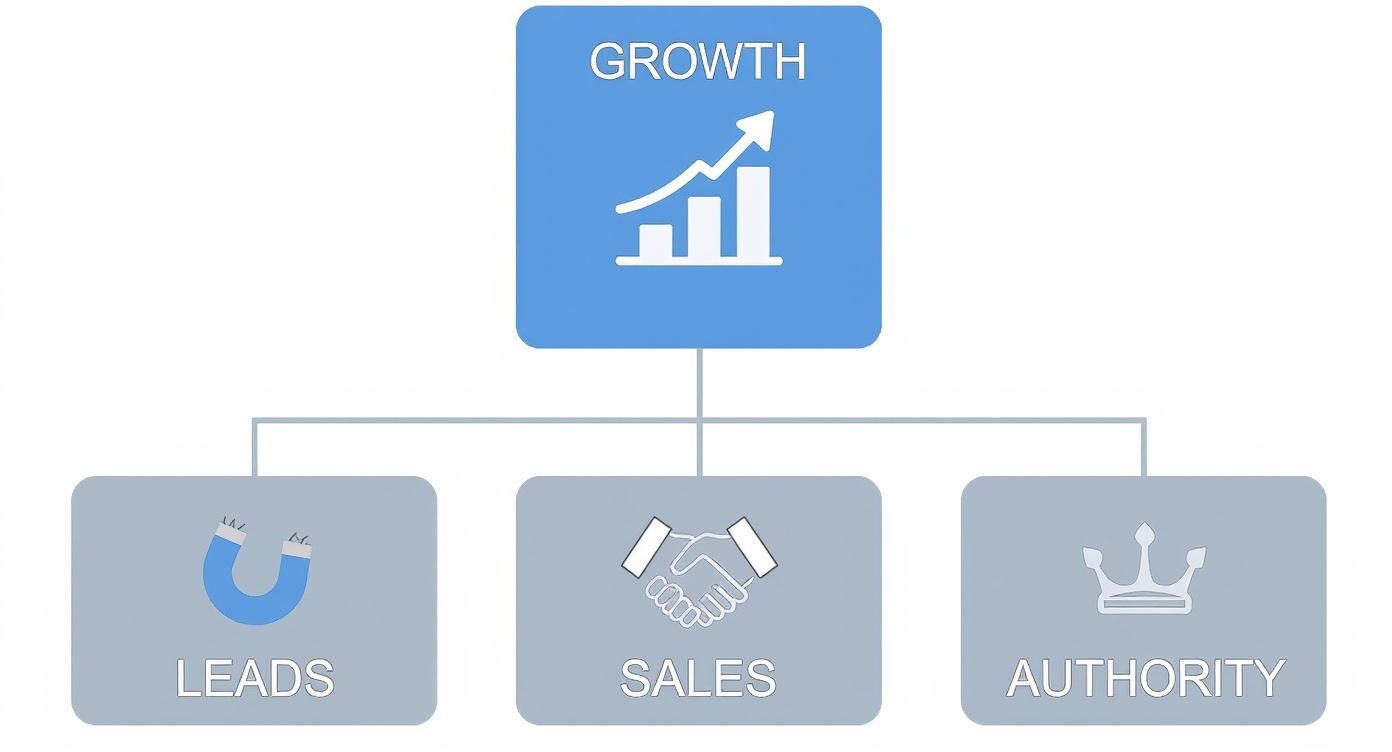
As you can see, growth is the end game, but it’s held up by three core pillars: generating qualified leads, closing more sales, and establishing yourself as the undeniable expert in your market.
Define Your Niche and Ideal Client
The biggest mistake I see agencies make is trying to be everything to everyone. Your real power is in being specific. Start by carving out your agency’s unique niche—are you the absolute go-to for SaaS companies, local tradies, or e-commerce brands in the wellness space?
Once your niche is sorted, build out a detailed Ideal Client Persona (ICP). This isn't just a vague list of industries; it’s a deep dive into the actual person you want to work with.
- What are their biggest professional headaches? Think beyond marketing. Are they struggling with team capacity, proving ROI to their boss, or just keeping up with new tech?
- What questions are they typing into Google? Put yourself in their shoes. What problems are they trying to solve at 10 PM on a Tuesday? Think about long-tail questions like "how to get more leads for my construction business" or "best b2b marketing agency for tech startups."
- What does a ‘win’ look like for them? Your content needs to speak directly to their goals, whether that’s hitting a revenue target, getting a promotion, or simply making their job less stressful.
Nailing this hyper-targeting makes every other step, from keyword research to your final call to action, ten times more effective.
Master High-Intent Keyword Research
With a clear ICP, you can now find the B2B keywords your ideal clients are actively searching for. The goal isn’t just traffic; it’s traffic with intent. You're looking for problem-aware search terms that signal a real business need.
An agency targeting a broad term like "digital marketing" is competing with the entire world. But an agency targeting "lead generation for recruitment agencies" is only competing with a handful of others and attracts prospects who are already halfway to buying.
Use keyword tools like Ahrefs or SEMrush to unearth long-tail keywords—those longer, more specific phrases that show someone wants a solution, not just information. These keywords might have lower search volumes, but their conversion rates are much, much higher because they capture people who are ready to act.
Conduct a Competitor Content Gap Analysis
You don’t have to reinvent the wheel. Your competitors have already done some of the heavy lifting for you. A competitor content gap analysis is simply the process of finding the valuable keywords your rivals are ranking for that you aren’t.
But more importantly, it’s about finding the strategic gaps in what they've covered. What topics have they only skimmed the surface of? What crucial questions have they left unanswered? These gaps are your golden opportunities.
This analysis gives you a clear roadmap for creating content that’s obviously better, more in-depth, and more helpful than what’s already out there. By filling these gaps, you position your agency as the true authority and capture an audience your competitors have completely missed.
Creating Content That Wins High-Value Clients

Once you’ve got your strategy sorted, it’s time to actually create the right assets. This isn't about pumping out content for the sake of it. The real magic is in crafting specific, high-impact pieces that guide your ideal client from being a curious browser to a qualified, ready-to-buy lead.
Think of these content formats as specialised tools in your workshop. Each one has a different job to do in the client acquisition process. The goal is to build a library of content that proves your expertise, demonstrates your value, and makes signing with your agency feel like the only logical next step.
Pillar Pages That Establish Authority
A pillar page is your agency's definitive guide on one of your core services. Forget short blog posts—this is an in-depth, comprehensive resource that aims to be the single best answer on the internet for a broad, valuable topic (like "LinkedIn Marketing for Recruiters").
This format is an absolute powerhouse for SEO. It targets a high-value "head" term while linking out to more specific "cluster" blog posts that flesh out the details. But more importantly, it positions your agency as the undisputed expert. When a potential client reads your pillar page, their immediate thought should be, "Wow, these guys really know their stuff."
A well-executed pillar page doesn't just attract traffic; it builds a powerful moat of authority around your brand that competitors will find difficult to cross. It’s your digital textbook, showcasing the depth of your knowledge.
Case Studies That Provide Undeniable Proof
While pillar pages show what you know, case studies prove what you can do. For a service-based business like an agency, there is simply no content more persuasive than a detailed breakdown of a real-world client win. Your claims of expertise are one thing; hard evidence is another entirely.
A powerful case study tells a simple but compelling story:
- The Challenge: Clearly outline the specific problem the client was facing before they came to you.
- The Solution: Detail the exact strategies and services your agency implemented to fix that problem.
- The Results: Showcase the tangible, measurable outcomes you achieved. Use hard numbers and metrics like a 150% increase in qualified leads or a 40% reduction in cost per acquisition.
These stories of transformation provide the social proof that decision-makers desperately need to feel confident in choosing you. To see how we showcase our own client transformations, check out our portfolio of client success stories.
Original Research That Starts Conversations
Want to truly separate your agency from the pack? Stop just commenting on industry trends—start creating them. By conducting and publishing your own original research, even a simple industry survey, you become a primary source of information.
This could be a report on the state of digital marketing in your niche, an analysis of new consumer behaviours, or a survey of the biggest challenges your ideal clients are facing. This is the kind of content that generates high-authority backlinks, gets shared widely, and gives your sales team an incredible conversation-starter.
The growth in this space is undeniable. Over the past five years, the Australian content marketing industry has swelled to a market size of $453.2 million, with the number of businesses in the sector growing by 9.2% annually. This professionalisation of the industry means that creating standout, original content is more crucial than ever.
To create content that truly hits the mark, you need a plan. The table below breaks down some of the most effective content formats for generating agency leads, helping you decide where to focus your resources.
High-Impact Content Formats for Agency Lead Generation
| Content Format | Primary Goal | Best for Funnel Stage | Typical Resource Investment |
|---|---|---|---|
| Pillar Pages | Establish deep topical authority and capture broad search traffic. | Top/Middle | High (in-depth research, writing, design) |
| Case Studies | Provide social proof and demonstrate tangible results. | Middle/Bottom | Medium (client interviews, data analysis, writing) |
| Original Research | Generate backlinks, build industry leadership, and create PR opportunities. | Top/Middle | High (survey design, data collection, analysis, report creation) |
| Webinars/Videos | Build personal connection, educate leads, and demonstrate expertise. | Middle/Bottom | Medium-High (planning, presentation, tech setup, promotion) |
By strategically mixing these formats, you create a powerful system that doesn't just attract traffic but actively nurtures prospects into becoming your next high-value client.
Webinars and Videos That Build Personal Connection
Finally, don't forget the human element. Video and webinar content allow potential clients to see and hear from your team, building a level of connection and trust that text alone can never achieve.
Webinars are perfect for deep-dive educational sessions where you can showcase your strategic thinking in real-time. Short-form videos, on the other hand, are fantastic for sharing quick tips, client testimonials, or a behind-the-scenes look at your agency's culture.
To give your content an invaluable edge, leveraging B2B intent data can help you understand your audience's active interests and buying signals. This data helps you tailor your topics for maximum relevance, ensuring every piece of content lands with impact.
Get Your Content Seen: A Guide to Maximum Impact

Let's be honest. Creating brilliant content is only half the job. In a world saturated with information, even the most groundbreaking case study will gather dust if the right people never see it. This is where a smart amplification strategy becomes your secret weapon in content marketing for agencies.
Effective distribution is the difference between shouting into an empty room and starting a real conversation with your ideal clients. It transforms your content from a passive library asset into an active, lead-generating machine.
Squeeze Every Drop of Value by Repurposing Content
You poured hours into that killer research report or in-depth webinar. Don't just publish it once and hope for the best. The smartest agencies get maximum mileage from their hero content by slicing and dicing it into different formats for different platforms. This gives it a much longer shelf life and connects with people no matter how they prefer to consume content.
Best of all? It saves you time and keeps your brand front and centre, consistently.
- Webinar to Video Series: Chop up your webinar into bite-sized video clips for LinkedIn, with each one hitting a single, powerful takeaway.
- Blog Post to Infographic: Pull the key stats and steps from a long-form article and hand them to a designer. Boom—you’ve got a highly shareable infographic.
- Research Report to LinkedIn Carousel: Turn the juicy findings from your report into a slick, visual carousel post that makes people want to click through for the full download.
This "create once, distribute many" approach is how you scale your impact without burning out your team.
Use Paid Social for Pinpoint Accuracy
Organic reach is great, but sometimes you need to guarantee your best stuff lands in front of key decision-makers. That's where paid social advertising, especially on a platform like LinkedIn, is an absolute game-changer for B2B agencies.
The numbers don't lie. In Australia, 73.1% of all advertising dollars are now spent on digital channels. Social media ads make up a massive chunk of that, hitting $4.26 billion in 2024. That's 29.3% of the total digital ad spend, proving just how vital these platforms are. You can dig into more stats on Australia's social media landscape on Meltwater.com.
By putting a small, targeted budget behind your top-performing content, you can jump the algorithmic queue and place your agency’s expertise right where your ideal clients will see it.
Build Real Relationships with Tactical Outreach
Another seriously powerful tactic is good old-fashioned outreach. This isn't about spamming people. It's about strategically identifying influencers, industry partners, or publications that your target audience already follows and trusts, and then building a genuine connection.
Don't just slide into their DMs asking for a share. Offer value first. The goal is to become a go-to source of quality insights, making it a no-brainer for them to share your work with their own audience.
This could look like:
- Featuring them in your content: Quote an expert or link to a brilliant resource they created, then give them a friendly heads-up.
- Offering a guest post: Pitch a high-value, original article for their blog that solves a real problem for their readers.
- Collaborating on a project: Team up with a non-competing agency to co-host a webinar or co-author a report that benefits both your audiences.
This approach not only puts your brand in front of new, highly relevant people but also builds valuable backlinks for your SEO. By combining clever repurposing, targeted paid ads, and strategic outreach, you create a powerful system that ensures every piece of content works as hard as you do.
Measuring Content Success and Proving ROI
Creating fantastic content is one thing, but proving it actually works is what keeps the budget coming and steers your strategy in the right direction. When it comes to content marketing for agencies, you can't just be busy—you have to be profitable. This means getting past the fluffy numbers and measuring what truly impacts your agency’s bottom line.
For far too long, agencies got stuck reporting on surface-level stuff like page views or social media likes. The real goal is to draw a straight line from your content to your revenue, giving you the solid proof you need to make smart, data-backed decisions.
Shifting From Vanity Metrics to Business KPIs
The first step in proving your ROI is to stop chasing vanity metrics and start focusing on Key Performance Indicators (KPIs) that actually mean something to your agency's health. Instead of just counting website visitors, you need to track how those visitors behave and what they add to your sales pipeline.
Your focus should be on metrics that answer the big questions:
- Lead Quality: Are your blog posts and guides attracting ideal clients, or are you just getting clicks from casual browsers with no intention of buying?
- Content-Driven Conversions: How many people who read your content went on to fill out a contact form, book a call, or download a guide?
- Cost Per Acquisition (CPA): When you compare it to paid ads, how much does it cost you to get a new lead through your content?
By keeping an eye on these KPIs, you’ll quickly see which pieces of content are your hardest-working salespeople.
A Simple Framework for Connecting Content to Revenue
You don’t need a complicated, expensive analytics platform to start proving your content’s worth. You can get a long way with the tools you probably already have, like Google Analytics and your Customer Relationship Management (CRM) system. The trick is to connect the dots between someone reading your content and them becoming a paying client.
This process breaks down into a few key steps:
- Set Up Goal Tracking: Inside Google Analytics, define goals for the important actions on your site, like someone submitting a form or requesting a demo.
- Use UTM Parameters: When you share your content in emails or on social media, tag the links with UTMs. This tells you exactly where your traffic is coming from.
- Integrate with Your CRM: Connect your website forms directly to your CRM. This lets you see every piece of content a lead interacted with before they decided to reach out, showing you what’s truly influencing decisions.
When you connect these data points, you can confidently walk into a meeting and say, "Our pillar page on local SEO influenced $50,000 in new business last quarter." That’s a statement that gets attention and justifies every dollar you've spent.
Beyond Direct Conversions
But proving ROI isn’t always about that final click. Content works its magic over time, building authority and trust in ways that are much harder to track. While measuring marketing ROI can definitely be tricky, you need to understand the full client journey to see the complete picture.
A smart approach includes learning how to measure customer experience to see how your content impacts client satisfaction and keeps them coming back. If you want to go deeper, you can explore the challenges and strategies in our article on why it is difficult to measure marketing ROI.
Ultimately, a data-driven approach lets you keep refining your strategy—doubling down on what works and fixing what doesn’t.
How to Scale Your Agency’s Content Engine
The content strategy that got your agency off the ground won't be the one that takes you to the next level. As you grow, you have to scale your content engine, but the real challenge is doing it without sacrificing the quality that built your name in the first place. This means moving from scrappy, ad-hoc creation to a streamlined, sustainable production system.
The secret? Building repeatable processes that take the guesswork out of the equation and empower your team. This is how you increase your output while keeping your brand voice and strategic focus locked in, ensuring your content marketing for agencies keeps delivering the goods.
Building Efficient Workflows
First things first: you need to standardise your production process, from the initial idea right through to hitting 'publish'. A chaotic workflow is the enemy of growth. Clear systems are how you produce more high-quality content, faster.
A solid workflow should include:
- A Master Content Calendar: This is your command centre. It maps out topics, formats, authors, and deadlines for months ahead, giving everyone a single source of truth.
- Detailed Content Briefs: Every single piece of content needs to start with a brief. It should outline the target audience, primary keyword, key talking points, and the desired call to action. No more flying blind.
- A Clear Review Cycle: Define the exact steps for drafting, editing, and approval. This eliminates bottlenecks and ensures every piece meets your high standards before it goes out the door.
The In-House vs. Freelancer Decision
As the demand for content ramps up, you'll hit a fork in the road: hire writers in-house or partner with specialised freelancers? There's no single right answer here; it all comes down to your agency's specific needs, cash flow, and long-term goals.
Outsourcing isn't just a trend; it's a strategic move. As many as 48% of companies now outsource some or all of their content marketing, tapping into external expertise to scale up without the overheads.
Here’s a quick breakdown to help you weigh it up:
| Factor | In-House Team | Freelance Partners |
|---|---|---|
| Brand Immersion | They live and breathe your culture and brand voice. | Needs more detailed briefs and onboarding to get up to speed. |
| Cost | A higher fixed cost with salary, benefits, and overheads. | A lower, more flexible cost—you pay per project. |
| Scalability | It's slower to scale your team up or down. | You can easily scale up or down based on project needs. |
| Specialisation | Usually generalists who cover all your content needs. | Gives you access to niche experts (like technical SEO writers). |
Intelligently Integrating Automation and AI
To truly scale, you have to embrace technology. Modern tools can speed up research, help with first drafts, and automate the boring, repetitive tasks. This frees up your team's brainpower for high-level strategy and creative thinking. For example, systems for marketing automation for small business can handle content distribution and lead nurturing while you sleep.
But here’s the critical part: AI should be your co-pilot, not the pilot. Human oversight is absolutely non-negotiable for maintaining your unique brand voice, checking facts, and guiding the overarching strategy. Use AI for speed and efficiency, but always rely on human expertise for that final polish and strategic direction that makes your agency stand out.
Frequently Asked Questions (FAQ)
Got questions about putting this all into practice? Let's tackle some of the most common ones that come up when I'm talking to agency leaders.
How much should an agency budget for content marketing?
There's no single magic number, but a smart starting point is 10-15% of your total marketing budget. For a lot of agencies, this is a far more strategic investment than adding another full-time headcount to the payroll.
My advice? Start small and focused. Run a pilot program. Pick one high-impact content type—like in-depth client case studies—and pour your initial investment there. This lets you measure your return cleanly before you go all-in and scale up your efforts.
How long does it really take to see results from content marketing?
Let's be upfront: content marketing for agencies is a long game, not a quick fix. If you're looking for overnight success, this isn't it. Patience and consistency are your two most valuable assets here.
You'll likely see some early green shoots within 3-6 months—things like a bump in organic traffic or better keyword rankings. But the results that actually move the needle, like a reliable stream of qualified leads and new client wins, generally take 6-12 months of consistent work to properly materialise.
Think of it like planting a tree. You do a lot of work underground at first, but with steady watering, it grows into an asset that throws shade (and brings in leads) for years.
Do we need to be on every social media platform?
Absolutely not. Resist the urge to spread yourself thin. It's far better to completely own one or two channels where your ideal clients actually hang out, rather than having a lukewarm presence everywhere.
For most B2B agencies, that means getting your LinkedIn game sorted first. Once you've built a solid, engaged community there, then you can start thinking about slicing and dicing your best content for other platforms, making sure to tweak it for each one's unique style.
Ready to build a content engine that pulls in high-value clients and fuels real growth? Homer Digital Marketing specialises in creating authority-building content and AI-powered marketing systems for service-based businesses. Let's build your growth playbook together. Learn more about our services.
