

Finding a steady stream of high-quality leads can feel like an endless uphill battle. It's a common struggle for businesses, but the real solution isn't just about finding more people; it's about building a smarter, more efficient system. The modern playbook for Australian businesses treats lead generation and nurturing as a single, connected ecosystem designed to attract and convert.
Think of it less like casting a wide, hopeful net and more like creating a magnetic pathway. This path doesn't just attract your ideal customers—it guides them, step-by-step, right to your door, ensuring you're only spending time on prospects who are a perfect fit.
Your Modern Playbook for Generating Leads
For any service-based business in Australia, getting lead generation right is the cornerstone of sustainable growth. The game has changed. It's no longer about simply collecting a list of names and email addresses.
The real aim is to build a system that consistently draws in the right kind of people, earns their trust, and smoothly turns them from curious onlookers into committed clients. This guide is your roadmap to building that exact system, taking you from the foundational basics to advanced strategies that deliver tangible results.
Moving from Theory to Action
Let's ditch the generic advice that sounds good but doesn't actually work for your business. We're going to focus on a practical framework where every marketing decision is tied back to one goal: generating high-quality leads that actually convert.
The core idea is simple: You don't just want more leads; you want better leads. A successful strategy always values quality over quantity, making sure your sales team invests its time on prospects who are genuinely interested and a perfect fit for what you offer.
This means we'll get our hands dirty with the essentials, including:
- Defining Your Ideal Customer: Getting crystal clear on who you serve so your marketing message hits the mark every time.
- Creating Value First: Building compelling resources (your lead magnets) that solve a real problem for your audience, long before you ask for the sale.
- Optimising Your Digital Front Door: Turning your website into a well-oiled machine that captures attention and inspires people to take the next step.
What to Expect in This Guide
As we move through this playbook, we’ll dive deep into the specific channels and tactics that work best in the Australian market. You’ll learn how to get your business noticed on Google, use LinkedIn to build high-value B2B relationships, and bring in smart automation to make the whole process run like clockwork.
Consider this your blueprint for building a predictable, scalable growth engine that transforms a flicker of interest into lasting revenue.
Building Your Foundation for High-Quality Leads
It's easy to get caught up in the latest shiny lead generation tactic, but the truth is, lasting success doesn't start with flashy ads or a complex new tool. It all begins with a solid, well-thought-out foundation.
Think about it like building a house. You wouldn't start putting up the walls before you've poured a solid concrete slab, right? The same logic applies here. Your entire strategy needs a stable base to support it, otherwise, everything else will eventually crumble.
The absolute cornerstone of this foundation is knowing exactly who you're trying to reach.
Defining Your Ideal Customer Profile
We're talking about creating your Ideal Customer Profile (ICP). This isn't just a vague sketch of who you serve; it's a crystal-clear, detailed portrait of your perfect client. The kind of client you can deliver incredible value to, and who, in return, brings the most value back to your business.
Once you have a sharp ICP, it becomes the filter for every marketing decision you make. It tells you where to find your audience, what keeps them up at night, and the exact language that will grab their attention. A well-defined ICP is your best defence against wasting time and money on prospects who were never going to be a good fit.
To get started on building your ICP, dig into these key areas:
- Demographics: What industry are they in? How big is their company? What’s their job title?
- Pain Points: What specific, nagging problems are they dealing with that your service is built to solve?
- Goals: What are they trying to accomplish? What does success look like for them?
- Watering Holes: Where do they hang out online? Are they scrolling through LinkedIn, active in specific forums, or following certain industry blogs?
This foundational work is more important than ever. So many Australian B2B companies struggle with poor lead quality simply because their targeting is far too broad. With the growing challenges in finding qualified prospects, a precise ICP isn't just helpful—it’s a massive competitive advantage. You can read more about the top challenges in B2B lead generation from marketingeye.com.au.
Creating Irresistible Lead Magnets
Okay, so you know exactly who you're talking to. Now, you need to give them a compelling reason to talk back. This is where lead magnets enter the picture. A lead magnet is simply a valuable, free resource you offer in exchange for someone's contact details, usually their email address.
The real purpose of a lead magnet isn’t just to grab an email. It's about offering a genuine solution to a small, specific part of your ICP's biggest problem. This is your first real chance to prove your expertise and start building trust.
This image shows how different lead generation channels and tactics fit into a typical marketing funnel. It helps to see where your efforts will make the biggest impact.
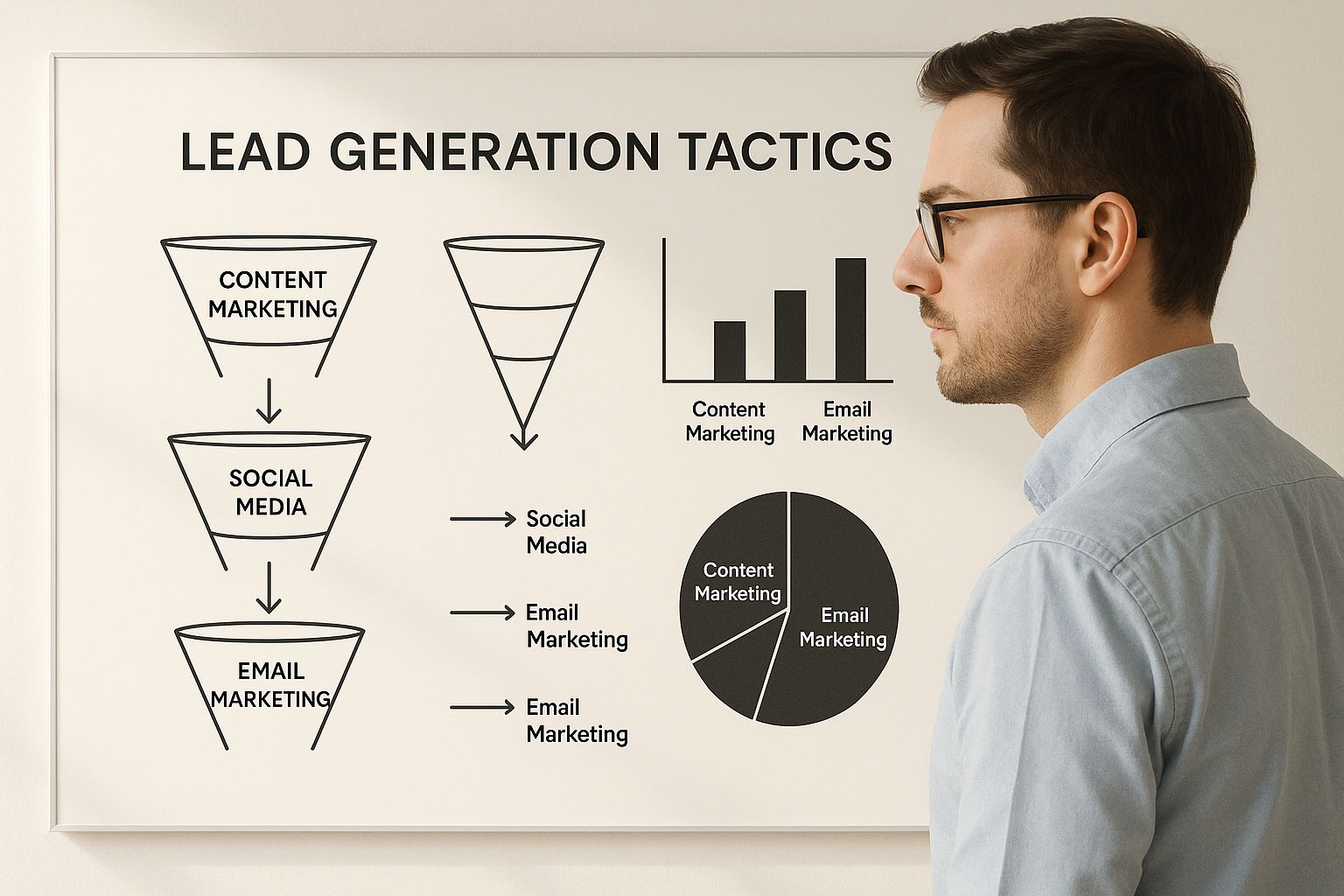
As you can see, foundational elements like your website and great content are right at the centre of everything, capturing the interest you generate from all your different channels.
For most service-based businesses, some of the most effective lead magnets are:
- In-depth eBooks or practical guides
- Exclusive webinars or hands-on workshops
- Data-rich case studies or white papers
- Time-saving templates or checklists
Without a sharp ICP and a compelling lead magnet, even the most sophisticated marketing tactics will fall flat. These two elements are the true cornerstones of any lead generation strategy that delivers consistent, high-quality results.
Turn Your Website Into a 24/7 Lead Generation Machine
Think of your website as your digital storefront. But unlike a shop on a high street, its location isn’t fixed—it’s decided by Google. Search Engine Optimisation (SEO) is the craft of securing that prime real estate on page one, making sure your business is the first thing people see when they’re looking for the exact services you provide.
When you get it right, your website transforms from a static online brochure into an active, powerful lead generation engine. It works for you 24/7, pulling in qualified prospects who are already hunting for a solution. The whole point of combining lead generation and SEO is to make it incredibly easy for your ideal customers to find you, not the other way around.

Uncovering High-Intent Keywords
Great SEO starts with getting inside the heads of your ideal customers and figuring out the exact words and phrases they’re typing into Google. This isn't a guessing game; it's about strategic keyword research focused on high-intent queries. These are the phrases that practically scream, "I'm ready to buy!"
For instance, a broad keyword like "accounting" is vague. Someone searching for that might just be a student doing research. But a long-tail keyword like "best accounting services for small business in Sydney" shows crystal-clear buying intent. Targeting these specific phrases means you attract people who are much, much closer to making a decision.
A sharp SEO strategy connects your business with prospects at the very moment they realise they need you. It's the digital equivalent of being in the right place at the right time, every single time.
Mastering On-Page and Local SEO
Once you've identified your golden keywords, the next step is to weave them naturally throughout your website. This is the core of on-page SEO. It means optimising things like your page titles, headings, and the actual content on the page to send strong signals to Google about what you do and who you help.
For any Australian service business, local SEO is just as crucial. It’s all about optimising your online presence to capture customers right in your backyard. The most powerful tool in your arsenal here is your Google Business Profile (GBP). A fully fleshed-out GBP—complete with glowing reviews, correct info, and regular updates—can dramatically boost your visibility in local search results and on Google Maps.
Nailing these basics is a must for any service-based company. To really get into the weeds, have a look at our comprehensive guide on small business SEO marketing for more practical tips.
These SEO tactics aren't just one-off tasks you can tick off a list. They’re ongoing strategies that build on each other, creating a sustainable pipeline of high-quality leads and making sure a steady stream of prospects finds your business first.
Using LinkedIn for B2B Lead Generation
For Australian B2B businesses, LinkedIn has outgrown its origins as just an online resume. Think of it now as the ultimate digital conference room—a place where you can pull up a chair next to key decision-makers, build your credibility, and steer conversations towards real business opportunities. For any serious B2B player, mastering LinkedIn is non-negotiable for generating quality leads.
The platform is purpose-built for professional networking, making it incredibly fertile ground for finding and connecting with your ideal clients. The secret? You need to switch your mindset from "selling" to "helping". Forget the hard pitch. The goal is to position yourself as a trusted expert who offers genuine value right from the start.
Optimising Your Profile to Attract, Not Just Inform
Your personal profile and company page are your digital shopfronts on LinkedIn. They need to do more than just list your job history; they must act like magnets, pulling in the right kind of prospects. A properly optimised profile instantly tells people who you help, what problems you solve, and why you're the person they should be talking to.
This involves turning your profile from a static CV into a dynamic landing page. We actually walk you through exactly how to do this in our guide on how to optimise your LinkedIn profile to attract the connections you want.
Building Relationships That Actually Convert
Once your profile is set up to draw people in, the real work begins. The true art of LinkedIn lead generation is found in authentic, one-on-one engagement. It’s about building genuine relationships, not just hoarding connections.
The process boils down to a few key steps:
- Strategic Connection Requests: Ditch the generic "I'd like to connect" message. Personalise every single invitation. Mention a mutual connection, a post of theirs you enjoyed, or something you find interesting about their company. Make it human.
- Meaningful Engagement: Don't just be a passive "liker" of posts. Jump into the comments on your prospects' content with thoughtful replies that add to the conversation. This shows you know your stuff and keeps you on their radar.
- Guiding the Conversation: After you've built some rapport, you can gently guide the conversation toward business. A simple, low-pressure message asking about the challenges they're facing in your field can be the perfect way to open the door to a proper chat.
Remember, you want to be a welcome guest in their feed, not an intrusive salesperson. Offer insights, share useful articles, and listen twice as much as you talk. This relationship-first approach is what turns a cold connection into a warm, qualified lead.
While digital platforms like LinkedIn are fantastic, they're even more powerful when they're part of a bigger picture. For instance, telemarketing is still a formidable tool in Australia. One campaign we saw involved 1,200 outbound calls that generated 250 qualified leads and secured 45 appointments. This proves that blending old-school outreach with digital finesse can deliver outstanding results. You can find more insights on effective lead generation tactics on telemarketingprofessionals.com.au.
Weaving AI and Automation Into Your Workflow
Imagine having a tireless digital assistant working for you 24/7. It manages your pipeline, qualifies new leads, and follows up at just the right moment. That’s the real power you unlock when you bring Artificial Intelligence (AI) and automation into your lead generation and nurturing process.
This isn't about replacing the human touch; it's about freeing you up to focus on it. These systems can handle the repetitive, time-consuming tasks that so often let good leads slip through the cracks. For most Aussie businesses, the journey begins with some simple, yet powerful, automation.
Starting with Simple Automation
You don’t need a ridiculously complex system to get an immediate win. Simple automation tools can be your first line of defence against missed opportunities, making sure no flicker of interest goes unanswered. Think of it as putting your most basic follow-ups on autopilot, so your team can jump into high-value conversations instead.
This foundational layer is all about tools that can:
- Send Instant Email Autoresponders: The second someone downloads your guide, it should land in their inbox with a warm welcome. No delays.
- Segment Your Audience Automatically: New leads can be tagged and sorted into different lists based on the specific action they took or the info they gave you.
- Schedule Follow-Up Reminders: Your sales team gets a ping, right on schedule, to follow up with a warm lead after a set number of days.
The name of the game is consistency. Automation guarantees every single lead gets the same timely, professional experience, building a foundation of trust from that very first interaction.
Advancing to AI-Powered Insights
Once you’ve got your basic automation humming along, the next step is using AI to get a whole lot smarter with your data. Modern Customer Relationship Management (CRM) platforms are now packed with AI features that do much more than just manage tasks; they analyse behaviour to predict what's coming next.
For instance, an AI-driven CRM can actually score your leads. It looks at their engagement—like which pages they’ve visited on your website or how many emails they’ve opened—and gives them a rating. This tells your sales team which prospects are hot and ready for a chat, and which ones need a bit more time in the oven. Suddenly, your CRM isn't just a database; it's a strategic tool for growth.
For a deeper look into this, check out our guide on marketing automation for small business, which lays out the practical steps to get started. By combining these technologies, you build a seamless workflow where AI points out the best opportunities and automation makes sure they’re followed up on, flawlessly.
Tap Into New Audiences with Influencer Marketing

Sometimes, the quickest way to build trust is to borrow it from someone who has already earned it. That's the whole idea behind influencer marketing. It’s a powerful way to generate leads and get your brand noticed, letting you sidestep the long, slow process of building credibility from the ground up.
When you team up with a respected voice in your industry, you get direct access to their community—people who already listen to and trust what they say. Think of it as a warm introduction from a mutual friend versus a cold call out of the blue. This is an incredibly effective way to connect with very specific, highly engaged groups of people.
Finding the Right Partners
Success here isn't about chasing the biggest follower counts. For most service-based businesses, the real gold is in micro-influencers. These are specialists with smaller, yet incredibly loyal and engaged audiences that perfectly match your ideal customer. Their endorsement often feels more genuine and carries a lot more weight.
To find them, you've got to put yourself in your customer's shoes:
- Who are they already following and paying attention to?
- Which industry experts are making waves on platforms like LinkedIn or even Instagram?
- Are there any local business figures here in Australia whose audience is your exact target market?
A great influencer collaboration is a true partnership, not just a paid transaction. It’s about finding someone whose values and audience genuinely align with yours. This creates a win-win: they offer real value to their followers, and you connect with a pipeline of qualified leads.
Here in Australia, influencer marketing has become a serious part of the marketing mix. By 2025, ad spending in the Australian influencer market is expected to hit around $929 million AUD. And with 46% of Australians saying they've bought something after seeing it promoted by an influencer, the impact on buying decisions is clear. You can find more detail on these trends and discover other marketing insights on eloquent.com.au.
The key to structuring these collaborations is to focus on the outcome. You could co-host a webinar, create a joint case study, or even do a simple social media takeover. No matter the format, the goal is always the same: deliver massive value and give interested followers a clear, easy path to becoming your next lead.
Answering Your Biggest Lead Generation Questions
If you’ve been wading into the world of lead generation, you’ve probably got a few nagging questions. It’s completely normal. Getting straight answers to these is the first step toward building a strategy that actually works, instead of just feeling like you're guessing.
Let's tackle a few of the most common questions I hear from Australian businesses.
How Long Does SEO Really Take to See Results?
This is the million-dollar question, isn't it? The honest, no-fluff answer is: it depends. You might see a few quick wins pop up in the first three months, but if you're chasing significant, reliable traffic from SEO, you need to be in it for the long haul.
For competitive keywords that actually move the needle, you should expect to see meaningful results within six to twelve months. It takes time for Google to properly index your content, for you to build authority, and for all that optimisation work to really kick in.
Think of it like planting a tree. It takes a lot of effort upfront, but the payoff is a sustainable source of leads that grows stronger over time.
What Is a Realistic Lead Conversion Rate?
Conversion rates can be all over the place depending on your industry. For most Australian service-based businesses, a solid benchmark for your website is a lead conversion rate between 1% and 3%.
What does that actually mean? For every 100 qualified visitors who land on your site, you can realistically expect one to three of them to become a lead.
Now, a really well-oiled machine with a killer offer and crystal-clear calls to action can definitely push that number higher. The key is not to get disheartened if your numbers are low at the start. Just keep tweaking your landing pages, refining your lead magnets, and sharpening your message.
A low conversion rate isn't a failure; it's feedback. It's your audience telling you exactly where you need to improve your message, your offer, or their user experience. Listen to that feedback, and you'll see your numbers climb.
How Do I Choose the Right CRM?
With so many options out there, picking a Customer Relationship Management (CRM) system can feel overwhelming. The secret is to ignore all the shiny features you'll probably never touch.
Start simple. Map out your current process for handling leads and making sales. What are the absolute must-have tasks you need the system to manage? It might be things like:
- Keeping track of new leads from different channels (e.g., website, LinkedIn).
- Sending out a welcome email automatically.
- Setting reminders for your sales team to follow up.
Find a CRM that nails those core functions. Most platforms offer free trials, so take a couple for a spin and see which one feels the most natural for you and your team to use. Seriously, don't overcomplicate it. The best CRM is always the one you'll actually use every day.
Ready to stop guessing and start building a predictable system for attracting your ideal clients? At Homer Digital Marketing, we implement proven strategies that combine Google optimisation, LinkedIn authority, and smart automation to help service businesses scale. Let's talk about how we can build your growth engine.
