

Trying to market your small service business can feel like shouting into the wind, especially when competitors have bottomless ad budgets. But what if you could level the playing field? Small business SEO marketing is the proven, cost-effective way to get in front of the exact people who are already online, actively searching for the services you provide. No massive ad spend required.
This guide will give you the actionable steps you need to turn your website into a lead-generating machine.
Why SEO Is Your Small Business Superpower
Let's bust a myth right now: SEO isn't some dark art reserved for massive corporations with huge teams.
At its core, search engine optimisation is simply about making your business more visible to the right people, at the right time. When a potential customer in your suburb searches for a service you offer, a solid small business SEO marketing strategy ensures your business is one of the first things they see.
This is what makes it a genuine superpower for small businesses. You're not just blasting out a generic message hoping someone listens. Instead, you're strategically placing your business directly in the path of customers who have already decided they need what you're selling.
The Real-World Benefits of Getting SEO Right
Investing in SEO isn't about chasing vanity rankings; it's about driving real, tangible growth for your business. The pay-offs are clear and they make a genuine difference.
- More Website Traffic: A higher rank on Google naturally means more clicks. It's that simple. This brings a steady stream of potential customers to your digital front door.
- Better Quality Leads: SEO attracts people who are actively looking for a solution right now. The visitors landing on your site are far more likely to be serious about hiring you compared to someone who just scrolled past an ad.
- Builds Trust and Credibility: When your business consistently shows up in the top search results, it builds trust. People see you as a reliable, authoritative choice in your field.
- A Better Customer Experience: Good, modern SEO is all about making your website fast, mobile-friendly, and easy to use. This doesn't just please Google; it keeps your visitors happy and makes it easier for them to book a job or get in touch.
This is a screenshot from Semrush, a powerful tool we use to track how visible a business is online and which keywords are bringing in traffic.

Tools like this give you the hard data you need to see what's working, what isn't, and where your biggest opportunities are.
The Numbers Don't Lie: The Return on Investment is Huge
Perhaps the most compelling reason to get serious about SEO is how incredibly efficient it is. For Australian small businesses, the return on investment (ROI) blows traditional advertising out of the water.
Data shows that well-run SEO campaigns can generate an average ROI of around 825% for Australian SMEs.
Even better, leads coming from search engines close at a rate of 14.6%. That completely eclipses the 1.7% close rate you get from old-school outbound marketing, and it cuts the cost of getting a new lead by as much as 61%. You can dig into more powerful SEO statistics here.
SEO is a long-term asset, not a short-term expense. Every blog post you write and every on-page tweak you make continues to work for you, attracting customers months and even years down the track. It's an investment that truly compounds over time.
Mastering Your Local SEO Foundation
If you run a service business, your local community is everything. That’s why your small business seo marketing strategy has to start right in your own backyard, making sure you dominate local search results.
When someone nearby needs what you offer, you need to be the first name they see. And the undisputed king of local visibility? Your Google Business Profile (or GBP).
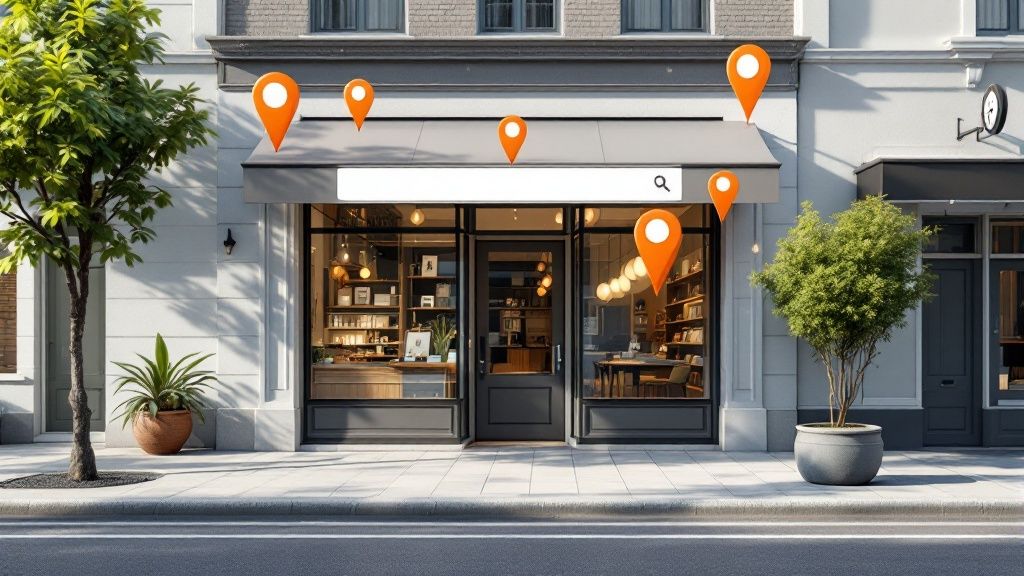
Think of your GBP as your digital shopfront on Google Search and Maps. It’s often the first thing a potential customer sees. A neglected profile is like a shop with a dusty window and a broken sign—it just doesn’t build trust. But a sharp, fully optimised profile? That makes you the obvious choice.
Your Google Business Profile Is Non-Negotiable
Getting your GBP right is one of the highest-impact things you can do for your business. It's a free tool that directly brings in phone calls, website clicks, and even foot traffic from people in your immediate area. It's not just a listing; it’s a living, breathing profile that shows off your expertise, services, and reputation.
The dashboard below is your command centre for managing business info, chatting with customers, and seeing how people find you on Google.
This is where you control how your business appears across Google’s entire network, making it the bedrock of all your local marketing.
The numbers don't lie. Here in Australia, a massive 46% of all Google searches have local intent. That’s nearly half of all searches looking for a nearby solution. Getting your local keywords right can boost your leads by 27%, and a complete GBP can pull in up to seven times more clicks than a half-finished one.
Even better, a staggering 78% of local mobile searches lead to a visit within 24 hours.
Your Google Business Profile isn't a 'set it and forget it' task. Treat it like a mini-website and social media channel rolled into one. Regular updates, fresh photos, and active engagement send strong signals to Google that your business is active, relevant, and deserves to be shown to local searchers.
Building a Profile That Attracts Customers
To get the most out of your GBP, you need to do more than just fill in your address and phone number. It’s about presenting your business in the best possible light. Here’s where to focus for maximum impact:
- Choose the Right Categories: Be specific. Instead of just "Plumber," choose "Emergency Plumber" or "Gasfitter" if they fit. You get one primary category and can add several secondary ones to cover everything you do.
- Write a Compelling Business Description: This is your elevator pitch. Use all 750 characters to explain what makes you different, what you specialise in, and why customers should trust you. Weave in your main service and location keywords naturally.
- Upload High-Quality Photos and Videos: Show, don't just tell. Post clear photos of your team, your work vehicle, and finished jobs (with the client's permission, of course!). A steady stream of new images tells Google your business is active and thriving.
- Encourage and Respond to Reviews: Reviews are a huge ranking factor. Don’t be shy about asking happy customers to leave you one. And just as importantly, respond to every single review—good or bad. It shows you're listening.
A well-optimised GBP is the cornerstone of your local presence, but getting all the details right can feel overwhelming. The checklist below breaks down the essential steps to ensure your profile is working as hard as you do.
Your Google Business Profile Optimization Checklist
| Element | Action Required | Why It Matters |
|---|---|---|
| Business Name, Address, Phone (NAP) | Ensure it's 100% consistent everywhere online. | Inconsistencies confuse Google and hurt your rankings. |
| Primary & Secondary Categories | Select the most specific primary category and add all relevant secondary ones. | This tells Google exactly what you do, helping you show up in the right searches. |
| Service Area | Define the specific suburbs or postcodes you serve. | Critical for service-based businesses to attract customers in the right locations. |
| Business Description | Write a keyword-rich, 750-character description of your business. | Your chance to sell your value proposition and include important search terms. |
| Photos & Videos | Regularly upload high-quality images of your team, work, and premises. | Fresh visuals signal an active business and build trust with potential customers. |
| Customer Reviews | Actively request reviews and respond to every single one (positive and negative). | Reviews are a top local ranking factor and a powerful form of social proof. |
| Google Posts | Publish weekly updates, offers, or news using the Posts feature. | Keeps your profile fresh and allows you to promote timely information directly in search results. |
| Q&A Section | Proactively add and answer frequently asked questions. | Positions you as an expert and provides helpful information upfront. |
| Services/Products | Add detailed descriptions and even pricing for your core services or products. | Gives customers the specific information they need to make a decision. |
Completing this checklist puts you miles ahead of competitors who just "set and forget" their profiles.
Advanced Tactics for Local Dominance
Once you’ve got the basics sorted, you can use some of GBP’s more advanced features to really stand out.
Use the Google Posts feature to share updates, special offers, or news. These are like mini-ads that appear directly on your profile. They’re perfect for promoting a limited-time deal or showing off a recent project, but they expire every seven days, so you need to post consistently.
The Q&A section is another goldmine. Don’t wait for customers to ask questions—add your own! Think about what people always ask on the phone, like "Do you offer free quotes?" or "Are you open on public holidays?", and answer them yourself. It saves everyone time and shows you know your stuff.
To see how all these pieces fit into the bigger picture, check out our guide on what is local SEO optimization. Mastering these tactics ensures your business isn't just listed; it's actively competing and winning in your local area.
Finding Keywords That Attract Ready-to-Buy Customers
Good small business SEO marketing starts by getting inside your customer’s head and figuring out what they’re actually typing into Google. This isn't a guessing game. It's about attracting people who have a problem you can solve and are looking for a solution right now.
You don’t want just any traffic; you want the right traffic.
This whole process is called keyword research. Think of it as learning the exact language your ideal customer uses the moment they decide they need help.
Understanding Search Intent: The Key to Quality Leads
Not all searches are the same. The real secret is to understand search intent—the "why" behind what someone is looking for. Some people are just kicking tyres and gathering info. Others have their wallet out, ready to go.
For instance, someone searching "how to fix a leaky tap" is probably in DIY mode. But someone searching "emergency plumber Parramatta" needs a professional, and they need one fast. That second search screams "I'm ready to buy."
When you focus on these high-intent keywords, the visitors you attract are far more likely to become paying customers. You're meeting them at the finish line, not the starting block.
Uncovering High-Intent Long-Tail Keywords
For small businesses, the real gold is in long-tail keywords. These are longer, more descriptive phrases—usually three or more words. They don’t get a massive amount of searches, but they convert like crazy because they are so specific.
A local cafe in Carlton doesn't want to rank for "coffee." That's way too broad. They want to show up for "best brunch spot Carlton" or "cafe with outdoor seating near Lygon Street." Your specificity is your superpower.
Here’s a simple way to start finding these gems:
- Think Like a Customer: What problem are you solving for them? Jot down every single way someone might describe that problem or the questions they’d ask about it.
- Add Your Location: This is non-negotiable for a service business. Tack on your city or suburb to everything (e.g., "accountant in Chatswood," "buyers agent eastern suburbs Sydney").
- Look for "Buying" Words: Keywords that include terms like "quotes," "prices," "near me," "for hire," or "service" are clear signals that someone is ready to pull the trigger.
Using Free Tools for Your Initial Research
You don’t need to spend a fortune on fancy software to get started. Google gives you some powerful tools for free that are perfect for finding and validating your ideas.
The Google Keyword Planner is a solid starting point. It’s built for Google Ads, but it’s just as useful for SEO. You can pop in a "seed" keyword like "landscaper Brisbane" and it'll spit back a list of related terms people are searching for, along with how many people are searching for them.
Another dead-simple trick is to use Google's autocomplete. Just start typing a phrase into the search bar and watch the suggestions appear. Those aren't random—they're based on what real people are actually searching for. The "People also ask" box in the search results is another goldmine for ideas.
Ethically Spying on Your Competitors
Want a shortcut? Go see what's already working for your competition. A quick look at their websites can reveal the keywords they’re targeting and, more importantly, the ones they’ve completely missed.
First, identify your top three local competitors. Then, head over to their websites and put on your detective hat. Pay close attention to the language they use on their main pages.
- Check their page titles and headings: What services are they pushing? Which locations do they mention over and over?
- Scan their blog posts: What topics are they writing about? Blog articles are almost always built around specific keywords they want to rank for.
- Use free online tools: A tool like Ubersuggest has a free version that can give you a sneak peek into the keywords a competitor is ranking for.
This isn't about copying their every move. It’s about understanding the lay of the land and finding your opening. Maybe they’re all over "blocked drain plumber," but no one is talking about "hot water system repairs." That’s your gap.
Combine this competitor intel with what you know about your customers, and you’ll have a killer keyword list that brings in people who are ready to do business.
Creating Content That Google and Customers Love
Once you’ve nailed down your keywords, the real work begins: building content around them. This isn't about awkwardly stuffing phrases into a page. It’s about creating genuinely useful, problem-solving content that speaks directly to both your customers and the search engines.
Think of your website as your best salesperson, working 24/7. Your content is its sales pitch. To convince visitors you’re the right choice, it needs to be clear, trustworthy, and get straight to the point of what they need.
Build Your Foundational Content First
Before you even think about blogging, get your foundational pages sorted. These are the heavy lifters of your website—the core pages that explain who you are, what you do, and where you do it. They’re the primary targets for your most valuable "ready-to-buy" keywords.
Your absolute must-haves are:
- Service Pages: Don’t just throw a list of services onto one page. Create a dedicated page for each major service you offer (e.g., "Emergency Plumbing," "Gas Hot Water Systems," "Blocked Drains"). This lets you target super-specific long-tail keywords and pack the page with detailed info that answers customer questions, instantly building your authority.
- Location Pages: If you cover multiple suburbs or a whole region, location-specific pages are non-negotiable. A page titled "Plumber Parramatta" tells both Google and local residents that you are the expert in that specific area. This massively boosts your chances of showing up in those crucial "near me" searches.
Answer Customer Questions with a Blog
With your core pages in place, a blog becomes your secret weapon for attracting customers who are still in the research phase. It’s your chance to answer the exact questions they’re typing into Google, positioning you as a helpful expert long before they’re ready to pick up the phone.
Finding topics is easier than you think. Free tools are brilliant for showing you what people are actually asking about your services.
Take a look at this screenshot from AnswerThePublic, which visualises search questions for a keyword like "bathroom renovation."
Instantly, you’ve got dozens of blog post ideas. Think "How long does a bathroom renovation take?" or "What is the average cost to renovate a small bathroom?".
By answering these questions, you pull in highly relevant traffic and build a library of content that proves you know your stuff. This content also gives you more opportunities to link back to your service pages, gently guiding readers from just browsing to becoming a solid lead.
Your blog isn't a diary; it's a customer service tool. Every article should solve a problem, answer a question, or make a complex topic easy to understand. Think of it as pre-emptively answering every question a potential client might have.
Optimising for Modern Search Habits
The way people search is changing fast, and your content needs to keep up. One of the biggest shifts is the explosion of voice search, which has a massive impact on local businesses.
Roughly 33% of Australians use voice search daily, often for local queries like "find a plumber near me." These searches are conversational and much longer than typed ones, which is a golden opportunity for small businesses willing to adapt. You can tap into this by structuring your content to give direct, clear answers. You can read the full research on Australian SEO statistics to learn more about local search trends.
Here’s how to tweak your strategy:
- Write Like a Human: Ditch the corporate jargon and write like you speak. Voice assistants pull answers from content that sounds natural and is easy to follow.
- Use Question-Based Headings: Structure your articles with H2 and H3 headings phrased as questions. For example, "How Do I Know If My Hot Water System Is Failing?". This makes it dead simple for search engines to spot your content as a direct answer.
- Create an FAQ Section: Adding a Frequently Asked Questions section to your service and location pages is a brilliant hack for capturing voice search traffic. It directly targets the question-based queries people use when talking to their devices.
By building high-quality service pages, writing genuinely helpful blog posts, and optimising for conversational search, you create a powerful content engine. This approach doesn't just drive traffic; it builds trust, showcases your expertise, and turns curious searchers into paying customers.
Getting the On-Page and Technical SEO Basics Right
The technical side of small business SEO marketing can sound a bit intimidating, but it's really just about making your website easy for Google and your customers to understand. Think of it like organising the aisles in your shop—when everything is clearly labelled and easy to find, people have a much better experience.

This all comes down to fine-tuning the elements on your web pages (on-page SEO) and making sure your site's foundation is solid (technical SEO). Nail these basics, and you're already way ahead of the competition.
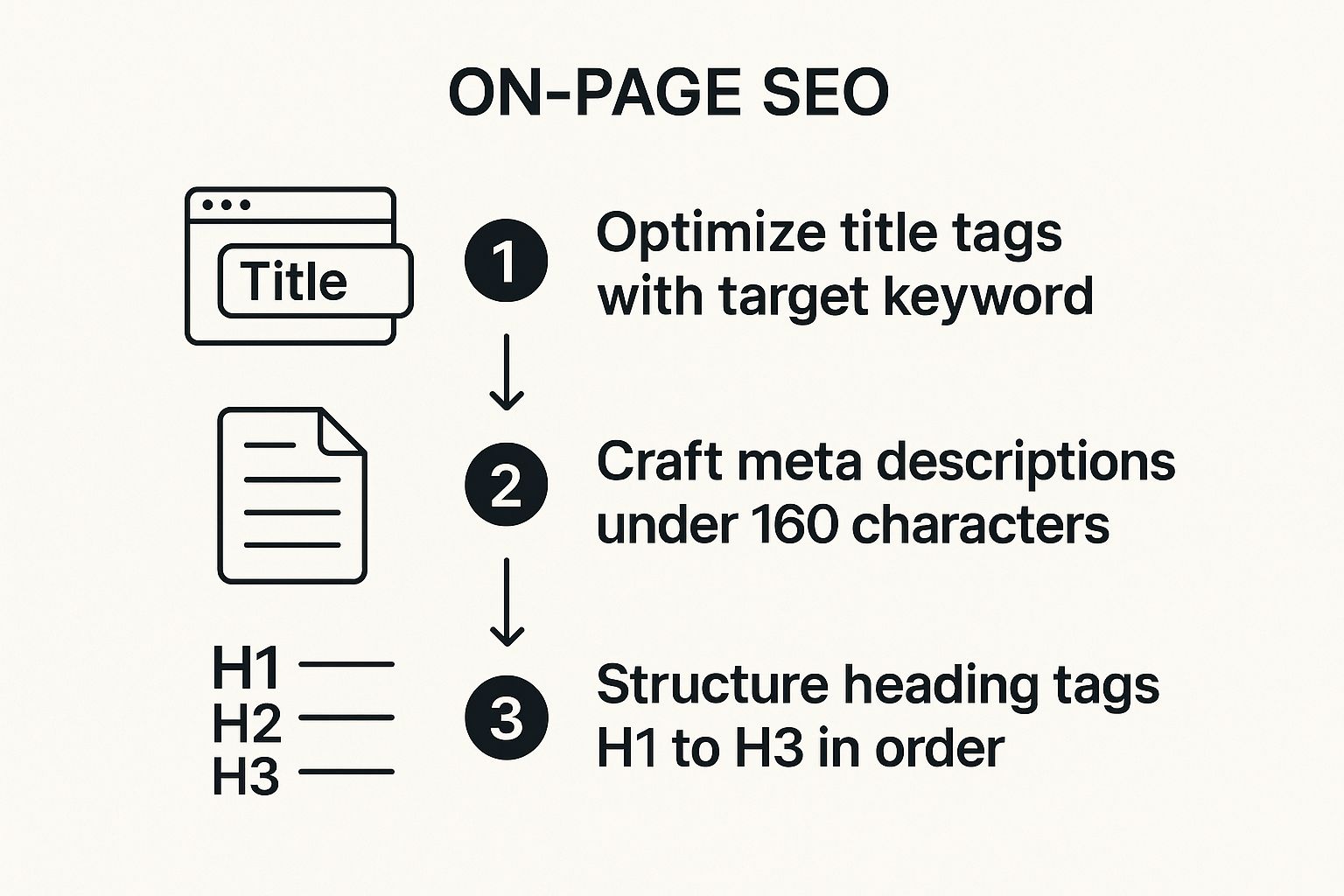
Crafting Title Tags and Meta Descriptions That Actually Get Clicks
Your page title and meta description are your first impression on Google. They’re like a mini-advertisement in the search results, and a good one can be the difference between someone clicking on your link or your competitor's.
A title tag is the clickable headline people see. Keep it short and sharp (under 60 characters), pop your main keyword in there, and make it obvious what the page is about.
The meta description is the little snippet of text underneath. It doesn't directly boost your rankings, but it absolutely influences clicks. This is your chance to write a compelling pitch (under 160 characters) that shows the searcher you have the solution to their problem.
Pro Tip: Your meta description needs a call to action. Simple phrases like "Get a free quote today," "Learn more about our services," or "See our recent projects" nudge people to take that next step.
Here’s a quick template for a service page meta description:
- For a plumber in Sydney: "Need a reliable emergency plumber in Sydney? We offer 24/7 service for blocked drains and hot water repairs. Call now for a fast, free quote!"
This example hits all the right notes: it states the service, location, key benefits (24/7, fast), and finishes with a strong call to action.
Make Your Website Fast and Mobile-Friendly (Or Lose Customers)
In today's world, a fast, mobile-friendly website isn't a "nice-to-have"—it's non-negotiable. Google’s own data shows the chance of a user bouncing increases by 32% as page load time goes from one to three seconds. Just two seconds!
A slow website frustrates visitors and tells search engines your site offers a poor experience. And with over half of all web traffic now coming from mobile devices, a site that’s clunky on a phone is actively turning away business.
Most modern website builders like Shopify or Squarespace are designed to be mobile-responsive from the get-go. You can easily check how your site stacks up using Google’s free PageSpeed Insights tool. It’ll give you a score and tell you exactly what to fix.
Using Images and Internal Links to Your Advantage
Images are fantastic for showing off your work, but they need to be optimised. Huge image files are one of the biggest culprits behind slow-loading websites. Always, always compress your images before you upload them.
You also need to give every image alt text. This is just a short, descriptive phrase that tells search engines what the image is about. It's also a sneaky-good place to include relevant keywords naturally, like "bathroom renovation in Parramatta" for a photo of a recent project.
Internal links are just as crucial. These are simply links that point from one page on your website to another. They help Google understand your site's structure and figure out which pages are the most important. A good rule of thumb is to link from your blog posts back to your core service pages whenever it makes sense. This passes authority through your site and guides visitors toward becoming a lead.
To help you get a handle on all these moving parts, check out some of the 12 best free SEO tools available. They can help you analyse everything from page speed to keywords without costing you a cent.
On-Page SEO Priority Actions
Not all on-page SEO tasks are created equal. For a busy small business owner, it's about focusing on the actions that deliver the biggest bang for your buck. Here’s a quick breakdown of where to focus your energy first.
| On-Page Element | Impact Level (High/Medium/Low) | Effort to Implement (Low/Medium/High) |
|---|---|---|
| Title Tags | High | Low |
| Meta Descriptions | High (for clicks) | Low |
| Image Alt Text | Medium | Medium |
| Internal Linking | Medium | Medium |
| Page Speed Optimisation | High | High |
| Mobile-Friendliness | High | Medium |
| Header Tags (H1, H2) | Medium | Low |
Start with the low-effort, high-impact tasks like your title tags and meta descriptions. Getting these right across your key service pages can deliver quick wins while you work on the more time-consuming technical elements.
Answering Your Toughest Small Business SEO Questions
Getting into SEO for your business can feel a bit like you’re trying to learn a whole new language. It's totally normal to have questions, and this is where I'll give you some clear, no-fluff answers to the ones I hear most from owners just like you.
How Long Does It Really Take to See SEO Results?
This is the big one, and the honest answer is: it depends. SEO is a long game, not a quick fix. Generally, you can expect to see some real movement and an uptick in traffic within four to six months of consistent work.
Early on, you might spot some small wins, like ranking for a few long-tail keywords or a bump in your Google Business Profile views. But the results that truly move the needle—like hitting the first page for your most competitive service keywords—take time. You’re building trust with Google, and that doesn’t happen overnight.
Think of SEO like planting a tree. You won't get a shady spot to relax under tomorrow. But with consistent watering and care (that’s your content, link-building, and tech fixes), it will grow into a valuable, long-lasting asset that brings you business for years.
Can I Realistically Do SEO Myself?
Absolutely. For most small business owners, a DIY approach is a fantastic place to start, especially with the foundational stuff. You can definitely get your hands dirty with:
- Optimising your Google Business Profile: Follow a good checklist, and you can turn your profile into a local powerhouse.
- Basic on-page SEO: Writing clear title tags, meta descriptions, and image alt text is completely achievable for a business owner.
- Creating helpful content: You know your customers' questions better than anyone. Turning that knowledge into blog posts or FAQ pages is the perfect use of your expertise.
But as your business grows, you’ll probably find that the time it takes becomes too much. More advanced strategies like technical SEO audits, building backlinks, and deep-diving into what your competitors are doing often require specialist tools and experience. Starting yourself is smart; knowing when to call in for backup is even smarter.
Which SEO Metrics Should I Actually Track?
It’s so easy to get lost in a sea of data. To stop the overwhelm, you need to focus on the numbers that actually show you whether your SEO is turning into business growth. Don't just chase vanity metrics; track what really matters.
- Organic Traffic: This is the number of visitors landing on your site from search engines. Is it trending up over time? This is your main signal that your visibility is improving.
- Keyword Rankings: Keep an eye on your rankings for your key "money" keywords (e.g., "electrician in Bondi"). Are you climbing from page three to page one? Tools like Ahrefs or SEMrush are great for tracking this.
- Leads and Conversions: This is the ultimate test. How many phone calls, contact form submissions, or online bookings are coming from your organic traffic? Make sure you set up conversion tracking in Google Analytics to measure this properly.
- Click-Through Rate (CTR): You’ll find this in Google Search Console. It shows you what percentage of people who see your site in the search results actually click on it. If your CTR is low, it might mean your title tags and meta descriptions need a rewrite to be more compelling.
By focusing on these key performance indicators, you’ll get a clear, honest picture of how your small business SEO marketing is paying off and make smarter decisions about where to put your energy next.
Ready to stop guessing and start growing your business with an SEO strategy that actually works? At Homer Digital Marketing, we build marketing systems that attract your ideal clients and deliver real, measurable results. Let's build your growth plan together.
